
Face veneer is a relevant product under the EUDR in its own right, and the plot where its log grew must be in the plywood importer's due diligence statement. Most Vietnamese panels have documented cores and undocumented faces, because the face veneer is imported through several companies. This guide shows what a complete face veneer record looks like and how to ask for one.
EUDR face veneer: does it need its own geolocation?
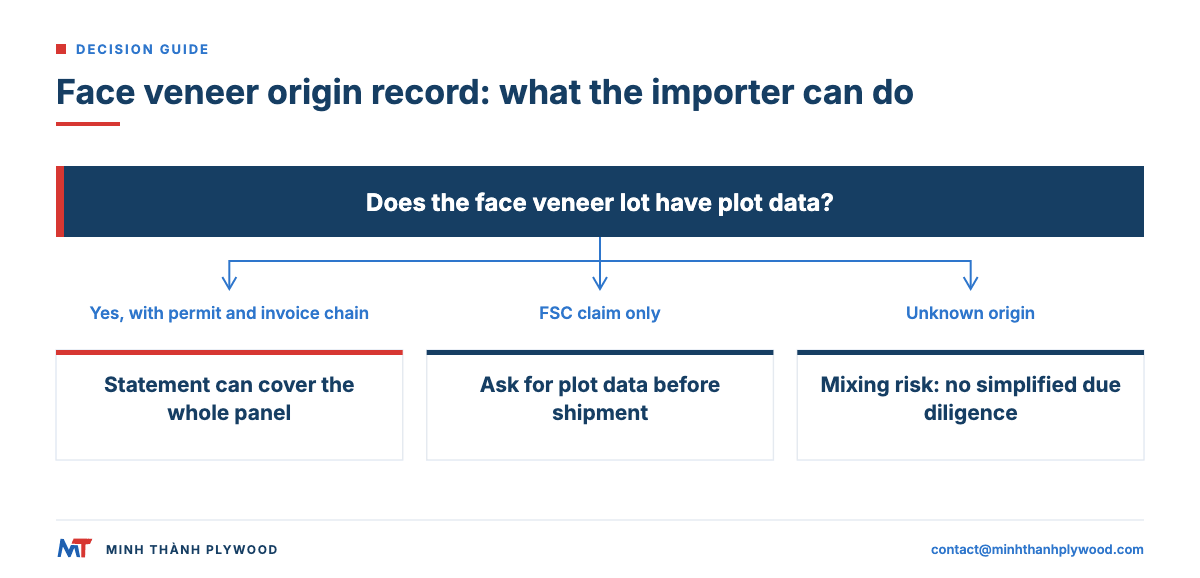
Yes. Face veneer needs its own plot geolocation under the EUDR whenever its log grew on a different plot from the core. The importer must report “the geolocation of all plots of land” where the wood in the product was produced, so a panel with a documented core and an undocumented face cannot be declared complete.
The rule is in Article 9 of Regulation (EU) 2023/1115. Point (a) asks for the species and “the list of relevant commodities or relevant products contained therein or used to make those products”; point (d) asks for the geolocation of every plot those commodities came from. A plywood panel is made using several veneers. Each one counts.
What the wording means for a panel maker
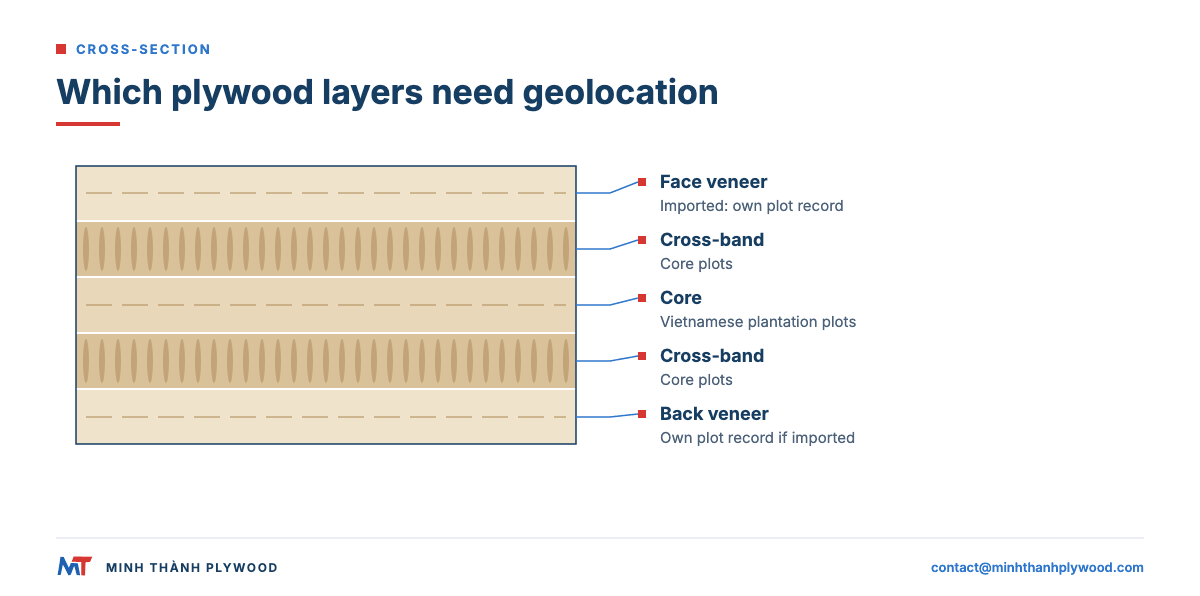
Read together, points (a) and (d) of Article 9 work like a bill of materials. Point (a) asks the importer to list every relevant commodity or product the plywood contains or was made from; point (d) asks for the plots behind each item on that list. For a panel maker, that means the dossier should start from the panel’s build: face, cross-bands, core, back. Each line of the build needs an origin line. When the build changes, for example a thicker panel with an extra core veneer from a new grower, the origin lines change with it.
Every page of our face veneer and core dossiers, with sensitive data masked, is shown in EUDR compliant plywood from Vietnam.
What is face veneer, and why does it travel so far?
Face veneer is the thin outer sheet of wood that gives a plywood panel its look: 0.2 to 0.6 mm for most furniture faces, peeled on a lathe or sliced from a log. The core under it is built from thicker veneers that carry the strength. A buyer chooses the panel by its face, so the face species follows fashion and the buyer’s market, while the core follows what grows near the mill.
That difference explains the EUDR problem. Face species such as birch, okoume, poplar for white faces, or eucalyptus with a tight figure are grown in a handful of regions with the right logs. Slicing and peeling them well needs specialised mills, and many of those mills are in China, where large poplar plantations and a dense veneer industry sit side by side. A Vietnamese plywood mill buys its face veneer from that industry. The log may have grown in China, in Uruguay, in Gabon or elsewhere; the veneer is sliced in one place and sold through another.
For EUDR purposes, each of those faces is wood with its own plot of origin. The regulation does not care where the veneer was sliced. It cares where the tree grew, when it was harvested and whether that land was forest that was cleared after 2020.
Rotary-peeled or sliced: does it matter for the EUDR?
No. Rotary-peeled veneer is cut by turning the log against a knife, which gives wide sheets with a broad grain; sliced veneer is cut from a flitch and shows a straighter figure. The cutting method changes the look and the price, not the EUDR duty. Both are sheets for veneering under heading 4408, and both need the plot of the log they were cut from.
Does the EUDR apply to veneer as well as plywood?
Yes. Annex I of the regulation lists heading 4408, “Sheets for veneering”, and heading 4412, “Plywood, veneered panels and similar laminated wood” (Regulation (EU) 2023/1115, Annex I). A veneer importer in the EU files a statement for the veneer; a plywood importer files one for the panel, and the panel’s statement has to cover the veneer inside it.
For a Vietnamese panel exported to the EU, the plywood importer is the operator. The veneer was imported into Vietnam, not into the EU, so no EU statement exists for it yet. The importer depends on the plywood mill to hand over the face veneer’s origin data.
Which wood layers in plywood need EUDR geolocation?
Every layer whose wood came from its own plots. In a typical Vietnamese furniture panel that means at least two origin records:
| Layer | Typical species in Vietnamese plywood | Usual origin | Typical state of the records |
|---|---|---|---|
| Face and back | Poplar, eucalyptus, birch, okoume, pine, engineered veneer | Imported, often through China | Invoice and FSC claim; plot data often missing |
| Cross-bands | Same species as the core | Vietnam | Covered with the core |
| Core | Styrax, eucalyptus, acacia | Vietnamese plantations | Land certificates and forestry dossiers with coordinates |
Engineered veneer is made from real wood veneer, usually poplar, so it carries the same duty as a natural face. The glue is not wood and needs no geolocation.
Does the back veneer and an engineered face need their own record?
Yes, whenever the wood came from its own plots. The back veneer of a furniture panel is often a lower grade of the same species as the face, cut from the same lots; then one record covers both. When the back is a different species or a different lot, such as a poplar back under a birch face, it needs its own record. The dossier lists face and back separately for that reason.
Engineered veneer, often called EV or recon, is made by peeling logs, usually poplar, dyeing the sheets, gluing them into a block and slicing the block again to imitate a species such as oak or walnut. For the EUDR it is still wood from the poplar logs. The record therefore has to point to the plots of those logs, not to the factory that made the block. The glue and the dye are not relevant commodities and need no geolocation.
Annex II of the regulation makes the point for any product with several origins: where the product “contains or has been made using commodities produced in different plots of land, the geolocation of all plots of land shall be included” (Regulation (EU) 2023/1115, Annex II).
Which face veneers do Vietnamese mills import, and from where?
Vietnamese furniture plywood uses more than ten face species, and most of them are imported. The table shows the common ones and the usual route; the actual origin of a lot is whatever its own record says.
| Face veneer | Typical origin of the log | Usual route to a Vietnamese mill | What to ask for |
|---|---|---|---|
| Poplar | Chinese plantations | Sliced or peeled in China, sold by a veneer trader | Plantation polygon, harvest permit, invoice chain |
| Eucalyptus | Plantations in South America or Asia | Often sliced in China from imported logs | Country where the tree grew, plantation records, FSC certificate if claimed |
| Birch | Northern Europe or other birch regions | Peeled abroad, traded as face sheets | Forest of origin, harvest period, legality records |
| Okoume | Central African forests | Peeled in Africa or China | Concession or plot, legality records; extra care because tropical natural forest |
| Pine | Plantations in several countries | Peeled abroad | Plantation plot, harvest period |
| Engineered veneer (EV) | Usually poplar logs | Peeled, dyed and re-sliced in China | The plots of the poplar logs used, not the factory that made the block |
Our own documented examples on this page are poplar and eucalyptus. Whatever face you order, the dossier for your order carries that face’s own origin record, prepared before production.
Grades and thickness of imported faces
Face veneers are bought by species, grade and thickness, and the grade decides which lots a buyer’s order can use. Our faces are quoted as face/back grade pairs matched to the buyer’s approved sample: poplar and eucalyptus as A/A, A/B or B/B, birch as D+, D and E pairs such as D+/D. A buyer who asks for A/A eucalyptus narrows the lots that can be used, so the origin record has to exist for the higher-grade lots too. When we confirm a face grade for an EU order, we confirm a documented lot of that grade at the same time.
Why are Vietnamese faces harder to trace than cores?
Because the core is bought next door and the face is bought through a chain. Our Styrax cores come from grower plots in Phu Tho, Lao Cai and Yen Bai, and the grower signs the purchase contract with us; the plot’s coordinates are on the land certificate. A face veneer reaches us after four or five companies, and each one has to pass on what it received.
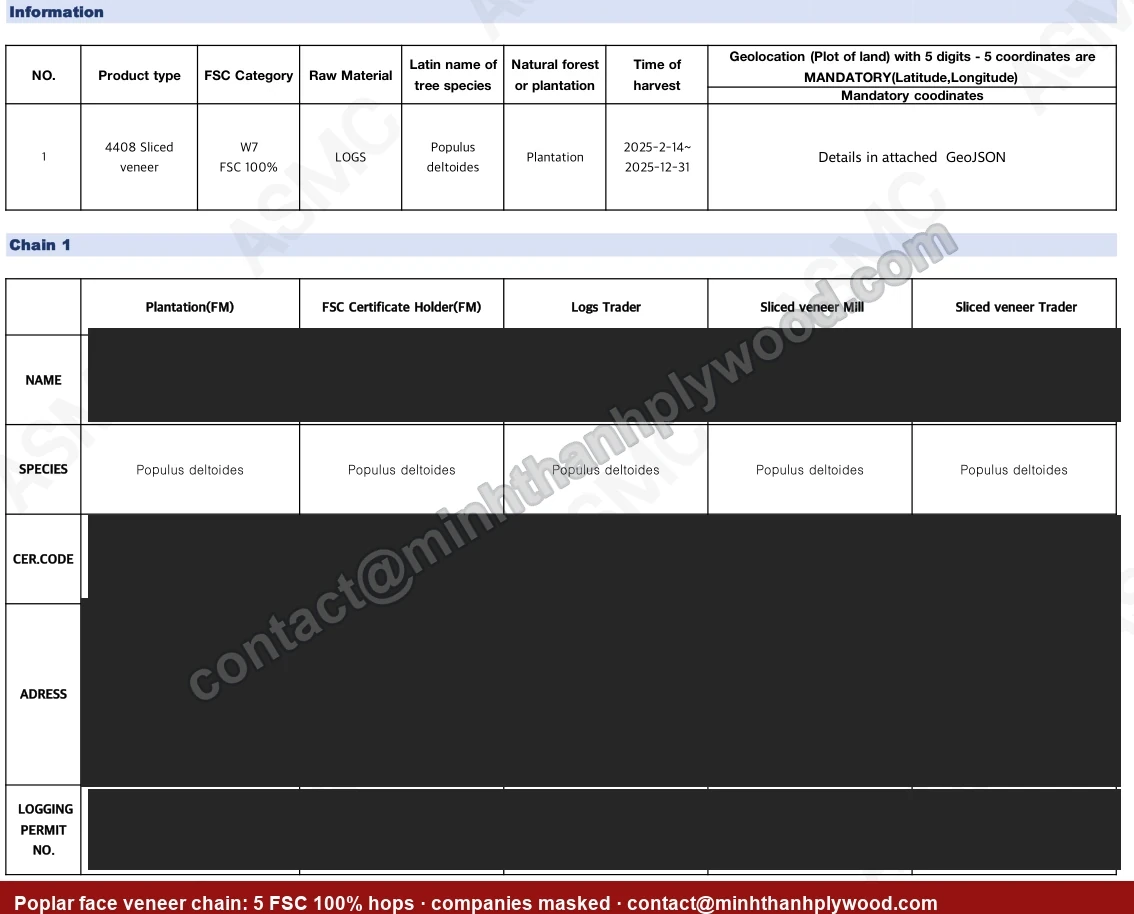
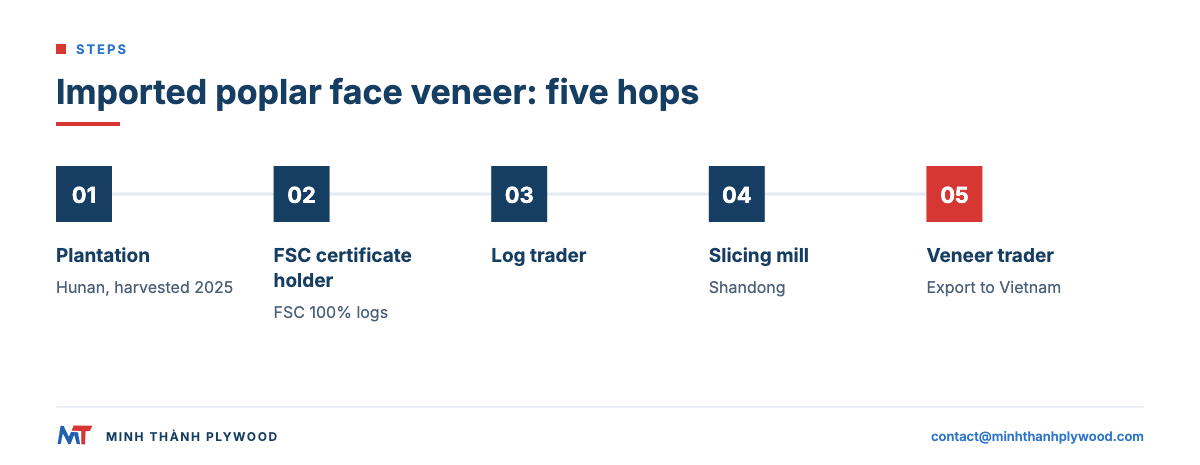
Our poplar face chain, documented in a dossier dated 10 September 2026, shows the hops:
- Plantation in Hunan province, harvested between 14 February and 31 December 2025 under a harvesting permit.
- FSC forest management certificate holder, which sells the logs as FSC 100%.
- Log trader.
- Slicing mill in Shandong, which turns the logs into face veneer.
- Veneer trader, which exports the sheets to Vietnam.
If any of those companies drops the plot data, the veneer still arrives with an invoice and an FSC claim. It looks the same on the press line. It is not the same in the importer’s due diligence system.
A core record next to a face record
Side by side, the two records show the difference in distance. A core record names one grower, one parcel, a few hectares, one purchase contract and a harvest within a season, all within a few hours’ drive of our factory. A face record names a plantation in another country, a harvest permit in another language, a certification code, and an invoice for each of four or five companies. Both end in the same fields: species, plot, harvest period, legality. Getting the second one takes partners who collect the data at the far end.
Imported veneer traceability: what has to pass from hop to hop?
Imported veneer traceability works only if four things travel with every lot, from the plantation to the plywood press. Lose one and the chain still looks fine on an invoice but breaks in the due diligence system.
- A lot identity. A lot or batch number that stays the same, or is mapped, at each hop, so the sheets on our press can be traced back to the logs.
- The plot. The polygon or point of the plantation, in WGS84 coordinates, with the area.
- The harvest record. The harvest permit or record with dates, linked to the plot.
- The custody documents. An invoice for each sale with the species, the quantity and any certification claim, so each hop can show what it received and what it sold.
In our poplar chain each invoice carries the FSC 100% claim, the species Populus deltoides and the certificate code of the seller, and the dossier links the last invoice to our purchase. The quantities add up: the lot record is 188.82 m³ and 72,600 sheets, and we draw our face veneer for an order from that lot.
The weak points are always the same. A trader buys from two plantations and mixes the logs; a slicing mill re-numbers the lot; a veneer trader sells from stock without the plot file. Our partners in the chain pass the plot file with every lot, so the record arrives with the veneer.
What each hop keeps
Each company in the chain keeps its own part: the plantation keeps the harvest permit and the plot; the certificate holder keeps its sales records and certification; the traders and the slicing mill keep their purchase and sales invoices with lot numbers. The plywood mill’s job is to collect a copy of each part for the lot it bought and to keep the chain unbroken in its own records. When an importer’s authority asks a question in three years, the answer starts at the mill and runs back through those copies.
Is Chinese veneer EUDR compliant? EUDR veneer from China
Chinese veneer can be EUDR compliant: the EUDR question for veneer from China is the same as for any face, whether the lot carries its plot record. China is on the low-risk list of Commission Implementing Regulation (EU) 2025/1093, together with Vietnam and Uruguay. A low-risk country does not make a lot compliant by itself; the lot still needs its plot data, harvest period and legality records.
Many Chinese veneer chains were not set up for plot-level data, because veneer has always been traded by grade and size rather than by plot. For a Vietnamese mill this means the face veneer is the part it cannot fix alone. It needs partners in China who collect the data at the plantation and pass it through every hop. That is the work behind our face dossiers.
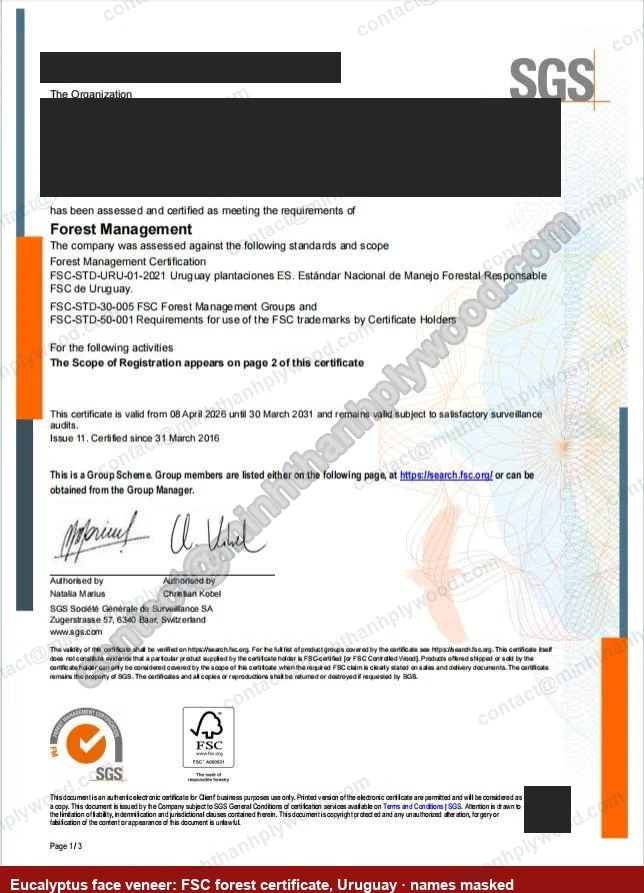
Watch one point when the veneer was sliced in China from imported logs: the country of production is where the tree grew. Our eucalyptus face veneer is sliced in China from logs grown in Uruguayan plantations certified under an FSC forest management certificate issued by SGS. Its record says Uruguay.
Why mixing happens in veneer trading
Veneer is sold by grade, thickness and size, not by plot. A trader who holds poplar face sheets from five plantations in one warehouse will sell them as one grade unless the buyer asks for lot separation. That is normal trade practice and the reason so many face records break. The fix is commercial as much as technical: buy by lot, pay for lot separation, and refuse mixed stock for EU orders.
How do you trace imported veneer for EUDR?
Ask the plywood mill for a face veneer record that answers six questions, and check each against the document behind it:
| Question | Document that answers it | What to check |
|---|---|---|
| Which plot did the log grow on? | GeoJSON or a map page with the plot polygon or point | Six decimals; a polygon if the plot is over 4 ha |
| When was it harvested? | Harvest permit or harvest record | Dates fall before the veneer invoice |
| Was it harvested legally? | Harvest permit, forest ownership or management certificate | Permit holder matches the plantation |
| Who handled it in between? | Invoice for every hop | Same species and claim on every invoice |
| Was the land deforested after 2020? | Land-cover maps or a risk screen of the polygon | 2020 cutoff; tree cover on the plot |
| Which panels used it? | Mill’s lot record linking veneer lot to production order | Veneer volume covers the panel volume |
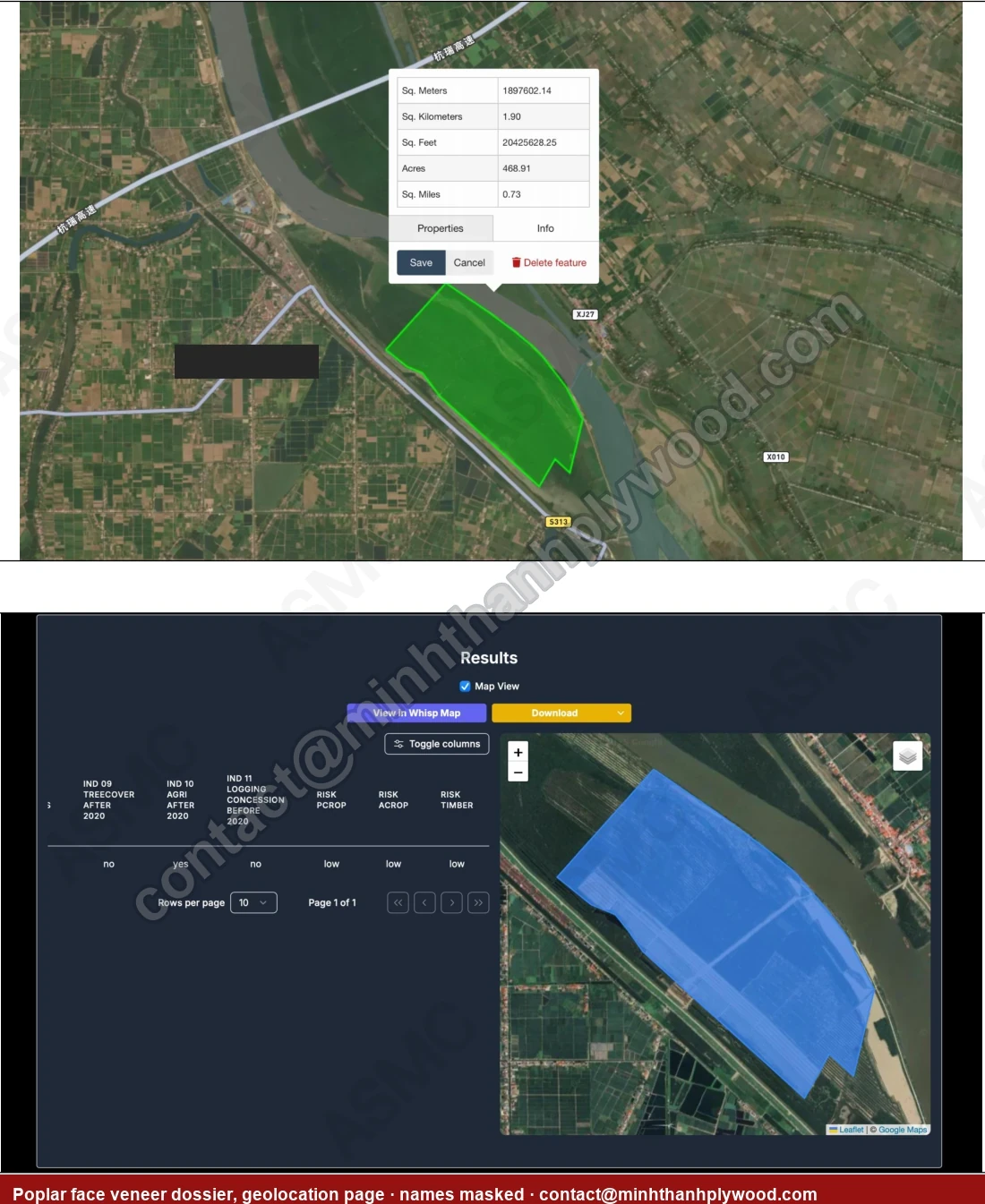
Our poplar face dossier answers all six. It has the plantation polygon of about 190 ha on satellite imagery, 10-metre land-cover maps for 2021 and 2025, a Whisp risk screen rating the plot low risk for timber, the harvesting permit, the forest ownership certificate and an invoice for every hop. It covers 188.82 m³, 72,600 sheets.
What does a face veneer lot record contain?
A face veneer lot record is the face veneer’s share of the plywood dossier. Ours holds these fields for each lot, so the importer can copy them straight into the due diligence statement:
| Field | Example from our poplar lot | Why it matters |
|---|---|---|
| Species | Populus deltoides | Product description, Article 9(1)(a) |
| Product | Sliced veneer, HS 4408 | Matches the Annex I listing |
| Quantity | 188.82 m³, 72,600 sheets | Shows the lot covers the panels made from it |
| Country of production | China | Where the tree grew |
| Geolocation | Plantation polygon, about 190 ha | Article 9(1)(d) |
| Harvest period | 14 February – 31 December 2025 | Article 9(1)(e) |
| Forest type | Plantation | Supports the deforestation-free check |
| Certification | FSC 100%, certificate code per hop | Legality and custody support |
| Legality | Harvest permit, forest ownership certificate | Article 9(1)(i) |
| Custody | Invoice per hop | No wood of unknown origin mixed in |
| Risk screen | Land-cover maps 2021 and 2025, risk screen low for timber | Deforestation-free since 31 December 2020 |
The core plots get the same fields, one record per grower plot, so a panel’s dossier has one face record and several core records side by side.
Example: what the dossier lists for one 40HC with a poplar face
Take a common order: 18 mm furniture plywood, poplar B/B on both sides, Styrax core, UF glue at E0 emission, 1220 × 2440 mm, one 40HC. On our standard container plan that is 990 panels, about 53 m³. The dossier for that container would hold:
| Part of the dossier | Content for this example |
|---|---|
| Product description | Plywood, HS 4412, 18 mm; face and back Populus deltoides; core Styrax tonkinensis |
| Quantity | 990 panels, about 53 m³, net mass from the packing list |
| Face and back origin | One poplar lot record: China, plantation polygon, harvest period, permit, invoice chain |
| Face veneer drawn | 1,980 sheets from that lot, face and back for 990 panels |
| Core origin | One record per Styrax grower plot used, Vietnam, points or polygons |
| Legality | Harvest permit and forest ownership for the face; land certificates and purchase contracts for the core |
| GeoJSON | One file with the face polygon and every core plot, ready to upload |
The importer’s statement then names two countries of production, China and Vietnam, and lists every plot in the file. One statement, one upload, every layer covered.
What happens to a panel when the face veneer origin is unknown?
The importer cannot file a complete statement for it. Article 13 lets operators use simplified due diligence for low-risk countries only after ruling out “the risk of mixing with products of unknown origin” (Regulation (EU) 2023/1115, Article 13). A face of unknown origin on a documented core is that mixing risk. The importer then has to run full due diligence, and with no plot data for the face, there is nothing to assess.
In practice the options are bad: hold the container, re-source the panels, or accept the risk of a non-compliant placing on the market. Member states must set fines whose maximum is at least 4% of the operator’s total annual Union-wide turnover (Regulation (EU) 2023/1115).
Is a plantation that was harvested and replanted “deforested”?
No. In the regulation, deforestation means “the conversion of forest to agricultural use” (Regulation (EU) 2023/1115, Article 2). A poplar or eucalyptus plantation that is harvested and replanted stays forest land; the harvest itself is not deforestation.
The second test is forest degradation, which for wood is the conversion of primary or naturally regenerating forests into plantation forests or other wooded land. That is why the record asks when the plantation was established and what was on the land before. For our poplar face plot, the land-cover maps for 2021 and 2025 show the same plantation area on both dates, so the plot was neither cleared for farming nor converted from natural forest after the 31 December 2020 cutoff.
For a natural-forest face such as okoume, the question is harder: the concession has to show that harvesting did not degrade the forest in the sense of the regulation. That is one more reason to ask for its record before you order.
What about face veneer bought before the EUDR applies?
Timing of production matters. The EUDR’s duties apply from 30 December 2026, and wood produced before 29 June 2023 that is placed on the market after that date stays under the EU Timber Regulation until 31 December 2029 (EUTR vs EUDR). Veneer harvested before 29 June 2023 therefore needs a legality record, not EUDR plot data.
In practice this matters little for face veneer. Veneer is a working stock that turns over in months, not years, and a lot harvested in 2023 is rarely still on a mill’s shelf. Our poplar lot was harvested in 2025. For any face lot, the harvest period on its record tells you which regime applies, and the dossier for an EU order states it.
What an authority can ask for
Competent authorities in EU member states check operators’ due diligence, on paper and on the goods. For plywood they can ask the importer for the Article 9 evidence behind a statement: the plots, the harvest periods, the legality records and the supplier chain. If the face veneer part of that evidence is a promise rather than a record, the check fails on paper, whatever the panel looks like. The importer cannot pass that question on to the mill once the panels are in the EU; the evidence has to be in the file before the statement is filed.
How do Vietnamese mills without a documented face respond?
Mills that can document the core but not the face have three options, and buyers should know which one their supplier is taking.
- Wait for the veneer chain. Keep buying faces as before and hope the traders deliver plot data before the deadline. Cheapest today, riskiest for the buyer.
- Switch face sources. Buy only from veneer suppliers who already pass plot data with each lot. It takes partners, checks at receipt and the discipline to refuse undocumented lots.
- Change the face. Offer a face whose chain is documented, sometimes a different species with a similar look, and agree it with the buyer before production.
Minh Thanh is past that choice. We work with long-standing partners across the face veneer chain, and every face lot for our European orders arrives with its forestry dossier and plot geolocation, just as every core lot does.
How does a panel with faces from China and a core from Vietnam appear in the statement?
As one product with two countries of production and several plots. Annex II asks for the “country of production and the geolocation of all plots of land where the relevant commodities were produced” (Regulation (EU) 2023/1115, Annex II), so the importer lists China and Vietnam and uploads every plot.
The easiest way to do that is one GeoJSON file per order with all features in it: the face plantation polygon and each core plot. Each feature carries the species, so a reviewer can see which plot fed which layer. That is how we deliver it. A supplier who sends the face data as a PDF map and the core as a spreadsheet of coordinates leaves the importer to merge and convert them by hand, which is where typing errors come in.
The records behind the file are kept for five years from placing on the market, by the importer under Article 9 and by us as the mill, so a question from an authority in 2030 can still be answered with the same lot records.
How do FSC, VNTLAS and the EUDR fit together for an imported face?
They answer different questions, and an imported face needs all three answered.
| Scheme | Question it answers | What it gives for a face veneer | What it does not give |
|---|---|---|---|
| FSC chain of custody | Was the wood controlled through the chain? | A claim such as FSC 100% on each invoice | Plot coordinates |
| VNTLAS, Vietnam’s timber legality system | Did the timber enter and move legally in Vietnam? | Import declaration and legality records for the veneer | The plot where the tree grew |
| EUDR | Was the plot deforestation-free and the harvest legal, and where is it? | The geolocation, harvest period and legality evidence | A certificate; it is a duty on the importer |
FSC helps the importer assess risk, and many EU buyers want it anyway. It does not replace the plot data (is FSC enough for the EUDR?). VNTLAS covers the Vietnamese side of the trade (VNTLAS and Vietnamese timber legality). Only the plot record answers the EUDR’s own question.
Does PEFC change anything?
No. PEFC, like FSC, certifies forest management and chain of custody. A PEFC claim on a veneer invoice supports legality and the risk assessment in the same way, and in the same way it carries no plot coordinates. Whichever scheme a face lot is certified under, the EUDR record still needs its own geolocation and harvest period.
What changes for traders and downstream buyers of the panels?
The EU importer carries the main duty, but the face veneer record also follows the panels downstream. A furniture maker that buys the plywood from the importer inside the EU is a downstream operator: it does not file a new statement for the plywood, but it keeps the reference numbers of the statements that covered it.
If there are substantiated concerns, non-SME downstream operators and traders must verify that due diligence was done upstream, which can include checking that the reference numbers they received are valid (Commission due diligence guidance). If the importer’s statement for a container had a gap in the face veneer record, the problem travels with the reference number.
For distributors that resell panels, the practical rule is to buy only panels whose statement covers every layer, and to keep the importer’s reference with the stock. When a customer asks where the face of a panel came from, the answer should be one lookup away: statement reference, dossier, face lot record.
On our side, each order’s dossier carries the order number and the lot numbers, so an importer can answer that question for any pack in the container.
Questions your own customers will ask
Furniture brands and retailers in Europe are starting to ask their suppliers the same question one level up: where did the wood in this cabinet come from? A distributor or furniture maker that can answer “face poplar from a documented plantation in China, core Styrax from documented plots in northern Vietnam, statement reference attached” turns the EUDR from a cost into a selling point. That answer is only possible if the face veneer record existed when the plywood was imported.
What are the red flags in a supplier’s answer about face veneer?
Most suppliers will say yes when asked about the EUDR. The answer to the face veneer question shows whether the yes is real. Watch for these:
- “Our veneer is FSC, so it is EUDR compliant.” FSC is not plot data.
- “We will provide it before the deadline.” Ask for a past or current lot’s record now.
- “The core is Vietnamese, so the panel is low risk.” The face may come from elsewhere; every layer counts.
- A map with a pin and no harvest record. Coordinates without a harvest period and permit do not show legality.
- A polygon for a different species or year. Check the species and harvest dates against the veneer invoice.
- Documents sent from a personal email. Brokers forward real mills’ documents; ask for the dossier from the mill’s company address.
A good answer is boring: a PDF with the plot, the permit, the invoices and a GeoJSON file, sent from the mill’s domain with the lot numbers that will go into your order.
Three questions that separate a record from a promise
Ask them in this order and stop at the first vague answer:
- “Which face veneer lot will you use for my order, and can you send its record now?”
- “Where did the tree grow, and what does the harvest permit say?”
- “How do you keep that lot separate from undocumented stock on the press line?”
A mill with real records answers the first question with a file. A mill without them answers it with a date.
Why do birch and okoume faces need extra care?
Birch and okoume are both popular faces on Vietnamese furniture plywood, and both come from forests rather than short-rotation plantations. Birch logs are grown in northern regions where supply routes have shifted since 2022, and buyers have to check the country where the tree grew, not the country that shipped the veneer (birch plywood after the sanctions). Okoume grows in the natural forests of Central Africa, where the legality and the deforestation-free check depend on the concession and its management.
For both, ask for the same record as for poplar: the plot or concession boundary, the harvest period, the legality documents and the invoice chain. The birch and okoume faces on our EU orders carry that record, like every other face we use.
Price is the other reason to ask early. A documented birch or okoume lot can cost more than an undocumented one, and the difference shows in the panel price. Knowing which face can be documented before the quotation lets a buyer compare like with like, rather than comparing a documented panel with a cheaper offer that carries only a promise.
How do we keep the face veneer documented from lot to panel?
Every lot we buy for European orders comes with its forestry dossier, face and core alike. That was already the rule under the EUTR, when each lot had to show legal origin. Under the EUDR the same dossiers carry plot geolocation: the plantation polygon for the face veneer and the grower plots for the core. Each order’s dossier lists the face lots and core plots that went into your panels, with the quantity drawn from each.
Our faces include poplar, eucalyptus, birch, okoume, pine and engineered veneer, and the furniture panels are pressed twice: the core board is pressed and calibrated, then the face and back are pressed on. The dossier for your order shows the face species you specify, with its own origin record next to the Vietnamese core records.
From EUTR to EUDR: the same dossiers, now with coordinates
Nothing about the paper trail is new to us. What the EUDR adds is the plot itself: coordinates with six decimals, polygons where plots exceed four hectares, and the harvest period tied to that plot. Our face suppliers deliver those fields with every lot, as our Vietnamese growers do for the core, so the dossier for an EU order is complete when the panels leave the press.
How do you write the face veneer requirement into the order?
Put it in the specification line and the contract, not in a later email. A requirement written into the order is prepared with production; one sent after loading has to be reconstructed.
Three lines cover it:
- In the specification: “Face and back: [species, grade]. EUDR origin record per face lot required: plot geolocation (GeoJSON, WGS84), harvest period, legality records, invoice chain.”
- In the delivery terms: “EUDR dossier, face and core, sent with the shipping documents from the mill’s company email.”
- In the quality clause: “No face veneer from a lot without an origin record; any change of face lot to be notified before production.”
The third line matters most. It closes the door on a quiet face swap when a lot runs short.
A checklist for one face veneer lot
Use this list on the first dossier a supplier sends. Each item is a yes or no.
- The lot record names the species with its scientific name.
- The country of production is where the tree grew, not where the veneer was sliced.
- The geolocation file opens in a map viewer and lands on plantation or managed forest land.
- Coordinates have at least six decimals; plots over 4 ha are polygons.
- The harvest period ends before the first invoice date.
- The harvest permit or record names the same plot or holder.
- Every hop has an invoice with the same species and the same claim.
- The quantities add up from the plantation to the mill’s purchase.
- The land-cover evidence shows no conversion to farmland after 31 December 2020.
- The dossier was sent from the mill’s company email, with your copy number.
Ten yes answers mean the face veneer can go into your due diligence statement as it is.
A sample clause for the purchase contract
Buyers who want the requirement in one paragraph can use this as a starting point and adapt it with their own adviser:
“The Seller shall supply, for every face and back veneer lot used in the goods, an origin record containing the species, the country of production, the geolocation of all plots in WGS84 with at least six decimals (polygons for plots above 4 ha), the harvest period, the legality documents and the invoice chain from the forest to the Seller. The Seller shall not use veneer from any lot without such a record. Any change of face lot shall be notified to the Buyer in writing before production. The records shall be delivered from the Seller’s company email together with the shipping documents.”
What should you ask your plywood supplier this week?
Send one question before the next order: “Please send the face veneer origin record for the lot you will use: plot geolocation, harvest period, harvest permit and the invoice chain.” A mill that has it sends it. A mill that answers “we can provide it later” has not got it yet.
Write to [email protected] for a sample dossier. Orders start at one 40HC, production takes 15–45 days after the deposit, and samples are free. A line we can quote from: “18 mm poplar B/B both faces, Styrax core, UF E0, 1220 × 2440 mm, 1 × 40HC, EUDR dossier with face and core GeoJSON.”
Read the EUDR compliant plywood guide for the full dossier, and the EUDR documents guide for every file in it.
If you already buy from several Vietnamese mills, send the same question to all of them on the same day. The answers arrive in three kinds: a file, a date, or silence. The file tells you who can ship to the EU after 30 December 2026 without a gap in the face veneer; the date tells you who is still waiting on their veneer traders.
Buyer questions, answered
Does the EUDR apply to veneer?
Yes. Sheets for veneering under heading 4408 are listed in Annex I of the EUDR, and so is plywood under 4412.
Does face veneer need geolocation under the EUDR?
Yes. The importer must give the geolocation of all plots where the wood in the product was produced, and the face veneer's log grew on its own plot.
Is Chinese veneer EUDR compliant?
It can be. China is a low-risk country, but a veneer lot is compliant only when its plot geolocation, harvest period and legality records travel with it.
Which wood layers in plywood need EUDR geolocation?
Every layer: face, back, cross-bands and core. Layers from the same plot can share one record; layers from different forests need their own.
Is an FSC 100% claim enough for imported face veneer?
No. The FSC claim supports legality and the risk assessment, but it does not carry plot coordinates.
What is the country of production for a veneer sliced in China from Uruguayan logs?
Uruguay. The EUDR country of production is where the tree was grown and harvested, not where it was sliced.
How many companies are in a typical imported face veneer chain?
Our poplar face chain has five: plantation, FSC certificate holder, log trader, slicing mill and veneer trader, before the plywood mill.
What happens if the face veneer origin is unknown?
The importer cannot complete the statement for that panel, and simplified due diligence is no longer open because of the risk of mixing with wood of unknown origin.
Can the mill swap face veneer between orders?
No. Each order's dossier lists the face lots used, each with its own plot record, so the face on the panels is the face in the dossier.
Does Minh Thanh supply face veneer geolocation?
Yes. Our dossiers carry plot geolocation for both the imported face veneer and the Vietnamese core, sent with the order.