
Furniture and door components
Sound, consistent surfaces selected for finishing and machining
Application brief
Rails, stiles, frame members and door-component blanks
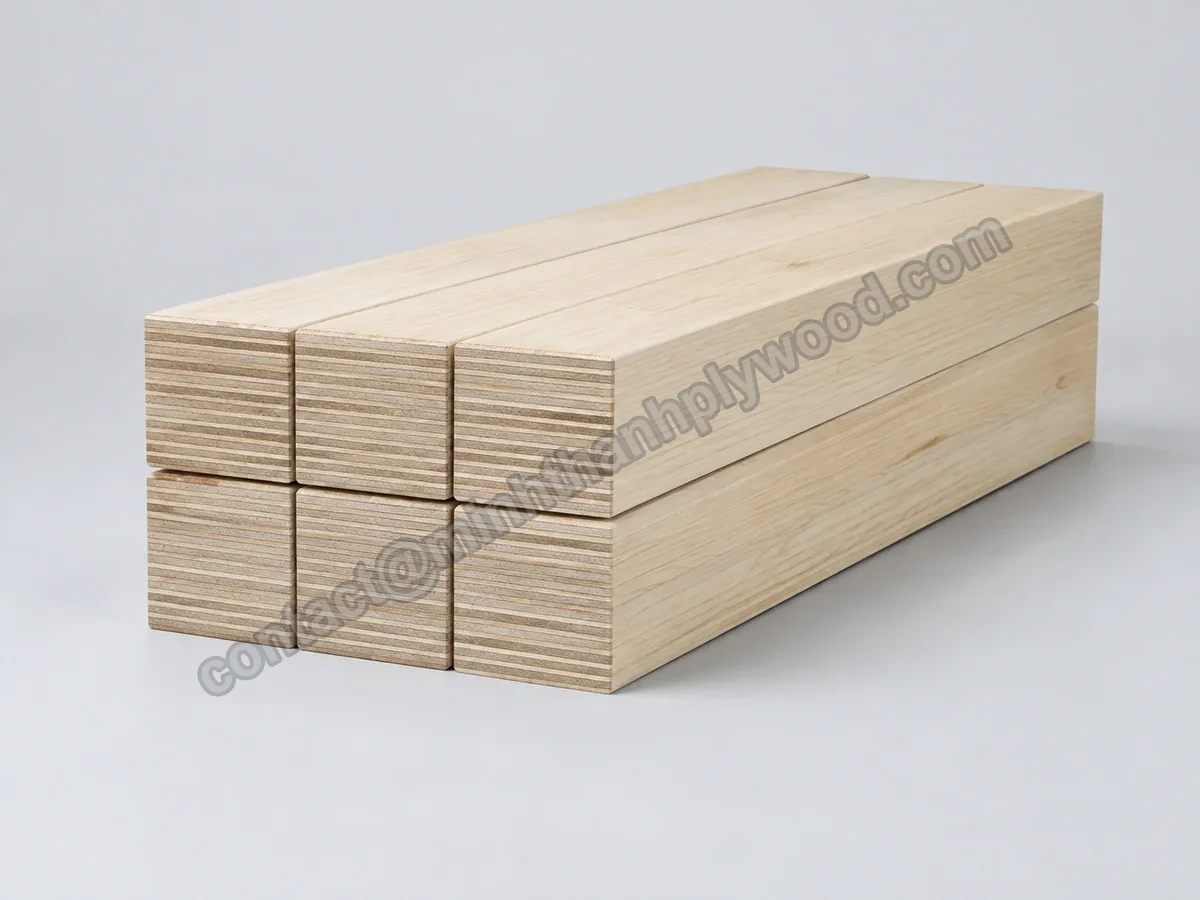
LVL Vietnam · Component supply
In short
Minh Thanh Plywood supplies laminated veneer lumber made from Acacia or Eucalyptus plantation veneers for furniture frames, door components and industrial packaging. Grain runs along the member. Choose UF adhesive at E0 for interiors, E1 as an option, or a water-resistant bond for the application.
Ha Hoa’s local plantation-veneer supply supports our LVL range. We supply the EUDR compliance dossier with origin records and geolocation files for your order. Send the component drawing and quantities; we quote the material, cutting and packing together.
LVL from grain direction to order
See the parallel-grain construction, available billet formats, glue choices and the payload-based container plan.
Read the material through its edges
LVL runs the veneer grain along the member; plywood alternates it across the panel. The diagram makes that construction difference visible.
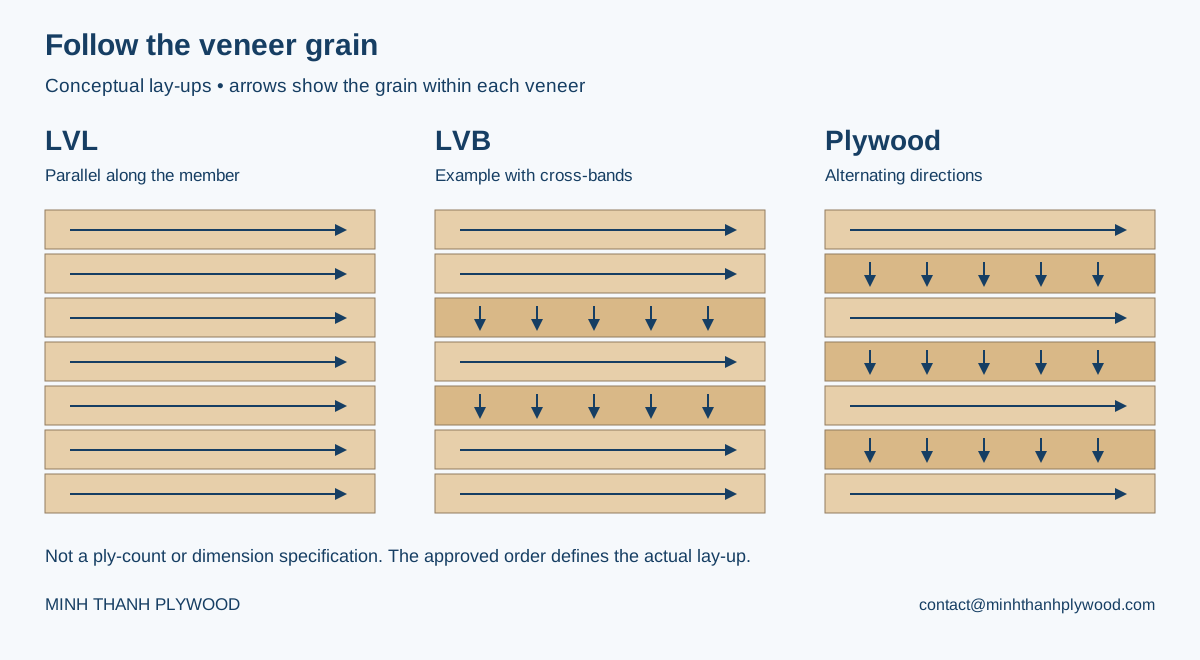
LVB can include selected cross-bands. The central example shows one such arrangement; the approved order defines the actual lay-up. This schematic explains grain direction rather than depicting a particular production billet.
An LVL specification describes a member
Our LVL uses Acacia or Eucalyptus veneers, about 580 kg/m³ for Acacia or 650–750 kg/m³ for Eucalyptus and 8–12% moisture, pressed in the billet formats listed here.
| Core veneers | Acacia or Eucalyptus plantation timber |
|---|---|
| Billet formats | 1220 × 2440 or 1250 × 2500 mm |
| Density | Acacia about 580 kg/m³; Eucalyptus 650–750 kg/m³ |
| Moisture | 8–12% |
| Interior adhesive / emission | UF at E0; E1 option |
| Water-resistant options | MR / melamine-fortified or phenolic WBP |
| Grain arrangement | Parallel along the LVL member; specify any cross-bands separately |
| Member cutting | Sections and lengths from the approved drawing within the selected billet |
| Surface | Calibrated furniture billets or component finish specified on the order |
| Quantity | Pieces by section and length, with total volume |
Choose the billet and cutting plan around the finished component. Put member thickness, width and length on the drawing, together with the supported face and any machining allowance. The quotation repeats those dimensions so purchasing and receiving work from the same specification.
Select LVL by application and inspection criteria
We select the LVL construction for furniture, door components or packaging, then grade the visible surfaces to the approved sample.
Furniture and door components
Sound, consistent surfaces selected for finishing and machining
Application brief
Rails, stiles, frame members and door-component blanks
Packaging members
Natural colour variation accepted; edges and bonding checked for the component
Application brief
Runners and frames specified by the packaging design
A furniture rail needs clean machining edges and the appearance your finish will reveal. A concealed packaging runner prioritises the sound member and fastening arrangement. Mark visible faces and connection areas on the drawing so the veneer selection follows the component.
Parallel veneer layers create the LVL member
LVL concentrates the veneer grain along the length; conventional plywood alternates grain direction through the panel.
| Construction point | LVL member | Conventional plywood |
|---|---|---|
| Grain arrangement | Predominantly along the member | Alternates across adjacent veneers |
| Product form | Billet or linear member | Sheet or cut panel |
| Specification | Section, length and material lay-up | Sheet format, thickness and face/core selection |
| Receiving evidence | End view, long edge and member reference | Sheet face, edge and panel reference |
Acacia and Eucalyptus plantation veneers are dried, graded, glued and assembled with the grain along the member. Pressing bonds the lay-up into a billet before it is cut into the ordered sections.
Veneer selection and staggered joints distribute natural wood variation through the member. The resulting construction gives component makers a repeatable alternative to a single sawn piece. Cross-banded LVB is specified separately when the drawing needs that arrangement.
Choose the LVL bond for its service environment
UF adhesive at E0 is the interior choice for our LVL; E1 is available, with MR / melamine-fortified and phenolic WBP bonds for the service environment.
| Application | Adhesive / bond | Emission or finishing requirement |
|---|---|---|
| Dry interior furniture | UF | E0 standard; E1 option |
| Humid service | MR / melamine-fortified | Emission class specified separately |
| Weather-exposed components | Phenolic WBP | Protect surfaces and cut ends for service |
Choose UF for indoor furniture components and the required emission class on a separate order line. Use the specified water-resistant bond for humid or outdoor applications, together with the surface and end protection required by the component.
Our mill’s six chamber tests (three by Shanghai Hongjun, three by ICTT Vietnam) under ASTM D6007 on 9, 15 and 18 mm plywood samples averaged 0.014–0.032 ppm between April 2025 and June 2026. These are the mill’s furniture-panel E0 evidence, with the tested product identified in the quality documents.
Write the section before comparing LVL lengths
We offer 1220 × 2440 and 1250 × 2500 mm LVL billet formats, cut to the component drawing.
| Standard billet | 1220 × 2440 mm |
|---|---|
| European billet | 1250 × 2500 mm |
| Member dimensions | Thickness × width × length from the approved drawing |
| Grain direction | Along the member; marked on the cutting plan |
Use the longer billet direction for the member grain. A section sketch shows whether the member will sit flat or on edge, and its dimensions include the allowance for any machining at your plant.
Group repeating parts by section and length. The cutting list and its revision stay with the order through production, bundle marking and receiving.
Choose LVL where the member shape fits the job
LVL suits linear components such as furniture rails, door-frame members and packaging frames; the component design determines its specification.
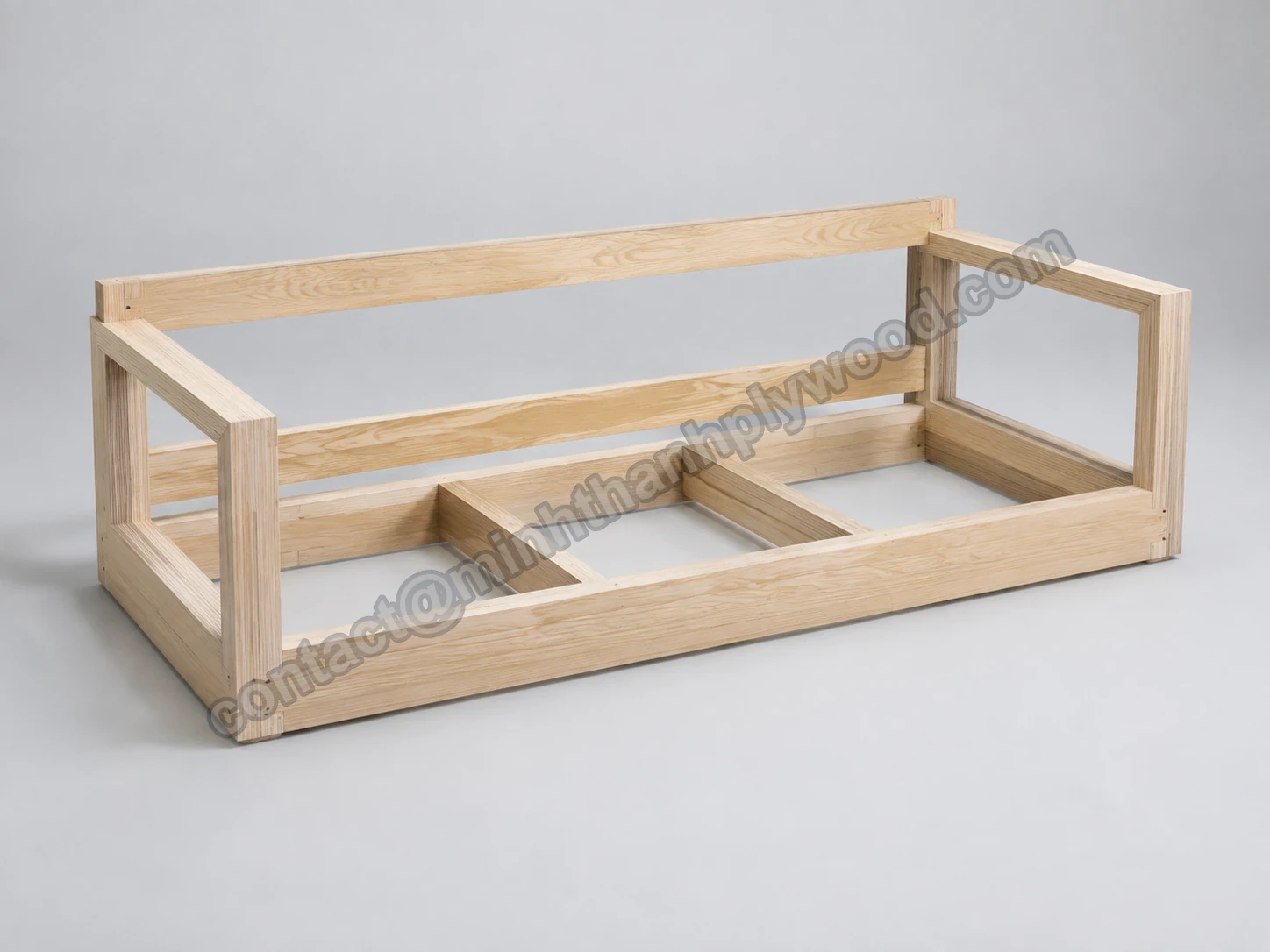
Linear rails and frame members can use a veneer-based construction where repeatable sections help assembly. Specify visible surfaces separately from concealed edges and allow for the machining that follows receipt.
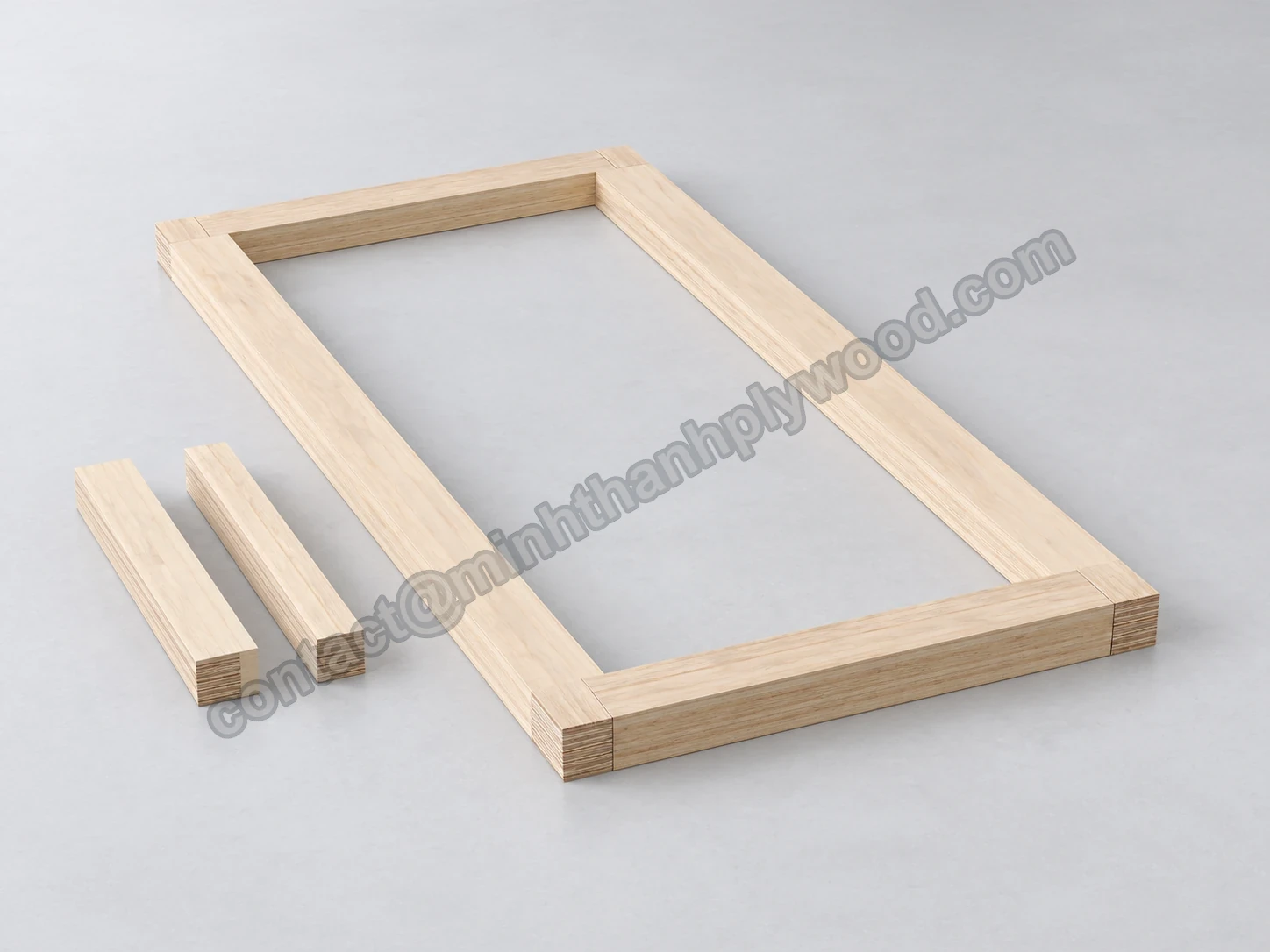
Straight members give the frame maker a defined blank for profiling and joining. Record the final section, face orientation and end allowance before comparing suppliers.
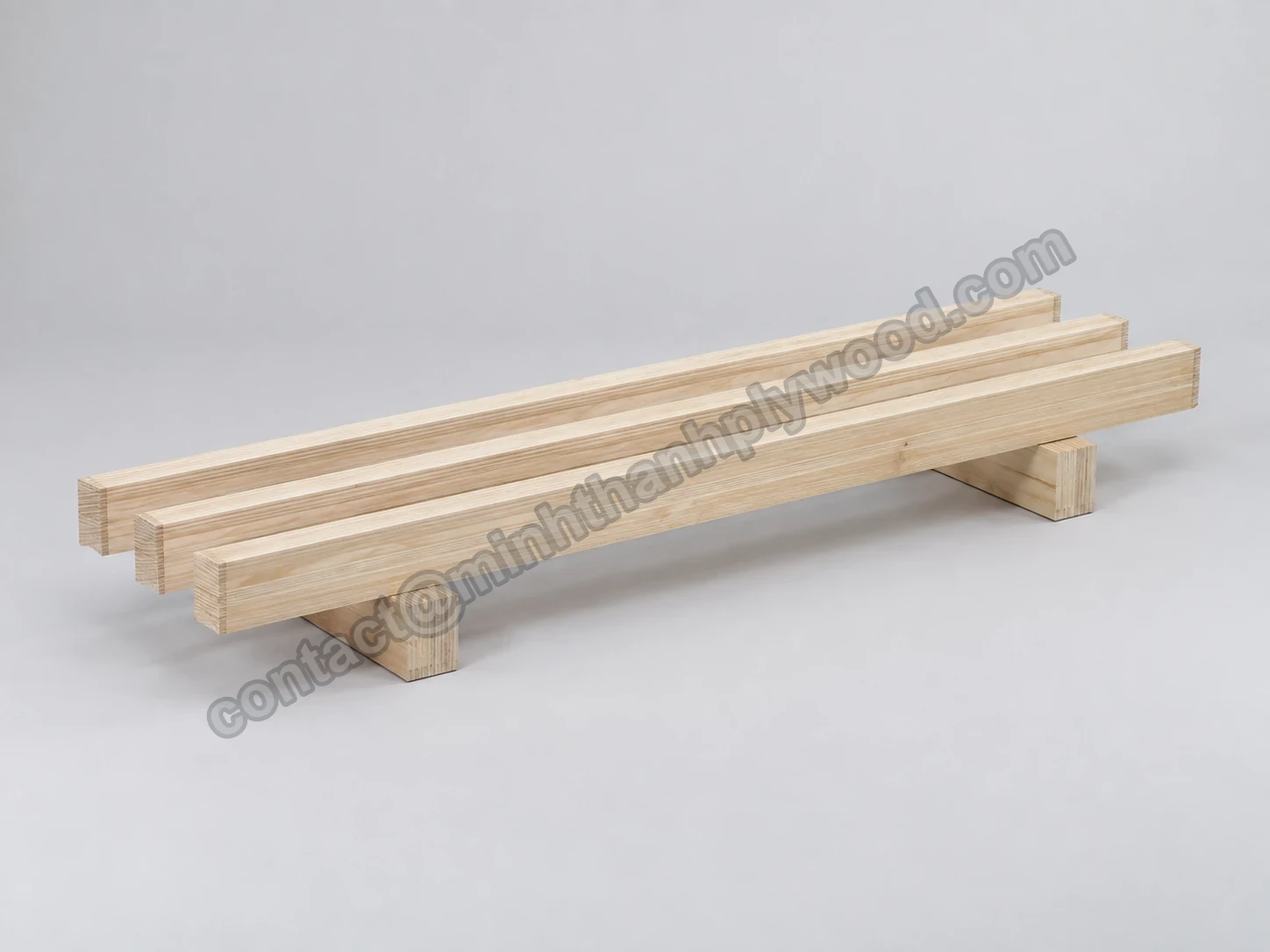
A runner is part of a complete packaging system. Its span, load arrangement and fastening matter alongside the member dimensions; use the packaging design as the reference.
For load-bearing construction, identify the evaluated product and its design values in the engineering specification. Member sizing follows that evidence and the project loads.
Furniture rails, door frames and packaging runners are the main component uses. We quote the veneer construction, bond and cutting plan around your drawing. Structural beams and project members use the evaluated grade and design values named by the project engineer.
LVL, LVB, plywood, glulam or sawn timber?
Compare construction first: the direction and form of the wood layers explain why these materials serve different roles.
| Material | Wood arrangement | Typical purchasing unit | Buyer decision |
|---|---|---|---|
| LVL | Veneers mainly along the member | Member or billet | Longitudinal component construction |
| LVB | Specified mix of veneer directions | Board or component blank | Obtain the actual lay-up |
| Plywood | Cross-banded veneers | Sheet or cut rectangle | Panel work and cabinetry |
| Glulam | Sawn timber laminations | Engineered member | Architectural or structural member design |
| Sawn timber | One sawn piece | Timber section | Species and timber grade |
LVL provides a straight, consistent member along its grain; plywood provides a cross-banded panel. Choose the form that matches the drawing: LVL for linear components, plywood for cabinet sides or broad panels. Glulam uses sawn timber laminations where LVL uses veneers.
Inspect the member against the drawing
We inspect the ordered section, straightness, edges and bond condition against the component drawing.
Match the bundle mark and component reference to the order.
Read section dimensions and length with the agreed method.
Check straightness, squareness and visible damage.
Inspect long edges and ends for the specified layer arrangement.
Review bond, emission and performance documents for the supplied material.
Record quantities and retain the inspection images.
The bundle mark connects the member to its material and cutting list. Inspection records show the section and length, the visible edges and the quantity ready to pack. For a repeat order, the approved sample stays alongside the drawing revision as the reference.
Keep documents within their product scope
ISO 9001:2015 quality management, KAC25/0185; the mill’s plywood certificates and E0 test evidence are available in our quality documents.
Plan LVL bundles by section, length and mass
As an example, a booking capped at 26 t with 1 t reserved for packaging leaves 25 t for LVL. The material allowance is about 43.1 m³ for Acacia at 580 kg/m³, or 33.3–38.4 m³ for Eucalyptus at 650–750 kg/m³.
| Planning density | LVL volume | LVL mass | Packaging reserve | Planned gross mass |
|---|---|---|---|---|
| Acacia / 580 kg/m³ | 43.1 m³ | 24,998 kg | 1,000 kg | 25,998 kg |
| Eucalyptus / 650 kg/m³ | 38.4 m³ | 24,960 kg | 1,000 kg | 25,960 kg |
| Eucalyptus / 750 kg/m³ | 33.3 m³ | 24,975 kg | 1,000 kg | 25,975 kg |
The table rounds volume down to stay within the mass allowance. The denser Eucalyptus load reaches the weight allowance at a smaller volume than Acacia. Confirm the load using the actual material density, bundle footprint and weighed gross mass.
Bundle matching sections and lengths together, protect the ends and place supports in line through the stack. Labels record the member reference, dimensions and count. Keep the delivered packs level, off the floor and under cover.
Illustrative 40HC plan for a booking capped at 26,000 kg. Final loading follows booking payload, pack geometry and measured gross mass.
Commercial terms for an LVL enquiry
Send a complete member schedule to receive a quotation with the material description, production plan and export terms together.
| Enquiry quantity | Pieces by section and length; total volume |
|---|---|
| Terms | FOB Hai Phong, CFR or CIF |
| Samples | Free samples |
Our standard export terms are one 40HC minimum, production 15–45 days after deposit, and payment of 30% deposit with 70% against the scanned bill of lading. We offer FOB Hai Phong, CFR or CIF and free samples. The quotation records the LVL specification and delivery plan for the order.
Compare quotations on the same section, species, bond and finish. Cutting, machining and pack identification are included in the order description so the price matches the component you receive.
Order LVL from a member schedule
Send the application and drawing first, then complete the material and packing specification before approving production.
Identify the application and destination market.
Send thickness, width, length, orientation and quantity for every member.
State species, lay-up, bond and emission requirements.
Include the technical evidence required by the component or structural design.
Approve the quotation, sample and drawing revision.
Review the inspection record and packing list before shipment.
For repeat purchasing, preserve the approved material reference even if the piece quantity changes. If the design changes, update the drawing revision and the quantity schedule together. This keeps a familiar product name from hiding a change in section or loading direction.
Questions about buying LVL from Vietnam
These answers connect the material name with the component, drawing and inspection needed for an order.
Laminated veneer lumber, or LVL, is engineered wood made by bonding thin veneers with their grain mainly aligned along the member. It is commonly supplied as members or billets for linear components rather than as cross-banded plywood sheets.
No. LVL plywood is a trade search term for a predominantly parallel-grain veneer product. Ordinary plywood alternates veneer directions through the sheet. Identify the actual lay-up on the order rather than relying on the word plywood alone.
LVL concentrates grain along the member. LVB refers to laminated veneer board with a specified arrangement that can include cross-bands. Obtain the construction description and drawing because the trade name alone does not define every layer.
Yes. LVL can provide higher, more consistent strength along the member than ordinary sawn timber because the veneers distribute natural wood variation. For structural use, the engineer sizes the evaluated grade from its published design values.
Yes, with the specified water-resistant bond and protection for the wood surfaces and cut ends. Choose phenolic WBP for weather-exposed components and keep the members under cover before installation.
LVL is used for linear furniture components such as frames and rails. Specify the section, visible surfaces, machining allowance and assembly requirement so the material and sample match the finished component.
Our LVL billet formats are 1220 × 2440 and 1250 × 2500 mm. Send the finished member thickness, width and length with the grain direction; the cutting plan follows your component drawing.
For a 40HC booking capped at 26 t, with 25 t allocated to wood and 1 t to packaging, the material plan allows about 43.1 m³ of Acacia LVL at 580 kg/m³, or 33.3–38.4 m³ of Eucalyptus at 650–750 kg/m³. The piece count follows your section and length schedule; the final load uses the booking payload and weighed bundles.
LVL is used in packaging members and frames. Specify the runner dimensions together with the span, load arrangement and fastening details from the packaging design so the supplied material serves the complete system.
No. UF, MR / melamine-fortified and phenolic WBP describe the adhesive or bond. E0 and E1 describe emission requirements. Our interior LVL option is UF at E0, with E1 also available.
Match the bundle reference to the order, measure the section and length, and inspect straightness, corners and glue lines. Keep the material documents and photographs with the received quantity record before further machining.
Send your application, destination, member dimensions, quantity, lay-up, species, glue and emission requirements. Add any design values or evaluation required by the project. Lisa replies within hours and can arrange free samples.
Our LVL uses locally grown Acacia or Eucalyptus plantation veneers. Density is about 580 kg/m³ for Acacia and 650–750 kg/m³ for Eucalyptus; moisture is 8–12%. We supply the EUDR dossier with origin records and geolocation files for the order.
Send your LVL member schedule
Tell us the application and dimensions; Lisa replies within hours.
Include the application, timber species, lay-up, glue and emission, section and length, packing, quantity and destination port. Attach up to 3 drawings or specification files. Email [email protected] or WhatsApp Lisa on +84 988 586 601. Free samples.
[email protected]