
The EU importer files the EUDR due diligence statement for plywood; the mill supplies the evidence behind it. Ask for eight things: species per layer, quantity, country of production, plot geolocation, harvest period, legality records, the custody chain and deforestation-free evidence. Missing plot data for any layer, usually the imported face veneer, stops the statement.
Who submits the EUDR due diligence statement for plywood?
The EU importer submits the EUDR due diligence statement for plywood, because the importer is the operator that places the panels on the EU market. A Vietnamese mill cannot file it. The mill’s job is to supply the evidence the statement rests on: species, quantity, country of production and plot geolocation for every wood layer, plus legality and custody records.
The statement’s contents are set by Annex II of Regulation (EU) 2023/1115: the operator’s name, address and EORI number; the HS code, description, scientific name and quantity; and the “country of production and the geolocation of all plots of land where the relevant commodities were produced”. For plywood the HS code is 4412. The statement applies from 30 December 2026 (EUDR dates for plywood).
What is an EUDR due diligence statement for plywood?
An EUDR due diligence statement for plywood is the importer’s declaration, filed in the EU information system, that a consignment of plywood is deforestation-free, legally produced and covered by due diligence. Article 4 of the regulation requires it before the product is placed on the market or exported (Regulation (EU) 2023/1115, Article 4). By filing it, the operator takes responsibility for the panels’ compliance.
The statement itself is short. It carries the Annex II information: who the operator is, what the product is, how much, the countries of production and the geolocation of all plots. Once filed, the system returns a reference number that customs and downstream buyers use to find it. The long part is the evidence behind the statement, which the operator collects under Article 9 and must keep for five years. That evidence is what the mill supplies.
For plywood the evidence is heavier than for most timber products, because a panel combines several woods. A sawn board has one species and one plot; a furniture panel may have a face from one continent and a core from another.
Operator, trader or downstream: which one are you?
The regulation gives different duties to different roles. The company that first places the plywood on the EU market, usually the importer, is the operator and files the statement. A company that buys plywood already on the EU market and sells it on is a trader, or a downstream operator if it makes products from it; it keeps the statement references it received and, depending on its size, has lighter duties. A furniture maker in Italy that imports plywood directly from Vietnam is an operator for that plywood, even though it also makes furniture. If you import directly from a mill, the statement is yours to file.
Does the mill need an EORI number?
No. The EORI number on the statement is the operator’s, the EU company that files it. A Vietnamese mill exporting to that importer does not register in the EU information system for the shipment. What the mill needs is the importer’s company name and, ideally, the EORI number for the dossier cover sheet, so the dossier issued for a shipment matches the statement filed for it. We ask for both when the order is confirmed.
Every page of our face veneer and core dossiers, with sensitive data masked, is shown in EUDR compliant plywood from Vietnam.
Which HS code and description go on a plywood statement?
Plywood falls under HS heading 4412, “Plywood, veneered panels and similar laminated wood”. The Combined Nomenclature splits it by the species of the outer plies, so the face veneer decides the code (Combined Nomenclature, chapter 44):
| Face (outer ply) | CN subheading | Notes |
|---|---|---|
| Birch | 4412 33 10 | At least one outer ply of birch |
| Poplar or aspen, no birch | 4412 33 20 | Covers poplar faces and most engineered veneer made from poplar |
| Eucalyptus, no birch or poplar | 4412 33 30 | Eucalyptus-faced panels |
| Okoume and other listed tropical woods | 4412 31 10 | At least one outer ply of tropical wood |
| Both outer plies coniferous, such as pine | 4412 39 00 | Pine-faced panels |
The supplementary unit for these codes is m³, and Annex II asks for the quantity in kilograms of net mass and, where it applies, in that supplementary unit. A plywood dossier should therefore give both the net mass and the volume per specification, from the packing list.
The free-text description should name the trade name, the thickness and the scientific names of the species in each layer, for example “Plywood 18 mm, face and back Populus deltoides, core Styrax tonkinensis”. If the face changes, the code and the description change with it.
Does the core change the HS code?
No. For plywood made only of veneer sheets, the subheading follows the outer plies, so a poplar-faced panel on a Styrax core and one on a eucalyptus core share the poplar code. The core still matters for the statement: its species and plots belong in the description and the geolocation, even though they do not move the code. Panels with a different structure, such as LVL or blockboard, have their own subheadings in the same heading 4412.
EUDR documents: what should you ask your plywood supplier for?
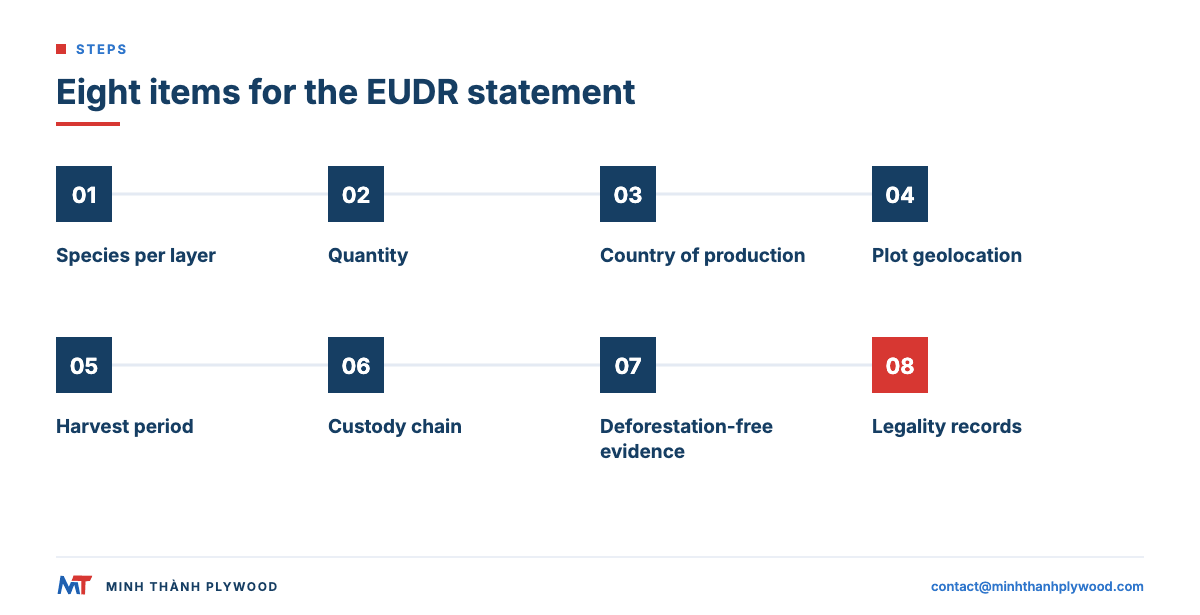
Ask for eight items, each for every wood layer of the panel. Article 9 of the regulation lists the information the operator must collect, keep for five years and back with evidence (Regulation (EU) 2023/1115, Article 9).
| # | Item | Document behind it | Article 9(1) point |
|---|---|---|---|
| 1 | Species per layer, common and scientific name | Product description per layer | (a) |
| 2 | Quantity | Packing list: net mass in kg and m³ | (b) |
| 3 | Country of production | Origin record per layer | (c) |
| 4 | Plot geolocation | GeoJSON file, map pages | (d) |
| 5 | Harvest date or period | Harvest permit or harvest record | (e) |
| 6 | Supplier and customer | Invoices for each hop | (f), (g) |
| 7 | Deforestation-free evidence | Land-cover maps or a risk screen of each polygon | (h) |
| 8 | Legal production | Land certificates, harvest permits, purchase contracts | (i) |
A dossier that covers only the core leaves out the face veneer, usually the layer with the longest chain. The face veneer guide shows what that record looks like.
What each item looks like in practice
- Species per layer. One line per layer: “Face and back: Populus deltoides (poplar). Core: Styrax tonkinensis.” Trade names alone, such as “white wood”, are not enough.
- Quantity. Net mass in kilograms and volume in m³ from the packing list, per specification.
- Country of production. Per layer, where the tree grew: China and Vietnam for a poplar-faced Styrax panel; Uruguay and Vietnam for our eucalyptus face.
- Geolocation. The GeoJSON file, one feature per plot, with the species on each feature.
- Harvest period. Dates per plot, from the harvest permit or record.
- Supplier and customer. Names and addresses in the chain, from the invoices.
- Deforestation-free evidence. Land-cover maps or a risk screen for each face polygon; land-use records for the core plots.
- Legal production. Permits, certificates and contracts, issued to you under a confidentiality notice.
EUDR geolocation for plywood: what is in the file?
An EUDR geolocation file is a GeoJSON FeatureCollection with one feature per plot: the geometry (a point or a polygon in WGS84 longitude and latitude) and properties that describe the plot. The regulation defines geolocation as coordinates “using at least six decimal digits” (Regulation (EU) 2023/1115, Article 2).
This is one feature from the core file we send with orders. The grower’s name and parcel are removed and the coordinates are left out for privacy; the fields are the real ones:
| Property | Value in our file |
|---|---|
| type | Feature |
| SourceId | VN-SRC-002 |
| ProducerCountry | VN |
| Area | 1.1347 |
| AreaBasis | certificate_parcel_area |
| SpeciesCommonName | Bo de (Styrax) |
| SpeciesScientificName | Styrax tonkinensis |
| SourceCoordinateSystem | VN-2000 / TM-3 104-45, EPSG:9208 |
| OutputCoordinateSystem | WGS84 longitude, latitude |
| ForestOrigin | Plantation-grown timber |
| geometry | Polygon, 12 vertices, closed ring, coordinates with six decimals |
The fields that matter to you:
- Geometry type tells you whether the plot is a point or a polygon.
- Area and AreaBasis say how big the plot is and where the number comes from, here the land certificate.
- Species in common and scientific names, matching the product description.
- Source and output coordinate systems show whether a conversion was made, and from which grid.
- SourceId links the feature to the purchase contract and harvest record in the paper dossier.
Points, polygons and multipolygons
GeoJSON has three geometry types that matter here. A Point is one coordinate pair, enough for a plot of four hectares or less. A Polygon is a closed ring of coordinate pairs describing one plot’s perimeter. A MultiPolygon holds several separate rings, for a single holding made of two or more parcels that do not touch. Ask for one feature per plot, with the geometry type that fits that plot, rather than one large polygon drawn around several growers’ land.
Polygon or point for EUDR geolocation?
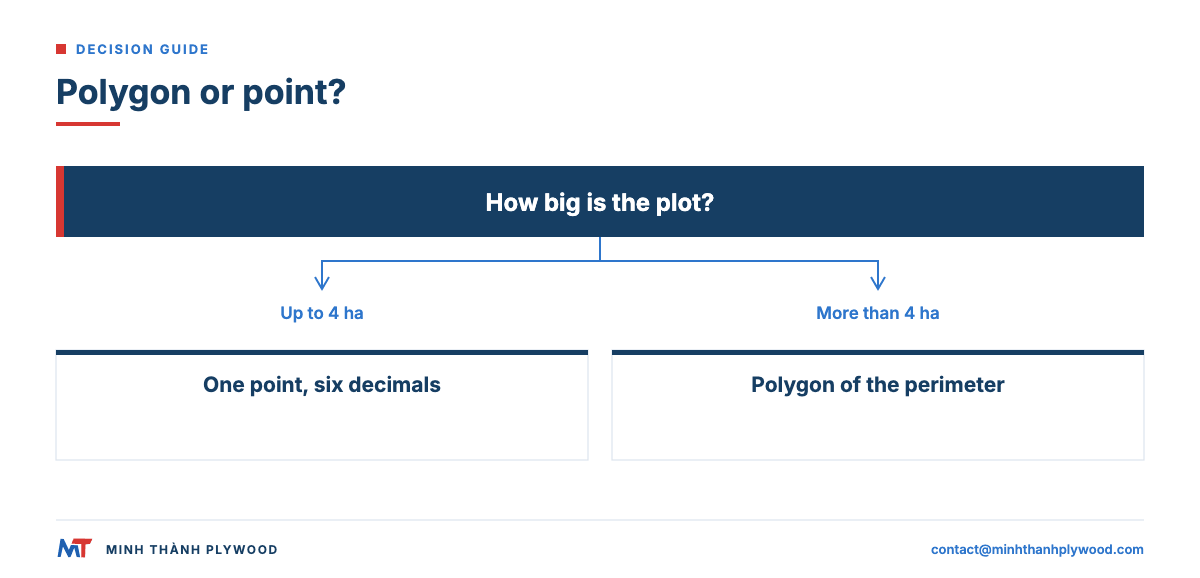
A point is enough for a plot of up to four hectares; a plot of more than four hectares used for wood needs a polygon “with sufficient latitude and longitude points to describe the perimeter” (Regulation (EU) 2023/1115, Article 2). The rule is per plot, not per shipment.
Vietnamese core plots are small. In the sample core file all five grower plots are between 0.29 and 1.26 ha, so a point would satisfy the rule; two of them still carry polygons of 12 and 8 vertices, taken from the cadastral boundary on the land certificate. Imported face veneer often comes from large plantations. Our poplar face plot is about 190 ha, so it is supplied as a polygon.
| Plot | Area (ha) | Rule | Supplied as |
|---|---|---|---|
| Core plot 1, Yen Bai | 0.51 | Point allowed | Point |
| Core plot 2, Lao Cai | 1.13 | Point allowed | Polygon, 12 vertices |
| Core plot 3, Lao Cai | 1.24 | Point allowed | Polygon, 8 vertices |
| Core plot 4, Phu Tho | 1.26 | Point allowed | Point |
| Core plot 5, Phu Tho | 0.29 | Point allowed | Point |
| Poplar face plot, Hunan | about 190 | Polygon required | Polygon |
How precise is six decimals?
One millionth of a degree of latitude is about 0.11 metres on the ground, so six decimals place a point to within a hand’s width. That is far finer than any plot boundary drawn on a Vietnamese land certificate, which is why converted coordinates should keep six or more decimals even when the source map was less precise. A file rounded to four decimals, about 11 metres, does not meet the rule, whatever the source accuracy.
Which area belongs in the file?
A plot can have two areas: the parcel area on the land certificate and the area actually harvested. Our core records keep both when they differ and state which one the file uses, in an AreaBasis field. The geolocation rule looks at the plot of land used for production, so a polygon should follow the parcel, while the harvest record shows how much of it was cut. When the two numbers are far apart, ask why before you file.
What are the most common errors in supplier geolocation files?
Most rejected or doubtful plywood files fail on a short list of mistakes. Check for each before you upload:
| Error | How it shows | Fix to ask for |
|---|---|---|
| Latitude and longitude swapped | Plot lands in the wrong hemisphere or at sea | GeoJSON order is longitude first, then latitude |
| Fewer than six decimals | Coordinates such as 104.85, 21.87 | Six decimals or more, as Article 2 requires |
| VN-2000 metres pasted as degrees | Numbers in the hundreds of thousands | Convert from the VN-2000 zone to WGS84 |
| Polygon not closed | Map viewer shows an open line | First and last vertex identical |
| Self-intersecting polygon | Boundary crosses itself | Redraw from the cadastral map |
| Point for a plot over 4 ha | Single point with an area above 4 ha | Polygon of the perimeter |
| One point for many plots | Several growers share a coordinate | One feature per plot |
| Face plots missing | Only core features in the file | Face lot polygon added |
| Species missing from features | Plots cannot be matched to layers | Species property on each feature |
Our core file carries the source coordinate system and the conversion method on each feature, and states when a source gave no datum, so each of these checks can be repeated.
How do you check a GeoJSON file yourself?
It is a quick check and needs no special software.
- Open it in a free map viewer. Drag the file into an online GeoJSON viewer or a desktop GIS. Every plot should appear where the dossier says: the province, the country, on land.
- Count the features. Compare the number of plots with the number of plot records in the dossier.
- Read the properties. Each feature should name the species, the area and the country.
- Check the decimals. Open the file in a text editor; coordinates need six decimals or more.
- Compare areas. For polygons, the area the viewer computes should be close to the area on the land certificate.
- Look at the imagery. On satellite imagery the plot should look like plantation or managed forest, not farmland or a village.
- Keep the file with the dossier. The file you upload must be the file you checked.
Why polygons fail in practice
Most polygon errors start on paper. A land certificate shows a parcel drawn on a map sheet with numbered vertices; someone types the vertices into a spreadsheet, skips one or swaps two, and the polygon twists. Others take a polygon from a satellite image without the certificate and draw the plantation as it looks today, which may cover a neighbour’s land. Ask how each polygon was made: from the certificate’s coordinates, from a field survey with GPS, or drawn on imagery. Our core polygons come from the certificates’ cadastral vertices, converted and checked against the certificate area, and the record says so.
Why do Vietnamese coordinates need converting to WGS84?
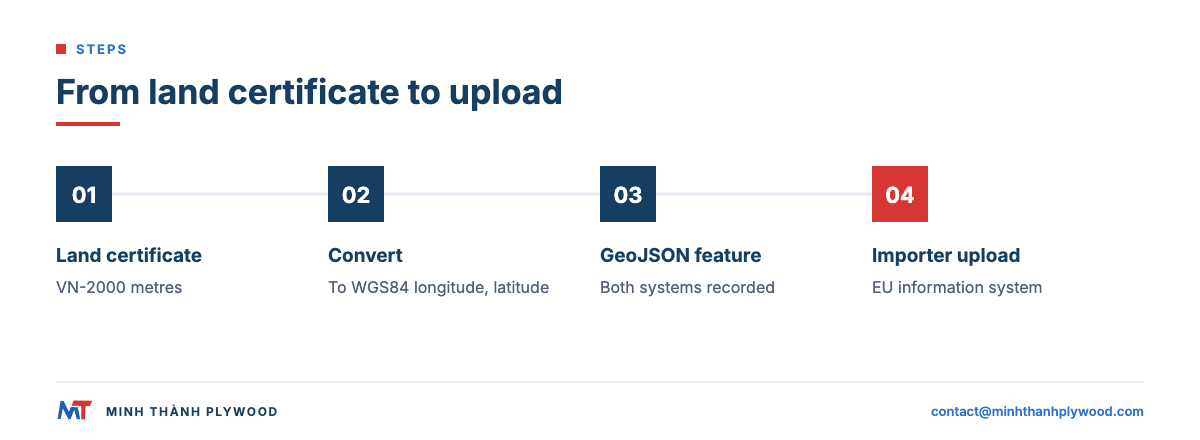
Vietnamese land certificates draw parcel boundaries in VN-2000, the national grid, as easting and northing in metres. The EU information system reads WGS84 longitude and latitude. A file that pastes VN-2000 metres into a GeoJSON puts the plot in the wrong place, sometimes in the sea.
We convert each vertex from the certificate’s VN-2000 zone to WGS84 and write both systems into the feature’s properties, so an auditor can repeat the step. Where a certificate gives only a longitude and latitude with no datum, the record says so instead of guessing. Ask your supplier which grid their source coordinates came from; a file that cannot answer has not been checked.
How the conversion is done
VN-2000 uses a transverse Mercator projection with local central meridians for each province, so the same metre values mean different places in different provinces. Our Lao Cai plots, for example, are in the zone with the central meridian at 104°45′, recorded as EPSG:9208 in the file. The conversion uses that definition and standard geodetic software to produce WGS84 longitude and latitude, and the record keeps the source zone so the step can be repeated. A supplier who cannot name the zone used for its coordinates has probably guessed it.
How does deforestation-free evidence work for a plantation plot?
The plot must not have been deforested after 31 December 2020, the cutoff date in Article 2 of the regulation. For a plantation that means showing what was on the polygon before and after that date.
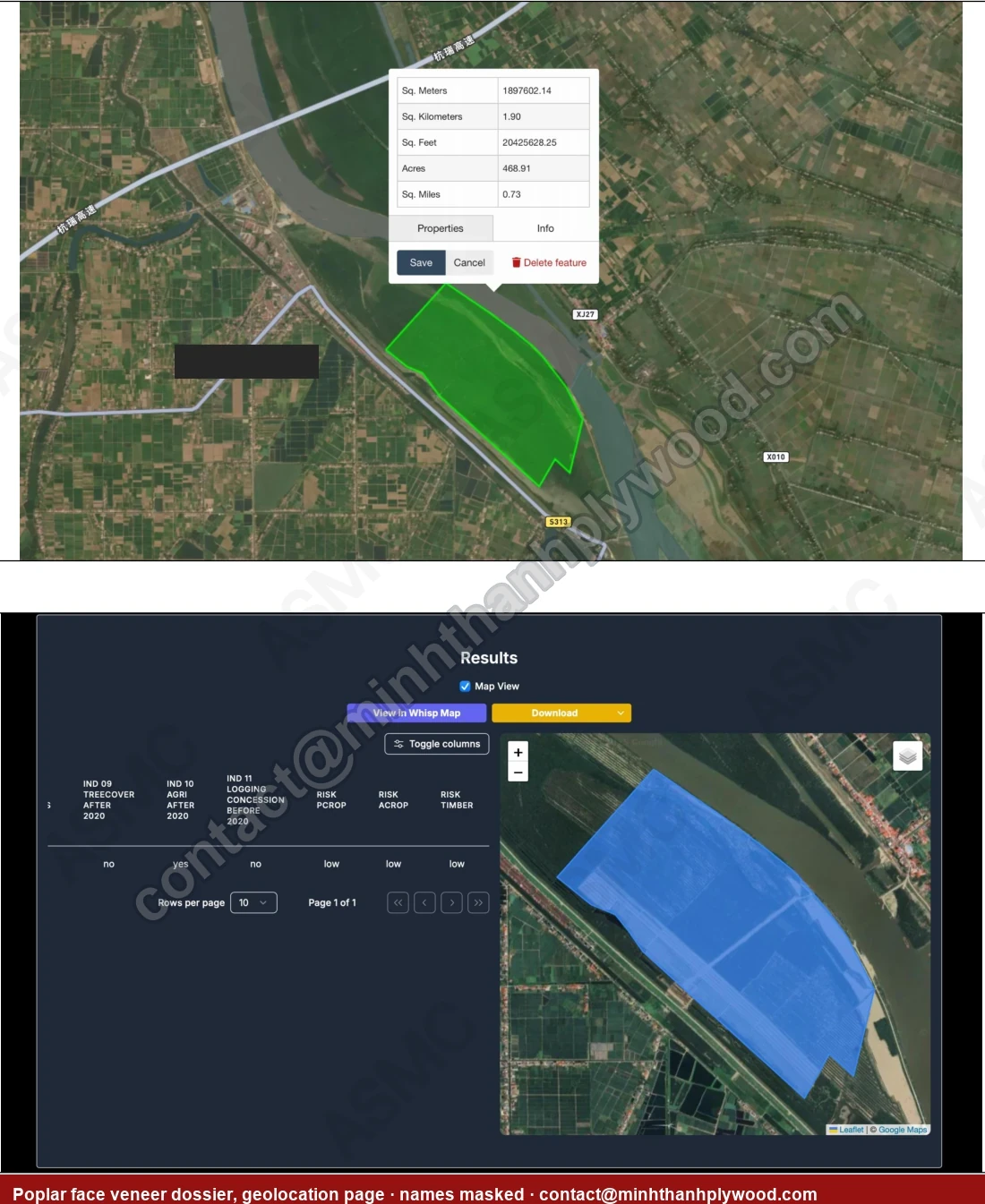
Our poplar face dossier does it with the same polygon laid over 10-metre land-cover maps for 2021 and 2025, and a Whisp risk screen of the polygon that rates it low risk for timber. For the Vietnamese core plots the land-use certificates record the land as plantation forest, and the purchase contracts tie the harvest to the certificate.
What land-cover maps show, and what they do not
Land-cover maps classify each 10-metre square of land as tree cover, cropland, built-up area and so on, from satellite imagery. Comparing a plot’s polygon on a map from before the cutoff with one from after shows whether the land changed class. They are strong evidence for a plantation that stayed a plantation. They cannot tell a natural forest from a plantation by themselves, and they can miss small clearings inside a large plot. That is why the evidence pairs the maps with the land-use and harvest records: the maps show the land did not change; the documents show what the land is.
Risk screens such as Whisp
Whisp, an open tool developed with the FAO, overlays a plot’s polygon on several public datasets on tree cover, land use and forest change, and returns indicators and a risk rating per commodity. It is a quick way for an importer to screen a supplier’s polygons. It is evidence, not a verdict: a rating supports the file, and the land-use and harvest documents still have to agree with it. Our poplar face record includes the screen’s result table, so an importer can rerun the same polygon and compare.
EUDR documents a plywood supplier sends: the dossier page by page
These are the EUDR documents a plywood supplier should send, in the order we send them: one stamped PDF plus the GeoJSON file. The PDF follows the panel from the outside in:
- Cover sheet: order number, product description per layer, quantity, countries of production, and the copy number issued to the buyer.
- Face veneer section: lot record, plantation polygon page with the land-cover evidence, harvest permit, forest ownership or management certificate, and an invoice for each hop of the chain.
- Core section: one record per grower plot with the plot point or polygon, the land-use certificate, the purchase contract for plantation timber and the harvest period.
- Production link: which face lots and core plots went into the order, and the quantity drawn from each.
- Packaging: the SGS PPWR report for the export pack.
The copy you receive is for your due diligence only: it carries a confidentiality notice, our email address and your copy number on every page. Personal data such as growers’ ID numbers never go on a website.
The PDF is laid out so that the importer can work through it in the same order as the statement: product, quantity, countries, plots, then the evidence. A reviewer who checks one plot can find its record, its source document and its place in the GeoJSON by the same SourceId.
What does Vietnam’s low-risk status change?
Less than many buyers hope. Vietnam, China and Uruguay are all on the low-risk list of Commission Implementing Regulation (EU) 2025/1093. Under Article 13, an operator whose products come only from low-risk countries may skip the risk assessment and risk mitigation of Articles 10 and 11 (Regulation (EU) 2023/1115, Article 13).
What does not change is Article 9. The operator still collects the species, quantity, country of production, geolocation of all plots, harvest period, supplier and legality information for every wood in the panel. Simplified due diligence is also conditional: the operator must have assessed the risk of mixing with products of unknown origin. A face veneer without its plot record is exactly that risk, and it takes the shipment out of the simplified route.
So low risk makes the paperwork lighter, not optional. The eight items in the table above are needed either way.
What “risk of mixing” means for a plywood mill
A plywood mill handles wood from many sources at once: core logs from dozens of growers, face veneer from several lots, sometimes for several customers in the same week. Mixing risk is the chance that wood without a record ends up in a panel that is declared as fully documented.
The defence is a production record that ties each order to the lots and plots it used. At Minh Thanh every lot bought for European orders already carries its forestry dossier with plot geolocation, face and core, so the production record only has to show which lots went into which order. Ask any supplier to show you that link for a past order.
Which documents prove legality for Vietnamese plantation timber?
For a Vietnamese core the legality evidence is a short, standard set:
- Land-use certificate. Issued to the household or company that holds the forest land, with the parcel number, map sheet, area and, on newer certificates, a boundary in the national grid.
- Purchase contract for plantation timber. Signed between the mill and the grower, with the parcel, the species, the area and the date. Ours follow Vietnam’s civil code and forestry rules, and payment is made by bank transfer.
- Harvest record. The grower’s harvest of planted forest, with the area and the period.
- Timber legality records. The records Vietnam’s timber legality system, VNTLAS, asks for when the timber moves and is processed (VNTLAS and Vietnamese timber legality).
The grower’s name, ID number and bank account are on these documents. They prove legality; they are not for publication. Copies go to buyers for due diligence only, under a confidentiality notice, and the originals stay with us for an authority that asks.
What a Vietnamese land-use certificate shows
The certificate, often called the red book, names the holder and lists each parcel by map sheet and parcel number, with its area in square metres, its land use and the term of use. Newer certificates add a small cadastral drawing with vertex coordinates in the VN-2000 grid; older ones give only an address and an area. In our core sample, one certificate records 5,153 m² for a plot the grower reported as 0.51 ha harvested, and the record keeps both figures and says which one it uses. That level of detail is what lets an auditor follow the number from the certificate to the file.
Chinese and Uruguayan face records
Face records come in the language of the country where the tree grew: harvest permits and forest ownership certificates in Chinese for our poplar face, forestry resolutions in Spanish and an FSC certificate in English for our eucalyptus face. Our poplar face dossier opens with English pages that set out the species, the harvest period, the chain and the geolocation, with the Chinese originals behind them, so the importer does not have to translate a permit to find the harvest dates.
Ask any supplier for the same: an English summary of the fields the statement needs, with the original documents attached rather than replaced. A translated summary without the originals cannot be checked; originals without a summary slow every review, and a slow review in the last weeks before a shipment is how gaps slip through to the statement.
Which documents differ by plywood type?
The eight items are the same for every panel; the layers behind them change with the product.
| Plywood type | Layers with their own records | What to watch |
|---|---|---|
| Furniture plywood, imported face | Face, back if different, core | The face veneer chain |
| Film-faced plywood | Veneer faces under the film, core | The film is not wood; the veneer under it is |
| Packing plywood | Low-grade faces, core | Mixed-origin faces from several lots |
| LVL | All veneers, usually one species | Many lots per beam; lot mapping |
| Thin plywood 3–6 mm | Face, cross-band, core | Two face sheets weigh much of the panel |
For packing plywood the paper trail is often the weakest, because low-grade faces come from many small lots. If you buy packing plywood for EU use, ask for the same lot mapping as for furniture panels.
Film-faced and LVL orders
Film-faced plywood for formwork usually has hardwood or eucalyptus veneers under a phenolic film. The film is paper and resin, not a relevant commodity, but the veneers under it are, so they need the same face records as an unfilmed panel. LVL is built from many veneers of one species, often from many lots; its dossier needs a lot map rather than a single face record, showing which lots fed which production run.
Thin plywood and cut-to-size panels
Thin panels of 3 to 6 mm use proportionally more face veneer: in a 3 mm five-ply panel the two faces are a large share of the wood. Their face records weigh more in the dossier, not less. Cut-to-size panels, where one sheet is cut into 4, 6 or 8 pieces, keep the records of the sheets they were cut from; the dossier should list the parent sheets’ specification and lots, and the packing list the cut sizes.
When is each document ready during an order?
A dossier is built with the order, not after it. On our orders the documents come in this sequence:
- Quotation. On request, a sample dossier from a recent lot, so you can check the format and run a test upload.
- Deposit. The face veneer lots and core supply for the order are allocated; any face without a documented lot is flagged now, before production.
- Production. The production record notes which face lots and core plots each run used and the quantity drawn.
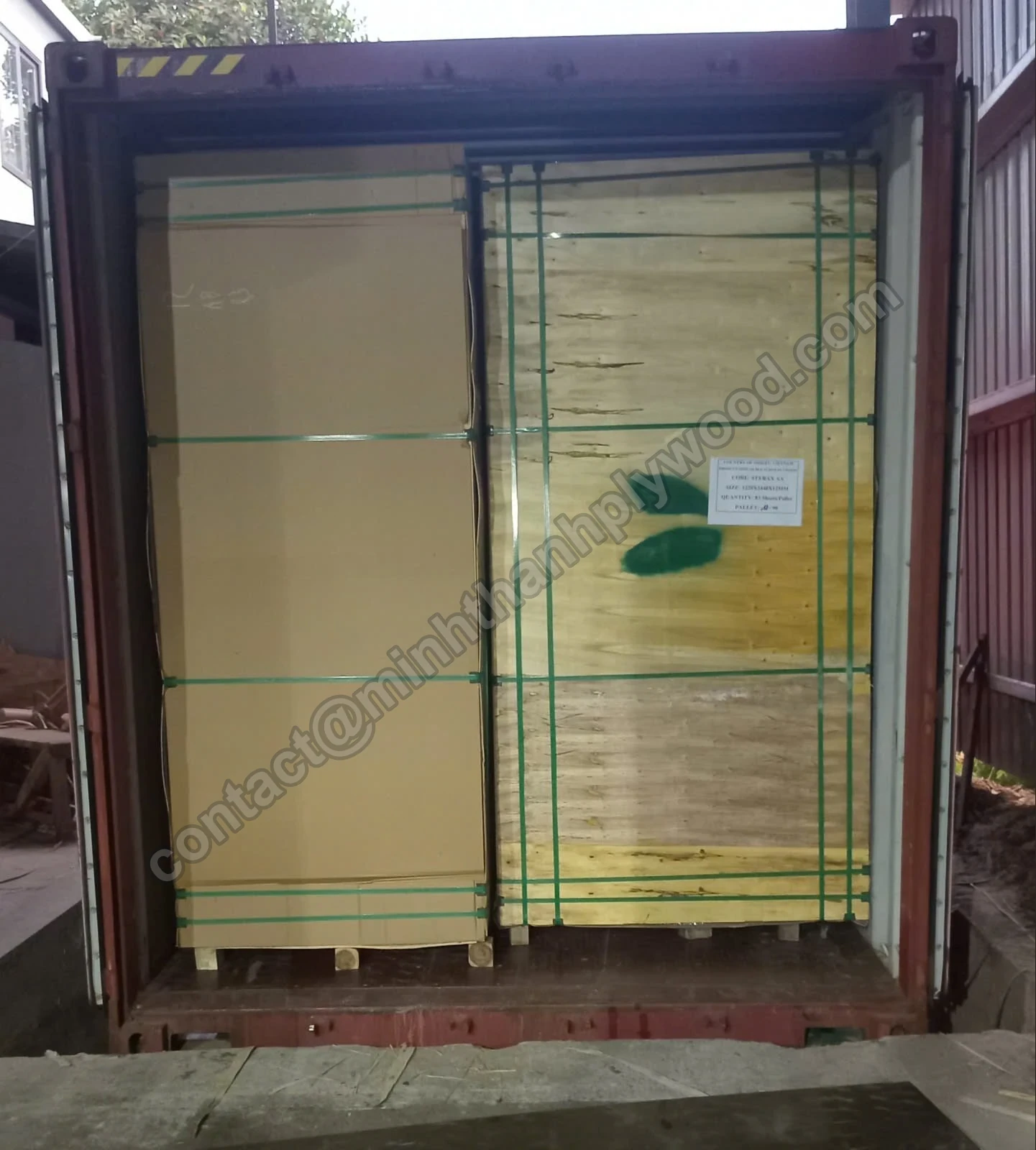
- Loading. Packing list with net mass and volume per specification; photos and video of the loaded container.
- Shipping documents. The stamped dossier PDF and the GeoJSON file go out with the invoice, packing list and bill of lading.
- At sea. The importer prepares and files the due diligence statement while the container travels, and has the reference number ready before arrival.
Orders start at one 40HC and production takes 15–45 days after the deposit, so the importer has the dossier weeks before the panels reach the port.
Ask for a sample dossier before the first order
Before a first order, ask the mill for a sample dossier from a recent lot and run it through your own process: open the GeoJSON, read the records, try a test entry in the information system. It costs a day and shows whether the format works for you, before a real container depends on it. We send a sample with the quotation when a buyer asks for one, with the same stamping and copy number as a real dossier.
What do you do when a document is missing or wrong?
Treat it as a blocker, not a formality, and settle it before the balance is paid. Three cases come up most often.
- A plot is missing. The dossier lists a core supplier or face lot without a geolocation. Ask for the plot or for a different lot; do not file with a gap.
- Quantities do not add up. The face lot is smaller than the face veneer the order needs. Ask which other documented lot covers the rest.
- A document is unreadable or in another language. Ask for a clean copy and an English summary of its key fields: holder, parcel, area, species, dates.
Our dossiers come in English, with the source documents attached in their original language behind each record. When a buyer finds a gap, we answer from the same email address the dossier came from, with the corrected page.
Settle gaps before the balance
Our payment terms are 30% deposit and 70% against the scanned bill of lading. The dossier reaches the buyer with the shipping documents, before the balance is due, so any gap can be raised while both sides still have something to settle. Use that window: read the dossier the day it arrives, not the day the container lands. Check the plots against the panels’ build, the quantities against the packing list and the face lots against the specification, and send any question to the same address the dossier came from.
How does one statement cover several containers?
The Commission’s due diligence guidance allows one statement to cover several shipments within the declared quantity and scope (Commission due diligence guidance). For a buyer taking several containers of the same specification, that saves work, but the evidence still has to cover every container.
Ask for a dossier per container and one combined GeoJSON for the statement, or a combined dossier with a container-by-container production link. Either way, the face lots and core plots listed must cover the total volume declared. When containers ship weeks apart, check that each later container’s lots are already in the file you filed, or file a new statement.
Who keeps which record, and for how long?
Records follow the role each company plays.
| Who | Keeps | For how long |
|---|---|---|
| EU importer (operator) | The statement, its reference number and the full Article 9 evidence | Five years from placing on the market |
| EU downstream operator or trader | Reference numbers of the statements covering what it bought | Five years |
| Plywood mill | The originals behind the dossier: lot records, land certificates, contracts, permits, invoices | Agree five years in the contract, to match the importer’s duty |
| Veneer and log suppliers | Their own custody records for the lots they sold | Under their own rules and certification |
An authority that audits the importer in year four asks for the same evidence the statement relied on. Keep the dossier version you filed with the statement, not a later one.
Mixed containers
A container with two or three specifications, for example 18 mm poplar-faced and 12 mm eucalyptus-faced panels, carries two product descriptions and possibly two HS subheadings. Each specification needs its own species, quantity and origin lines in the dossier, even though they share the same Styrax core plots. We prepare the dossier per specification inside one container file, so the importer can enter each product line in the statement without splitting the records again.
How do you check the dossier came from the mill?
Ask for it from the mill’s own company email address, never from a personal one. Brokers and some trading-company staff forward mills’ supply-chain documents as if they were their own; the documents may be real while the seller is not the mill.
Our dossiers come only from [email protected]. Each PDF is stamped with that address and a copy number issued to one buyer, and the GeoJSON is sent with it. We do not quote, take orders or ask for deposits from Gmail or any other personal address. If our documents reach you from anyone else, send the copy number to [email protected] and we will confirm whether it is ours.
What a copy number tells you
Every page of our dossier PDF carries our email address and a copy number issued to one buyer. The pages are flattened, so the marks cannot be lifted off in a PDF editor, and the file carries a notice that it is an internal company document that may not be copied without our written consent. If a broker sends you pages with a copy number that was issued to another company, you know where the copy came from. Send the number to [email protected] and we will tell you whether it is ours and who it was issued to, if you are entitled to know.
Reference numbers: how the statement follows the panels
When the importer files the statement, the information system returns a reference number. That number is how the statement travels: customs use it when the plywood is released for free circulation, and the importer passes it to the next company in the chain.
For a furniture maker or distributor inside the EU that buys the panels from the importer, the reference number is the proof that the plywood was covered. Ask your importer for it on every delivery and keep it with the batch. If the panels are cut into furniture parts and sold on, the reference numbers stay in your records for five years.
On our side, the order number on the dossier cover sheet matches the order number on the invoice and the pack labels, so the importer can link a pack in a warehouse to the statement it was filed under.
Linking a pack to the statement
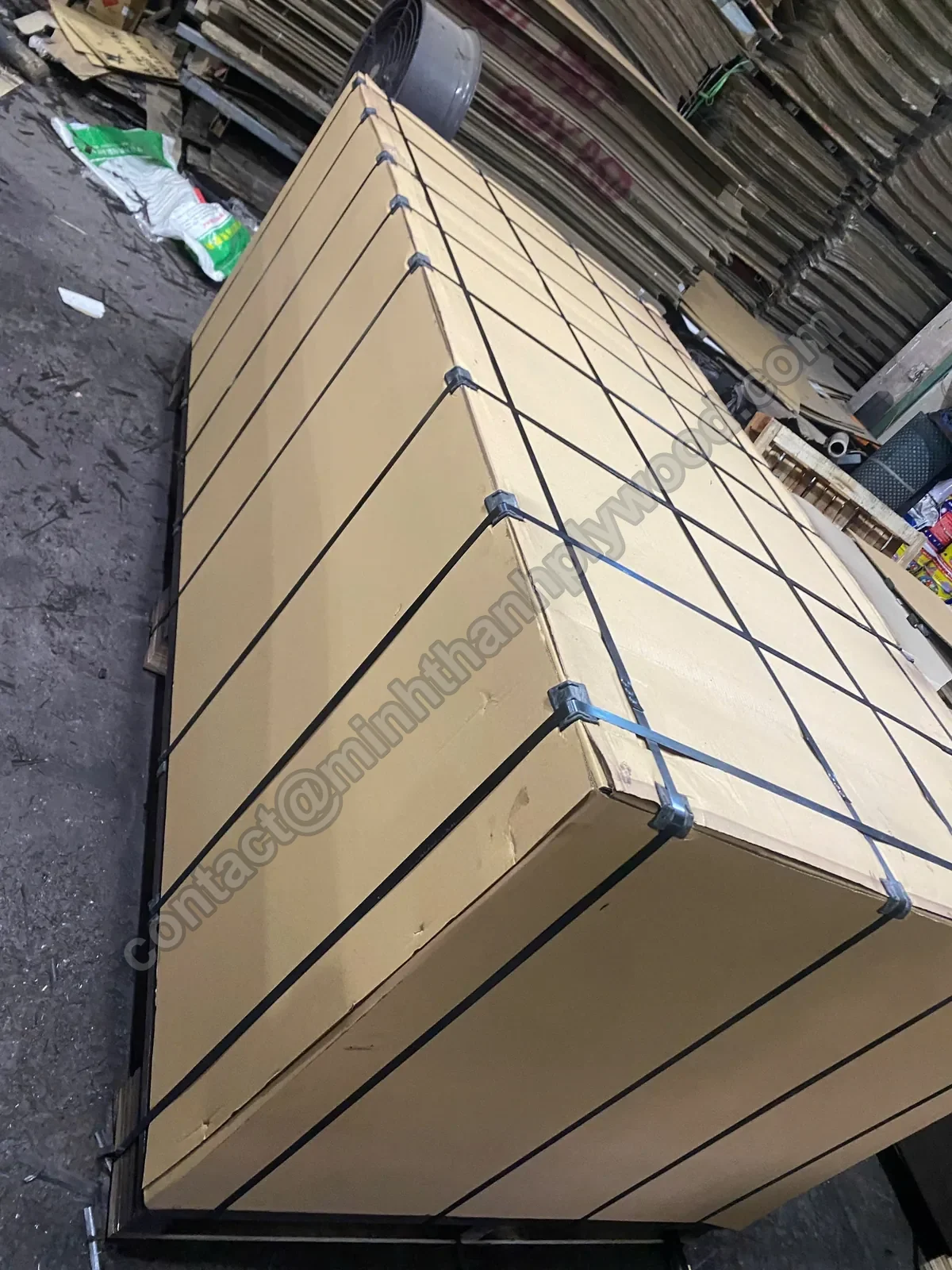
Every pack we ship carries a label with the packing date and lot, and the packing list ties those lots to the order and its dossier. A warehouse that receives several containers can therefore trace any single pack back to its container, its dossier and the statement reference. Keep the pack labels until the stock is used, or record the order number against the batch in your stock system. Then any pack in your warehouse can be traced back to its statement in one step.
What else should travel with an EUDR plywood shipment?
The EUDR dossier sits next to the usual shipping documents: commercial invoice, packing list, bill of lading, certificate of origin (EUR.1 for the EU), phytosanitary and fumigation certificates, and insurance with CIF. For the export pack, the EU Packaging Regulation adds a heavy-metal limit; SGS tested our four packing materials in September 2026 and found lead, cadmium, mercury and hexavalent chromium not detected (PPWR packaging test).
One statement can cover several shipments within the declared quantity and scope (Commission due diligence guidance). Keep the dossier with the statement’s reference number for five years.
UK and US orders
The UK Timber Regulations ask importers into Great Britain for legality due diligence, not plot geolocation, so the EUDR dossier more than covers a UK order. For the United States, the Lacey Act declaration asks for the species and country of harvest of each wood in the panel; on US orders we supply the face and core species and harvest origin for that declaration, and the panels carry the TSCA Title VI label.
How do you ask for the dossier with your order?
Put the request in the specification line, so the dossier is prepared with the production order, not after loading:
“15 mm eucalyptus A/B, Styrax core, UF E0, 1220 × 2440 mm, 1 × 40HC, EUDR dossier: species per layer, face and core GeoJSON in WGS84, harvest periods, legality records, issued to [company, EORI].”
Send it to [email protected]. Orders start at one 40HC, production takes 15–45 days after the deposit, and samples are free. The EUDR compliant plywood guide shows the whole dossier, face and core.
If you are not ready to order yet, ask for the sample dossier on its own. It shows the format, the stamping and the GeoJSON, and lets your compliance team test the file before any money changes hands.
Buyer questions, answered
Who submits the EUDR due diligence statement for plywood?
The operator, normally the EU importer that places the plywood on the market. A non-EU mill does not file it; it supplies the evidence.
What EUDR documents should I ask my plywood supplier for?
Species per layer, quantity, country of production, plot geolocation, harvest period, legality records, the custody chain and deforestation-free evidence, for the face veneer as well as the core.
What is in an EUDR geolocation file?
One feature per plot: a point or polygon in WGS84 longitude and latitude, with properties such as species, area, country and the source document.
Polygon or point for EUDR geolocation?
A single point is enough for plots up to four hectares; plots of more than four hectares need a polygon that describes the perimeter.
How many decimal places does EUDR geolocation need?
At least six decimal digits for latitude and longitude.
What file format does the EU information system accept?
GeoJSON is the usual exchange format; plots can also be entered on the map. Ask the mill for GeoJSON so you can upload it without retyping.
Can one statement cover several containers?
Yes, within the declared quantity and scope, according to the Commission's due diligence guidance.
How long must the documents be kept?
Five years from the date the plywood is placed on the market.
How do I know the documents really come from the mill?
Ask for them from the mill's own company email. Our dossiers come only from [email protected], as stamped PDFs with a copy number issued to you.
Do Vietnamese growers' coordinates need converting?
Often. Vietnamese land certificates use the VN-2000 grid; the coordinates must be converted to WGS84 longitude and latitude before upload.