
10mm ply is a seven-ply panel about one third lighter than 15 mm, used for cabinet backs, linings, partitions and drawer parts. Minh Thanh Plywood presses it on white Styrax or Eucalyptus cores to ±0.2–0.3 mm. A 1220 × 2440 mm sheet weighs 14.9–19.3 kg by core, and one 40HC carries 1,440–1,800 sheets. UK shelves stop at 9 and 12 mm, so 10 mm is a mill order.
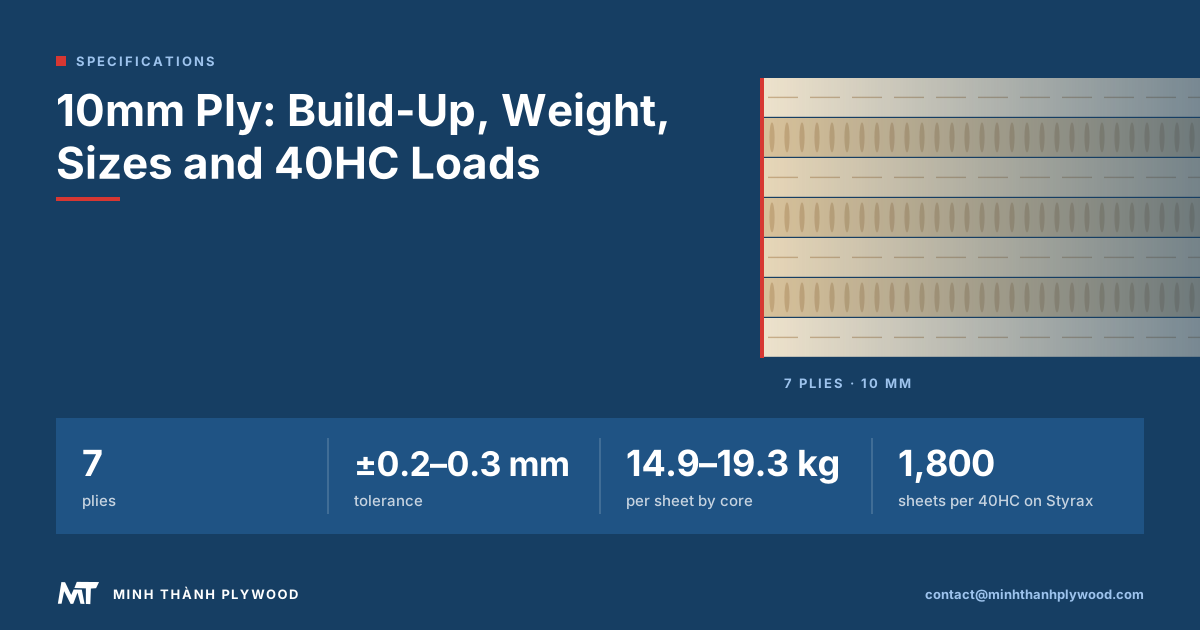
What is 10mm ply, and how thick is the sheet you receive?
10mm ply is plywood with a nominal thickness of 10 millimetres: thin wood veneers glued with the grain of each layer turned across the one below. In the UK and Australia it is sold as “10mm ply board” or “10mm ply wood”; in North America the nearest size is 3/8 inch, which is 9.5 mm.
The nominal figure is the target. The tolerance decides what you measure. A sanded 10 mm furniture panel from Minh Thanh Plywood is held to ±0.2–0.3 mm, so the thinnest sheet in a ±0.3 mm order is 9.7 mm and the thickest is 10.3 mm. Commercial and film-faced 10 mm panels are held to ±0.5 mm, packing plywood to ±0.5–1.0 mm.
Write the thickness and the tolerance as one line on the order: “10 mm ±0.3 mm”. Without the tolerance a supplier can deliver a commercial panel at 9.5 mm and still call it 10 mm.
Is 10mm ply sold in the UK, or do you buy 9 mm?
UK merchants stock 9 mm and 12 mm, not 10 mm: Wickes lists plywood at 5.5, 9, 12 and 18 mm, so a 10 mm panel is a mill-made size, not a shelf size. That makes 10 mm a deliberate choice for a drawing that needs it, and a container order from Vietnam the way to get it.
| Thickness | On a UK shelf? | Listed price, 2440 × 1220 mm | Mill route from Minh Thanh |
|---|---|---|---|
| 9 mm | Yes, non-structural hardwood | £24.55 at Wickes | Made on order |
| 10 mm | No | none | Standard order, 7-ply |
| 12 mm | Yes, non-structural hardwood £27.65, structural CE2+ softwood £32 | £27.65 to £32 at Wickes | Standard order |
A raw FOB Hai Phong example for one 1220 × 2440 × 10 mm sheet (0.0298 m³) is about US$10.4 at the furniture rate of US$350/m³ and about US$7.4 at the commercial rate of US$250/m³. It is not a delivered price: sea freight, UK import VAT and delivery are added, so compare container landed cost per sheet with the shelf price.
The labels a UK buyer filters on, and where a Minh Thanh 10 mm panel sits:
| UK label | What it means | Minh Thanh 10 mm |
|---|---|---|
| Non-structural hardwood | Furniture and interior panel, no load rating | The product: sanded hardwood-faced furniture panel |
| Structural (EN 636-2S, CE2+) | Load-rated panel with a CE mark under EN 13986 | Not this product |
| EN 636 use class 1, 2, 3 | Dry, humid, exterior service | Specify the declared panel class and the glue separately; an adhesive name alone does not establish the class |
| EN 314-2 bond class 1, 2, 3 | Glue-line test for those classes | Tested to the buyer’s method through SGS on request |
| E1 or E0 | Formaldehyde emission class | UF glue at E0 as standard; EN 717-1 testing arranged through SGS |
| BS 1088 marine | Marine-grade panel with named species and a boil-tested bond | A separate class; this 10 mm panel is not sold as marine |
For EU timber rules the mill supplies the EUDR compliance dossier with origin records and geolocation files. Wickes also lists half sheets of 606 × 1220 mm and Jewson lists handy panels of 1220 × 610 mm. Minh Thanh cuts 10 mm sheets to size before shipping, so a UK distributor can load handy panels directly (see the sheet sizes section below).
How is a 10 mm plywood panel built?
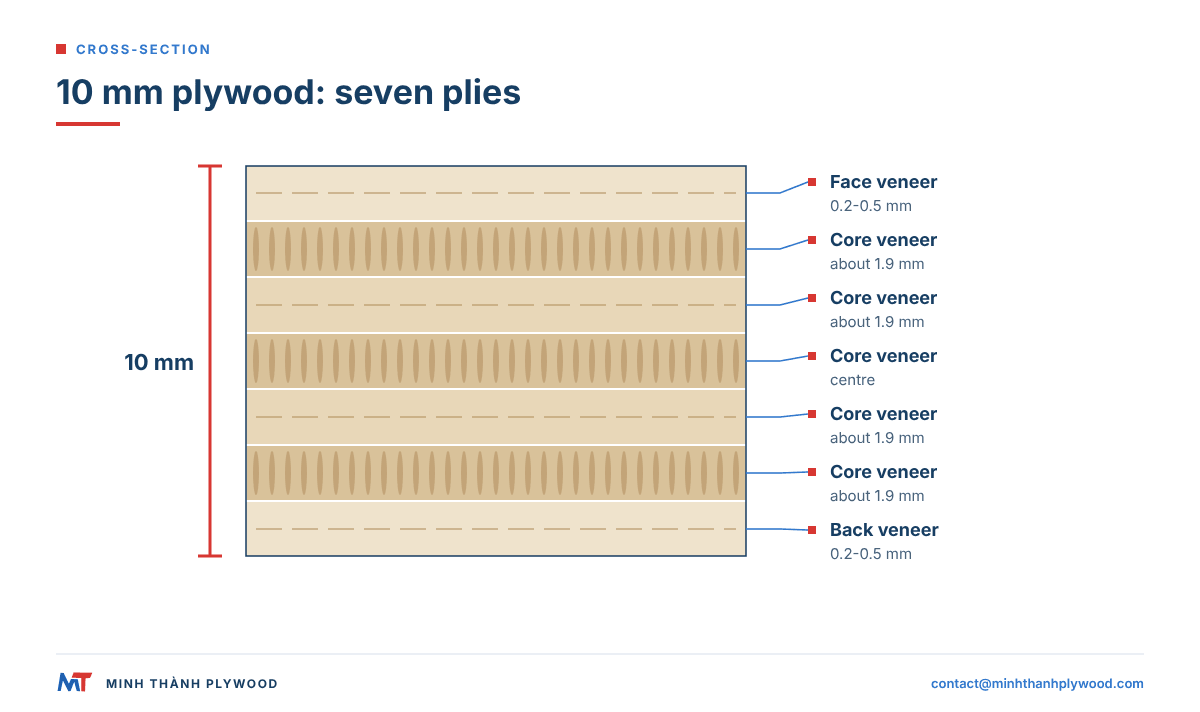
A 10 mm furniture panel is normally seven plies: one face veneer, five core veneers and one back veneer. Face veneers are 0.2–0.5 mm thick and core veneers 1.4–2.0 mm, so five core layers of about 1.9 mm plus two faces of about 0.3 mm make the 10 mm.
| Layer | Count | Thickness each | Grain |
|---|---|---|---|
| Face veneer | 1 | 0.2–0.5 mm | Along the sheet |
| Core veneers | 5 | about 1.9 mm | Alternating, cross and long |
| Back veneer | 1 | 0.2–0.5 mm | Along the sheet |
| Panel | 7 plies | 10 mm ±0.3 mm | Balanced about the centre |
The odd number of layers keeps the panel balanced: the layers on either side of the centre veneer pull against each other equally, so the sheet stays flat when the humidity changes.
Two steps set a furniture build apart from a commercial one. Core veneers are stitched horizontally and vertically before lay-up, so gaps do not open between core pieces and show through a lacquered face. Then the panel is pressed twice: the core board is pressed and calibrated to thickness first, and the face and back are pressed on after. Calibrating the core before the faces go on is what lets a 10 mm panel hold ±0.2 mm.
After pressing, both faces are sanded and polished and left UV-ready, so a buyer can apply a UV coating on their own line. Moisture content at dispatch is 8–12 %, the normal range for furniture plywood.
10 mm or 11 mm plywood: which should you order?
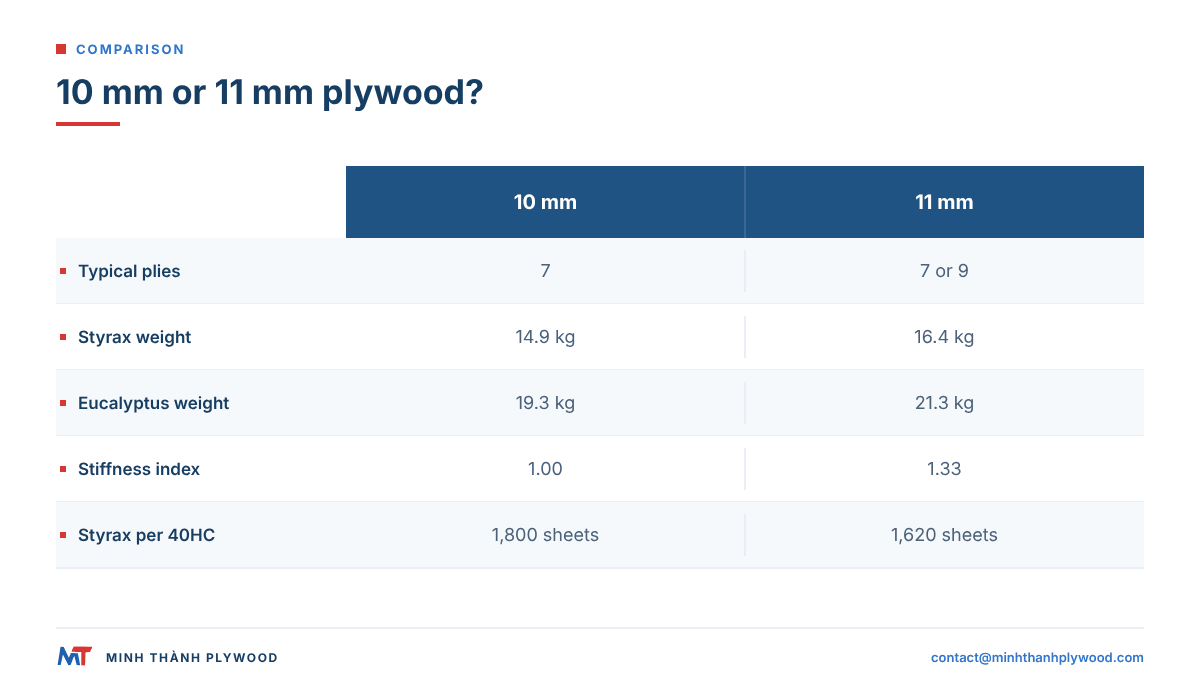
Order 10 mm when weight and cost per part matter and the part is light duty; order 11 mm when the drawing, the groove or a local sheathing practice asks for it. Plywood 11mm is common in UK construction lists and in some fit-out specifications, and Minh Thanh makes it on the same lines.
| 10 mm | 11 mm | |
|---|---|---|
| Typical build | 7 plies | 7 or 9 plies |
| Core veneers | 5 at about 1.9 mm | 5 at about 2.0 mm, or 7 at about 1.5 mm |
| Volume per 1220 × 2440 mm sheet | 0.0298 m³ | 0.0327 m³ |
| Weight on Styrax core | about 14.9 kg | about 16.4 kg |
| Weight on Eucalyptus core | about 19.3 kg | about 21.3 kg |
| Bending stiffness | 1.00 (reference) | about 1.33 |
| Sheets per 40HC on Styrax | 1,800 | 1,620 |
| Nearest imperial size | 3/8 inch (9.5 mm) | 7/16 inch (11.1 mm) |
Stiffness rises with the cube of thickness, so one extra millimetre buys about a third more resistance to bending for about 10% more weight. For a cabinet back fixed in a groove, that extra stiffness is wasted. For a lining screwed to battens at wider centres, or a shelf held on three sides, it is worth the weight.
Which core should you choose for 10mm ply board?
The core sets the weight, the colour of the edge and how well the panel holds a screw. Minh Thanh uses white Styrax and Eucalyptus cores as standard and makes Acacia and Pine cores on order.
| Core | Reference density | Edge colour | Best 10 mm use |
|---|---|---|---|
| Styrax | 500 kg/m³ | Pale, almost white | Backs, linings, van interiors, visible edges, most sheets per container |
| Acacia | 580 kg/m³ | Light brown | A middle choice for partitions and display units |
| Eucalyptus | 650 kg/m³ | Pink to light brown | Parts that take screws close to the edge, drawer parts, heavier wear |
European furniture buyers often choose Styrax for thin and mid-thickness panels because it is light and leaves a clean pale edge under clear lacquer. A 10 mm Styrax sheet is about 4.4 kg lighter than the same sheet on Eucalyptus, which adds up across a kitchen or a van fit-out.
How much does a sheet of 10 mm plywood weigh, per sheet and per m³?
A 1220 × 2440 × 10 mm sheet holds 0.0298 m³ of wood, so one cubic metre is about 33.6 sheets. Sheet weight is volume times core density:
| Size and thickness | Volume per sheet | Styrax 500 kg/m³ | Acacia 580 kg/m³ | Eucalyptus 650 kg/m³ |
|---|---|---|---|---|
| 1220 × 2440 × 10 mm | 0.0298 m³ | about 14.9 kg | about 17.3 kg | about 19.3 kg |
| 1250 × 2500 × 10 mm | 0.0313 m³ | about 15.6 kg | about 18.1 kg | about 20.3 kg |
| 1220 × 2440 × 11 mm | 0.0327 m³ | about 16.4 kg | about 19.0 kg | about 21.3 kg |
Per cubic metre the weight equals the density: about 500 kg on Styrax, 580 kg on Acacia and 650 kg on Eucalyptus. Eucalyptus panels can run up to 750 kg/m³ when the veneer comes from denser logs, so weigh one real sheet before you plan a payload close to its limit.
For handling, one person carries a 10 mm Styrax sheet comfortably. That matters for fit-out crews and van converters who move sheets by hand. Our plywood weight calculator gives the same figures for any size and thickness.
How many sheets of 10mm ply fit in a 40HC?
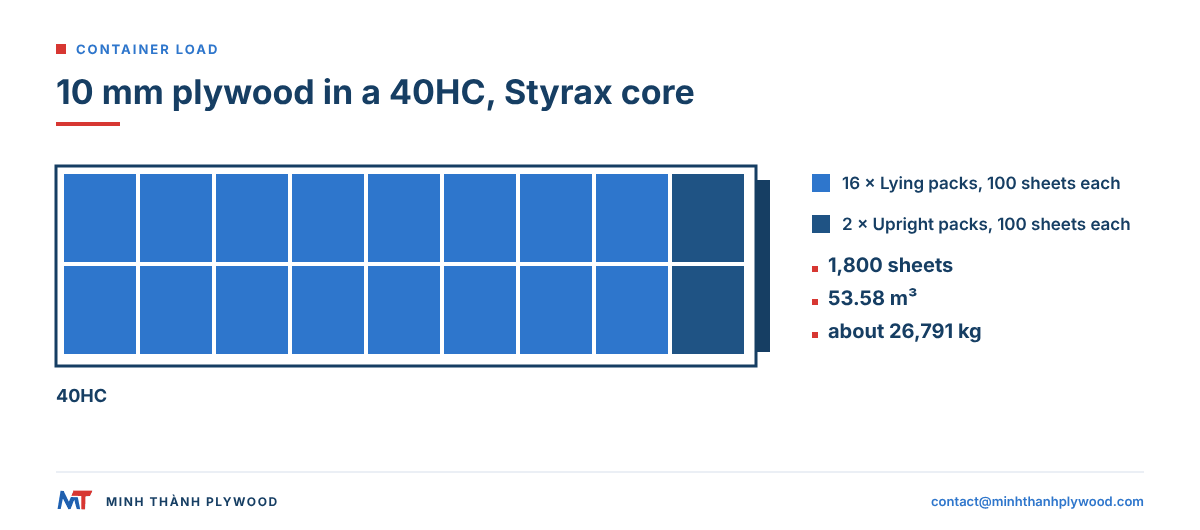
A 40HC of 1220 × 2440 mm sheets is loaded in packs about 1,000 mm high, which is 100 sheets of 10 mm per pack. The number of packs depends on the core: 18 packs on Styrax (16 lying and 2 upright), 16 on Acacia and 15 on Eucalyptus, within a planning payload of 28,000 kg.
| Thickness and core | Packs × sheets | Sheets per 40HC | Volume | Cargo weight |
|---|---|---|---|---|
| 10 mm Styrax | 18 × 100 | 1,800 | 53.58 m³ | about 26,791 kg |
| 10 mm Acacia | 16 × 100 | 1,600 | 47.63 m³ | about 27,625 kg |
| 10 mm Eucalyptus | 15 × 96 | 1,440 | 42.87 m³ | about 27,863 kg |
| 11 mm Styrax | 18 × 90 | 1,620 | 53.05 m³ | about 26,523 kg |
| 11 mm Acacia | 16 × 90 | 1,440 | 47.15 m³ | about 27,348 kg |
| 11 mm Eucalyptus | 15 × 87 | 1,305 | 42.73 m³ | about 27,776 kg |
On Eucalyptus the weight, not the space, sets the load: 15 packs of 100 would pass 28,000 kg, so each pack is cut to 96 sheets. If your booking allows less than 28,000 kg, give the figure with the order and the plan is recalculated. The container packing calculator runs the same arithmetic for other thicknesses and payloads.
Which sheet sizes is 10mm ply wood made in?
10mm plywood sheets are made as standard in 1220 × 2440 mm, the 8 × 4 ft sheet, and in 1250 × 2500 mm, which suits metric cutting plans in Europe. Custom sizes such as 1220 × 2500 and 1220 × 2280 mm are made on order.
Cut-to-size is a regular service: one panel cut into 4, 6 or 8 pieces, shipped regularly to Italy and other European markets. For a 10 mm back-panel programme it removes a saw step from your plant and the freight you would pay on offcuts. Length and width are held to ±2 mm on full sheets.
What tolerance should you put on a 10 mm order, and how do you check it?
Put the tolerance your process needs on the order, by product line:
- Sanded furniture panels: ±0.2–0.3 mm, down to ±0.2 mm for parts that slide into grooves or run through CNC nesting at fixed tool depths.
- Commercial and film-faced panels: ±0.5 mm.
- Packing plywood: ±0.5–1.0 mm.
- Length and width: ±2 mm.
A 10 mm back that slots into a 10 mm groove is the case where tolerance shows. At +0.3 mm the panel binds; at −0.3 mm it rattles. Order ±0.2 mm, or cut the groove to the measured stock.
To check a delivery, take five sheets from different packs and measure each with a digital caliper at four points 50 mm in from the edges. Record the readings against the order line. Every Minh Thanh shipment is photographed and filmed before loading and the buyer receives the files, so readings can be checked before the container leaves Hai Phong.
Which faces and grades are ordered in 10 mm?
The face is chosen for the look of the finished part; the grade describes face and back appearance as a pair. Minh Thanh makes 10+ face veneers. The most produced are engineered veneer (EV), poplar, birch, okoume and pine; bintangor, eucalyptus, gurjan and sapele are made on request.
| Face | Grade pairs | 10 mm example |
|---|---|---|
| Birch | D+/D, D/D, D/E | D+/D, close to B/BB, for a clear-lacquered wardrobe back seen from inside |
| Poplar | A/A, A/B, B/B | B/B under paint or laminate for linings |
| Pine | A/A, A/B, B/B (B/C for utility) | A/B for a visible van lining |
| Eucalyptus | A/A, A/B, B/B | B/B for partitions that get overlaid |
The approved sample fixes the appearance of the whole order. Birch faces are imported veneer laid on a Vietnamese core: the panel is birch-faced plywood, with Styrax or Eucalyptus inside.
Which glue and emission class for 10 mm?
Glue and emission class are two separate lines. For furniture and interior 10 mm panels the standard is UF glue at E0 emission. Melamine-fortified (MR) and phenolic (WBP) bonds are made to the buyer’s specification for kitchens, bathrooms, vehicle interiors and outdoor parts.
The emission evidence buyers in Europe and the US ask for:
- CARB P2 / TSCA Title VI certification for veneer-core hardwood plywood, ICTT mill no. 23024, covering 3–50 mm. The limits come from the California Air Resources Board composite wood products programme and the US EPA TSCA Title VI standard (both checked October 2026). The TSCA Title VI limit for veneer-core hardwood plywood is 0.05 ppm under EPA’s TSCA Title VI emission standards.
- Six ASTM D6007 chamber tests between April 2025 and June 2026 on 9, 15 and 18 mm panels averaged 0.014–0.032 ppm against the 0.05 ppm limit; three by Shanghai Hongjun and three by ICTT Vietnam.
- E0 tested every three months, and third-party testing to your method, for example EN 717-1, arranged through SGS on request.
What is 10 mm plywood used for, and when should you step up?
10 mm is the thickness for panels that need a real plywood edge and some screw-holding, without the weight of 12 or 15 mm:
- cabinet and wardrobe backs, fixed in grooves or rebates;
- drawer bottoms for wide or heavy drawers, where 6 mm would flex;
- wall and ceiling linings in shops, offices and exhibition stands;
- partitions and display units in retail fit-out;
- van, camper and boat interior linings, where every kilogram counts;
- signage backing and picture backs;
- crate sides and packaging panels on the packing line.
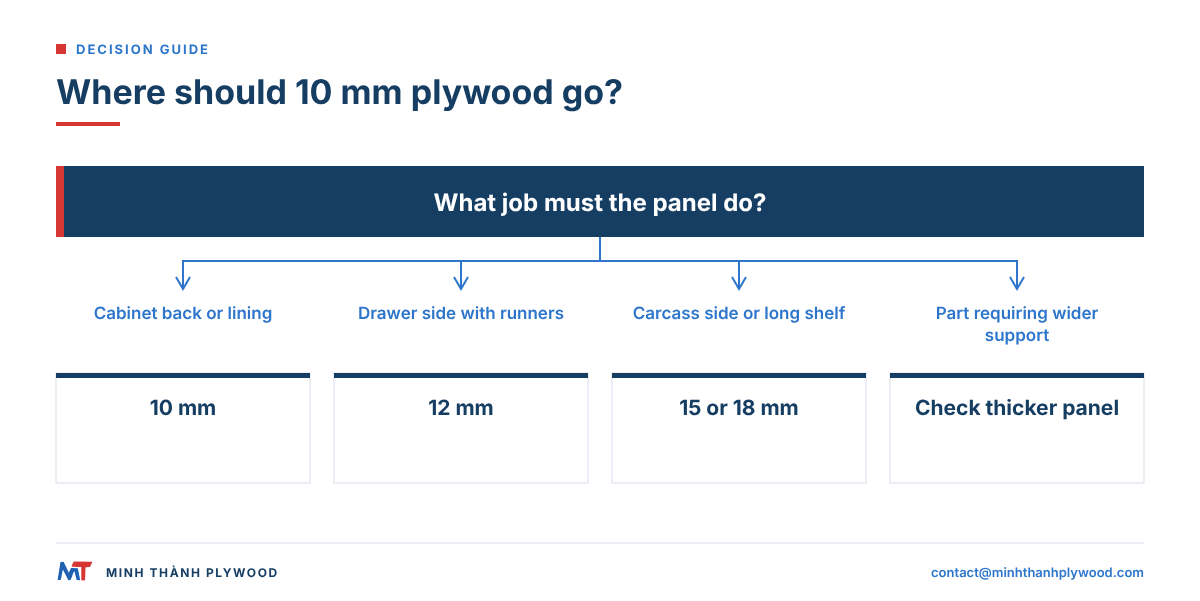
Step up when the part carries load across a span. Drawer sides that take runner screws are usually 12 mm; carcass sides, long shelves and tabletops 15 or 18 mm. A 12 mm panel is about 1.7 times stiffer than 10 mm, and an 18 mm panel about 5.8 times. The 12 mm plywood guide covers the next size up; the plywood thickness guide compares every thickness by use.
How does 10mm ply compare with 3/8 plywood and other nearby sizes?
10 mm sits between 9 mm and 12 mm in a metric range, and between 3/8 inch (9.5 mm) and 7/16 inch (11.1 mm) in an imperial one. Buyers who move between the two systems get caught on grooves and hardware, not on strength.
- 9 mm: the common European size below 10 mm; about 27% less stiff than 10 mm. Many buyers who ask for “10 plywood” mean the 9–10 mm class.
- 3/8 inch: 9.5 mm nominal. A 10 mm panel fits a 3/8 inch groove only if the groove was cut oversize.
- 11 mm: about one third stiffer than 10 mm; see the comparison above.
- 12 mm: the drawer-side and short-shelf thickness, about 1.7 times stiffer than 10 mm.
Minh Thanh makes any thickness from 3 to 40 mm, so if your machines are set for 9.5 mm, order 9.5 mm. Write it in millimetres with the tolerance. The 3/8 plywood guide covers the imperial sizes in detail.
How do you write a 10 mm line on a quotation request?
A quotation is only as exact as the line you send. A complete 10 mm line reads:
10 mm furniture plywood, poplar face B/B, Styrax core, UF glue at E0, CARB P2 / TSCA Title VI, sanded both sides UV-ready, 1220 × 2440 mm, ±0.3 mm, 8–12 % moisture, export packing, 1×40HC (about 1,800 sheets), FOB Hai Phong.
Each element moves the price: face and grade, core, glue and emission class, sanding, size, tolerance, packing, quantity and delivery term. Leave one out and two mills quote two different panels.
Indicative starting prices, October 2026: furniture and interior plywood from US$350/m³ and commercial plywood from US$250/m³. A 10 mm order is priced per cubic metre like any other thickness, and 33.6 sheets make one cubic metre.
What happens after you order 10 mm plywood from Vietnam?
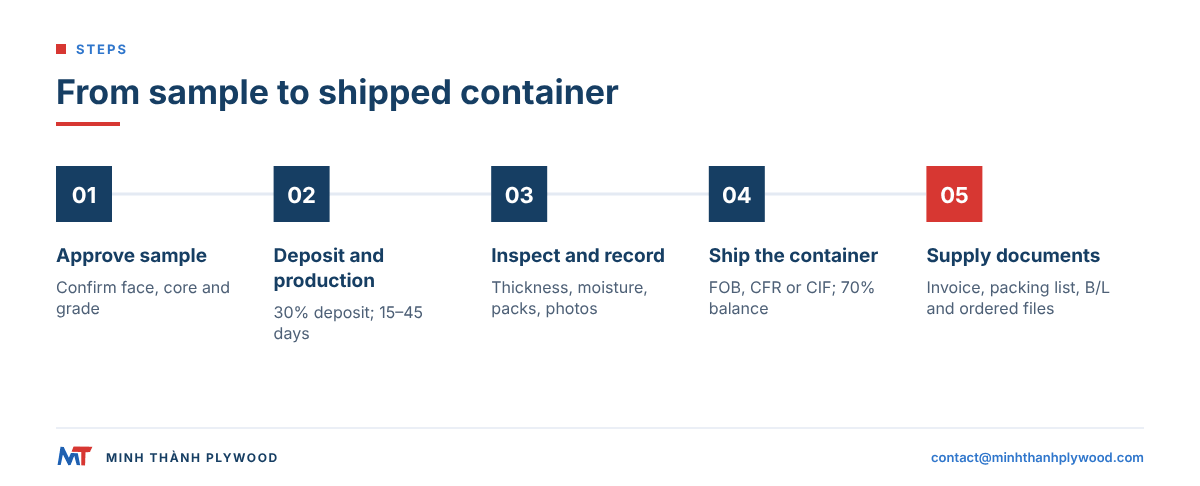
- Sample. Free samples of the face, core and grade you specify; the one you approve is the reference for the order.
- Deposit and production. 30% deposit; production takes 15–45 days.
- Inspection before loading. Thickness, size, face grade against the sample, moisture and pack count are checked; the shipment is photographed and filmed and the files go to you.
- Shipment. FOB Hai Phong, CFR or CIF. The 70% balance is paid against the scanned B/L, or by irrevocable L/C at sight.
- Documents. Commercial invoice, packing list, B/L, certificate of origin (EUR.1 for the EU), phytosanitary and fumigation certificates, insurance with CIF, and the CARB P2 / TSCA files, test reports and EUDR compliance dossier on order.
One 40HC is the minimum, and it can carry 10 mm with other specifications by agreement: usually one or two, three to six when volumes justify it. A 10 mm back-panel order can share a container with 18 mm carcass panels. Typical days at sea from Hai Phong are 25–35 to the Mediterranean, 30–40 to Northern Europe and 20–30 to the US West Coast.
Buyer questions, answered
How thick is 10mm ply really?
A sanded 10 mm furniture panel from Minh Thanh measures 9.7–10.3 mm at the outside of a ±0.3 mm tolerance, and ±0.2 mm can be ordered. Commercial and film-faced panels are held to ±0.5 mm.
How many plies does 10 mm plywood have?
Usually seven plies. Two face veneers of 0.2–0.5 mm and five core veneers of about 1.9 mm make up the 10 mm, with the grain turned at each layer.
How much does a sheet of 10mm ply weigh?
A 1220 × 2440 × 10 mm sheet holds 0.0298 m³ of wood, so it weighs about 14.9 kg on a Styrax core, 17.3 kg on Acacia and 19.3 kg on Eucalyptus at reference densities of 500, 580 and 650 kg/m³.
How many sheets of 10 mm plywood fit in a 40HC container?
About 1,800 sheets on a Styrax core (18 packs of 100), 1,600 on Acacia (16 packs of 100) and 1,440 on Eucalyptus (15 packs of 96, capped by weight), for 1220 × 2440 mm sheets.
Is 10 mm plywood the same as 3/8 inch?
No. 3/8 inch is 9.5 mm, so a 10 mm panel is half a millimetre thicker. Grooves cut for 3/8 inch panels need to be checked before you switch to metric 10 mm stock.
Should I order 10 mm or 11 mm plywood?
Order 10 mm for furniture backs, linings and drawer parts where weight counts; order 11 mm when a drawing, a groove or a sheathing rule calls for it. 11 mm is about one third stiffer and about 10% heavier.
What is 10mm ply board used for?
Cabinet and wardrobe backs, drawer bottoms on wide drawers, wall and ceiling linings, partitions, display units, van and camper interiors, signage backing and crate panels.
Which glue is used in 10 mm furniture plywood?
UF glue at E0 emission is the standard for furniture and interior panels. Melamine-fortified (MR) and phenolic (WBP) bonds are made to the buyer's specification for humid or outdoor parts.
What sizes does 10mm ply come in?
1220 × 2440 mm (8 × 4 ft) and 1250 × 2500 mm as standard, custom sizes such as 1220 × 2500 and 1220 × 2280 mm on order, and cut-to-size pieces from one panel cut into 4, 6 or 8.
What is the minimum order for 10 mm plywood from Vietnam?
One 40HC, which can carry 10 mm with other thicknesses by agreement. Production takes 15–45 days after the 30% deposit, and samples are free.