
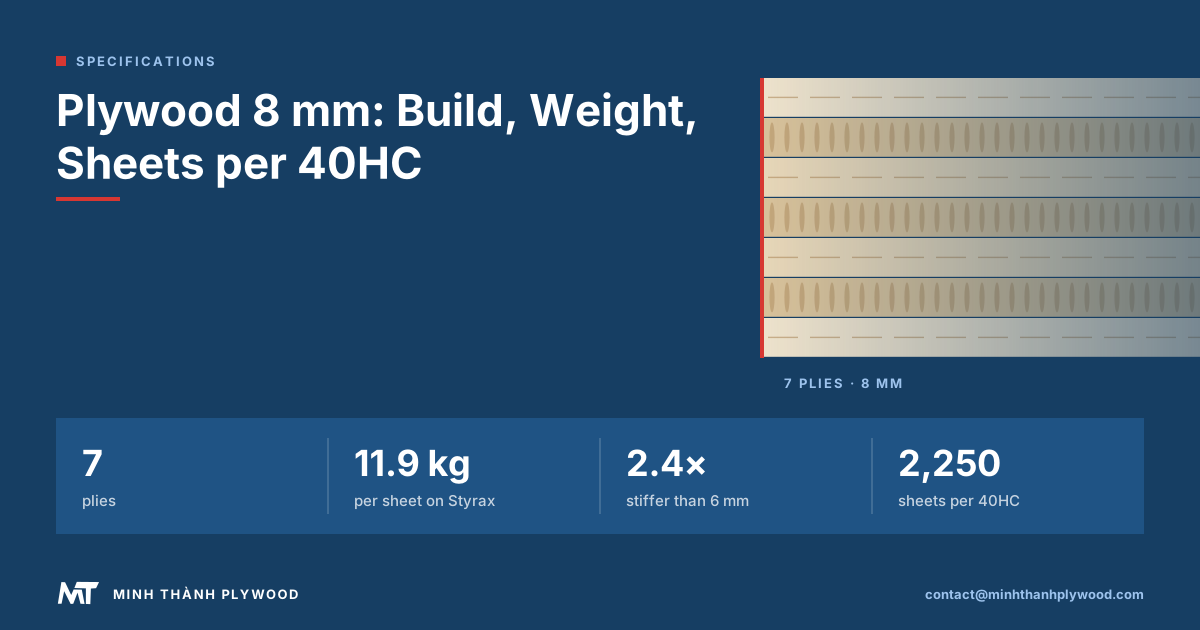
Plywood 8 mm is the lightest panel above the thin-panel range: seven plies, about 11.9 kg per 8 × 4 ft sheet on a Styrax core, stiff enough for cabinet backs, drawer bottoms and crate sides. Minh Thanh Plywood makes it as sanded furniture panels to ±0.2–0.3 mm and as packing plywood, and loads up to 2,250 sheets in one 40HC.
What is 8 mm plywood, and how close is it to 5/16 inch?
Plywood 8 mm is a cross-laminated panel with a nominal thickness of 8 millimetres, sold mainly as 1220 × 2440 mm (8 × 4 ft) sheets. The nearest imperial size is 5/16 inch, which is 7.94 mm, so for practical purposes the two are the same panel.
What you measure depends on the tolerance on the order. A sanded 8 mm furniture panel from Minh Thanh Plywood is held to ±0.2–0.3 mm: between 7.7 and 8.3 mm at worst, and closer on most sheets. Packing plywood in 8 mm is held to ±0.5–1.0 mm, which is fine for a crate and wrong for a groove.
8 mm sits just above the thin range. Panels from 3 to 5 mm are always 5-ply at Minh Thanh; from 8 mm the build changes, and that changes how the panel behaves.
What do 8 mm sheets cost, and which class and size do you order?
A raw FOB Hai Phong example for one 1220 × 2440 × 8 mm sheet (0.0238 m³) is about US$8.3 at the furniture rate of US$350/m³ and about US$6.0 at the commercial rate of US$250/m³. It is not a delivered price. A UK shelf price covers a different thing, because UK merchants stock 8 mm mainly as flexible (bendy) ply at about £31 to £33 ex VAT a sheet at Sheet Materials Wholesale, a different build described in flexible plywood. Wickes lists plywood at 5.5, 9, 12 and 18 mm and no 8 mm.
| Order line | Choice | Notes |
|---|---|---|
| Sheet size | 1220 × 2440 mm, or 1250 × 2500 mm | 1250 × 2500 mm suits metric cutting plans: 0.0250 m³ per sheet, about US$8.8 or US$6.3 at the two rates |
| Glue and EN 636 class | Specify UF, melamine-fortified or phenolic resin separately from the required dry, humid or exterior service class | The panel must meet the requirements of EN 636; resin type alone does not establish the class. Bond testing to EN 314-2 is arranged through SGS on request |
| Emission | E0 as standard with UF glue; CARB P2 / TSCA Title VI | EN 717-1 testing through SGS on request |
| Face | Birch, poplar, pine and others | Grade pairs quoted against an approved sample |
| Core | Styrax or Eucalyptus, stitched, pressed twice | 7-ply build at 8 mm |
| Documents | EUDR compliance dossier with orders | Origin records and geolocation files |
In the UK, B&Q and Wickes category pages list birch BB/BB, BS 1088 marine and CE2+ structural softwood; a 7-ply 8 mm furniture panel is none of those. It is the interior hardwood-faced panel for cabinet backs, drawer bottoms and crate sides, and it ships in full packs to a distributor who cuts it.
How is an 8 mm plywood panel built?
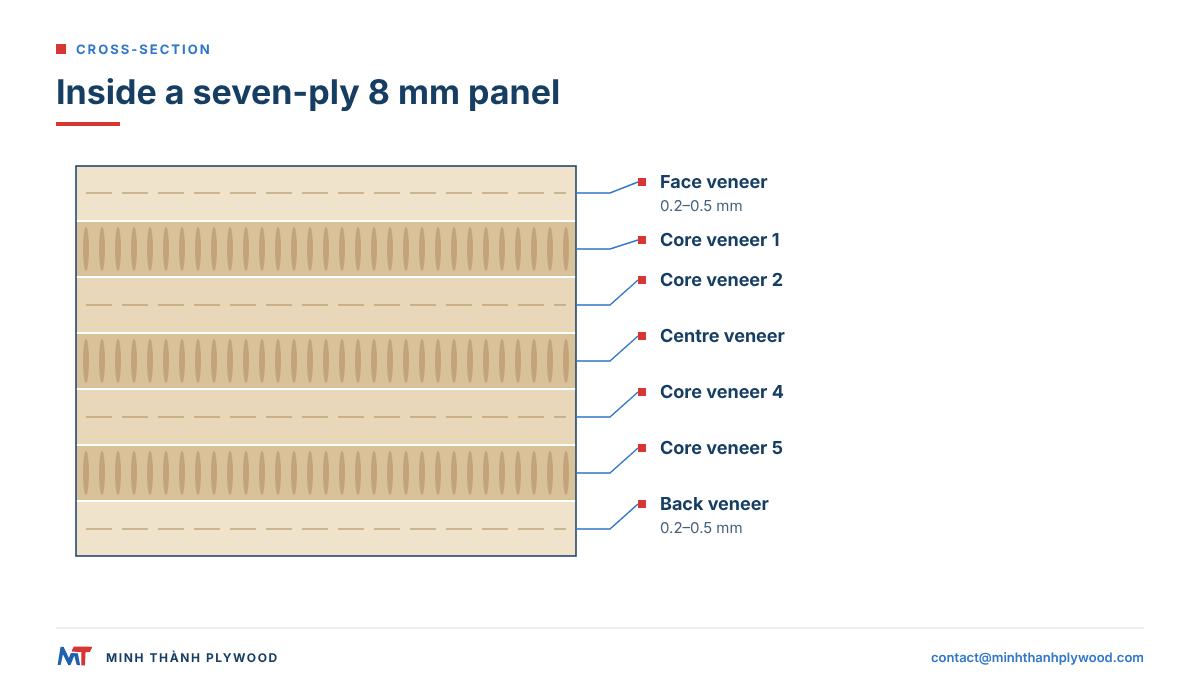
An 8 mm panel is normally seven plies: a face veneer, five core veneers and a back veneer. Face veneers are 0.2–0.5 mm thick and core veneers 1.4–2.0 mm, so five core layers of about 1.5 mm and two faces of about 0.3 mm make the 8 mm.
| Layer | Count | Thickness each | Grain |
|---|---|---|---|
| Face veneer | 1 | 0.2–0.5 mm | Along the sheet |
| Core veneers | 5 | about 1.5 mm | Alternating, cross and long |
| Back veneer | 1 | 0.2–0.5 mm | Along the sheet |
| Panel | 7 plies | 8 mm ±0.3 mm | Balanced about the centre |
Seven plies in 8 mm means thinner core veneers than a 5-ply build would need, and more glue lines. The result is a flatter, more stable panel that holds its shape when one face is lacquered and the other is not, which is the usual case for a cabinet back.
On furniture panels the core veneers are stitched horizontally and vertically before lay-up, so gaps between core pieces cannot open and print through the face. The core board is pressed and calibrated first, then the face and back are pressed on. This double pressing is what lets an 8 mm panel hold ±0.2 mm.
8 mm, 6 mm or 9 mm: which thickness fits the part?
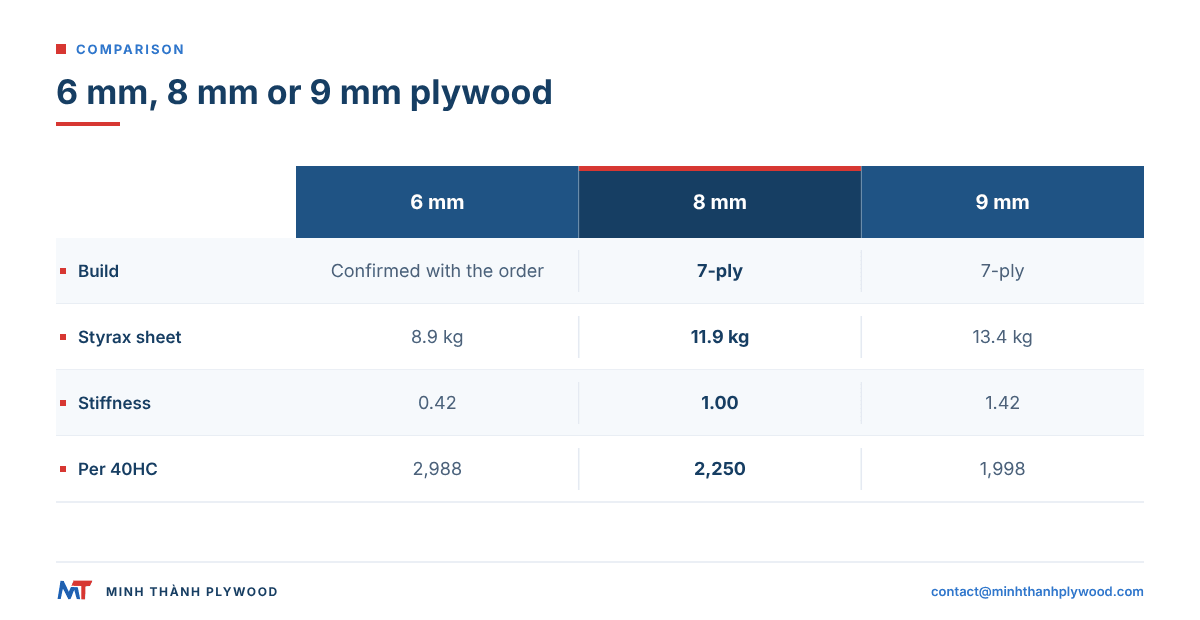
Choose 8 mm when 6 mm flexes and 9 mm is heavier than the part needs. Stiffness rises with the cube of thickness, so small steps make large differences:
| 6 mm | 8 mm | 9 mm | |
|---|---|---|---|
| Build | Confirmed with the order | 7-ply | 7-ply |
| Weight per 1220 × 2440 mm sheet, Styrax core | about 8.9 kg | about 11.9 kg | about 13.4 kg |
| Bending stiffness, 8 mm = 1.00 | about 0.42 | 1.00 | about 1.42 |
| Sheets per 40HC, Styrax core | 2,988 | 2,250 | 1,998 |
| Typical part | Backs in grooves, small drawer bottoms | Wide drawer bottoms, screwed backs, crate sides | Linings on battens, partitions |
The practical rule: a 6 mm back captured in a groove on four sides is enough. A back screwed on across a wide wardrobe, a drawer bottom wider than a normal kitchen drawer, or a crate side that takes a forklift knock wants 8 mm. Above that, the 10 mm and 11 mm plywood guide picks up.
Which product lines are made in 8 mm?
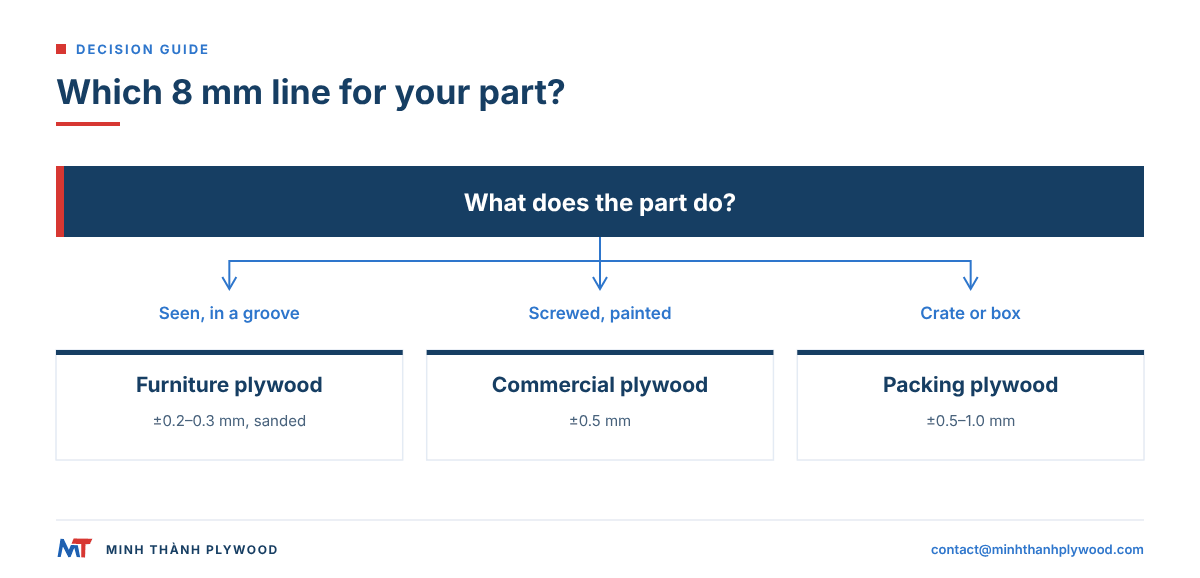
The thickness is the same; the panel is not. Minh Thanh makes 8 mm in three lines, and the line decides the core, the sanding and the tolerance:
| Line | Face | Core and build | Tolerance | Typical buyer |
|---|---|---|---|---|
| Furniture and interior | Birch, poplar, pine, EV, okoume and others, sanded both sides | Grade A Styrax or Eucalyptus core, stitched, pressed twice, UF glue at E0 | ±0.2–0.3 mm | Furniture, kitchen and wardrobe factories |
| Commercial | Utility poplar or eucalyptus | Grade AB core, laid loose or jointed, light or no sanding | ±0.5 mm | Distributors, fit-out, joinery |
| Packing | Utility faces, appearance not graded | Grade AB core laid loose, cost-led | ±0.5–1.0 mm | Crate, box and pallet makers |
The factory is built for the first line, top-grade furniture and interior plywood with Europe as its main market. Commercial and packing 8 mm panels are made on the same presses when a buyer needs them, and they can share a container with furniture stock. The packing plywood page covers that line in full.
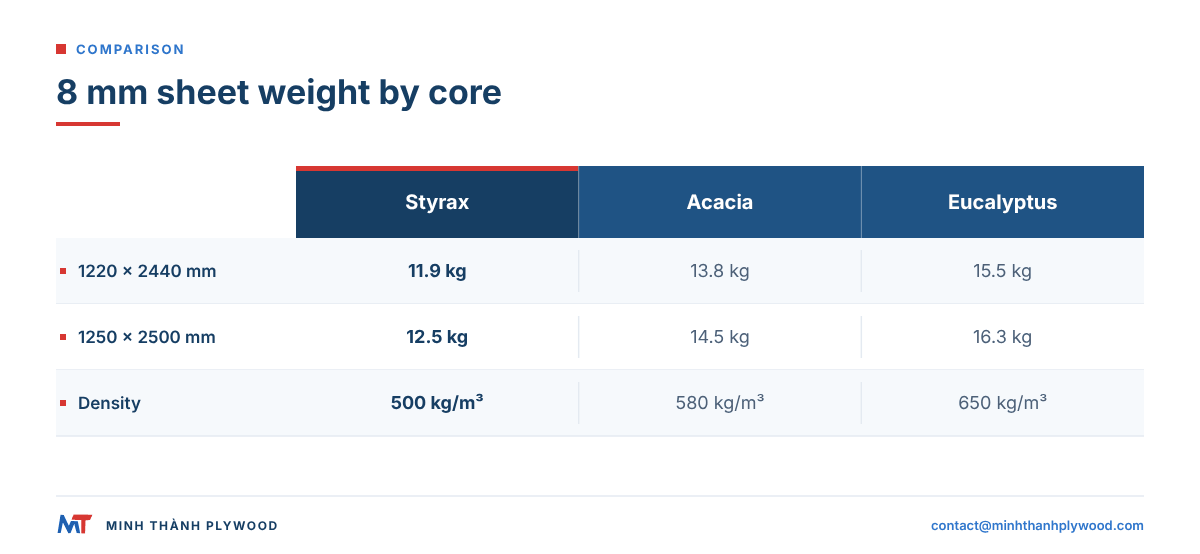
How much does a sheet of plywood 8 mm weigh?
A 1220 × 2440 × 8 mm sheet holds 0.0238 m³ of wood, so one cubic metre is about 42 sheets. Multiply the volume by the core density:
| Size | Volume per sheet | Styrax 500 kg/m³ | Acacia 580 kg/m³ | Eucalyptus 650 kg/m³ |
|---|---|---|---|---|
| 1220 × 2440 × 8 mm | 0.0238 m³ | about 11.9 kg | about 13.8 kg | about 15.5 kg |
| 1250 × 2500 × 8 mm | 0.0250 m³ | about 12.5 kg | about 14.5 kg | about 16.3 kg |
These are planning values. Real Eucalyptus panels can reach 750 kg/m³ when the veneer comes from denser logs, so weigh a real sheet before you plan a payload close to the limit. For packing buyers the weight also sets freight per crate: an 8 mm crate side on Styrax is about 3.6 kg lighter per full sheet than the same side on Eucalyptus.
How many 8 mm sheets fit in a 40HC container?
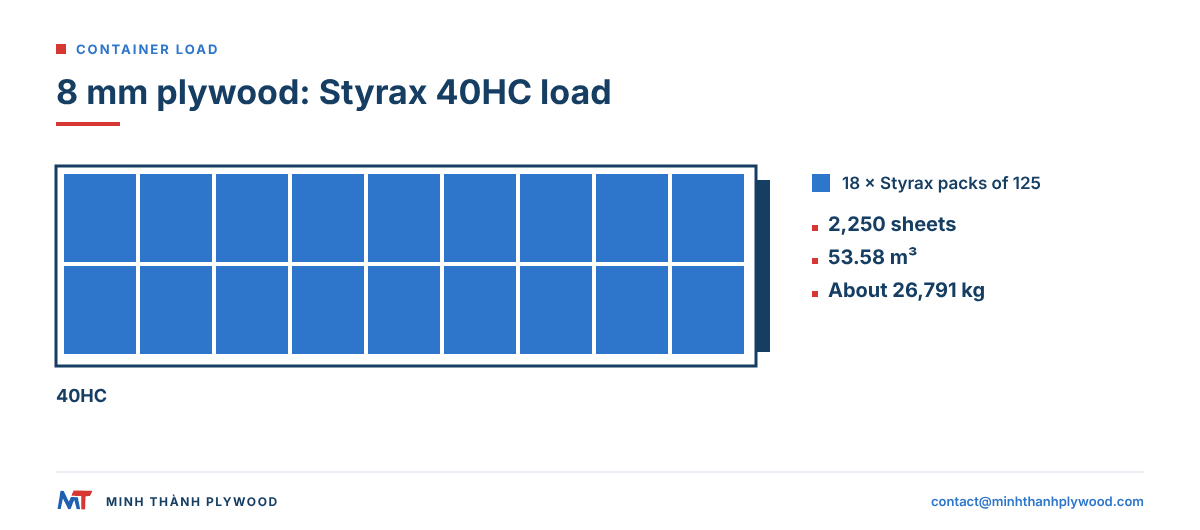
A 40HC of 1220 × 2440 mm sheets is loaded in packs about 1,000 mm high, which is 125 sheets of 8 mm per pack. The pack count depends on the core: 18 on Styrax (16 lying and 2 upright), 16 on Acacia and 15 on Eucalyptus, within a planning payload of 28,000 kg.
| Core | Packs × sheets | Sheets per 40HC | Volume | Cargo weight |
|---|---|---|---|---|
| Styrax | 18 × 125 | 2,250 | 53.58 m³ | about 26,791 kg |
| Acacia | 16 × 125 | 2,000 | 47.63 m³ | about 27,625 kg |
| Eucalyptus | 15 × 120 | 1,800 | 42.87 m³ | about 27,863 kg |
On Eucalyptus the weight sets the load: 15 packs of 125 would pass 28,000 kg, so each pack is cut to 120 sheets. If your booking allows less than 28,000 kg, give the figure with the order and the plan is recalculated. You can run other sizes and payloads in the container packing calculator.
Which sizes does 8mm plywood come in?
8mm plywood 8x4, 1220 × 2440 mm, is the standard sheet. 1250 × 2500 mm is the second standard size and suits European cutting plans. Custom sizes such as 1220 × 2500 and 1220 × 2280 mm are made on order. Length and width are held to ±2 mm.
Cut-to-size is a regular service: one panel cut into 4, 6 or 8 pieces, shipped regularly to Italy and other European markets. A drawer-bottom or back-panel programme in 8 mm suits cut-to-size well, because the parts are many, the same and easy to stack.
What tolerance do you need on 8 mm, and how do you check it?
Match the tolerance to the job of the part:
- Backs and bottoms in grooves: sanded furniture panel, ±0.2–0.3 mm, or ±0.2 mm when the groove is cut to the nominal 8 mm.
- Screwed-on backs and linings: ±0.5 mm is enough; commercial and film-faced panels are held to that.
- Crate and box sides: packing plywood at ±0.5–1.0 mm.
- Length and width: ±2 mm on all lines.
An 8 mm bottom in an 8 mm groove binds at +0.3 mm and rattles at −0.3 mm. Ask for ±0.2 mm, or measure the stock and set the groove cutter to it.
To check a shipment, take five sheets from different packs and measure each with a digital caliper at four points, 50 mm in from the edges. Every Minh Thanh shipment is photographed and filmed before loading and the files go to the buyer, so the readings can be seen before the container leaves Hai Phong.
Where does 8mm ply board work best?
8mm ply board earns its place where a part must stay flat and take a few screws, but carries no load across a span:
- Cabinet and wardrobe backs. Screwed or nailed into a rebate, 8 mm squares up a carcass better than 6 mm and still weighs little.
- Drawer bottoms. About 2.4 times stiffer than 6 mm, for wide kitchen drawers, file drawers and drawers that carry pans.
- Door and panel skins. Faced 8 mm panels over a frame for flush doors and wall panels.
- Display and shopfitting backs. Slatwall backs, poster boards and sign backing.
- Van and caravan linings. Light enough to fix overhead, firm enough to take trim screws.
- Crates, boxes and pallet tops. In packing plywood, 8 mm crate sides carry machinery parts and furniture in export.
Step up when the part spans and carries load. Shelves, drawer sides with runner screws and carcass sides need 12, 15 or 18 mm. The plywood thickness guide maps every thickness to its parts.
Why use 8 mm plywood for crates and packing?
8 mm packing plywood gives a crate side that is light, nail-friendly and hard to puncture, at a cost-led build. The core is laid loose without stitching and the faces are utility grade, because the panel protects the product inside and is not seen.
Plywood is a processed wood product, so a crate built entirely from plywood does not need ISPM 15 heat treatment or the mark. The ISPM 15 standard of the International Plant Protection Convention (checked October 2026) excludes wood packaging made wholly of processed wood such as plywood. Solid wood battens, skids or bearers on the same crate still need treatment and the stamp.
For a crate maker the numbers that matter are sheets per container and weight per crate. At 2,250 sheets per 40HC on Styrax, an 8 mm packing order delivers about 42 sheets per cubic metre of freight.
Which faces, glue and emission class for 8 mm?
For furniture 8 mm, the face is chosen for the look and the grade is quoted as a face/back pair, fixed by the approved sample:
- Birch: D+/D (close to B/BB), D/D (close to BB/BB) or D/E. Birch is imported veneer on a Vietnamese core, so the panel is birch-faced plywood.
- Poplar, pine and eucalyptus: A/A, A/B or B/B; pine also B/C for utility parts.
- Engineered veneer and okoume: to the buyer’s sample.
Glue and emission class are separate lines. Furniture and interior 8 mm panels use UF glue at E0 emission; melamine-fortified (MR) and phenolic (WBP) bonds are made to order for humid or outdoor use. Minh Thanh holds CARB P2 / TSCA Title VI certification (ICTT mill no. 23024, 3–50 mm), and six ASTM D6007 chamber tests between April 2025 and June 2026 on 9, 15 and 18 mm panels averaged 0.014–0.032 ppm against the 0.05 ppm limit. That limit for hardwood plywood with a veneer core is set by 40 CFR 770.10 (the US TSCA Title VI rule).
The bonding-quality requirements for plywood are in EN 314-2, which is the standard to name when a buyer needs a bond class on the order. Third-party testing to EN 717-1 or another method is arranged through SGS on request.
Why does moisture content matter for a thin back panel?
Moisture content decides whether an 8 mm back stays flat after it leaves the factory. Veneers and finished panels at Minh Thanh are dried to 8–12 % moisture content at dispatch, the normal range for furniture plywood.
A thin panel reacts faster to the air around it than a thick one. A back that arrives too wet dries in a heated European workshop and shrinks in its groove; one that arrives too dry takes up moisture and bows. Dried to 8–12 % and balanced with seven plies, an 8 mm panel moves little between the container and the finished cabinet. Store packs flat, off the floor and wrapped until they are cut.
How do you write an 8 mm line on a quotation request?
A complete line names every element that changes the panel or the price:
8 mm furniture plywood, poplar face B/B, Styrax core, UF glue at E0, CARB P2 / TSCA Title VI, sanded both sides UV-ready, 1220 × 2440 mm, ±0.3 mm, 8–12 % moisture, export packing, 1×40HC (about 2,250 sheets), FOB Hai Phong.
For packing plywood, the line is shorter: “8 mm packing plywood, utility faces, 1220 × 2440 mm, ±0.5–1.0 mm, 1×40HC”. Indicative starting prices, October 2026: commercial plywood from US$250/m³ and furniture and interior plywood from US$350/m³.
One 40HC is the minimum. It can carry 8 mm with other specifications by agreement, usually one or two and three to six when volumes justify it. Production takes 15–45 days after the 30% deposit; the 70% balance is paid against the scanned B/L or by irrevocable L/C at sight, FOB Hai Phong, CFR or CIF. Samples are free. Send the line and the reply comes within hours, Monday to Friday, Vietnam time.
Buyer questions, answered
How thick is 8 mm plywood really?
A sanded 8 mm furniture panel from Minh Thanh measures 7.7–8.3 mm at the outside of a ±0.3 mm tolerance, and ±0.2 mm can be ordered. Packing plywood is held to ±0.5–1.0 mm.
How many plies does 8 mm plywood have?
Usually seven. Two face veneers of 0.2–0.5 mm and five core veneers of about 1.5 mm make up the 8 mm, each layer turned across the one below.
How much does an 8 mm plywood sheet weigh?
A 1220 × 2440 × 8 mm sheet holds 0.0238 m³ of wood, so it weighs about 11.9 kg on a Styrax core, 13.8 kg on Acacia and 15.5 kg on Eucalyptus at reference densities of 500, 580 and 650 kg/m³.
How many sheets of 8 mm plywood fit in a 40HC?
About 2,250 sheets on a Styrax core (18 packs of 125), 2,000 on Acacia (16 packs of 125) and 1,800 on Eucalyptus (15 packs of 120, capped by weight), for 1220 × 2440 mm sheets.
Is 8 mm plywood the same as 5/16 inch plywood?
Almost. 5/16 inch is 7.94 mm, so an 8 mm panel is 0.06 mm thicker, well inside any sanded tolerance. The two are interchangeable in most grooves and fixings.
Is 8mm plywood 8x4 a standard size?
Yes. 1220 × 2440 mm is the 8 × 4 ft sheet and is the standard size for 8 mm, beside 1250 × 2500 mm for metric cutting plans. Custom sizes and cut-to-size pieces are made on order.
What is 8 mm plywood used for?
Cabinet and wardrobe backs, drawer bottoms, door and panel skins, display backs, signage, linings, and crate and box sides in packing plywood.
Is 8 mm plywood strong enough for a drawer bottom?
Yes for most drawers. An 8 mm bottom is about 2.4 times stiffer than a 6 mm one, so it suits wide kitchen drawers and drawers that carry pans or files.
Do plywood crates made from 8 mm plywood need ISPM 15 treatment?
No. ISPM 15 exempts packaging made entirely of processed wood such as plywood. Solid wood bearers or battens on the same crate still need treatment and the mark.
What is the minimum order for 8 mm plywood?
One 40HC, which can carry 8 mm with other thicknesses by agreement. Production takes 15–45 days after the 30% deposit, and samples are free.