
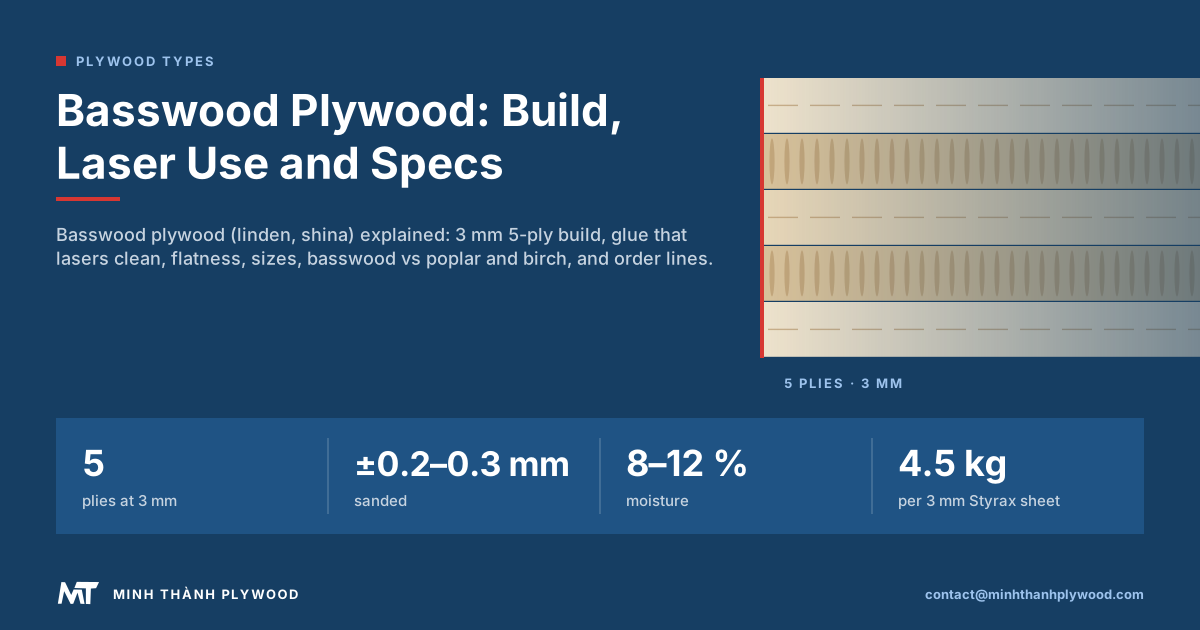
Basswood plywood is plywood faced with basswood veneer, the pale, fine-grained wood also sold as linden, lime or shina. Thin 3 mm sheets are the favourite of laser cutters and model makers. This guide covers the build, the glue and flatness that decide a clean cut, sizes, and how basswood compares with poplar laser ply. Minh Thanh Plywood makes thin 3 mm 5-ply panels.
What is basswood plywood?
Basswood plywood is a plywood panel whose face veneers are basswood (genus Tilia), a pale cream, soft and very even-grained hardwood. The core may be basswood or another light species, and the veneers are cross-laid and glued like any plywood.
It is sold mostly as thin sheets of 3–6 mm for laser cutting and engraving, architectural and railway models, craft kits, signs and puzzles. In those uses buyers want three things: a pale, uniform face that engraves evenly, a sheet that stays flat on the laser bed, and a build that cuts through cleanly in one pass.
Basswood plywood is a specialist face. The same results are reached with other pale, light faces, poplar in particular, when the build is right. This guide covers both.
Basswood plywood sheet sizes, packs and price
Basswood plywood is sold mostly in 1/8 in (3 mm) and 1/4 in (6 mm), with 4 mm also common, as hobby blanks in packs of 4 to 48 or as full 4 × 8 ft (1220 × 2440 mm) sheets from a mill. US retail packs cost about US$3 per 12 × 12 in blank, against a raw mill price of about US$1 per square metre of 3 mm furniture plywood.
| Format | Size in inches | Size in mm | Pack counts seen at retail |
|---|---|---|---|
| Hobby blank | 12 × 12 in | 305 × 305 mm | 12, 18, 24, 36, 48 |
| Hobby blank | 11.8 × 11.8 in | 300 × 300 mm | 6, 18, 30 |
| Hobby blank | 12 × 18 in | 305 × 457 mm | 10 |
| Hobby blank | 12 × 24 in | 305 × 610 mm | 10 |
| Hobby blank | 11.8 × 23.6 in | 300 × 600 mm | 6, 18, 30 |
| Full sheet | 4 × 8 ft | 1220 × 2440 mm | Cartons from the mill |
Thickness tolerance on retail laser sheets is 3 ± 0.2 mm at Bambu Lab, and 1/8 ± 1/50 in at xTool, which also lists CO2, blue-light and UV lasers as supported. Pack counts come from Home Depot’s basswood listings, checked 21 October 2026.
| Price basis | Example | Per 12 × 12 in blank | Per m2 |
|---|---|---|---|
| US retail pack | 48 blanks of 12 × 12 × 1/8 in at US$154.77 (Home Depot) | About US$3.22 | About US$34.71 |
| Mill container, raw FOB example | Furniture plywood from US$350/m³, 3 mm thick | About US$0.10 | About US$1.05 |
The mill row is a raw FOB example from our October 2026 indicative starting price, 350 × 0.003, not a quote for basswood-faced sheets, and it excludes cutting, packing and freight; a distributor who cuts full sheets into blanks keeps the difference. Each 4 × 8 ft sheet yields 32 blanks of 12 × 12 in.
On glue, retailers such as Bambu Lab print E0 as 0.5 mg/L or less by the desiccator method; E0 thresholds differ by test method and market. Our furniture panels use UF glue at E0 and are CARB P2 / TSCA Title VI certified.
Is basswood the same as plywood?
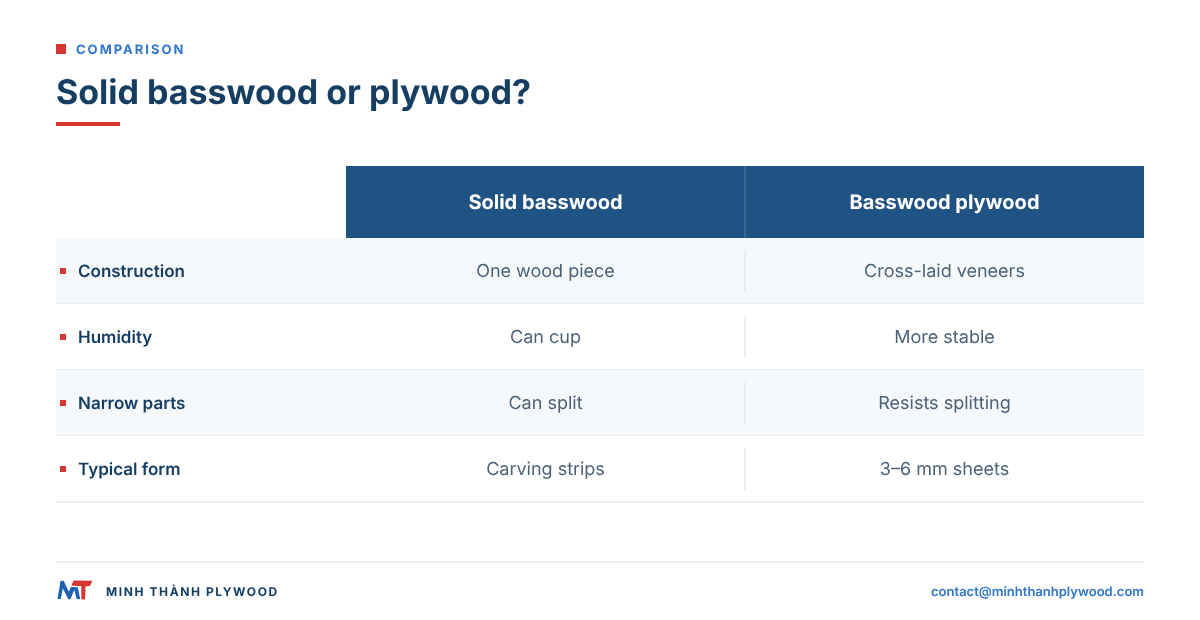
Basswood is not the same as plywood. Basswood is a wood species; plywood is a panel made of thin veneers glued with the grain of each layer at right angles to the next. Basswood plywood is the combination: a plywood panel that uses basswood veneers.
The difference matters when you buy:
| Solid basswood sheet | Basswood plywood | |
|---|---|---|
| Structure | One piece of wood, grain in one direction | 3, 5 or more cross-laid veneers |
| Stability | Moves and cups with humidity across the grain | Stable in both directions |
| Strength | Splits easily along the grain when thin | Resists splitting; strong in both directions |
| Widths | Limited by the log; narrow boards | Full sheets such as 1220 × 2440 mm |
| Typical thickness | Thin strips and sheets for carving and models | 3–6 mm laser and craft sheets |
For flat laser parts, plywood wins: a 3 mm solid basswood sheet can split along the grain at a narrow bridge, where a 5-ply sheet holds.
Basswood, linden, lime and shina plywood: one wood, many names
Basswood, linden, lime and shina are names for the same genus, Tilia. Plywood sold under any of these names has the same face species; the name follows the market.
| Name | Where it is used | Species most often meant |
|---|---|---|
| Basswood | North America | American basswood, Tilia americana |
| Linden | Continental Europe, international trade | European and Asian Tilia species |
| Lime, limewood | United Kingdom | European lime, Tilia × europaea and relatives |
| Shina | Japan | Japanese linden, Tilia japonica; “shina plywood” is a common Japanese interior and craft panel |
| Tilia | Botanical name | The whole genus |
Shina plywood in Japan often has shina faces over a core of another species. When a buyer asks for “shina”, “linden ply” or “basswood ply sheets”, the order should still say the face species, the core species and the ply count, so the panel is clear.
Properties: how basswood compares with poplar and birch faces
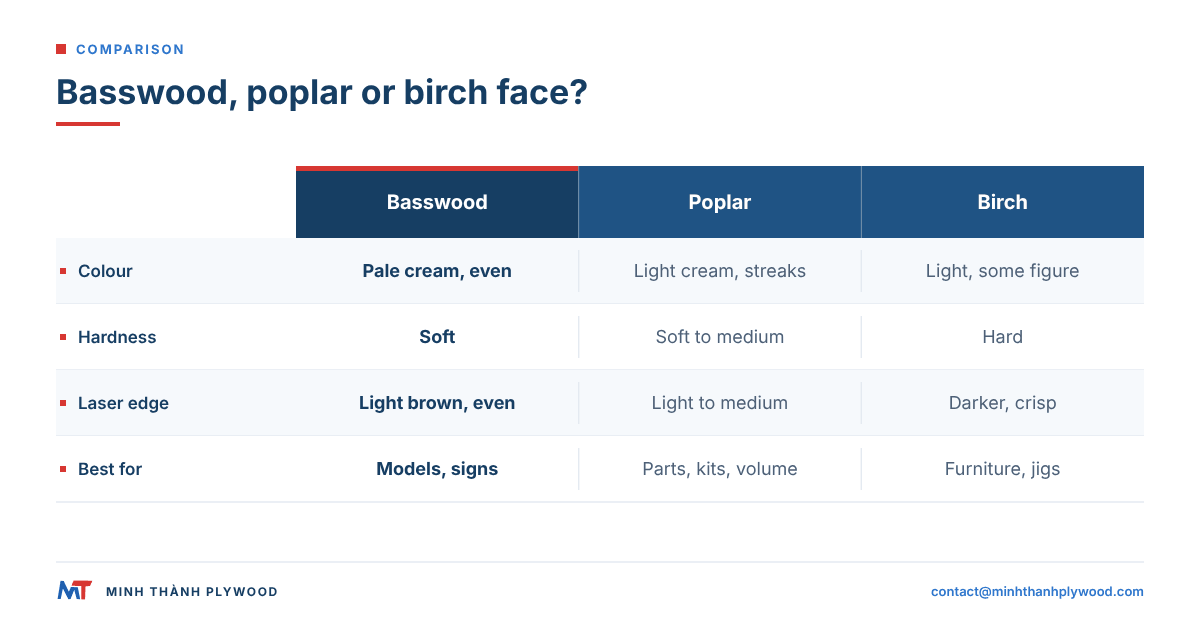
Basswood is softer, paler and more uniform than birch, and paler and slightly softer than poplar. Those three faces cover most thin plywood for lasers, models and crafts.
| Property | Basswood face | Poplar face | Birch face |
|---|---|---|---|
| Colour | Pale cream, very even | Light cream to grey-green streaks | Light yellow-white, some figure |
| Grain | Very fine, almost invisible | Fine, straight | Fine, with visible figure |
| Hardness | Soft | Soft to medium | Hard |
| Laser cut edge | Light brown, even | Light to medium brown | Medium brown, crisper |
| Engraving contrast | High and even | Good, streaks can show | Good, figure can show |
| Carving and sanding | Very easy | Easy | Harder |
| Typical uses | Models, signs, decorative laser work | Laser parts, crafts, toys, furniture backs | Furniture, jigs, load-bearing parts |
Is basswood the same as balsa?
No. Balsa is a much lighter, very soft tropical wood used mainly for model aircraft. Basswood is firmer, holds fine detail and sharp corners, and does not crush under a clamp; it is the usual choice for model buildings, kits and laser-cut parts.
How is 3 mm basswood plywood built?
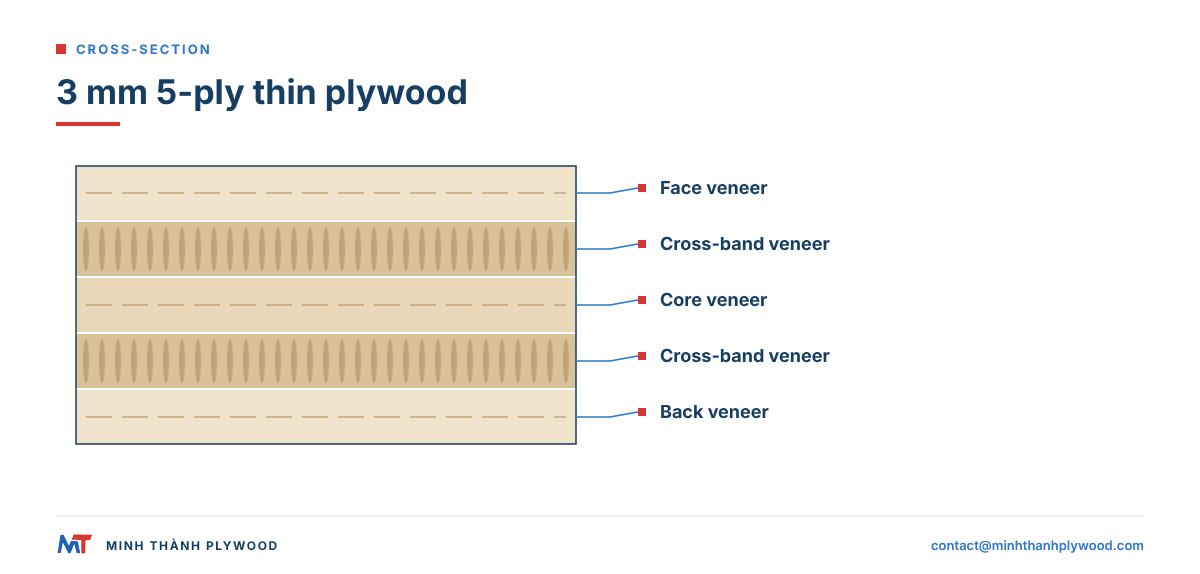
A good 3 mm basswood plywood is built of 5 plies: one core veneer in the centre, two cross-band veneers either side, and two face veneers. The grain alternates at right angles, so the sheet is balanced and stays flat.
| Thickness | Good build | Weaker build | Why it matters |
|---|---|---|---|
| 3 mm | 5 plies: 1 core, 2 cross-bands, 2 faces | 3 plies: 1 core, 2 faces | 5 thinner layers resist warping and splitting at narrow cuts |
| 4–6 mm | 5 plies (3–5 mm): 3 core veneers, 2 faces | 3 plies | More layers keep the sheet flat and the core even |
This is how we build every thin panel: our thin plywood of 3–5 mm is always 5-ply. At 3 mm that means one core veneer, two cross-band veneers and two face veneers; at 4 and 5 mm, three core veneers and two faces, with the core veneer thickness adjusted to the panel.
The more plies, the more glue lines a laser must cut through, but each line is thin and the core has fewer voids. In practice a 5-ply 3 mm sheet cuts as fast as a 3-ply one and gives cleaner edges, because there are no gaps for the beam to jump.
Basswood plywood for laser cutting and engraving: what decides a clean cut?
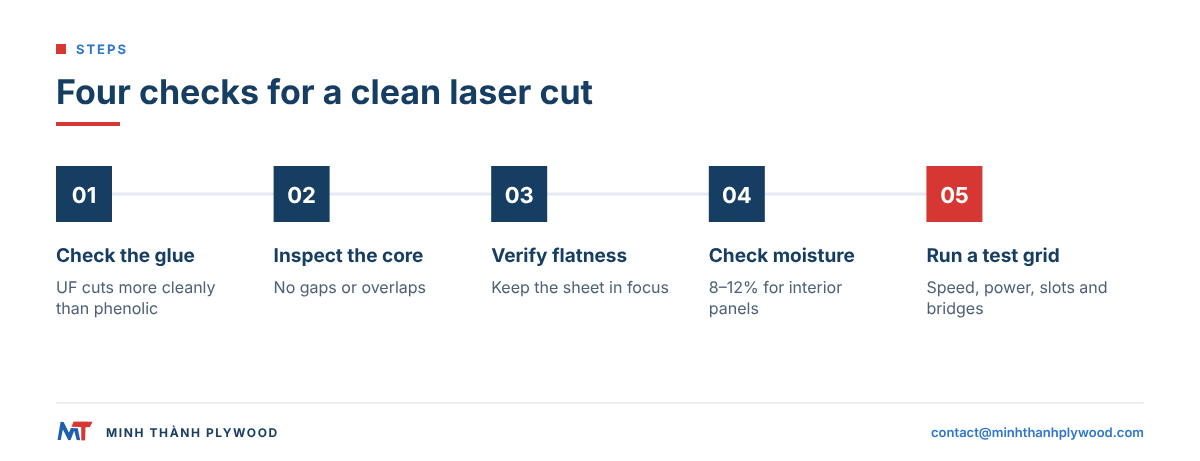
A clean laser cut depends on four things: the glue, the core, the flatness and the moisture. The face species decides how the engraving looks; the build decides whether the beam goes through.
- Glue. Interior UF glue lasers cleanly. Waterproof phenolic and heavy melamine glue lines are harder to cut and char more. For indoor laser parts, specify UF glue at E0 emission. In the US, the limit for veneer-core hardwood plywood is 0.05 ppm under 40 CFR 770.10.
- Core voids. A gap in the core lets the beam pass through air, then strike the next layer at the wrong focus; a doubled veneer leaves an uncut spot. Ask for a core without gaps or overlaps.
- Flatness. A bowed sheet moves out of focus across the bed. Sheets that are pressed and calibrated, then sanded, lie flat.
- Moisture. Wet veneer cuts slower and chars unevenly. Panels at 8–12 % moisture content, the normal range for interior plywood, cut consistently.
Thickness tolerance matters too. If thickness drifts across a pack, the cut speed set for one sheet leaves the next one uncut. Our sanded panels are made to ±0.2–0.3 mm, so one setting works across the pack. Our guide to the best plywood for laser cutting compares the faces in more detail.
Run a test grid on each new batch: a set of squares at rising speed and power, plus the smallest slot and the narrowest bridge your design uses.
Basswood vs poplar laser ply
Both basswood and poplar make good laser plywood; basswood is paler and more uniform, poplar is firmer, more widely made and usually less expensive. For production runs, the build matters more than the face species.
| Basswood plywood | Poplar laser plywood | |
|---|---|---|
| Face colour | Pale cream, very uniform | Light cream, occasional grey or green streaks |
| Engraving | Very even contrast | Even, streaks can show in large engraved areas |
| Face hardness | Soft, dents easily | A little firmer |
| Availability | Specialist face, smaller supply | Made in volume across Asia |
| Grades | By supplier | A/A, A/B and B/B by face and back, matched to the approved sample |
| Good build at 3 mm | 5-ply, UF glue, no core voids | 5-ply, UF glue, no core voids |
Choose basswood when the face is the product: engraved signs, pale model buildings, decorative panels. Choose poplar for parts, kits and volume work where the cut and the price per sheet count most. Many laser buyers run both: basswood for display pieces, poplar for structure. See our poplar plywood range for the face grades.
Basswood vs birch plywood
Birch plywood is harder, stronger and more wear resistant; basswood plywood is softer, lighter, paler and easier to cut and carve. Pick by what the part must do.
- Choose birch for parts that carry load, take screws or see wear: furniture, jigs, drawer parts, toys handled hard. Birch faces at our mill are graded D+, D and E, comparable to the European birch grade ladder.
- Choose basswood for parts that are looked at more than used: model buildings, signs, decorative laser pieces, engraved panels.
- Choose poplar when you want a pale face like basswood at a lower price, with a little more firmness.
Birch cuts with a crisper, darker edge and needs more laser power per millimetre; basswood cuts faster at the same power.
Sizes and thickness of basswood ply sheets
Basswood ply sheets come as full sheets for production and as small blanks for hobby lasers. Thin sheets are usually 3, 4 and 6 mm; 3 mm is the most common laser thickness.
| Format | Size | Who buys it |
|---|---|---|
| Full sheet | 1220 × 2440 mm (4 × 8 ft) | Mills, cutting shops, distributors |
| Full sheet, European | 1250 × 2500 mm | European distributors and manufacturers |
| Cut to size, 4 pieces | 610 × 1220 mm | Large-bed lasers, CNC |
| Cut to size, 8 pieces | 610 × 610 mm | Mid-size lasers |
| Hobby blank | 300 × 300 mm (about 12 × 12 in) | Desktop lasers, craft retail |
Full sheets are cut into 4, 6 or 8 pieces at the mill, so a distributor receives packs that fit its customers’ laser beds without cutting on arrival. A 3 mm sheet of 1220 × 2440 mm on a white Styrax core weighs about 4.5 kg, light enough for one person to carry.
What is basswood plywood used for?
Basswood plywood is used where a pale, fine face and easy cutting matter more than strength.
- Laser-cut parts and kits: model buildings, puzzles, ornaments, desk organisers.
- Architectural and railway models: walls, floors and roofs at scale, often engraved with brick or plank lines.
- Signs and engraving: names, logos and maps with even contrast.
- Pyrography and painting: a pale, smooth base that takes stain and paint evenly.
- Decorative linings: small panels, inlays and backs where a light colour is wanted.
- Teaching and prototyping: design-school models and quick prototypes.
For furniture parts, cabinet backs and drawer bottoms, poplar or birch thin plywood gives more strength at the same thickness; see our thin plywood page for those builds.
How to keep thin basswood plywood flat in storage
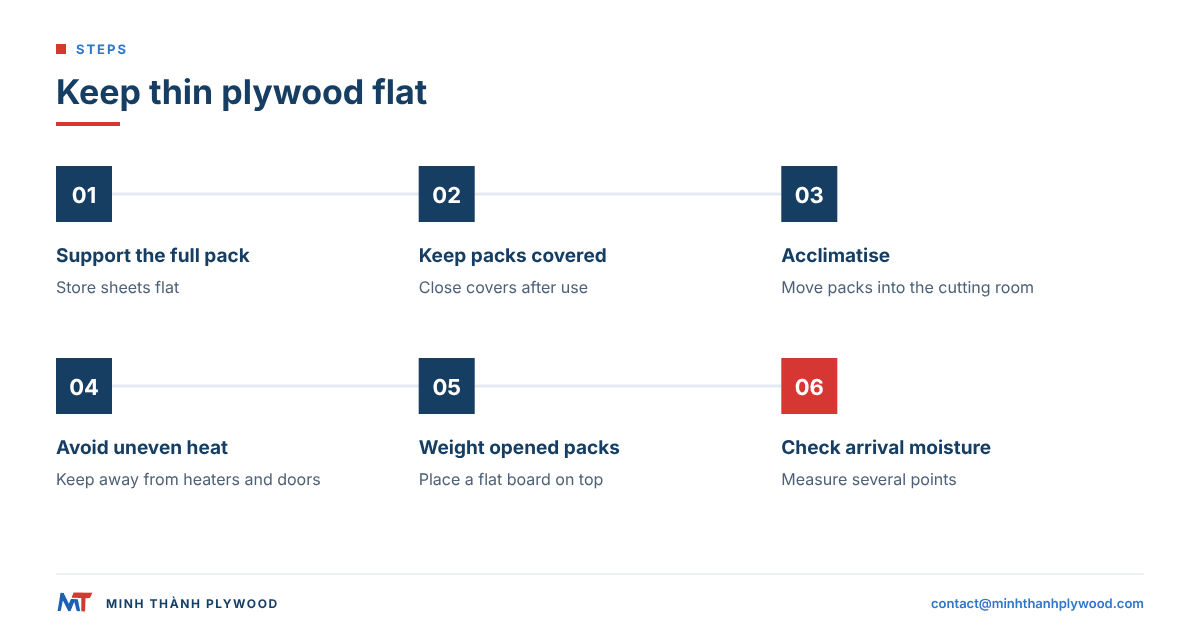
Thin plywood stays flat when it is stored flat, dry and covered, at the humidity of the room where it will be cut. Most “warped sheet” complaints with 3 mm panels start after delivery, in storage.
- Store flat on a full base. Lay packs on a pallet or on bearers no more than a short span apart, so thin sheets do not sag between supports.
- Keep the cover on until the sheets are needed, and close it again after taking sheets out.
- Acclimatise before cutting. Move a pack into the cutting room a few days ahead, so the moisture of the sheets settles to the room before the laser sees them.
- Keep away from heaters and doors. Warm air on one face dries that face first and bows the sheet.
- Weight the top. A flat board on top of an opened pack keeps the top sheets from curling.
- Check moisture on arrival. A pin meter reading at several points on a few sheets shows whether the batch arrived at the moisture you ordered.
A 5-ply build helps here as well: the balanced layers pull against each other evenly, so a 5-ply 3 mm sheet moves far less with humidity than a 3-ply one.
What to write on a basswood plywood order
Write the build line by line, so every supplier quotes the same panel. The face name alone, “basswood ply”, leaves the core, glue and ply count open.
| Line | Example for laser sheets |
|---|---|
| Face and back | Basswood (Tilia) face and back, grade or approved sample |
| Core | Species, no gaps or overlaps |
| Thickness and plies | 3 mm, 5-ply |
| Thickness tolerance | ±0.2–0.3 mm, sanded |
| Glue and emission | UF glue at E0 emission, as two separate lines |
| Moisture | 8–12 % at dispatch |
| Size | 1220 × 2440 mm, or cut to 610 × 610 mm |
| Flatness | Pressed, calibrated and sanded; packed flat |
| Packing | Sheets per pack, covers, pack labels |
| Quantity and delivery | Sheets or containers, destination port, FOB, CFR or CIF |
Run your laser test file on the sample before you order, so you see the edge and set the speed on the panel you will buy. For workplace laser safety, see the OSHA laser hazards page.
Basswood plywood and poplar thin plywood from Minh Thanh Plywood
We make thin 3–5 mm plywood in Ha Hoa, Phu Tho, always 5-ply, for laser, model and furniture buyers. Our standard pale face for laser work is poplar; basswood faces are outside our standard list and we quote other faces on request.
| Line | What we offer |
|---|---|
| Thickness | 3, 4 and 5 mm thin panels, always 5-ply |
| Faces | Poplar A/A, A/B and B/B; birch D+, D and E; EV, okoume, pine; others on request |
| Cores | White Styrax or Eucalyptus |
| Glue | UF glue at E0 emission; CARB P2 / TSCA Title VI certified under the EPA formaldehyde standards |
| Tolerance | Sanded panels ±0.2–0.3 mm, down to ±0.2 mm |
| Moisture | 8–12 % at dispatch |
| Sizes | 1220 × 2440 and 1250 × 2500 mm; cut to size into 4, 6 or 8 pieces |
| Order | MOQ 1×40HC with mixed specifications by agreement; free samples |
Send your target face, thickness and sheet size with a sample request through the thin plywood page; free samples go out before the first order, and we reply within hours.
Buyer questions, answered
What is basswood plywood?
Basswood plywood is plywood with face veneers of basswood (Tilia), a pale, soft, fine-grained hardwood. Its core may be basswood or another light species, and thin 3 mm sheets are widely used for laser cutting, models and crafts.
Is basswood the same as plywood?
No. Basswood is a tree species and its wood; plywood is a panel made of glued, cross-laid veneers. Basswood plywood is plywood that uses basswood veneers, usually on the faces.
Is basswood the same as linden?
Yes. Basswood is the North American name for Tilia; in Europe it is called linden or lime, and in Japan shina. Plywood sold under any of these names has the same face species.
Is basswood plywood good for laser cutting?
Yes. Its even, low-resin grain cuts and engraves with consistent edge colour. The glue and the core matter as much as the face: an interior glue, a core without voids and a flat sheet give clean through-cuts.
Basswood or poplar plywood for laser cutting?
Both laser well. Basswood is paler and more uniform in colour; poplar is slightly firmer, widely available and usually costs less. For production runs, the build matters more than the species: same glue, same core, same thickness tolerance.
Basswood vs birch plywood: which is better?
Birch is harder, stronger and better for parts that carry load or wear, such as furniture and jigs. Basswood is softer and lighter, easier to cut and carve, and suits models, signs and decorative laser work.
How many plies does 3 mm basswood plywood have?
A good 3 mm sheet has 5 plies: one core veneer, two cross-band veneers and two face veneers. Cheaper 3 mm sheets have 3 plies, which warp and split more easily.
What sizes does basswood plywood come in?
Full sheets are usually 1220 × 2440 mm or 1250 × 2500 mm; hobby blanks are cut down to 300 × 300 mm and similar laser-bed sizes. Thin sheets are commonly 3, 4 and 6 mm thick.
Is basswood the same as balsa?
No. Balsa is a much lighter and softer tropical wood used for model aircraft. Basswood is denser and firmer, holds fine detail and sharp edges, and is the usual choice for model buildings, kits and laser parts.