
The best wood for patio furniture has heartwood that resists rot on its own: teak first, then ipe and iroko, with acacia and eucalyptus as the good value. Cedar is light and stable, thermally modified wood is durable without chemicals, and treated pine is the budget choice. Design and care matter as much as species. Minh Thanh Plywood makes acacia- and eucalyptus-core plywood in Vietnam.
What is the best wood for patio furniture?
The best wood for patio furniture is teak, because its oily heartwood resists rot, insects and movement with very little upkeep. For most buyers, though, the good value is acacia or eucalyptus: dense plantation hardwoods that last many seasons when they are oiled and well designed.
A short ranking by what buyers usually want:
- Longest life, least care: teak.
- Very durable, very hard: ipe and iroko.
- Good value hardwoods: acacia and eucalyptus.
- Light and stable: western red cedar.
- Durable without chemicals: thermally modified wood.
- Lowest cost: pressure-treated pine.
No wood is maintenance-free outdoors. Even teak turns grey. What separates a piece that lasts from one that rots is the species, the share of heartwood, the drying, the joints and the care.
What makes wood good for outdoor use?
Wood is good for outdoor use when its heartwood naturally resists fungi and insects, it moves little as humidity changes, and it is dense enough to resist wear. Five properties decide it:
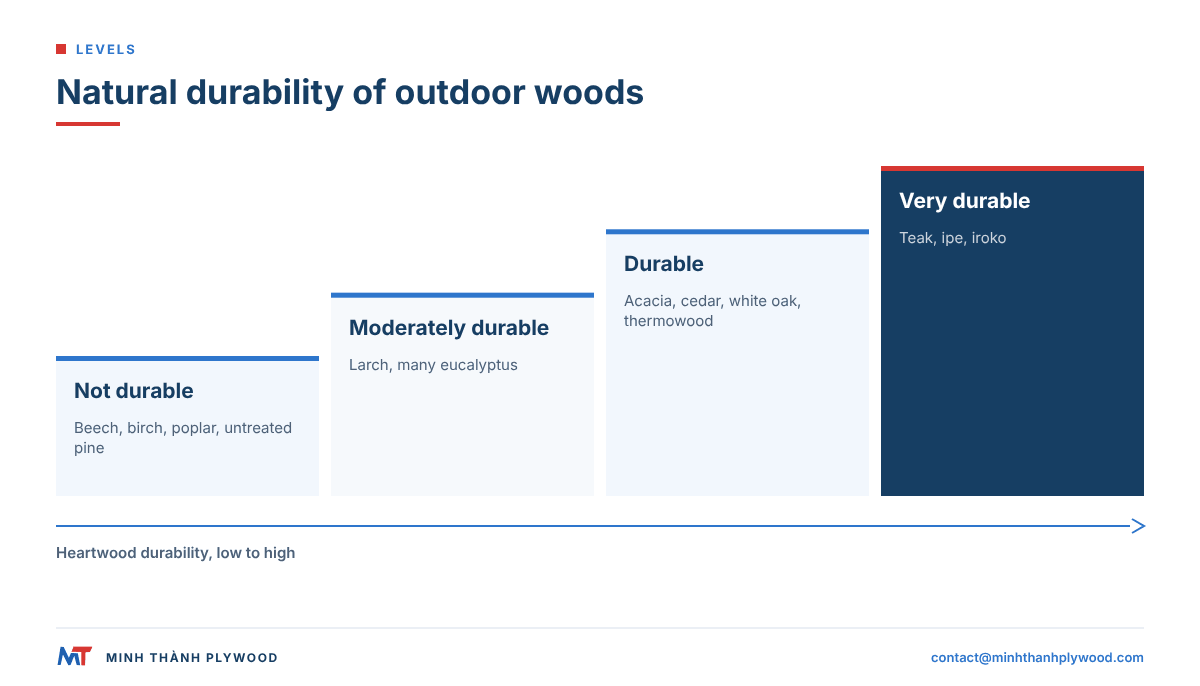
- Natural durability: how long the heartwood resists decay in contact with moisture. European standard EN 350 rates it in five classes, from 1 (very durable) to 5 (not durable).
- Oil and extractive content: natural oils and extractives repel water and deter insects; teak is the classic example.
- Stability: how much the wood swells and shrinks with humidity; stable wood keeps joints tight.
- Density and hardness: dense wood resists dents and wear but is heavier to move.
- Heartwood versus sapwood: sapwood of almost every species is not durable outdoors; good outdoor furniture uses heartwood.
Drying matters too. Wood that is not dried properly moves and cracks once it is in sun and rain.
Outdoor wood species compared
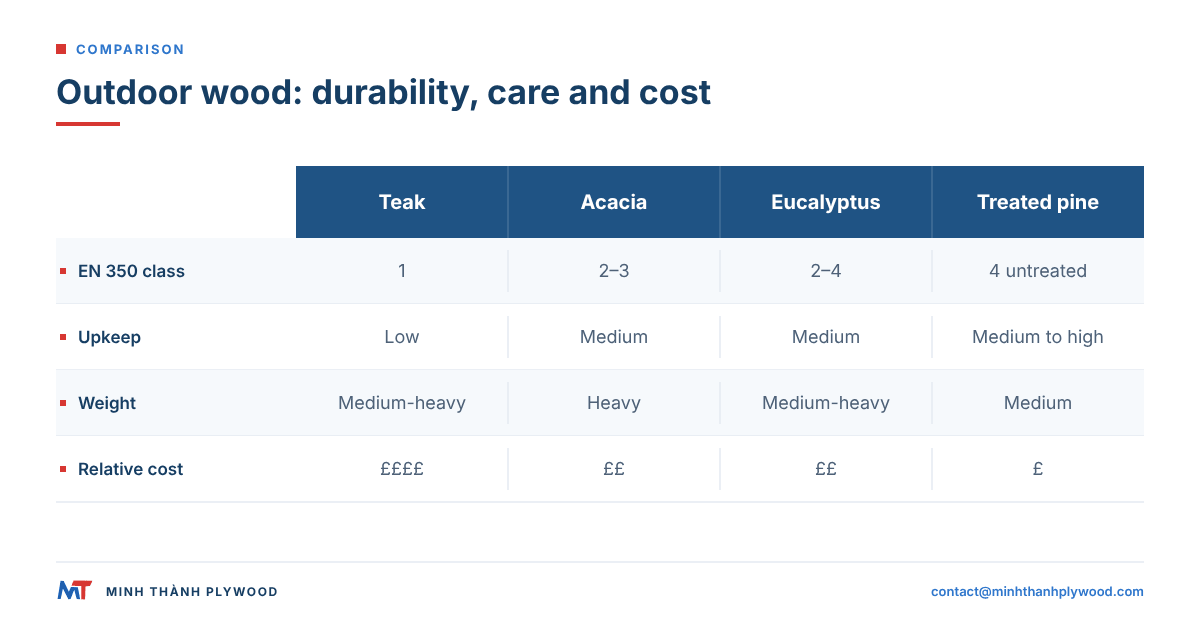
The table rates the common outdoor woods on the same rows. Durability is the EN 350 heartwood class, from 1 (very durable) to 5 (not durable); sapwood is class 5 in every species, and origin and tree age move a rating by a class. Relative cost uses one to four £ symbols.
| Wood | EN 350 class | Natural durability | Upkeep | Weight | Colour | Relative cost | Best use |
|---|---|---|---|---|---|---|---|
| Teak | 1 | Very durable | Low: weathers to grey | Medium-heavy | Honey to silver | ££££ | Premium sets, yachts, public seating |
| Ipe | 1 | Very durable | Low to medium | Very heavy | Dark brown | £££ | Benches, decking-style pieces |
| Iroko | 1–2 | Durable to very durable | Low to medium | Medium-heavy | Golden brown | £££ | Benches, garden tables |
| Sweet chestnut | 2 | Durable | Low to medium | Medium | Honey brown | ££ | UK-grown benches, fencing-style furniture |
| White oak | 2 | Durable | Medium | Heavy | Light brown | £££ | Benches, tables |
| Acacia | 2–3, by species | Durable for its price | Medium: oil or seal each season | Heavy | Warm brown, varied grain | ££ | Dining sets, chairs, loungers |
| Eucalyptus | 2–4, by species | Varies by species | Medium: oil each season | Medium-heavy | Reddish to light brown | ££ | Folding chairs, dining sets |
| Western red cedar | 2–3 | Durable | Medium | Light | Red-brown | ££ | Adirondack chairs, planters |
| Larch | 3–4 | Moderately durable | Medium | Medium | Straw to orange | ££ | Rustic benches, tables |
| Thermally modified wood | 2 (Thermo-D pine) | Durable above ground | Medium | Light-medium | Dark brown | ££ | Modern furniture, cladding-style pieces |
| Pressure-treated pine | 4 (untreated), durable once treated | Durable while treated | Medium to high | Medium | Green or brown tint | £ | Budget furniture, planters |
The classes come from the EN 350 heartwood ratings as listed by Swedish Wood and UK timber merchants such as Woodworkers UK, and the thermally modified class from the Stora Enso ThermoWood factsheet (all read 21 October 2026). Check the species and origin on the supplier’s data sheet, because ratings for acacia, eucalyptus and cedar vary by species.
What a set costs at UK retailers follows the species. Listings checked on 21 October 2026 include FSC acacia four-seat dining sets at Wickes and Dobies, and teak sets at Norfolk Designer Gardens, The Teak Store and Bramblecrest.
Four-seat acacia dining sets sit at about £250 to £320 at mainstream retailers, and design-led brands charge up to about £1,050 for the same size. Four-seat teak sets run from about £550 to £800 and reach about £1,900 for premium folding sets; prices move with stock and sales. That gap of two to three times is why acacia and eucalyptus carry the volume in the UK market: they look like hardwood furniture at a fraction of teak’s price.
Teak: the benchmark outdoor wood
Teak is the benchmark for outdoor furniture because its heartwood is very durable, stable and naturally oily. It can stand outdoors untreated for years, weathering from honey to silver-grey without losing strength.
What to check when buying teak:
- Heartwood share: the darker, even-coloured heartwood is the durable part; pale sapwood is not.
- Plantation or old growth: most teak furniture today comes from plantations; older, slower-grown teak is denser and oilier.
- Grade: furniture makers use their own grade names; ask what share of sapwood and knots each grade allows.
- Joints and fixings: mortise and tenon joints and stainless steel fixings make teak furniture last as long as the wood.
Teak’s drawback is price. That is why acacia and eucalyptus have taken a large share of the outdoor furniture market.
Is acacia wood good for outdoor furniture?
Yes, acacia wood is good for outdoor furniture: it is dense, hard, naturally resistant to decay and attractive, and it costs far less than teak. It is one of the most used woods in outdoor dining sets, chairs and loungers sold in Europe and North America.
Is acacia wood weather resistant? Acacia resists sun and rain well for a mid-priced hardwood, but it needs care:
- Oil it with an outdoor hardwood oil before first use and once or twice a year.
- Keep it off standing water: feet in puddles are where acacia furniture fails first.
- Cover or store it in winter in cold, wet climates.
- Expect weathering: untreated acacia turns grey and can show fine surface checks.
Plantation acacia from South-East Asia, including Vietnam, is fast-growing and widely planted, which keeps supply steady. The same plantation acacia is used as a core species in plywood: our acacia-core panels are made on order, and our film-faced and anti-slip plywood use eucalyptus or acacia cores.
Is eucalyptus wood good for outdoor furniture?
Yes, eucalyptus wood is good for outdoor furniture when it is a durable species, well dried and finished. It is dense, stable and straight-grained, takes oil well and costs less than teak.
Eucalyptus is not one wood but hundreds of species, and their durability varies widely. Furniture makers choose denser, more durable plantation species and dry the timber carefully, because eucalyptus can check if it dries too fast. Treat it like acacia:
- Oil before first use and each season.
- Keep joints drained and feet off wet ground.
- Store or cover in winter.
In plywood, eucalyptus is one of our two standard cores, with white Styrax. Eucalyptus-core plywood is dense, about 650 kg/m³, and holds screws well. See our eucalyptus plywood page for eucalyptus-faced panels.
Other outdoor hardwoods: ipe, iroko and oak
Ipe, iroko and white oak are durable hardwoods used where buyers want long life and accept higher cost or weight.
- Ipe: very hard, very dense and very durable; used for heavy benches and public seating. Its weight and hardness make it slow to machine.
- Iroko: durable, golden brown, sometimes sold as a teak alternative; it darkens with age.
- White oak: durable heartwood with closed pores that keep water out; it contains tannins that stain if steel fixings are used, so stainless fixings are a must. Red oak is not suitable outdoors.
Tropical hardwoods should come with legal origin documents. Ask the supplier for the chain-of-custody certificate or the origin dossier before ordering.
Softwoods and modified wood: cedar, larch, pine and thermowood
Softwoods cost less and weigh less than hardwoods, but most need treatment or a durable heartwood to last outdoors.
- Western red cedar: light, stable and naturally durable, with an aromatic smell; soft, so it dents easily. Popular for Adirondack chairs and planters.
- Larch: resinous and moderately durable (EN 350 class 3–4); UK-grown larch is a common choice for rustic garden furniture and benches.
- Sweet chestnut and UK oak: UK-grown hardwoods that buyers ask for by name; sweet chestnut heartwood is class 2 and oak heartwood class 2, and both need stainless fixings because of their tannins.
- Pressure-treated pine: preservative forced into the wood makes it durable at low cost; it needs a finish to look good and to slow cracking.
- Thermally modified wood: pine, ash or other species heated in a low-oxygen kiln, which makes them more durable and stable without chemicals, but somewhat more brittle.
Untreated pine, spruce, beech, birch and poplar are not suited to outdoor furniture: they rot quickly where water sits.
How do oil and finishes protect outdoor wood?
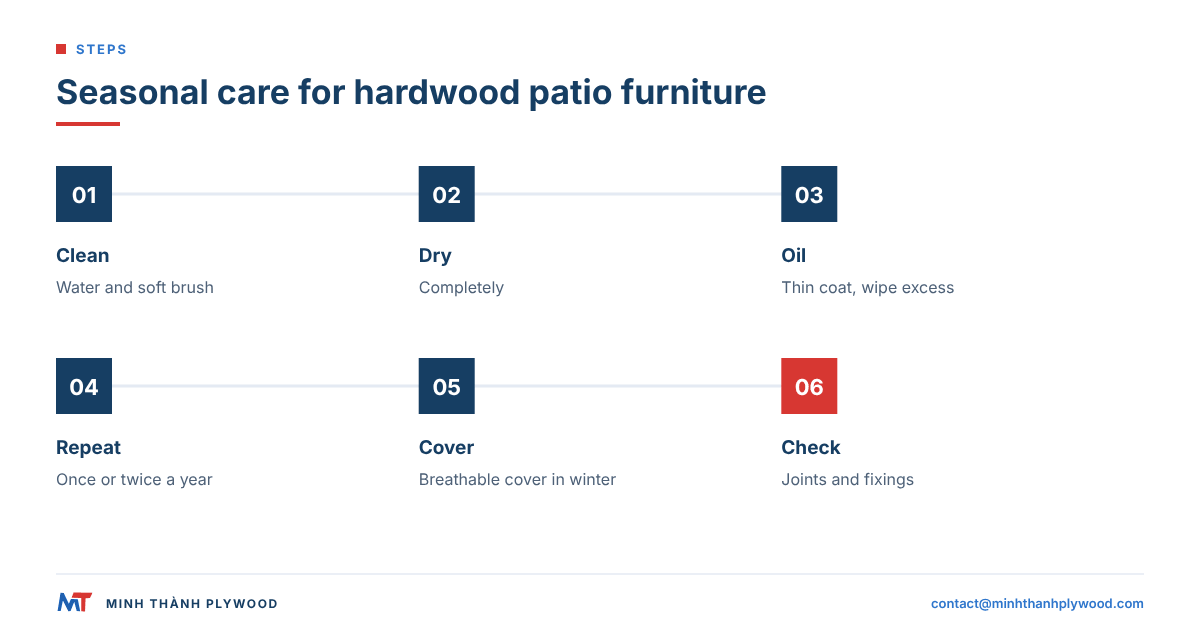
Oil and finishes slow water uptake and UV greying; they do not make a non-durable wood durable. A simple care routine keeps hardwood furniture sound for many seasons:
- Clean the furniture with water and a soft brush at the start of the season.
- Let it dry completely.
- Apply an outdoor hardwood oil thinly, wiping off the excess.
- Repeat once or twice a year, more often in strong sun. For acacia, use a water-based sealant; a piece that arrives with a polyurethane (PU) coat needs no treatment for the first 12 months, then goes on the same yearly routine.
- Cover or store the furniture in winter, under a breathable cover.
- Check joints and fixings and tighten where needed.
Retailers such as Royalcraft give the same rule: apply a protective treatment or sealant once or twice a year (checked on 21 October 2026). Film-forming finishes such as varnish look good at first but crack and peel outdoors, then trap water underneath. Penetrating oils are easier to maintain on hardwoods. On painted plywood, a full exterior paint system is used instead.
Why Vietnam makes so much acacia and eucalyptus outdoor furniture
Vietnam is a major exporter of wooden outdoor furniture, built on planted acacia and eucalyptus and on imported certified hardwoods. Plantation acacia and eucalyptus grow fast, so the wood is affordable and the supply is steady. The coastal area around Quy Nhon is known for its outdoor furniture factories.
Two documents matter to European buyers:
- FSC certification: many outdoor furniture makers sell FSC chain-of-custody products from certified plantations. The claim is valid only when the certificate code is on the invoice.
- EUDR: under Regulation (EU) 2023/1115, wood products listed in its Annex I, including plywood and wooden furniture, need due diligence with origin and geolocation data before they are placed on the EU market. Obligations start on 30 December 2026 for large and medium operators.
Our plywood cores use plantation timber grown locally around Ha Hoa in Phu Tho. We supply the EUDR compliance dossier (origin records and geolocation files) with orders, and FSC is available*.
*Supplied directly or through qualified partner mills.
When is plywood used for outdoor furniture?
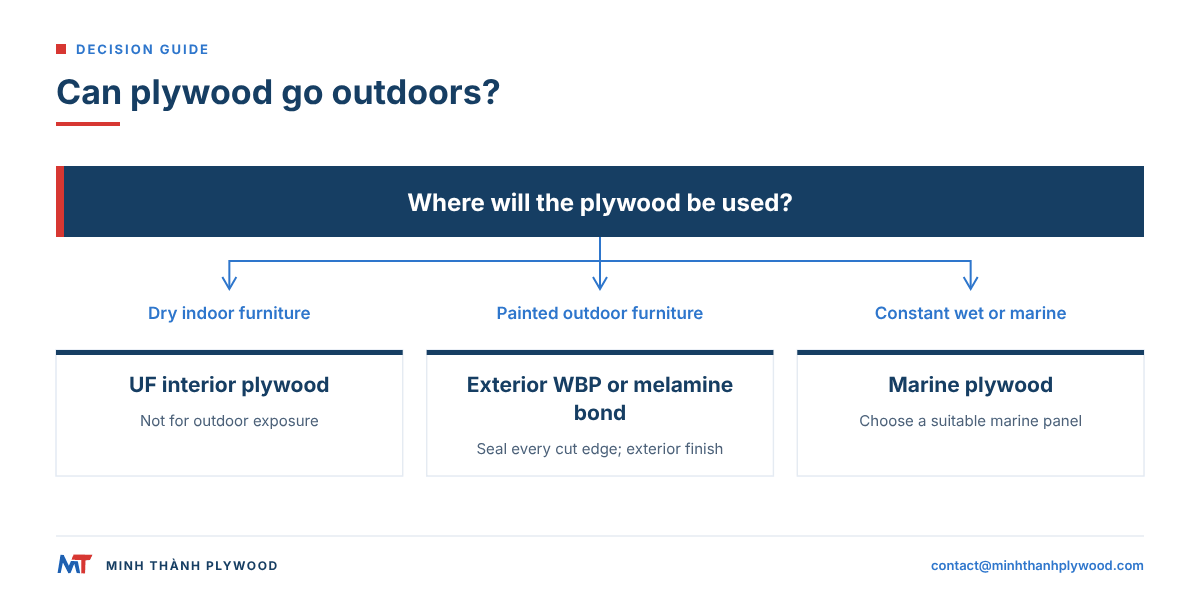
Plywood is used for outdoor furniture when the design calls for flat sheets: painted seats and backs, planters, outdoor kitchens, play furniture and modern flat-pack designs. It works outdoors only with the right glue and full edge protection.
Rules for plywood outside:
- Glue: exterior plywood with phenolic (WBP) or melamine-fortified glue. Interior plywood with UF glue delaminates outdoors.
- Edges: seal every edge and cut, because water enters through the end grain of the veneers.
- Finish: a full exterior paint system or a film face; plywood is rarely left bare outdoors.
- Design: no flat tops that hold water, drained joints, feet raised off the ground.
Marine plywood is used where the furniture sits in constant wet or near the sea. Our marine plywood buying guide and our article on whether plywood is waterproof explain the glue classes. No plywood is waterproof by itself; the glue and finish decide how it lasts.
Design details that make outdoor furniture last
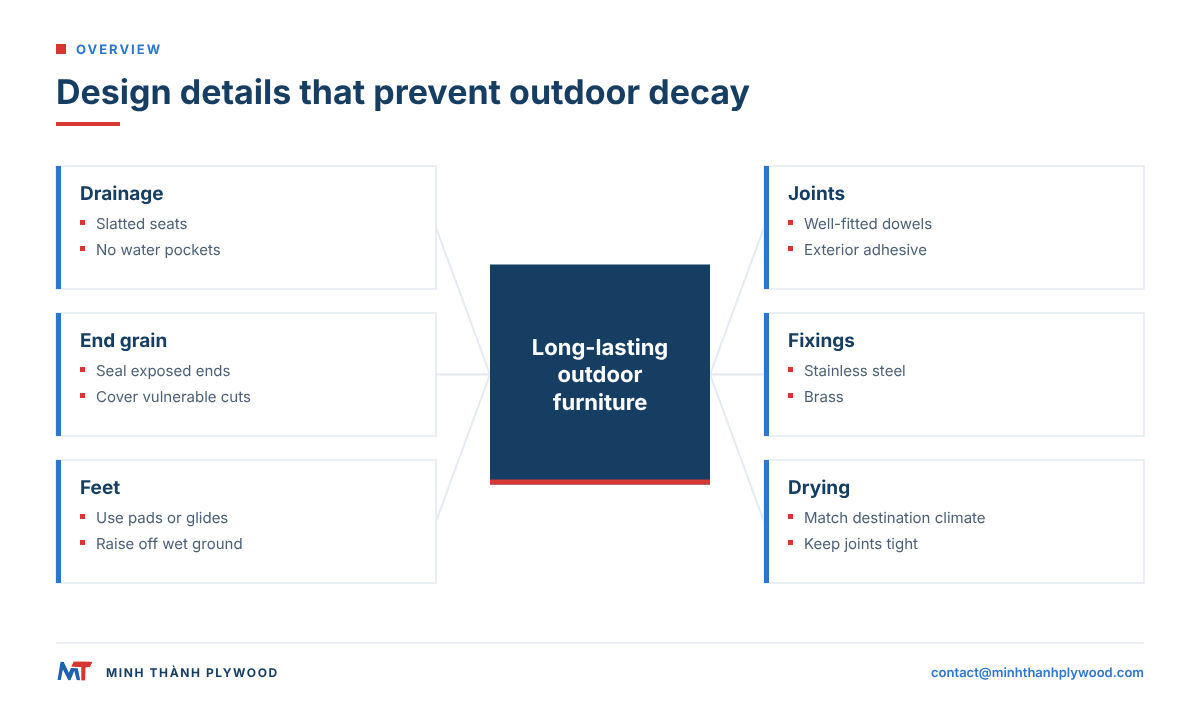
Good design adds more years to outdoor furniture than a better species. Check these details on samples before ordering:
- Drainage: slatted seats and tables with gaps, no pockets that hold water.
- End grain: sealed or covered, because end grain soaks up water fastest.
- Feet: raised on pads or glides so they do not sit in water.
- Joints: mortise and tenon or well-fitted dowels, glued with an exterior adhesive.
- Fixings: stainless steel or brass; plain steel rusts and stains tannin-rich woods.
- Moisture at production: wood dried to the right level for the destination climate, so joints stay tight.
For indoor pieces, furniture plywood is dried to 8–12 % moisture content at dispatch, the normal range for furniture plywood. Outdoor pieces are dried to suit the climate where they will stand.
What this means for your order
Minh Thanh Plywood makes plywood, not finished outdoor furniture. For furniture makers and importers, we supply the panel side of the job:
| Item | What we supply |
|---|---|
| Exterior plywood | Phenolic (WBP) or melamine-fortified glue, utility C/D faces, for painted outdoor pieces |
| Eucalyptus-faced plywood | Faces quoted A/A, A/B or B/B, matched to the approved sample |
| Cores | Eucalyptus as standard; acacia on order |
| Thickness | 3–40 mm |
| Size | 1220 × 2440 mm, 1250 × 2500 mm, custom and cut-to-size |
| Tolerance | ±0.5 mm on commercial and exterior panels, ±2 mm on length and width |
| Documents | EUDR compliance dossier with orders; FSC available* |
Orders start at one 40HC with mixed specifications by agreement, 15–45 days after the 30% deposit, FOB Hai Phong, CFR or CIF. Free samples are available so your workshop can test glue, paint and edge sealing first.
Specify your outdoor furniture plywood
Send us the line your workshop would write, and we will quote it within hours:
Exterior plywood for painted outdoor furniture, 18 mm, 1220 × 2440 mm, phenolic glue (WBP), eucalyptus core, C/D faces for painting, ±0.5 mm, export packing, one 40HC, CIF your port.
For indoor furniture panels, read our guide to the best plywood for furniture, or see our exterior plywood page. The planned guides on types of wood and on the best wood for furniture compare species indoors.
Buyer questions, answered
What is the best wood for patio furniture?
Teak is the best all-round wood for patio furniture because its oily heartwood resists rot, insects and movement with little upkeep. Acacia and eucalyptus are the good value, and ipe and iroko are very durable alternatives.
Is acacia wood good for outdoor furniture?
Yes. Acacia is dense, hard and naturally resistant to decay, and it is one of the most used woods for outdoor furniture. It lasts longest when oiled once or twice a year, kept off standing water and covered or stored in winter.
Is acacia wood weather resistant?
Acacia resists weather well for a mid-priced hardwood, but it is not as durable as teak. Left untreated in sun and rain it turns grey and can check; regular oiling and good drainage keep it sound for many seasons.
Is eucalyptus wood good for outdoor furniture?
Yes, eucalyptus is a good, affordable outdoor wood when it is a durable species, well dried and finished. It is dense and stable, takes oil well and needs regular oiling and winter cover to last.
Which lasts longer outdoors, acacia or eucalyptus?
Both last many seasons with care. Durability depends more on the species, the heartwood share, the finish and the design than on the name: dense, well-dried, oiled furniture with drained joints lasts longest in either wood.
Does teak furniture need oiling?
No. Teak can be left untreated and will weather to a silver-grey without losing strength. Oil or a teak protector is only needed to keep the honey colour.
What wood should you avoid for outdoor furniture?
Avoid untreated softwoods such as plain pine or spruce and non-durable hardwoods such as beech, birch and poplar outdoors. They rot quickly where water sits, unless they are pressure-treated or fully protected.
Can plywood be used for outdoor furniture?
Yes, exterior plywood with a phenolic (WBP) glue can be used for painted outdoor furniture, planters and seats, as long as every edge is sealed and the finish is maintained. Interior plywood with UF glue is not suitable outdoors.
How long does acacia outdoor furniture last?
Well-made acacia furniture that is oiled each season, stored or covered in winter and kept off wet ground lasts for many years. Neglected pieces left in standing water fail far sooner, from the feet and joints first.
Is FSC wood available for outdoor furniture?
Yes. Teak, acacia and eucalyptus outdoor furniture is widely sold with FSC chain-of-custody certification from plantation timber. Ask for the certificate code on the invoice to make the claim.