
Basswood for laser cutting is the easy choice for fine, light parts: it cuts fast with little char and engraves with strong contrast. Birch plywood is the choice when parts must be strong, flat and durable. Poplar laser ply sits between them on price and weight. The glue line and the core decide a clean cut more than the face species. Minh Thanh Plywood makes birch and poplar-faced thin plywood in Vietnam.
Basswood for laser cutting or birch plywood: the short answer
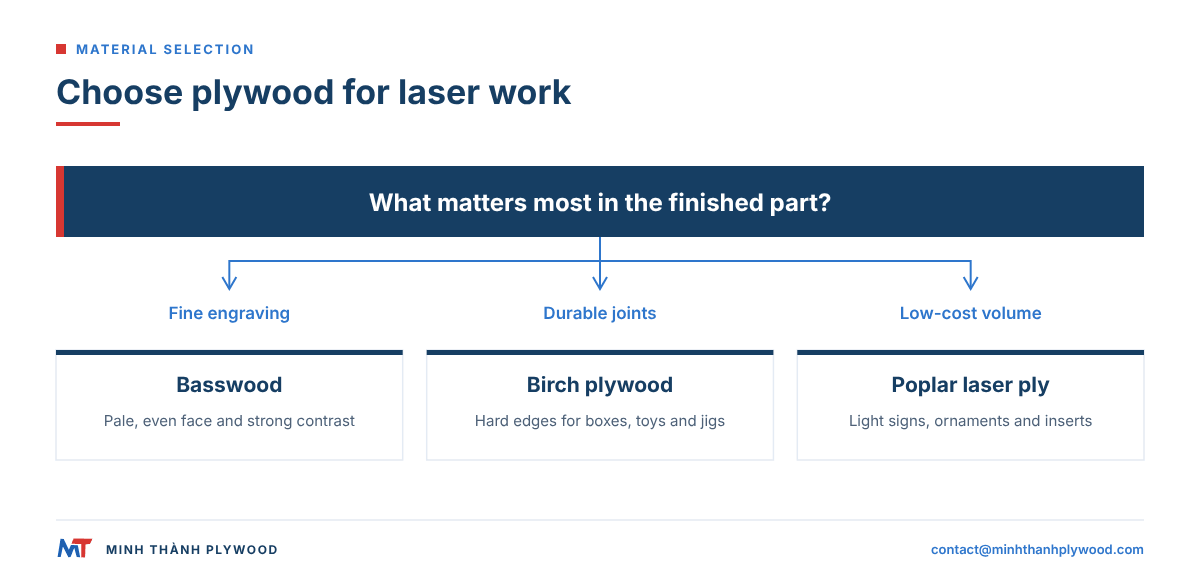
Choose basswood for laser cutting when parts are fine, light and decorative; choose birch plywood when parts must be strong, flat and handled every day. Choose poplar laser ply when you need large quantities of light parts at the lowest cost.
| Pick | When the project needs | Typical projects |
|---|---|---|
| Basswood or basswood plywood | Fine detail, fast cutting, high engraving contrast | Architectural models, miniatures, ornaments, puzzles |
| Birch plywood | Strength, flat sheets, crisp edges, durable parts | Boxes, furniture models, jigs, signage, toys |
| Poplar laser ply | Low weight and price in volume | Crafts, signs, packaging inserts, display parts |
All three cut well on a CO2 laser. The difference shows in the edge colour, the detail you can hold, the strength of the part and the price per sheet.
Is basswood plywood the same as basswood?
Basswood plywood is not the same as solid basswood. Solid basswood is a single board of the timber; basswood plywood is thin veneers glued with their grain crossed, with basswood on the faces and basswood or another light species in the core.
What changes on the laser:
- Glue lines: plywood has a glue line between every pair of veneers, and the beam must burn through each one. Solid basswood has none.
- Stability: cross-laminated plywood stays flatter than a thin solid board, which tends to cup.
- Sheet size: solid basswood is sold as narrow boards and sheets; plywood comes in large sheets.
- Edge: plywood edges show the layers; solid basswood shows one even edge.
Model makers often use solid basswood sheet for small, detailed parts and basswood plywood for anything that must stay flat. The same reasoning applies to birch: solid birch is rare on the laser, birch plywood is the norm.
Side-by-side: birch, basswood and poplar on the laser
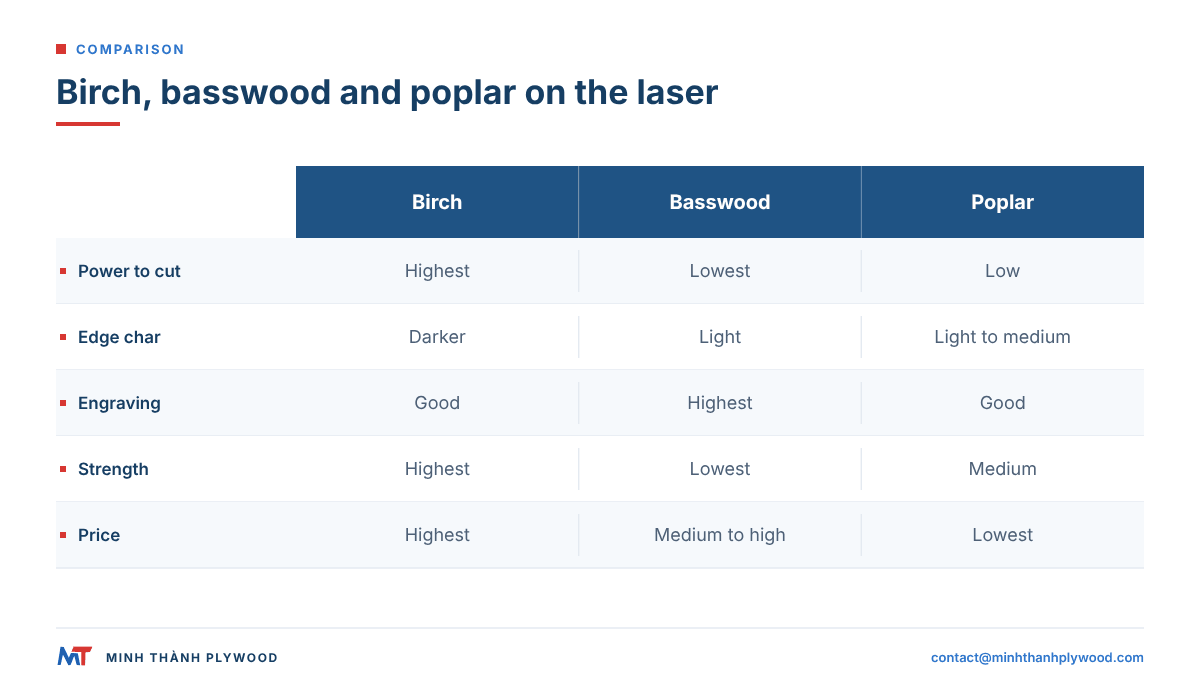
The table compares birch plywood, basswood plywood and poplar laser ply on the points that decide a laser job. Ratings are relative between the three; settings depend on the laser and lens.
| Point | Birch plywood | Basswood plywood | Poplar laser ply |
|---|---|---|---|
| Wood density | High | Low | Low to medium |
| Power needed to cut | Highest of the three | Lowest | Low |
| Edge char | Darker brown edge | Light edge | Light to medium edge |
| Kerf | Narrow and crisp | Narrow, can widen at slow speed | Narrow |
| Engraving contrast | Good, some grain shows | Highest, very even | Good, some colour variation |
| Fine detail | Very good, edges stay sharp | Very good, but small parts are fragile | Good |
| Strength and hardness | Highest | Lowest, dents easily | Medium |
| Flatness | Very good in a well-pressed sheet | Good; thin sheets can bow | Good |
| Weight | Heaviest | Lightest | Light |
| Price per sheet | Highest | Medium to high | Lowest |
| Janka hardness (solid wood) | About 1,260 lbf (yellow birch) | About 410 lbf | About 540 lbf (yellow poplar) |
| Dried density (solid wood) | About 690 kg/m³ | About 415 kg/m³ | About 455 kg/m³ |
The Janka and density rows are solid-wood figures from the Wood Database species pages (checked October 2026); plywood faced with the same species sits close to them, with glue adding a little weight. Basswood is the softest by a wide margin: birch resists a dent about three times harder (1,260 against 410 lbf).
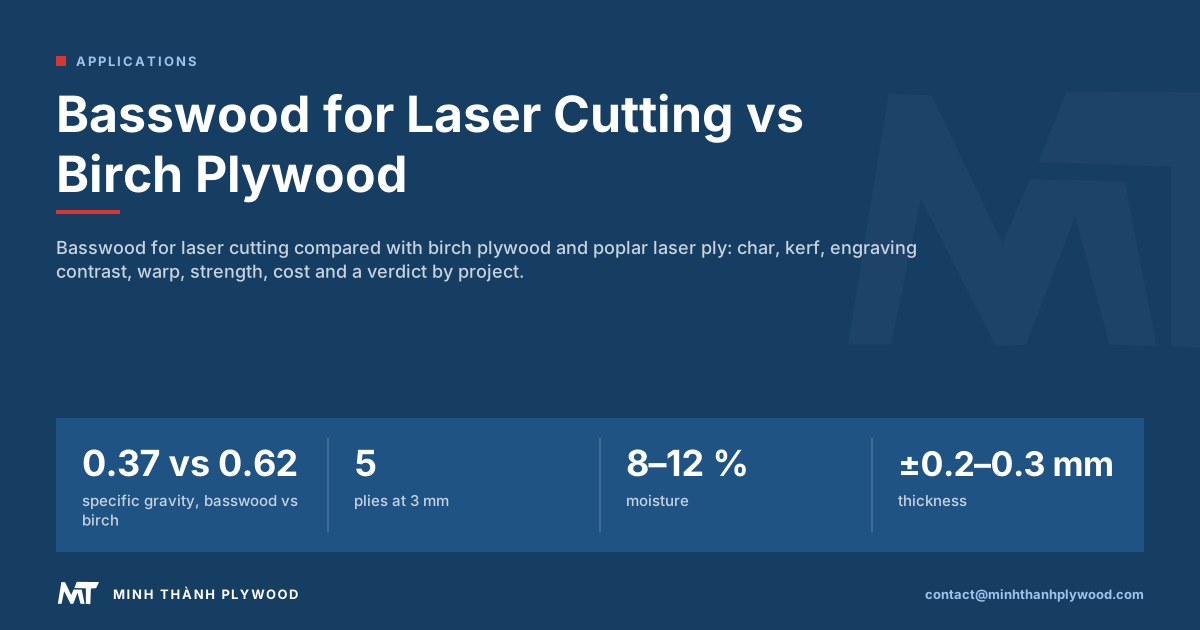
The wood figures behind the first row come from the US Forest Products Laboratory: American basswood has a specific gravity of about 0.37 at 12 % moisture, yellow birch about 0.62 (Wood Handbook, FPL-GTR-282, 2021). Birch is about two-thirds denser, which explains the extra power and the darker edge.
Laser cut basswood: why it cuts fast and clean
Laser cut basswood is fast and clean because the wood is light, fine-textured and low in resin. The beam removes less material per millimetre of cut, so the same laser runs faster and leaves a paler edge.
- Even texture: little difference between early and late wood, so the cut and the engraving stay even across the sheet.
- Low resin: less flare and fewer sticky deposits on the lens and honeycomb.
- Pale colour: char shows as a thin, light-brown line.
- Soft wood: small parts break if they are handled roughly; tabs and bridges help.
Basswood’s limits are strength and dent resistance. Parts that are clicked together many times, carry screws or get handled every day wear faster than birch.
Birch plywood on the laser: strength, detail and darker edges
Birch plywood is the strongest and flattest of the three on the laser, and the most demanding to cut. Its dense, hard wood holds sharp corners, thin bridges and tight joints that would crush in basswood.
- Crisp edges and joints: finger joints and slots stay tight after many assemblies.
- Flat sheets: a well-pressed birch sheet lies flat on the bed, so focus stays even.
- Darker edges: more energy per cut leaves a darker brown edge; air assist and the right speed keep it even.
- Higher price than poplar and most basswood ply.
Birch face grade matters for visible parts. Vietnamese birch faces are named D+, D and E and quoted as face/back pairs such as D+/D or D/E; D+ compares with B in the European birch ladder and D with BB. For engraved faces, a D+ face shows the fewest repairs and colour changes.
Basswood for laser engraving: contrast and colour
Basswood for laser engraving gives the strongest contrast of the three, because its pale, even face turns dark brown where the beam hits and stays pale everywhere else. Photographs, fine text and gradients read most clearly on basswood.
| Engraving job | Basswood | Birch | Poplar |
|---|---|---|---|
| Photo engraving | Best: even tone, no grain pattern | Good: slight grain shows | Good: some colour streaks |
| Fine text | Very clear | Very clear, crisp edges | Clear |
| Deep engraving | Surface can go fuzzy | Best: clean floor and walls | Good |
| Colour-filled engraving | Good, filler can bleed into soft wood | Best: firm walls hold the filler | Good |
For basswood for engraving that will be handled, seal the face after engraving: the soft wood picks up dirt quickly. For birch, a light pass at lower power gives a softer tone, and two passes give deep, clean lettering.
Poplar laser ply: the third option
Poplar laser ply is the cost-effective middle choice: light and pale like basswood, cheaper than birch, and stable enough for most crafts and signs. It is the standard sheet for high-volume laser products.
- Face: pale cream with soft grain; colour varies a little between leaves.
- Cut: easy, with a light edge.
- Engraving: good contrast, slightly less even than basswood.
- Strength: between basswood and birch.
Poplar faces are quoted as face/back pairs A/A, A/B and B/B, matched to an approved sample. A/A suits pieces seen on both sides, such as ornaments; A/B suits signs and boxes with a hidden back.
Glue line and core: what decides a clean laser cut
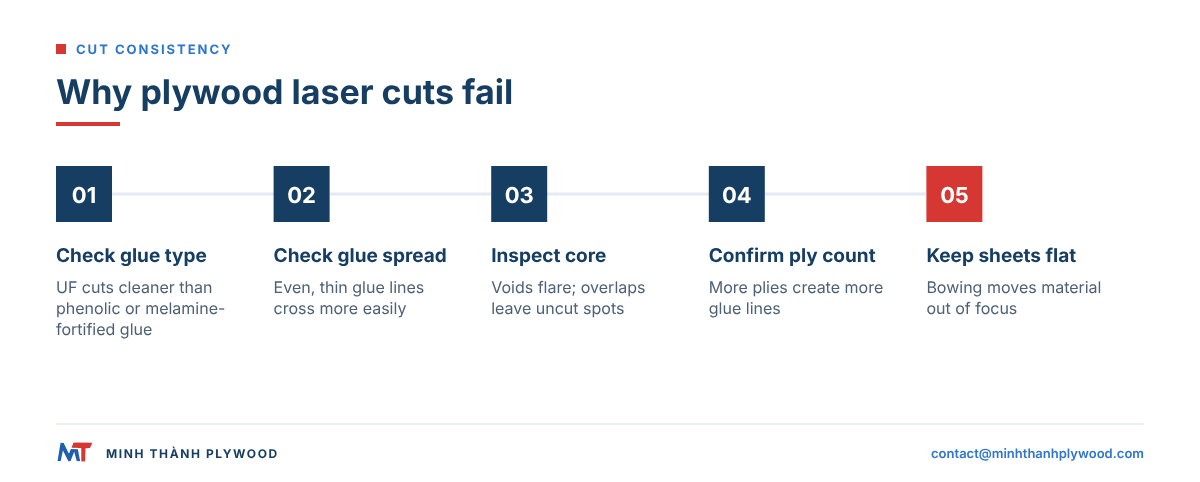
The glue line and the core decide a clean laser cut more than the face species. A sheet with an even, thin glue line and a closed core cuts through in one pass everywhere; a sheet with voids or heavy glue leaves uncut spots and dark streaks.
- Glue type: UF glue cuts most cleanly. Melamine-fortified and phenolic (WBP) glues are made for water resistance and resist the beam, leaving darker kerfs.
- Glue spread: an even, light spread gives a thin line the laser crosses easily.
- Core voids: a gap in an inner veneer makes the beam flare and can leave a burn mark on the face; an overlap leaves a spot that does not cut through.
- Ply count: more, thinner plies mean more glue lines; balance strength against cutting speed.
- Flatness: a bowed sheet moves out of focus at the edges.
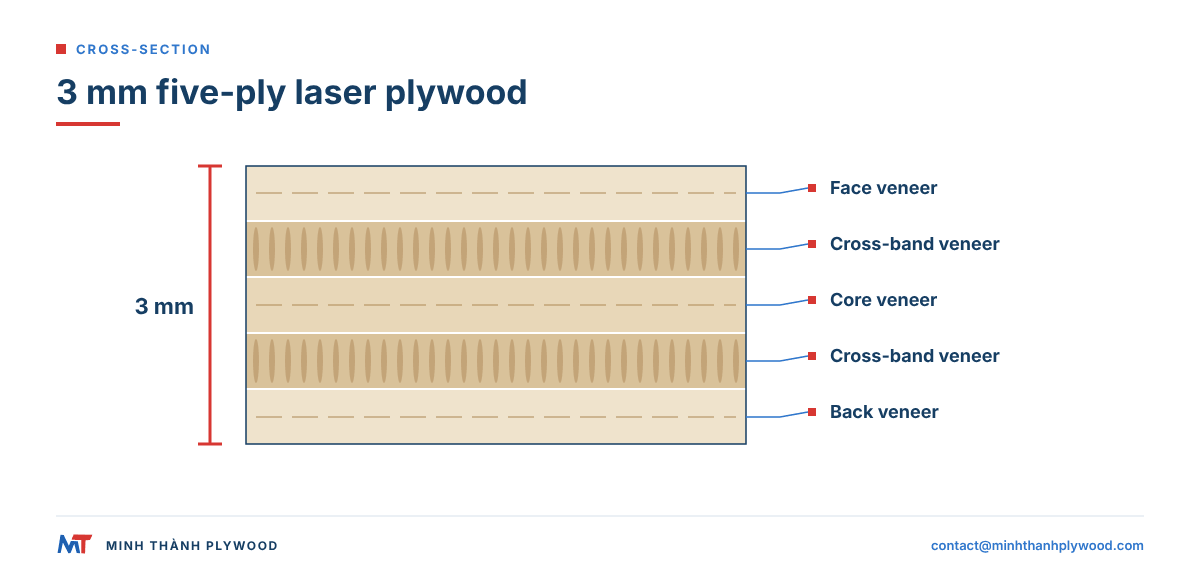
Our thin plywood of 3–5 mm is always 5-ply: 3 mm is one core veneer, two cross-band veneers and two faces; 4 and 5 mm are three core veneers and two faces. Core layers are stitched both horizontally and vertically, so gaps and overlaps are closed before pressing. Furniture and interior panels use UF glue at E0 emission. Our guide to the best plywood for laser cutting covers glue and grades in more depth. For workplace laser hazards, see the US Occupational Safety and Health Administration’s laser hazards page.
Warp and flatness on the laser bed
A sheet must lie flat within the laser’s focus range across the whole bed, or cuts fail at the corners. Warp comes from unbalanced construction, uneven moisture and storage.
- Balanced build: an odd number of plies with matching faces stays flatter; 5-ply thin sheets are more stable than 3-ply.
- Moisture: panels dried to 8–12 % moisture content at dispatch, the normal range for furniture plywood, and stored in the same climate as the workshop, move least.
- Storage: flat on a solid surface, wrapped, never on end against a wall.
- Hold-down: pins, magnets or weights at the corners for thin basswood sheets.
Birch plywood is usually the flattest; thin basswood sheets bow most easily. Our furniture-grade panels are pressed twice as standard, the core board first and then the faces, which keeps sheets flat.
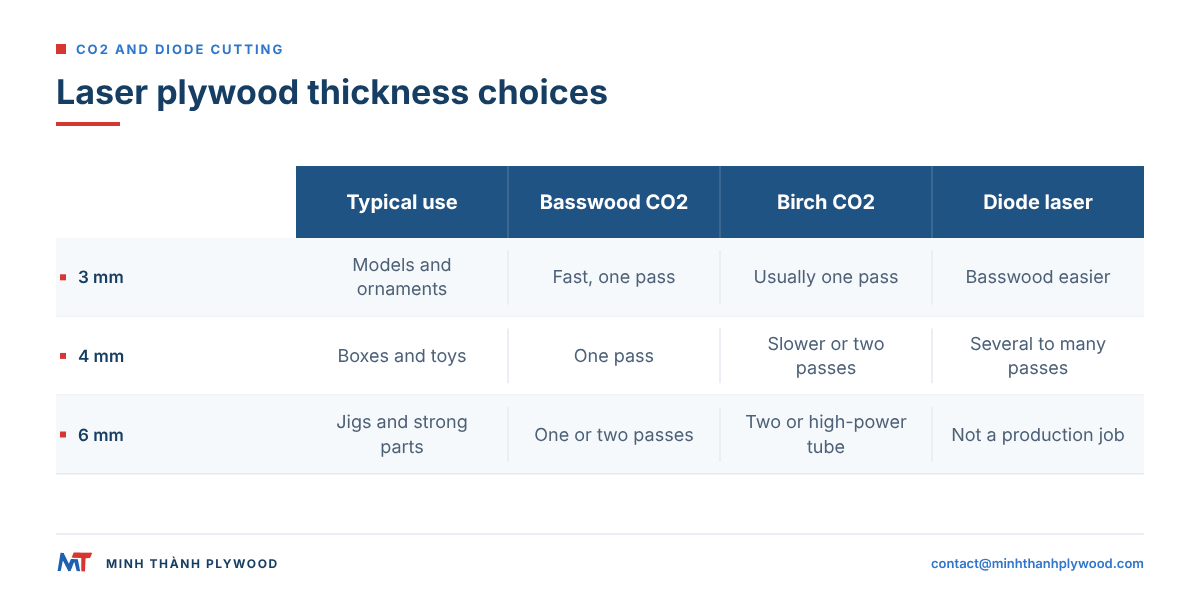
Thickness and power: 3 mm, 4 mm and 6 mm
3 mm is the most common laser plywood thickness, used for models, signs, ornaments and puzzles. 4 mm and 6 mm are used for boxes, structural model parts and anything that carries load or is assembled with slots.
| Thickness | Common uses | Basswood, CO2 | Birch, CO2 | Basswood, 10-20 W diode | Birch, 10-20 W diode |
|---|---|---|---|---|---|
| 3 mm | Models, ornaments, signs, puzzles | Fast, one pass | One pass on most CO2 lasers | One to three passes | Two or more passes, slower feed |
| 4 mm | Boxes, toys, display parts | One pass | Slower, or two passes on low-power tubes | Several passes | Many passes; rarely worth it |
| 6 mm | Furniture models, jigs, strong parts | One or two passes | Two passes or a high-power tube | Not a production job | Not a production job |
On a 10 W diode, published starting points for 3 mm basswood plywood are about 180-300 mm/min with one to three passes and air assist (ZapCraft, 2026); 3 mm birch plywood needs about 100-220 mm/min and two to five passes (LaserTinkerer, 2026). A diode laser therefore favours basswood or poplar for cutting, and birch is better engraved than cut through. Treat these as starting points and run a test grid on your own sheet.
Thicker sheets need more power or more passes, and each pass adds char. Test a small square and a circle on every new batch before a long job: the settings carry over within a batch, not always between batches.
Cost, supply and sheet sizes
Poplar laser ply is the lowest cost per sheet, basswood plywood sits above it, and birch plywood is the highest. Supply follows the same order: poplar and birch are made in volume, basswood laser ply in smaller runs, and basswood plywood is mostly supplied from North American or Chinese sources in thin 1.5-6 mm sheets (TT Plywood, 2025).
What a US hobby buyer pays, and what a mill price looks like. One US retail reference point: a 24-pack of 1/8 in (3 mm) x 12 x 12 in basswood project panels is listed at US$38.97 at Home Depot (October 2026, after a new-card promotion), with a stated thickness error within 0.1 mm. That is about US$1.62 per 12 x 12 in blank, or about US$17.50 per square metre of 3 mm panel.
| Reference point | 3 mm panel cost |
|---|---|
| US retail, basswood 24-pack of 12 x 12 in blanks | About US$17.50 per m² (US$38.97 / 2.23 m²) |
| Mill price, furniture plywood from US$350/m³, raw FOB example | About US$1.05 per m² (US$350 per m³ spread over a 3 mm sheet) |
The mill row is a raw FOB example for the board only: it is not a sheet price, and cutting into blanks, packing, freight, duty and the importer’s margin all come on top. A 1220 x 2440 mm sheet yields 32 blanks of 300 x 300 mm (the usual nominal 12 x 12 in blank) with kerf allowance, so a laser-product maker buying by the container is comparing a few cents of board per blank with a retail pack price per blank more than ten times higher.
Solid basswood is a separate product. US maker shops sell S4S solid basswood boards in 1/4 in and 3/4 in thickness and 4.5 in width, with a Janka hardness of 410 lbf, for carving and engraving; MakerStock lists them with US$12 flat-rate shipping per box up to 50 lb. Solid stock suits carving and single-piece engraving, while laser-cut kits and panels are made from plywood.
- Full sheets: 1220 × 2440 mm and 1250 × 2500 mm, and custom sizes such as 1220 × 2500 mm.
- Laser-bed sizes: many laser users need small sheets; we cut one panel into 4, 6 or 8 pieces before packing.
- Thickness tolerance: sanded panels made to ±0.2–0.3 mm keep focus settings the same across a pack.
- Price: for furniture and interior plywood, indicative prices start from US$350/m³ (October 2026); face, thickness and quantity set the final price.
For a laser product sold in volume, the panel cost per part matters more than the sheet price: a flat sheet with no voids gives fewer rejected parts.
Which wins for your project?
Basswood wins on detail and contrast, birch wins on strength and durability, poplar wins on cost. Choose by what the finished part must do.
| Project | Best choice | Why |
|---|---|---|
| Architectural and railway models | Basswood | Fine detail, light, easy to cut |
| Photo and text engraving | Basswood, or D+ birch | Highest contrast, even tone |
| Boxes and slot-together kits | Birch | Joints stay tight |
| Children’s toys and puzzles | Birch | Hard, durable edges |
| Signs and wall art in volume | Poplar | Light, low cost, good contrast |
| Jigs and templates | Birch | Stiff and wear-resistant |
| Christmas ornaments and gifts | Basswood or poplar | Light and pale |
Our guide to laser cutting plywood covers settings, and the pillar guide on how to cut plywood covers every cutting method.
What this means for your order
For laser work, specify the glue line and the core as carefully as the face. Send these lines with your request:
- Application: laser cutting, engraving or both, and the product.
- Face: birch (D+/D or D/E) or poplar (A/A, A/B or B/B).
- Thickness and build: 3, 4 or 5 mm, 5-ply; 6 mm ply count confirmed with the order.
- Glue and emission: UF glue at E0 emission.
- Size: full sheet, or your laser-bed size cut from full sheets.
- Packing and quantity: from one 40HC, mixed thicknesses by agreement.
Minh Thanh Plywood supplies CARB P2 / TSCA Title VI certified panels (ICTT mill no. 23024). The US limit for veneer-core hardwood plywood is 0.05 ppm under 40 CFR 770.10. Free samples are available, so you can run your own test cuts before ordering. See our birch plywood and thin plywood pages.
Buyer questions, answered
Is basswood good for laser cutting?
Yes. Basswood is light, even-grained and low in resin, so it cuts quickly with little char and holds fine detail. It is the favourite of model makers and hobby laser users for thin, delicate parts.
Birch or basswood for laser engraving?
Basswood gives the highest contrast, because its pale, even surface darkens strongly where the beam hits. Birch engraves with good contrast and a little more grain showing, and takes deeper engraving without the surface going fuzzy.
Is basswood plywood the same as basswood?
No. Solid basswood is a single piece of the timber; basswood plywood is cross-laminated veneers glued into a sheet, usually with basswood faces. The plywood is more stable and comes in larger sheets, but its glue lines change how it cuts.
Which is stronger, birch plywood or basswood plywood?
Birch plywood is stronger and harder. Birch wood is much denser than basswood, so birch parts hold screws, joints and wear far better; basswood parts are lighter and dent more easily.
Why does my laser not cut through plywood in some spots?
Usually a core void, a thick glue line or a glue type the laser struggles to burn through. Panels with closed cores and UF glue lines cut evenly; melamine-fortified and phenolic glue lines need more power and leave darker edges.
Does birch plywood char more than basswood on the laser?
Birch needs more power or slower speed because it is denser, so its cut edges are usually darker. Air assist, a clean lens and the right speed keep char on both species light.
What thickness of plywood is best for laser cutting?
3 mm is the most common laser plywood thickness for models, signs and crafts; 4–6 mm is used for boxes, furniture models and parts that carry load. Thicker sheets need more power and passes.
Where can I buy basswood plywood for laser cutting in Israel?
Laser and maker supply shops sell basswood and birch laser ply in small sheets. Importers buying by the container order birch or poplar-faced thin plywood from mills, cut to the size of their laser beds.
Is poplar plywood good for laser cutting?
Yes. Poplar is light and pale, cuts easily and costs less than birch, so poplar-faced plywood is widely used for laser crafts and signs. It is softer than birch and engraves with slightly less crisp detail.
Does the glue in plywood matter for laser cutting?
Yes, more than the face species. A thin, even UF glue line cuts cleanly; heavy or water-resistant glue lines resist the beam, leave dark streaks in the kerf and can stop a cut part from dropping out.