
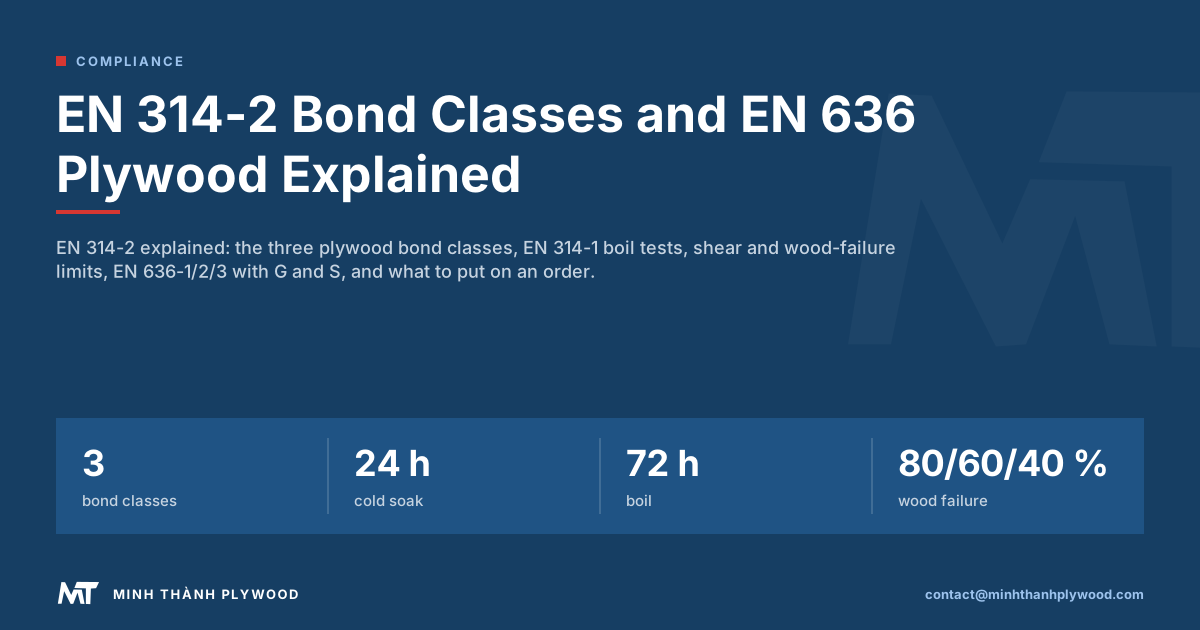
EN 314-2 sets three bond classes for plywood glue lines: Class 1 for dry interiors, Class 2 for humid or covered exterior use, Class 3 for exterior exposure. EN 314-1 gives the soak and boil tests behind them, and EN 636 turns each class into a plywood type, EN 636-1, -2 or -3. Minh Thanh Plywood builds furniture, MR and WBP panels to the class on your order.
What do EN 314-2 and EN 636 cover?
EN 314-2 rates the glue line of plywood; EN 636 specifies the whole panel. The first answers “will the layers stay bonded after water?”, the second answers “is this plywood fit for dry, humid or exterior conditions, and for structural or general use?”.
The two standards work as a pair, with a third one behind them:
| Standard | Title | What it settles |
|---|---|---|
| EN 314-1 | Plywood, bonding quality, Part 1: test methods | Test piece, soak and boil pre-treatments, shear test, wood failure reading |
| EN 314-2 | Plywood, bonding quality, Part 2: requirements | Three bond classes and the pass limits for each |
| EN 636 | Plywood, specifications | Panel types for dry, humid and exterior use; G or S; bending classes; tolerances by reference to EN 315 |
EN 314-2 dates from 1993 and is still the current edition; EN 314-1 was revised in 2004; EN 636 is current as EN 636:2012+A1:2015. All three come from CEN technical committee TC 112, wood-based panels. When a quotation says “EN 314-2 Class 3, EN 636-3S”, it states both the glue line and the panel’s use class. The BSI catalogue lists BS EN 314-2 for plywood bonding quality requirements and BS EN 636:2012+A1:2015 for plywood specifications.
What are the three EN 314-2 bond classes?
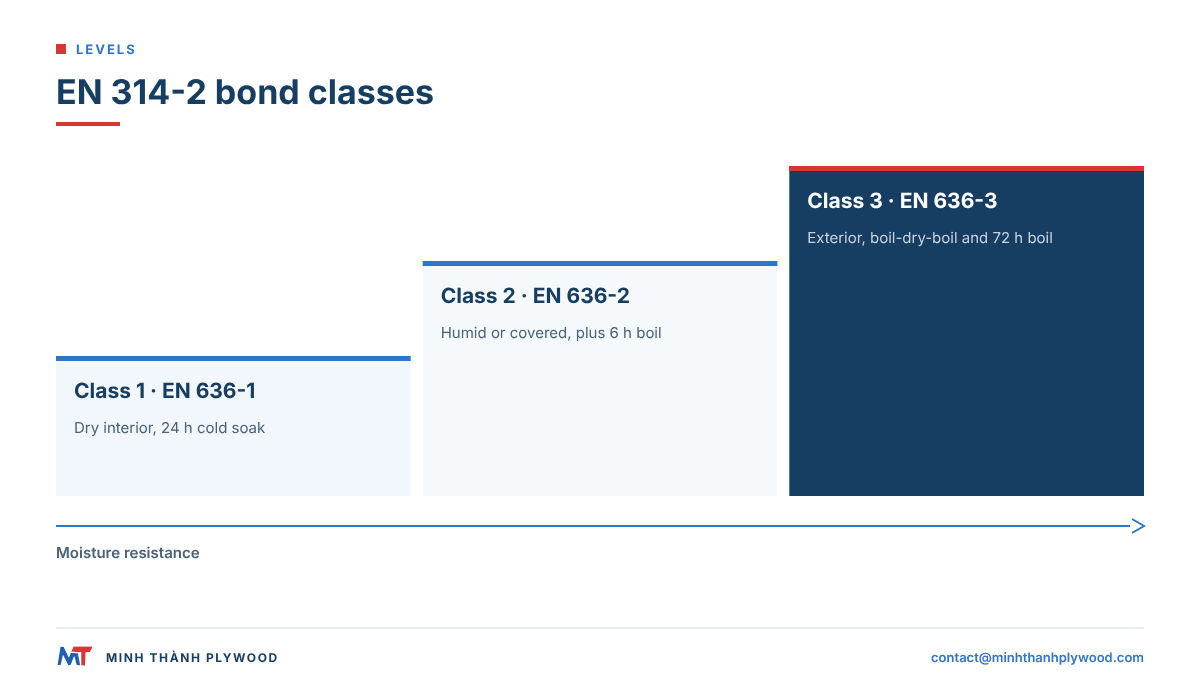
EN 314-2 divides plywood bonding quality into three classes by moisture resistance: Class 1 for dry conditions, Class 2 for humid conditions and Class 3 for exterior conditions. They match the panel types in EN 636-1, EN 636-2 and EN 636-3, and the standard’s own wording is short:
- Class 1, dry conditions: “appropriate for normal interior climate”. Furniture, cabinets, wall panels and shelving indoors.
- Class 2, humid conditions: for protected external applications, for example behind cladding or under roof coverings, and able to resist weather exposure for short periods, such as during construction. It also covers interiors where moisture stays above the dry level.
- Class 3, exterior conditions: “designed for exposure to weather over sustained periods”. Exterior sheathing, concrete formwork, vehicle floors and outdoor joinery.
The standard adds a note buyers often miss: the durability of plywood depends on more than its bonding performance. A Class 3 glue line holds; it does not stop a non-durable veneer from decaying.
How does the EN 314-1 test work?
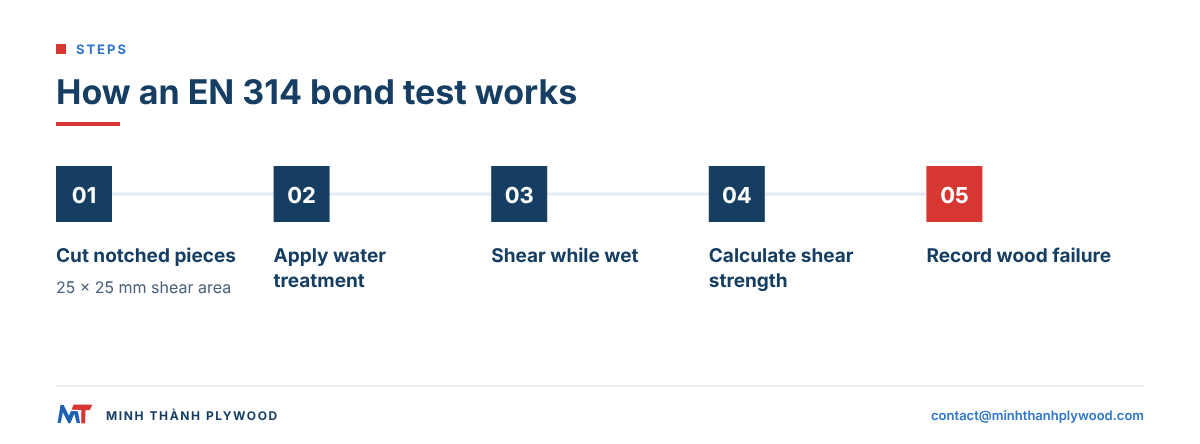
EN 314-1 tests glue lines by pulling small notched test pieces apart in shear after a water pre-treatment, then reading how much of the broken surface is wood. The procedure has five steps:
- Cut test pieces. Each piece has a shear area of 25 mm × 25 mm, with saw cuts 2.5–4 mm wide that reach into the layer between the glue lines under test. Plywood of 3 to 9 layers is tested at full thickness.
- Pre-treat in water. The pieces are soaked or boiled according to the bond class (next section).
- Shear them wet. The pieces are loaded in a tensile machine until they break, within 30 seconds or so, and the breaking load is recorded to 1 %.
- Calculate shear strength. Shear strength is the failing force divided by the shear area, in N/mm².
- Read wood failure. After drying, the broken surface is compared with the reference pictures of the standard and the apparent cohesive wood failure is recorded, in 5 % steps from 0 to 100 %.
At least ten test pieces per glue line are tested for each pre-treatment, and each pre-treatment uses its own set of ten. A mill can run the test in-house for production control; buyers usually want the report from an independent laboratory.
What pre-treatments does each bond class pass?
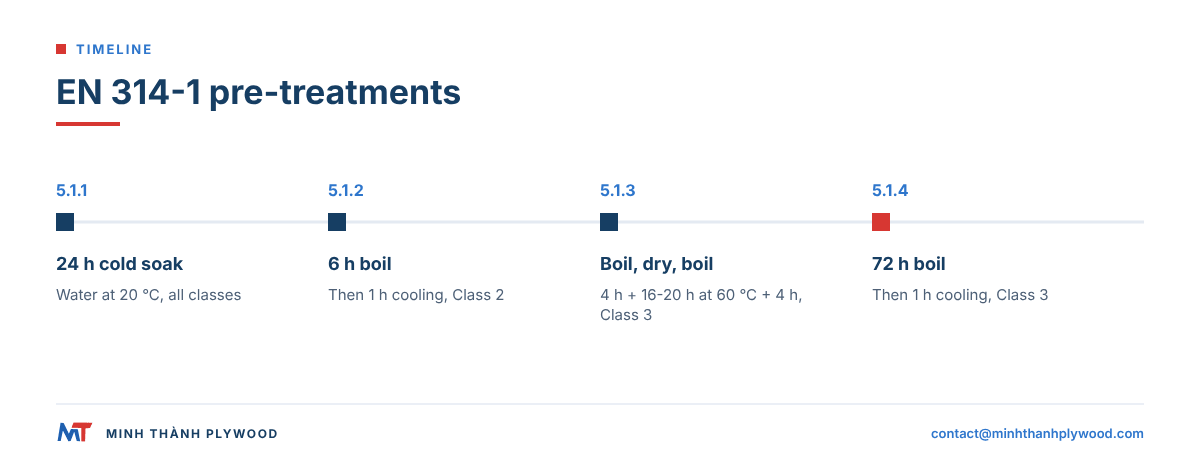
Each bond class adds harder water treatments. EN 314-1 defines four pre-treatments and EN 314-2 Table 1 assigns them to the classes:
| Pre-treatment (EN 314-1) | What happens to the test piece | Class 1 | Class 2 | Class 3 |
|---|---|---|---|---|
| 5.1.1 | Immersion for 24 h in water at 20 °C | Yes | Yes | Yes |
| 5.1.2 | 6 h in boiling water, then at least 1 h cooling in water at 20 °C | — | Yes | — |
| 5.1.3 | 4 h boiling, 16–20 h drying at 60 °C, 4 h boiling, then 1 h cooling | — | — | Yes |
| 5.1.4 | 72 h in boiling water, then at least 1 h cooling | — | — | Yes |
A footnote to the table allows a shortcut for full phenolic glue: pre-treatment 5.1.3 can be used on its own, provided the 72 h boil is run from time to time as a confirmation test. That is why many exterior plywood reports show the cyclic boil only.
What shear strength and wood failure does EN 314-2 require?
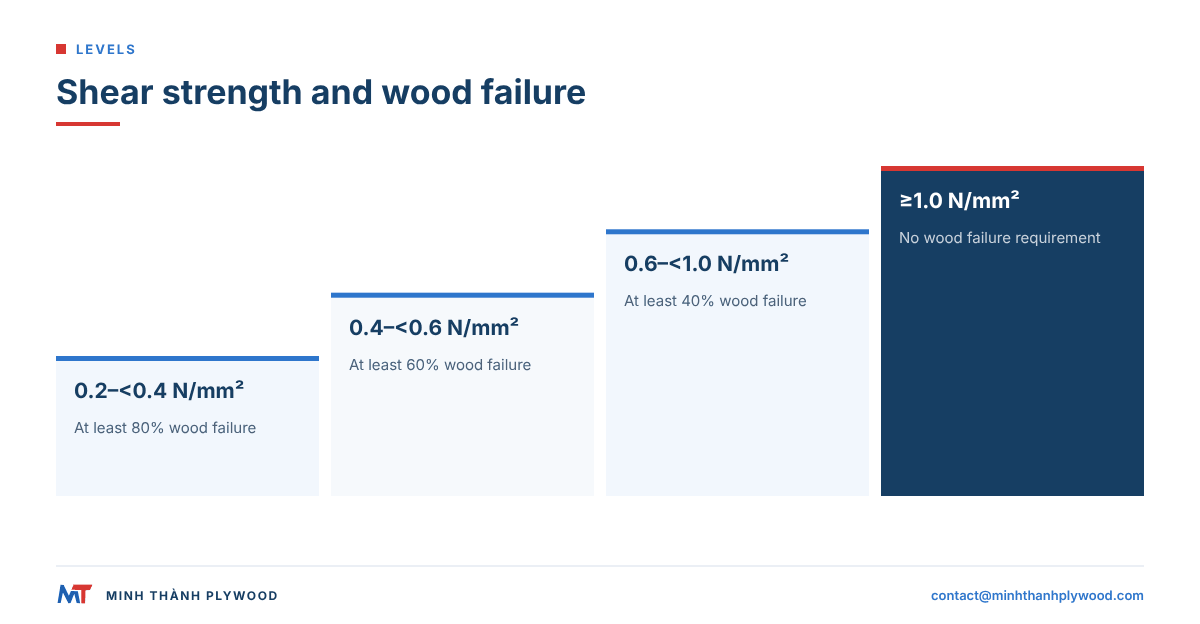
Every glue line must meet two criteria together after each pre-treatment: the mean shear strength and the mean apparent cohesive wood failure, read from one table. The weaker the bond in shear, the more wood failure it must show.
| Mean shear strength fv (N/mm²) | Mean apparent cohesive wood failure |
|---|---|
| 0.2 ≤ fv < 0.4 | At least 80 % |
| 0.4 ≤ fv < 0.6 | At least 60 % |
| 0.6 ≤ fv < 1.0 | At least 40 % |
| fv ≥ 1.0 | No requirement |
The same table applies to all three classes; what changes is the pre-treatment the pieces survive first. A glue line that shears at 0.5 N/mm² passes only if 60 % or more of the broken surface is torn wood. Below 0.2 N/mm² there is no pass at all.
This is the most common misreading in supplier pages: “minimum shear strength 1.0 N/mm²” is not a requirement of EN 314-2. At 1.0 N/mm² or above, wood failure stops mattering; below it, wood failure carries the result.
Which glue reaches which bond class?
The resin family sets the ceiling of the bond class. Pressing, spread and veneer moisture decide whether a given panel reaches it.
| Glue | Common names | Bond class it can reach | Typical plywood |
|---|---|---|---|
| Urea-formaldehyde (UF) | Interior glue, MR in some markets | Class 1 | Furniture and interior panels |
| Melamine-urea-formaldehyde (MUF) | Melamine-fortified, MR/WBP melamine | Class 2; some formulations Class 3 | Humid interiors, film-faced and exterior-type panels |
| Phenol-formaldehyde (PF) | Phenolic, WBP | Class 3 | Exterior, structural and marine plywood |
Glue and emission are two different lines. UF glue at E0 emission is a dry-interior bond with low formaldehyde release; E0, E1 and CARB P2 describe emission, not bond class. At Minh Thanh Plywood, UF glue at E0 emission is standard for furniture and interior panels, while MR/melamine-fortified and phenolic (WBP) bonds are made to the customer’s specification. Hot-press temperatures differ with the resin: about 110–120 °C for MR panels and 130–145 °C for WBP.
Why a boil test alone does not prove Class 3
A boil test is a bond test on a sample, not a bond class. A panel that survives 72 hours of boiling in a supplier’s yard has passed one old-style test; it has not been sheared, its wood failure has not been read, and the cyclic 5.1.3 treatment has not been run.
Three old tests still appear on quotations:
- “6 h boil”: the EN 314-1 5.1.2 treatment, the Class 2 test. It tells you nothing about Class 3 on its own.
- “72 h boil” or “WBP 72 h”: the traditional weather- and boil-proof test of IS 710 and the old British WBP rating. It matches the length of pre-treatment 5.1.4, but without the shear and wood failure reading it is not an EN 314-2 result.
- “Boil-proof” with no hours: a marketing word.
Ask for the EN 314 report itself: pre-treatments run, number of test pieces per glue line, mean shear strength and mean wood failure for each glue line, and the panel build tested.
What is EN 636 plywood?
EN 636 plywood is plywood specified to EN 636, the European product standard that sets requirements for plywood in dry, humid or exterior conditions, for general purpose or structural use. It ties the panel to a bond class and to dimensional, mechanical and formaldehyde requirements.
| EN 636 type | Service condition (EN 636 definition) | Bond class required | Typical uses |
|---|---|---|---|
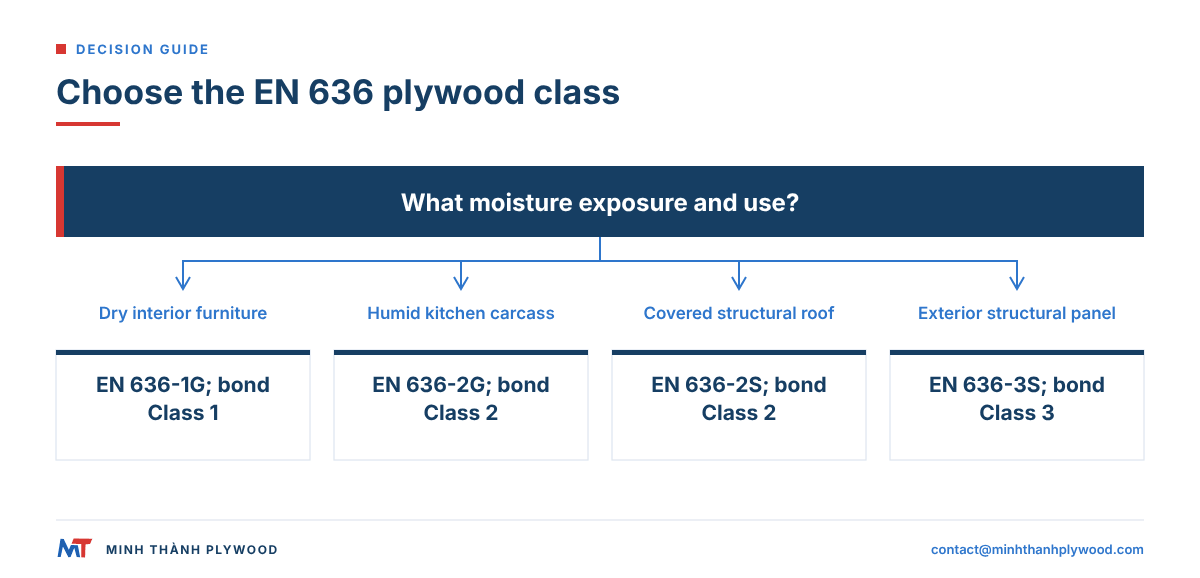
| EN 636-1 | Dry: 20 °C and air humidity above 65 % only a few weeks a year (Service Class 1) | EN 314-2 Class 1 | Furniture, interior fit-out, shelving |
| EN 636-2 | Humid: air humidity above 85 % only a few weeks a year (Service Class 2) | EN 314-2 Class 2 | Roof decking under cover, wall sheathing behind cladding, humid interiors |
| EN 636-3 | Exterior: higher moisture contents than Service Class 2 (Service Class 3) | EN 314-2 Class 3 | Exterior sheathing, formwork, trailer floors, outdoor structures |
The humidity limits are the definitions in EN 636 itself, and the service classes are those of EN 1995-1-1, the timber design code. EN 636 does not cover overlays or preservative treatment: a film face or a preservative is specified separately.
What do the G and S suffixes mean: EN 636-2S, EN 636-3S?
The letter after the EN 636 type says whether the plywood is for general purpose (G) or structural (S) use. EN 636-2S is humid-condition structural plywood; EN 636-3S is exterior structural plywood; EN 636-1G is general-purpose plywood for dry conditions.
S plywood carries bending properties that a designer can use. EN 636 classifies them by bending strength (F classes) and bending stiffness (E classes), written in the order strength along/strength across/stiffness along/stiffness across, for example F 10/20 E 30/40. Characteristic values for timber design then come from EN 12369-2 or from the manufacturer’s own testing to EN 789.
G plywood needs no structural classes. Furniture and interior panels are G panels: EN 636-1G for a dry interior, EN 636-2G for a kitchen or bathroom carcass that sees steam.
EN 636 plywood, EN 13986 and CE marking
EN 636 becomes a legal matter only when plywood is sold in the EU for construction works. Then EN 13986, the harmonised standard for wood-based panels in construction, applies: the panel needs a Declaration of Performance and CE marking, and EN 636 is the product standard EN 13986 points to for plywood. CE marking for construction products is set by the Construction Products Regulation (EU) No 305/2011.
For structural plywood the system is AVCP 2+, with a notified body certifying factory production control; non-structural construction panels follow system 4. Furniture plywood is not a construction product and carries no CE mark; its proof is the specification, the bond test and the emission certificate. CE is available* from Minh Thanh for construction orders. The full route is in EN 13986 and CE marking for plywood, and the structural mark in CE 2+ structural plywood.
*Supplied directly or through qualified partner mills.
Which EN 314-2 class and EN 636 type for each use?
Specify the lowest class that covers the worst moisture the panel will see in service, and one class higher if it will stand uncovered on site.
| Use | EN 636 type | EN 314-2 class | Glue to ask for |
|---|---|---|---|
| Wardrobes, shelves, office furniture | EN 636-1G | Class 1 | UF at E0 emission |
| Kitchen and bathroom carcasses | EN 636-2G | Class 2 | MUF (melamine-fortified) |
| Packing crates and pallets stored outdoors | EN 636-2G | Class 2 | MUF |
| Roof decking under cover, wall sheathing | EN 636-2S | Class 2 | MUF or PF |
| Concrete formwork, film-faced | EN 636-3 | Class 3 | PF or Class 3 MUF |
| Exterior sheathing, trailer floors, stair treads | EN 636-3S | Class 3 | PF (WBP) |
| Boat building | BS 1088 marine plywood | Class 3 plus durability | PF |
For boats, the glue class is only the start: see BS 1088 marine plywood for the extra requirements. For the strength values behind S panels, see plywood strength values.
Does Vietnamese plywood meet European standards?
Yes. Vietnamese mills build plywood to EN 314-2 and EN 636 specifications for European buyers every day; the class is a property of glue, press and process, not of country. What decides it is the order line and the test behind it.
Minh Thanh Plywood is built for top-grade furniture and interior plywood, with Europe as its main market, and its panels meet the emission and quality requirements European and US furniture buyers ask for. The proof sits in documents:
- Bond: UF glue at E0 emission for furniture panels; MR/melamine-fortified and phenolic (WBP) bonds to the customer’s specification for humid and exterior panels.
- Emission: CARB P2 / TSCA Title VI certification (ICTT mill no. 23024); six ASTM D6007 chamber tests between April 2025 and June 2026 on 9, 15 and 18 mm panels averaged 0.014–0.032 ppm. The limit for veneer-core hardwood plywood is 0.05 ppm under EPA’s TSCA Title VI requirements.
- Independent testing: third-party testing to the buyer’s method, EN 314 bond tests included, is arranged through SGS on request.
- Build: furniture-grade panels pressed twice, core stitched both ways, sanded faces held to ±0.2–0.3 mm, down to ±0.2 mm.
For birch-faced panels the same applies: the face species does not set the bond class; the glue line does.
How do you write EN 314-2 and EN 636 on a plywood order?
Write the bond class, the EN 636 type and the emission class as three separate lines, and name the report you expect with the shipment. A complete order line has seven parts:
- Use: for example kitchen carcasses, or exterior wall sheathing.
- Panel type: EN 636-1G, 2G, 2S, 3G or 3S.
- Bond class: EN 314-2 Class 1, 2 or 3, tested to EN 314-1.
- Glue: UF, MUF or PF.
- Emission: E0 or E1 by the named method, or CARB P2 / TSCA Title VI.
- Build: face and back grade, core species, thickness and tolerance, size (1220 × 2440 mm or 1250 × 2500 mm).
- Proof: EN 314 report from an independent laboratory, and a Declaration of Performance where the panel is a construction product.
Minh Thanh supplies furniture, MR and WBP panels in 1220 × 2440 mm and 1250 × 2500 mm and custom sizes, 3–40 mm thick, with MOQ one 40HC, mixed specifications by agreement, and free samples. Send the seven lines to contact@minhthanhplywood.com, or start from exterior plywood with WBP bond and our quality and test reports.
Buyer questions, answered
What is EN 314-2?
EN 314-2 is the European standard that sets the bonding quality requirements for veneer plywood. It defines three bond classes, Class 1, 2 and 3, and the shear strength and wood failure each glue line must reach after the matching EN 314-1 pre-treatment.
What is the difference between EN 314-1 and EN 314-2?
EN 314-1 is the test method: test piece shape, soak and boil pre-treatments, and the shear test. EN 314-2 is the requirement: which pre-treatments each bond class must pass and the shear strength and wood failure limits.
What is EN 314-2 Class 3 plywood?
Plywood whose glue lines pass the Class 3 tests: shear testing after a 24 h cold soak, after the 4 h boil, dry and boil cycle, and after a 72 h boil. It is the bond class for exterior plywood exposed to weather.
What is EN 636 plywood?
Plywood specified under EN 636, the European plywood product standard. EN 636-1 is for dry conditions, EN 636-2 for humid conditions and EN 636-3 for exterior conditions, each with a matching EN 314-2 bond class.
What does the S in EN 636-2S or EN 636-3S mean?
S marks plywood for structural use, with bending strength and stiffness declared for design; G marks general-purpose, non-structural plywood. EN 636-3S is exterior structural plywood, the usual marking on CE-marked construction panels.
Is EN 314-2 Class 3 the same as marine plywood?
No. Class 3 describes the glue line only. Marine plywood under BS 1088 also limits species, durability, veneer defects and core gaps, so a Class 3 panel with a soft core is still not marine plywood.
Is WBP the same as EN 314-2 Class 3?
WBP is the old British name for weather- and boil-proof glue, from the withdrawn BS 6566. Phenolic WBP plywood normally reaches Class 3, but the European proof is an EN 314 test report, not the word WBP.
Which glue is used for each EN 314-2 bond class?
Urea-formaldehyde (UF) glue gives Class 1, melamine-fortified UF (MUF) reaches Class 2 and some formulations Class 3, and phenol-formaldehyde (PF) glue is the standard route to Class 3.
Does EN 314-2 Class 1 plywood meet European furniture standards?
Yes, for dry interior furniture Class 1 is the bond class Europe expects. Formaldehyde emission is a separate line on the specification, proven by chamber tests such as CARB P2 / TSCA Title VI or EN 717-1.
Does EN 314-2 make plywood waterproof?
No. EN 314-2 rates how well the glue line holds after soaking and boiling. The wood itself still takes up water and can decay; durability depends on species, edge sealing and use class.