
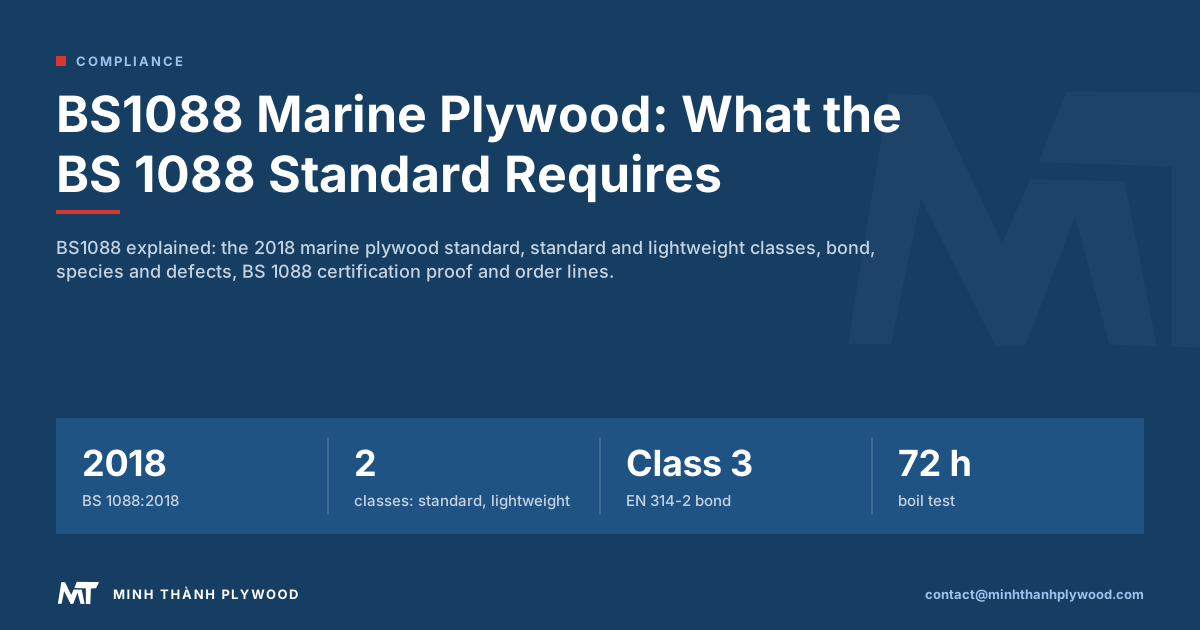
BS1088 is the British standard for marine plywood. Its 2018 edition sets two classes, standard and lightweight, chosen by veneer density and resistance to decay, with an exterior Class 3 glue line, durable veneers and tightly limited defects. A stamp alone proves little: ask for the bond report and the species record. Minh Thanh Plywood makes WBP exterior plywood for non-marine outdoor work.
What is BS1088?
BS1088 is the British Standard for marine plywood: plywood made from durable veneers, bonded with an exterior glue and free of the core gaps that let water in. The current edition, BS 1088:2018, was published by BSI on 31 August 2018 and specifies two classes, standard and lightweight, for marine craft and other marine and waterway uses, with building construction also considered.
The standard addresses two failures above all: bio-deterioration, meaning decay of the wood, and loss of bond strength with time. Everything in it serves those two points: which species may be used, how the glue line must perform and which veneer defects are allowed.
The 2018 edition replaced two parts from 2003: BS 1088-1:2003 with the requirements, and BS 1088-2:2003 with the knife test for bonding quality. Older quotations still cite “BS 1088-1:2003”; the current reference is BS 1088:2018.
What does the BS1088 marine plywood specification require?
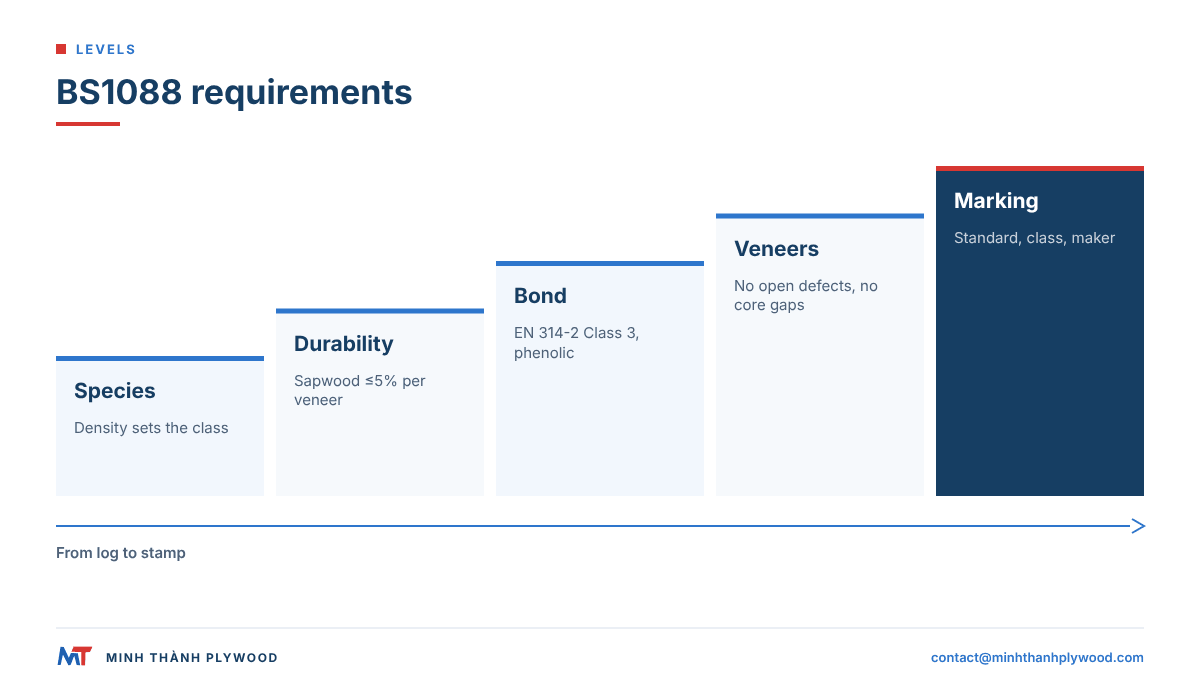
BS 1088 controls the panel from the log to the stamp. The requirements fall into five groups:
| Requirement | What BS 1088 controls | Why it matters on the water |
|---|---|---|
| Species and density | Veneer species chosen by density and resistance to bio-deterioration; standard and lightweight classes | A soft, perishable core rots from a drilled hole inward |
| Durability | Natural durability of the heartwood against fungi; the species and sapwood allowance must be checked against the relevant BS 1088:2018 provisions | Sapwood decays far faster than heartwood |
| Bond | Exterior, boil-proof glue line: EN 314-2 Class 3 performance, in practice phenolic glue | Delamination is the first failure of wet plywood |
| Veneer quality | Faces and inner plies free of open defects; core gaps and overlaps tightly limited | A gap in the core becomes a water channel and a soft spot |
| Marking | Panels identified with the standard, class and maker | The stamp links the sheet to its documents |
The standard does not provide structural design values and does not cover every property a particular use may need. A hull designer still specifies thickness, ply count and lay-up separately.
BS 1088 also sets measurable limits that a buyer can check on a delivered sheet:
| Property | BS 1088 limit |
|---|---|
| Moisture content | 6 % to 14 % when the panel leaves the factory |
| Length and width | ±3.5 mm from nominal |
| Squareness | Verify the class-specific panel tolerance under BS 1088:2018 Table 4, using BS EN 324-2 as the measurement reference |
| Face veneer thickness | Verify the finished veneer limits in BS 1088:2018 clause 4 against the actual panel construction |
| Inner and core veneer thickness | At most 4.8 mm for multi-ply panels over 3.8 mm nominal thickness |
| Thickness tolerance | By nominal thickness and sanding condition; see Table 4 of BS 1088:2018 |
The standard-specific limits must be verified in the current licensed text of BS 1088:2018 for the quoted panel build. The public standard preview confirms the edition and relevant tables but does not provide full clause-level proof for every figure shown; a seller’s table is not a substitute for lot-specific manufacturing and test records.
What is the difference between standard and lightweight BS 1088 plywood?
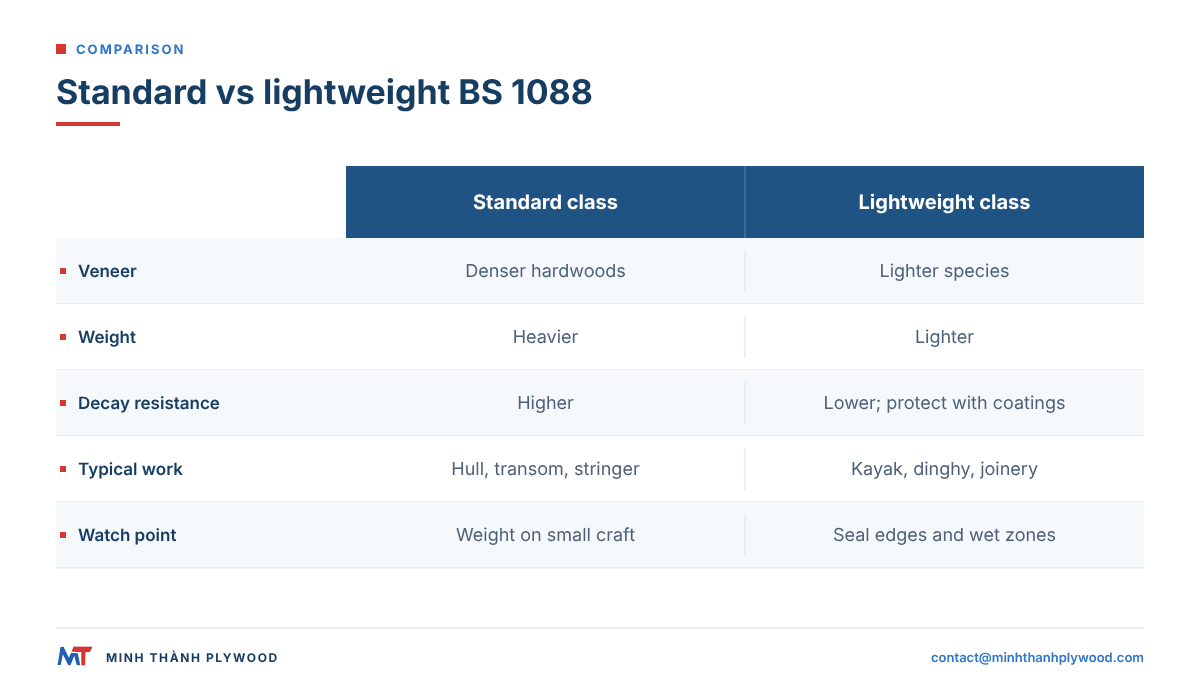
Standard-class BS 1088 plywood uses denser veneer species with higher natural resistance to decay; lightweight class uses lower-density species and saves weight. Both classes share the same bonding and defect logic; the species group is the difference, and the panel marking names the class.
| Standard class | Lightweight class | |
|---|---|---|
| Veneer species | Denser hardwoods with good natural durability | Lighter species |
| Weight | Heavier sheet | Lighter sheet |
| Resistance to decay | Higher | Lower: relies more on coating and sealing |
| Typical use | Hull planking, transoms, stringers, work boats | Kayaks, dinghies, interior joinery, panels above the waterline |
| What to watch | Weight on small craft | Edge sealing and epoxy sheathing in wet zones |
Okoume, the light West African species many builders know as “marine ply”, is the best-known light face. Mahogany-type hardwoods such as sapele and meranti are the classic denser choices. Ask which class a quotation means; “BS 1088” without a class is half a specification. The BSI listing for BS 1088:2018 names the two classes, standard and lightweight.
Which glue does BS 1088 require: WBP, phenolic, EN 314-2 Class 3?
BS 1088 plywood needs an exterior glue line that passes EN 314-2 Class 3, the bond class for sustained weather exposure; in practice that means phenol-formaldehyde (phenolic) glue. WBP, “weather and boil proof”, is the older British name for the same kind of bond.
Class 3 is tested in EN 314-1 by shearing glue lines after a 24 h cold soak, after a cycle of 4 h boiling, drying at 60 °C and boiling again, and after a 72 h boil. Each glue line must then reach the shear strength and wood failure limits of EN 314-2. The full table is in EN 314-2 bond classes and EN 636. BSI lists BS EN 314-2 as the standard for the bonding quality requirements of plywood.
A Class 3 glue line is necessary but not sufficient. Exterior plywood with phenolic glue and a soft, gappy core passes the bond test and still fails on a boat. That is the gap between WBP plywood and marine plywood.
BS 6566 plywood and the old WBP rating
BS 6566 was the old British plywood standard; its Part 8 graded bond performance as WBP (weather and boil proof), BR (boil resistant), MR (moisture resistant) and INT (interior). BS 6566 is withdrawn, and bond performance in Britain and the EU is now rated by EN 314-2 Classes 1, 2 and 3.
The old names survive in the trade:
- WBP is used today for phenolic exterior plywood, roughly the Class 3 level.
- MR is used in Asia for melamine-fortified or interior moisture-resistant glue, often Class 1 or 2.
- “BS 6566 marine plywood” is a legacy phrase: BS 6566 never defined marine plywood. Marine plywood was always BS 1088.
When a quotation says “WBP to BS 6566”, ask for an EN 314 report instead: it is the test a European or UK buyer can check.
BS 1088 vs EN 314, EN 636 and Lloyd’s Register
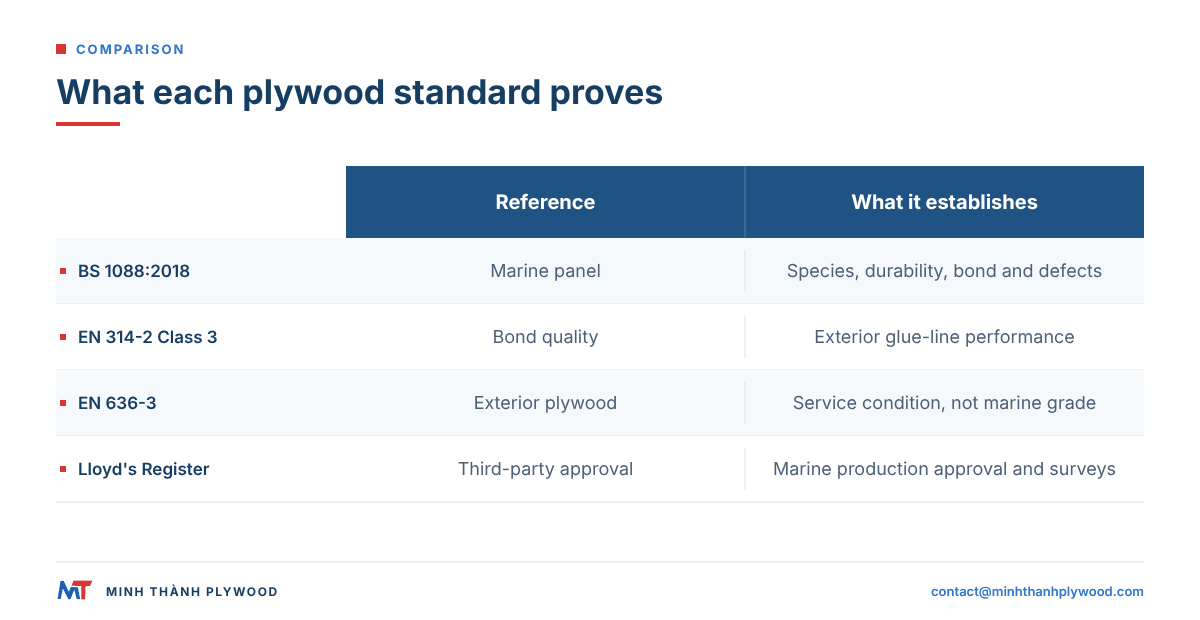
BS 1088 is the only one of these four that defines marine plywood; the others rate the bond, the panel type or the mill.
| Reference | What it covers | Does it make a panel marine plywood? |
|---|---|---|
| BS 1088:2018 | Marine plywood: species, durability, bond, veneer defects, two classes | Yes |
| EN 314-2 Class 3 | Glue line after soaking and boiling | No: bond only |
| EN 636-3 / 3S | Plywood for exterior conditions, general or structural | No: no species or core-gap rules |
| Lloyd’s Register approval | Third-party approval and surveys of a mill’s marine plywood production | Supports a BS 1088 claim with an audit |
| IS 710 | Indian marine plywood standard, 72 h boil tradition | No for UK and EU orders unless BS 1088 is also met |
For a boat builder in Europe, the pair that matters is BS 1088 for the panel and EN 314-2 Class 3 for the bond report. Construction panels sold in the EU also need EN 13986 and CE marking; a boat panel does not.
Is there BS 1088 certification?
There is no single official BS 1088 certificate that every marine plywood mill holds. A BS 1088 stamp is, in most cases, the manufacturer’s own declaration that the panel meets the standard. That is legal, and it is often true, but it is a claim until a document backs it.
Third-party BS 1088 certification exists in three forms:
- Product certification by a certification body: an auditor checks the mill’s production against BS 1088 and allows a certification mark.
- Lloyd’s Register approval: the mill’s marine plywood process is approved and surveyed, and the panels carry the approval stamp.
- Independent test reports: a laboratory tests the bond to EN 314 Class 3 and identifies the species, for a stated batch.
“Certified BS 1088” on a quotation should name one of these. If it names none, the supplier is declaring, not certifying.
How do you identify real BS1088 marine plywood?
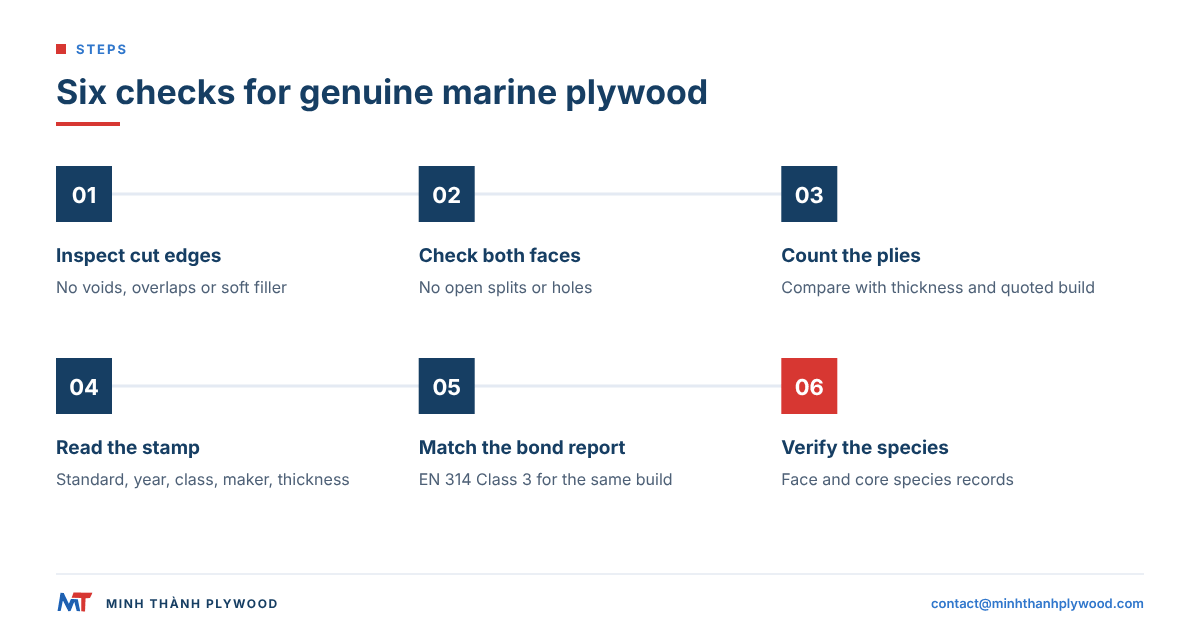
Real BS 1088 plywood shows a solid, gap-free core at every cut edge, carries a stamp that names the standard and class, and comes with a bond report and a species record. Check the sheet and the papers in six steps:
- Edge: cut or look at an edge. Every ply should be continuous, with no voids, overlaps or soft filler.
- Faces: both faces even, without open splits, holes or patches that break the surface.
- Plies: count the plies against the thickness; marine panels use more, thinner plies than packing plywood.
- Stamp: BS 1088, edition year, class (standard or lightweight), maker and thickness.
- Bond report: EN 314 Class 3, from an independent laboratory, for the same build.
- Species record: the face and core species by name, which sets the class and the durability.
A weight check helps too: a light sheet sold as “standard class” with a dense-species face may hide a light core. The marine plywood grades guide shows what a good and a bad core look like.
What BS1088 does not cover
BS 1088 does not make plywood waterproof, does not give structural design values and does not replace boat design. The glue line resists boiling; the wood still takes up water through faces, edges and screw holes.
Marine plywood therefore still needs:
- Sealed edges and holes: epoxy or a marine sealer on every cut and drilled hole.
- A coating system: paint, varnish or epoxy and glass sheathing on hulls and decks.
- Ventilation: no standing water in bilges and lockers.
- Correct thickness and lay-up: set by the designer for the loads, not by the standard.
Treat the standard as the floor of quality for the panel. Service life comes from the panel plus its finish and the way it is built in.
Marine plywood vs exterior WBP plywood: which do you need?
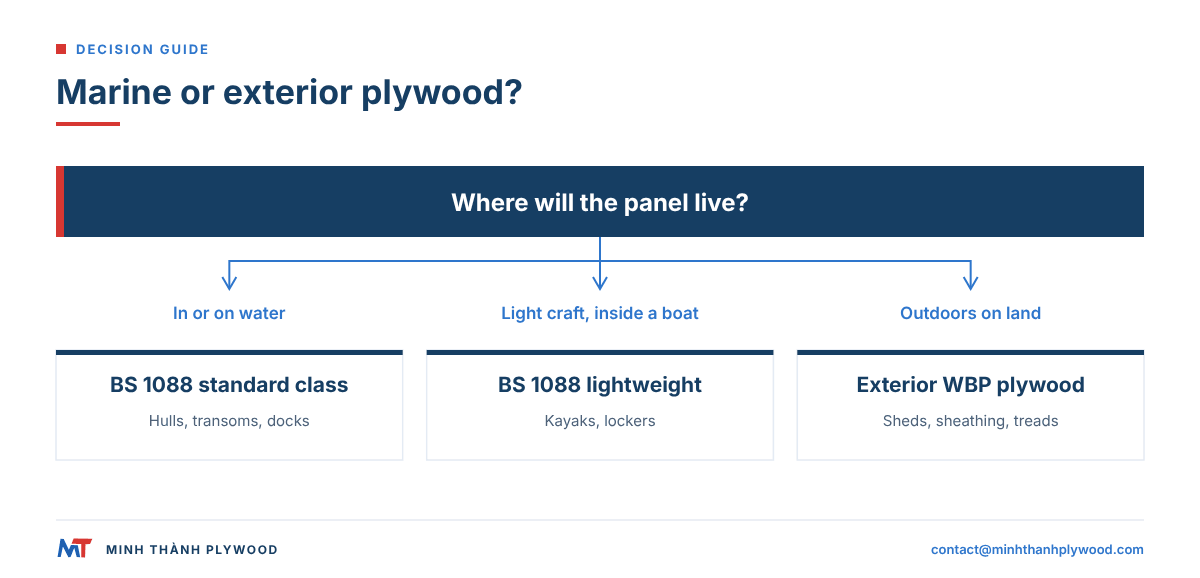
Use BS 1088 marine plywood for parts that live in or on water; use exterior WBP plywood for outdoor work on land. The glue may be the same; the core and the species are not.
| Use | Panel to specify | Why |
|---|---|---|
| Hull planking, transoms, stringers | BS 1088 standard class | Decay resistance and a void-free core under constant wetting |
| Kayaks, dinghies, light panels | BS 1088 lightweight class, epoxy sheathed | Low weight with a sealed surface |
| Boat interiors, lockers, bunks | BS 1088 lightweight class | Damp air, low weight |
| Docks and pontoon decking | BS 1088 standard class or treated structural panel | Wet, loaded, walked on |
| Garden sheds, wall sheathing, roof decks | Exterior plywood, EN 314-2 Class 3 (WBP) | Weather, not immersion |
| Stair treads, outdoor furniture, signs | Exterior plywood, phenolic glue, sealed edges | Short wet spells, then dry |
The full comparison is in marine plywood vs regular plywood.
What Minh Thanh supplies for outdoor plywood
Minh Thanh Plywood is a furniture and interior plywood manufacturer with Europe as its main market, and it does not sell marine plywood under BS 1088. For outdoor work on land it supplies exterior plywood: utility C/D faces with water-resistant melamine-fortified or phenolic (WBP) glue, for stair treads, wall sheathing and similar uses.
What the exterior order covers:
- Glue: phenolic (WBP) or melamine-fortified, to the customer’s specification; WBP panels are hot-pressed at 130–145 °C.
- Testing: third-party testing to the buyer’s method, EN 314 bond tests included, is arranged through SGS on request.
- Sizes: 1220 × 2440 mm and 1250 × 2500 mm, 3–40 mm thick, length and width to ±2 mm.
- Documents: the EUDR compliance dossier (origin records and geolocation files) with orders, for importers under Regulation (EU) 2023/1115.
Okoume-faced panels from Minh Thanh are furniture plywood and are sold as furniture plywood. Details of the outdoor range are on exterior plywood with WBP bond.
How do you write BS 1088 on a purchase order?
Write BS 1088 as a full line with edition, class, bond proof and species, so that the panel can be checked against it. A marine plywood order has seven lines:
- Standard: BS 1088:2018.
- Class: standard or lightweight.
- Species: face, back and core species by name.
- Bond: EN 314-2 Class 3, phenolic glue, report from an independent laboratory.
- Size and thickness: for example 1220 × 2440 mm, 12 mm, with ply count.
- Marking: each sheet stamped with standard, class, thickness and maker.
- Proof: certification route named (certification body, Lloyd’s Register approval or test reports), plus the EUDR dossier for EU imports.
For the full buying process, from supplier checks to inspection on arrival, read the marine plywood buying guide. For exterior plywood for work on land, send your specification to contact@minhthanhplywood.com.
Buyer questions, answered
What is BS1088?
BS 1088 is the British Standard for marine plywood. The current edition, BS 1088:2018, specifies two classes, standard and lightweight, with requirements on veneer species, resistance to decay, bonding and veneer defects.
What replaced BS 1088-1:2003?
BS 1088:2018, published on 31 August 2018. It replaced BS 1088-1:2003, the requirements part, and BS 1088-2:2003, the bonding test part, with one standard.
What is the difference between standard and lightweight BS 1088 plywood?
Standard class uses denser veneer species with higher natural resistance to decay; lightweight class uses lower-density species. The choice of species rests on density and resistance to bio-deterioration.
Is there an official BS 1088 certification?
No single certificate covers every BS 1088 panel. Most stamps are the mill's own declaration. Real proof is third-party: an EN 314 Class 3 bond report, species and durability records, or an audit of the mill's production.
Is BS 1088 marine plywood waterproof?
The glue line is boil-proof, but the wood still takes up water. Marine plywood needs sealed edges and a coating or epoxy in service; BS 1088 limits decay and delamination, not water uptake.
What is the difference between BS 1088 and BS 6566?
BS 6566 was a general plywood standard whose Part 8 rated bonds as WBP, BR, MR and INT. It is withdrawn and replaced by EN 314. BS 1088 is a product standard for marine plywood that also sets species and defect limits.
Is okoume plywood BS 1088?
Okoume can be made to BS 1088 when the panel meets the standard's species, bond and defect requirements. Okoume-faced furniture plywood with an interior glue is not marine plywood, whatever the face.
Can exterior WBP plywood replace BS 1088 marine plywood?
For sheds, sheathing, stair treads and outdoor furniture, yes. For hulls, decks and transoms, no: those parts need marine plywood with durable veneers and a void-free core.
How do I identify real BS 1088 marine plywood?
Check the edge for a solid core with no gaps, ask for the EN 314 Class 3 report and the species name, and read the stamp: standard, edition year, class and maker. A panel without papers is unproven.
What thickness does BS 1088 plywood come in?
Marine plywood is usually made from 4 mm to 25 mm, in 1220 × 2440 mm and 1250 × 2500 mm sheets. UK merchants stock full boards in 6, 9, 12, 18 and 25 mm. Thin panels such as 4 mm and 6 mm are for planking and panels, 12–18 mm for decks and bulkheads.