
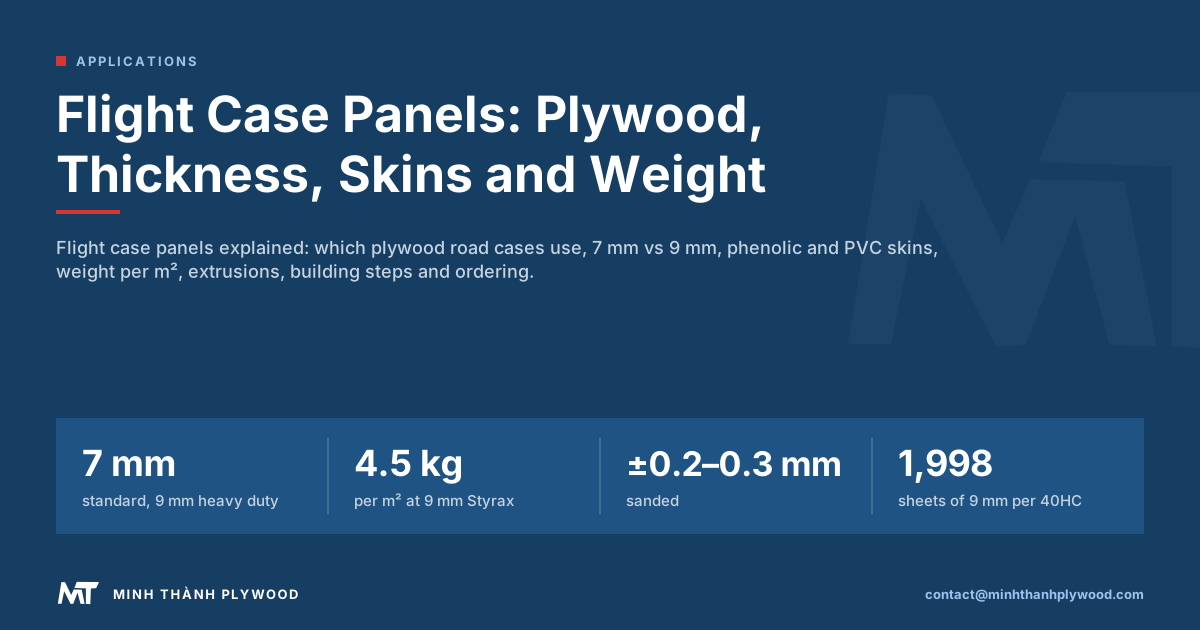
Flight case panels are thin plywood sheets, usually 7 or 9 mm, faced with a hard-wearing skin and framed with aluminium extrusions, corners and handles. Birch-faced and poplar plywood are the usual flight case wood: stiff, light and good at holding rivets. This guide compares thickness, skins, weight and alternatives. Minh Thanh Plywood makes the plywood behind these panels in Vietnam.
What are flight case panels?
Flight case panels are thin plywood sheets with a hard-wearing laminate on both faces, cut to size and framed with aluminium extrusions, steel or aluminium ball corners, recessed handles and latches. They form the walls, lid and base of road cases for audio, lighting, musical instruments and tools.
- Core: thin hardwood plywood, mostly birch-faced or poplar.
- Skin: phenolic film, PVC or ABS, usually black and textured.
- Frame: aluminium angle, hybrid or tongue-and-groove extrusions.
- Hardware: ball corners, handles, butterfly latches, hinges, castors.
The panel takes the knocks, the extrusions hold the edges together and the foam inside holds the equipment.
What plywood is used for flight cases?
Flight cases use thin hardwood plywood, mostly birch-faced or poplar, because it is stiff for its weight, holds rivets and screws close to the edge and does not crumble when struck. The panel must be all-veneer with no voids in the core.
| Flight case wood | Strengths | Limits | Typical use |
|---|---|---|---|
| Birch-faced plywood | Hard face, many thin plies, stiff | Heavier than poplar | Touring and heavy cases |
| Poplar plywood | Light, easy to cut and rivet | Softer face | Light and medium cases |
| Mixed hardwood plywood | Good balance of weight and stiffness | Look varies, hidden by the skin | General road cases |
| MDF | Smooth and cheap | Heavy, weak at rivets, swells when wet | Not recommended |
| Softwood plywood | Light | Coarse plies, voids, splits at edges | Not recommended |
The skin hides the face veneer, so case makers buy on core quality, thickness and weight rather than face appearance.
Flight case panel thickness: 7 mm or 9 mm?
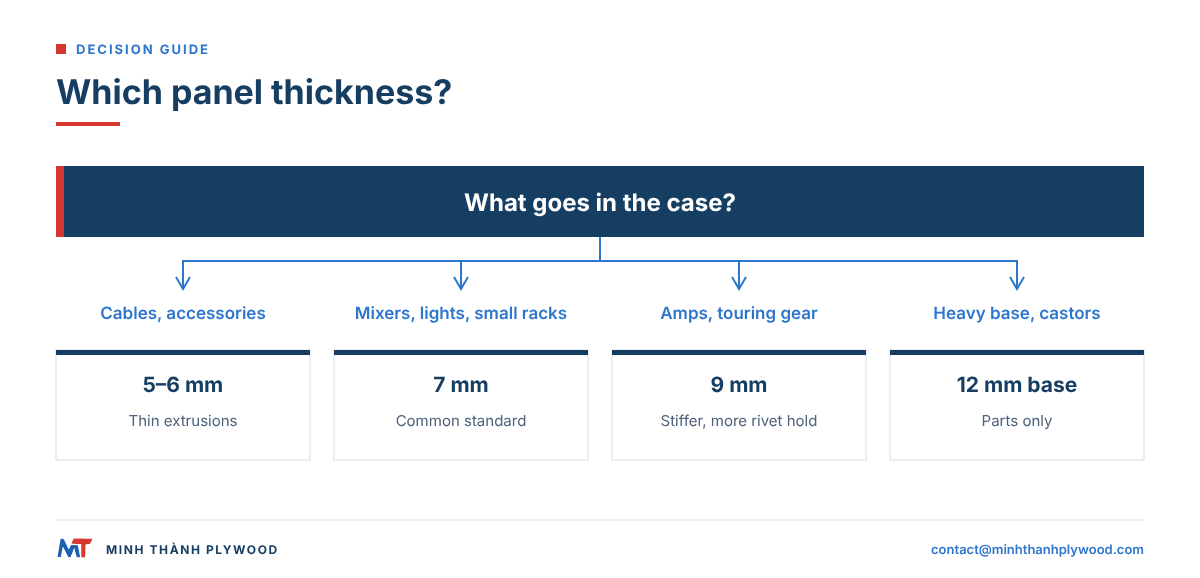
7 mm is the standard thickness for most flight case panels, and 9 mm is the choice for heavy equipment and cases that travel often. Thinner panels suit small accessory cases; thicker ones suit bases.
| Panel thickness | Typical case | Notes |
|---|---|---|
| 5–6 mm | Accessory, cable and small instrument cases | Lightest, needs matching thin extrusions |
| 7 mm | Most road cases: mixers, lights, small racks | The common standard for extrusions |
| 9 mm | Amplifier racks, touring cases, large instruments | Stiffer, heavier, more rivet hold |
| 12 mm | Bases and dividers of very heavy cases | Used in parts, not whole cases |
Extrusions are made for a panel thickness including the laminate. A 7 mm panel goes with 7 mm extrusions; mixing them leaves loose edges or panels that will not seat.
Laminate skins for road case plywood
Road case plywood is covered with a laminate that resists scuffs, moisture and impacts, and the black textured skin is the most common. The choice of skin changes the look, the durability and the price.
| Skin | Look | Durability | Notes |
|---|---|---|---|
| Phenolic film | Black or brown, textured or smooth | Hard, water-resistant | Pressed on as on film-faced plywood |
| PVC laminate | Black and colours, textured | Tough, flexible, scuff-resistant | Glued on by laminators |
| ABS laminate | Black and colours, textured | Impact-resistant | Glued on by laminators |
| High-pressure laminate (HPL) | Any colour or pattern | Hard, scratch-resistant | For display and branded cases |
| Fibreglass or aluminium skin | Industrial | Very tough | For extreme handling |
We press phenolic film on our film-faced plywood. PVC, ABS and high-pressure laminate skins are applied by specialised laminators onto plain sanded panels.
Flight case panel weight per square metre
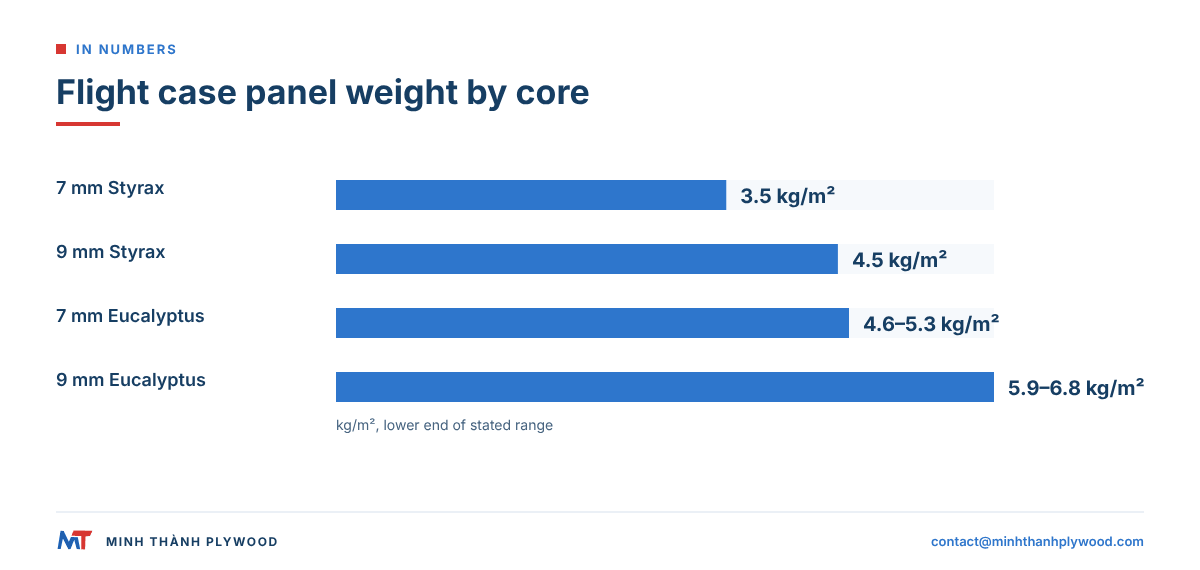
Panel weight is thickness times core density, so a lighter core gives a lighter case at the same thickness. The table uses our reference core densities, before the skin.
| Panel | Core density | Weight per m², before skin |
|---|---|---|
| 7 mm, Styrax core | 500 kg/m³ | about 3.5 kg |
| 9 mm, Styrax core | 500 kg/m³ | about 4.5 kg |
| 7 mm, Eucalyptus core | 650–750 kg/m³ | about 4.6–5.3 kg |
| 9 mm, Eucalyptus core | 650–750 kg/m³ | about 5.9–6.8 kg |
Calculation: 0.009 m × 500 kg/m³ = 4.5 kg per m². A full 1220 × 2440 × 9 mm sheet of white Styrax core weighs about 13.4 kg. The skin adds a little weight, and the extrusions and hardware add more.
A Styrax core is the light choice for cases that are lifted by hand often. A Eucalyptus core is harder and stiffer for heavy-duty bases.
Why the core matters more than the face
The core decides how well a flight case panel holds rivets and screws, resists punctures and stays flat, while the face is hidden under the skin. A void or overlap in the core shows up as a dent, a loose rivet or a bulge in the laminate.
- No voids: our core layers are stitched both horizontally and vertically, which closes gaps between core veneers.
- Flat sheets: furniture-grade panels are pressed twice, the core board first, then the faces, so the panel stays flat for laminating.
- Even thickness: sanded panels hold ±0.2–0.3 mm, so extrusions seat evenly on every edge.
- Moisture: veneers and finished panels are dried to 8–12 % moisture content at dispatch, which suits laminating.
A flat, even panel also gives a smooth laminate surface without telegraphing core joints through the skin.
Glue bond for touring cases
Touring cases face rain on loading docks, humid trucks and cold holds, so the plywood bond should resist moisture. Bonding-quality requirements for plywood are set in BS EN 314-2:1993. MR (melamine-fortified) and phenolic (WBP) bonds are made to the customer’s specification, and both hold up better than interior UF glue when a case gets wet.
- WBP phenolic bond: the safest choice for touring and outdoor work.
- MR or melamine-fortified bond: a good choice for cases kept mostly indoors.
- UF glue at E0 emission: for display and indoor cases where emission matters most.
The laminate protects the faces, but the cut edges sit under the extrusions where water can enter, so the bond matters at the edges.
Hardware: extrusions, corners and handles
Flight case hardware is sized to the panel: extrusions grip the panel edge, corners cap three extrusions where they meet, and handles and latches are recessed into the panel. The panel thickness sets which hardware fits.
| Hardware | Role | Panel point |
|---|---|---|
| Angle extrusion | Joins two panels at a corner | Sized to panel thickness |
| Hybrid or tongue-and-groove extrusion | Lid-to-body joint that seals and locates | Sized to panel thickness |
| Ball corners | Protect corners from impact | Riveted through extrusion and panel |
| Recessed handles and latches | Lifting and closing | Need a flat, void-free panel for rivets |
| Castor plates | Wheels on heavy cases | Often on a 9 or 12 mm base |
Rivets close to the panel edge are where a weak core fails first. Stitched, void-free cores give each rivet solid wood to grip.
How a flight case is built from panels
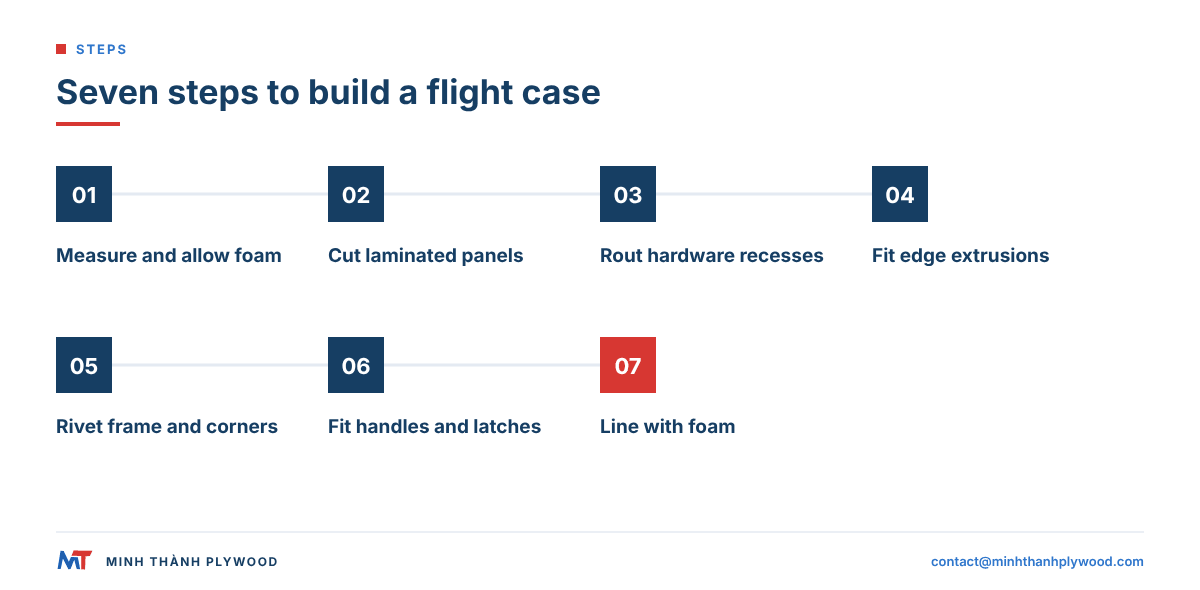
A flight case is built by cutting laminated panels to size, framing them with extrusions and riveting the hardware on. The same steps apply to a one-off case and a production run.
- Measure the equipment and add foam allowance on every side.
- Cut the panels to size on a panel saw or CNC router.
- Rout the recesses for handles, latches and connectors.
- Fit the extrusions to the panel edges and cut them to length.
- Rivet the structure: extrusions, corners and the lid joint.
- Fit the hardware: handles, latches, hinges and castors.
- Line the case with foam cut to the equipment.
Volume case makers save time by buying panels already cut to their standard sizes.
Flight case wood vs other case materials
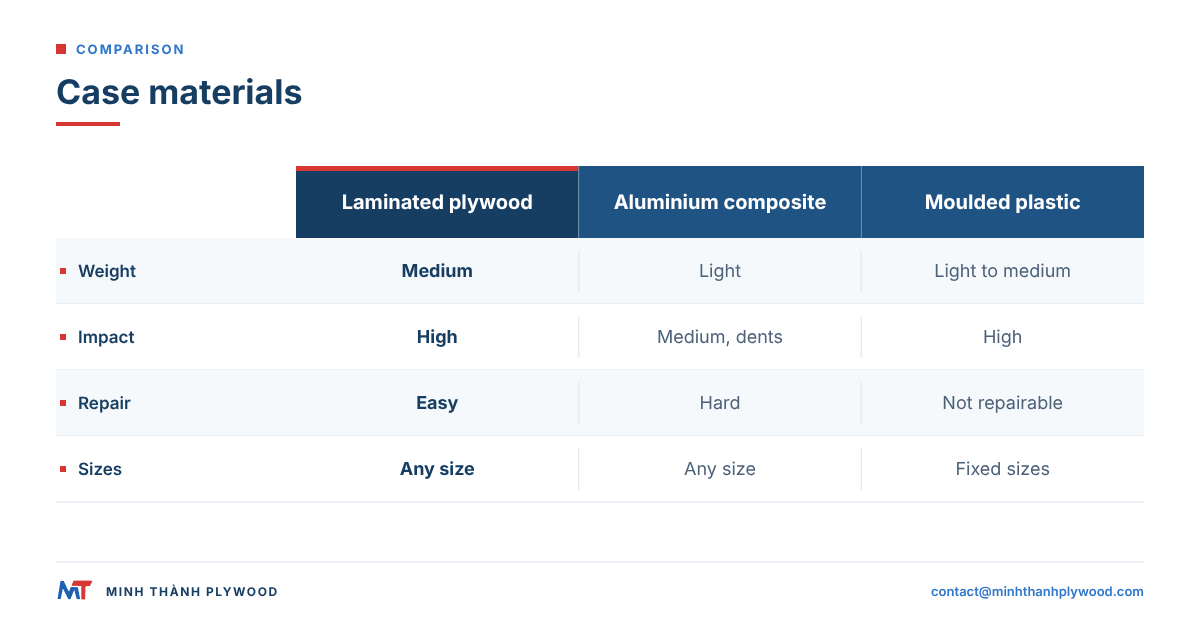
Plywood is the standard material for flight cases because it gives the best balance of stiffness, impact resistance, repairability and cost. Lighter materials exist for special cases.
| Material | Weight | Impact resistance | Repair | Cost |
|---|---|---|---|---|
| Laminated plywood | Medium | High | Easy: replace a panel or hardware | Moderate |
| Aluminium composite | Light | Medium, dents | Hard | Higher |
| Polypropylene honeycomb | Very light | Medium | Hard | Higher |
| Roto-moulded plastic | Light to medium | High | Not repairable | Tooling cost |
How does plywood compare with plastic flight case panels?
Plywood on a light core is lighter per square metre than foamed polypropylene flight case panels. Röchling’s Foamlite, a foamed plastic sold in 6–30 mm sheets, has a density of 0.65 g/cm³ (650 kg/m³) and is about 30 % lighter than compact plastic sheet.
| Panel material | Density | Weight at 7 mm | Weight at 9 mm |
|---|---|---|---|
| Plywood, white Styrax core | About 500 kg/m³ | 3.5 kg/m² | 4.5 kg/m² |
| Foamed polypropylene (Foamlite type) | 650 kg/m³ | 4.6 kg/m² | 5.9 kg/m² |
| Plywood, Eucalyptus core | About 650 kg/m³ | 4.6 kg/m² | 5.9 kg/m² |
| Birch plywood | About 680 kg/m³ | 4.8 kg/m² | 6.1 kg/m² |
Weights are density × thickness. A Styrax-core plywood case wall is about 23 % lighter than the same thickness in foamed polypropylene, and it is repaired with a rivet gun and a new panel, not a moulding tool.
Plywood also allows any case size from the same materials, while moulded cases come in fixed sizes. For more background on road cases, see the road case entry (read 20 October 2026).
Flight case panels in the UK: who buys them and what do they cost?
UK case makers buy flight case panels as laminated sheets, aluminium extrusions and hardware from case-component distributors such as Penn Elcom, Adam Hall and Swan Flight, and a distributor can import the base plywood by the container and laminate it in house. A 9 mm laminated birch sheet of 1220 × 2440 mm lists at about £156, against about £11–18 for the same size of bare 9 mm hardwood plywood.
| UK listing, 1220 × 2440 mm, 9 mm | Price per sheet | Note |
|---|---|---|
| Rigid PVC laminate on birch ply (Flight Case Fittings) | £155.66 | Laminated flight case sheet; VAT status not stated on the page |
| Hardwood ply, EN 636 grade 2 (Roofing Outlet) | £11.25 ex VAT | Bare sheet |
| Structural hardwood ply (London Building Supplies) | £18.24 inc VAT | Bare sheet |
| Minh Thanh raw FOB example | US$9.38 | Arithmetic: 0.0268 m³ at the US$350/m³ starting price; faces and skins extra |
The difference between a bare sheet and a laminated one is the skin, the press and the margin. A distributor that imports calibrated bare plywood and laminates it in house keeps that margin. Duty on Vietnam-origin birch-faced plywood is 0 % in the UK against 6 % from third countries, and VAT is 20 %.
What a UK buyer should write on the specification:
- Bond: EN 314-2 class 3 for the glue line, tested through SGS to your method on request. Touring cases see rain at loading bays.
- Moisture: 8–12 % at dispatch.
- Tolerance: ±0.2–0.3 mm on sanded panels, so the laminate bonds evenly.
- Timber due diligence: the UK Timber Regulation requires operators placing timber on the UK market to exercise due diligence. We supply origin records and geolocation files with orders, the same dossier built for the EU Deforestation Regulation. FSC-certified supply is available* on request. For an FSC order, the FSC chain of custody standard requires the seller’s certificate code and product claim on the sales documents or approved linked documents.
*Supplied directly or through qualified partner mills.
Cut-to-size panels and laminating
Case makers can order full sheets or panels cut to size, laminated or plain. Plain sanded panels go to a laminator for PVC or ABS skins; film-faced panels arrive with the phenolic skin pressed on.
- Full sheets: 1220 × 2440 or 1250 × 2500 mm, for workshops with their own saws.
- Cut to size: one panel cut into 4, 6 or 8 pieces for standard case sizes.
- Thin panels: our thin plywood from 3 to 5 mm is always 5-ply, for light cases and dividers.
- Plain sanded: calibrated faces ready for a laminator.
We cut panels to size, one panel into 4, 6 or 8 pieces, and ship cut-to-size panels regularly to Italy and other European markets.
Packing and container loading
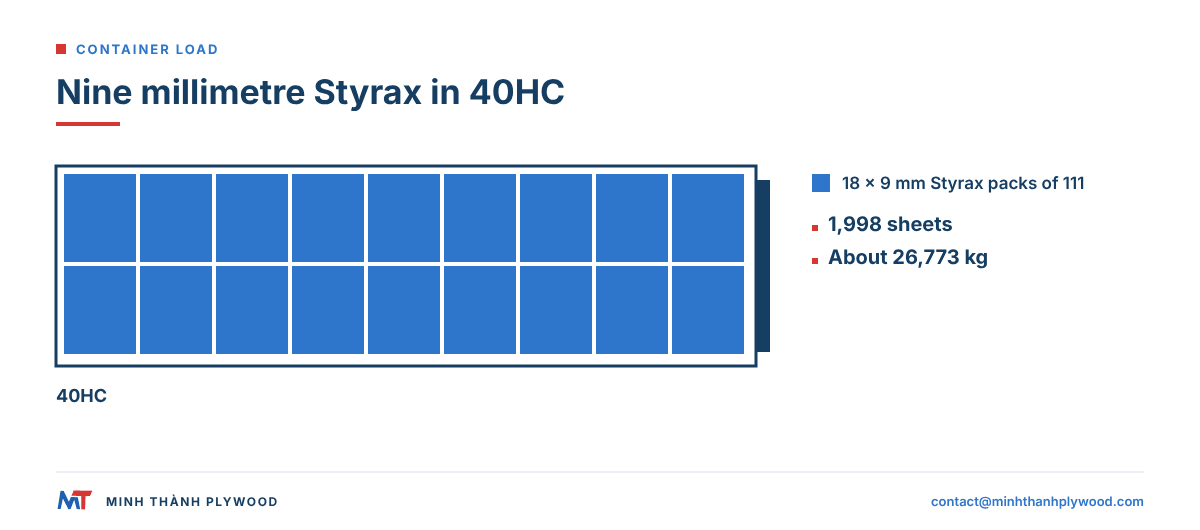
Thin panels load many sheets per container, so weight, not space, often sets the limit. In our 40HC plan for 1220 × 2440 mm sheets, packs are about one metre high and the sheet count per pack is the pack height divided by the thickness, then capped by weight.
| Panel | Sheets per pack | Packs | Sheets per 40HC |
|---|---|---|---|
| 9 mm, Styrax core | 111 | 18 | 1,998 |
| 12 mm, Styrax core | 83 | 18 | 1,494 |
At 9 mm, 1,998 sheets of about 13.4 kg each weigh about 26,773 kg, inside the 28,000 kg planning payload. Mixed specifications, such as 7 mm panels with a 9 mm base stock, go in one container by agreement.
Common flight case panel faults and how to avoid them
Most flight case panel faults start in the plywood core or the laminate bond, and a good panel specification prevents them before the case is built. The table lists what case makers see and where it comes from.
| Fault | Where it comes from | How to avoid it |
|---|---|---|
| Rivets pulling out near the edge | Core void or soft core under the rivet | Void-free, stitched core; 9 mm for heavy hardware |
| Laminate bubbles or lifts | Damp panel, dust, uneven face | Dry, sanded panel; clean face before laminating |
| Panel bulges under the skin | Overlapping core veneers | Calibrated core board, pressed twice |
| Lid does not close evenly | Panels of different thickness | Sanded tolerance of ±0.2–0.3 mm |
| Edges swell after rain | Interior glue at the cut edge | Phenolic (WBP) or MR bond, sealed edges |
| Panel twists after cutting | Uneven moisture | Panels at 8–12 % moisture content |
Each of these faults costs more to repair on a finished case than it costs to prevent in the panel order. A sample panel from the batch, laminated and riveted in your own workshop, is the quickest test before a full container.
What this means for your order
For flight case panels, order by thickness, core and bond first, then size and skin. Send these lines with your request:
- Application: road or flight case walls, lids or bases.
- Core: white Styrax for light cases, Eucalyptus for heavy-duty bases.
- Glue: phenolic (WBP) or MR bond for touring cases.
- Face: film-faced phenolic, or plain sanded for your laminator.
- Thickness and size: 7 mm, 9 mm or 12 mm; full sheets or cut to size.
- Packing and quantity: from one 40HC, mixed specifications by agreement.
Production takes 15–45 days after the deposit, and free samples are available. See thin plywood and film-faced plywood, and read plywood stage flooring and plywood for signs.
Buyer questions, answered
How much does a 9 mm flight case sheet cost in the UK?
A laminated 9 mm birch sheet of 1220 × 2440 mm lists at about £156 in the UK in October 2026, while bare 9 mm hardwood plywood of the same size is about £11–18. The difference is the laminate and its pressing.
What plywood is used for flight cases?
Flight cases use thin hardwood plywood, mostly birch-faced or poplar, in 7 or 9 mm, laminated with a phenolic, PVC or ABS skin. The core must be free of voids so rivets and screws hold.
What thickness are flight case panels?
7 mm is the standard for most road cases, 9 mm for heavy equipment and touring cases, and 5–6 mm for light accessory cases. Bases of very heavy cases can use 12 mm.
Is 7 mm or 9 mm better for a flight case?
7 mm is lighter and enough for most cases up to the size of a large mixer case. 9 mm is stiffer and better for heavy amplifiers, racks and cases that travel often by truck and air.
What is road case plywood covered with?
Usually a black textured phenolic film, PVC or ABS laminate. High-pressure laminate, fibreglass and aluminium skins are used for special cases.
How much does a flight case panel weigh?
A 9 mm panel on a Styrax core weighs about 4.5 kg per square metre before the skin; on a Eucalyptus core about 5.9–6.8 kg. A 7 mm Styrax-core panel weighs about 3.5 kg per square metre.
Can I use MDF for a flight case?
MDF is too heavy for its strength and holds rivets and screws poorly at case-panel thickness. It also swells if it gets wet, so case makers use plywood.
Do flight case extrusions fit any panel?
No. Aluminium extrusions are made for a panel thickness, usually 7 or 9 mm including the laminate. Order the panel and the extrusion for the same thickness.
What is the difference between a flight case and a road case?
The terms are used for the same product: a plywood case with aluminium edges, corners and latches for transporting equipment. Some makers reserve flight case for cases built to airline transport specifications.
Can flight case panels be cut to size at the mill?
Yes. Panels can be cut to size from full sheets, which saves sawing for case makers who build standard case sizes in volume.