
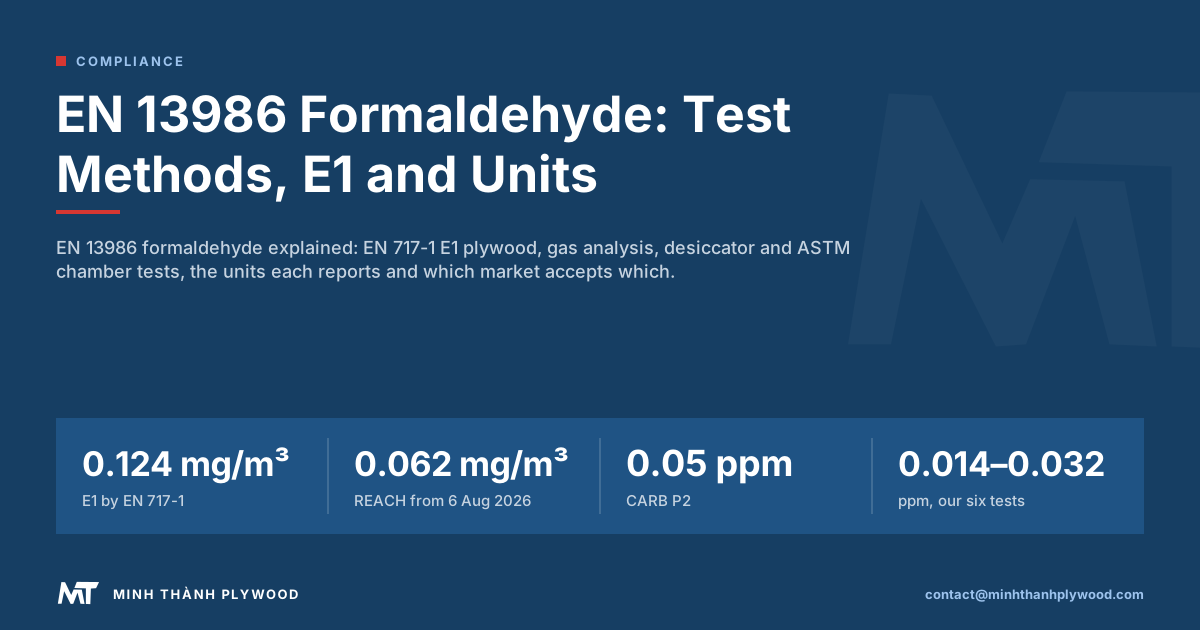
EN 13986 formaldehyde classes are set by a chamber test, EN 717-1: a plywood panel is class E1 when the steady air concentration stays at or below 0.124 mg/m³. Other methods report other units and serve other markets. Minh Thanh Plywood tests its panels by ASTM chamber and arranges EN 717-1 tests on request; this guide maps every method, unit and limit.
What does EN 13986 say about formaldehyde?
EN 13986 is the European standard for wood-based panels used in construction, and it sorts them into two formaldehyde classes, E1 and E2. For plywood, class E1 means the EN 717-1 chamber test gives a steady-state formaldehyde concentration of 0.124 mg/m³ or less; a higher result is E2.
The standard sets two layers of testing. The class is first proved by the chamber test on the product type. After that, the mill controls each production run with a faster derived method, such as gas analysis for plywood, calibrated against the chamber result.
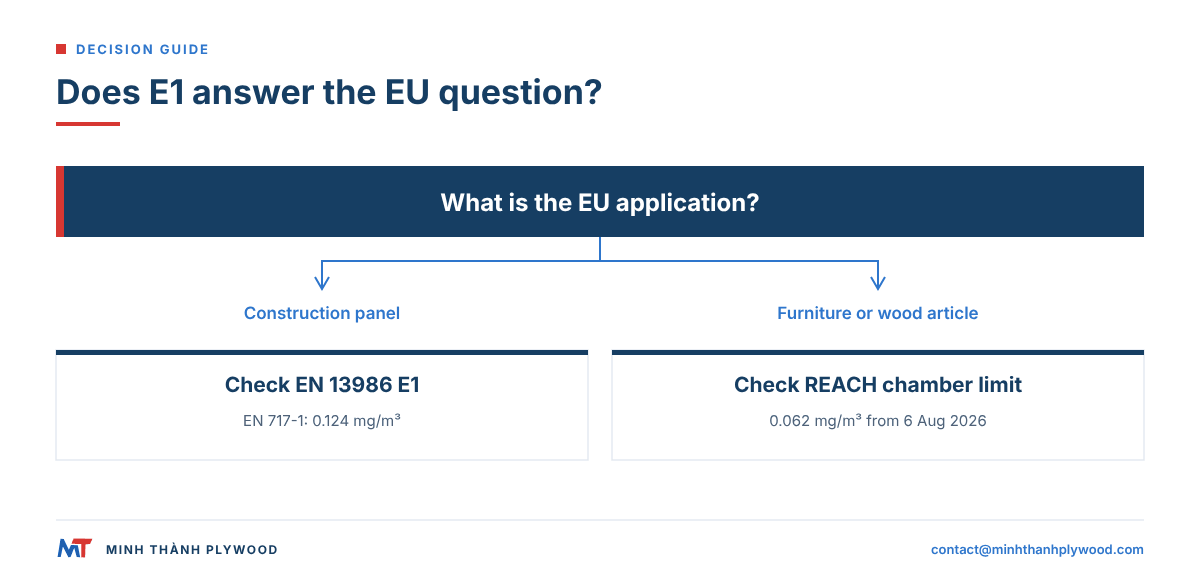
EN 13986 is the harmonised standard behind CE marking of construction panels. That marking falls under the Construction Products Regulation (EU) No 305/2011. Its formaldehyde class is one of the characteristics the maker declares. Furniture panels are not construction products, so the same E1 class reaches them through buyer specifications and, since August 2026, through EU REACH. The rest of the CE declaration covers bond quality, strength and reaction to fire.
EN 717-1 E1 plywood: what does the chamber test measure?
The EN 717-1 test measures the formaldehyde concentration in the air of a ventilated chamber holding panel samples, and E1 plywood is plywood that keeps that concentration at or below 0.124 mg/m³ once it is steady. It is the reference method: every other European method is checked against it.
The chamber runs at 23 °C and 45% relative humidity, with one square metre of panel surface per cubic metre of chamber and one air change per hour. The edges of the samples are partly sealed, so the result reflects the faces as they would sit in a room. Air is sampled until the concentration stops falling, which can take days to weeks.
Because the test copies room conditions, its result in mg/m³ reads directly as indoor air. That is why EU REACH uses chamber conditions of the same kind for its new limit. It is also why the test is slow and costly, and why mills use derived methods for daily control.
Which formaldehyde test methods are used for plywood?
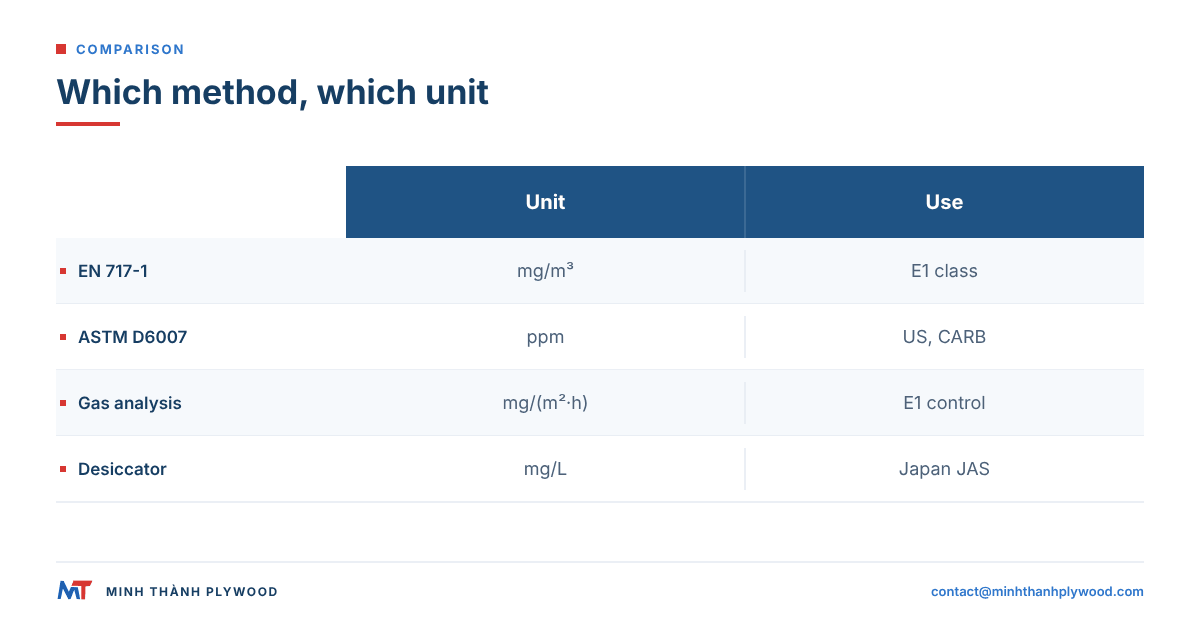
Plywood is tested for formaldehyde by four main kinds of method: chambers (EN 717-1, ASTM E1333, ASTM D6007), gas analysis (EN ISO 12460-3), the desiccator (JIS A 1460 and ISO 12460-4) and, for content rather than emission, the perforator, which is meant for particleboard and MDF. Each reports a different unit.
| Method | What it measures | Unit | Typical use for plywood |
|---|---|---|---|
| EN 717-1 chamber | Steady air concentration in a ventilated chamber | mg/m³ | Proving the EN 13986 class; REACH conditions |
| ASTM E1333 large chamber | Air concentration in a large chamber | ppm | US and CARB reference method |
| ASTM D6007 small chamber | Air concentration in a small chamber, correlated to E1333 | ppm | US certification and quarterly tests |
| EN ISO 12460-3 gas analysis (formerly EN 717-2) | Emission rate from a heated sample with edges sealed | mg/(m²·h) | Factory production control of E1 plywood |
| JIS A 1460 / ISO 12460-4 desiccator | Formaldehyde absorbed in water under a bell jar | mg/L | Japan (JAS F-star grades) and Australia |
| EN 717-3 flask | Formaldehyde released into water from small pieces | mg/kg | Quick factory checks |
| EN ISO 12460-5 perforator (formerly EN 120) | Formaldehyde content extracted by solvent | mg/100 g | Particleboard and MDF, not plywood |
Results from different rows cannot be swapped. Each method has its own sample, climate and unit, and each regulation names the method its limit is written in.
What do the units mean: mg/m³, ppm, mg/(m²·h), mg/L and mg/100 g?
The units tell you what each method measured: mg/m³ and ppm are concentrations in chamber air, mg/(m²·h) is a rate leaving each square metre of panel, mg/L is formaldehyde caught in water, and mg/100 g is formaldehyde held inside the board. Only the first two describe the same thing.
- mg/m³: milligrams of formaldehyde per cubic metre of chamber air. European and Chinese limits use it.
- ppm: parts per million by volume in chamber air. US limits use it.
- mg/(m²·h): milligrams leaving one square metre of panel per hour in gas analysis. The E1 control value for plywood is 3.5 mg/(m²·h).
- mg/L: milligrams per litre of water that absorbed the formaldehyde in a desiccator. Japanese grades use it.
- mg/100 g: milligrams extracted from 100 g of dry board by the perforator. The E1 value for particleboard and MDF is 8 mg/100 g.
A mill that quotes “E1” in mg/(m²·h) or mg/100 g is quoting a control result. Ask for the chamber result behind it if your market needs the class proved.
How do you convert ppm to mg/m³?
To convert formaldehyde from ppm to mg/m³, multiply by about 1.24; to go from mg/m³ to ppm, divide by 1.24. The factor is the molar mass of formaldehyde, 30.03 g/mol, divided by the volume of one mole of air at 23 °C and normal pressure, about 24.3 litres.
| ppm | mg/m³ at 23 °C | Where the value appears |
|---|---|---|
| 0.020 | 0.025 | Chinese ENF grade, GB/T 39600 |
| 0.040 | 0.050 | Chinese E0 grade, GB/T 39600 |
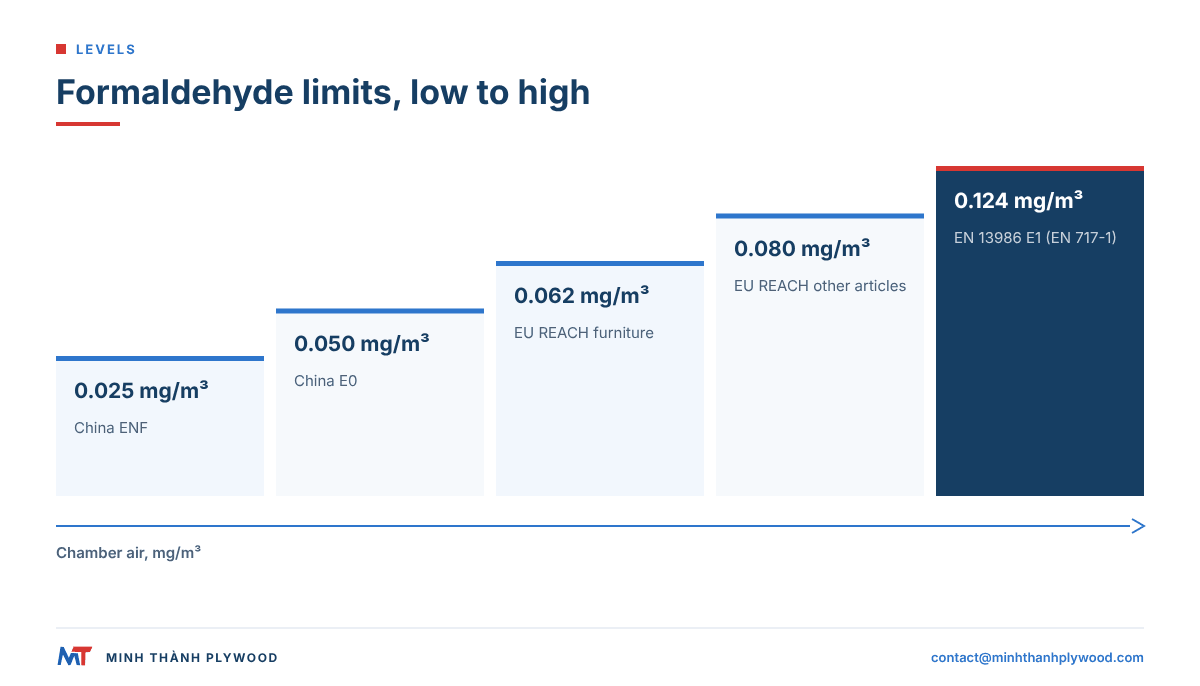
| 0.050 | 0.062 | CARB Phase 2 / TSCA Title VI for veneer-core hardwood plywood; EU REACH limit for furniture and wood-based articles |
| 0.065 | 0.080 | EU REACH limit for other articles |
| 0.100 | 0.124 | EN 13986 class E1; Chinese E1 grade |
The arithmetic converts units, not methods. An ASTM chamber result in ppm and an EN 717-1 result in mg/m³ come from different chambers, loadings and climates, so a result that converts below a European limit has not been tested against it. Each market’s rule is met with the method that rule names.
Desiccator, gas analysis and perforator results have no unit conversion to air concentration. Labs relate them to chamber results by testing the same panels both ways.
Which method does each market accept?
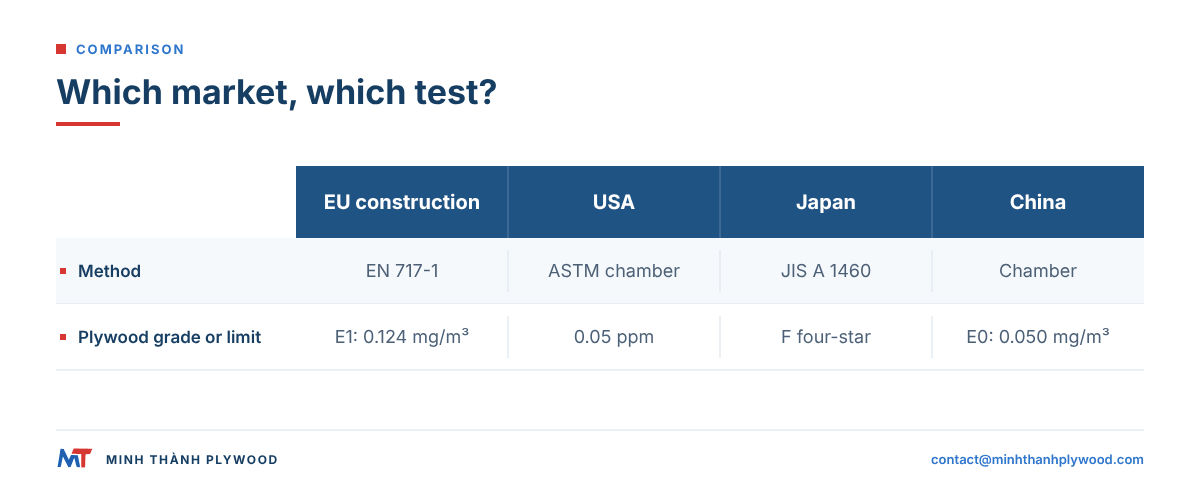
Each market writes its formaldehyde limit in its own method: Europe in EN 717-1 or REACH chamber terms, the US in ASTM chamber terms under TSCA Title VI, Japan in desiccator terms under JAS, and China in its own chamber terms. Order the test your destination names.
| Market | Rule | Method | Limit for plywood |
|---|---|---|---|
| EU, construction panels | EN 13986, CE marking | EN 717-1 chamber; gas analysis for production control | E1: 0.124 mg/m³ |
| EU, furniture and wood-based articles | REACH Annex XVII entry 77, from 6 August 2026 | Chamber under REACH Appendix 14 conditions | 0.062 mg/m³ |
| USA | TSCA Title VI, matching CARB Phase 2 | ASTM E1333 or ASTM D6007 | 0.05 ppm, veneer-core hardwood plywood |
| Japan | JAS for plywood | Desiccator, JIS A 1460 | F four-star: mean 0.3 mg/L, max 0.4 mg/L |
| China | GB 18580 and GB/T 39600 | Chamber | E1: 0.124 mg/m³; E0: 0.050 mg/m³ |
REACH entry 77 comes from Commission Regulation (EU) 2023/1464, checked on 20 October 2026. The US limits are on the EPA formaldehyde emission standards page and the CARB composite wood products programme.
What changed in EU formaldehyde rules in August 2026?
From 6 August 2026, EU REACH bars furniture and wood-based articles from the EU market when their formaldehyde emission exceeds 0.062 mg/m³ under the chamber conditions of REACH Appendix 14; other articles have a limit of 0.080 mg/m³. Road vehicle interiors follow from 6 August 2027.
The new limit is half the old E1 line in mg/m³. A furniture panel that meets E1 at 0.110 mg/m³ meets EN 13986 and still fails REACH for a cabinet sold in the EU. That moves the question for European furniture buyers from “is it E1?” to “what is its chamber result?”.
The rule has exceptions, including articles used only outdoors. Because it applies to the finished article, coatings, edges and assembly also shape the result. Third-party testing to the REACH or EN 717-1 method is arranged through SGS on request.
What are E0, Super E0 and ENF?
E0, Super E0 and ENF are market and national grades below E1, not classes of EN 13986. Their limits differ by country and by method, so an E0 figure is only clear when the method and unit are written next to it.
In China, GB/T 39600 defines E0 as 0.050 mg/m³ and ENF as 0.025 mg/m³ in a chamber. In other markets, “E0” is often used for panels near the Japanese four-star grade or near CARB Phase 2. Some suppliers write “Super E0” for results below their own E0 line.
Glue and emission are two separate lines on a specification. Our furniture panels use UF glue at E0 emission: the resin is urea formaldehyde, and the emission grade is set by the formulation and the test. The E0 and E1 emission page sets out how we test them.
How does the US CARB and TSCA test work?
The US test measures formaldehyde in chamber air in ppm: the ASTM E1333 large chamber is the reference, and the ASTM D6007 small chamber is accepted when correlated to it. Hardwood plywood with a veneer core must not exceed 0.05 ppm under TSCA Title VI, which matches CARB Phase 2.
Mills are certified through a third-party certifier approved by CARB and the EPA. The certifier tests panels, audits the mill’s quality control and assigns a mill number that goes on the panel label. Panels for US orders carry the TSCA Title VI label with producer, lot, certifier number and the words “TSCA Title VI compliant”.
Our certification is CARB P2 / TSCA Title VI, ICTT mill no. 23024, with ICTT as certifier TPC-43. The scope is hardwood plywood with a veneer core, 3–50 mm. Read our CARB P2 and TSCA Title VI page for the label and documents.
What results does Minh Thanh Plywood have?
Six ASTM D6007 chamber tests between April 2025 and June 2026, on 9, 15 and 18 mm panels, averaged 0.014–0.032 ppm against the 0.05 ppm CARB Phase 2 / TSCA Title VI limit for veneer-core hardwood plywood. Three were run by Shanghai Hongjun and three by ICTT Vietnam.
| Report | Laboratory | Method |
|---|---|---|
| HJ-QAT-250597 | Shanghai Hongjun | ASTM D6007 |
| HJ-QAT-251303 | Shanghai Hongjun | ASTM D6007 |
| HJ-QAT-261036 | Shanghai Hongjun | ASTM D6007 |
| ICTTVN-QAT-250841 | ICTT Vietnam | ASTM D6007 |
| ICTTVN-QAT-251173 | ICTT Vietnam | ASTM D6007 |
| ICTTVN-QAT-260272 | ICTT Vietnam | ASTM D6007 |
These are results on the tested samples, by the method named. E0 emission is tested periodically, every three months, and the panels meet the emission requirements European and US furniture buyers ask for. Where a European buyer needs EN 717-1 or the REACH chamber method, third-party testing is arranged through SGS on request.
Which labs test plywood formaldehyde in Vietnam?
Plywood formaldehyde in Vietnam is tested by CARB- and EPA-recognised certifiers such as ICTT Vietnam for the US route, and by international inspection groups such as SGS for European and buyer-named methods. A buyer should check that the laboratory is accredited for the exact method on the report.
ICTT Vietnam runs ASTM D6007 chamber tests and is the certifier, TPC-43, for our CARB P2 / TSCA Title VI certification. Three of our six chamber reports come from its laboratory. SGS arranges tests to EN 717-1, REACH conditions or another method the buyer names.
Accreditation is method by method. A laboratory accredited for ASTM D6007 is not, by that alone, accredited for EN 717-1. Ask for the accreditation scope that lists the method on your report.
How do you read a formaldehyde test report?
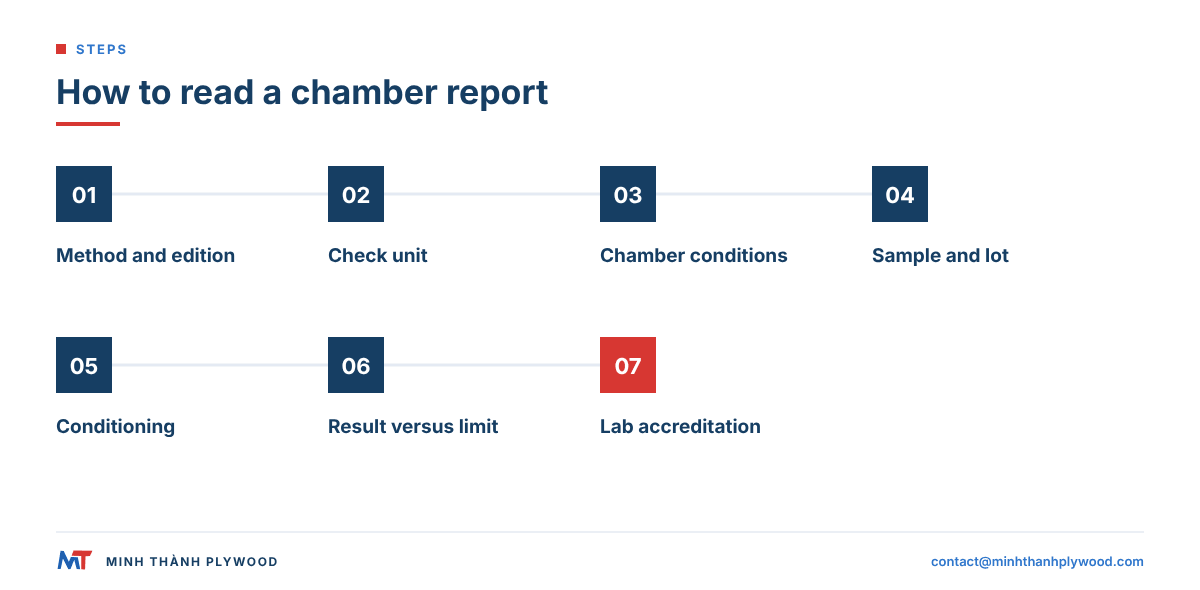
Read a formaldehyde test report from the method down: the method and edition, the unit, the chamber conditions, the sample identity, the conditioning, the result against the limit, and the laboratory. A number without these lines cannot be compared with anything.
- Method and edition: EN 717-1, ASTM D6007, JIS A 1460 or another, with the year.
- Unit: mg/m³, ppm, mg/(m²·h), mg/L or mg/100 g, matching the method.
- Conditions: temperature, humidity, loading and air change for a chamber test.
- Sample: thickness, faces, core, glue, production date and lot.
- Conditioning: how long the samples were stored and sealed before the test.
- Result: the value at steady state, or the mean of the series, and the limit it is compared with.
- Laboratory: name, report number and accreditation for the method.
Glue and emission belong on the same report but on separate lines. “UF resin at E0 grade” names both.
What should you write on a plywood order for formaldehyde?
Write the market, the method, the limit and the evidence on the order, as separate lines from the glue. A furniture order from Minh Thanh Plywood for the EU reads like this:
Furniture plywood, 18 mm, 1220 × 2440 mm, birch faces D+/D, Styrax core, UF glue at E0 emission, CARB P2 / TSCA Title VI certified, SGS test to EN 717-1 on the shipped lot for the EU REACH limit of 0.062 mg/m³, one 40HC, CIF destination port.
For the US, replace the SGS line with the TSCA Title VI label on each panel and the compliance statement on the invoice and B/L. MOQ is one 40HC with mixed specifications by agreement; production takes 15–45 days after the 30% deposit.
Our furniture plywood page lists the faces and cores. Send your specification through it and we reply within hours.
Buyer questions, answered
What is the EN 13986 formaldehyde limit for E1 plywood?
Under EN 13986, plywood is formaldehyde class E1 when the EN 717-1 chamber test gives a steady-state concentration of 0.124 mg/m³ or less. Production is then controlled with a faster derived method such as gas analysis.
What is the EN 717-1 test?
EN 717-1 is the European chamber method for formaldehyde emission from wood-based panels. Panel samples sit in a ventilated chamber at 23 °C and 45% relative humidity until the air concentration is steady, and that concentration is reported in mg/m³.
Is E1 0.1 ppm?
Approximately. The E1 limit of 0.124 mg/m³ works out to about 0.1 ppm at 23 °C. The European class is defined in mg/m³ by EN 717-1, so a ppm figure from another method does not set the class.
How do I convert ppm to mg/m³ for formaldehyde?
Multiply ppm by about 1.24 to get mg/m³ at 23 °C and normal pressure, and divide by 1.24 to go back. The arithmetic converts units only; each regulation still names its own test method.
Is E0 an EN 13986 class?
No. EN 13986 has the classes E1 and E2. E0 is a market and national term with different limits by country and method, so an E0 figure should always state the method behind it.
Which formaldehyde test does the US require for plywood?
The US requires TSCA Title VI certification, which matches CARB Phase 2: hardwood plywood with a veneer core must emit no more than 0.05 ppm, tested by the ASTM E1333 large chamber or the ASTM D6007 small chamber.
Can the perforator method be used for plywood?
No. The perforator method measures formaldehyde content in particleboard and MDF in mg per 100 g of board. Plywood is classed by the chamber method and controlled by gas analysis.
What is the new EU formaldehyde limit for furniture?
From 6 August 2026, REACH entry 77 bars furniture and wood-based articles from the EU market if they emit more than 0.062 mg/m³ under its chamber conditions; other articles have a limit of 0.080 mg/m³.
Which labs test plywood formaldehyde in Vietnam?
Our six ASTM D6007 chamber reports come from ICTT Vietnam and Shanghai Hongjun. Third-party testing to a European method such as EN 717-1 is arranged through SGS on request.
What does the JAS F four-star rating mean?
It is the top Japanese formaldehyde grade for plywood, measured by the desiccator method in mg/L. The four-star grade allows a mean of 0.3 mg/L and a maximum of 0.4 mg/L.