
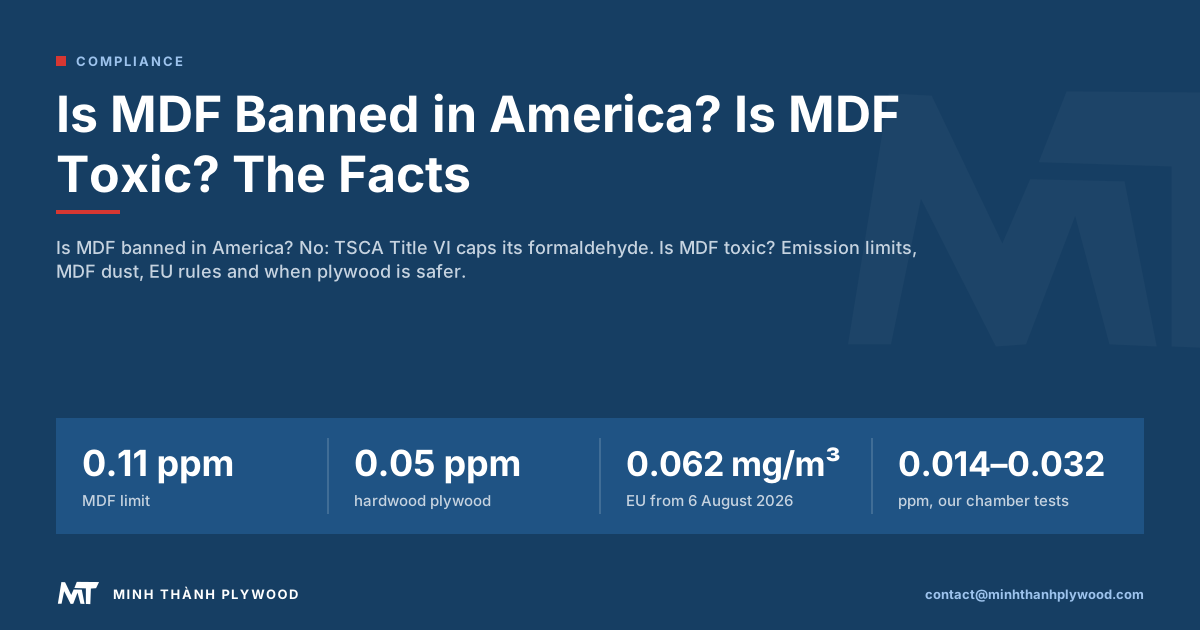
MDF is not banned in America. It is regulated: since 2018 every MDF panel sold in the US must meet the TSCA Title VI formaldehyde limit of 0.11 ppm and carry a compliance label. MDF is not toxic in normal use when it meets that limit, but its dust needs control. Minh Thanh Plywood compares MDF, particleboard, OSB and plywood on emission and shows when plywood is the safer choice.
Is MDF banned in America?
MDF is not banned in America. Medium-density fibreboard is legal in every US state, sold in every home centre and used in most kitchen cabinet doors. What exists is a federal limit on its formaldehyde emission, TSCA Title VI, which MDF must meet before it can be sold.
In Britain the myth is older than the American rule. In 1994 rumours went round the British timber trade that MDF was about to be banned in the United States and Australia over formaldehyde; what had happened was that the US cut its workplace exposure limit to 0.3 ppm, seven times lower than the British limit of the time (The Observer, 21 September 1997). No ban followed. The DIY and school-workshop worries of the Changing Rooms years were mostly about dust, not emission, and the dust section below deals with that.
The ban myth in the US comes from California. From 2009 the California Air Resources Board (CARB) phased in strict emission limits for MDF, particleboard and hardwood plywood, and panels that could not meet them disappeared from the market there. In 2016 the US Environmental Protection Agency (EPA) made the same limits national, and from 1 June 2018 composite wood panels made for the US had to meet TSCA Title VI and be labelled as compliant, and from 22 March 2019 importers also had to certify compliance.
So the question to ask is not “is MDF banned in America” but “does this MDF meet TSCA Title VI”. A panel without the label, or a cabinet without a compliance statement, is the one that cannot be sold.
Which rules limit formaldehyde from MDF in the US?
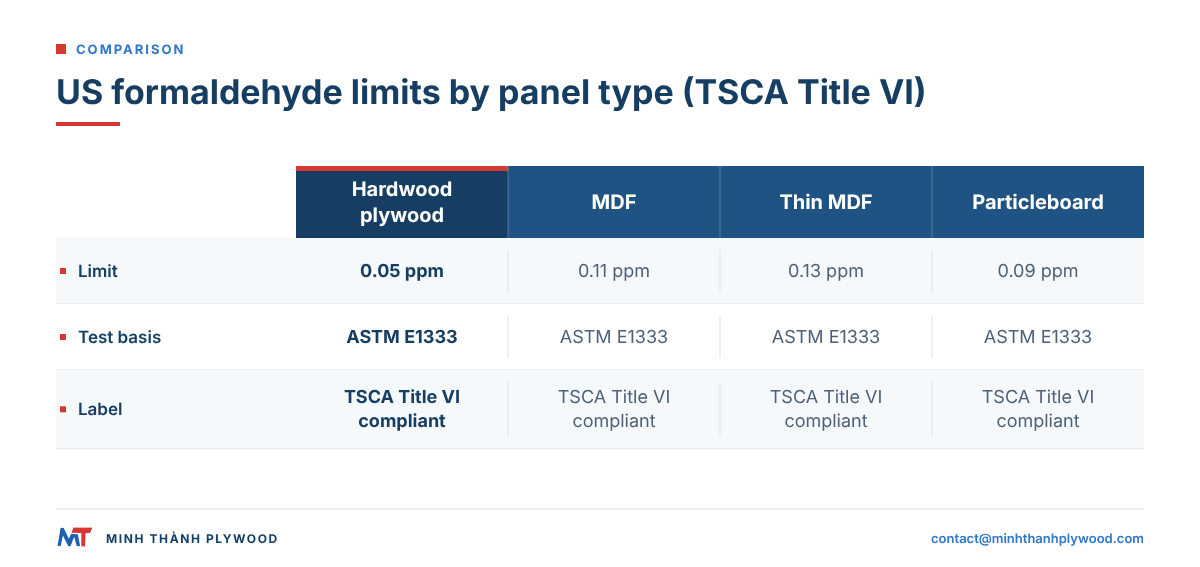
Two rules with the same limits apply: CARB’s Airborne Toxic Control Measure (Phase 2) in California and TSCA Title VI nationwide, written into 40 CFR Part 770. EPA states that the rule covers “hardwood plywood, medium-density fiberboard, and particleboard, as well as household and other finished goods containing these products.” The limits in the table are set in 40 CFR 770.10.
| Panel | TSCA Title VI limit | Test basis |
|---|---|---|
| Hardwood plywood, veneer or composite core | 0.05 ppm | ASTM E1333 large chamber |
| Medium-density fibreboard (MDF) | 0.11 ppm | ASTM E1333 large chamber |
| Thin MDF | 0.13 ppm | ASTM E1333 large chamber |
| Particleboard | 0.09 ppm | ASTM E1333 large chamber |
Mills prove compliance through a third-party certifier approved by EPA and CARB, with regular quality-control tests, often by the ASTM D6007 small chamber. Importers, distributors and fabricators keep the certificates and invoices for three years.
Is MDF toxic?
MDF is not toxic in normal indoor use when it meets the TSCA Title VI or EU limits. Formaldehyde is the only real concern from the panel itself, and it is the reason those limits exist.
Formaldehyde is a gas that irritates the eyes, nose and throat at high concentrations, and the International Agency for Research on Cancer classes it as a human carcinogen. At the levels a compliant panel adds to a ventilated room, the risk is low, and emission falls as the panel ages.
Three things raise exposure in practice:
- Old or non-compliant panels, made before the limits or imported without certification.
- Many panels in a small, closed room, such as a new fitted wardrobe with no ventilation.
- Unsealed edges and backs, where emission escapes most easily.
Buy certified panels, seal every face and edge, and ventilate new furniture for the first weeks.
Is MDF dangerous to cut and sand? What MDF dust does
MDF is dangerous to cut and sand without dust control, because its dust is extremely fine and reaches deep into the lungs. Is MDF dust dangerous? Yes: wood dust in general is classed as a human carcinogen by IARC, and MDF’s fine fibres stay airborne longer than sawdust from solid wood.
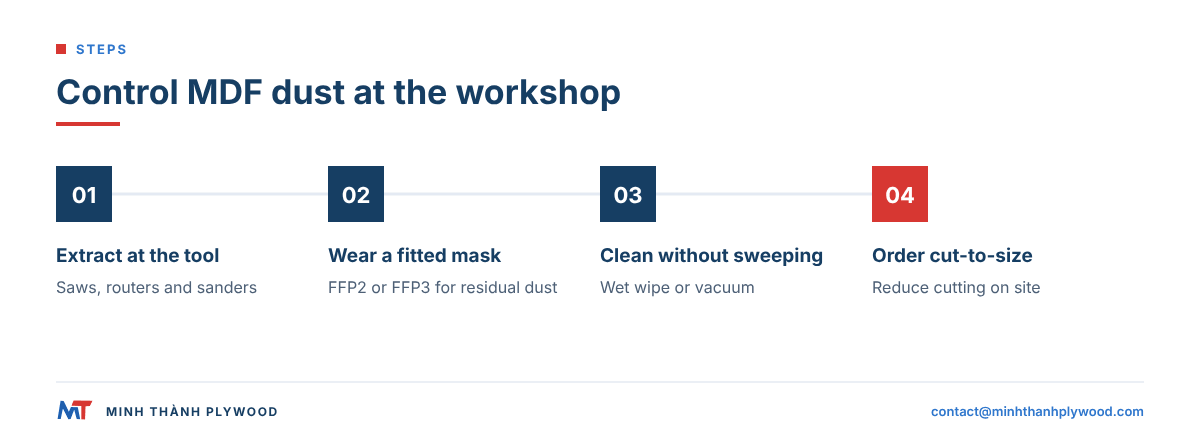
Workshops control it with four measures:
- Extraction at the tool, on saws, routers and sanders.
- A fitted FFP2 or FFP3 mask for any job the extraction does not fully capture.
- Wet wiping or vacuum cleaning, never dry sweeping or compressed air.
- Cutting to size at the supplier, so fewer cuts happen on site.
Plywood also makes dust when machined, but its coarser chips settle faster. Ordering cut-to-size parts reduces the dust at your own workshop whichever panel you use.
Does MDF still contain formaldehyde?
Most MDF still contains formaldehyde-based resin, usually urea-formaldehyde (UF) or melamine-urea-formaldehyde (MUF), but at far lower emission than before 2009. The resin bonds the refined wood fibres; better resin chemistry and scavengers keep emission under the legal limits.
Two lower-emission options exist under the US rules:
- ULEF (ultra-low-emitting formaldehyde): formaldehyde resin with emission low enough for reduced testing.
- NAF (no added formaldehyde): resins such as MDI, soy or PVA, with no formaldehyde in the glue. Wood itself still releases a trace naturally.
For formaldehyde MDF and for plywood alike, the useful question is the measured emission of the panel you buy, shown in a certificate or chamber test, not the resin name alone.
How do MDF, particleboard, OSB and plywood compare on emission?
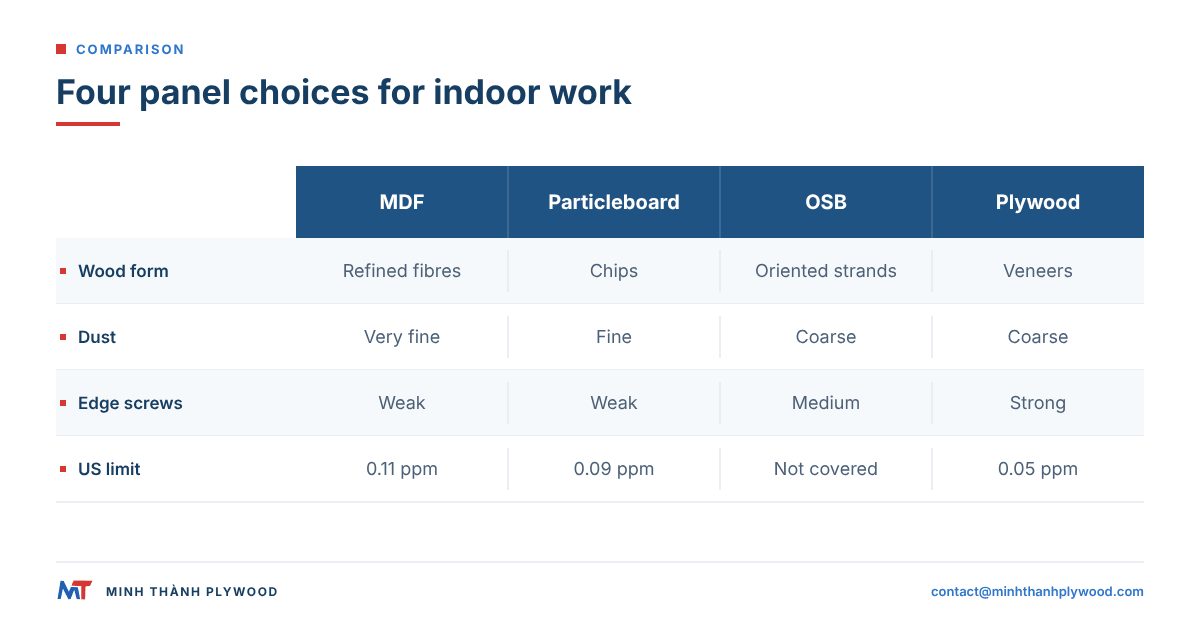
Plywood carries the lowest legal emission limit of the formaldehyde-bonded panels in the US, because its veneers need less glue than fibres or particles. This table compares the four common panels on the points that decide indoor air quality:
| Point | MDF | Particleboard | OSB | Plywood |
|---|---|---|---|---|
| Wood form | Refined fibres | Chips and particles | Oriented strands | Veneer sheets |
| Usual resin | UF or MUF | UF or MUF | MDI or PF | UF, MUF or PF |
| Resin content | High | High | Medium | Low |
| US emission limit (TSCA Title VI) | 0.11 ppm | 0.09 ppm | Not covered (structural) | 0.05 ppm |
| Low-emission option | NAF MDF | NAF particleboard | MDI-bonded as standard | E0 plywood |
| Dust when machined | Very fine | Fine | Coarse | Coarse |
| Screw holding, edges | Weak | Weak | Medium | Strong |
OSB is outside TSCA Title VI because structural panels bonded with moisture-resistant resins emit very little formaldehyde. For furniture, the realistic choice is between MDF, particleboard and plywood, and plywood has the strictest limit and the strongest edges.
Is MDF banned in Europe, and what are the EU and UK rules?
MDF is not banned in Europe either. The EU now caps formaldehyde from finished goods: under Regulation (EU) 2023/1464, REACH Annex XVII entry 77, furniture and wood-based articles placed on the EU market from 6 August 2026 must not cause more than 0.062 mg/m³ of formaldehyde under the regulation’s chamber conditions. Other articles are capped at 0.080 mg/m³.
Before that rule, the reference was the E1 class of EN 13986 for construction panels, and national rules such as Germany’s for furniture panels. Many buyers still write “E1” or “E0” on orders; E0 has no single international threshold, so the method and number must be written next to it.
European results in mg/m³ and US results in ppm come from different test methods and cannot be converted one to one. Ask for the result in the method your market uses, or for third-party testing in that method.
What do E0, E1, CARB P2 and NAF mean on a panel?
These four labels describe emission, not glue type or quality. This table explains each one and where buyers meet it:
| Label | What it means | Where it is used |
|---|---|---|
| E1 | European emission class for wood-based panels | EU construction and furniture |
| CARB P2 / TSCA Title VI | US legal limits by panel type, third-party certified | United States, also accepted as proof in Europe |
| E0 | Emission below E1, method and number stated per order | Furniture for Europe and Asia |
| NAF | No added formaldehyde in the resin | US premium cabinets, MDF and plywood |
Minh Thanh’s furniture and interior plywood is made with UF glue at E0 emission and is CARB P2 / TSCA Title VI certified under ICTT mill no. 23024. Glue type and emission class are two separate lines on our specification sheet. The E0 and E1 emission page explains each class.
Is plywood the safer choice for cabinets?
For cabinet boxes, shelves and drawer sides, E0 plywood is the safer choice on emission and on service life. Its US legal limit is less than half of MDF’s, 0.05 ppm against 0.11 ppm, and good plywood measures far lower than the limit.
Minh Thanh’s proof: six ASTM D6007 chamber tests between April 2025 and June 2026, on 9, 15 and 18 mm panels, averaged 0.014–0.032 ppm against the 0.05 ppm limit. Three were run by Shanghai Hongjun and three by ICTT Vietnam.
Plywood also holds screws in its edges, survives a leaking sink far better than MDF and is lighter: an 18 mm Styrax-core panel of 1220 × 2440 mm weighs about 26.8 kg. For kitchens and bathrooms, that combination of lower emission and better moisture behaviour is why cabinet makers move carcasses to plywood. Our plywood vs MDF guide compares the two part by part.
When does MDF make more sense than plywood?
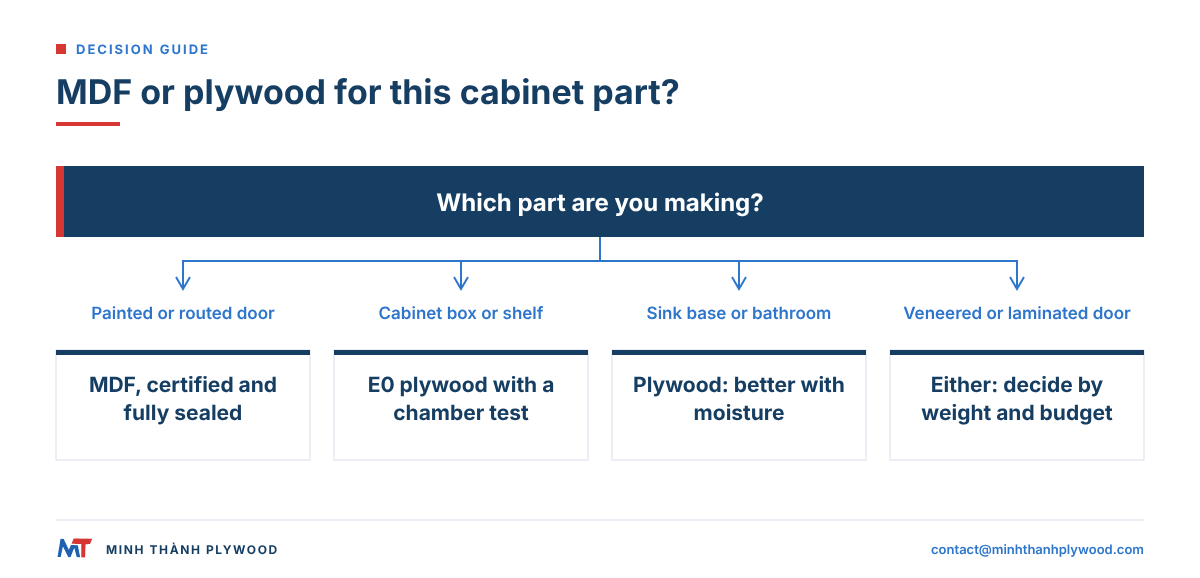
MDF makes more sense where a perfectly smooth, machinable surface matters more than strength or moisture: painted doors, routed profiles and moulded panels. Its uniform fibre core takes a router edge and a spray finish without grain or voids showing.
The honest split many cabinet makers use:
- MDF: painted door fronts, routed and shaker profiles, decorative panels.
- Plywood: cabinet boxes, shelves, drawer sides, sink bases and anything that carries load or meets water.
- Either: veneered or laminated doors and panels, decided by weight, budget and the finish.
If you choose MDF for doors, choose a certified panel and seal it fully. If you choose plywood for the box, choose E0 with a chamber test, sanded flat for laminating.
Is plywood always better for indoor air quality than MDF or chipboard?
Plywood is not automatically better for indoor air; a high-emission plywood can emit more than a NAF MDF. The panel’s measured emission decides indoor air quality, and plywood starts with the advantage of a lower legal limit and less glue.
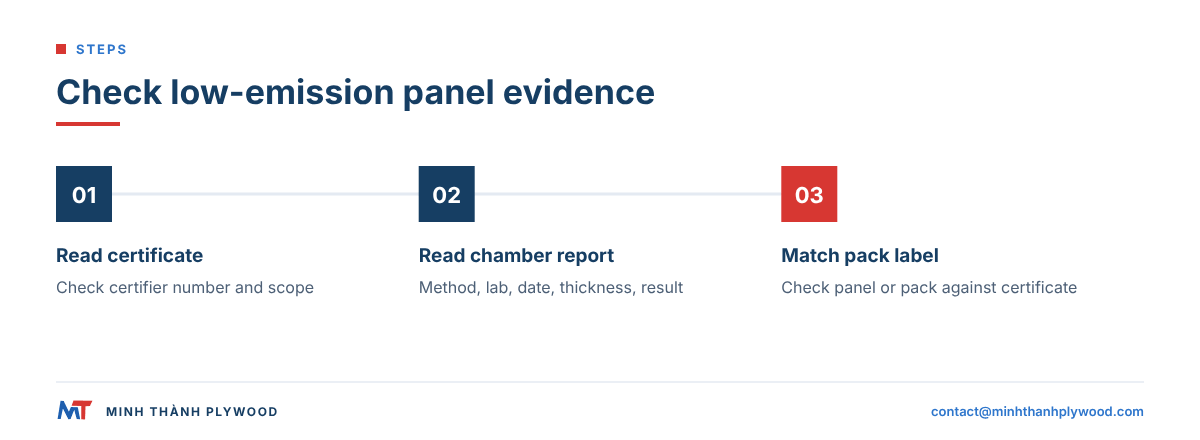
Compare panels on three documents, not on the material name:
- The certificate: CARB P2 / TSCA Title VI with the certifier number, or the EU equivalent your market needs.
- The test report: method, laboratory, date, panel thickness and result.
- The label: on the panel or the pack, matching the certificate.
A plywood supplier who can show all three, as we do, gives you the best indoor-air position at a reasonable price. Third-party testing to the buyer’s method, for example EN 717-1, is arranged through SGS on request.
How do you read a TSCA Title VI label?
A TSCA Title VI label on a panel or bundle names the producer, the lot or batch, the third-party certifier’s number and the statement “TSCA Title VI compliant”. Finished goods such as cabinets carry the statement on the product or its box.
Check four points when MDF or plywood arrives in the US:
- The statement “TSCA Title VI compliant” is present.
- The certifier number belongs to an EPA-recognised third-party certifier.
- The producer on the label matches your invoice.
- The invoice and bill of lading repeat the compliance statement.
For US orders, Minh Thanh’s panels carry the TSCA Title VI label with producer, lot and certifier number TPC-43, and the invoice and bill of lading state compliance. Details are on our CARB P2 / TSCA Title VI page.
What should you specify to keep emission low?
Specify emission as its own line, with the proof you need, separate from the glue type. Write these lines into your request for quotation:
- Application: cabinet boxes, shelves, doors, wardrobes.
- Emission: E0 with CARB P2 / TSCA Title VI certification, or a named EU method and limit.
- Glue: UF at E0 emission for dry interiors; MR or phenolic only where moisture needs it.
- Face and core: for example poplar or birch face on Styrax core.
- Thickness, size and tolerance: for example 18 mm, 1220 × 2440 mm, sanded to ±0.2–0.3 mm.
- Documents: labels, invoice statement, test reports.
Production takes 15–45 days after the 30% deposit, minimum one 40HC with mixed specifications by agreement. Send the lines to contact@minhthanhplywood.com or through the contact form, and see our plywood products for faces and cores.
Buyer questions, answered
Is MDF banned in the USA?
No. MDF is legal in all 50 states. Under TSCA Title VI, MDF sold in the US must emit no more than 0.11 ppm of formaldehyde, thin MDF no more than 0.13 ppm, and every panel or product must be labelled as compliant.
Is MDF toxic?
Compliant MDF is not toxic in normal indoor use. Its formaldehyde emission is capped by law in the US and the EU. The real health concern is fine dust when MDF is cut or sanded without extraction and a mask.
Does MDF still contain formaldehyde?
Most MDF is still bonded with urea-formaldehyde resin, at much lower emission than before 2009. NAF (no added formaldehyde) MDF, made with MDI or other resins, is also available at a higher price.
Is MDF dust dangerous?
Yes, if inhaled without protection. MDF dust is very fine and wood dust is classed as a human carcinogen by IARC. Use dust extraction at the tool, a fitted FFP2 or FFP3 mask and wet cleaning rather than sweeping.
Is plywood safer than MDF for kitchen cabinets?
On emission limits, yes: US law allows hardwood plywood 0.05 ppm against 0.11 ppm for MDF. Plywood also holds screws and resists moisture better. E0 plywood with a chamber test is the low-emission choice for cabinet boxes.
How long does MDF off-gas formaldehyde?
Emission is highest when a panel is new and falls over the first months, faster with ventilation and slower in heat and humidity. Sealing all faces and edges with paint or laminate cuts emission from the panel further.
Is MDF banned in Europe?
No. From 6 August 2026, REACH Annex XVII entry 77 caps formaldehyde from furniture and wood-based articles in the EU at 0.062 mg/m³ under its chamber conditions. MDF and plywood that meet it stay on the market.
What does the TSCA Title VI label on MDF mean?
It states that the panel or product complies with the TSCA Title VI emission limits, and names the producer, the lot or batch and the number of the third-party certifier that audits the mill's testing.
Is painted MDF safe in a child's room?
Compliant MDF that is fully sealed, faces and edges, emits very little. For the lowest emission, use NAF MDF or E0 plywood with a chamber test report, and ventilate the room for the first weeks.
What low-emission panel does Minh Thanh supply for cabinets?
Minh Thanh Plywood manufactures plywood. For cabinet and furniture parts we supply E0 plywood with UF glue at E0 emission, CARB P2 / TSCA Title VI certified, with chamber test results averaging 0.014–0.032 ppm.