
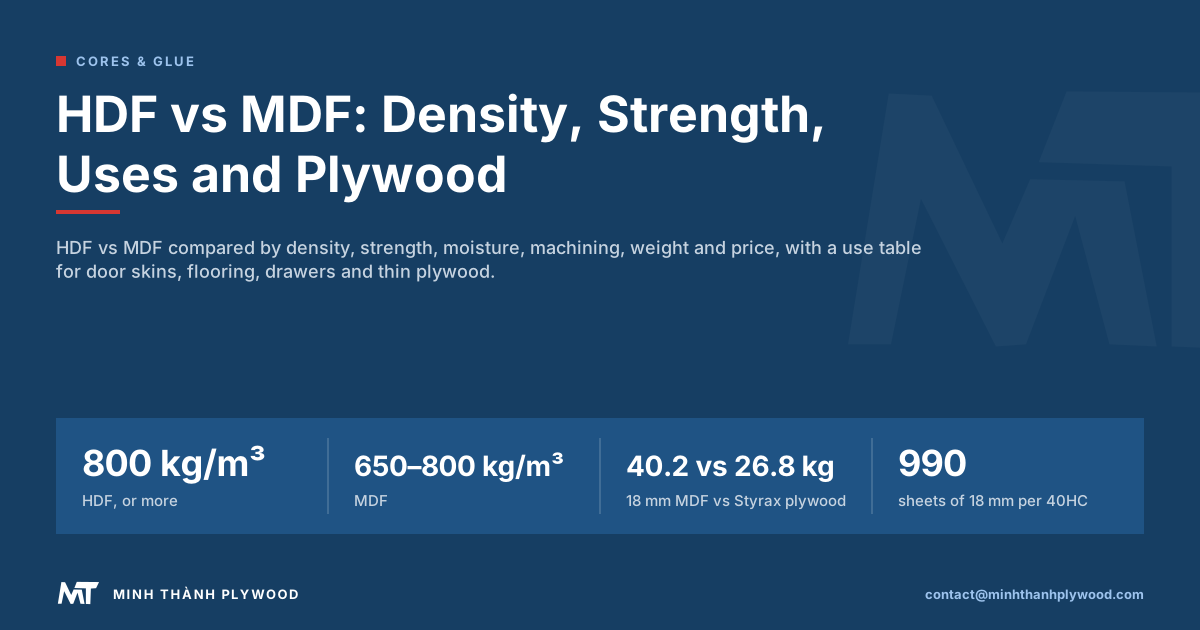
HDF vs MDF comes down to density: HDF (high density fibreboard) is pressed to 800 kg/m³ or more, MDF sits between 650 and 800 kg/m³ in the European classes. HDF is the thin, hard skin for doors, flooring cores and drawer bottoms; MDF is the thicker, paintable board for carcasses and profiles. Minh Thanh Plywood makes the veneer-core alternative, and this guide shows where thin plywood beats both.
What is the difference between HDF and MDF?
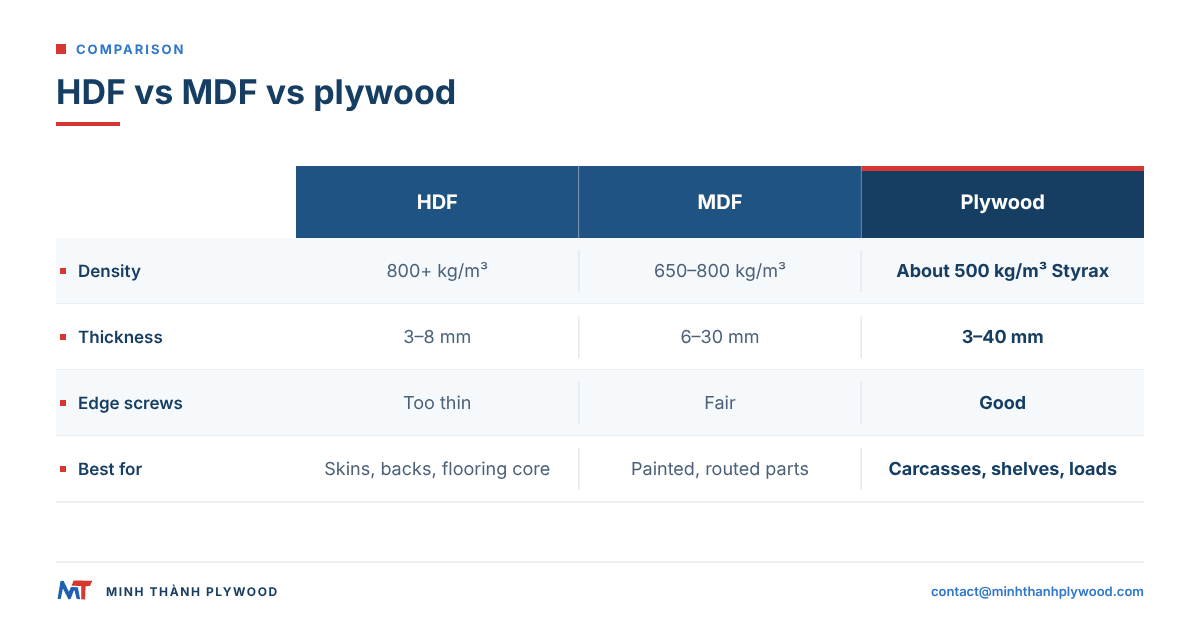
HDF vs MDF is a question of density: HDF is pressed to 800 kg/m³ or more, MDF to between 650 and 800 kg/m³, and that one number changes hardness, weight, thickness range and use. The table compares them line by line, with veneer-core plywood beside them because buyers usually weigh all three.
| Metric | HDF (high density fibreboard) | MDF (medium density fibreboard) | Thin and furniture plywood |
|---|---|---|---|
| Density | 800 kg/m³ or more | 650–800 kg/m³ | About 500 kg/m³ on Styrax core |
| Usual thickness | 3–8 mm | 6–30 mm | 3–40 mm |
| Faces | Very smooth, hard | Smooth, softer | Wood veneer, sanded |
| Edge screw holding | Too thin for edge screws | Fair, splits near edges | Good, cross-grain plies |
| Behaviour when wet | Edge swelling | Edge swelling | Depends on glue bond |
| Weight, 1220 × 2440 mm | About 7.6 kg at 3 mm | About 40.2 kg at 18 mm | 4.5 kg at 3 mm, 26.8 kg at 18 mm |
| Typical parts | Door skins, flooring core, drawer bottoms, backs | Painted carcasses, doors, profiles | Carcasses, shelves, drawer bottoms, doors |
The verdict by use: HDF for thin, hard skins; MDF for thick, painted and routed parts; plywood where the part carries load, takes screws in its edge or may meet water. The rest of this guide explains each line, with the numbers behind it.
What is HDF board?
HDF board is high density fibreboard: wood fibres bonded with resin under heat and pressure to a density of 800 kg/m³ or more. The fibres come from chipped wood, softened with steam and separated in a refiner, then dried, sprayed with resin and pressed into a mat. Because the press squeezes the mat harder than for MDF, the board ends up thin, hard and very flat.
Most HDF is made between 3 and 8 mm. In that range it gives a tight, closed surface that takes print, lacquer, laminate and the embossing of door skins. Buyers meet HDF under several names: high density fibreboard in British English, high density fiberboard in American English, and HDF material or HDF wood on marketplaces. All of them describe the same dry-process fibreboard.
HDF is still wood fibre and resin. It has no grain direction, which makes it stable in both directions of the sheet, and no veneer layers, which makes its edge weak for fixings.
What is MDF, and how is it made differently?
MDF, medium density fibreboard, is made on the same kind of line as HDF from the same fibres and resin, pressed to a lower density, usually between 650 and 800 kg/m³. The lower density lets the line make thicker boards, from about 6 mm up to 30 mm, with a softer core that routers cut cleanly.
The differences in production are small but they show in the board:
- Fibre fineness: HDF uses finer fibres so the thin board has a closed surface.
- Press pressure: HDF is compressed further, so it is harder and denser through the whole section.
- Thickness: MDF is pressed thicker; the mat for an 18 mm MDF board would be impractical at HDF density.
- Density profile: both boards are denser at the faces than at the core, and the gap is larger in thick MDF.
For a deeper look at grades, sizes and the MR and fire-retardant versions of MDF, see what MDF is. The wider family, from softboard to hardboard, is in fibreboard explained.
How much denser is high density fibreboard than MDF?
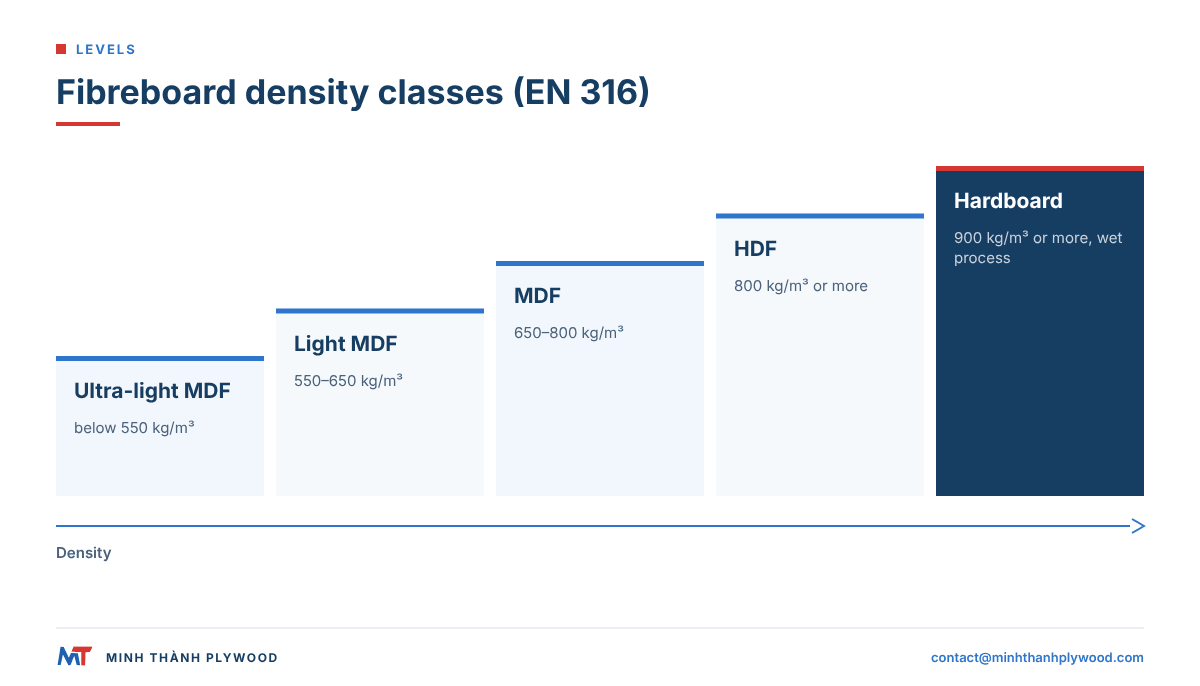
The European standard that names wood fibreboards is BS EN 316:2009. High density fibreboard is at least 800 kg/m³, and MDF is 650–800 kg/m³ in its classes. Below MDF sit light MDF and ultra-light MDF; above HDF sits wet-process hardboard at 900 kg/m³ or more.
| Board class (EN 316 names) | Density | Process | Where it is used |
|---|---|---|---|
| Ultra-light MDF | Below 550 kg/m³ | Dry | Lightweight furniture parts |
| Light MDF | 550–650 kg/m³ | Dry | Shop fitting, light panels |
| MDF | 650–800 kg/m³ | Dry | Carcasses, doors, mouldings |
| HDF | 800 kg/m³ or more | Dry | Door skins, flooring core, backs |
| Hardboard | 900 kg/m³ or more | Wet | Backs, pegboard, packaging |
Density is a planning number, not a performance rating. Two HDF boards at the same density can swell differently in water and hold screws differently, because resin, fibre and pressing differ between lines. Ask the supplier for the declared density and the standard the board is made to, and judge the sample in your own process.
Which is stronger, HDF or MDF?
At the same thickness, HDF is stronger, stiffer and harder than MDF, because there is more fibre in each cubic centimetre. It resists dents from a chair leg or a dropped tool better, which is why it is the core of laminate flooring.
The comparison changes once thickness enters. HDF is used thin, MDF thick. An 18 mm MDF shelf is far stiffer than a 3 mm HDF drawer bottom, so the useful question is which board gives the stiffness the part needs at an acceptable weight.
Both fibreboards share two weaknesses against plywood:
- Edge fixings: screws in the edge of MDF split the board near corners; HDF is too thin to take them at all.
- Long spans: MDF shelves sag over time under constant load, more than plywood of the same thickness, because fibreboard creeps.
Plywood’s cross-laminated veneers carry load along both directions of the sheet and grip a screw in every ply. That is why kitchen and wardrobe plants use plywood for carcasses that hang on walls and for shelves that carry books or plates.
HDF vs MDF around moisture
Neither HDF nor MDF is waterproof: both swell at the edges when they stay wet, and the swelling does not go back when they dry. HDF swells less in thickness than MDF at the same exposure because its fibres are packed tighter, which is one reason it serves as the core of laminate flooring.
Manufacturers make moisture-resistant versions of both, often dyed green, with more resin or a melamine-fortified resin. They suit kitchens and bathrooms where panels see humidity and splashes, and they still need sealed edges. Our guide to moisture-resistant MDF covers the MR, HMR and exterior grades.
Plywood behaves differently because its strength comes from the glue line between veneers. A furniture panel with UF glue at E0 emission belongs indoors, like MDF; a panel with a melamine-fortified (MR) or phenolic (WBP) bond survives humidity or boiling water. For exterior use there is no fibreboard answer in this comparison: specify plywood with a WBP bond, as on our exterior plywood page.
Which takes paint and laminate better?
HDF gives a very smooth finish, because its faces are hard and closed: it is printed for flooring decors, pressed into panelled door skins and lacquered to a high gloss. MDF paints very well on its faces and, unlike HDF, on its routed edges and profiles once they are sealed.
Plywood takes paint and laminate on faces sanded to a tight tolerance. Minh Thanh’s furniture panels are pressed twice as standard: the core board is pressed and calibrated, then the face and back are pressed on, so the face lies flat for laminating. Both faces are UV-ready, prepared to the standard buyers need to apply their own UV coating.
Artists’ painting panels. HDF is the usual art panel: cut from a 4 × 8 ft sheet of 1/8 in or 1/4 in board, it gives a hard, smooth face for oils and acrylics. Seal both faces and all four edges before the first coat, because bare fibre swells under water-based gesso and lifts its surface.
Thin HDF warps, especially at 1/8 in, and a wooden cradle on the back reduces but does not remove that risk (Ampersand Art, painting on panel, checked October 2026). Panels above a small size need the thicker board. A sanded birch- or poplar-faced plywood panel is the stiffer alternative for large works, because crossed plies resist warping.
The visible difference is the edge. MDF and HDF edges are uniform fibre; a plywood edge shows its plies, which some designers leave visible and others band with veneer or ABS edging.
How do HDF and MDF machine?
MDF is the easiest of the three to machine: it routes, profiles and drills cleanly in any direction, which is why kitchen door makers mill it into shaker frames and raised panels. HDF cuts cleanly too, but it is used too thin for deep profiles and it wears tools faster.
Both fibreboards produce fine dust, and both need extraction and the right cutters. Plywood cuts and drills well with sharp tooling; its plies can splinter at the exit of a cut, which scoring blades and sanded faces control.
Three practical rules for a production line:
- Route profiles in MDF, not in HDF or plywood.
- Use HDF where the part is a thin, flat skin with no fixings in its edge.
- Use plywood where screws, dowels or hinges go into the panel close to its edge.
How do weight and container load compare?
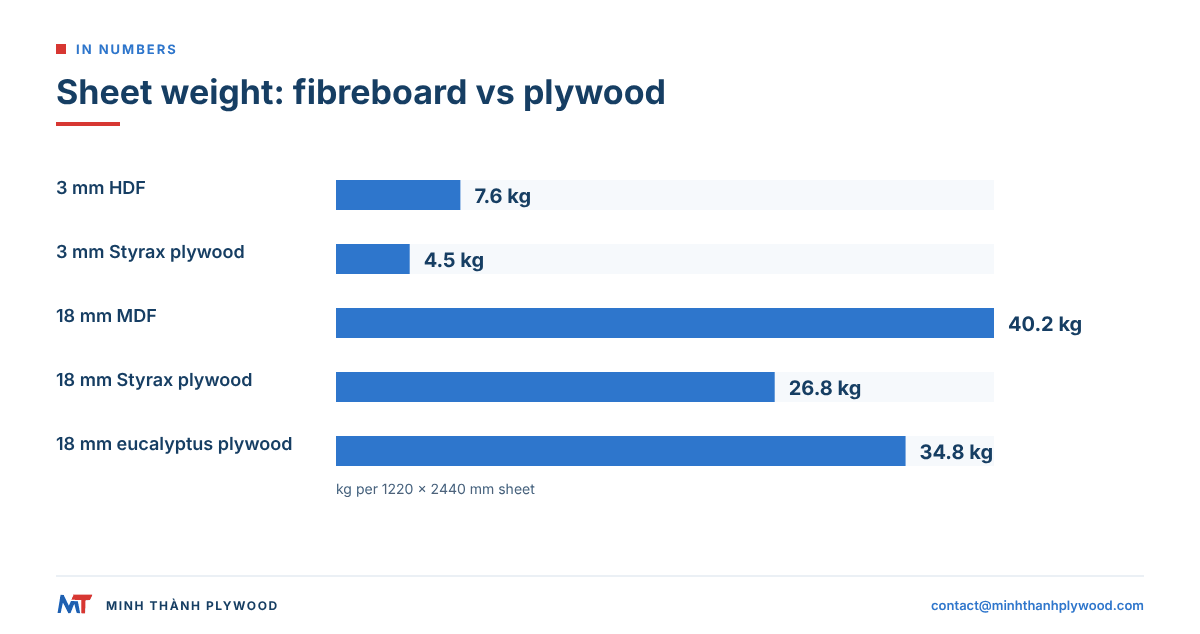
Fibreboard is heavier than Styrax-core plywood, and the difference decides how much fits in a container. Sheet weight is density times volume: a 1220 × 2440 mm sheet holds about 0.0536 m³ at 18 mm and about 0.0089 m³ at 3 mm.
| Sheet, 1220 × 2440 mm (4 × 8 ft) | Density used | Weight per sheet |
|---|---|---|
| 3 mm (1/8 in) HDF | 850 kg/m³ | About 7.6 kg, 16.8 lb |
| 3 mm (1/8 in) thin plywood, Styrax core | 500 kg/m³ | 4.5 kg, 9.9 lb |
| 18 mm (3/4 in) MDF | 750 kg/m³ | About 40.2 kg, 88.6 lb |
| 18 mm (3/4 in) plywood, Styrax core | 500 kg/m³ | 26.8 kg, 59.1 lb |
| 18 mm (3/4 in) plywood, Eucalyptus core | 650 kg/m³ | 34.8 kg, 76.7 lb |
US sheets are cut 4 × 8 ft (48 × 96 in), a little smaller than 1220 × 2440 mm, so a US-size sheet weighs about 0.1 % less. A 1/4 in (6 mm) HDF sheet at 850 kg/m³ weighs about 15.2 kg, 33.5 lb.
A 40HC container is limited by weight before it is full with dense boards. With a planning payload of 28,000 kg, fewer than 700 sheets of 18 mm MDF reach the weight limit, while the loading plan for 18 mm Styrax-core plywood ships 990 sheets in 18 packs of 55. For an importer paying freight per container, the lighter core is more panel per shipment. Our container loading page explains the full plan.
Weight also matters after delivery: two people carry an 18 mm Styrax-core sheet more easily than an MDF one, and lighter cabinets cost less to ship as finished furniture.
HDF vs MDF vs plywood: where does thin plywood replace HDF?
Thin plywood replaces HDF where a thin part must be light, must hold a fixing or may meet moisture. HDF wins where the part needs the hardest, smoothest skin at the lowest cost and stays dry. This is the decision behind most HDF vs MDF vs plywood questions.
Minh Thanh’s thin plywood from 3 to 5 mm is always 5-ply. A 3 mm panel has one core veneer, two cross-band veneers and two faces; 4 and 5 mm panels have three core veneers and two faces, for example three 1.3 mm Styrax core veneers in a 4 mm furniture panel. Five plies give a thin panel that bends without cracking and holds small staples and pins.
Where thin plywood earns its place over HDF:
- Drawer bottoms in solid or heavy drawers: a 5-ply bottom spans the drawer without sagging under tools or files.
- Lightweight doors: plywood skins cut the door weight against HDF skins at the same thickness.
- Backs that carry fixings: a wardrobe back that holds hooks or a wall rail needs plies, not fibre.
- Caravan, boat and vehicle interiors: weight and humidity favour plywood.
Which board for which part?
The best use cases for HDF, MDF and plywood in furniture and construction follow from the lines above. The table gives the usual first choice and the plywood alternative.
| Part | First choice | Why | Plywood alternative |
|---|---|---|---|
| Panelled door skins | HDF, 3–4 mm | Hard face, takes embossing | 3–4 mm plywood for lighter doors |
| Laminate flooring core | HDF | Hard, low swelling, holds the click profile | Plywood core for engineered wood flooring |
| Drawer bottoms | HDF or 3–6 mm plywood | Thin and flat | 5-ply (3–5 mm) plywood for heavy drawers |
| Cabinet and wardrobe backs | HDF | Low cost, flat | Thin plywood where backs take fixings |
| Painted kitchen doors | MDF, 18 mm | Routes and paints cleanly | Plywood with a paint-grade face |
| Kitchen and wardrobe carcasses | MDF or plywood | Flat faces | Plywood for weight and edge screws |
| Shelves under load | Plywood | Less sag, stiffer | — |
| Bathroom and humid rooms | MR MDF or MR plywood | Humidity resistance | Plywood with an MR bond |
| Exterior and formwork | Plywood | Bond survives water | WBP plywood |
For the core options inside a plywood panel, from veneer and combi cores to MDF-core plywood, see plywood core types.
Which emission rules apply to HDF, MDF and plywood?
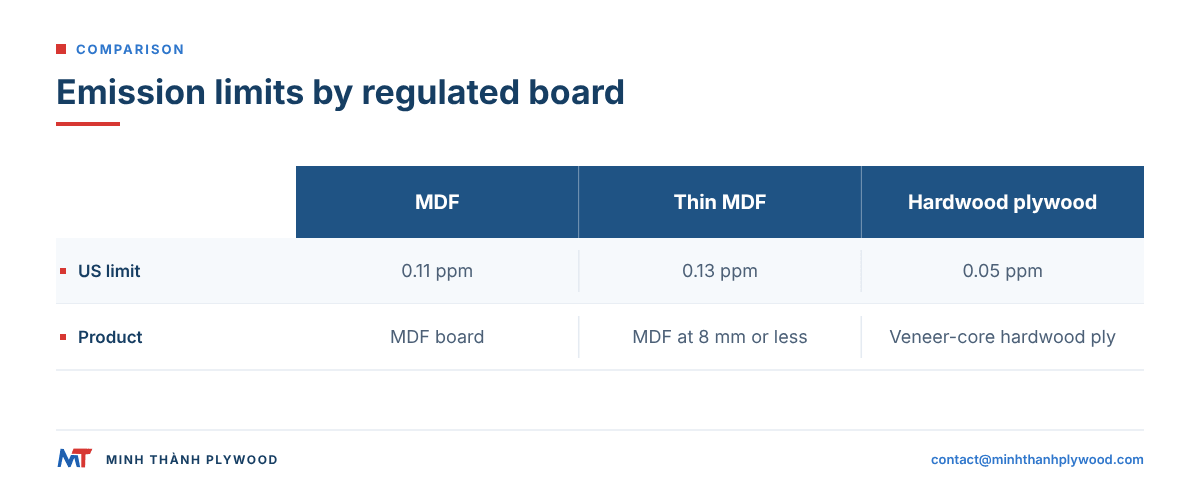
In the United States, MDF, thin MDF (8 mm or less) and hardwood plywood each have their own formaldehyde limit under CARB Phase 2 and EPA TSCA Title VI: 0.11 ppm for MDF, 0.13 ppm for thin MDF and 0.05 ppm for veneer-core hardwood plywood, as set out in 40 CFR 770.10. A fibreboard falls under the MDF or thin MDF line by its thickness, so a door skin and an 18 mm board can sit on different lines of the same rule; the certificate names the product type.
Minh Thanh’s furniture plywood is certified to CARB P2 / TSCA Title VI under ICTT mill no. 23024. Six ASTM D6007 chamber tests between April 2025 and June 2026, on 9, 15 and 18 mm panels, averaged 0.014–0.032 ppm against the 0.05 ppm limit, three by Shanghai Hongjun and three by ICTT Vietnam. The glue is UF glue at E0 emission; glue type and emission class are two separate lines on a specification. Details are on our CARB P2 and TSCA Title VI page.
European buyers order to E1 or lower classes and test with EN 717-1; we arrange third-party testing to the buyer’s method through SGS on request.
How do HDF and MDF prices compare?
Per sheet, HDF is usually the cheapest of the three, because it is thin; per cubic metre it costs more than MDF, because it holds more fibre and resin and runs slower through the press. MDF is the low-cost choice for thick painted parts. Plywood costs more per cubic metre than both and earns that back in lighter parts, stronger edges and the option of a water-resistant bond.
Compare quotations by the finished part, not by the sheet. A cabinet carcass in 18 mm plywood can need fewer reinforcements and less edge preparation than one in MDF, and it ships lighter. As an indicative starting point in October 2026, Minh Thanh’s furniture and interior plywood starts from US$350/m³; the final price follows face, core, glue, thickness, size and quantity.
How do you choose between HDF, MDF and plywood?
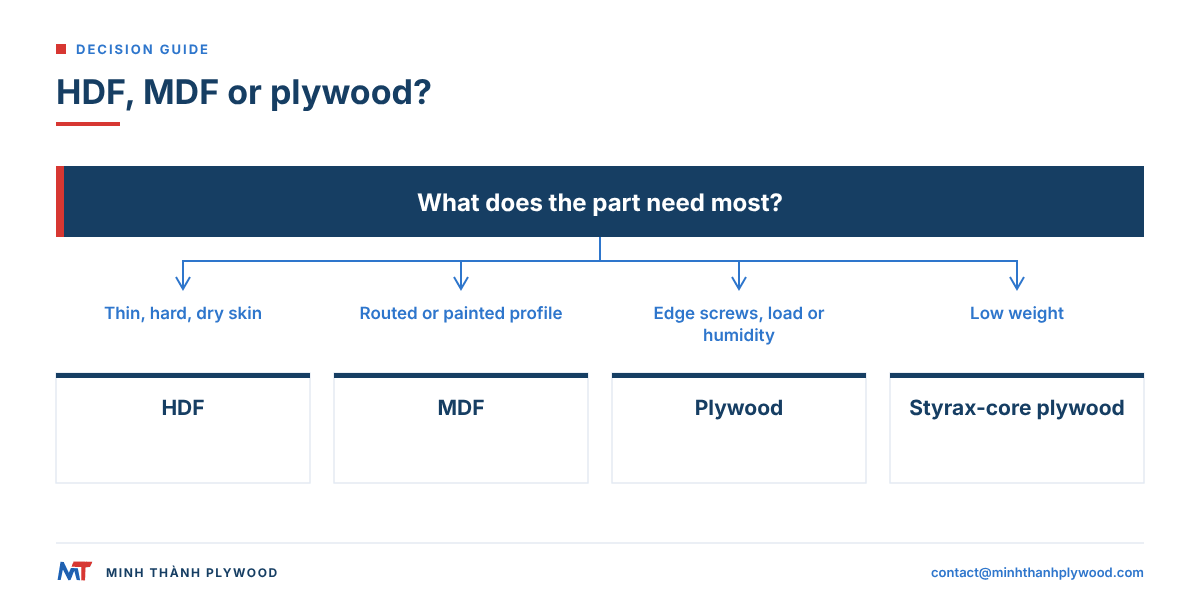
Choose by the part, in five questions, and the board follows:
- How thick is the part? Under 6 mm, compare HDF and thin plywood; over 12 mm, compare MDF and plywood.
- Does anything screw into its edge? If yes, plywood.
- Will it be routed or profiled? If yes, MDF.
- Can it get wet? Humidity calls for MR grades; water and weather call for WBP plywood.
- Does weight matter in handling, freight or the finished product? If yes, Styrax-core plywood.
Many furniture plants mix the three in one cabinet: plywood carcass, MDF doors, HDF back. That mix is normal; write each material on its own line of the bill of materials, with its density, thickness and emission class.
What to send for a quotation
If your comparison points to plywood for some parts, send the specification line for each one and we quote within hours. A typical line for a drawer bottom or a cabinet back reads:
- Application: drawer bottoms for kitchen cabinets
- Core: white Styrax, 5-ply
- Glue and emission: UF glue at E0 emission, CARB P2 / TSCA Title VI
- Face: poplar or birch, grade pair to sample
- Size and thickness: 1220 × 2440 mm, 4 mm, sanded, ±0.2 mm
- Packing and quantity: export packs, one 40HC
The minimum order is one 40HC with mixed specifications by agreement, production takes 15–45 days after the 30% deposit, and samples are free. Send the line through the quotation form or by email to contact@minhthanhplywood.com.
Buyer questions, answered
What is the difference between HDF and MDF?
Density. HDF is pressed to 800 kg/m³ or more and made mostly in thin sheets; MDF sits between 650 and 800 kg/m³ and comes in thicker boards. HDF is harder and smoother on thin parts, MDF machines and paints more easily in thick parts.
Is HDF stronger than MDF?
At the same thickness HDF is harder and stiffer and resists dents better. In practice HDF is used thin, so a 3 mm HDF door skin is not stronger than an 18 mm MDF shelf; compare the part, not the board name.
Is HDF waterproof?
No. Standard HDF swells at the edges when it stays wet, like MDF. Moisture-resistant grades swell less, but neither fibreboard is an exterior panel; use plywood with a WBP bond outdoors.
Which is better for furniture, HDF or MDF?
MDF for painted carcasses, doors and profiled parts; HDF for backs, drawer bottoms and door skins. Plywood takes over where screws go into edges, where weight matters or where the part may get wet.
Is HDF the same as hardboard?
Close, but not the same. Hardboard is a wet-process fibreboard of 900 kg/m³ or more with one smooth face; HDF is dry-process, pressed with resin and smooth on both faces.
Can you screw into HDF?
Only with care. Thin HDF is too thin to hold a screw in its edge; screws go through it into a frame. For hinges and edge screws, use MDF of enough thickness or plywood.
Which is heavier, HDF, MDF or plywood?
HDF is the heaviest per cubic metre, then MDF, then a Styrax-core plywood at about 500 kg/m³. An 18 mm sheet of 1220 × 2440 mm Styrax-core plywood weighs about 26.8 kg; the same sheet of MDF at 750 kg/m³ weighs about 40.2 kg.
What is HDF used for?
Door skins, laminate flooring cores, drawer bottoms, cabinet and wardrobe backs, pegboard and furniture panels that need a hard, thin, flat sheet.
Is thin plywood a good alternative to HDF?
Yes for parts that must be light, hold fixings or meet some moisture: drawer bottoms, backs, door skins on lightweight doors. Minh Thanh's 3–5 mm plywood is always 5-ply and sanded to tight tolerance.
Do MDF and HDF need CARB certification?
For most US sales, yes. CARB and EPA TSCA Title VI set separate limits for MDF, thin MDF and hardwood plywood; check that the certificate names the product type you buy.