
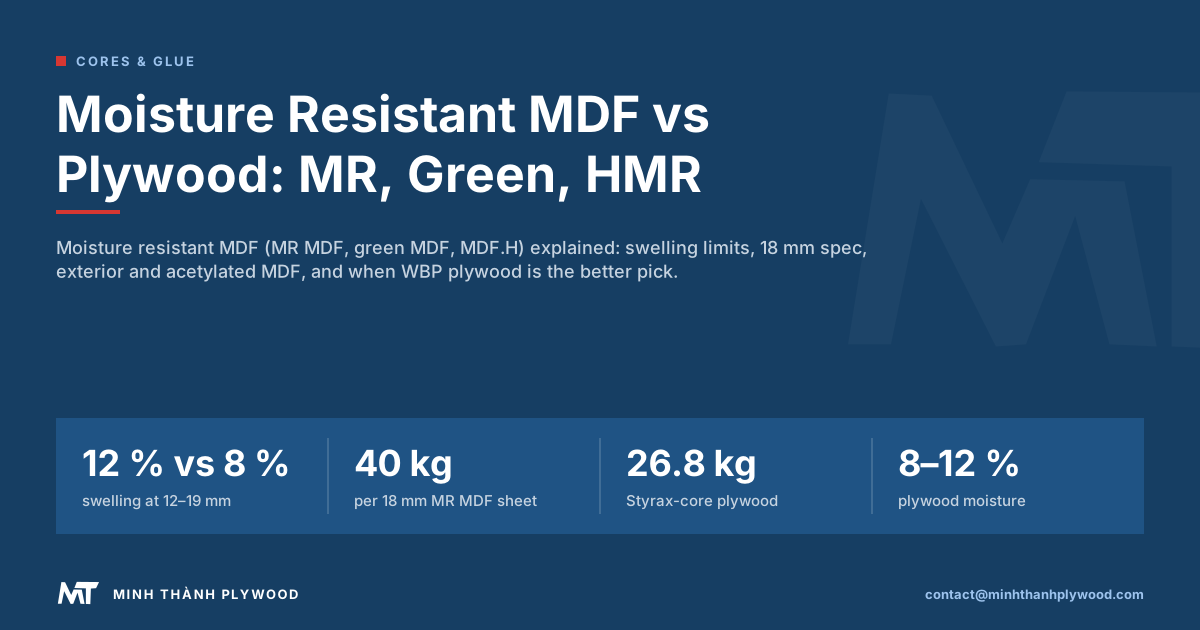
Moisture resistant MDF is fibreboard made with water-resistant resin and extra wax so it swells less in humid rooms; it is usually dyed green and sold as MR MDF or MDF.H. It is not waterproof: raw edges still swell under standing water. Minh Thanh Plywood makes MR and phenolic-bonded plywood, and this guide shows where each panel belongs.
What is moisture resistant MDF?
Moisture resistant MDF is medium density fibreboard made with water-resistant resin and more wax, so it takes up water and swells more slowly than standard MDF in humid rooms. In Europe it is the type MDF.H of EN 622-5: general-purpose MDF for use in humid conditions.
MR MDF keeps the advantages of MDF: a smooth face for paint, clean routed profiles and an even board. It is the usual board for painted kitchen doors, bathroom furniture fronts and window boards. It does not change what MDF is: a mass of wood fibres without layers, which swells for good once liquid water reaches a raw edge.
Why is moisture resistant MDF green, and what are the other names?
Moisture resistant MDF is sold under several names, and they mean similar but not identical boards:
| Name | Where you meet it | What it usually means |
|---|---|---|
| MDF.H | EU orders, EN 622-5 | MDF for humid conditions, tested to the EN 622-5 limits |
| MR MDF | UK, Asia, Middle East | Moisture-resistant MDF, often to MDF.H |
| Green MDF | Everywhere | MR MDF dyed green as a trade mark of the type |
| HMR | India, Middle East | High moisture resistant board, MDF or particle board, with tighter swelling values |
| Exterior MDF | UK, EU, Australia | MDI-bonded or acetylated MDF for outdoor joinery |
The colour is a convention, not a test. A green board without the type on its label is only a green board, so ask for the datasheet and the swelling figure.
What makes MDF moisture resistant?
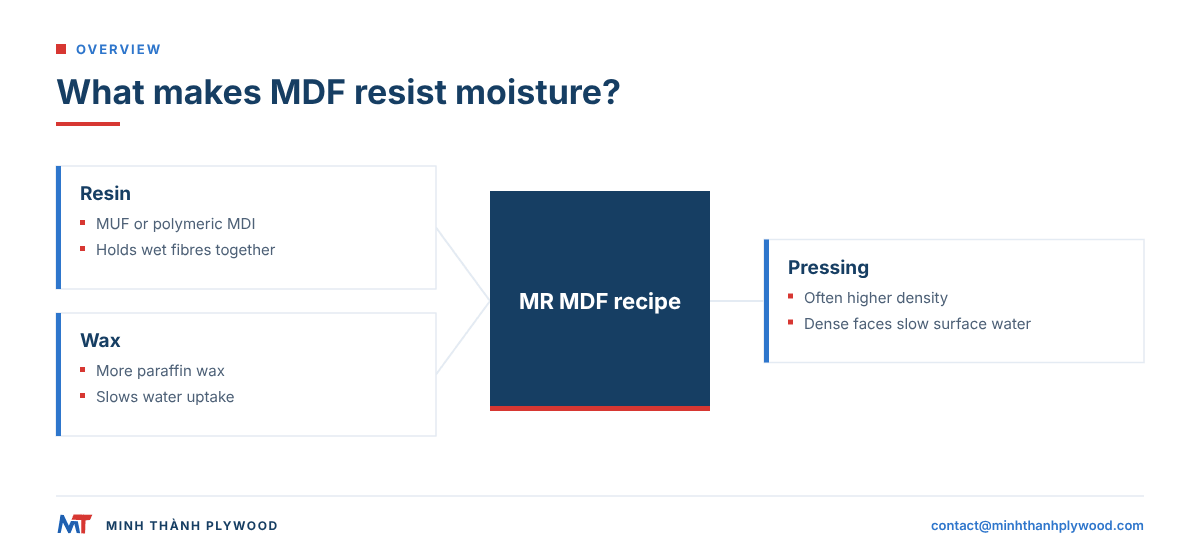
Three changes in the recipe make MDF moisture resistant:
- Resin. Standard MDF uses urea-formaldehyde (UF) resin, which breaks down in water. MR MDF uses melamine-urea-formaldehyde (MUF) or polymeric MDI resin, which holds the fibres together when wet.
- Wax. More paraffin wax is added to the fibres in the blowline, which slows the uptake of liquid water.
- Density and pressing. MR boards are often pressed to a higher density, with dense faces that slow water at the surface.
The same logic decides plywood. Minh Thanh uses UF glue at E0 emission as standard for furniture and interior panels, and makes MR or melamine-fortified and phenolic (WBP) bonds to the customer’s specification. In both panels, the resin decides the behaviour in water, not the wood.
Swelling limits: standard MDF vs moisture resistant MDF
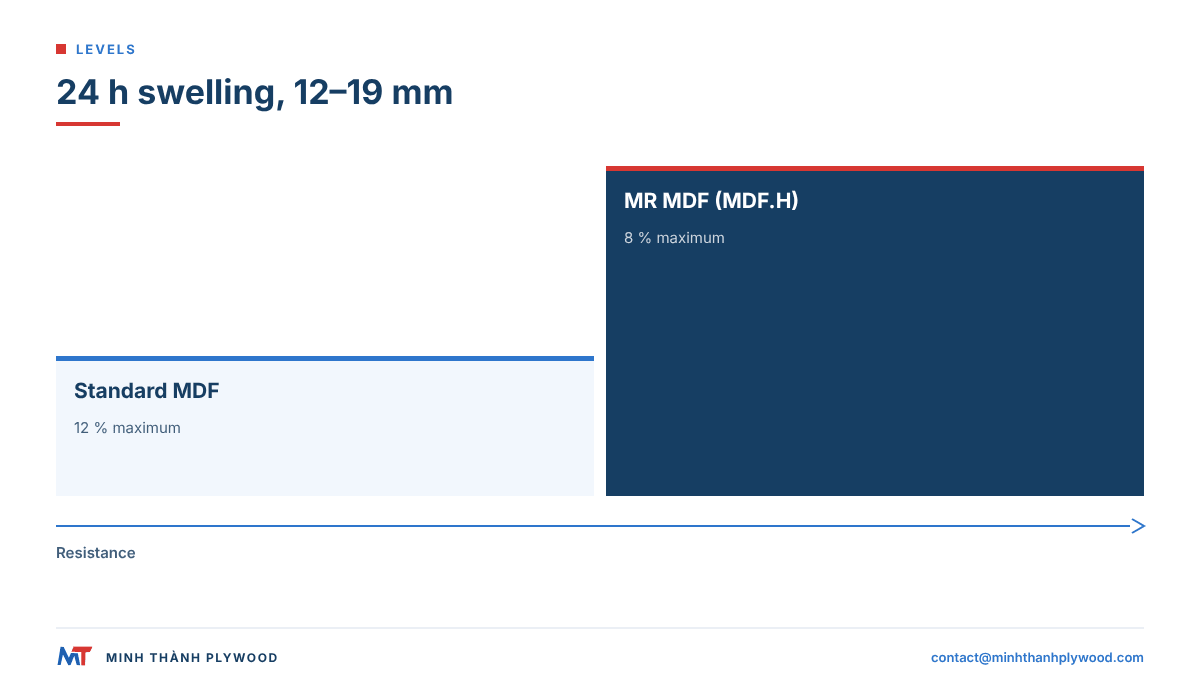
The 24-hour thickness swelling test is the number that separates MR MDF from standard MDF. A 50 × 50 mm sample is soaked in water at 20 °C for 24 hours under EN 317, and the increase in thickness is measured.
| Board, 12–19 mm | 24 h thickness swelling, maximum | Extra moisture test |
|---|---|---|
| Standard MDF (EN 622-5, dry conditions) | 12 % | None |
| Moisture resistant MDF (EN 622-5 MDF.H) | 8 % | Cycle test (EN 321) or boil test, by option |
These values come from published EN 622-5 datasheets of European MDF mills for boards of 12–19 mm; the limits rise for thinner boards and fall for thicker ones. The lower figure does not mean the board is waterproof: 8 % on an 18 mm board is still about 1.4 mm of swelling at a raw edge, enough to lift an edge band.
Plywood is not graded by swelling but by bond: EN 314-2 bond classes 1, 2 and 3 for dry, humid and exterior use, tested by soaking and boiling the glue line.
Is moisture resistant MDF waterproof?
No: moisture resistant MDF resists humid air and splashes, not standing water. It works in a kitchen or bathroom that is ventilated and cleaned with a damp cloth; it fails under a leaking sink, on a wet floor or in a shower.
Three facts explain it:
- The fibres still absorb water. Better resin holds them together, but the wood fibres themselves take up water and expand.
- Swelling does not recover. When a swollen MDF edge dries, it stays thicker and softer.
- Edges are the weak point. Faces are dense and painted; cut edges, screw holes and cut-outs are open fibre.
The same caution applies to plywood: interior UF-bonded plywood is not for wet areas either. The is plywood waterproof guide sets out which glue survives which exposure.
Moisture resistant MDF 18 mm: weight, sizes and spec
Moisture resistant MDF 18 mm weighs about 40 kg per 1220 × 2440 mm sheet at about 750 kg/m³, and it is the most ordered MR board, for doors, carcass fronts and vanity panels. A typical specification:
| Item | Moisture resistant MDF, 18 mm |
|---|---|
| Type | MDF.H (EN 622-5), dyed green |
| Density | about 750 kg/m³ |
| Sheet sizes | 1220 × 2440 mm, 2070 × 2800 mm, 1830 × 2440 mm |
| Sheet weight, 1220 × 2440 mm | about 40 kg |
| 24 h swelling (EN 317) | 8 % maximum at 12–19 mm |
| Emission | E1 (EN 717-1) in the UK and EU, CARB P2 / TSCA Title VI 0.11 ppm in the US, or EU 0.062 mg/m³ for furniture |
| Surface | Sanded both faces, ready for primer or foil |
In the US, the TSCA Title VI limit for medium-density fiberboard is 0.11 ppm under the EPA formaldehyde emission standards.
The weight is computed: 1.22 m × 2.44 m × 0.018 m = 0.0536 m³ × 750 kg/m³ = 40.2 kg. For comparison, an 18 mm Styrax-core plywood sheet of the same size weighs 26.8 kg at 500 kg/m³, and a Eucalyptus-core sheet 34.8 kg at 650 kg/m³.
Moisture resistant MDF sizes, thicknesses and price
Moisture resistant MDF is sold in thicknesses of 6, 9, 12, 15, 18, 22 and 25 mm, in sheets of 1220 × 2440 mm and 1220 × 3050 mm, and an 18 mm sheet of the UK reference board costs about £36 to £72 including VAT at the main sheet-material dealers. The weights below are computed at 750 kg/m³.
| Thickness | Sheet 1220 × 2440 mm | Sheet 1220 × 3050 mm |
|---|---|---|
| 6 mm | 13.4 kg | 16.7 kg |
| 9 mm | 20.1 kg | 25.1 kg |
| 12 mm | 26.8 kg | 33.5 kg |
| 15 mm | 33.5 kg | 41.9 kg |
| 18 mm | 40.2 kg | 50.2 kg |
| 22 mm | 49.1 kg | 61.4 kg |
| 25 mm | 55.8 kg | 69.8 kg |
The UK reference spec is Medite MR for humid interiors and Medite Exterior (Tricoya-based) for outdoor joinery. Dealers list Medite MR 18 mm at about £42 including VAT at the wholesale end and about £72 at the single-sheet end; the full £36 to £72 band works out at roughly £670 to £1,340 per m³ at retail. Cut-to-size services add the cutting: a precision saw service quotes ±0.1 mm on parts, a CNC service ±1 mm, and a mill sheet is sanded to about ±0.2 mm in thickness.
For a container buyer, the plywood alternative is priced per m³ FOB: commercial plywood from US$250/m³ and furniture plywood from US$350/m³ (October 2026), against a UK retail sheet of MR MDF at about £670 to £1,340 per m³. Plywood for carcasses and sink bases weighs 26.8 kg at 18 mm in Styrax-core against 40.2 kg for MR MDF, so a van carries more sheets.
Exterior MDF and acetylated MDF
Exterior MDF is a separate product from MR MDF, made for painted outdoor parts. Two kinds are on the market:
- MDI-bonded exterior MDF: polymeric MDI resin with no added formaldehyde and a high wax content, for signs, painted joinery and soffits.
- Acetylated MDF (sold under the Tricoya name): fibres are treated with acetic anhydride before pressing, which blocks most of the water uptake. It is sold for cladding, window and door parts, and wet-room panels.
Both still need a sealed paint system on every face and edge, and both cost more per cubic metre than MR MDF and most plywood. For load-bearing outdoor parts, exterior plywood with phenolic glue remains the usual choice.
Where MR MDF works and where it fails
MR MDF works for painted and routed parts in humid rooms, and fails where water stands or where the part carries load. The verdict by part:
| Part | MR MDF | Better panel if MR MDF fails |
|---|---|---|
| Painted kitchen doors and drawer fronts | Works, edges sealed | — |
| Kitchen wall cabinets | Works | Plywood for carcasses that carry heavy loads |
| Sink base cabinet | Fails at the first leak | Plywood with MR/melamine-fortified glue, sealed edges |
| Bathroom vanity doors | Works away from direct splash | — |
| Bathroom vanity carcass on the floor | Fails where the floor is wet | Plywood with phenolic (WBP) glue or a raised plinth |
| Shower walls and floors | Fails | Cement board or WBP plywood with a tanking system |
| Window boards, skirting | Works, painted | — |
| Garden furniture, outdoor signs | Fails | Exterior MDF, or exterior plywood with WBP glue |
| Shelves with long spans | Sags | Plywood, Eucalyptus core for stiffness |
MR MDF vs MR plywood vs WBP plywood
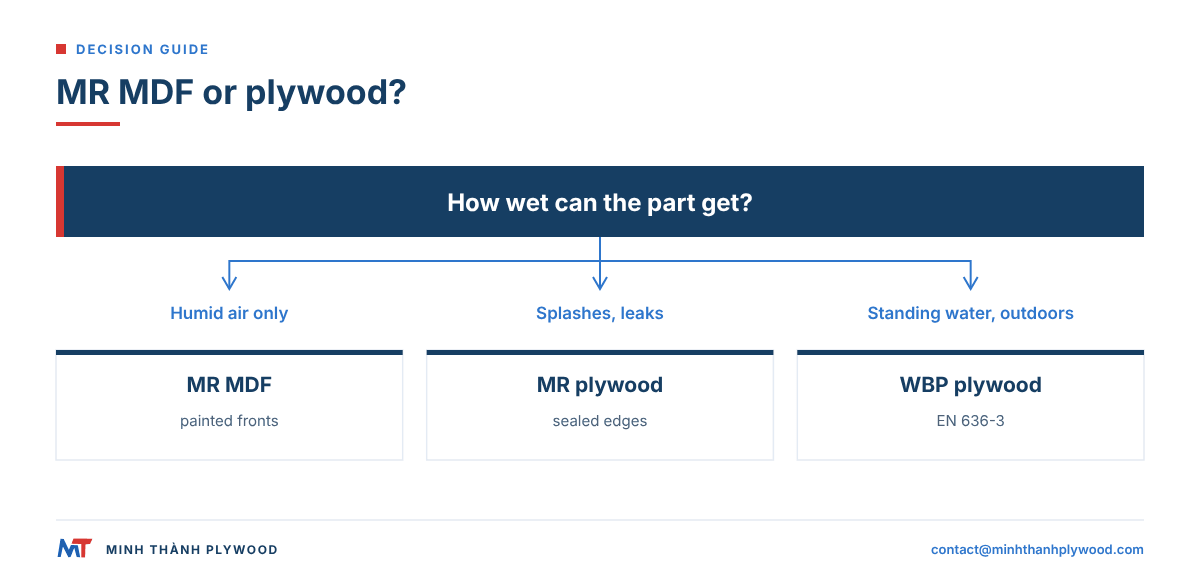
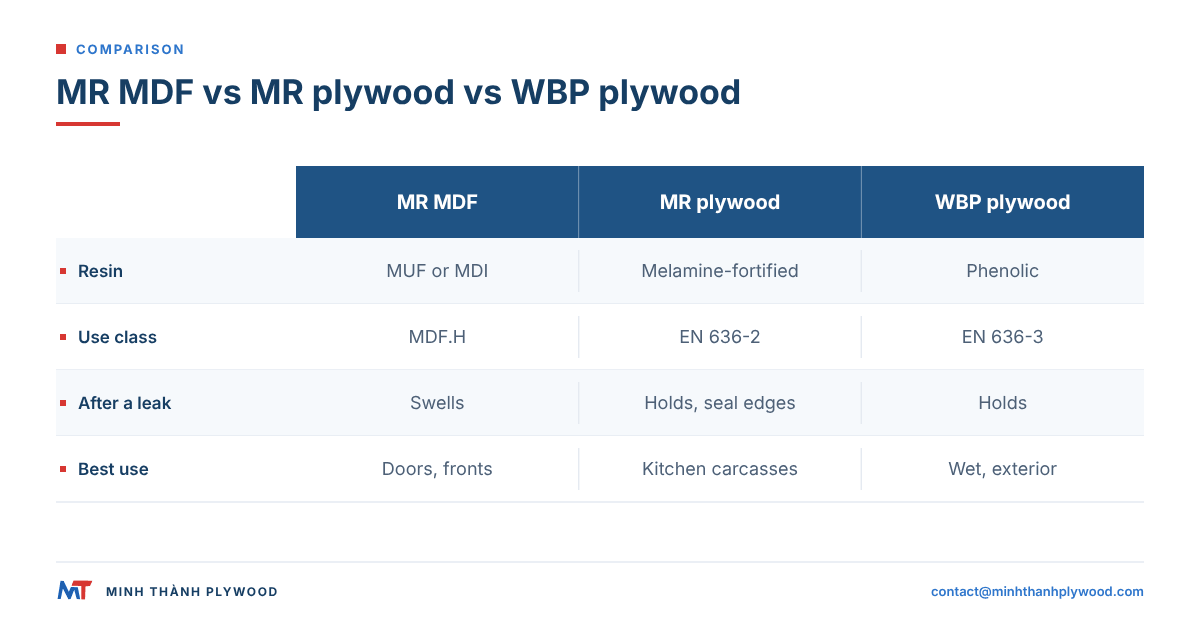
MR MDF gives the best painted face; MR plywood gives better structure in humid rooms; WBP plywood is the panel for parts that get wet. The comparison at 18 mm:
| Metric | MR MDF (MDF.H) | MR plywood (MUF glue) | WBP plywood (phenolic glue) |
|---|---|---|---|
| Glue or resin | MUF or MDI | Melamine-fortified UF | Phenol-formaldehyde |
| Plywood use class | — | EN 636-2 (humid) | EN 636-3 (exterior) |
| Bond class (EN 314-2) | — | Class 2 | Class 3 |
| Density | about 750 kg/m³ | 500–650 kg/m³ by core | 500–650 kg/m³ by core |
| Sheet weight, 1220 × 2440 mm | about 40 kg | 26.8–34.8 kg | 26.8–34.8 kg |
| Edge after a leak | Swells, does not recover | Holds if the glue line holds; seal edges | Holds |
| Screw holding | Low in the edge | Good | Good |
| Painted finish | Flawless | Good with poplar or EV face | Good, darker glue line |
| Best use | Doors, fronts, panels | Kitchen carcasses, sink bases | Wet areas, exterior parts |
Minh Thanh’s exterior plywood uses water-resistant melamine-fortified or phenolic (WBP) glue for outdoor uses such as stair treads and wall sheathing. The MUF vs phenolic glue guide compares the two glues in detail.
When you need WBP plywood instead of MR MDF
Switch from MR MDF to WBP plywood in four cases:
- Water can stand on the part: floors, sink bases, shower areas, boat interiors.
- The part is outdoors: garden furniture, stair treads, sheathing, signs that carry load.
- The part carries load and gets wet: shelves in cold stores, truck and van linings, wet-room benches.
- The part is fixed with many screws: hardware that is removed and refitted, such as service panels.
WBP plywood stays a sheet of whole veneers bonded with a boil-resistant glue line, so a wet edge dries back without crumbling. The WBP plywood guide explains how the bond is tested.
Moisture content at delivery: MDF and plywood
Furniture plywood should arrive at 8–12 % moisture content, the range Minh Thanh dries to at dispatch; moisture content is a separate question from moisture resistance. A board that leaves the mill wetter than the room it goes into shrinks and warps after machining.
- Plywood: Minh Thanh dries veneers and finished panels to 8–12 % moisture content at dispatch, the normal range for furniture plywood, and packs them in export packs.
- MDF: boards leave the press dry and pick up moisture to match the air; mills state the range on the datasheet.
On arrival, check a few sheets per pack with a pin moisture meter set for the species, or weigh and oven-dry a sample. Sea transit from Hai Phong to Northern Europe takes 30–40 days and to the Mediterranean 25–35 days; sealed packs keep the moisture content stable on the way.
Edge sealing and installation rules for MR MDF
MR MDF lasts in a humid room only when every open fibre is sealed. The rules a kitchen or bathroom installer follows:
- Seal every cut edge with primer or a sealer before paint, and apply edge band with a moisture-resistant glue.
- Seal every hole for hinges, handles and pipes, and every cut-out for a sink or hob.
- Leave a gap above floors that are mopped: plinths or legs keep the board off standing water.
- Ventilate. MR MDF resists humid air; constant condensation still soaks the edges over time.
- Use moisture-resistant fixings: stainless or coated screws, so rust does not stain and swell the fibres.
The same edge rules help plywood: a sealed plywood edge stays cleaner and keeps its finish longer in a kitchen.
How to check MR MDF and plywood on arrival
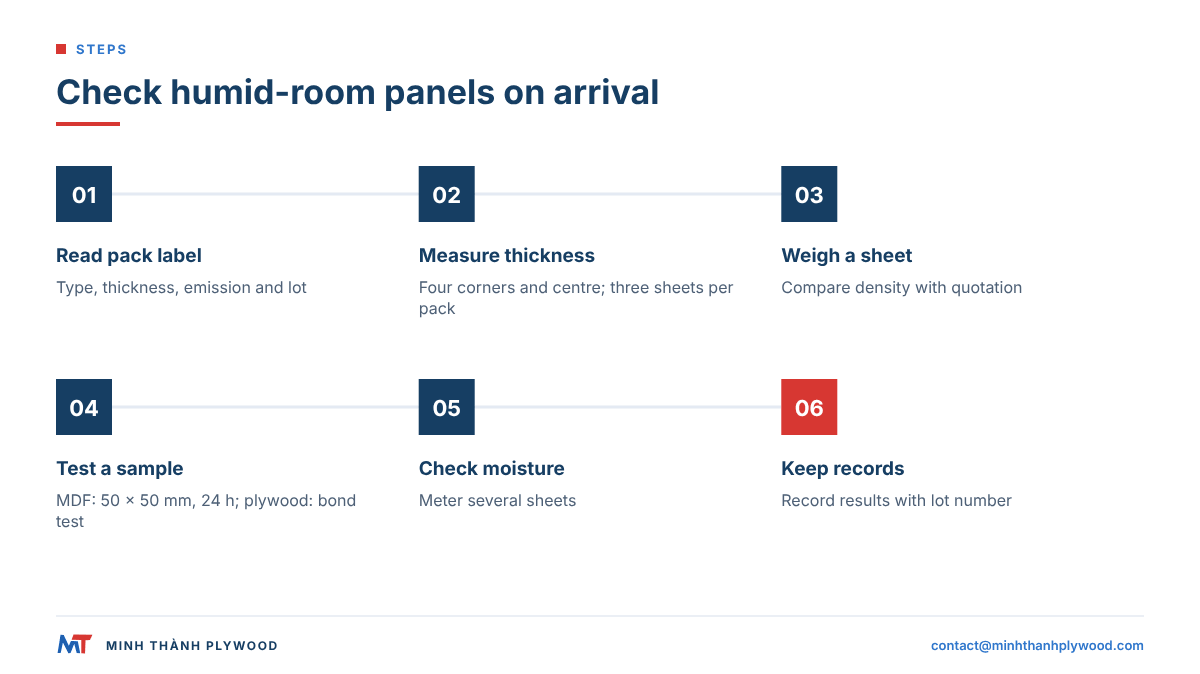
Check humid-room panels on arrival in five steps:
- Read the pack label: type (MDF.H or MR, or plywood with its glue and use class), thickness, emission class and lot.
- Measure thickness at four corners and the centre of three sheets per pack.
- Weigh one sheet to check the density against the quotation.
- Soak a sample: 50 × 50 mm for 24 hours in water for MR MDF (EN 317), or a soak or boil test of the glue line for MR and WBP plywood (EN 314-1).
- Check moisture content on a few sheets with a moisture meter.
Keep the test results with the lot number. For US orders, Minh Thanh’s plywood carries the TSCA Title VI label (producer, lot, certifier number TPC-43); third-party testing to the buyer’s method is arranged through SGS on request.
What to write on the order
Write the type, the swelling figure, the emission rule and the use; “MR MDF 18 mm” leaves the type and the test open. A complete MR MDF line: “MDF.H (EN 622-5), green, 18 mm, 2070 × 2800 mm, 24 h swelling 8 % maximum (EN 317), CARB P2 / TSCA Title VI, sanded both faces, for kitchen doors.”
For the carcasses and the wet parts, the plywood line reads: “Furniture plywood, poplar face B/B, Styrax core stitched, melamine-fortified (MR) glue, 1220 × 2440 × 18 mm, sanded to ±0.2–0.3 mm, export packs”, or with “phenolic (WBP) glue, EN 636-3” for parts that get wet. At Minh Thanh the minimum order is one 40HC with mixed specifications by agreement, and production takes 15–45 days after the 30% deposit.
Send the line to [email protected] or through the quotation form and ask for free samples to run your own soak test. The plywood for kitchen cabinets guide gives the part-by-part kitchen specification.
Buyer questions, answered
What is moisture resistant MDF?
Moisture resistant MDF is medium density fibreboard made with melamine-fortified or MDI resin and more wax, so it absorbs water and swells more slowly than standard MDF. In Europe it is sold as type MDF.H under EN 622-5.
Is moisture resistant MDF waterproof?
No. MR MDF resists humidity and short splashes, but standing water or a leak still swells the raw edges, and the swelling stays. For wet parts use exterior MDF or plywood with phenolic (WBP) glue.
Why is moisture resistant MDF green?
The green dye is a trade convention that marks the board as moisture resistant. The resistance comes from the resin and wax; a green colour alone proves nothing, so check the type on the label.
What is the difference between MR MDF and HMR?
MR MDF is moisture-resistant fibreboard. HMR is a high-moisture-resistant grade, a trade name used mostly in India and the Middle East for MR particle board or MDF with tighter swelling values. Ask for the datasheet swelling figure.
Can I use moisture resistant MDF in a bathroom?
Yes for vanity doors, wall panels and furniture away from direct water, when every edge and hole is sealed and painted. Not for shower walls, floors or parts that can stand in water.
Is MR MDF or plywood better for kitchen cabinets?
Use plywood with MR or melamine-fortified glue for carcasses and sink bases, and MR MDF for painted doors and fronts. Plywood holds hinges and screws better and recovers better after a leak.
What is the weight of moisture resistant MDF 18 mm?
At about 750 kg/m³, an 18 mm sheet of 1220 × 2440 mm weighs about 40 kg. The same sheet in Styrax-core plywood weighs 26.8 kg.
What is Tricoya MDF?
Tricoya is a brand of MDF made from acetylated wood fibres. Acetylation changes the wood so it takes up far less water, and the board is sold for exterior joinery and cladding.
How much does MR MDF swell?
Published EN 622-5 datasheets for 12–19 mm boards list a 24-hour swelling limit of 12 % for standard MDF and 8 % for MDF.H, tested to EN 317.
What moisture content should plywood have at delivery?
Furniture plywood is dried to 8–12 % moisture content at dispatch. Panels much wetter than that shrink and warp after they are machined in a dry factory.
Is there an exterior MDF?
Yes. Exterior MDF is made with MDI resin or from acetylated fibres and is sold for painted outdoor joinery, signs and cladding. It still needs a sealed paint system on every face and edge.