
Heavy duty plywood is plywood built for load and wear: a dense hardwood core such as Eucalyptus, more plies, a phenolic (WBP) or melamine-fortified bond, a gap-free core and 18–40 mm thickness. No standard defines the name, so the order must state each line. Minh Thanh Plywood explains the build, the specification steps, the receiving checks and when LVL or film-faced plywood fits better.
What is heavy duty plywood?
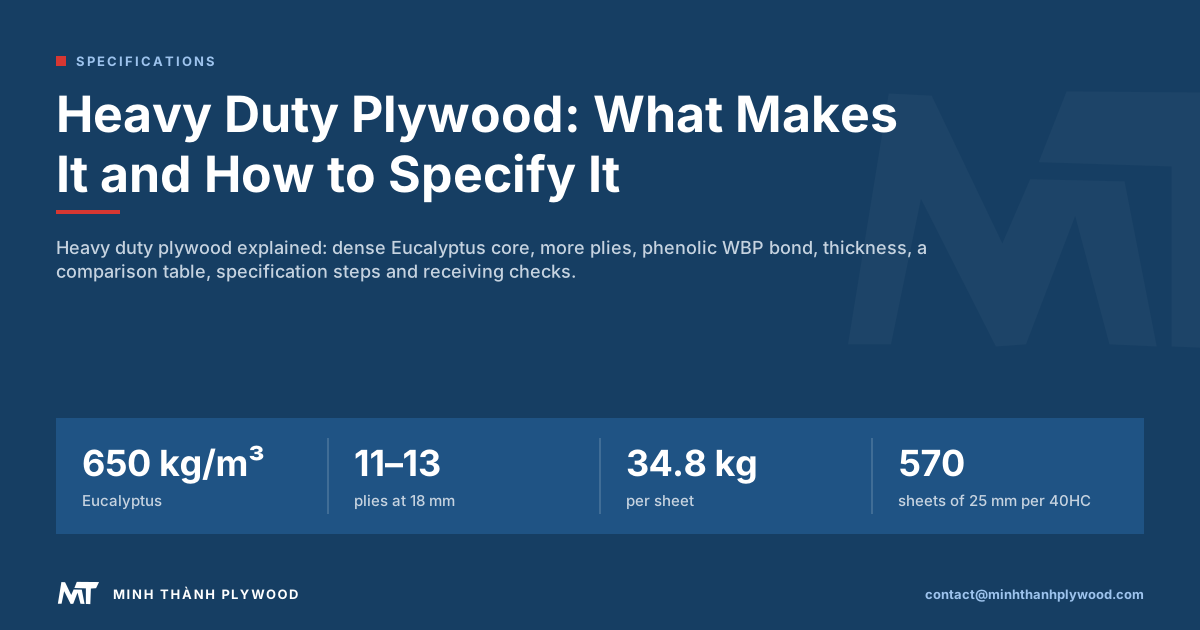
Heavy duty plywood is plywood built to carry high loads and take hard wear: a dense hardwood core, more plies, a water-resistant bond and a thick, gap-free panel. It is a trade description, not a grade in a standard, so two sheets both sold as “heavy duty” can be very different panels.
Buyers asking for “heavy duty plywood sheets” usually need one of four things. The first is a floor that carries wheels and pallets in trailers, trucks and warehouses. The second is a top that takes impact and tools, such as a workbench or machine table. The third is a deck that spans between supports in racking, stages and platforms, and the fourth is a box for a heavy product, such as an export crate. Each needs strength, stiffness, screw holding and a bond that survives damp.
At Minh Thanh Plywood we make heavy panels in our commercial and construction ranges, on Eucalyptus or Acacia cores with phenolic WBP or melamine-fortified glue, up to 40 mm thick. The sections below give the build, the steps to specify it and the checks to run when it arrives.
What makes a plywood panel heavy duty?
Five build choices make plywood heavy duty, and each one should be a line on the order.
- A dense core species. Eucalyptus at 650–750 kg/m³ or Acacia at about 580 kg/m³, instead of a light core such as Styrax at about 500 kg/m³. Density brings hardness, screw holding and stiffness.
- More plies. At 18 mm, 11–13 plies instead of 7 or 9. More, thinner plies give a stiffer, more even panel and bridge any single weak veneer.
- A water-resistant bond. Phenolic (WBP) for exterior and wet use, melamine-fortified for humid use. UF glue is a furniture glue for dry interiors.
- A gap-free core. Core veneers laid tight, with the joints stitched both across and along the panel, so there are no voids under a wheel or a fixing.
- Thickness and calibration. 18–40 mm, pressed, calibrated and sanded to a known thickness, so the panel sits flat on its supports.
A face can add wear resistance on top of these: a phenolic film face for formwork and floors, or an anti-slip wire-mesh pattern for walkways and trailer decks.
Heavy duty vs standard plywood: the comparison
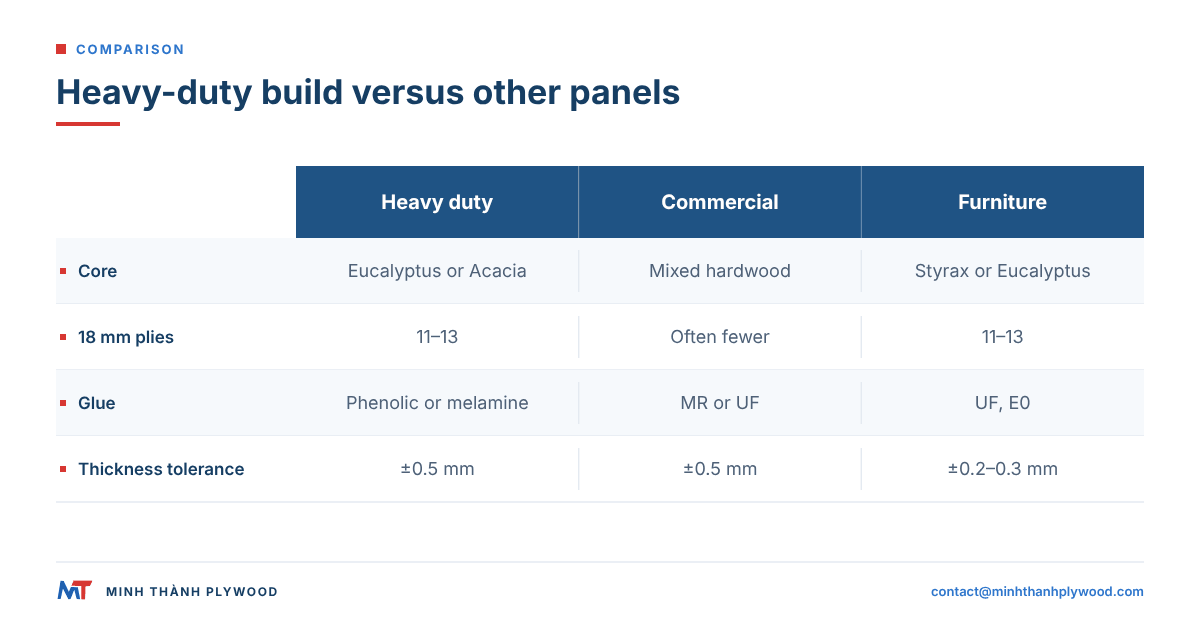
The table compares an 18 mm heavy duty build with an 18 mm standard commercial panel and an 18 mm furniture panel, line by line.
| Line | Heavy duty build | Standard commercial | Furniture panel |
|---|---|---|---|
| Core species | Eucalyptus or Acacia | Mixed hardwood | White Styrax or Eucalyptus |
| Planning density | 580–650 kg/m³ | varies with the mix | 500 kg/m³ on Styrax |
| Weight, 1220 × 2440 × 18 mm | about 31.1 kg Acacia, 34.8 kg Eucalyptus | varies | about 26.8 kg on Styrax |
| Plies at 18 mm | 11–13 | often fewer, thicker plies | 11–13 |
| Glue | Phenolic WBP or melamine-fortified | MR or UF | UF glue at E0 emission |
| Core joints | Tight, stitched both ways | Gaps allowed by grade | Tight, stitched both ways |
| Thickness tolerance | ±0.5 mm | ±0.5 mm | ±0.2–0.3 mm |
| Faces | Utility hardwood, film or anti-slip | Commercial hardwood | Birch, poplar, EV, okoume, pine |
| Best for | Floors, decks, benches, heavy crates | Interior building, general use | Cabinets, furniture, interiors |
Two lines decide most heavy-duty jobs: the core species and the glue. A dense core with a weak glue fails in the damp; a strong glue on a light core dents and loosens its screws.
Which core species makes the strongest plywood?
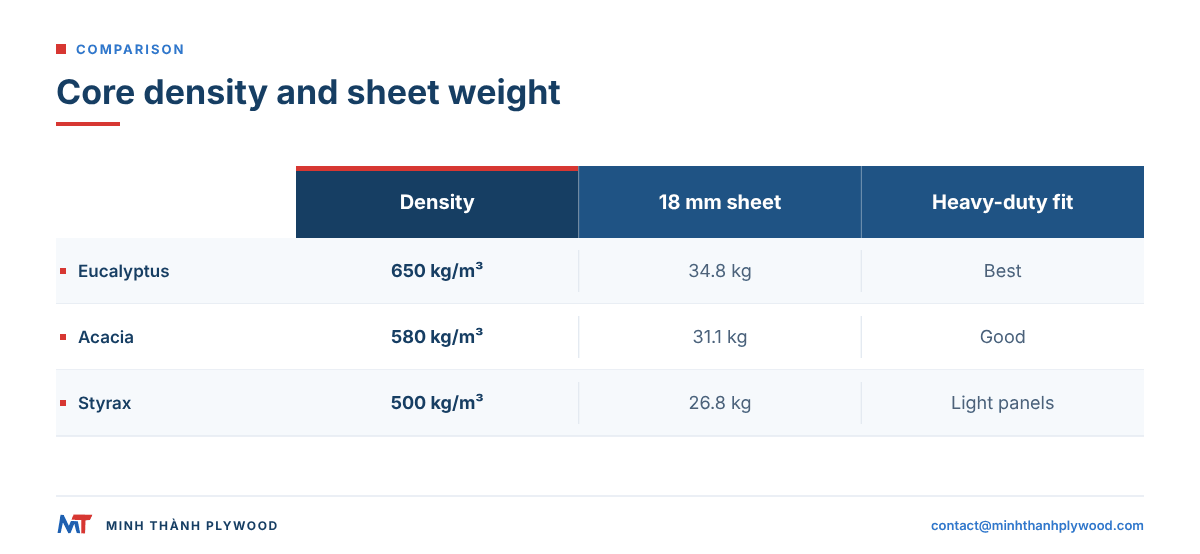
Eucalyptus makes the strongest and hardest plywood core in our range. Its planning density of 650–750 kg/m³ is about a third higher than white Styrax at 500 kg/m³, and density is what gives a panel hardness, stiffness and screw holding.
| Core | Planning density | 18 mm sheet weight, 1220 × 2440 mm | Heavy-duty fit |
|---|---|---|---|
| Eucalyptus | 650 kg/m³ (range 650–750) | about 34.8 kg | Best: floors, benches, point loads |
| Acacia | 580 kg/m³ | about 31.1 kg | Good: crates, decks, general heavy use |
| White Styrax | 500 kg/m³ | about 26.8 kg | Light panels: furniture, flat-pack |
Eucalyptus and Acacia are plantation timbers grown around our mill in Ha Hoa, so the dense core veneers come from local supply. Poplar and Styrax cores make light, flat furniture panels, which is their job; for a trailer floor or a workbench top, choose Eucalyptus. Our Eucalyptus plywood page covers that panel in full.
Phenolic WBP or melamine glue for heavy duty plywood?
Choose phenolic (WBP) glue when the panel will see rain, wet floors or repeated wetting and drying; choose melamine-fortified glue when it will see humidity but stay under cover. UF glue is for dry interiors only and is not a heavy-duty bond.
We press phenolic panels at about 130–145 °C and melamine-fortified panels at about 110–120 °C. The European bond classes in EN 314-2 describe the result: class 1 for dry interiors, class 2 for humid conditions and class 3 for exterior exposure. EN 636 then names the panel’s use class: dry, humid or exterior.
The bond classes sit in BS EN 314-2:1993, the bonding-quality requirements standard, and the use classes in BS EN 636:2012+A1:2015, which covers plywood for dry, humid or exterior conditions. Write both on a European order, for example “bond EN 314-2 class 3, panel EN 636-3”.
The glue line is also where heavy panels fail first. A floor that stays wet under a pallet, or a crate stored outside, loosens a weak glue line long before the wood itself gives way. That is why the glue gets its own line on the order, separate from the face and the core.
How thick should heavy duty plywood be?
Choose 18 mm as the starting point for heavy duty use and go thicker as the span between supports or the point load grows. Our range runs to 40 mm.
| Use | Typical thickness | What drives the choice |
|---|---|---|
| Crate and pallet decks | 12–18 mm | Product weight, fork entry, fixing pattern |
| Workbench and machine tops | 18–30 mm | Impact, clamping, flatness |
| Trailer and truck floors | 18–30 mm | Wheel loads of trolleys and forklifts, support spacing |
| Racking and mezzanine decks | 18–25 mm | Span between beams, stored weight |
| Stage and event platforms | 18–25 mm | Span, foot traffic, equipment |
| Heavy platforms and stair treads | 25–40 mm | Span and concentrated loads |
These are starting points from common practice, not load ratings. The required thickness for a deck or floor comes from the span, the load and the support detail; a structural deck is sized by the engineer from tested values. Stiffness rises with the cube of the thickness, so a step from 18 to 25 mm makes a panel more than two and a half times stiffer over the same span.
How to specify heavy duty plywood: the steps
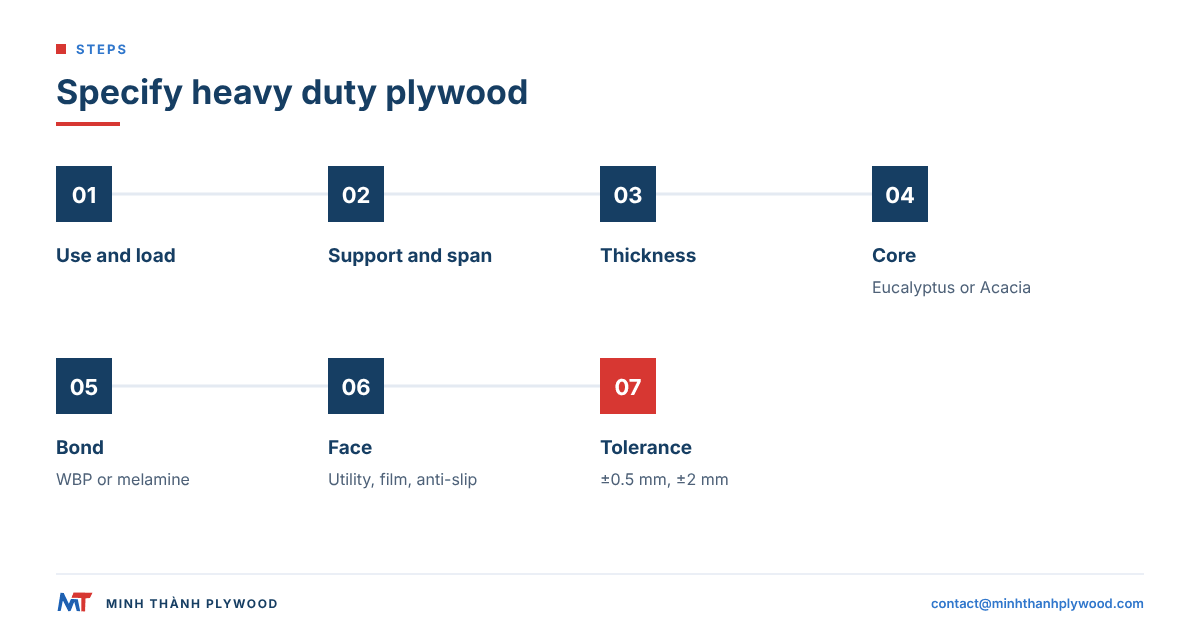
Specify heavy duty plywood in seven steps, in this order, so each choice follows from the one before.
- Write the use and the load. “Trailer floor, forklift traffic”, “workbench top, 1,200 × 2,400 mm” or “export crate base for 2-tonne machine”. The use decides everything else.
- Set the support and span. The distance between joists, beams or crate runners, and how the panel is fixed.
- Choose the thickness from the span and the load, with your engineer where the panel is structural.
- Choose the core: Eucalyptus for the hardest panel, Acacia for a lighter dense core.
- Choose the bond: phenolic WBP for exterior or wet service, melamine-fortified for humid service.
- Choose the face: utility hardwood, phenolic film or anti-slip pattern, and the back.
- Fix the tolerance and the paperwork: ±0.5 mm on thickness, ±2 mm on length and width, ply count, edge sealing and any test you need.
Send these lines with your enquiry and request a sample of the exact build before the order. For a full quote comparison, our guide on how to compare plywood quotations lays out the line-by-line method.
How is heavy duty plywood made?
A heavy panel goes through the same steps as our other plywood, with a denser core, a water-resistant glue and thicker lay-ups.
- Peel and dry the veneers. Eucalyptus and Acacia logs are peeled into core veneers and dried to 8–12 % moisture content.
- Grade the core veneers. Veneers with open splits or holes go to lower grades; the heavy-duty core uses sound, full veneers.
- Spread the glue. Phenolic or melamine-fortified resin is spread on each core veneer.
- Lay up and stitch the core. Veneers are laid with grain crossed and the joints stitched both horizontally and vertically, leaving no gaps.
- Hot press. The stack is pressed at about 130–145 °C for phenolic or 110–120 °C for melamine-fortified glue.
- Calibrate. The core board is sanded to an exact thickness before the faces.
- Face and press again. Face and back veneers, or a phenolic film, go on in a second pressing.
- Trim, sand, grade and pack. Edges are trimmed to size, and each sheet is checked for thickness, flatness and face before packing.
Pressing the core first and then the faces is the same double pressing we use on furniture panels. It gives a flat, calibrated base, so a 30 mm panel sits evenly on its supports.
When should you choose LVL or film-faced plywood instead?
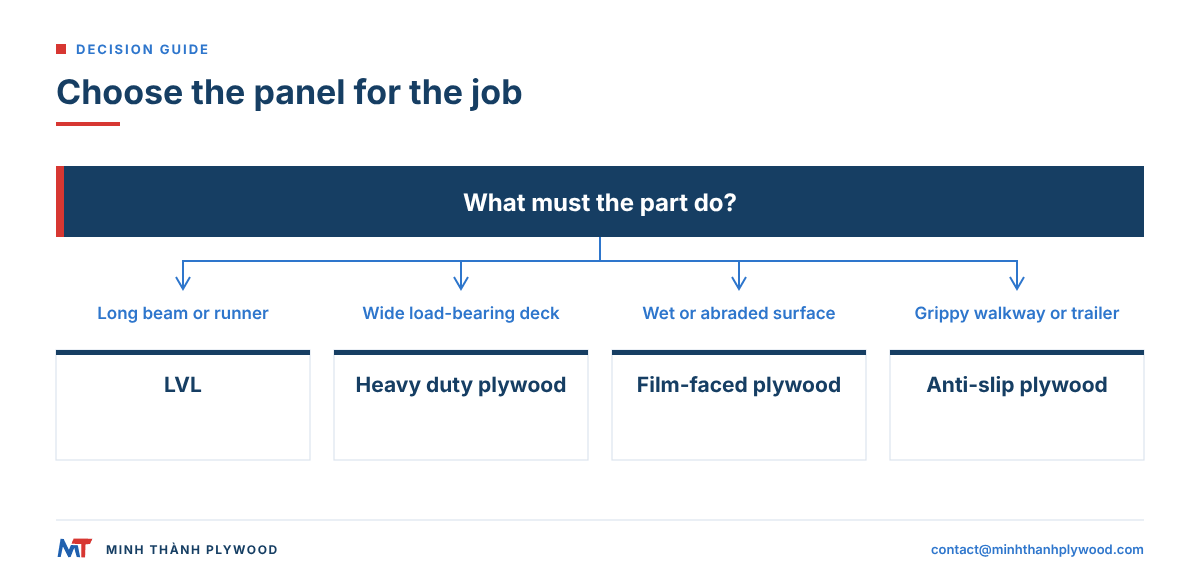
Choose LVL when the part is long and narrow and carries load along its length, and film-faced plywood when the surface must shed water and resist wear.
| If the part is | Choose | Why |
|---|---|---|
| A beam, rail, runner or skid | LVL | All the grain runs along the member, so it is stronger along its length than a plywood strip |
| A wide deck, floor or top | Heavy duty plywood | Crossed grain spreads load in both directions and resists splitting |
| A surface that gets wet, muddy or abraded | Film-faced plywood | A phenolic film face sheds water and concrete and is easy to clean |
| A walkway or trailer deck that must not be slippery | Anti-slip plywood | A wire-mesh pattern pressed into the film face gives grip |
| A crate for a light product | Packing plywood | Lower-cost faces and core for one-trip use |
A common heavy-duty assembly uses two products: LVL runners or skids under a heavy-duty plywood deck. The LVL strength guide compares LVL with timber; our film-faced plywood range covers the coated panels, and anti-slip plywood is made on order.
Is heavy duty plywood the same as marine or structural plywood?
No. Heavy duty describes a strong build, marine describes a boat-building standard, and structural describes a graded panel with design values. One panel can be more than one of these, but the names are not interchangeable.
- Marine plywood is made to a marine standard such as BS 1088, with durable face and core species, a WBP bond and no core gaps. A heavy-duty Eucalyptus panel can share the bond and the gap-free core, but it is not sold as marine plywood. See commercial vs marine plywood.
- Structural plywood carries a structural grade and marking under a building standard, with tested design values. Ask for it when an engineer designs the floor or deck from those values.
- Heavy duty plywood is the right name for trailer floors, benches, crates, stages and racking where the user sets the requirement by thickness, core, bond and face.
Use the name that matches the requirement, and write the build lines anyway; the build is what you receive.
Heavy duty plywood in US terms: CDX, pressure-treated and span-rated panels
In the US, heavy duty plywood means a 3/4 in. (23/32 in. performance category, about 18 mm) 4 x 8 ft sheet, usually CDX and often pressure-treated, sold with an APA span rating such as 48/24. CDX is a C-D face grade with exterior glue that APA classes as Exposure 1; the span rating gives the maximum support spacing in inches, 48 for roof sheathing and 24 for subflooring, and APA reserves long-term weather exposure for its Exterior grade (APA Rated Sheathing data sheet).
A retailer such as Hamshaw Lumber sells the 3/4 in. pressure-treated CDX sheet for load-bearing surfaces (read 21 October 2026).
| US term | What it is | Our nearest build |
|---|---|---|
| 3/4 in. (23/32 in.) 4 x 8 ft | About 18 mm, 1220 × 2440 mm | 18 mm Eucalyptus core, 34.8 kg a sheet |
| CDX | C-D faces, exterior glue, Exposure 1 | Utility C/D faces, phenolic (WBP) bond |
| Pressure-treated | Preservative driven into the wood | Not supplied; panels ship untreated |
| APA span rating, 48/24 | APA-stamped panel, third-party quality assurance | Not APA-stamped; specified by thickness, ply count and bond |
We supply untreated panels without an APA stamp, so a US building inspector who requires a span-rated stamp will not accept them for code-regulated sheathing. For packing, crating, platforms, formwork backing, industrial floors and furniture, the 18 to 25 mm Eucalyptus phenolic build does the same job at a container price: commercial plywood starts from US$250/m³ FOB (October 2026), which is US$13.40 of panel for one 18 mm 1220 × 2440 mm sheet before freight and duty.
Ask for the ply count, the glue and the thickness tolerance on the quote, as in the steps above.
How do you check heavy duty plywood on arrival?
Check five things on a sample of sheets from each pack before the panels go into use.
- Thickness. Measure with a caliper at the corners and mid-edges; readings should sit within ±0.5 mm of the nominal.
- Ply count and core. Count the plies on a cut edge and look for core gaps, overlaps and soft veneers.
- Weight. Weigh a sheet: an 18 mm Eucalyptus-core sheet of 1220 × 2440 mm should weigh about 34.8 kg, give or take its moisture. A much lighter sheet has a lighter core.
- Bond. For a WBP order, a boil test on an offcut checks the glue line: the plies should not separate.
- Flatness and face. Lay a sheet on a flat floor and check for bow; look for open splits, patches and film damage on the face.
Keep the readings with the packing list and the pack labels, next to the certificates and test reports listed on our quality page. Every Minh Thanh shipment is photographed and filmed before loading, and you receive the photos and video, so the receiving check can be set against the loading record.
How much do heavy duty plywood sheets weigh, and how many fit in a 40HC?
Heavy duty plywood is heavy by design, so a container fills by weight before it fills by space. On our 40HC plan, with a planning payload of 28,000 kg of panels:
| Sheet, 1220 × 2440 mm | Core | Weight per sheet | Packs × sheets | Sheets per 40HC | Panel weight |
|---|---|---|---|---|---|
| 18 mm | Eucalyptus | about 34.8 kg | 15 × 53 | 795 | 27,666 kg |
| 18 mm | Acacia | about 31.1 kg | 16 × 55 | 880 | 27,368 kg |
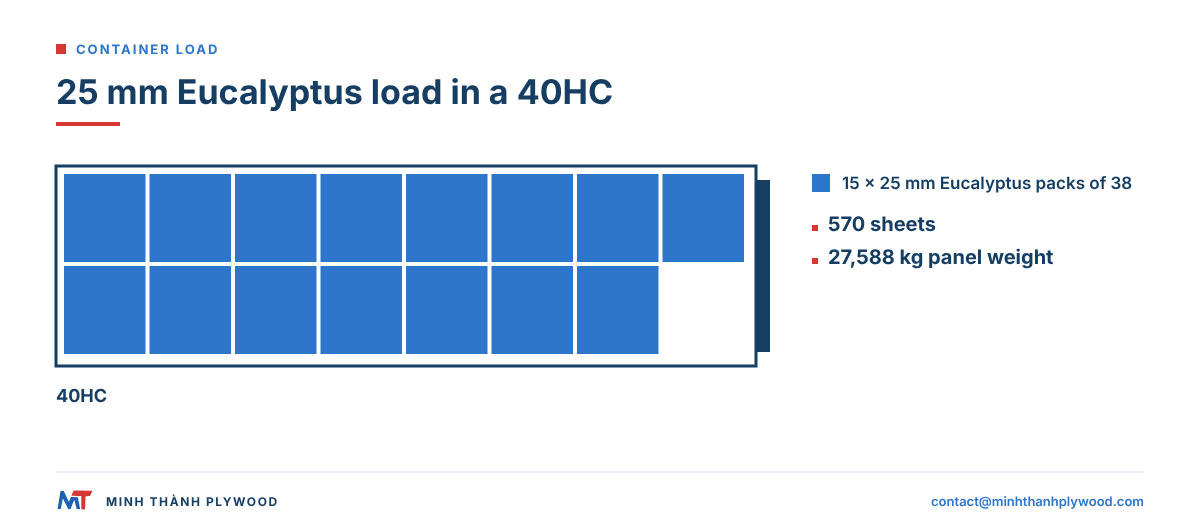
| 25 mm | Eucalyptus | about 48.4 kg | 15 × 38 | 570 | 27,588 kg |
| 25 mm | Styrax | about 37.2 kg | 18 × 40 | 720 | 26,784 kg |
Packs are about 1,000 mm high; sheets per pack are 1,000 ÷ thickness, rounded down and then reduced where the weight limit comes first, as it does for Eucalyptus. Packaging is added for the booking check, and a lower booking limit lowers the count. One 40HC can carry two or three thicknesses by agreement. Try your own mix with the packing calculator.
Where is heavy duty plywood used?
Heavy duty plywood goes wherever a panel takes weight, wheels or knocks every day.
- Trailer, truck and van floors: Eucalyptus core, phenolic WBP, often a film or anti-slip face.
- Workbenches and machine tables: thick sanded panels, sometimes laminated two layers, with sealed edges.
- Racking and mezzanine decks: 18–25 mm panels fixed to beams.
- Stage and event platforms: film-faced or anti-slip decks on frames.
- Export crates for machinery: dense decks on LVL or timber skids, with phenolic glue for long sea voyages.
- Stair treads and walkways: exterior-type panels with water-resistant glue; Minh Thanh’s exterior plywood is made for stair treads and sheathing.
For each use, the same seven specification lines apply; only the values change.
What to write on a heavy duty plywood order
Write one line per specification point, and the panel you receive will be the panel you asked for.
- Application and load: “trailer floor, forklift traffic, joists at 400 mm”.
- Core: “Eucalyptus core, 11–13 plies at 18 mm, no core gaps”.
- Glue: “phenolic WBP, EN 314-2 class 3”.
- Face and back: “phenolic film 2 sides” or “utility hardwood C/D”.
- Size and tolerance: “1220 × 2440 × 18 mm, thickness ±0.5 mm, length and width ±2 mm”.
- Packing and quantity: sheets per pack, total sheets, edge sealing.
- Port and Incoterm: FOB Hai Phong, CFR or CIF.
Commercial plywood starts from US$250/m³ (October 2026); the final price follows the core, glue, face, thickness and quantity. The minimum order is one 40HC, mixed specifications by agreement, and production is 15–45 days after the 30 % deposit, with the 70 % balance against the scanned B/L. Free samples of the exact build come first. Send the lines to [email protected] or to Lisa on WhatsApp at +84 988 586 601; we reply within hours.
Buyer questions, answered
What is heavy duty plywood?
Heavy duty plywood is a trade name for thick, dense plywood made to carry load and resist wear: a hardwood core such as Eucalyptus, a high ply count, a phenolic (WBP) or melamine-fortified bond and a gap-free core, usually 18–40 mm thick.
What is the strongest plywood for heavy loads?
For a panel, a thick, many-ply sheet on a dense hardwood core with a phenolic WBP bond. For a long beam or rail that carries load along its length, LVL is stronger than any plywood of the same size.
What thickness is heavy duty plywood?
Usually 18 mm and up. Trailer floors, workbenches and racking decks often use 18–25 mm; heavy platforms and stage decks use 25–40 mm. Minh Thanh makes plywood up to 40 mm thick.
Is heavy duty plywood waterproof?
No plywood is waterproof, but a phenolic WBP bond keeps the plies together after wetting and drying. The wood still needs sealed edges and a coated or film face to stay sound outdoors.
Which core is best for heavy duty plywood, poplar or eucalyptus?
Eucalyptus. At 650–750 kg/m³ it is denser and harder than poplar or Styrax, so it holds screws better and resists dents and point loads. Poplar and Styrax suit lighter furniture panels.
How much does an 18 mm heavy duty plywood sheet weigh?
A 1220 × 2440 × 18 mm sheet on a Eucalyptus core weighs about 34.8 kg, against about 26.8 kg on a white Styrax core.
How many plies does heavy duty plywood have?
At 18 mm, expect 11–13 plies; 11 is what most orders get. Thicker panels add plies, and the order should state the ply count in writing.
Is heavy duty plywood the same as marine plywood?
No. Marine plywood is made to a marine standard such as BS 1088 with durable species and no core gaps. Heavy duty plywood is a load-and-wear specification and may use other species.
Is heavy duty plywood the same as structural plywood?
Not necessarily. Structural plywood is graded and marked under a structural standard with design values. Heavy duty describes a strong build; ask for structural certification only when the engineer requires it.
What is heavy duty plywood used for?
Trailer and truck floors, workbench and machine tops, racking and mezzanine decks, stage platforms, crates for heavy goods, stair treads and anti-slip walkways.
How many 25 mm heavy duty sheets fit in a 40HC?
On our plan, 570 sheets of 1220 × 2440 × 25 mm on a Eucalyptus core, in 15 packs of 38, about 27,600 kg of panels. On a Styrax core the plan is 720 sheets.