
Gloss white panels are boards with a mirror-like white face made in one of five ways: acrylic sheet, PET film, UV lacquer, gloss HPL or gloss melamine. Each scratches, yellows and edges differently, and the core under it, MDF, particleboard or plywood, decides weight and screw hold. Minh Thanh Plywood makes the flat, UV-ready plywood that gloss makers face.
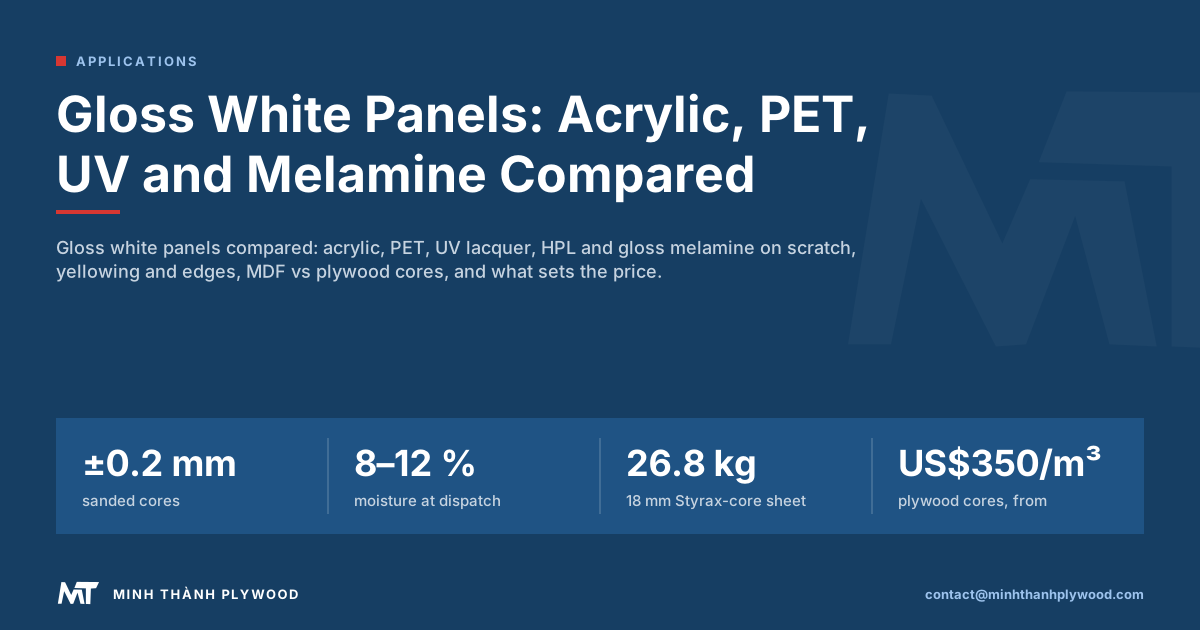
Gloss white panels in short
Gloss white panels are boards with a high-shine white face, and the finish, not the colour, decides how they wear and what they cost. There are five common finishes, each on one of three cores.
- Finishes: acrylic sheet, PET film, UV-cured lacquer, gloss HPL, gloss melamine.
- Cores: MDF (most common), particleboard (cheapest), plywood (lightest and strongest at the screws).
- Main uses: kitchen doors, wardrobe fronts, wall panels, retail and hotel fit-outs.
- Key choices: scratch resistance, yellowing, edge matching and the core.
The comparison table below sets the five finishes against each other on the same rows.
What is a high gloss white panel made of?
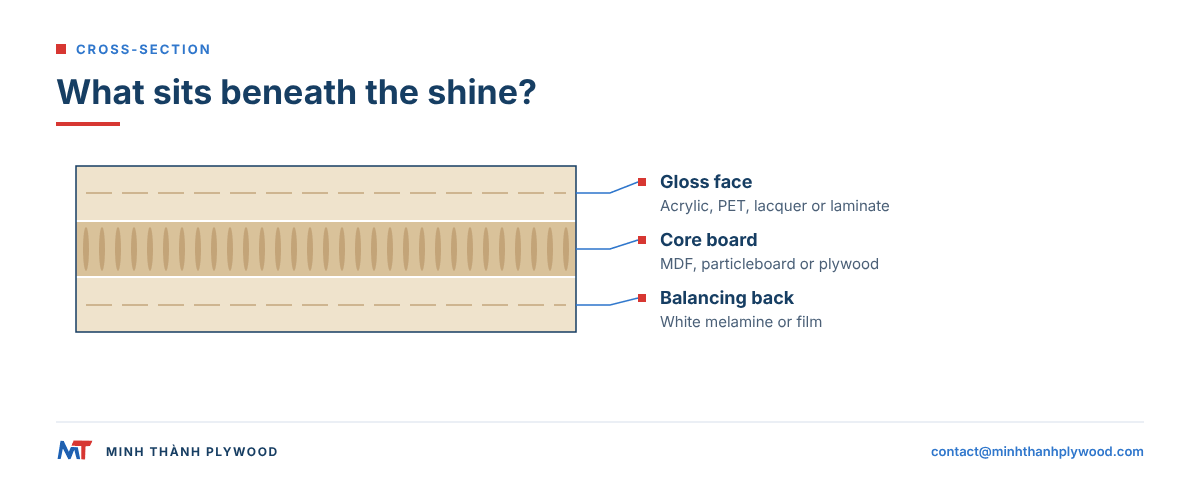
A high gloss white panel has three parts: a core board, a gloss layer on the show face and a balancing layer on the back. The gloss layer is a plastic sheet, a film, a lacquer or a decorative laminate; the core is MDF, particleboard or plywood; the back is usually a white melamine or a cheaper film that stops the panel bowing.
The balancing layer matters more than buyers expect. A strong gloss layer on one face pulls the board as it ages and as humidity changes; a weaker back layer or none at all lets the panel cup. Good gloss panels press the face and the back together, or balance them by design.
The core under the gloss sets the weight, the screw hold and how the panel handles a damp kitchen. The face of the core must be smooth, because any ripple, sanding mark or open grain telegraphs through a high-gloss surface and shows under a light.
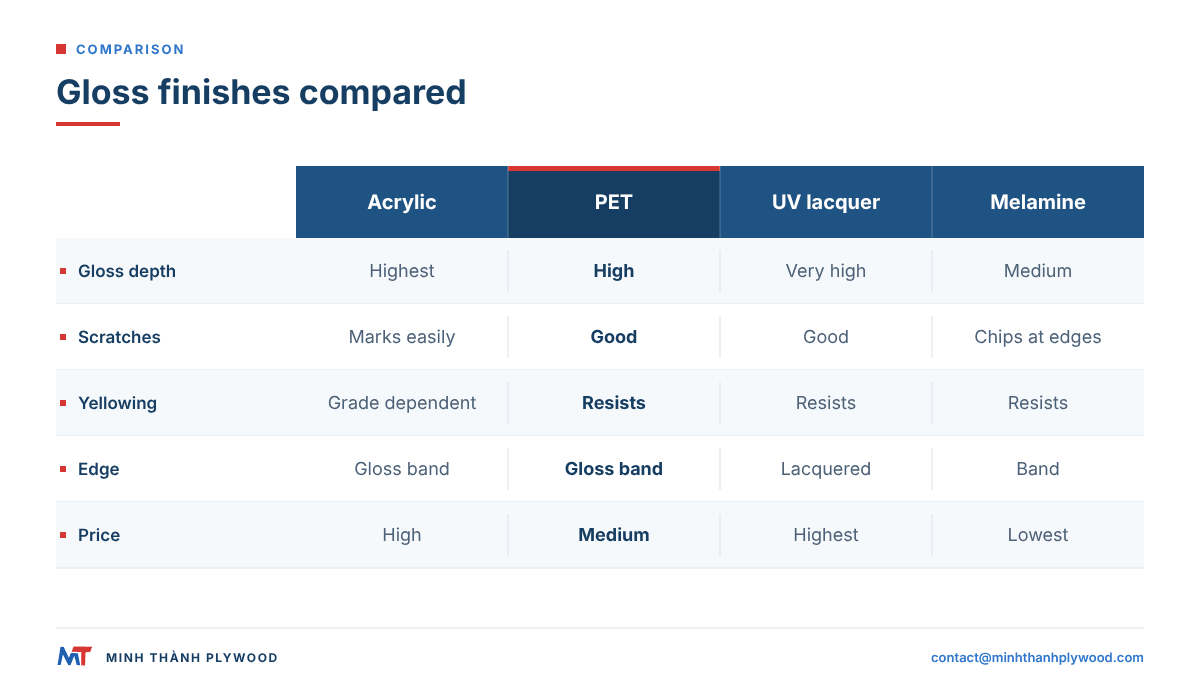
Acrylic, PET, UV lacquer, HPL and gloss melamine compared
Acrylic gives the deepest gloss, PET the best balance of wear and cost, UV lacquer the cleanest one-piece look, HPL the hardest surface and gloss melamine the lowest price. The table compares the five finishes on one metric per row.
| Metric | Acrylic sheet | PET film | UV lacquer | Gloss HPL | Gloss melamine |
|---|---|---|---|---|---|
| Depth of gloss | Highest, mirror | High | Very high | High | Medium |
| Scratch resistance | Lowest; polishable | Good | Good | Highest | Good, but chips |
| Yellowing in sun | Can yellow (grade dependent) | Resists | Resists (good grades) | Resists | Resists |
| Edge look | Matching gloss edge band | Matching edge band | Can be lacquered over the edge | Edge band or wrap | Edge band |
| Repair of light scratches | Polish out | Hard to repair | Recoat | Not repairable | Not repairable |
| Typical core | MDF or plywood | MDF, particleboard, plywood | MDF or plywood | Plywood or particleboard | Particleboard or MDF |
| Relative price | High | Medium | Highest | Medium to high | Lowest |
No finish wins on every row, which is why the right choice starts with how the panel will be used.
PET vs acrylic kitchen doors
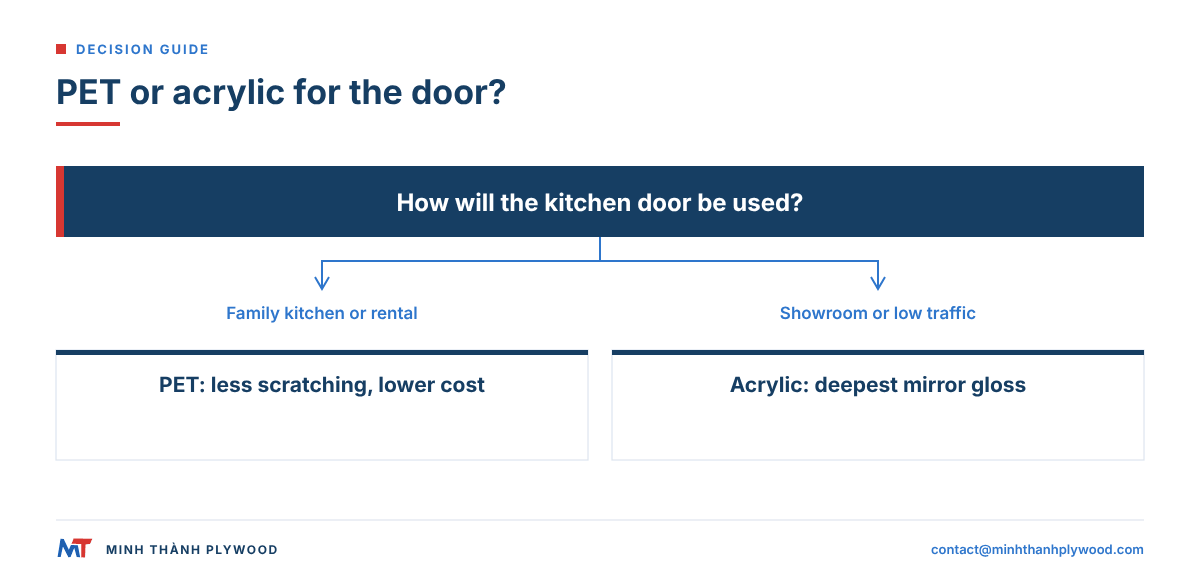
For most kitchen doors, PET is the better choice than acrylic: it scratches less, holds its white without yellowing and costs less, while the gloss is only slightly softer. Acrylic is the better choice where the deepest mirror shine matters more than wear, such as a showroom kitchen or a wall that is rarely touched.
- Acrylic: a solid sheet of PMMA plastic bonded to the board. Very deep gloss and colour depth. Light scratches can be polished out. Softer surface, so it marks with daily use.
- PET: a polyester film laminated to the board. Harder-wearing surface, good resistance to cleaning chemicals, colour stable. Recyclable film. Gloss a little less deep than acrylic.
A practical rule many kitchen makers use: PET for families and rentals, acrylic for low-traffic, high-design projects.
UV lacquer and HPL: the hardest gloss faces
UV lacquer is a gloss coat cured instantly under ultraviolet lamps, and it gives the cleanest one-piece gloss panel because the same coat can run over the edge of the door. Lines spray or roll several coats, sanding between them, then polish the final coat to a mirror. The result is very hard and colour stable, and it costs the most.
Gloss HPL is a high-pressure decorative laminate with a gloss surface, glued to the board. High-pressure decorative laminates are specified in the EN 438 series, described in the BSI record for BS EN 438-1. It has the hardest surface of the five and the best impact resistance, which suits shop fittings, reception desks and commercial wardrobes. Its edges need a matching edge band or a wrapped profile.
Both finishes need a perfectly flat core. Our panels leave the factory sanded and polished, with both faces UV-ready to the standard customers need to apply their own UV coating.
Gloss melamine and white gloss melamine boards
White gloss melamine boards are the lowest-cost gloss panels: a melamine resin paper is pressed onto particleboard or MDF in one hot-press cycle. The surface is hard and hygienic, but the gloss is flatter than acrylic or PET, and edges chip if cut with a worn saw.
Melamine is a resin, not a material on its own. In board language, “melamine” means a decorative paper soaked in melamine resin and fused to the face of the board. The same process gives matt, textured and woodgrain faces; gloss is one press-plate option. The melamine board guide lists sizes and colours, and melamine-faced chipboard vs melamine plywood compares the cores.
MDF or plywood under the gloss?
MDF is the usual core for gloss panels because its face is smooth and uniform, while plywood is the better core where weight, screw hold and kitchen damp matter. Particleboard is the lowest-cost option and the weakest at the screws.
| Core | Face smoothness under gloss | Screw and hinge hold | Weight | Damp kitchens |
|---|---|---|---|---|
| MDF | Very smooth | Fair, poor in the edge | Heavy | Swells at open edges |
| Particleboard | Smooth with a fine top layer | Weakest | Medium | Swells at open edges |
| Plywood | Smooth when sanded and calibrated | Strong, also in the edge | Lightest | Best, by bond class |
Plywood needs one thing that MDF gives for free: a calibrated, flat face. That is where factory practice decides the result.
What a plywood core needs for a gloss face
A plywood core takes a gloss face well when it is flat, calibrated and sanded, so nothing of the core shows through. Our furniture panels meet these points as standard:
- Double pressing: the core board is pressed and calibrated, then face and back are pressed on, which keeps the panel flat.
- Stitched cores: core layers are stitched horizontally and vertically, so no gaps or overlaps print through the face.
- Tight thickness: sanded furniture panels hold ±0.2–0.3 mm, down to ±0.2 mm, so doors and panels match.
- Sanded, polished, UV-ready faces: both faces are ready for UV coating, PET, acrylic or HPL lamination.
- Stable moisture: veneers and finished panels are dried to 8–12 % moisture content at dispatch.
For a gloss face, a fine, close-grained face veneer such as poplar or engineered veneer works best, because the grain is smooth under film. White Styrax cores keep the panel light: an 18 mm sheet of 1220 × 2440 mm weighs about 26.8 kg.
Scratches, yellowing and fingerprints
Scratches, yellowing and fingerprints are the three complaints buyers make about gloss white panels, and the finish choice prevents most of them. Scratches show most on acrylic; yellowing comes mainly from sunlight on white PVC films and low-grade acrylic; fingerprints show on every high gloss and are a cleaning matter.
- Against scratches: choose PET, HPL or UV lacquer for doors that are touched daily; keep the protective film on until the kitchen is finished.
- Against yellowing: avoid white PVC foils for sunny rooms; ask for a UV-stable acrylic or PET; keep gloss away from south-facing windows without blinds.
- Against fingerprints: handleless doors with push-latches or a profile handle keep hands off the face.
Clean gloss panels with a soft microfibre cloth and a mild detergent. Abrasive pads and solvent cleaners dull and scratch every gloss finish.
Edges: matching the gloss
The edge is what makes a gloss white door look premium or cheap. A white edge band of a slightly different shade or gloss level shows every time the light hits it.
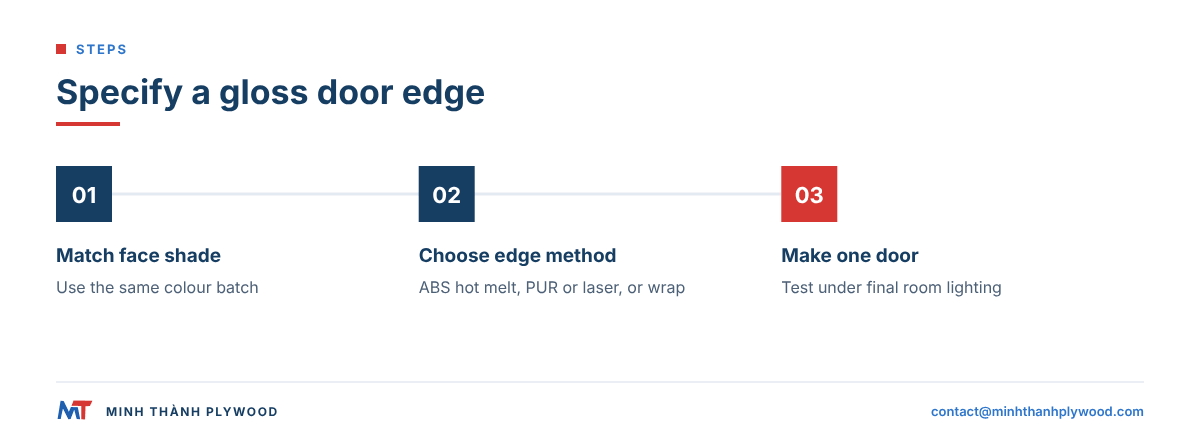
Three edge methods, from good to best:
- ABS gloss edge band with hot-melt glue: low cost, a visible glue line.
- PUR glue or laser edge banding: near-invisible joint and better moisture resistance at the edge.
- Lacquer or wrapped edge: the gloss runs over the edge, as with UV-lacquered doors, for a look with no visible joint.
Order the edge band from the same supplier and colour batch as the gloss face, and test one door under the room’s own lighting before the run.
Gloss board prices: what drives the cost
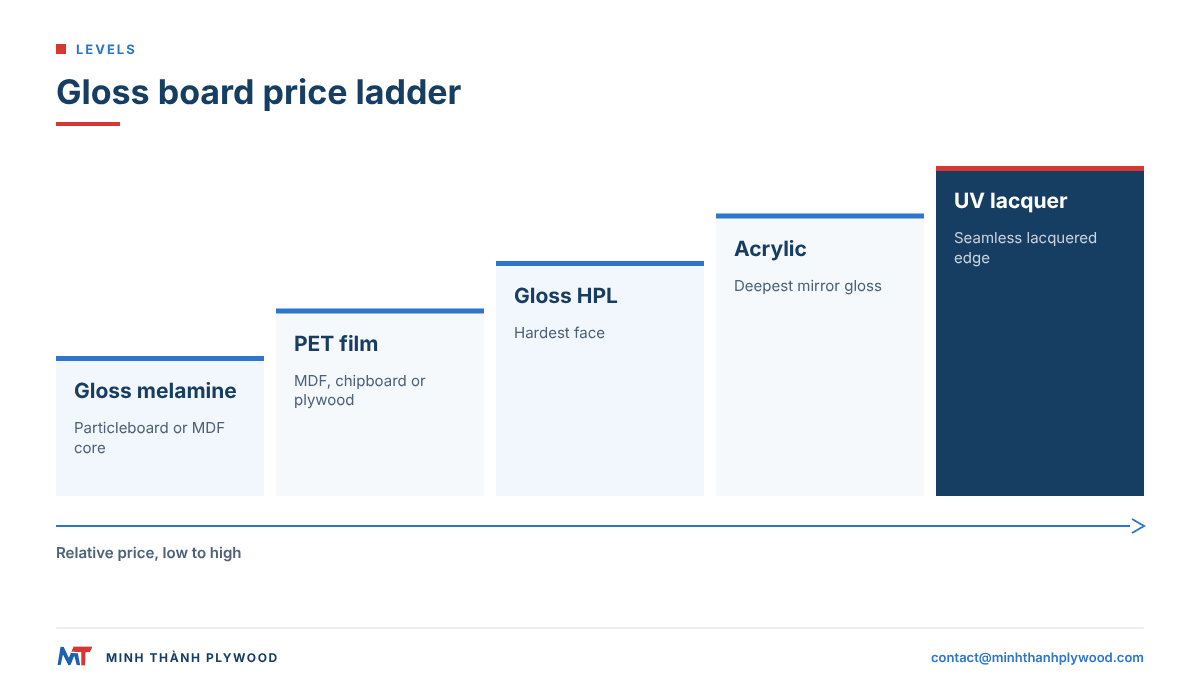
Gloss board prices are set mainly by the finish and the core, then by the faces, edges and order size. A gloss melamine particleboard sits at the bottom of the range and a UV-lacquered plywood door at the top.
| Price driver | Lower cost | Higher cost |
|---|---|---|
| Finish | Gloss melamine | Acrylic, UV lacquer |
| Core | Particleboard | MDF, then plywood |
| Gloss faces | One face, white back | Gloss both faces |
| Edges | ABS band, hot melt | Laser band or lacquered edge |
| Colour | Standard white | Custom colour or super-matt pair |
| Order size | Full container, one colour | Small runs, many colours |
| Destination | FOB at the mill | Delivered, small lots |
We supply the plywood core, not the finished gloss panel: furniture and interior plywood starts from US$350/m³ (October 2026), and the final price depends on face, core, glue, thickness, size, quantity and delivery term.
White gloss plywood: where it fits
White gloss plywood is plywood with a gloss white face of HPL, acrylic, PET or lacquer, and it fits wherever a gloss panel must be light, strong at the screws or exposed to damp. Typical uses are kitchen doors on tall units, boat and caravan interiors, retail displays, and wall panelling that is moved or reused.
Panel makers in Europe and the Middle East often buy the plywood and laminate it themselves, which keeps colour, gloss level and stock under their control. For them, the plywood order matters as much as the gloss sheet: flatness, face quality and tolerance decide the reject rate.
Where gloss white panels work, and where they do not
Gloss white panels work best on vertical surfaces that are seen more than they are touched: wall units, tall units, wardrobe fronts and feature walls. They reflect light and make small rooms feel larger, which is why they are common in apartments and hotel rooms.
| Application | Fit for gloss white | Best finish | Note |
|---|---|---|---|
| Kitchen wall units | Very good | PET or acrylic | Above hand height, few scratches |
| Kitchen base units | Good with care | PET, HPL or UV lacquer | Kicks and pans mark softer faces |
| Wardrobe fronts | Very good | Acrylic or PET | Large flat doors show the gloss well |
| Bathroom vanities | Good | HPL or PET on a damp-tolerant core | Seal every edge |
| Wall panelling | Very good | UV lacquer or HPL | Plan joints and light angles |
| Shop counters and desks | Good | Gloss HPL | Hardest face for daily wear |
| Worktops and shelves | Poor | None of these | Use HPL matt or stone |
Gloss is the wrong choice for horizontal working surfaces. Pots, keys and dust scratch any gloss finish placed flat, and the damage shows at every angle. Pair gloss doors with a matt worktop and matt interior shelves.
Light also matters. A gloss wall under a low-angle spotlight shows every ripple in the core and every joint between panels. Specify a calibrated core and test one panel under the final lighting before a large run.
Buyer checklist for gloss kitchen doors
A gloss kitchen door order works when the finish, the core and the edges are specified together. Check these points before you confirm:
- Use: family kitchen, rental, showroom or commercial; which doors are touched daily.
- Finish: acrylic, PET, UV lacquer, HPL or gloss melamine; gloss level and white shade with a sample.
- Core: MDF, particleboard or plywood; thickness and tolerance.
- Back: gloss both faces or a balancing white back.
- Edges: band type, glue (hot melt, PUR or laser) and colour match.
- Protection: factory film left on; packing that keeps faces apart.
- Emission: CARB P2 / TSCA Title VI or the buyer’s emission method for the core.
Gloss level is stated as a gloss value at 20°, 60° or 85° under ISO 2813:2014, so ask which angle any gloss figure uses and compare samples at the same angle.
What this means for your gloss panel core order
A gloss panel maker ordering plywood cores should send these lines:
- Application: gloss kitchen doors, wardrobe fronts or wall panels; finish to be applied.
- Core: white Styrax for light panels, or Eucalyptus at 650–750 kg/m³ for denser ones.
- Glue and emission: UF glue at E0 emission for dry interiors; MR or WBP to your specification.
- Face: poplar or engineered veneer, sanded and polished, both faces UV-ready.
- Size and thickness: 1220 × 2440 mm or 1250 × 2500 mm, 3–40 mm; ±0.2 mm on sanded furniture panels; cut-to-size into 4, 6 or 8 pieces.
- Packing and quantity: from one 40HC, mixed specifications by agreement; destination port.
Our panels are CARB P2 / TSCA Title VI certified (ICTT mill no. 23024); six ASTM D6007 chamber tests averaged 0.014–0.032 ppm. The US limit for veneer-core hardwood plywood is 0.05 ppm under 40 CFR 770.10. Production is 15–45 days after the deposit, FOB Hai Phong, CFR or CIF, with free samples. Compare other cores in types of wood boards and plywood for kitchen cabinets.
Buyer questions, answered
What are gloss white panels?
Gloss white panels are furniture boards with a high-shine white face, made from acrylic sheet, PET film, UV-cured lacquer, gloss HPL or gloss melamine bonded to MDF, particleboard or plywood. They are used mainly for kitchen doors, wardrobes and wall panelling.
PET or acrylic: which is better for kitchen doors?
Acrylic gives the deepest mirror gloss and can be polished, but it scratches more easily. PET is harder-wearing, resists yellowing and costs less, with a slightly softer gloss. For a busy family kitchen PET is the safer choice; for a showroom look, acrylic.
Do white gloss kitchen doors turn yellow?
Some do. White PVC films and lower-grade acrylic can yellow with sunlight and heat over time, while PET and good UV lacquer hold their colour better. Ask the supplier for the UV stability of the white you order.
What is a high gloss board price based on?
A high gloss board price is set by the finish (gloss melamine lowest, then PET, HPL and acrylic, with UV lacquer at the top), the core (particleboard, MDF or plywood), the number of gloss faces, edge work and order size.
Is high gloss melamine the same as acrylic?
No. Gloss melamine is a resin-impregnated paper pressed on the board, cheap and hard but with a lower, flatter shine. Acrylic is a solid plastic sheet with a much deeper gloss and a higher price.
Is plywood a good core for gloss white panels?
Yes, where weight, screw hold or moisture matter. Plywood is lighter than MDF, holds hinge screws better and tolerates kitchen damp, but its face must be flat and sanded so the grain does not show through the gloss.
Can you get white gloss plywood?
Yes. White gloss plywood is plywood faced with gloss HPL, acrylic, PET or a UV lacquer. Panel makers buy sanded plywood with UV-ready faces and apply the gloss layer themselves.
How do you stop gloss white panels scratching?
Choose PET, HPL or UV lacquer over acrylic for high-traffic doors, keep the factory protective film on until installation, clean with a soft microfibre cloth and avoid abrasive cleaners.
What edge suits a gloss white door?
A matching high-gloss edge band, laser-fused or PUR-glued for a near-invisible joint, or a door with the gloss wrapped or lacquered over the edge. A plain ABS edge in a slightly different white is what makes cheap gloss doors look cheap.