
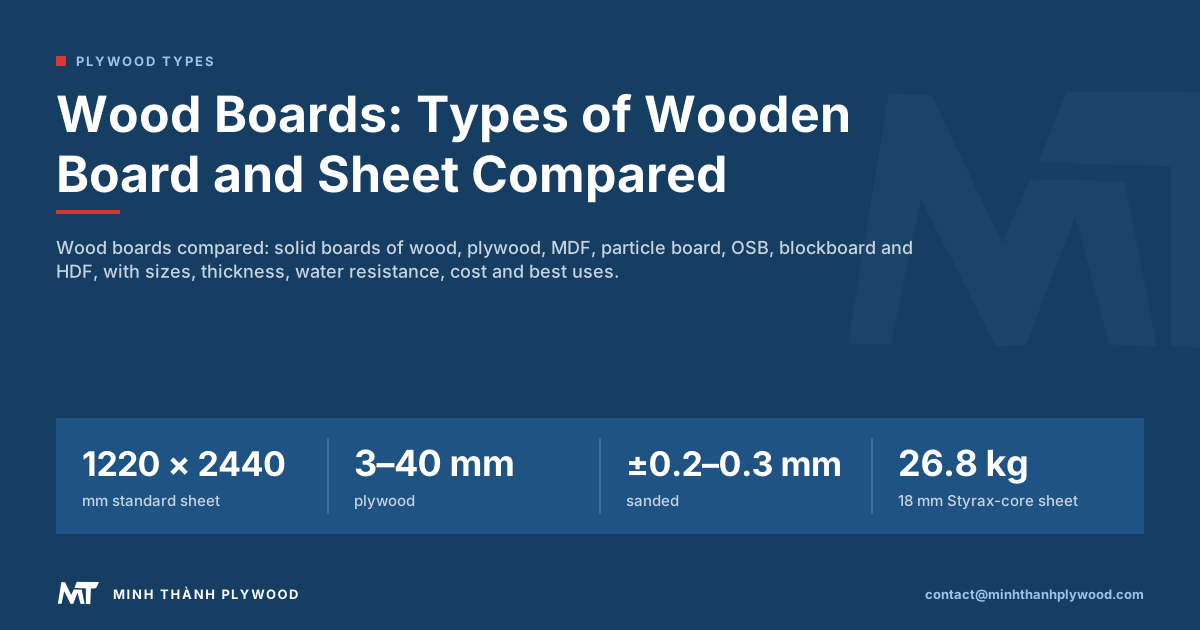
Wood boards come in two kinds: solid boards sawn from a log, and wood sheets made by bonding veneers, strips, chips, strands or fibres. Plywood, MDF, particle board, OSB, blockboard and HDF are the sheets you meet in furniture and building. This guide from Minh Thanh Plywood, a Vietnamese plywood manufacturer, compares them on one table and tells you which board fits each job.
What are wood boards?
Wood boards are flat pieces of wood used to build furniture, interiors and buildings: either solid boards sawn from a log, or manufactured sheets made by bonding wood pieces with glue. In trade, “board” covers both.
Solid boards keep the grain of the tree in one piece. They are limited in width by the log, and they shrink and swell across the grain as humidity changes. Manufactured boards rebuild the wood from smaller elements, so they come as large, flat sheets of a set size and thickness.
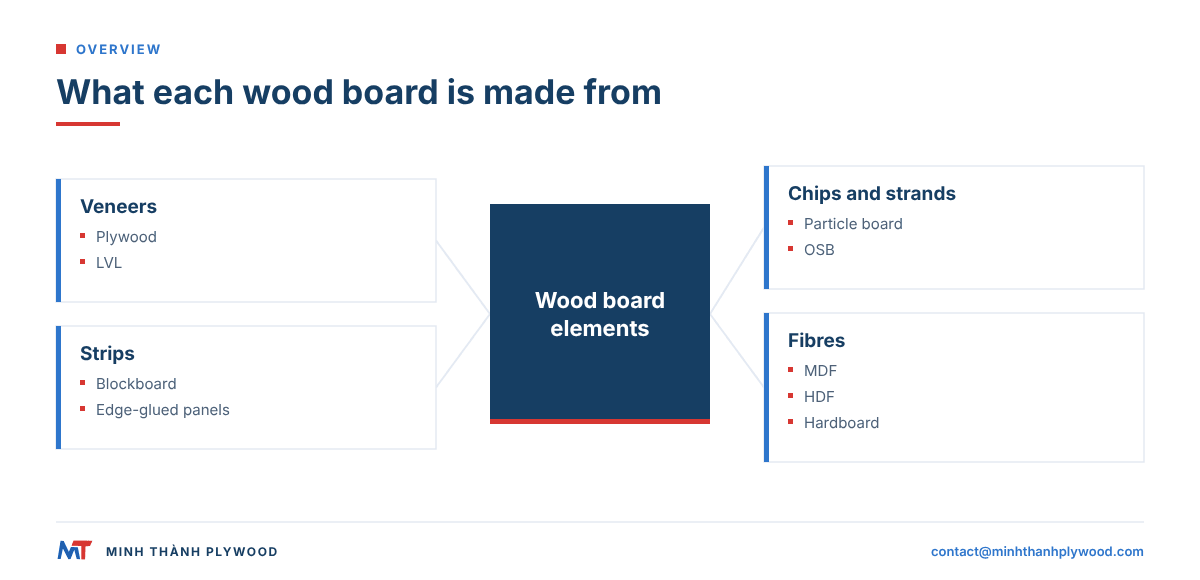
The element a board is built from decides how it behaves:
- Veneers: plywood, LVL.
- Strips or small boards: blockboard, edge-glued and finger-jointed panels.
- Chips: particle board.
- Strands: OSB.
- Fibres: MDF, HDF and hardboard.
The larger and more continuous the element, the stronger the board and the better it holds screws. The finer the element, the smoother and cheaper the surface.
Types of wood boards at a glance: the selector table
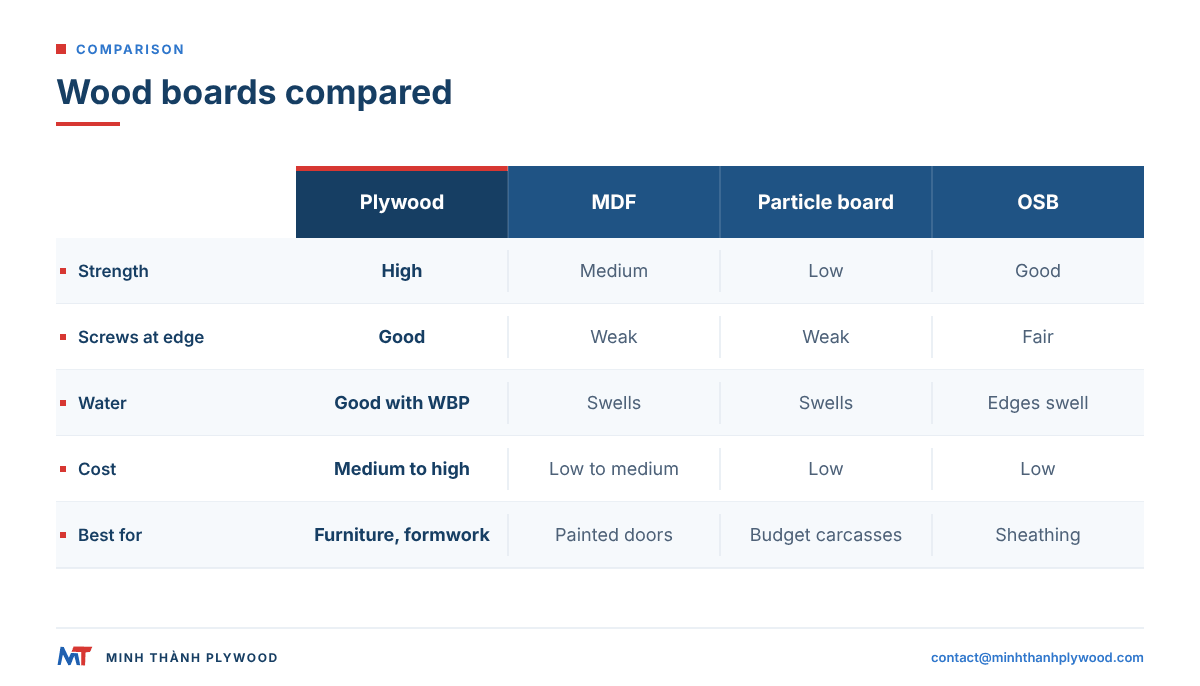
The main types of wood boards are solid wood boards, plywood, MDF, HDF and hardboard, particle board, OSB, blockboard and edge-glued panels. The table compares them on what each is made of, size, thickness, water resistance, cost band and best uses. Cost band is relative, from low to high, for boards of the same thickness.
| Board | Made of | Standard size | Common thickness | Water resistance | Cost band | Best uses |
|---|---|---|---|---|---|---|
| Solid wood boards | Sawn timber | Limited by the log | 18–40 mm planed | Moves with humidity; durable species last outdoors | Medium to high | Tables, frames, edges, carving |
| Plywood | Crossed veneers and glue | 1220 × 2440 or 1250 × 2500 mm | 3–40 mm | Good with MR or WBP glue | Medium to high | Furniture, cabinets, formwork, floors |
| MDF | Wood fibres and resin | 1220 × 2440 mm | 3–30 mm | Swells when wet; moisture-resistant grades exist | Low to medium | Painted doors, mouldings, routed parts |
| HDF and hardboard | Dense fibres | 1220 × 2440 mm | 3–6 mm | Swells at edges | Low | Drawer bottoms, backs, flooring cores |
| Particle board | Wood chips and resin | 1220 × 2440 mm and larger | 9–25 mm | Swells when wet | Low | Melamine-faced carcasses, shelving |
| OSB | Oriented strands and resin | 1220 × 2440 mm | 9–25 mm | Faces resist rain; edges swell | Low | Wall, roof and floor sheathing |
| Blockboard | Wood strips between veneers | 1220 × 2440 mm | 16–25 mm | Interior use | Medium | Doors, long shelves |
| Edge-glued panel | Solid strips glued edge to edge | Made to order | 18–40 mm | Like solid wood | Medium to high | Worktops, stair parts, furniture |
Plywood is the board that covers the most jobs: it is strong, light for its stiffness, holds screws and can be built for humid or wet use. MDF and particle board win on smoothness and price; OSB wins on price for sheathing.
Solid wood boards in the US: nominal and actual sizes, types and craft boards
In the United States, “wood boards” at a lumberyard means solid lumber sold by nominal size, not by the true size of the piece. A board sold as 1 × 4 is really 3/4 × 3-1/2 in. The table gives the nominal and actual sizes for the common widths, in lengths of 6, 8, 10 and 12 ft.
| Nominal size | Actual size (in) |
|---|---|
| 1 × 2 | 3/4 × 1-1/2 |
| 1 × 3 | 3/4 × 2-1/2 |
| 1 × 4 | 3/4 × 3-1/2 |
| 1 × 6 | 3/4 × 5-1/2 |
| 1 × 8 | 3/4 × 7-1/4 |
| 1 × 10 | 3/4 × 9-1/4 |
| 1 × 12 | 3/4 × 11-1/4 |
Some finger-joint trim is thinner still: Home Depot lists a primed 1 × 4 × 8 ft finger-joint pine board at an actual 0.719 × 3.5 × 96 in. Board types are named by face and finish:
- Common or whitewood board: kiln-dried square-edge pine or fir, the budget framing and shelf board, in 1 × 4 and 1 × 6 × 8 ft.
- Select or clear pine: fewer knots, for visible shelves and trim.
- Primed finger-joint pine (radiata pine): short lengths joined end to end, primed for paint, for trim.
- S4S hardwood: surfaced on four sides, in red oak, poplar or maple, for furniture and cabinets.
- Shiplap and tongue-and-groove: profiled boards in white oak or cedar for walls and slat walls.
- Edge-glued panels and rounds: narrow boards glued side by side into a wide top, such as an 18 in round pine panel.
- Reclaimed and barn-wood boards: weathered planks sold by the square foot for feature walls.
Craft and laser boards are a separate small-sheet market. Craft Closet sells 1/8 and 1/4 in boards in sizes such as 12 × 12, 12 × 19 and 16 × 24 in, in maple, walnut, cherry, African mahogany, sapele, red and white oak, hickory, bamboo and Baltic birch B/BB; basswood plywood comes as 12 × 18 in, 1/8 in sheets in packs of 10.
When does a plywood sheet beat gluing boards edge to edge? For a wide, flat panel such as a cabinet side, a door or a table top, a sheet of 1220 × 2440 mm (4 × 8 ft) plywood is flatter and moves less than glued-up boards, and it costs less per square metre. Solid boards win where the edge shows or the piece is carved. The second half of this guide compares the sheet goods that fill the first case.
Sources: Wood boards, The Home Depot and Finished wood, Craft Closet, both checked on 21 October 2026.
Solid boards of wood: sawn timber
Solid boards of wood are planks sawn from a log and dried, sold in hardwood species for furniture and softwood species for building. They are the only wood boards with real grain through their full thickness.
Hardwood boards such as oak, ash, walnut and maple make table tops, frames, chair parts and visible edges. Softwood boards of pine, spruce and fir become joists, studs, battens and joinery, graded for strength in construction.
Solid boards have two practical limits. Width is limited by the tree, so wide tops are edge-glued from several boards. And every board moves across its grain with the seasons, which is why furniture makers leave room for movement in frames and fixings.
Solid boards make sense where the edge shows, where a surface will be sanded back over the years, or where the piece is carved or shaped. For large flat panels, a manufactured sheet is more stable and cost-effective. Our types of wood chart lists the species.
Plywood: the strongest wood sheet for its weight
Plywood is a wood sheet made of thin veneers glued in layers with the grain crossed, which makes it strong in both directions, stable and good at holding screws. It is the core product of our factory.
What sets plywood apart from other wood sheets:
- Strength and stiffness for its weight; an 18 mm sheet of 1220 × 2440 mm on a white Styrax core weighs about 26.8 kg.
- Screw and hinge holding, including near the edge.
- Glue for the use: UF glue at E0 emission for interiors, melamine-fortified or phenolic WBP for humid and wet use.
- Real wood faces: birch, poplar, EV, okoume, pine, eucalyptus and others.
Our furniture-grade panels are pressed twice as standard: the core board is pressed and calibrated, then face and back are pressed on. Sanded panels reach ±0.2 mm thickness tolerance, which matters for hardware and CNC parts. Read what plywood is for the layer-by-layer build.
MDF, HDF and hardboard: fibre boards
MDF (medium-density fibreboard) is a wood board made of fine wood fibres pressed with resin into a smooth, uniform sheet with no grain. HDF and hardboard are denser, thinner fibre boards.
MDF is the board of choice for painted cabinet doors, mouldings and routed shapes, because its surface and edges machine cleanly and take paint without grain showing. It is heavy for its thickness, holds screws poorly in its edges and swells permanently when water reaches it. Moisture-resistant MDF grades narrow the gap but do not match plywood with exterior glue.
HDF (high-density fibreboard) and hardboard come mostly in thin sheets for drawer bottoms, cabinet backs, door skins and laminate flooring cores. Our plywood vs MDF guide compares the two boards point by point.
Particle board and chipboard
Particle board, also called chipboard, is a wood board made of wood chips and resin pressed into a sheet. It is the lowest-cost furniture board and is usually sold with a melamine face.
Most flat-pack furniture carcasses, wardrobe sides and office desks are melamine-faced particle board. It is flat, cheap and easy to laminate. Its weaknesses are low screw holding, edges that crumble if knocked, sagging over long spans and swelling when water gets past the edge band.
Particle board fits dry rooms, short spans and budget furniture. For kitchens, bathrooms, long shelves or furniture that will be assembled more than once, plywood lasts longer. See particle board vs plywood for the full comparison.
OSB: oriented strand board
OSB (oriented strand board) is a wood board made of long, thin strands laid in crossed layers and pressed with resin. It is the low-cost sheathing board for walls, roofs and subfloors.
OSB’s strands are oriented in alternate directions, so it borrows plywood’s crossing principle at a coarser scale. That makes it strong enough for structural sheathing at a lower price than plywood. Its faces are rough and its edges swell when they get wet, so it is rarely used for furniture or for exposed surfaces. In the US, OSB is exempt from the TSCA Title VI emission limits (TSCA §601, 15 U.S.C. 2697) and falls outside the composite wood product definitions in 40 CFR 770.3.
Choose OSB for sheathing where cost leads; choose plywood where the panel must stay flat, take a fine finish, hold screws near edges or survive repeated wetting. Our plywood vs OSB guide covers subfloors, roofs and walls.
Blockboard and edge-glued panels
Blockboard is a wood board with a core of solid wood strips glued side by side and covered with veneers on both faces. Edge-glued panels are solid wood strips glued edge to edge with no face veneer.
Blockboard is lighter than plywood of the same thickness and stiff along the strips, which makes it useful for doors, long shelves and bed panels. Gaps between strips can telegraph through thin faces, and it holds screws poorly across the strips at the edge.
Edge-glued and finger-jointed panels look like solid wood because they are solid wood, built up from narrow strips. They make worktops, stair treads and furniture tops. Read blockboard vs plywood to compare the two sheets.
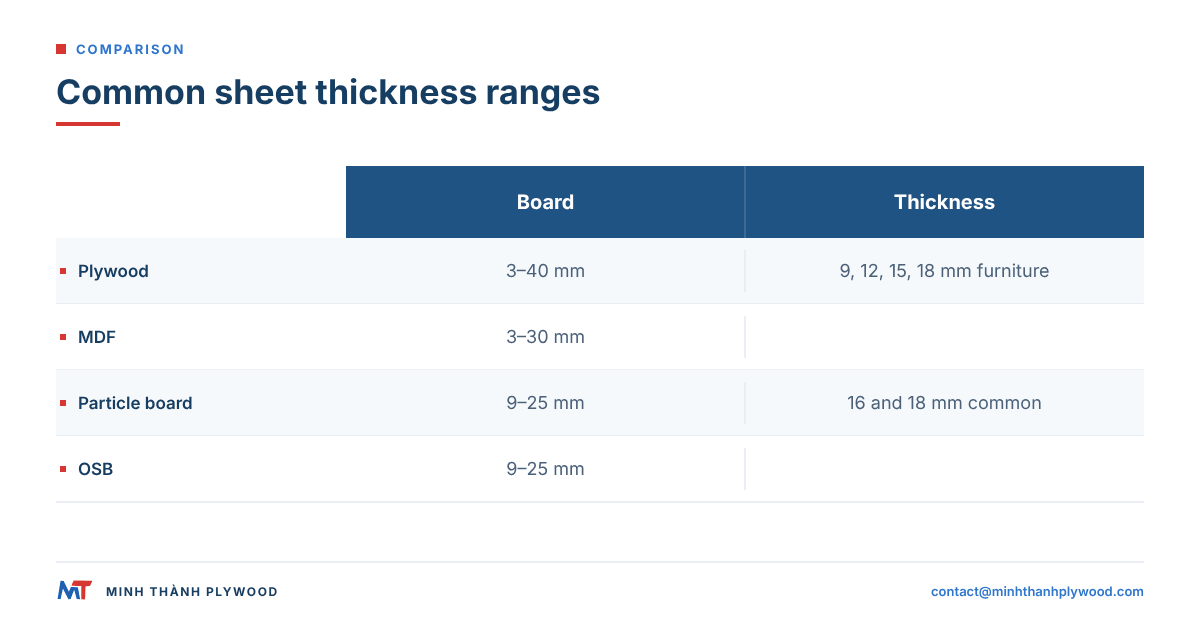
Wood sheet sizes and thicknesses
The standard wood sheet size is 1220 × 2440 mm, the metric version of the 4 × 8 ft sheet; 1250 × 2500 mm is common in Europe. Most sheet goods are made in these two sizes, with custom sizes from many mills.
| Board | Common thicknesses |
|---|---|
| Plywood | 3–40 mm; 9, 12, 15 and 18 mm most ordered for furniture |
| MDF | 3–30 mm |
| Particle board | 9–25 mm; 16 and 18 mm most common |
| OSB | 9–25 mm |
| HDF and hardboard | 3–6 mm |
| Blockboard | 16–25 mm |
At Minh Thanh we make plywood in 1220 × 2440 and 1250 × 2500 mm, plus custom sizes such as 1220 × 2500 and 1220 × 2280 mm. We also cut one panel into 4, 6 or 8 pieces on order; see cut-to-size plywood. Thickness tolerance is ±0.2–0.3 mm on sanded furniture panels, ±0.5 mm on commercial and film-faced, and ±2 mm on length and width.
What are sheet goods, and how do they differ from boards?
Sheet goods are wood boards made as large flat sheets: plywood, MDF, particle board, OSB, HDF and blockboard. “Boards” in the narrow sense are solid planks; “sheet goods” are the manufactured panels cut into parts.
The difference shapes how a workshop works. With solid boards, a maker selects, planes and glues timber to width. With sheet goods, a maker lays parts out on a 1220 × 2440 mm sheet, cuts them on a panel saw or CNC router and bands the edges.
Sheet goods made modern cabinetry possible: a kitchen line can cut hundreds of identical sides, tops and shelves from a stack of sheets. That is why the flatness and thickness tolerance of each sheet matter so much to furniture plants.
Which wood boards resist water?
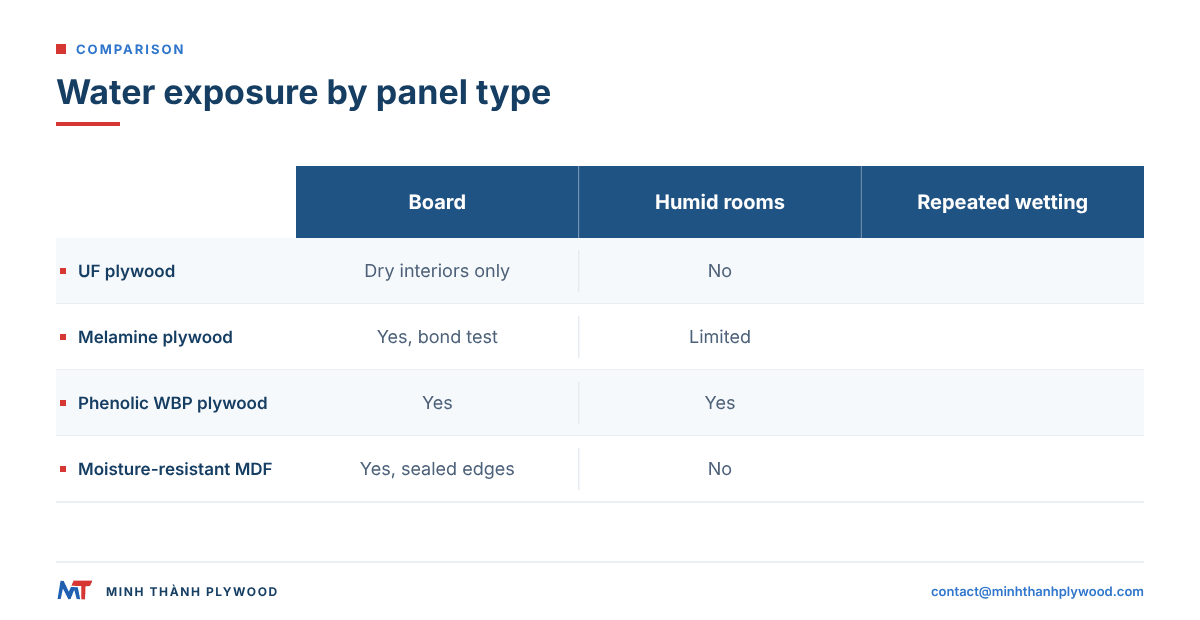
Wood boards resist water through their glue and their edges, not their face. Plywood with phenolic WBP glue resists repeated wetting best; standard MDF and particle board swell when water reaches them.
| Board | In humid rooms | In repeated wetting |
|---|---|---|
| Plywood, UF glue at E0 | Dry interiors only | No |
| Plywood, melamine-fortified glue | Yes, with an agreed bond test | Limited |
| Plywood, phenolic WBP glue | Yes | Yes |
| Film-faced plywood | Yes | Yes, for concrete formwork |
| MDF, moisture-resistant grade | Yes, with sealed edges | No |
| Particle board | Only with sealed edges | No |
| OSB, exterior grade | Yes | Faces resist rain; edges swell |
Seal every cut edge of any board used in a wet area. Film-faced plywood with melamine-fortified glue gives about 12–15 uses as formwork, and phenolic WBP up to about 25, with proper handling, release agent and edge sealing.
What is a wooden board used for? Best board by application
A wooden board is used for furniture, cabinets, shelving, doors, floors, walls, roofs, formwork and packing. The table gives the best board for each common job.
| Job | Best board | Alternative |
|---|---|---|
| Kitchen and bathroom carcasses | Plywood, melamine-fortified glue | Moisture-resistant particle board |
| Painted cabinet doors | MDF | Poplar-faced plywood |
| Wardrobes and dry carcasses | Plywood or particle board | MDF |
| Long shelves | 18 mm plywood on Eucalyptus core | Blockboard |
| Table tops | Solid wood or edge-glued panel | Veneered plywood |
| Drawer bottoms and backs | Thin plywood | HDF |
| Wall and roof sheathing | Plywood or OSB | — |
| Concrete formwork | Film-faced plywood | — |
| Crates and pallets | Packing plywood | OSB |
| Floors, trailers and platforms | Anti-slip plywood | — |
See our film-faced, packing and anti-slip plywood for the building and industrial jobs.
Emission and standards for wood boards
Wood boards bonded with formaldehyde-based resins are rated by formaldehyde emission, and buyers in the US and Europe require proof. In the US, CARB Phase 2 and TSCA Title VI set limits for hardwood plywood, MDF, thin MDF and particle board.
Glue type and emission class are separate specifications: a board can have water-resistant glue and still need an emission rating. For interior furniture, ask for both lines on the quotation.
Our furniture plywood uses UF glue at E0 emission and is certified to CARB P2 / TSCA Title VI (ICTT mill no. 23024). Six ASTM D6007 chamber tests between April 2025 and June 2026 on 9, 15 and 18 mm panels averaged 0.014–0.032 ppm. The TSCA Title VI limit for veneer-core hardwood plywood is 0.05 ppm under 40 CFR 770.10. The limits for each board type are on the EPA formaldehyde standards page.
How to choose the right wood board
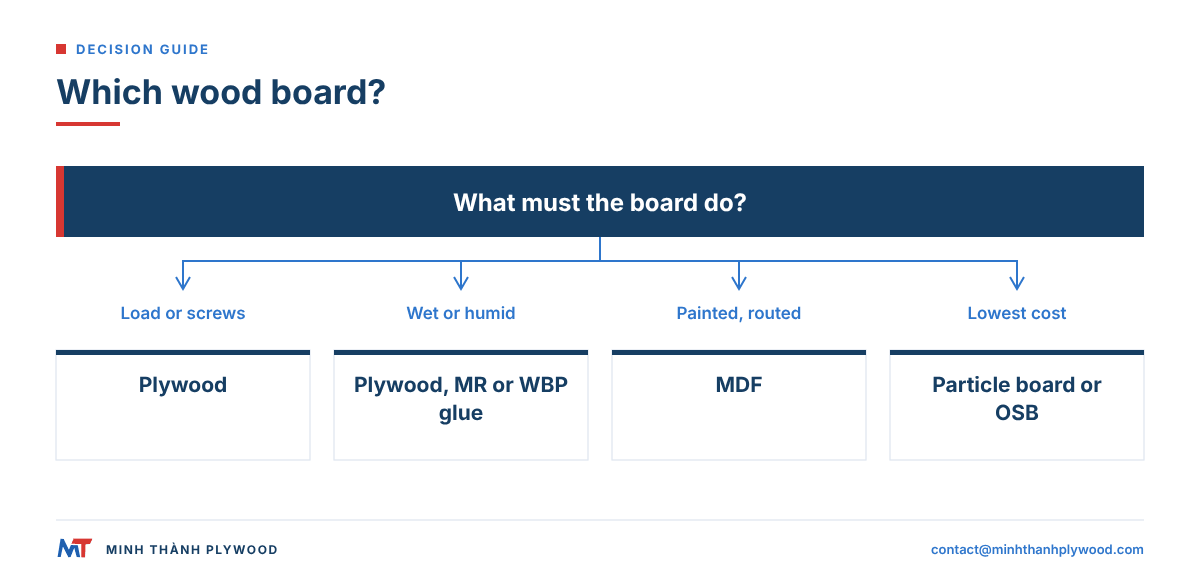
Choose a wood board by its job: load and screws point to plywood, a painted routed surface to MDF, the lowest price to particle board or OSB, and a visible solid edge to solid wood. Four questions settle most choices.
- Will it carry load or hold screws near the edge? Choose plywood.
- Will it get wet or sit in a humid room? Choose plywood with melamine-fortified or phenolic WBP glue, or film-faced plywood.
- Will it be painted with routed details? Choose MDF.
- Is cost the main driver in a dry room? Choose particle board for furniture or OSB for sheathing.
Then fix the details: thickness, size, face, glue, emission and tolerance. Two quotations for “18 mm board” can be very different products; the specification line makes them comparable.
Which wood boards Minh Thanh supplies
Minh Thanh Plywood makes plywood in Ha Hoa, Phu Tho, Vietnam, with 50,000+ m³ per year of capacity. We do not make MDF, particle board or OSB; we make the plywood that replaces them where strength, moisture resistance or screw holding count.
Our range:
- Furniture plywood: Birch, Poplar, EV, Okoume, Pine and Eucalyptus faces on white Styrax or Eucalyptus cores; see furniture plywood.
- Commercial and packing plywood: utility faces for fit-out, crates and pallets.
- Film-faced and anti-slip plywood: for concrete formwork, floors and platforms.
- Exterior plywood: utility C/D faces with melamine-fortified or phenolic WBP glue.
- Thin plywood 3–5 mm: always five plies, for drawer bottoms and backs; see thin plywood.
- Cut-to-size panels and LVL.
The whole range is on our products page.
What this means for your order
If plywood is the right board for your job, send a specification that names every layer, so we quote the panel you need. One line per item is enough.
- Application: furniture, cabinets, shelves, formwork, sheathing or packing.
- Core: white Styrax or Eucalyptus as standard; Acacia or Pine on order.
- Glue and emission: UF glue at E0 emission for interiors; melamine-fortified or phenolic WBP to your specification.
- Face and grade: for example Poplar A/B, Birch D+/D or EV matched to your sample.
- Size and thickness: 1220 × 2440 or 1250 × 2500 mm, or custom; 3–40 mm.
- Packing and quantity: from one 40HC, mixed specifications by agreement, and your destination port.
Production takes 15–45 days after the 30% deposit, and free samples are available. Email contact@minhthanhplywood.com or message us on WhatsApp. We reply within hours. Read what engineered wood is for the wider family of manufactured boards.
Buyer questions, answered
What types of wood boards are there?
Solid wood boards sawn from logs, and manufactured wood sheets: plywood, MDF, HDF and hardboard, particle board, OSB, blockboard and edge-glued panels. Each is made from a different wood element and suits different jobs.
What are sheet goods?
Sheet goods are wood boards made as large flat sheets, usually 1220 × 2440 mm, such as plywood, MDF, particle board and OSB. Cabinet makers and builders cut parts from them instead of from solid boards.
Which wood board is strongest?
Plywood is the strongest common wood sheet for its weight and holds screws best, including near the edge. OSB is close for sheathing; MDF and particle board are weaker and break at the edges.
Which wooden board is best for kitchen cabinets?
Plywood with melamine-fortified glue is the best carcass board for kitchens because it resists moisture and holds hinges. MDF suits painted doors; particle board is the low-cost carcass option for dry areas.
Which wood board is waterproof?
No wood board is fully waterproof. Plywood with phenolic WBP glue, film-faced plywood and exterior-grade OSB resist repeated wetting; standard MDF and particle board swell when water reaches them.
What is the standard size of a wood board sheet?
The standard sheet is 1220 × 2440 mm, the metric 4 × 8 ft. 1250 × 2500 mm is common in Europe, and many mills cut custom sizes.
Is MDF a wood board?
Yes. MDF is a wood board made from fine wood fibres pressed with resin. It is smoother than plywood but weaker at edges and swells when wet.
Which board is best for shelves?
18 mm plywood, especially on a stiff Eucalyptus core, sags least over a span. Blockboard also works for long shelves; particle board sags most.
What is the cheapest wood board?
Particle board is usually the cheapest furniture board and OSB the cheapest building sheet. Their low price comes with lower strength and poorer edges and moisture resistance than plywood.
Which wood boards does Minh Thanh make?
Minh Thanh makes plywood: furniture plywood with more than ten faces, commercial, packing, film-faced, anti-slip, exterior and thin plywood, plus cut-to-size panels and LVL.