
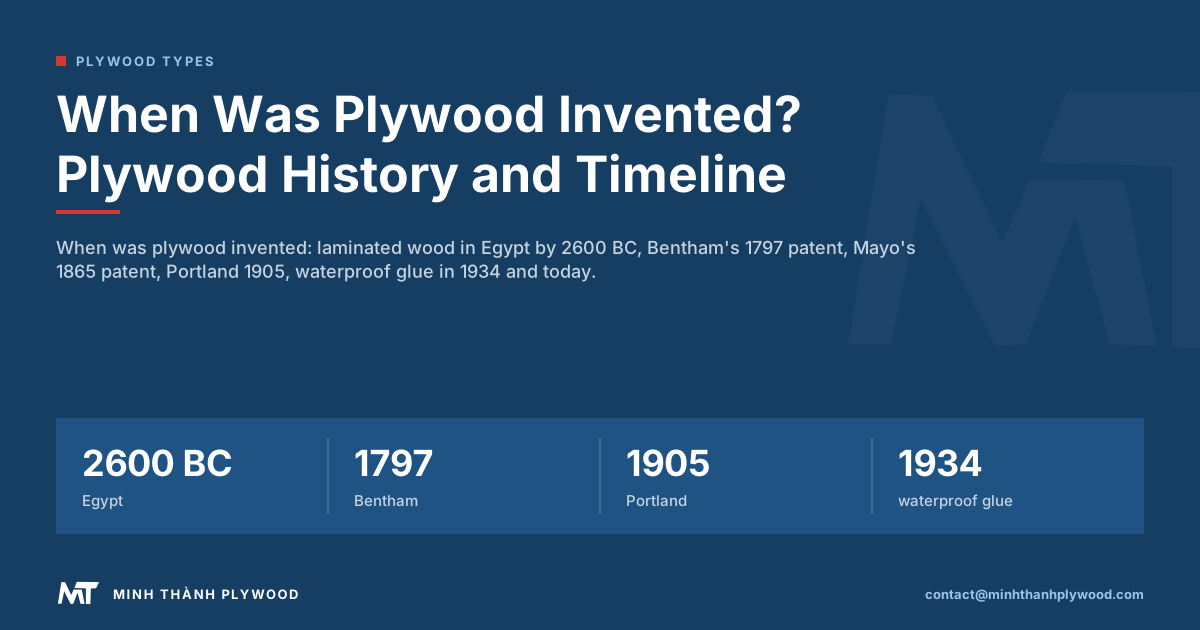
Plywood was invented in stages: Egyptians glued thin wood layers by about 2600 BC, Samuel Bentham described laminating veneers with glue in his 1797 patents, John K. Mayo patented plywood in the United States in 1865, and the modern industry began in Portland, Oregon, in 1905. Minh Thanh Plywood, a Vietnamese mill, sets out the dated timeline.
When was plywood invented? The short answer
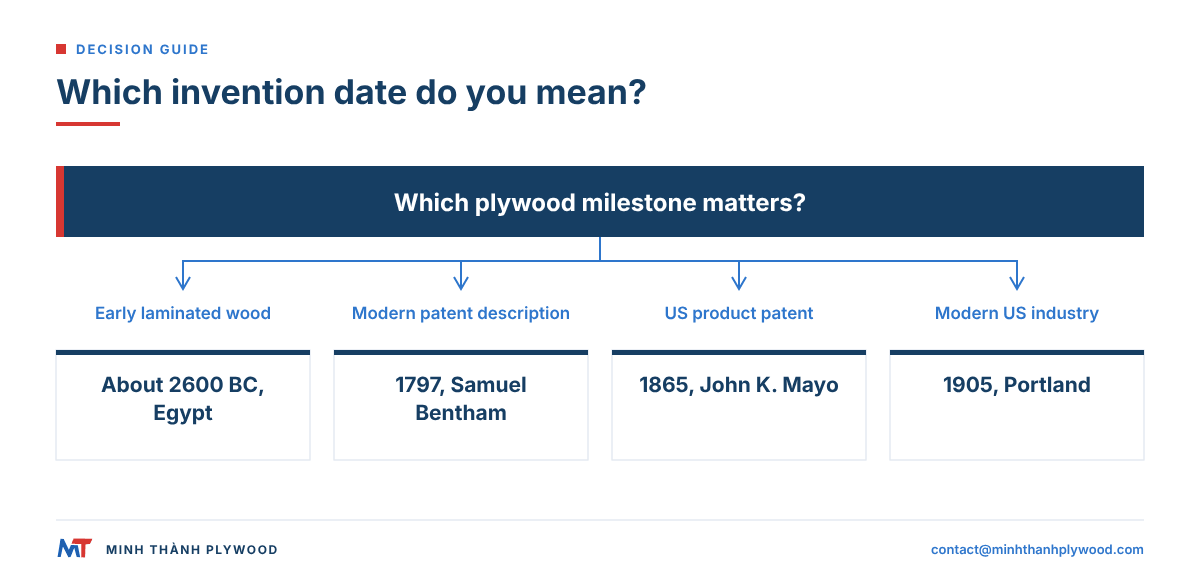
Plywood has no single invention date, because it was invented in stages over four thousand years. Egyptian craftsmen glued thin layers of wood by about 2600 BC; Samuel Bentham described laminating veneers with glue in 1797; John K. Mayo patented plywood in the United States in 1865; and the modern plywood industry began in Portland, Oregon, in 1905.
- First laminated wood: ancient Egypt, about 2600 BC.
- First modern description: Samuel Bentham, Britain, 1797.
- First patent for plywood as a product: John K. Mayo, New York, 1865.
- Start of the plywood industry: Portland Manufacturing Company, Oregon, 1905.
- First fully waterproof plywood glue: Dr James Nevin, 1934.
The answer you need depends on which milestone you mean: the idea, the patent, the industry or the weatherproof panel.
Plywood history timeline: the dated table
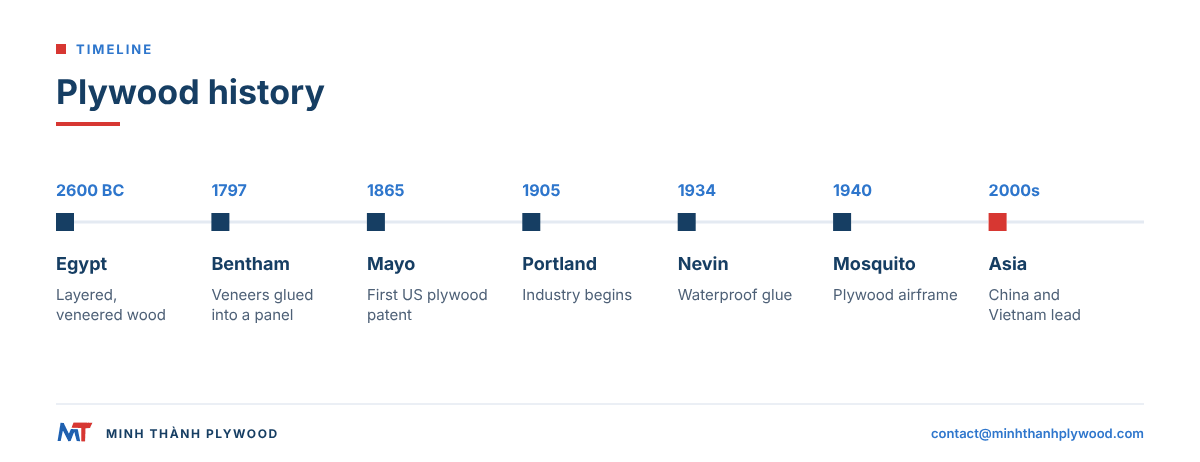
The plywood history timeline runs from Egyptian veneered furniture to today’s Asian mills. The table gives each milestone with its date and what changed.
| Date | Milestone | What changed |
|---|---|---|
| About 2600 BC | Layered and veneered wood in Egyptian furniture and coffins | Thin wood layers glued for strength and looks |
| 1797 | Samuel Bentham’s British patent applications | Laminating several veneers with glue into a thicker panel described |
| 1840s–1850s | Rotary lathe, credited to Immanuel Nobel | Logs peeled into long, continuous veneer sheets |
| 1858 | John Henry Belter patents laminated chair backs | Moulded plywood furniture made in quantity |
| 1865 | John K. Mayo’s US patent | Plywood patented as a product in its own right |
| 1867 | Elevated plywood railway prototype, American Institute Fair, New York | Plywood shown as a structural material at full scale |
| 1880s | A. M. Luther, Reval (Tallinn), Russian Empire | Plywood boards made in large quantities, mainly tea chests and packing cases |
| 1905 | Portland Manufacturing Company, Oregon | First Douglas fir plywood panels; start of the industry |
| 1917 | Haskell Boat Company canoe, Ludington, Michigan | One-piece moulded plywood hull, in sale by about 1930 |
| 1933 | Douglas Fir Plywood Association founded | Grading standard adopted for the industry |
| 1934 | Dr James Nevin’s waterproof adhesive | Fully waterproof plywood for exterior use |
| 1937 | USDA Forest Products Laboratory house, Madison Home Show | Plywood prefabrication system shown as a full-scale house |
| 1940 | de Havilland Mosquito first flight | Plywood airframe in wartime production |
| 1942 | Eames moulded plywood leg splint | Moulded plywood in mass production |
| Post-war | Housing boom | Plywood sheathing and subfloors standard in houses |
| 1960s onward | Production shifts to Asia | Japan, then Korea, Taiwan, Indonesia, China and Vietnam |
Sources: Plywood, Wikipedia; History of APA, plywood and engineered wood, APA, both read 20 October 2026; A history of plywood in ten objects, Victoria and Albert Museum for 1867, the 1880s, 1917 and 1937, checked on 21 October 2026.
When did people first use laminated wood?
People first used laminated wood in ancient Egypt, where examples of layered and veneered wood date to about 2600 BC. Egyptian craftsmen glued thin sheets of fine wood over cheaper wood and stacked thin layers so a part would not split like a single thick board.
- Why they did it: good timber was scarce in Egypt, so fine woods were sliced thin and glued over local wood.
- What they made: furniture, chests and coffins.
- What glue they used: animal and plant glues, which water softens.
The same two ideas, thin layers for strength and a fine face over a plain core, are still the logic of a modern furniture panel. China, Greece and Rome used veneering too, but none of these early panels had plywood’s defining feature in a controlled, industrial form: alternating grain directions bonded with glue that resists water.
Who invented plywood? Bentham, Nobel and Mayo
No single person invented plywood: three people did the key steps. Samuel Bentham, a British naval engineer, described gluing several layers of veneer into a thicker panel in his 1797 patent applications; Immanuel Nobel, father of Alfred Nobel, is credited with the rotary lathe that peels a log into continuous veneer; and John K. Mayo of New York took the first US patent for plywood as a product in 1865.
| Person | Date | Contribution |
|---|---|---|
| Samuel Bentham | 1797 | First written description of laminating veneers with glue |
| Immanuel Nobel | 1840s–1850s | Rotary lathe for peeling veneer from a turning log |
| John Henry Belter | 1858 | Patent for laminated, moulded chair backs |
| John K. Mayo | 1865 | First US patent for plywood as a product |
The Victoria and Albert Museum adds a correction to the flat-board picture: between 1850 and 1890 moulded plywood, not flat board, was the most common form, and furniture design drove its use. Plywood boards were made on a large scale only from the 1880s, when the Russian company A. M. Luther, based in Reval (now Tallinn), produced them in huge quantities, with tea chests and packing cases as its best-selling products.
Two later firsts sit on the same record: the Haskell Boat Company’s one-piece moulded plywood canoe, designed in 1917, and the 1937 Madison Home Show house, built to show the US Forest Products Laboratory’s plywood prefabrication system.
Bentham’s patents covered the machines for cutting veneer; the panel idea came with them. Nobel’s lathe mattered most for cost, because peeling a log is far faster than sawing or slicing it.
The invention of plywood as an industry: Portland, 1905
The invention of plywood as an industry dates to 1905, when the Portland Manufacturing Company in St Johns, Oregon, made its first Douglas fir plywood panels and showed them at the Lewis and Clark Centennial Exposition, the Portland world’s fair. Orders for door panels, drawer bottoms and trunk panels followed, and other mills copied the process.
- 1905: first western-wood plywood panels made at Portland Manufacturing Company.
- By 1929: 17 plywood mills in the Pacific Northwest made a record 358 million square feet, on a 3/8-inch basis.
- The size: the 4 × 8 ft panel goes back to the same company and became the standard building sheet in the US.
That 4 × 8 ft sheet is the 1220 × 2440 mm format most plywood is still sold in.
Sources: APA history and the APA monograph on the Portland Manufacturing Company, read 20 October 2026.
When was plywood invented in the United States?
Plywood was invented in the United States in two steps: John K. Mayo of New York was granted the first US patent for plywood in 1865, and the Portland Manufacturing Company began commercial production in Oregon in 1905. Mayo’s patent was not widely made; Portland’s process, on Douglas fir, is what grew into the American industry.
- 1858: John Henry Belter, New York, patents laminated chair backs.
- 1865: John K. Mayo, New York, patents plywood.
- 1905: Portland Manufacturing Company makes Douglas fir plywood.
- 1933: the Douglas Fir Plywood Association is founded, the same year the first US commercial standard for Douglas fir plywood (CS45-33) takes effect on 15 February.
- 1964: the association becomes the American Plywood Association, now APA.
Waterproof glue in 1934: the change that made plywood a building panel
The turning point for building with plywood was 1934, when Dr James Nevin, a chemist at Harbor Plywood Corporation in Aberdeen, Washington, developed the first fully waterproof adhesive for plywood. Until then, plywood glued with animal, casein or soy glues delaminated when it stayed wet, so it was kept indoors.
- Before 1934: interior plywood for doors, panels and furniture.
- After 1934: exterior plywood for sheathing, boats, concrete formwork and later marine use.
- Today: phenolic, weather- and boil-proof (WBP) glue is the exterior and formwork standard; melamine-fortified (MR) glue sits between; UF glue at E0 emission is the interior furniture standard.
Synthetic resins also let mills set the glue line in a hot press. Our mill presses MR glue lines at 110–120 °C and phenolic WBP at 130–145 °C, the normal ranges for each glue. Bonding-quality classes for plywood are set out in BS EN 314-2.

When did plywood become common in houses?
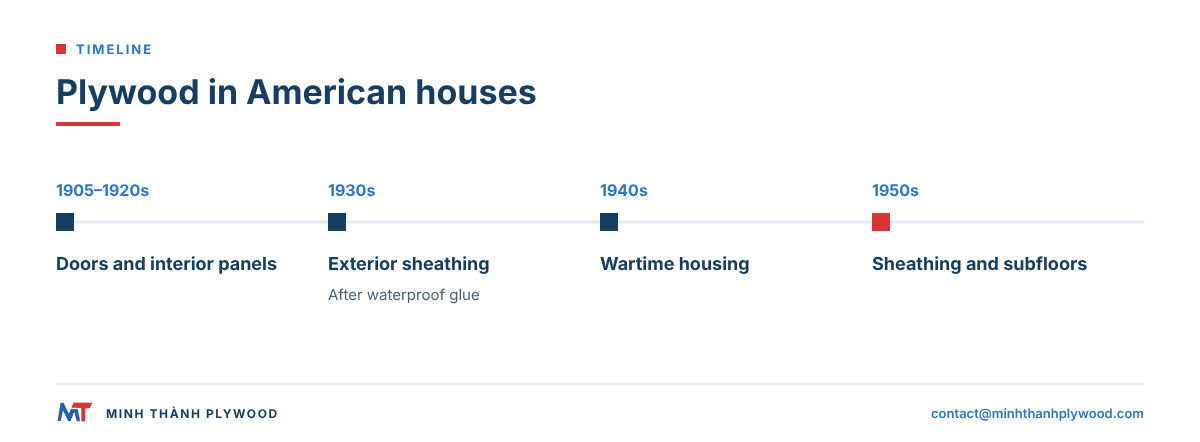
Plywood became common in houses in the United States between the late 1920s and the 1950s: first as doors and interior panels, then as wall and roof sheathing once waterproof glue arrived in 1934, and as standard sheathing and subfloors in the post-war housing boom. Demonstration prefabricated plywood houses were built in the 1930s.
When was plywood first used in houses?
Plywood was first used in houses in the 1900s and 1910s as doors, interior panels and drawer bottoms, after the Portland Manufacturing Company made its first panels in 1905. Exterior sheathing followed only after the waterproof adhesive of 1934, and prefabricated demonstration houses were built in the 1930s.
| Period | Plywood in houses |
|---|---|
| 1905–1920s | Doors, panels, drawer bottoms |
| 1930s | Exterior sheathing after waterproof glue; prefabricated demonstration houses |
| 1940s | Wartime housing and military buildings |
| 1950s | Standard sheathing, subfloors and roof decks in new houses |
The same decades fixed the sheet size and the grade stamps builders still use.
Plywood in the Second World War
The Second World War showed what plywood could carry: the de Havilland Mosquito, first flown in November 1940, had a moulded plywood airframe and was nicknamed the Wooden Wonder; gliders, patrol boats and military buildings used plywood; and Charles and Ray Eames made moulded plywood leg splints for the US Navy from 1942.
- Aircraft: the Mosquito’s fuselage was a plywood skin over a light core; it used little strategic metal.
- Boats: patrol and landing craft used marine plywood.
- Medicine: Eames leg splints, made by moulding plywood under heat and pressure.
- After the war: the same moulding methods produced the Eames plywood chairs.
Sources: A history of plywood in ten objects, Victoria and Albert Museum, read 20 October 2026.
Plywood in design: Aalto, the Eameses and modern furniture
Plywood entered modern design in the 1930s, when Alvar Aalto’s Paimio armchair of 1932 bent laminated birch into a light, sprung seat made in a factory. After the war, Charles and Ray Eames turned their wartime moulding work into chairs, and plywood became a material designers chose for its look as well as its strength.
- 1932: Alvar Aalto’s Paimio chair, bent birch plywood.
- 1946: Eames moulded plywood chairs go into production.
- 1960s: plywood kits for boats such as the Mirror dinghy bring plywood to home builders.
- Today: CNC-cut plywood furniture uses flat sheets that ship and machine cleanly.
Furniture plywood today is a precise panel: calibrated thickness, sanded faces and low emission, made for CNC lines and lacquer or laminate.
How plywood production moved to Asia and Vietnam
Plywood production moved from North America and Europe to Asia from the 1950s onward: Japan first, then Korea and Taiwan, then Indonesia and Malaysia on tropical hardwood, and since the 2000s China and Vietnam, which make plywood from fast-growing plantation timber. Vietnam’s mills peel locally grown Acacia, Eucalyptus and Styrax for cores and lay imported or local faces on top.
| Period | Main growth in plywood production |
|---|---|
| 1950s–1960s | Japan |
| 1960s–1970s | Korea and Taiwan |
| 1980s–1990s | Indonesia and Malaysia |
| 2000s onward | China, then Vietnam |
Minh Thanh is part of this latest stage: a plywood mill in Ha Hoa, Phu Tho, with over 20 years of plywood-making experience and a capacity of 50,000+ m³ per year, built for top-grade furniture and interior plywood with Europe as its main market.
Early lamination vs the modern plywood panel
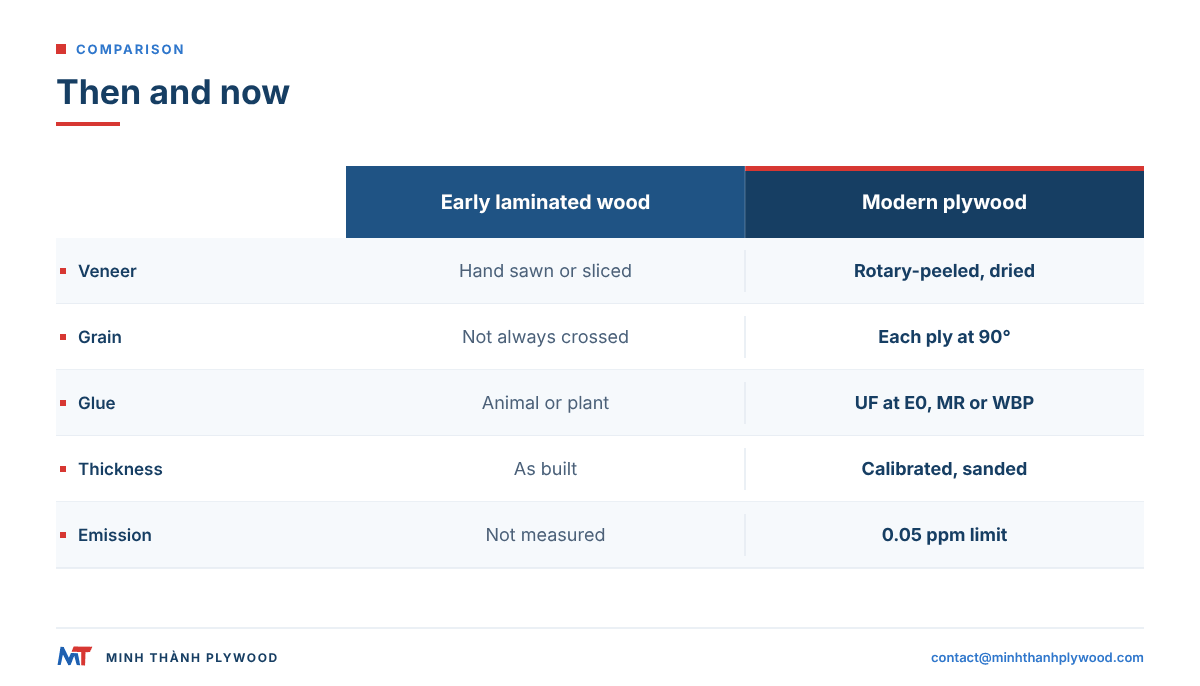
The plywood a furniture plant buys today differs from early laminated wood in five measurable ways: grain direction, glue, thickness control, emission and documents. The table compares them.
| Point | Early laminated wood | Modern furniture plywood |
|---|---|---|
| Veneer | Sawn or sliced by hand | Rotary-peeled, dried to 8–12 % moisture |
| Grain | Not always crossed | Each ply at 90° to the next |
| Glue | Animal or plant glue | UF at E0 emission, MR or phenolic WBP |
| Thickness | As built | Calibrated, ±0.2–0.3 mm sanded |
| Emission | Not measured | CARB P2 / TSCA Title VI limit 0.05 ppm |
| Documents | None | Test reports, origin records |
Our panels are CARB P2 / TSCA Title VI certified (ICTT mill no. 23024). The 0.05 ppm limit for hardwood plywood with a veneer core is set in 40 CFR 770.10, and the origin records come under Regulation (EU) 2023/1115.
What plywood history means for your order
Each stage of plywood history added a line to today’s order: the veneer species from the lathe, the glue from 1934, the size from Portland, and the emission and origin documents from the last twenty years. A complete furniture plywood order names all of them.
- Application: cabinets, furniture, interiors or exterior use.
- Core: white Styrax or Eucalyptus as standard; Acacia or Pine on order.
- Glue and emission: UF glue at E0 emission for interiors; MR or phenolic WBP on order.
- Face: Birch, Poplar, EV, Okoume, Pine or another of 10+ faces.
- Size: 1220 × 2440 or 1250 × 2500 mm, thickness 3–40 mm.
- Packing and quantity: from one 40HC; the destination port.
Production is 15–45 days after the 30% deposit, with free samples. Read our advantages and disadvantages of plywood guide next, and see our furniture plywood page and the plywood vs MDF guide.
Buyer questions, answered
When was plywood invented?
Laminated wood dates to about 2600 BC in Egypt, but modern plywood was first described by Samuel Bentham in 1797 and patented as a product by John K. Mayo in 1865. Industrial plywood began in Portland, Oregon, in 1905.
Who invented plywood?
No single person. Samuel Bentham described gluing veneers into a thicker panel in 1797, Immanuel Nobel is credited with the rotary lathe that peels logs into veneer, and John K. Mayo took the first US patent for plywood in 1865.
What year was plywood invented?
The year most often given is 1797, when Samuel Bentham's British patent applications described laminated veneers. The first US patent for plywood as a product was in 1865.
Where was plywood invented?
Laminated wood first appears in ancient Egypt; the modern idea was patented in Britain in 1797; the plywood industry as we know it started in the United States, in Portland, Oregon, in 1905.
When was plywood invented in the United States?
John K. Mayo of New York patented plywood in 1865, and the Portland Manufacturing Company made the first Douglas fir plywood panels in 1905, which started the US industry.
When did plywood become common?
Plywood became a common building material in the United States from the late 1920s and especially after 1934, when fully waterproof glue made exterior use possible. It became standard in house building after the Second World War.
When was plywood first used in houses?
Plywood was used in doors and interior panels from the early 1900s; demonstration prefabricated plywood houses were built in the 1930s, and plywood sheathing and subfloors became standard in post-war housing.
When was waterproof plywood invented?
In 1934 Dr James Nevin, a chemist at Harbor Plywood Corporation in Aberdeen, Washington, developed the first fully waterproof plywood adhesive.
Was plywood used in the Second World War?
Yes. The de Havilland Mosquito, first flown in 1940, had a plywood airframe, and Charles and Ray Eames made moulded plywood leg splints for the US Navy from 1942.
Where is most plywood made today?
Most plywood is now made in Asia. Production moved from North America and Europe to Japan, then Korea, Taiwan and Indonesia, and today China and Vietnam both produce plywood at scale.