
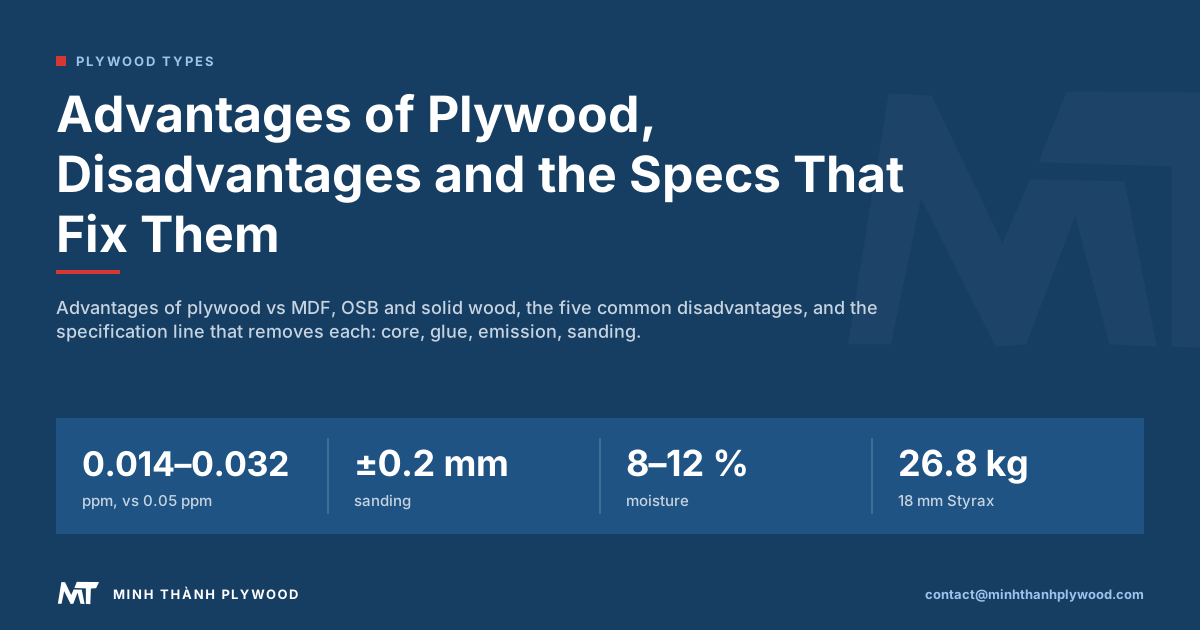
The main advantages of plywood are strength in both directions, dimensional stability, screw holding, low weight for its stiffness and large flat sheets; its disadvantages are edge voids, moisture damage, formaldehyde emission, visible edges and a higher price than OSB or MDF. Minh Thanh Plywood shows which specification removes each disadvantage.
Advantages of plywood: the short answer
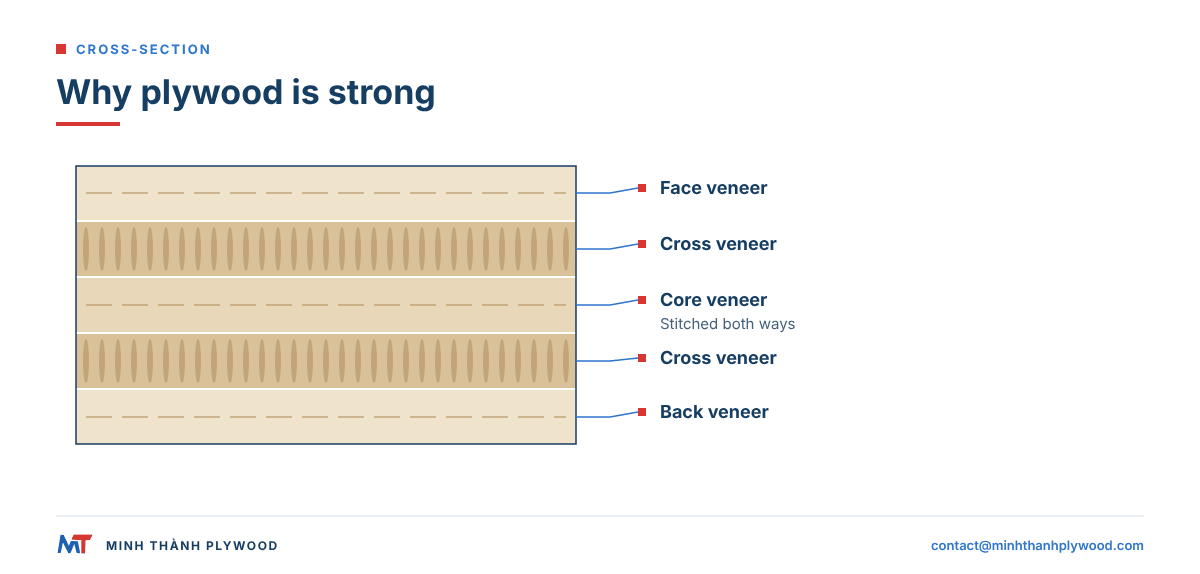
The advantages of plywood come from its build: thin wood veneers glued with each layer’s grain at 90° to the next. That cross-lamination makes a panel that is strong in both directions, stays stable when humidity changes, holds screws, resists splitting and comes in large, flat, light sheets.
- Strength in two directions: no weak cross-grain like a solid board.
- Dimensional stability: little swelling or shrinking across the sheet.
- Screw and nail holding: strong, including near edges.
- Light for its stiffness: easier to handle and ship than MDF of the same job.
- Large flat sheets: 1220 × 2440 mm and bigger, in 3–40 mm thickness.
- Choice of faces: birch, poplar, okoume and more, ready for paint, lacquer or laminate.
The rest of this guide sets each advantage against MDF, OSB and solid wood, and each disadvantage against the specification that removes it.
Why plywood works: cross-laminated veneers
Plywood works because wood is strong along its grain and weak across it, and crossing the grain in each layer shares the strength both ways. An odd number of plies keeps the panel balanced around its centre, so the top and bottom halves pull against each other evenly and the sheet stays flat.
- Face and back veneers: the visible layers, chosen for appearance.
- Core veneers: the inner layers, chosen for strength and weight.
- Glue lines: the bond between plies, chosen for the service conditions.
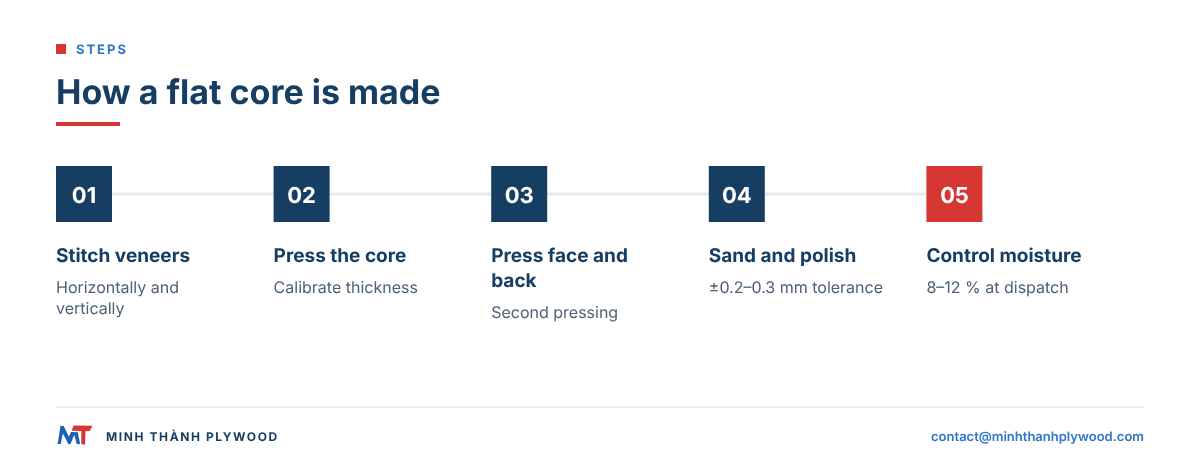
A furniture panel adds two steps that matter for the advantages: core layers stitched both horizontally and vertically, and double pressing, where the core board is pressed and calibrated before the face and back go on.
The main advantages of plywood, one by one
Plywood’s advantages show up in the jobs buyers use it for: furniture, cabinets, floors, packing and construction. Each advantage has a practical meaning.
| Advantage | What it means in use |
|---|---|
| Strength both ways | Shelves and spans carry load; parts do not split along the grain |
| Dimensional stability | Doors and drawers keep their size through the seasons |
| Screw holding | Hinges, runners and connectors hold close to edges |
| Stiffness for weight | Lighter furniture and lower freight per part |
| Impact resistance | Takes knocks and point loads without cracking |
| Large flat sheets | Fewer joints in cabinets, floors and wall panels |
| Workability | Cuts, routes and CNC-machines cleanly |
| Choice of faces | Real veneer, or a sanded face for paint and laminate |
| Bends to curves | Thin, flexible plywood wraps curved walls, counters and moulded furniture; the veneers bend across the grain and the panel keeps its shape |
| Takes fire and moisture treatment | Panels can be fire-retardant treated or specified in water-resistant glue for damp rooms |
| Light on the planet | Fast-growing plantation cores such as Eucalyptus and Acacia, and an EUDR dossier of origin records with each order |
| Value per square metre | One sheet covers a large area for the price of a few solid boards, with less waste |
Thickness is the line UK buyers ask about: plywood is sold from 3 mm to 40 mm, against the 6–32 mm ranges that general guides quote, so one supplier can cover thin bending ply and thick structural sheets. A white Styrax-core furniture panel of 1220 × 2440 × 18 mm weighs about 26.8 kg, which is why light-core plywood is chosen for wardrobe doors and mobile furniture.
Plywood advantages and disadvantages against MDF, OSB and solid wood
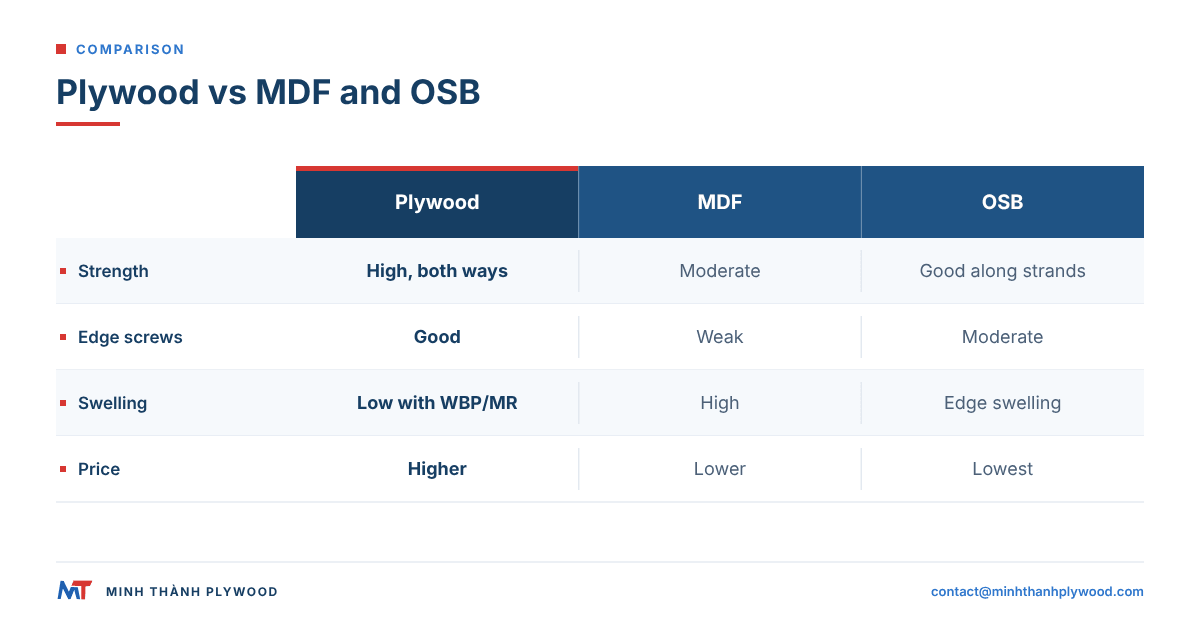
Plywood advantages and disadvantages only make sense against the board you would use instead. Plywood wins on strength, screw holding and moisture behaviour; MDF wins on a smooth painted face and low cost; OSB wins on price for sheathing; solid wood wins on solid edges and carving.
| Point | Plywood | MDF | OSB | Solid wood |
|---|---|---|---|---|
| Strength across the panel | High, both ways | Moderate | Good along strands | Low across grain |
| Screw holding near edges | Good | Weak | Moderate | Good |
| Weight for the job | Light to moderate | Heavy | Moderate | Varies |
| Moisture swelling | Low with WBP or MR glue | High | Edge swelling | Moves across grain |
| Paint finish | Good on sanded faces | Very smooth | Rough | Good |
| Exposed edge | Layered | Plain, needs sealing | Rough strands | Solid |
| Price per m³ | Higher | Lower | Lowest | Highest |
Our plywood vs MDF guide, plywood vs OSB guide and particle board vs plywood guide give the detail by use.
What are the disadvantages of plywood?
The disadvantages of plywood are real, but most of them belong to a grade, not to plywood itself. The five common ones are core voids, moisture damage, formaldehyde emission, visible or rough edges and a higher price than OSB or MDF.
- Core voids and overlaps: gaps in the inner veneers weaken screws and show through thin finishes.
- Moisture damage: interior glue lines delaminate when they stay wet.
- Formaldehyde emission: some glues release formaldehyde indoors.
- Edges: the layered edge needs banding or sanding on visible furniture.
- Price: plywood costs more per sheet than OSB or MDF.
Others buyers mention: surface splinters on low grades, face variation from sheet to sheet, and termites in untreated panels in hot climates.
The disadvantage and the specification that removes it
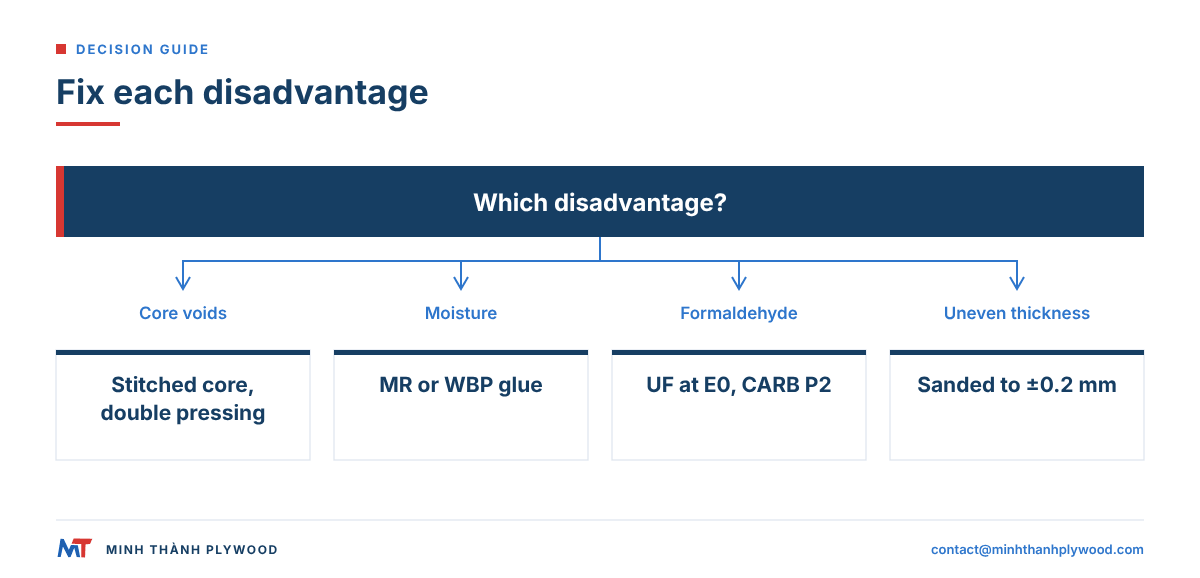
Every common disadvantage of plywood has a specification line that removes it, and that line belongs on the order. The table pairs them.
| Disadvantage | Specification that removes it |
|---|---|
| Core voids and overlaps | Stitched core (both directions), double pressing, approved core grade |
| Moisture damage | MR (melamine-fortified) or phenolic WBP glue for wet areas; sealed edges |
| Formaldehyde emission | UF glue at E0 emission; CARB P2 / TSCA Title VI certified panels |
| Uneven thickness | Calibrated sanding, ±0.2–0.3 mm, down to ±0.2 mm |
| Warping in service | Balanced build; 8–12 % moisture at dispatch |
| Rough or splintered faces | Sanded and polished faces; face grade by approved sample |
| Visible layered edges | Edge banding, or a fine core shown as a design edge |
| Price against OSB or MDF | The right grade for the job: commercial for packing, furniture grade where seen |
The CARB Phase 2 / TSCA Title VI limit for hardwood plywood with a veneer core is 0.05 ppm under 40 CFR 770.10.
Is plywood waterproof? Moisture, glue and edges
Plywood is not waterproof as a class: its water resistance depends on the glue and the edges. Interior plywood with UF glue is for dry rooms; MR glue resists humidity and occasional wetting; phenolic WBP glue survives repeated wetting and boiling tests and is the choice for exterior and formwork panels.
| Glue | Service | Typical use |
|---|---|---|
| UF at E0 emission | Dry interiors | Furniture, cabinets, wall panels |
| MR (melamine-fortified) | Humid interiors | Kitchens, bathrooms, some packing |
| Phenolic WBP | Wet and exterior | Formwork, exterior, stair treads |
Glue line and emission class are two separate lines on an order. Seal cut edges in wet areas whatever the glue.
Formaldehyde: the disadvantage buyers ask about most
Formaldehyde comes from the urea-formaldehyde glue in interior plywood, and it is removed as a disadvantage by ordering panels at a low emission class with proof. Furniture plywood with UF glue at E0 emission and CARB P2 / TSCA Title VI certification meets the emission requirements European and US furniture buyers ask for.
Our panels hold CARB P2 / TSCA Title VI certification (ICTT mill no. 23024). Six ASTM D6007 chamber tests on 9, 15 and 18 mm panels between April 2025 and June 2026 averaged 0.014–0.032 ppm, against the 0.05 ppm limit; three were run by Shanghai Hongjun and three by ICTT Vietnam. Third-party testing to the buyer’s method, for example EN 717-1, is arranged through SGS on request.
Core voids, flatness and thickness: the furniture-grade fix
Core voids, bumps and uneven thickness are the disadvantages furniture plants notice first, because they show through lacquer and laminate and upset CNC lines. They are removed at the mill, not in the plant: by the way the core is laid and pressed.
- Stitch the core both horizontally and vertically, so veneers do not gap or overlap.
- Press the core board first and calibrate it to thickness.
- Press the face and back on in a second press, for a flat panel.
- Sand and polish the faces to a tolerance of ±0.2–0.3 mm, down to ±0.2 mm.
- Dry to 8–12 % moisture before dispatch, so panels do not move in the buyer’s plant.
These are standard steps on Minh Thanh furniture panels, and both faces leave the mill UV-ready.
Advantages of using plywood by application
The advantages of using plywood weigh differently by job, so the best grade for one use is the wrong one for another. The table gives the main advantage and the usual grade.
| Application | Main advantage | Usual grade |
|---|---|---|
| Furniture and cabinets | Screw holding, flat sanded faces | Furniture plywood, UF at E0 emission |
| Kitchens and bathrooms | Moisture behaviour | MR or WBP glue, sealed edges |
| Concrete formwork | Reuse and smooth concrete | Film-faced, phenolic WBP |
| Packing and crates | Strength for weight, cost | Packing plywood |
| Floors and sheathing | Stiffness and fastener holding | Structural or exterior grade |
| Laminated parts | Flat, calibrated substrate | Sanded furniture plywood |
Our best plywood for furniture guide gives the furniture grades in detail.
Poplar, Eucalyptus, Acacia and Styrax cores: which advantage you get
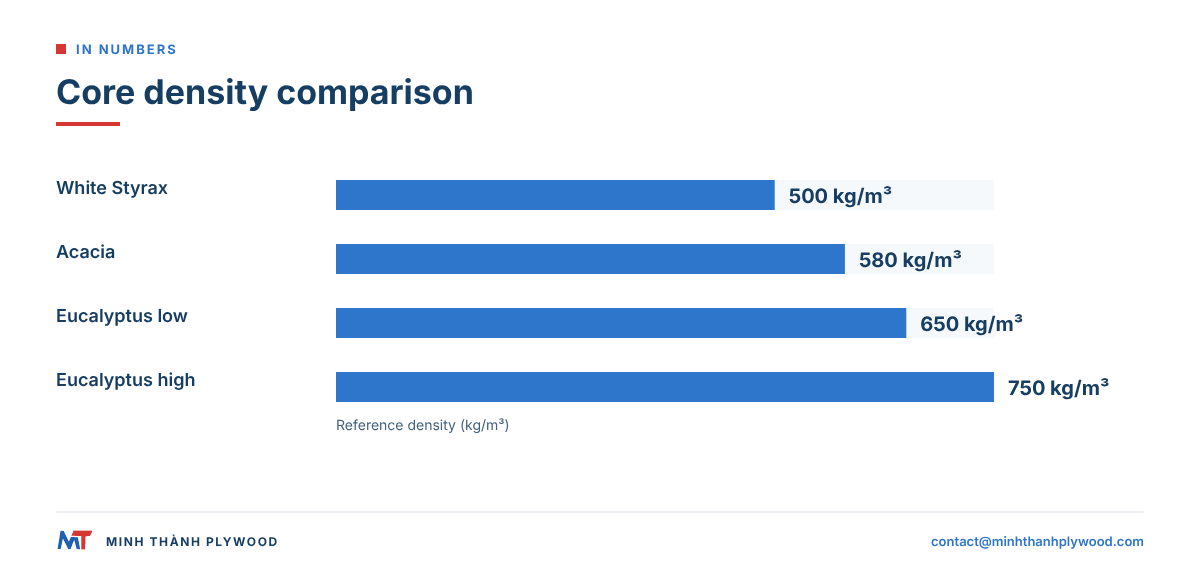
The core species decides weight, hardness and screw holding. Light Styrax and poplar cores give the lightest sheets and smooth, easy-machining panels; denser Eucalyptus and Acacia give harder panels with stronger screw holding.
| Core | Reference density | Advantage |
|---|---|---|
| White Styrax | 500 kg/m³ | Lightest; pale, even core for furniture |
| Acacia | 580 kg/m³ | Mid weight; hard, stable core |
| Eucalyptus | 650–750 kg/m³ | Densest; strongest screw holding and wear |
Furniture panels use white Styrax or Eucalyptus cores as standard; Acacia and Pine cores are made on order. An 18 mm sheet of 1220 × 2440 mm is about 26.8 kg on Styrax, 31.1 kg on Acacia and 34.8 kg on Eucalyptus.
Advantages and disadvantages of Vietnamese plywood
Vietnamese plywood’s main advantages are locally grown plantation timber for cores, a skilled workforce and competitive prices for high-grade panels; its main disadvantage is that quality ranges widely between mills, so the buyer has to specify the build and check proof. Indicative prices in October 2026 start from US$250/m³ for commercial plywood and from US$350/m³ for furniture and interior plywood.
- Advantage: plantation Acacia, Eucalyptus and Styrax grown near the mills.
- Advantage: short sea times to Asia and the Middle East; typically 15–25 days to the Gulf from Hai Phong.
- Advantage: EUDR compliance dossier (origin records and geolocation files) supplied for EU orders, under Regulation (EU) 2023/1115 (checked on 20 October 2026). Its obligations start on 30 December 2026 for large and medium operators.
- Watch-out: grades range from commercial to top furniture; name core, glue, emission, face and tolerance on every order.
For buyers in the UAE comparing plywood with MDF, the same rule holds: plywood for strength and moisture, MDF for painted flat parts.
How to order plywood that keeps the advantages
An order that keeps plywood’s advantages and removes its disadvantages names six lines. Send them with your request and we quote from them:
- Application: furniture, kitchen, formwork, packing or flooring.
- Core: white Styrax or Eucalyptus as standard; Acacia or Pine on order.
- Glue and emission: UF glue at E0 emission for dry interiors; MR or phenolic WBP for wet use.
- Face: Birch (D+/D or D/E), Poplar, EV, Okoume, Pine or another face.
- Size and tolerance: 1220 × 2440 or 1250 × 2500 mm, 3–40 mm, ±0.2–0.3 mm sanded.
- Packing and quantity: from one 40HC, mixed specifications by agreement; the destination port.
Production is 15–45 days after the 30% deposit, FOB Hai Phong, CFR or CIF, with free samples. Read when was plywood invented for the story behind the panel, and see our furniture plywood page.
Buyer questions, answered
What are the advantages of plywood?
Plywood is strong in both directions, stays dimensionally stable, holds screws well, is light for its stiffness and comes in large flat sheets. Its veneer faces can be fine hardwoods or ready for paint, lacquer or laminate.
What are 5 disadvantages of plywood?
Voids in the core, moisture damage with interior glue, formaldehyde emission from some glues, rough or visible layered edges, and a higher price than OSB or MDF. Each one is removed by a specification line: core grade, glue class, emission class, edging and the right grade for the job.
Is plywood better than MDF?
For strength, screw holding, weight and moisture, yes. MDF gives a smoother face for paint and costs less, so it suits flat painted doors and decorative panels that carry no load.
Is plywood better than OSB?
Plywood is stiffer for its weight, holds fasteners better near edges and recovers better after getting wet. OSB costs less and is widely used for sheathing where those points matter less.
Is plywood stronger than solid wood?
Across the panel, yes: solid wood is strong along the grain and weak across it, while plywood's crossed plies make it strong both ways and stop it splitting. Solid wood has the edge for thick carved parts and exposed solid edges.
Does plywood warp?
Well-made plywood resists warping because its crossed layers balance each other. Warping comes from uneven moisture, poor storage, or an unbalanced build, which a calibrated, balanced panel at 8–12 % moisture avoids.
What is AdvanTech plywood?
AdvanTech is a brand of engineered subfloor and sheathing panel made from wood strands and resin, closer to OSB than to veneer plywood. It is sold as an alternative to plywood subfloor.
What is the main advantage of poplar plywood over eucalyptus or acacia?
Poplar is lighter and has a smooth, pale face that takes paint and laminate well. Eucalyptus and Acacia are denser and harder, which gives stronger screw holding and better wear.
What are the disadvantages of marine plywood?
Marine plywood costs more than standard plywood and is heavier on hardwood cores; its waterproof glue does not stop rot in the wood itself, so edges and faces still need sealing.
Is Vietnamese plywood good quality?
Vietnamese mills range from commercial to top-grade furniture panels. A top-grade Vietnamese furniture panel has a stitched core, double pressing, ±0.2 mm sanding tolerance and CARB P2 / TSCA Title VI certification, as Minh Thanh panels do.