
Plywood is a wood panel made of thin sheets of veneer glued on top of each other, with the grain of each layer turned at right angles to the one below, then pressed under heat into a flat, stiff sheet. The crossed layers make it strong in both directions and far more stable than solid wood. This guide from Minh Thanh Plywood, a Vietnamese plywood manufacturer, explains every layer, how plywood is made and how to choose it.
What is plywood? The definition
Plywood is a wood panel made of thin veneers glued in layers, with the grain of each layer at right angles to the next, pressed under heat into a flat, stiff sheet. The crossed grain is the whole idea: it makes the panel strong in both directions and stable when humidity changes.
A sheet of solid wood is strong along its grain and weak across it. It splits along the grain and swells and shrinks across it. Plywood fixes both problems by turning every second layer through 90 degrees. Each layer holds the next one in place, so the panel behaves almost the same in length and width.
Three things define any plywood panel:
- The veneers: thin sheets of real wood, peeled or sliced from logs.
- The lay-up: an odd number of plies, or a balanced even build, with grain alternating.
- The glue: the adhesive that bonds the layers and decides where the panel can be used.
Everything else, from the face species to the thickness, is a choice made for the panel’s use. A furniture panel and a formwork panel are both plywood; they differ in face, glue and core.
The meaning of plywood: where the word comes from
The meaning of plywood is in the word itself: “ply” means a layer, so plywood is wood built from layers. The term came into general use in the early twentieth century, when rotary-peeled veneer and hot presses made layered panels a factory product.
People also call it ply, ply board or plyboard, and in some markets multiplex or multi-ply. In the trade, the name of a plywood product usually comes from its face veneer: birch plywood, poplar plywood, okoume plywood. The name tells you the look of the surface, not what is inside.
That naming habit matters when you buy. A “birch plywood” from one mill can be birch-faced on a Styrax core, while another is birch all the way through. The definition of plywood stays the same; the specification has to say what each layer is. Our guide to hardwood plywood shows how face names map onto builds.
What is plywood made of, layer by layer?
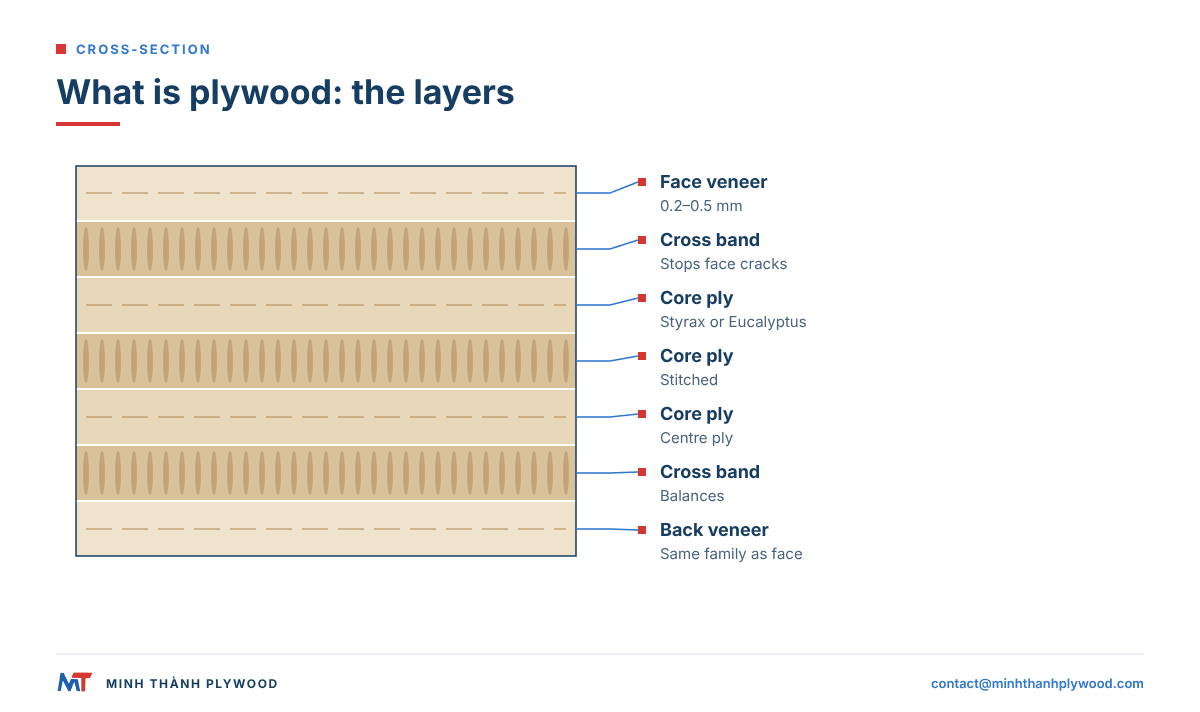
Plywood is made of wood veneers and glue, arranged as a face, cross bands, a core and a back. Each layer has its own job, its own wood and its own thickness.
| Layer | What it does | Typical wood at Minh Thanh | Typical thickness |
|---|---|---|---|
| Face veneer | The visible surface: look, sanding, finishing | Birch, Poplar, EV, Okoume, Pine, Eucalyptus, Bintangor, Gurjan | 0.2–0.5 mm; European buyers often order 0.3 mm |
| Cross band | Sits under the face at 90 degrees; stops the face cracking and gives a flat base | Styrax or Eucalyptus core veneer | Core veneer, 1.4–2.0 mm |
| Core plies | Give the panel its thickness, stiffness and screw holding | White Styrax or Eucalyptus; Acacia and Pine on order | 1.4–2.0 mm each |
| Back veneer | Balances the face so the panel stays flat; often a lower grade | Same family as the face | 0.2–0.5 mm |
| Glue lines | Bond the layers; decide water resistance and emission | UF glue at E0 emission; melamine-fortified or phenolic WBP to order | Thin film between plies |
The face is chosen for the look the buyer orders, including imported birch and okoume veneers. The core is Vietnamese plantation wood: white Styrax is light and gives a smooth base, Eucalyptus is denser and stiffer. Product pages give each build: birch plywood, poplar plywood, EV plywood and Eucalyptus plywood.
At Minh Thanh, core layers are stitched both horizontally and vertically before pressing. Stitching holds the core veneers edge to edge, so the panel has no gaps or overlaps that would show through the face.
The structure of plywood: why the layers cross and why the count is odd
Plywood layers cross at 90 degrees because wood moves very little along its grain and a great deal across it. Gluing a layer across the grain of its neighbour locks that movement, so the whole panel stays close to its original size.
The numbers explain it. Along the grain, wood typically shrinks only 0.1–0.2 % from green to oven-dry, according to the USDA Forest Products Laboratory’s Wood Handbook. Across the grain, radial and tangential shrinkage are many times larger, measured in whole per cent. In plywood, every layer that wants to move across its grain is held by a layer that barely moves in that direction.
The ply count is usually odd: 3, 5, 7, 9, 11 or 13. An odd number puts the face and back in the same grain direction around a centre ply, so the stresses on both sides match and the panel stays flat. Where a build has an even number of veneers, two parallel core veneers act as one ply to keep the balance.
Typical ply counts at Minh Thanh:
- 3–5 mm: always five plies. 3 mm is one core veneer, two cross bands and two faces; 4 and 5 mm are three core veneers and two faces, with core thickness adjusted, for example three 1.3 mm Styrax core veneers in a 4 mm panel.
- 18 mm: usually 11–13 plies, most often 11.
More plies at the same thickness mean thinner veneers, more glue lines and usually a stiffer, flatter panel with better screw holding at the edge.
How is plywood made? The steps from log to sheet
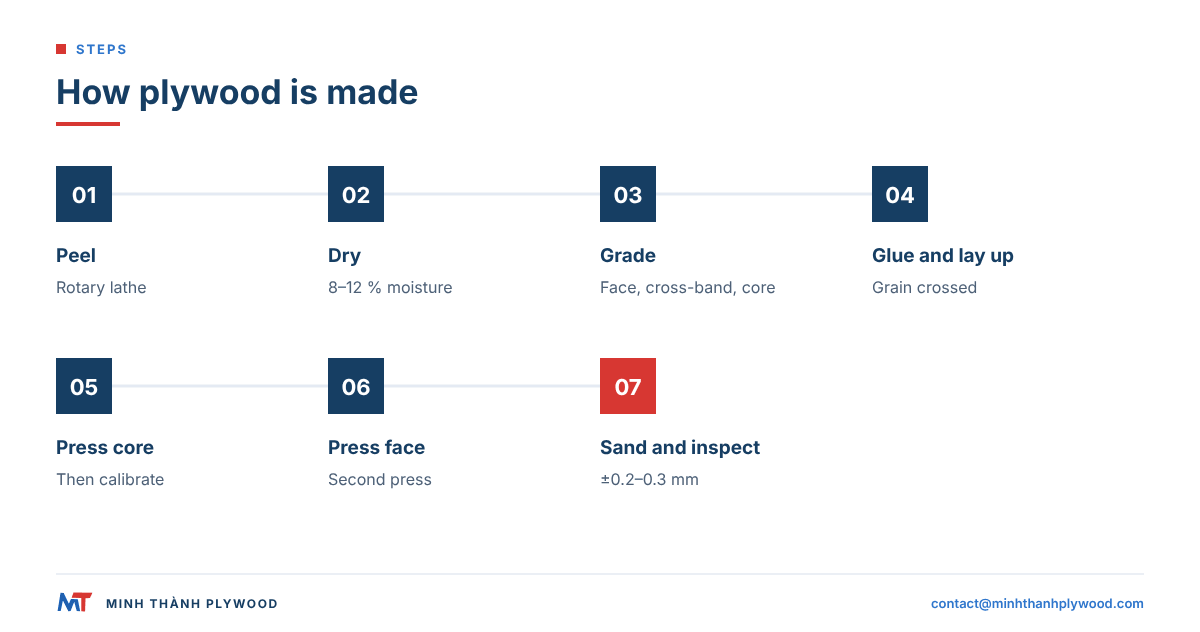
Plywood is made by peeling logs into veneer, drying and grading it, gluing it in crossed layers and hot-pressing the stack into a panel. At Minh Thanh’s factory in Ha Hoa, Phu Tho, furniture panels go through these steps:
- Peeling: plantation logs are turned on a rotary lathe that peels a continuous sheet of veneer, like unrolling paper from a roll.
- Drying: veneers are dried to 8–12 % moisture, the normal range for furniture plywood.
- Grading: core and face veneers are sorted by defects; see our veneer grading process.
- Glue spreading: glue is rolled onto the core veneers in a controlled spread.
- Lay-up and stitching: veneers are laid with alternating grain, and core layers are stitched horizontally and vertically.
- Pre-pressing: the stack is pressed cold so it holds together before the hot press.
- First hot press: the core board is pressed; UF and melamine (MR) bonds press at about 110–120 °C, phenolic WBP at about 130–145 °C.
- Calibration: the core board is sanded to an even thickness.
- Second hot press: face and back veneers are pressed onto the calibrated core.
- Trimming and sanding: panels are cut to size and sanded, down to ±0.2 mm thickness tolerance on sanded furniture panels.
- Grading and QC: every sheet is checked against the order and the approved sample; see quality control.
- Packing: sheets are packed on pallets and strapped for export.
Pressing twice is standard on our furniture-grade panels. A calibrated core gives a flatter face, so veneer, paint or UV coating sits evenly. Commercial and packing panels are usually pressed once. The whole line is shown on our manufacturing page.
What glue is used in plywood?
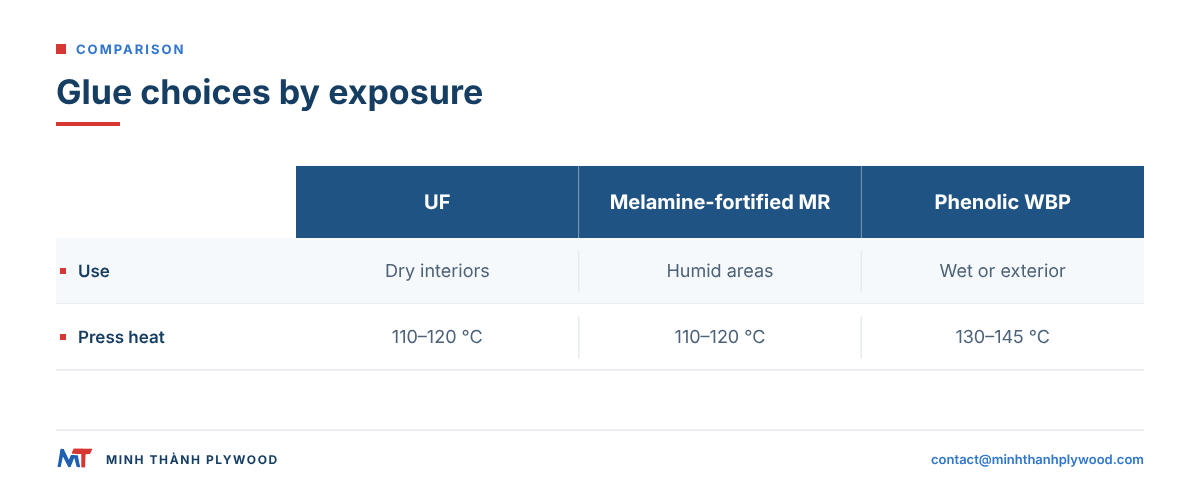
Plywood is glued with one of three adhesive families: urea-formaldehyde (UF) for dry interiors, melamine-fortified (MR) for humid use, and phenolic (WBP) for wet and exterior use. The glue decides where a plywood panel can live.
| Glue | Where it is used | Water resistance | Hot-press temperature |
|---|---|---|---|
| UF glue | Furniture, cabinets, interior panels | Dry interior use | About 110–120 °C |
| Melamine-fortified (MR) | Kitchens, bathrooms, humid areas, some formwork | Humid and wet-use specifications with a bond test | About 110–120 °C |
| Phenolic (WBP) | Exterior, film-faced formwork, marine-type uses | Repeated wetting and weather | About 130–145 °C |
Emission is a separate specification from the glue. Our furniture plywood uses UF glue at E0 emission. For US buyers, panels are certified to CARB P2 / TSCA Title VI (ICTT mill no. 23024). Six ASTM D6007 chamber tests between April 2025 and June 2026 on 9, 15 and 18 mm panels averaged 0.014–0.032 ppm, against the 0.05 ppm limit for veneer-core hardwood plywood; three were by Shanghai Hongjun and three by ICTT Vietnam. The limit is listed in the EPA formaldehyde emission standards.
Types of plywood: by face, glue and use
Plywood types are named by the face, the glue or the job the panel does. The table maps the main types to what they are built for.
| Type | Face and build | Glue | Main uses |
|---|---|---|---|
| Furniture plywood | Birch, Poplar, EV, Okoume, Pine or Eucalyptus face on Styrax or Eucalyptus core; sanded, UV-ready | UF at E0 | Furniture, cabinets, interiors |
| Commercial plywood | Utility faces on a commercial core | UF or MR | Fit-out, backing, general use |
| Packing plywood | Utility faces and core, thickness tolerance ±0.5–1.0 mm | UF | Crates, pallets, packaging |
| Film-faced plywood | Phenolic film on both faces, Eucalyptus or Acacia core | Melamine-fortified or phenolic WBP | Concrete formwork |
| Anti-slip plywood | Patterned film on the face | Phenolic WBP | Floors, platforms, trailers |
| Exterior / CDX-type plywood | Utility C/D faces | Melamine-fortified or phenolic WBP | Sheathing, roofs, stair treads |
| Thin plywood | 3–5 mm, always five plies | UF | Drawer bottoms, backs, door skins |
See the products: furniture plywood, packing plywood, film-faced plywood, exterior plywood and thin plywood. Film colour on formwork panels is a separate choice; our guide to black vs brown film-faced plywood explains it.
Hardwood plywood vs softwood plywood
Hardwood plywood has hardwood veneers on its faces and usually in its core; softwood plywood uses softwood veneers such as pine, fir or spruce. The terms describe the tree family, not how hard the panel is.
Most furniture plywood is hardwood plywood: birch, poplar, okoume or eucalyptus faces over hardwood cores such as Styrax or Eucalyptus. It sands smooth, takes veneer and paint well and holds screws close to the edge. Softwood plywood dominates structural sheathing in North America and Europe, where pine and fir panels are graded for strength.
Pine-faced plywood sits between the two: a softwood face for a warm, knotty look on a hardwood core. We make pine plywood with face/back grade pairs A/A, A/B and B/B. For the full comparison, read our hardwood plywood guide.
Plywood grades: what A/A, A/B and B/B mean
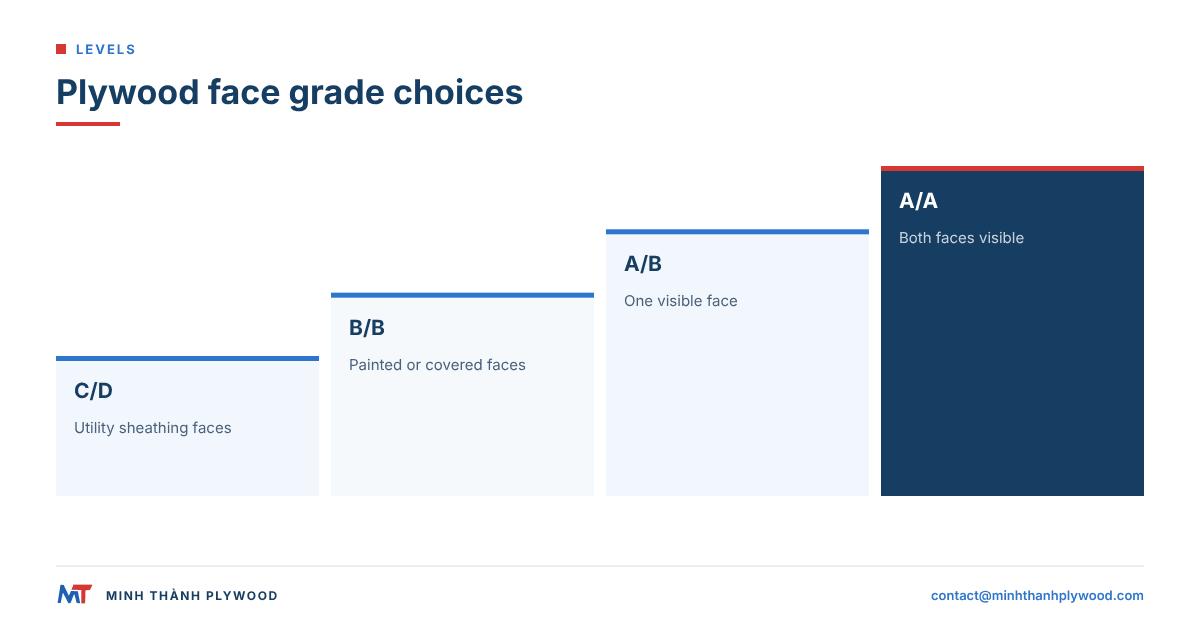
Plywood grades describe the look of the face and back veneers, written as a pair: face grade first, back grade second. A/A means both faces are the top appearance grade; B/B means both faces allow more natural marks.
| Grade pair | Face | Back | Typical use |
|---|---|---|---|
| A/A | Top appearance | Top appearance | Both faces visible: doors, shelves, open furniture |
| A/B | Top appearance | Good | One face visible: carcasses, panels against a wall |
| B/B | Good | Good | Painted, laminated or covered faces |
| C/D | Utility | Utility | Exterior and CDX-type sheathing |
Poplar, pine and Eucalyptus faces are quoted this way and matched to the buyer’s approved sample. Poplar buyers also order by the Chinese codes B/BB, BB/CC and CP, which map onto the same ladder. Birch faces are named D+, D and E in Vietnam and quoted as pairs such as D+/D; as a buying comparison, D+ is close to European B and D close to BB.
Grades describe the face, not the strength. The strength of a panel comes from its core, ply count and glue.
Plywood sizes and thicknesses
The standard plywood sheet is 1220 × 2440 mm, the metric version of the 4 × 8 ft sheet; 1250 × 2500 mm is the common European size. We also make custom sizes such as 1220 × 2500 and 1220 × 2280 mm, and we cut one panel into 4, 6 or 8 pieces on order.
Thickness runs from 3 to 40 mm. The most ordered thicknesses for furniture are 9, 12, 15 and 18 mm; 18 mm is also the usual formwork thickness.
Thickness tolerance depends on the product line:
| Line | Thickness tolerance |
|---|---|
| Sanded furniture panels | ±0.2–0.3 mm, down to ±0.2 mm |
| Commercial and film-faced | ±0.5 mm |
| Packing | ±0.5–1.0 mm |
| Length and width, all lines | ±2 mm |
A tight tolerance matters most where panels meet hardware: drawer runners, hinge cups and CNC-machined joints. For panels cut to your parts list, see cut-to-size plywood.
What is plywood used for?
Plywood is used wherever a flat, strong, stable wood sheet is needed: furniture and interiors indoors, formwork and sheathing on building sites, and packing in industry. The glue and face decide which use a panel suits.
| Use | Plywood to choose | Why |
|---|---|---|
| Furniture and kitchen cabinets | Furniture plywood, UF at E0, sanded faces | Flat, smooth, light, holds screws |
| Shelving and long spans | 18 mm on Eucalyptus core | Stiffer per span |
| Wall panels and doors | Birch, Poplar, EV or Okoume faces | Face look, stability |
| Concrete formwork (plywood shuttering) | Film-faced plywood, melamine-fortified or phenolic WBP | Smooth concrete, many pours |
| Floors, trailers, platforms | Anti-slip plywood | Grip on a patterned film |
| Roof and wall sheathing | Exterior / CDX-type plywood | Water-resistant glue |
| Crates and pallets | Packing plywood | Cost-effective, strong enough |
Plywood shuttering is simply plywood used as concrete formwork. A film-faced panel with melamine-fortified glue gives about 12–15 uses, and phenolic WBP up to about 25, with proper handling, release agent and edge sealing.
A brief history of plywood
Layered, veneered wood goes back to ancient Egypt, where craftsmen glued thin wood layers into furniture and coffins about 2600 BC. The modern panel came later: Samuel Bentham patented veneer-cutting machinery in 1797, the rotary lathe followed in the 1840s and 1850s, and John K. Mayo took the first US plywood patent in 1865.
The Portland Manufacturing Company made the first commercial Douglas fir panels in 1905, and waterproof phenolic adhesive in 1934 turned plywood into an exterior building panel. Today most furniture plywood comes from plantation-core mills in Asia, Vietnam among them. The full dated timeline is in our history of plywood (sources: Plywood, Wikipedia and Everything you need to know about plywood, Buildworld, checked on 21 October 2026).
What is marine plywood?
Marine plywood is plywood made to the British Standard BS 1088, built for boats and wet use: durable hardwood veneers, a core with no gaps, and a waterproof glue line. The standard’s key point is that the veneers are free of core gaps and voids, so water cannot sit inside the panel.
WBP plywood (weather and boil proof) is the glue class: a phenolic glue line that survives boiling. All marine plywood is WBP, but not all WBP plywood is marine, because WBP says nothing about core gaps or veneer species. For a UK buyer the order line reads “marine plywood to BS 1088” for boats and docks, and “WBP exterior plywood to EN 636-3” for sheds, hoardings and formwork. The standard itself, BS EN 636, covers plywood for use in dry, humid or exterior conditions.
Plywood vs solid wood, MDF, particle board and OSB
Plywood is the only common wood sheet built from continuous veneers, which gives it the best mix of strength, low weight and screw holding. MDF and particle board are smoother or cheaper; OSB is cheaper for sheathing; solid wood shows real grain at the edge.
| Material | Made of | Strength and screw holding | Moisture | Best for |
|---|---|---|---|---|
| Plywood | Cross-laid veneers and glue | High, good at edges | Good with MR or WBP glue | Furniture, cabinets, formwork |
| Solid wood | Sawn boards | High along grain, splits across | Moves with humidity | Visible edges, frames, tables |
| MDF | Wood fibres and resin | Medium, weak at edges | Swells when wet | Painted, routed doors |
| Particle board | Wood chips and resin | Low to medium | Swells when wet | Low-cost carcasses |
| OSB | Oriented strands and resin | Good for sheathing | Edges swell | Walls, roofs, subfloors |
Read the full comparisons: plywood vs MDF, particle board vs plywood and plywood vs OSB. All of these panels belong to the wider family of engineered wood.
Is LVL considered plywood?
LVL (laminated veneer lumber) is not plywood, although it uses the same veneers, glue and presses. In LVL every veneer runs in the same grain direction; in plywood the layers cross.
That one change gives LVL a different job. Parallel grain makes it very strong along its length, so it is cut into beams, rails, door frames, bed slats and packing timbers. Plywood’s crossed grain makes it stable in both directions, so it is used as a sheet.
Minh Thanh supplies LVL alongside its plywood. If you need a long, straight member, order LVL; if you need a flat panel, order plywood.
Advantages and disadvantages of plywood
Plywood’s main advantages are strength in both directions, stability, low weight for its stiffness and good screw holding. Its main disadvantages are visible layers at the edge and a higher price than particle board or OSB.
Advantages:
- Stable: crossed layers keep movement small when humidity changes.
- Strong for its weight: an 18 mm sheet on Styrax core weighs about 26.8 kg at a planning density of 500 kg/m³.
- Holds screws and fixings, including near the edge.
- Resists splitting, so it can be nailed close to edges.
- Takes finishes: veneer, paint, lacquer, UV coating, melamine or film.
- Water-resistant when built for it, with melamine-fortified or phenolic WBP glue.
Disadvantages:
- The layered edge shows and usually needs banding on furniture.
- It costs more than particle board, MDF or OSB of the same thickness.
- Quality depends on the mill: core gaps, overlaps or poor glue lines are hidden inside the panel.
- Interior panels with UF glue are for dry use only.
How much does plywood weigh?
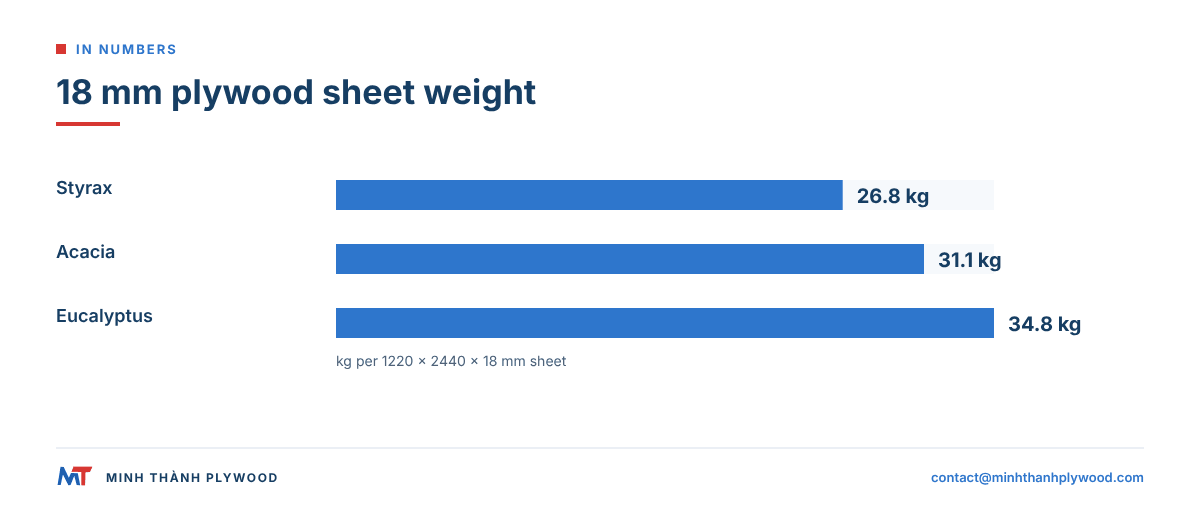
An 18 mm plywood sheet of 1220 × 2440 mm weighs about 26.8 kg on a Styrax core, 31.1 kg on Acacia and 34.8 kg on Eucalyptus. Weight follows the core species, because the core makes up most of the panel.
| Core | Planning density | 18 mm sheet, 1220 × 2440 mm |
|---|---|---|
| White Styrax | 500 kg/m³ | About 26.8 kg |
| Acacia | 580 kg/m³ | About 31.1 kg |
| Eucalyptus | 650 kg/m³ | About 34.8 kg |
These are planning values; Eucalyptus in practice runs 650–750 kg/m³, so weigh real sheets before booking freight. Weight also sets how much fits in a container: a 40HC of 18 mm sheets holds about 990 sheets on Styrax core, 880 on Acacia and 795 on Eucalyptus within a 28,000 kg planning payload. Many European furniture buyers choose Styrax for the lighter sheet and the clean face.
How to check plywood quality
Check plywood quality at the edge, on the face and with a caliper. Most faults are inside the panel, so the edge and a cut sample tell you more than the face.
- Look at the edge: plies even and continuous, no gaps, overlaps or voids.
- Measure thickness at several points with a caliper against the tolerance for the line.
- Check flatness: lay the sheet on a flat surface and look for bow or twist.
- Inspect the face against the approved sample: grade, colour, patches, sanding.
- Check moisture: furniture panels leave our factory at 8–12 %.
- Cut a sample: a clean saw cut shows the core and the glue lines.
- Ask for documents: emission certificate and test reports, bond test where the glue is MR or WBP.
UK buyer box. A UK order for plywood checks five things:
- EN 636 class: -1 for dry interiors, -2 for humid interiors and sheltered exteriors, -3 for exterior use.
- Marking: CE marking under EN 13986, or UKCA marking for Great Britain.
- Timber legality: the UK Timber Regulation due-diligence file for the species and origin.
- Certification claim: an FSC or PEFC claim only with a valid chain-of-custody number on the invoice.
- Size and thickness: 1220 × 2440 mm (4 × 8 ft) sheets in 12, 18 and 25 mm are the stock sizes UK merchants list.
Every shipment from Minh Thanh is photographed and filmed before loading, and buyers get the photos and video. Our quality control page shows what we check on the line.
What this means for your order
Specify plywood by its layers, not by its name. A quotation that lists face, core, glue, emission, thickness and tolerance can be compared line by line; a quotation that says only “birch plywood 18 mm” cannot.
Send these lines with your enquiry:
- Application: furniture, cabinets, interior panels, formwork or packing.
- Core: white Styrax or Eucalyptus as standard; Acacia or Pine on order.
- Glue and emission: UF glue at E0 emission for interiors; melamine-fortified or phenolic WBP to your specification.
- Face and grade: species and grade pair, for example Poplar A/B or Birch D+/D.
- Size and thickness: 1220 × 2440 or 1250 × 2500 mm, or custom; 3–40 mm.
- Packing and quantity: from one 40HC, mixed specifications by agreement, and your destination port.
Production takes 15–45 days after the 30% deposit, and free samples are available. Email contact@minhthanhplywood.com or message us on WhatsApp. The number is +84 988 586 601, and we reply within hours. Prefinished faces are covered in our guides to prefinished plywood and UV-coated plywood, and species in Sande plywood vs birch and types of wood.
Buyer questions, answered
What is plywood?
Plywood is a wood panel made of thin veneers glued in layers, each layer's grain at right angles to the next, and hot-pressed into a flat sheet. The crossed grain makes it strong in both directions and stable when humidity changes.
What is plywood made of?
Plywood is made of wood veneers and glue. A typical furniture panel has a face and back veneer, such as birch or poplar, over core veneers of a plantation wood such as Styrax or Eucalyptus, bonded with UF, melamine-fortified or phenolic glue.
What is the meaning of plywood?
The word combines 'ply', meaning a layer, with 'wood'. Plywood means wood built up from layers, which describes exactly how the panel is made.
Is plywood real wood?
Yes. Every layer of plywood is real wood veneer peeled or sliced from a log; only the glue lines are not wood. That sets it apart from MDF and particle board, which are made from wood fibres or chips.
Why does plywood have an odd number of layers?
An odd number of plies puts the face and back grain in the same direction around a central layer, so the panel is balanced and stays flat. Even-numbered builds use a pair of parallel core plies to keep that balance.
What is plywood used for?
Furniture, kitchen cabinets, shelving, wall panels and doors indoors; concrete formwork, sheathing, floors, packing and crates in construction and industry. The face, glue and core are chosen for each use.
What is plywood shuttering?
Plywood shuttering is plywood used as concrete formwork, usually film-faced plywood with water-resistant glue. The smooth film gives a clean concrete surface and lets the panel be reused for many pours.
How many layers does 18 mm plywood have?
18 mm plywood usually has 11–13 plies, most often 11. Thin panels from 3 to 5 mm are made with five plies.
Is plywood stronger than solid wood?
Plywood is stronger across the panel and far more stable, because its crossed layers resist splitting and movement. A solid board can be stronger along its grain, but it splits, cups and moves with humidity.
Is plywood waterproof?
No plywood is waterproof, but exterior and formwork plywood made with phenolic WBP glue resists repeated wetting. Interior plywood with UF glue is for dry indoor use.
What are the standard plywood sizes?
The standard sheet is 1220 × 2440 mm, the metric version of 4 × 8 ft; 1250 × 2500 mm is common in Europe. Thicknesses run from 3 to 40 mm at Minh Thanh.
Is LVL a type of plywood?
LVL is a close relative, not plywood. It uses the same veneers and glue but lays every layer in the same grain direction, making it a strong beam or rail rather than a stable sheet.