
How to test plywood quality: three tests you can run on a sample at home (soak, boil, chisel split), then the laboratory report that proves it. Start with the paper and finish with the panels: read the report for sample, method, conditioning and result against the limit, then measure thickness, moisture, bond and core on arrival. Minh Thanh Plywood publishes six ASTM D6007 chamber results, 0.014–0.032 ppm against a 0.05 ppm limit, and uses them here as the worked example.
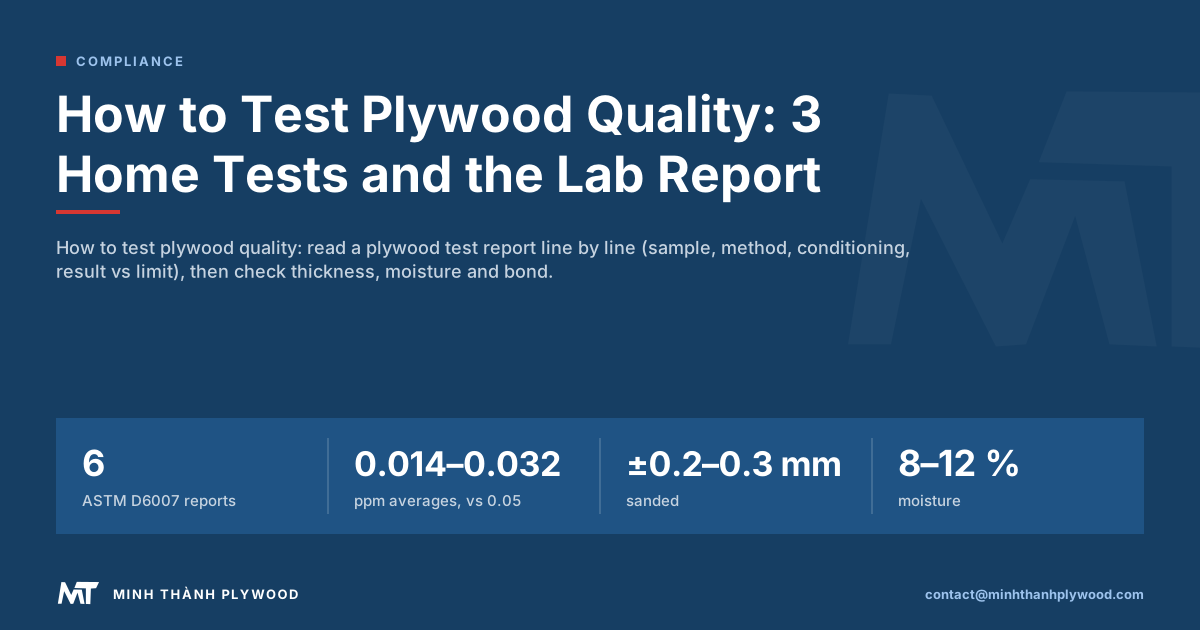
How to test plywood quality: the short answer
The fastest way to test plywood quality is three home tests on a sample: soak it for 24 hours, boil a small strip, and split the glue line with a chisel. The sections below start with those, then show how to read the laboratory report that proves the result.
Testing plywood quality has two halves: the laboratory report, which proves what a sample did under a named method, and the receiving check, which proves the delivered panels match that sample. A report without a receiving check proves the sample; a receiving check without a report proves only what you can measure with a calliper.
- Paper: emission, bond and strength reports, each with laboratory, method, conditioning, result and limit.
- Certificate: for US orders, CARB P2 / TSCA Title VI certification links ongoing production to the results.
- Panels: thickness, moisture, flatness, core, face and bond on a few sheets from each pack.
- Record: shipment photos and video, so the receiving check starts from what left the factory.
The steps below walk through a real plywood emission test report from Vietnam, our own, then the checks on arrival.
What a plywood test report proves and what it does not
A plywood test report proves that a named sample, prepared and conditioned in a named way, gave a stated result under a stated method. It does not, by itself, prove that every later lot gives the same result; that link comes from certification, regular testing and matching construction.
| A report proves | A report does not prove |
|---|---|
| The sample’s result under the method | The result of panels made later |
| The thickness and construction tested | Other thicknesses or cores |
| The date and laboratory | Approval for a different market’s rule |
| Pass or fail against the stated limit | Bond or strength, if it is an emission test |
Read the report for what it covers, then ask what links it to your order: the same thickness and core, a recent date, and a certification number where the market requires one.
Plywood emission test report from Vietnam: the six report numbers by laboratory
Our emission evidence is six ASTM D6007 chamber reports, three from each of two laboratories, run between April 2025 and June 2026 on 9, 15 and 18 mm panels. Their averages were 0.014–0.032 ppm against the 0.05 ppm CARB Phase 2 / TSCA Title VI limit.
| Laboratory | Report numbers |
|---|---|
| Shanghai Hongjun | HJ-QAT-250597, HJ-QAT-251303, HJ-QAT-261036 |
| ICTT Vietnam | ICTTVN-QAT-250841, ICTTVN-QAT-251173, ICTTVN-QAT-260272 |
These are sample results, reported with their method; they are the proof behind our CARB P2 / TSCA Title VI certification (ICTT mill no. 23024). E0 emission is also tested periodically, every three months. The certificate and its scope are on our CARB P2 and TSCA Title VI page.
How to read a plywood test report: seven lines in order
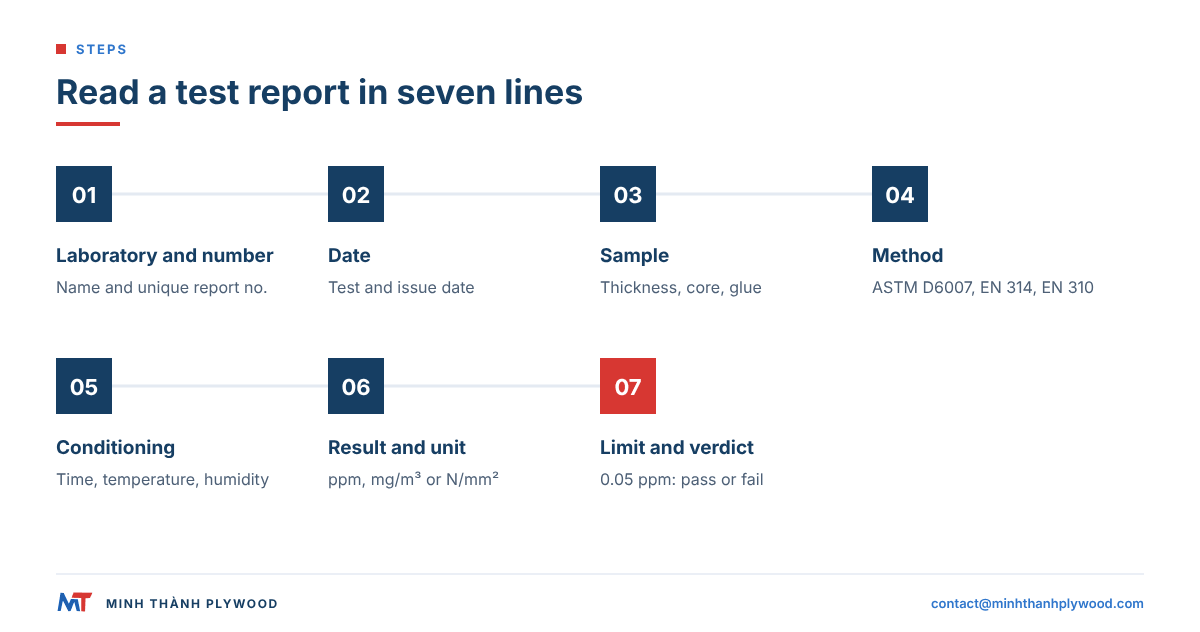
Read a plywood test report in the order the laboratory wrote it: who tested, what was tested, how, and against what limit. Seven lines decide whether the report supports your order.
- Laboratory and report number. The laboratory’s name and a unique number, for example ICTTVN-QAT-260272. A number you can quote back to the supplier ties the PDF to one test.
- Date. Test date and issue date. A recent date matters because glue systems and lines change.
- Sample identification. Product, thickness, core and face, glue, and how the sample was selected. A report on 18 mm Styrax-core panels speaks for that build.
- Method. The standard used, such as ASTM D6007 for emission, EN 314 for bond, EN 310 for bending strength. Two results from different methods cannot be compared as numbers.
- Conditioning. How long and at what temperature and humidity the sample was held before testing. Conditioning is part of the method, and skipping it changes the result.
- Result and unit. The value with its unit: N/mm² for strength, ppm for ASTM chamber emission, mg/m³ for the European chamber method.
- Limit and verdict. The limit the result was judged against and the pass or fail line. A result means nothing until it sits beside its limit.
If any of the seven lines is missing, ask for the full report; a summary page or a screenshot cannot be checked.
Worked example: an ASTM D6007 emission report, line by line
An ASTM D6007 report is read by matching the sample to your panel, then the result to the 0.05 ppm limit. Here is how the lines of one of our reports map to the questions a buyer asks.
| Report line | What it shows | What to check |
|---|---|---|
| Laboratory | ICTT Vietnam or Shanghai Hongjun | The name matches the report number prefix |
| Report number | ICTTVN-QAT- or HJ-QAT- series | Quote it when you request the PDF |
| Sample | 9, 15 or 18 mm panel, its construction | Your thickness and core are covered |
| Method | ASTM D6007 small chamber | Accepted for CARB P2 / TSCA Title VI |
| Glue | UF resin at E0 grade | Glue and emission class are separate lines |
| Result | Averages between 0.014 and 0.032 ppm | Same unit as the limit |
| Limit | 0.05 ppm, veneer-core hardwood plywood | The right product category |
The glue line deserves a second look: test reports identify UF resin at E0 grade, and E0 is an emission class, not a glue type. A report that reads “E0 glue” mixes the two lines. Our guide to CARB Phase 2 vs TSCA Title VI explains how the two rules share one limit.
The regulatory basis behind the 0.05 ppm limit
The 0.05 ppm limit is the US federal emission standard for veneer-core hardwood plywood under TSCA Title VI, set equal to California’s CARB Phase 2 limit. It is written into 40 CFR 770.10, which names 0.05 parts per million for veneer-core hardwood plywood. The EPA formaldehyde emission standards for composite wood products (read 20 October 2026) require panels sold in the US to be certified by an EPA-recognised third-party certifier and labelled.
- Limit: 0.05 ppm for hardwood plywood with a veneer core.
- Methods: ASTM E1333 large chamber, or ASTM D6007 small chamber correlated to it.
- Label: producer, lot, certifier number and “TSCA Title VI compliant”; our panels for US orders carry TPC-43.
- Documents: commercial invoice and B/L state TSCA Title VI compliance.
For European buyers, the same reports and certification are the accepted proof, and third-party testing to EN 717-1 or the buyer’s method is arranged through SGS on request.
Bond, strength and moisture reports: what each one tests
An emission report, a bond report and a strength report answer three different questions, and one never stands in for another. Read each against its own method and limit.
| Report | Question it answers | Typical method |
|---|---|---|
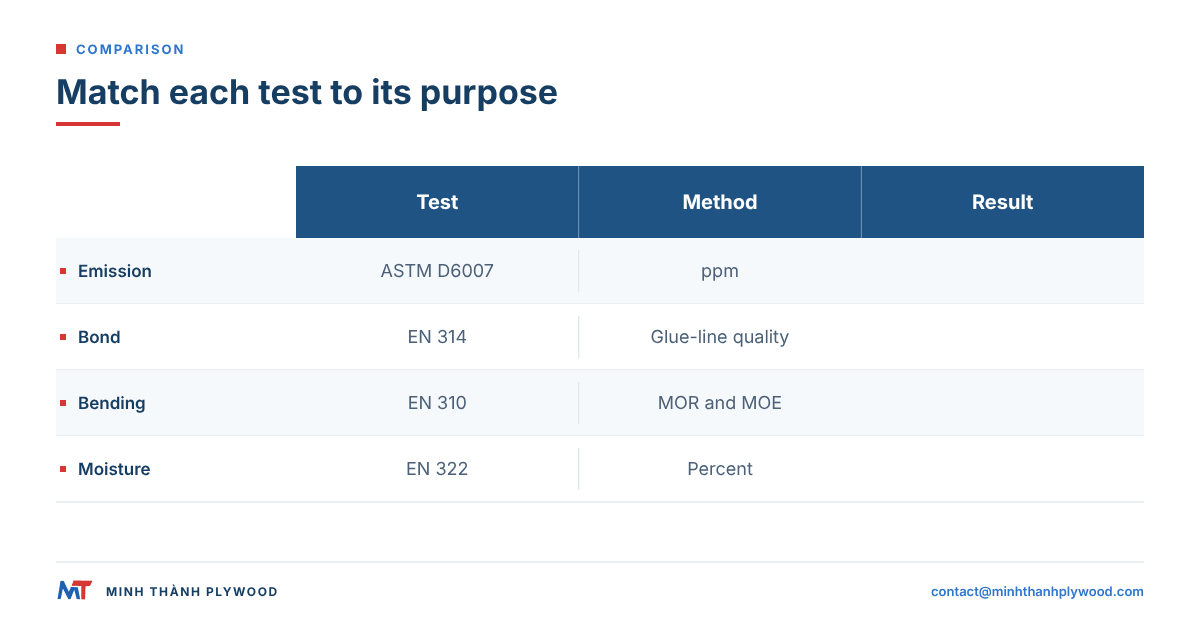
| Emission | How much formaldehyde the panel releases | ASTM D6007, ASTM E1333 or EN 717-1 |
| Bond quality | Does the glue line hold after soaking or boiling? | EN 314-1 and EN 314-2, boil tests |
| Bending strength | How strong and stiff is the panel? | EN 310 (MOR and MOE) |
| Moisture content | Is the panel dry enough? | EN 322 |
| Density | How heavy is the panel for its volume? | EN 323 |
| Dimensions | Thickness, length, width, squareness | EN 324-1 / EN 324-2 (measurement), EN 315 (tolerances) |
Strength results are given in N/mm² and moisture as a percentage. Emission results come in ppm for the ASTM chamber methods and in mg/m³ for the European chamber method.
A bond report is a test on samples after a pre-treatment, such as a soak, a boil or a boil-dry-boil cycle; it is not an emission test. The requirements for bonding quality are set in the BSI record for BS EN 314-2:1993, so state the class you need in the order. Our guide to plywood strength values covers MOR, MOE and the other mechanical tests.
What one sample result does and does not prove for a lot
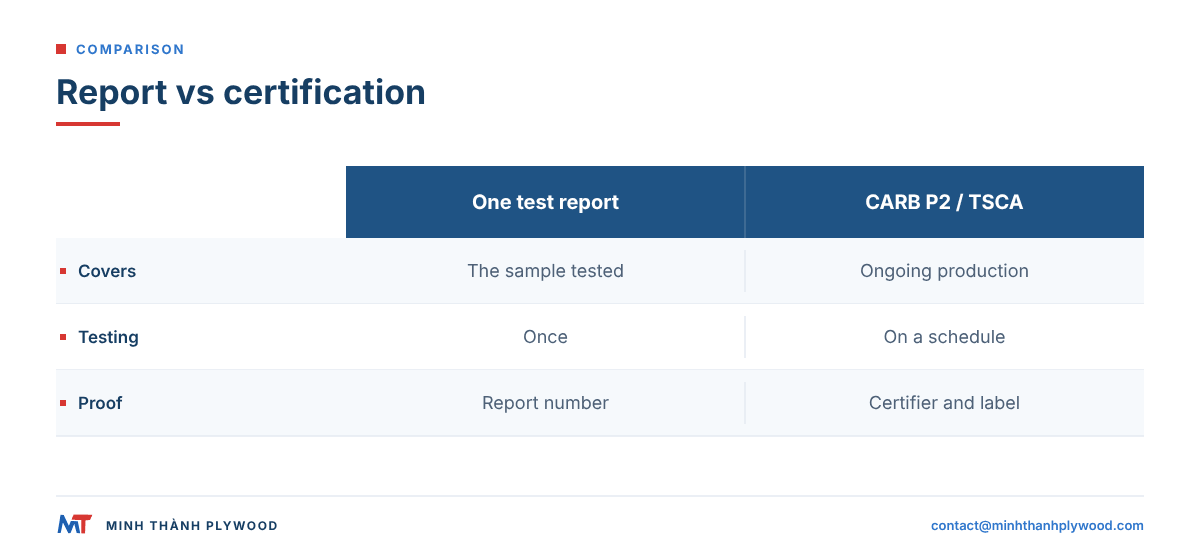
One sample result proves the sample; it supports a lot when the lot matches the sample’s construction and the mill tests on a schedule. That is the logic of certification: CARB P2 / TSCA Title VI adds regular testing and an independent certifier, so a result is not a single photograph of one good day.
- Same build: thickness, core species, face and glue as the sample.
- Recent result: tested within the certifier’s schedule; our E0 emission is tested every three months.
- Certificate in force: the certifier and mill number on the label and the paperwork.
- Shipment record: every shipment photographed and filmed before loading, with the photos and video sent to the buyer.
Write “chamber result on a sample panel, method ASTM D6007” on internal records, not “every lot tested”. The difference is what a sample result can honestly carry.
Red flags on a plywood test report
The red flags on a plywood test report are missing lines, not low numbers. A result that looks excellent is worthless if the laboratory, method or sample cannot be traced.
- No laboratory name or report number.
- No test date, or a date long before the production run.
- A sample with a different thickness or core from the quoted panel.
- A result without its unit or without the limit.
- “E0 glue” or “E1 glue” in place of a glue type and an emission class.
- “Waterproof” in place of a bond class and method.
- A certificate image with no report behind it.
A supplier who sends the full PDF answers all seven lines before you ask.
How to test plywood quality on arrival: eight checks
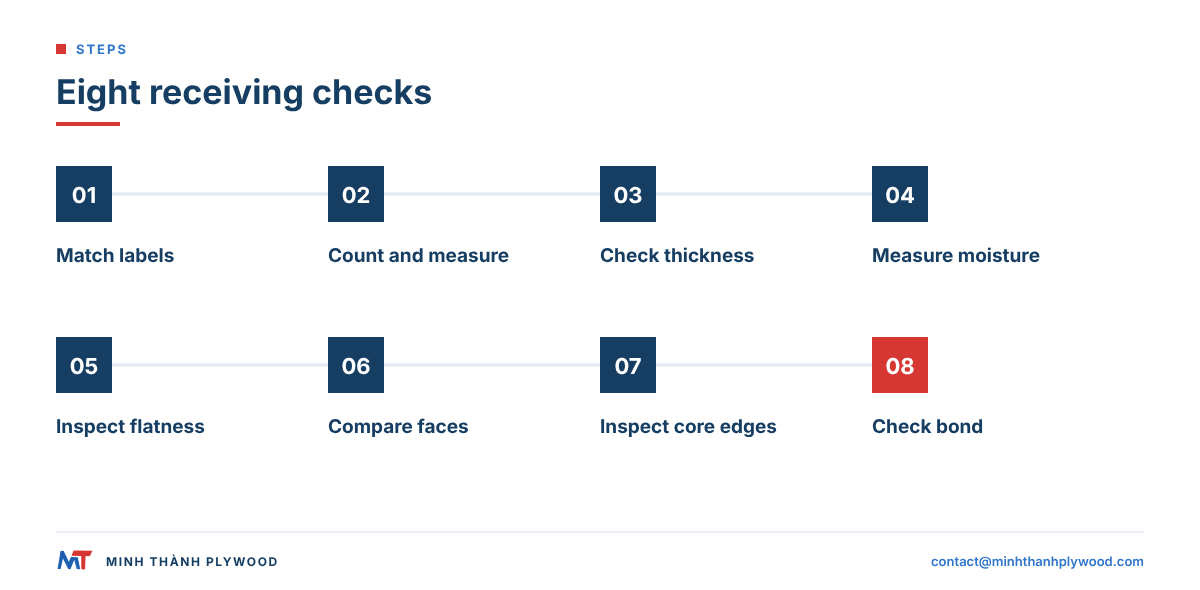
Testing plywood quality on arrival means checking a few sheets from each pack against the order, in the same order every time. Eight checks catch most problems before the panels go to production.
- Labels and documents. Match pack labels to the packing list, and for US orders find the TSCA Title VI label on each panel.
- Count and size. Count sheets per pack and measure length and width; the tolerance is ±2 mm.
- Thickness. Measure several points per sheet with a calliper: ±0.2–0.3 mm for sanded furniture panels, ±0.5 mm for commercial and film-faced, ±0.5–1.0 mm for packing.
- Moisture. Use a moisture meter; furniture panels leave the factory at 8–12 % moisture content.
- Flatness. Lay a sheet on a flat surface and look for bow or twist.
- Face. Compare the face and back with the approved sample: grade, colour, joints, sanding.
- Edges and core. Look along the edges for gaps, overlaps and open glue lines.
- Bond. Cut a strip and split it with a chisel at the glue line; wood fibre on both sides shows a sound bond. For a formal result, send samples to a laboratory.
Photograph every check, so a question about one pack can be answered from evidence.
Three home tests on a sample
Three simple tests on an offcut show whether the glue line survives water, which a calliper and a moisture meter cannot. They are indicative; the laboratory methods in the table below are the formal version.
- Water soak. Soak an offcut in a bucket of water for 24–48 hours and measure swelling and edge lifting. Moisture-resistant (MR) plywood should survive at least 24 hours; boiling-water-resistant (BWR) and boiling-waterproof (BWP) grades last much longer.
- Boil. Boil a strip of about 100 mm in a pressure cooker for 2–3 whistles, roughly 10–15 minutes at higher pressure. A sound glue line stays closed; delaminated plies fail the water-resistance claim.
- Chisel split. Cut a strip and split it at the glue line with a chisel. Wood fibre on both faces shows a sound bond; clean glue or bare veneer shows a weak one.
The formal versions of these tests follow IS 1734, as summarised by an Indian manufacturer:
| Grade | Formal conditioning before the bond check |
|---|---|
| BWP | Boil for 72 hours (in one run or several sessions, with the pieces kept in cold water in between) |
| BWR | Boil for 8 hours, then dry in an oven at about 65 °C for 16 hours |
| MR | Soak in warm water at about 60 °C for 3 hours, then dry in an oven at about 65 °C for 8 hours |
| European bond (EN 314) | Class 1, 2 or 3 pre-treatment, then shear test on the glue line |
A passing home test is not a certificate. It tells you whether to spend money on the laboratory test.
How to check genuine plywood quality in India: ISI mark and core test
In India, genuine plywood carries the ISI mark with its standard and licence number, and the licence can be checked with the Bureau of Indian Standards. The Plywood and Wooden Flush Door Shutters (Quality Control) Order makes the mark mandatory for plywood under IS 303 (general purpose) and IS 710 (marine), including imports.
- Mark: ISI logo, the standard (IS 303 or IS 710), the grade (MR, BWR or BWP) and the CM/L licence number.
- Licence: check the number on the Bureau’s public licence search; the product and grade must match the sheet.
- Core test: cut a sample and look for gaps, overlaps and soft veneers.
- Boil test: IS 710 relies on a 72-hour boil, and BWR grade on an 8-hour boil followed by 16 hours at about 65 °C; a sample that opens early fails the claim. The hours are in the home-test table above.
The same idea holds everywhere: a printed mark is a claim until a licence or report number confirms it.
Requesting reports before you order
Request reports before you order, with the specification attached, so the supplier sends the reports that match your panel and your market. A request that names product, thickness and market gets the right PDFs; a request for “all certificates” gets a folder.
| Market or need | Ask for | From us |
|---|---|---|
| United States | CARB P2 / TSCA Title VI certificate and chamber reports | ICTT mill no. 23024; six ASTM D6007 reports |
| Europe, emission | Chamber reports, or a test to EN 717-1 | Reports by email; SGS test on request |
| Europe, packaging | PPWR heavy-metal test | SGS report under Regulation (EU) 2025/40 |
| Quality system | ISO 9001:2015 certificate | KAC25/0185 |
| Vietnam product standard | TCVN 11902:2017 certificate | VietCert 141.1-VNC-HC |
| Timber origin | EUDR compliance dossier | Origin records and geolocation files |
Our quality and certificates page lists every certificate with its number.
What this means for your plywood order
An order that is easy to test names the method and the limit on the specification, so the report and the receiving check have something to measure against. Send these lines:
- Application: furniture, cabinets, interior panels or packing.
- Core: white Styrax or Eucalyptus.
- Glue and emission: UF glue at E0 emission, and the proof the market needs (CARB P2 / TSCA Title VI, or a test to EN 717-1).
- Face: species and grade pair, matched to the approved sample.
- Size and tolerance: thickness, 1220 × 2440 mm or 1250 × 2500 mm, and the tolerance to check on arrival.
- Packing and quantity: from one 40HC; destination port.
We reply within hours with the matching reports and free samples, so your laboratory or your receiving team can test the same build before the order ships.
Buyer questions, answered
How can I test the quality of plywood?
Read the laboratory reports first: emission, bond and strength, each with its method and limit. Then check the delivered panels for thickness, moisture, flatness, core gaps and bond on a few sheets per pack.
What should a plywood test report show?
The laboratory, report number and date, the sample's thickness and construction, the test method, the conditioning, the result with its unit and the limit it was judged against.
Does one test report cover every lot?
No. A report covers the sample tested. Certification schemes such as CARB Phase 2 and TSCA Title VI add regular testing and a certifier, which is what links one result to ongoing production.
What is ASTM D6007?
ASTM D6007 is a small-chamber method for formaldehyde emission from wood products. CARB and the EPA accept it, correlated to the ASTM E1333 large chamber, for hardwood plywood certification.
What does 0.05 ppm mean on a formaldehyde report?
It is the CARB Phase 2 and TSCA Title VI emission limit for veneer-core hardwood plywood. A result below 0.05 ppm passes; our six chamber tests averaged 0.014–0.032 ppm.
Where can I download a plywood emission test report from Vietnam?
Ask the mill for the full PDF, not a summary page. We send our six ASTM D6007 reports and the CARB P2 / TSCA Title VI certificate by email with the quotation.
Is a boil test the same as an emission test?
No. A boil test checks the glue bond on samples; an emission test measures formaldehyde released by the panel. A report shows one or the other, and the glue type and emission class are separate lines.
How do I check plywood thickness on arrival?
Measure several points on a few sheets per pack with a calliper and compare with the ordered tolerance, such as ±0.2–0.3 mm for sanded furniture panels or ±0.5 mm for commercial and film-faced panels.
How do I check genuine plywood quality in India?
Look for the ISI mark with the standard number, IS 303 or IS 710, and the licence number printed on the sheet, and check the licence with the Bureau of Indian Standards. Then cut a sample and look for core gaps and overlaps.
Can a buyer order a test to their own method?
Yes. We arrange third-party testing through SGS to the buyer's method, for example EN 717-1, on request.