
Mold in plywood is fungal growth on a panel that stayed damp. Surface mould on sound plywood can be cleaned: dry the sheet, vacuum it with a HEPA filter, scrub with detergent and water, dry it fast and seal it once the wood is dry. Replace panels that are soft, delaminated or mouldy deep in the core. Minh Thanh Plywood explains how to tell mould from stains, the cleaning steps and how to prevent it.
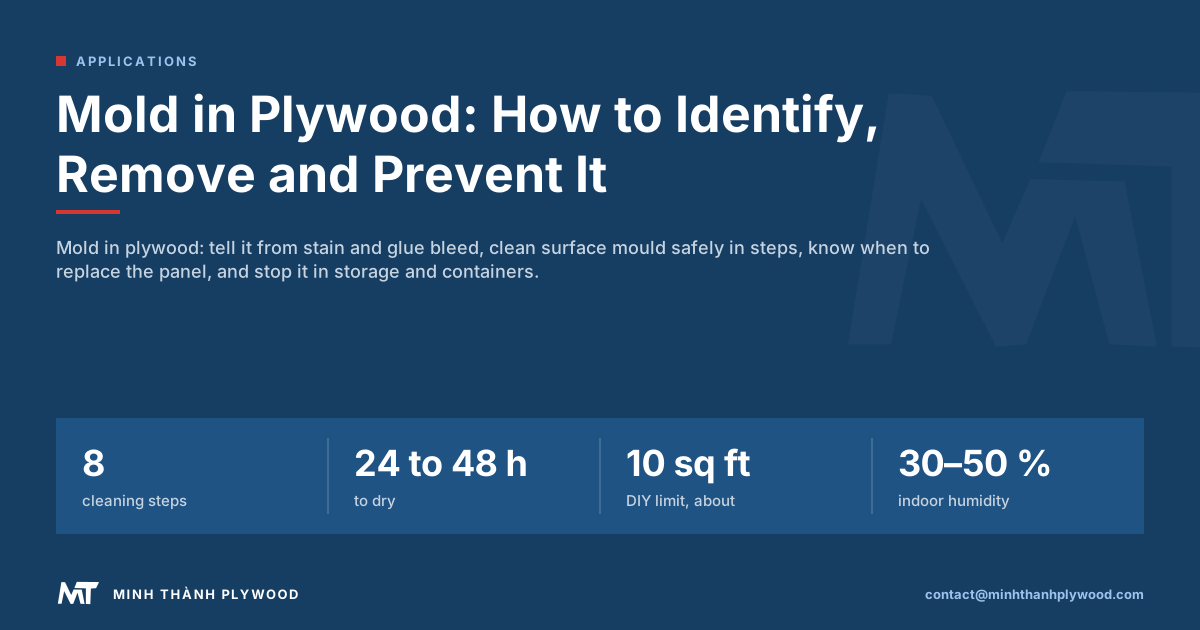
Mold in plywood: what it is and what to do first
Mold in plywood is fungal growth on the surface or in the outer veneers of a panel that has stayed damp: it needs moisture, still air and wood to feed on. The first step is always the same: find and stop the water, then decide whether to clean or replace.
Before any cleaning, do four things in order:
- Stop the moisture. Fix the leak, cover the stack, or open the container and let it air.
- Separate the affected sheets from clean ones, so spores and damp do not spread.
- Photograph and record the packs, the sheets and where the mould is, before anything is moved.
- Dry the panels with air flow and dehumidification, not heat on one face only.
Then check each sheet: is it only a surface growth on sound wood, or is the wood soft, the plies separated or the mould inside the core? The first can be cleaned; the second is replaced. The sections below explain how to tell them apart.
What does mold on plywood look like?
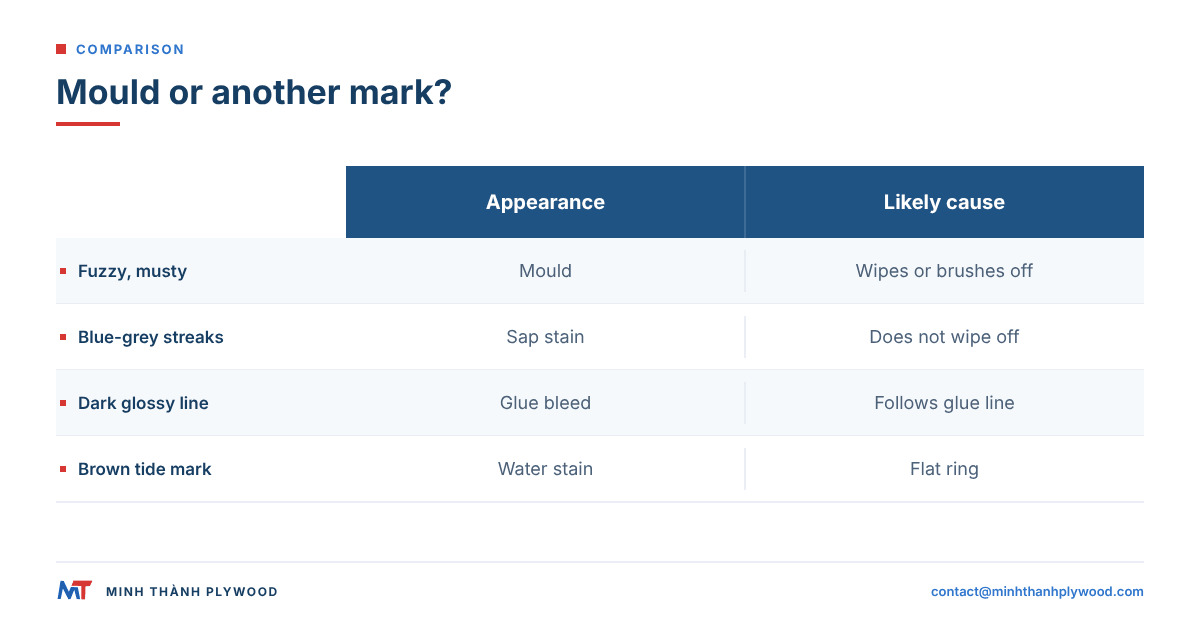
Mold on plywood looks like fuzzy or powdery spots in white, green, grey or black, spread in patches or along edges and where sheets touched, with a musty smell. Several other marks look similar but are not mould: stains, glue bleed, mineral marks and early decay.
| What you see | Most likely | How to tell |
|---|---|---|
| Fuzzy or powdery spots, musty smell | Mould | Wipes or brushes off; returns if damp |
| Flat grey or white film on the surface | Mildew, an early mould | Wipes off easily |
| Black spots that wipe off | Black mould on plywood | Fuzzy texture, damp area |
| Blue-grey streaks along the grain | Sap stain fungus in the veneer | Does not wipe off; wood is sound |
| Dark, glossy spots or lines | Glue bleed through the face | Hard, shiny, follows a glue line |
| Brown tide marks | Water stain | Flat, no growth, dries to a ring |
| White crystals or powder | Mineral salts from wet masonry | Crunchy, no smell |
| Soft, crumbling or stringy wood | Decay (rot) | A screwdriver goes in easily |
The colour does not tell you the type of mould or how harmful it is. “Black mold” is not one species, and white mould can be as active as black. What matters is whether it is growing, how far it has spread and whether the wood under it is still sound.
Is mold on plywood dangerous?
Mold on plywood can be harmful to health: the spores and fragments it releases can cause allergic reactions, asthma symptoms and irritation, more so for people with breathing problems. It is also a sign of moisture that, left alone, leads to decay and failed panels.
Protect yourself when you handle or clean it:
- Mask. Wear at least an N95 respirator; the US EPA names it as the minimum for small mould clean-ups.
- Gloves and goggles. Use long gloves and goggles without vent holes.
- Ventilation. Work outdoors or with a window open and the door to the rest of the building closed.
- Size. The EPA treats about 10 square feet, roughly a 3 ft × 3 ft patch, as the limit for a do-it-yourself clean-up; larger areas or mould in heating and air ducts need a professional.
The EPA guide to mold clean-up sets out these limits and the methods. On a building site or in a warehouse, the employer’s health and safety rules apply as well.
Why mold wood grows: moisture, still air and time
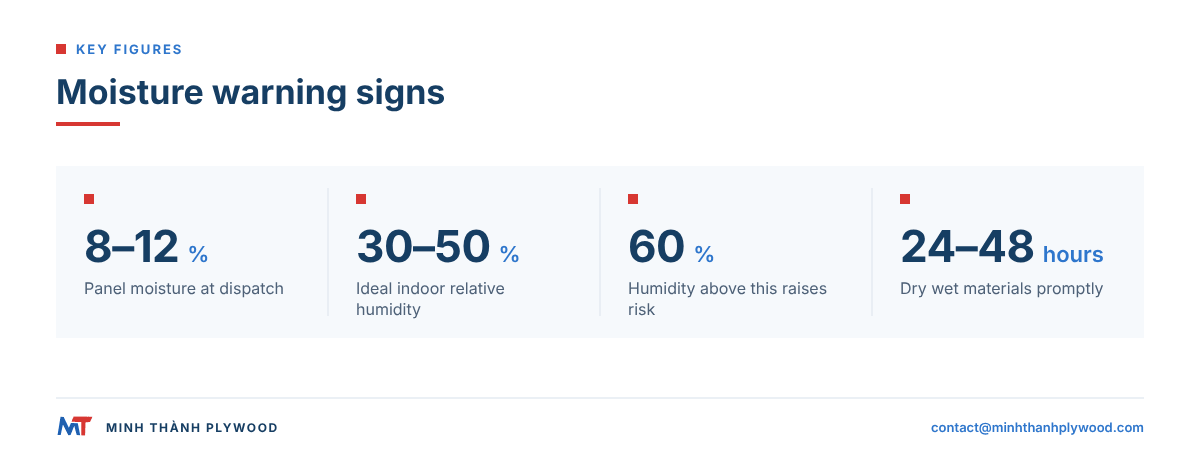
Mould grows on wood when its surface stays damp: wet panels, high humidity, condensation and still air give spores the water they need, and a few days of damp are enough. Dry wood in moving air does not grow mould.
| Condition | Risk of mould on plywood |
|---|---|
| Panel at 8–12 % moisture content, dry air | Very low |
| Room air kept between 30–50 % relative humidity | Low |
| Room air above 60 % relative humidity for long periods | Rising |
| Panel surface damp from condensation | High |
| Panel wet from rain or a leak, no air flow | Very high |
| Wood above about 20 % moisture content for weeks | Mould first, then decay risk |
The US EPA advises drying wet materials within 24 to 48 hours to stop mould from starting. It also advises keeping indoor relative humidity below 60 percent, ideally between 30 percent and 50 percent. Wood itself is a slow store of water: a pack of plywood that got wet stays damp in the middle for far longer than the outside sheets suggest.
Minh Thanh dries veneers and finished panels to 8–12 % moisture content at dispatch, the normal range for furniture plywood. The plywood moisture content guide explains meters and readings.
How to get rid of mold on plywood in eight steps
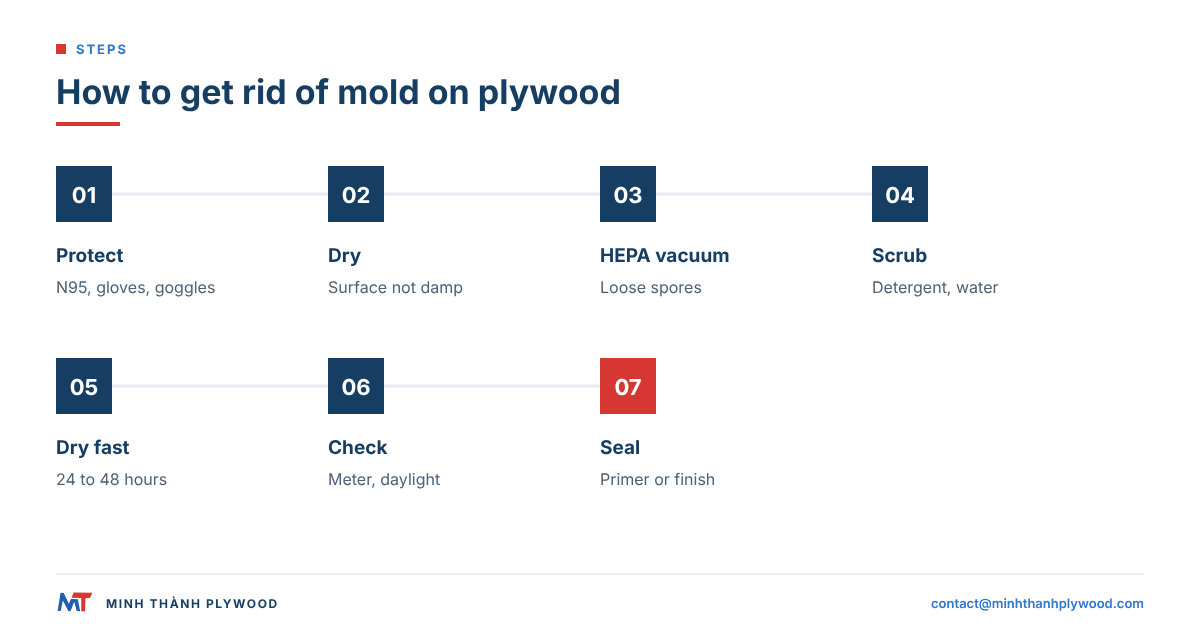
To get rid of mold on plywood, dry the panel, remove loose mould with a HEPA vacuum, scrub the surface with detergent and water, dry it fast, check it, then sand lightly and seal. The aim is to remove the mould, not just kill it, and to keep the wood dry afterwards.
- Put on protection: N95 mask, gloves, goggles.
- Let the panel dry until the surface is no longer damp; wet scrubbing on a soaked sheet spreads the growth.
- Vacuum the mould with a vacuum fitted with a HEPA filter; a normal vacuum blows spores back into the air.
- Scrub the surface with a stiff brush and a solution of household detergent in warm water, working with the grain.
- Wipe it clean with a damp cloth, rinsing the cloth often, and do not soak the panel.
- Dry the panel fast, within 24 to 48 hours, with fans and a dehumidifier; stand sheets apart or on sticks.
- Check it in daylight and with a moisture meter; repeat steps 3 to 6 where any growth remains.
- Sand lightly and seal once it reads dry: a light sanding with HEPA extraction removes stains in the surface, then a stain-blocking primer or the planned finish closes it.
Throw away the cleaning cloths and vacuum contents in sealed bags. Clean the tools before they go back to the workshop.
Bleach, vinegar or detergent? Cleaning products compared
Detergent and water with scrubbing is the method the US EPA describes for mould on hard surfaces; bleach and vinegar kill some surface mould but do not remove it, and their extra water can make a wood panel worse. On plywood, what you remove and how fast you dry matter more than what you spray.
| Product | What it does on plywood | Use it? |
|---|---|---|
| Detergent and warm water | Loosens and lifts mould for scrubbing | Yes, the main method |
| HEPA vacuum | Removes loose spores and growth | Yes, before and after |
| White vinegar | Kills some surface moulds | Possible, then scrub and dry |
| Chlorine bleach | Whitens, does not reach the pores, adds water | Not as a routine; never mixed with vinegar or ammonia |
| Borate solution | Wood treatment that slows regrowth | For framing and hidden panels, to the label |
| Commercial mould remover | Varies by product | Follow the label; test on an offcut |
Whatever the product, test it on a hidden part of the same panel: some cleaners darken or bleach the face veneer, and that shows under a clear finish. Never mix cleaning products, because bleach with ammonia or acids gives off toxic gas.
Black mould on plywood walls, roofs and subfloors
Black mould on plywood that is already built in, such as roof sheathing in an attic, a subfloor or a wall lining, is cleaned in place the same way, but the moisture source is usually the building itself: a leak, poor ventilation or condensation. Fix that first or the mould comes back.
| Where | Usual cause | Fix the cause |
|---|---|---|
| Underside of roof sheathing | Warm, moist air from the house condensing in a cold attic | Seal ceiling leaks, add roof ventilation |
| Subfloor over a crawl space | Damp ground, no vapour barrier | Ground cover, crawl-space ventilation or conditioning |
| Behind bathroom or kitchen walls | Leaking pipes, no extraction | Repair the leak, fit an extract fan |
| Wall sheathing at windows | Water behind cladding | Flashings, sealed openings |
| Cabinet backs and bed bases | Panel against a cold, damp wall | Leave an air gap, lower room humidity |
For attic sheathing with widespread black staining but sound wood, specialists often clean, dry and seal it with a mould-resistant primer rather than replace the roof. Soft or delaminated sheets are replaced. For plywood ceilings and bed bases in humid climates, an air gap and dry room air matter more than the panel type.
When to replace moldy plywood
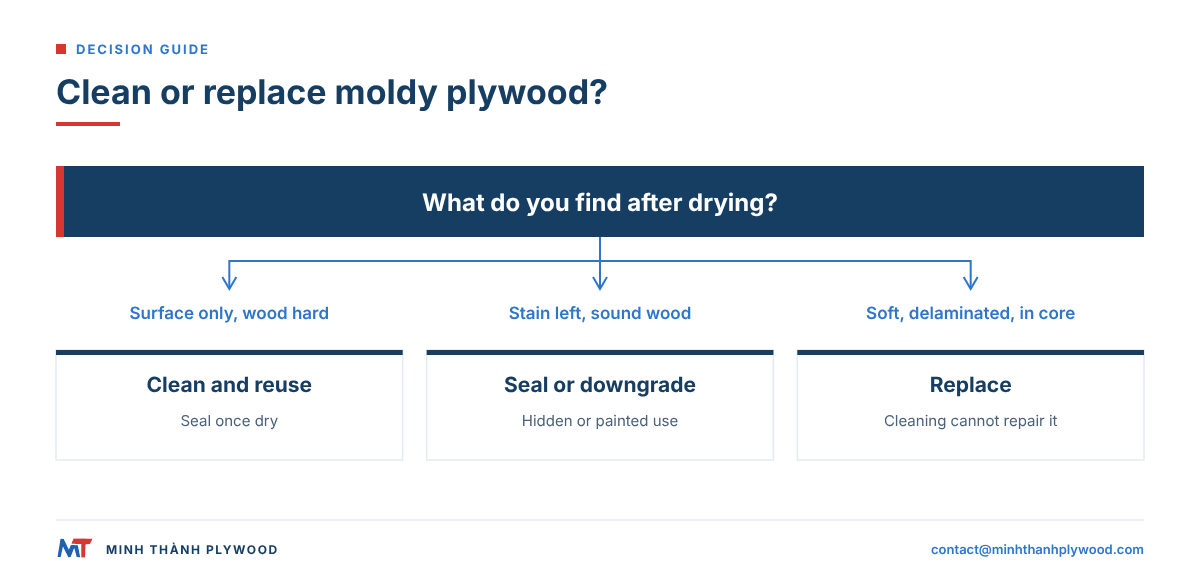
Replace moldy plywood when the wood is soft or crumbles, the plies have separated, the mould is inside the core, the panel is in a food, bedroom or nursery area and stains remain, or the affected area is larger than about 10 square feet in a building. Cleaning does not repair a weakened panel.
| Condition after drying and cleaning | Decision |
|---|---|
| Surface growth only, wood hard, plies bonded | Clean, dry, seal and reuse |
| Light stain left, wood sound, hidden position | Seal with stain-blocking primer and reuse |
| Light stain left, visible clear-finished face | Downgrade to a hidden or painted use |
| Plies separated or face blistered | Replace |
| Wood soft, a screwdriver goes in | Replace: decay |
| Mould visible at the edges inside the core | Replace |
| Large area in an occupied building | Professional assessment, usually replace |
A panel that was wet long enough to grow mould may also have swollen or lost its flatness. Check flatness and thickness before using a cleaned sheet in furniture or flooring.
Plywood mould in containers: why it appears on arrival
Plywood mould found on arrival from a sea shipment usually comes from condensation in the container: warm, humid air cools at night or as the ship moves into colder seas, water condenses on the packs and the outer sheets stay damp long enough for mould to start. The panels can leave the factory dry and still arrive with surface growth.
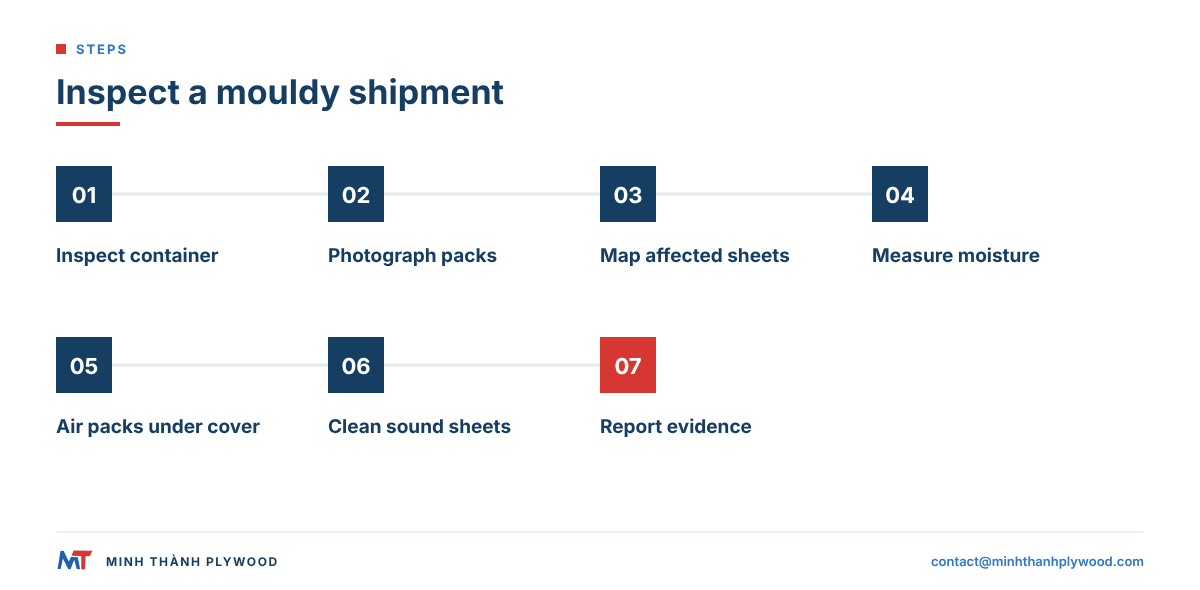
What importers do on arrival:
- Open and inspect the container at once; photograph the doors, roof, floor and packs before unloading.
- Note where the mould is: top sheets, the pack ends, under the wrapping or throughout.
- Take moisture readings on outer and inner sheets of the affected packs.
- Unwrap and air the affected packs under cover, on bearers, with space between packs.
- Clean and dry surface mould on sound sheets, as above, before the panels go into production.
- Report to the supplier with the photos, readings and pack numbers.
Mould on the outer sheets alone, with dry inner sheets, points to condensation in transit. Mould deep inside packs with high readings points to panels that were packed damp. Minh Thanh dries panels to 8–12 % moisture content at dispatch and photographs and films every shipment before loading; buyers get the photos and video, which help to show the condition of the packs when they left.
How to prevent mold in plywood in storage and on site
Prevent mold in plywood by keeping it dry and in moving air: store packs off the ground on bearers, under a roof, with the wrapping opened once they are inside, and fix panels with gaps and ventilation behind them. Prevention is cheaper than any clean-up.
- On arrival. Move packs under cover the same day; do not leave them in the rain or on wet ground.
- In the warehouse. Stack flat on level bearers, keep packs away from walls and doors, and keep the air dry and moving.
- Wrapping. Wrapping protects in transit; inside a dry building, open it so trapped moisture can leave.
- On site. Cover stacks with a tarpaulin that leaves the sides open to air; never wrap wet sheets tightly.
- In use. Leave an air gap behind panels against walls, seal exterior edges, and keep room humidity in check.
The plywood storage and handling guide covers stacking, bearers and conditioning in more detail.
Does glue, species or treatment make plywood mold-resistant?
The glue does not stop mould: phenolic (WBP) glue keeps the plies bonded when wet, but the wood surface can still grow mould if it stays damp. Treatments and sealed faces help; moisture control matters most. Mold-resistant plywood is plywood with a fungicide or preservative treatment, or with a sealed film face.
| Panel | Mould resistance | Why |
|---|---|---|
| Interior plywood, UF glue | Low if wet | Bond and wood both suffer in water |
| Exterior plywood, phenolic (WBP) glue | Bond survives; surface can still grow mould | Glue is waterproof, wood is not |
| Film-faced plywood | Faces sealed; edges must be sealed | Phenolic film keeps water off the face |
| Treated plywood | Higher, to the treatment’s rating | Preservative in the veneers |
| Painted or sealed plywood | Higher while the coating is intact | Water cannot reach the wood |
Minh Thanh’s furniture plywood uses UF glue at E0 emission for dry interior use. For damp or outdoor places, order an exterior panel with melamine-fortified or phenolic (WBP) glue, or film-faced plywood, and seal it; the outdoor plywood guide compares the types.
Mold in plywood in humid and cold climates
Climate changes where mould starts: in hot, humid climates such as the Philippines, Singapore and the Gulf coast, it grows on panels that face cooled, damp air; in cold climates such as Denmark, it grows where warm indoor air meets a cold surface and condenses. The fix is the same: keep the panel’s surface dry.
- Humid tropics. Air-conditioned rooms cool walls and furniture backs below the outdoor dew point; plywood ceilings and bed bases against outside walls need an air gap and a sealed back face.
- Hot, dry climates with humid coasts. Panels near the sea or in air-conditioned rooms with poor drainage of condensate grow mould in hidden places.
- Cold climates. Roof and wall sheathing gets damp from indoor air leaking into the cold side; an air barrier and ventilation keep it dry.
In every climate, a panel sealed on both faces and all edges takes up water more slowly and evenly, which is the best defence for plywood in wet rooms and outside walls.
What this means for your order
Order plywood for the moisture of the place it goes, specify the moisture at dispatch and plan dry storage on arrival: furniture panels for dry rooms, exterior or film-faced panels for damp ones, and packs opened and aired once they are inside. A furniture line with the moisture spelled out reads:
18 mm furniture plywood, white Styrax core, pressed twice, UF glue at E0 emission, poplar B/B, 1220 × 2440 mm, moisture 8–12 % at dispatch, packs wrapped, photos and video of loading; 1×40HC.
For bathrooms, outdoor walls and humid sites, change the glue to phenolic (WBP) or choose film-faced plywood. Minh Thanh’s minimum order is one 40HC, with production 15–45 days after the 30% deposit, and free samples on request. Send the use and the climate, and we quote exterior plywood or furniture plywood to suit. More guides are in plywood applications.
Buyer questions, answered
How do you get rid of mold on plywood?
Fix the moisture source, let the panel dry, vacuum the mould with a HEPA vacuum, scrub the surface with detergent and water, dry it within a day or two, then sand lightly and seal once it reads dry. Replace panels that are soft or delaminated.
What does mold on plywood look like?
Fuzzy or powdery spots in white, green, grey or black, often in patches along edges or where sheets touched. It wipes or brushes off the surface and smells musty; a stain that does not wipe off is usually not mould.
Is mold on plywood dangerous?
It can be. Mould spores can cause allergic reactions and breathing problems, so wear an N95 mask, gloves and goggles when cleaning and keep the area ventilated. Large areas need a professional.
Can you paint over mold on plywood?
No. Paint over live mould traps it and lets it grow under the film. Clean and dry the panel first, then use a stain-blocking primer before the paint.
Does bleach kill mold on plywood?
Bleach whitens the surface but does not reach mould in the wood's pores, and its water can make the problem worse. The US EPA does not recommend routine use of biocides such as bleach; detergent, scrubbing and fast drying are the method.
Does vinegar kill mold on plywood?
White vinegar can kill some surface mould, but the panel still needs scrubbing to remove it and fast drying afterwards. Never mix vinegar with bleach.
When should moldy plywood be replaced?
When the wood is soft or crumbles, the plies have separated, the mould is inside the core, or the panel covers more than about 10 square feet of mould in a building. Replacement is also the safer choice for food areas and bedrooms.
Can you sand mold off plywood?
Only after cleaning and drying, and only lightly, with a sander connected to a HEPA vacuum. Sanding live mould spreads spores, and heavy sanding can cut through the thin face veneer.
Why is there mold on new plywood from a container?
Condensation. Warm, humid air in a container cools at night or in colder seas, water condenses on the packs and the surface sheets stay damp long enough for mould to start.
Is there mold-resistant plywood?
Plywood treated with a fungicide or preservative resists mould better, and film-faced plywood has a sealed face. Any plywood still grows mould if it stays wet, so moisture control is the main defence.
What moisture content stops mold growing on plywood?
Mould needs damp wood, and wood kept below about 20 % moisture content in dry air rarely grows it. Furniture plywood leaves the factory at 8–12 %.