
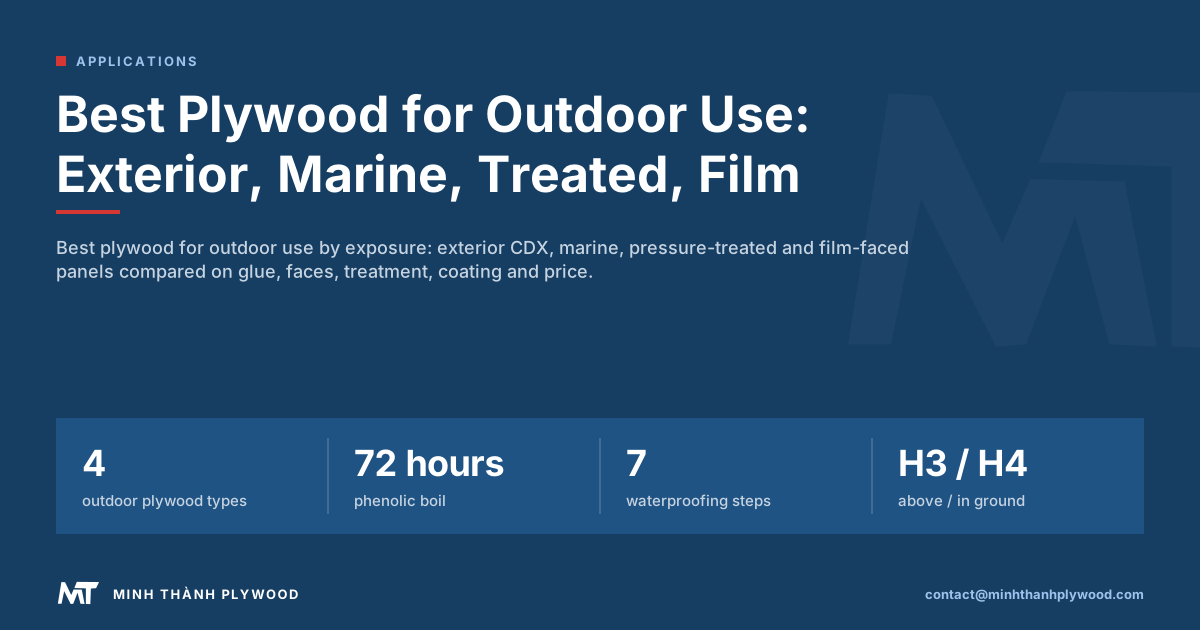
The best plywood for outdoor use is exterior plywood with a phenolic (WBP) glue for most covered and weather-exposed jobs, marine plywood where it stays wet, pressure-treated plywood for ground contact, and film-faced plywood where the face takes water and wear. Any of them needs sealed edges and a coating. Minh Thanh Plywood compares the four types by exposure, glue and use.
Best plywood for outdoor use: the answer by exposure
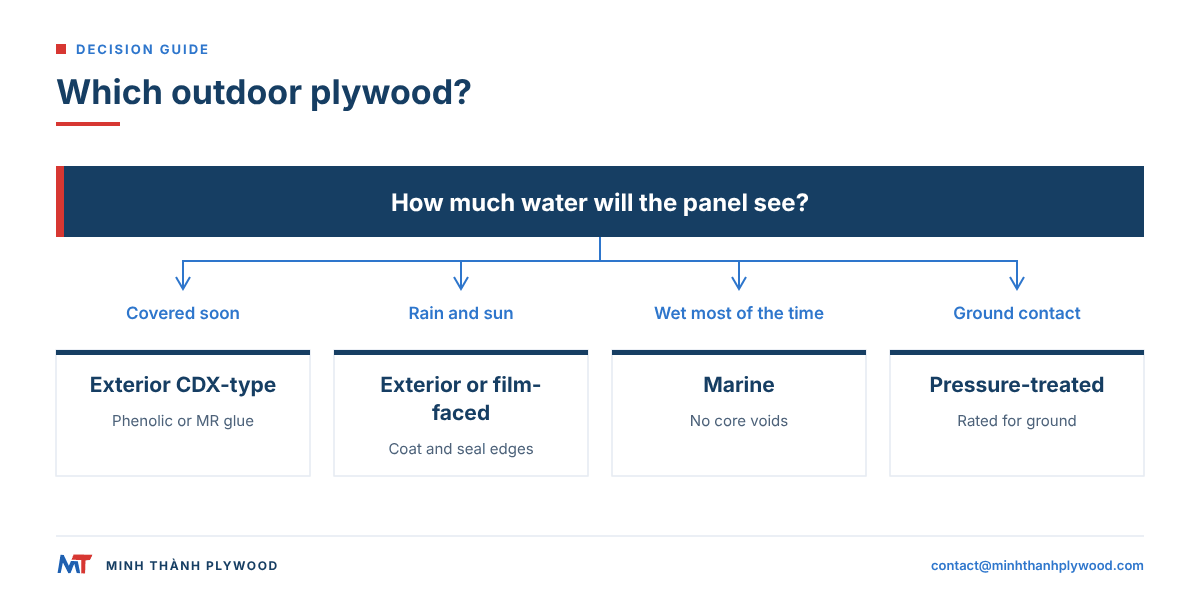
The best plywood for outdoor use depends on how much water reaches the panel: exterior plywood with phenolic glue for covered and weather-exposed work, marine plywood for panels that stay wet, pressure-treated plywood for ground contact and film-faced plywood for faces that take water and wear.
| Exposure | Best panel | Glue | Protection needed |
|---|---|---|---|
| Covered: roof decks, wall sheathing, soffits | Exterior, CDX-type | Phenolic (WBP) or melamine-fortified | Cover within weeks; seal edges |
| Intermittent wet: sheds, signs, fences, furniture | Exterior with better faces, or film-faced | Phenolic (WBP) | Primer, two coats of exterior paint, sealed edges |
| Permanently in the weather: cladding, planters, decks | Marine or film-faced; overlaid siding panels | Phenolic (WBP) | Full coating system, drainage, maintenance |
| Wet most of the time: docks, boats, wet areas | Marine | Phenolic (WBP) | Epoxy or marine varnish, all edges sealed |
| Ground contact | Pressure-treated, rated for ground contact | Exterior | Treatment to the local hazard class |
The glue decides whether the panel holds together when it gets wet; the veneers, the treatment and the coating decide how long the wood itself lasts. Choose the panel for the worst water it will see, not the average.
What makes plywood suitable for outdoor use?
Plywood is suitable for outdoor use when its glue is waterproof, its veneers are sound and without large core gaps, its faces can hold a coating and its edges are sealed. All four matter; a waterproof glue on a gappy core still fails.
- Waterproof glue. Phenolic (WBP) glue survives boiling water and the weather. Interior UF glue does not.
- Sound veneers and a closed core. Gaps in the core trap water inside the panel and lead to rot and face blisters. Minh Thanh stitches core layers both horizontally and vertically to keep the core closed.
- A face that holds paint. Sanded or overlaid faces take a coating; rough, open faces check and let water in.
- Durable or treated wood. Untreated wood rots if it stays wet; durable species or a preservative treatment slow that.
- Sealed edges. End grain at the edges takes up water many times faster than the face.
Exterior grades fail outdoors mainly through the edges and fixings, not through the face. That is why the same panel can last for years on one project and fail on the next.
Exposure classes: covered, wet, weather and ground contact
Outdoor plywood is specified by exposure class: the standards name the conditions, and each class sets the glue and, for treated wood, the preservative. Match the class on the specification to the place the panel goes.
| Exposure | European plywood class (EN 636) | US bond classification | Australian hazard class (AS 1604) |
|---|---|---|---|
| Dry interior | EN 636-1 | Interior | H1, H2 |
| Humid interior, covered outside | EN 636-2 | Exposure 1 | H2 |
| Exterior, above ground | EN 636-3 | Exterior | H3 |
| In ground contact | Treated, outside EN 636 bond scope | Exterior, treated for ground contact | H4, H5 |
| Marine immersion | EN 636-3 with marine veneers | Exterior, marine grade | H6 |
The European classes are set out in BS EN 636, and the bond tests behind them in BS EN 314-2. A panel stamped Exposure 1 in the US is made with an exterior glue but is meant to be covered after a short time in the weather during building; a panel stamped Exterior can stay outside. US buyers check the APA trademark on the panel edge or back for the words “Exterior” or “Exposure 1” before anything else. Structural plywood in the US is made to Voluntary Product Standard PS 1.
Outdoor plywood types compared
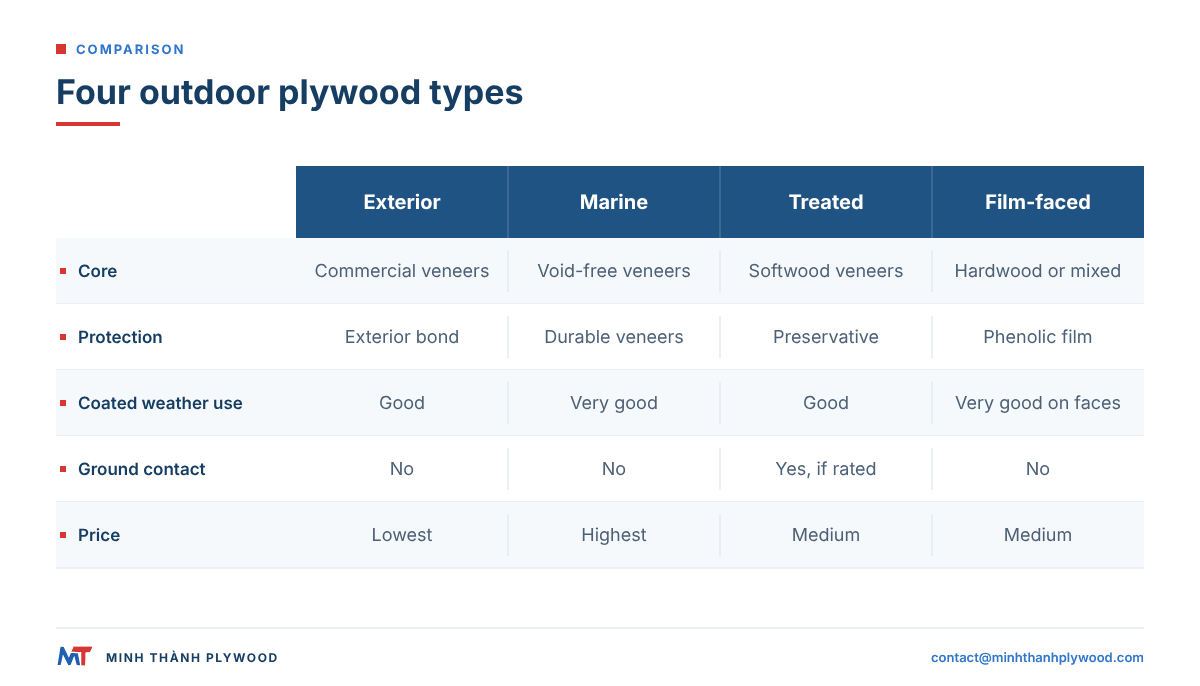
The four outdoor plywood types differ in glue, faces, treatment, weather resistance and price; the table compares them one metric per row. Exterior plywood is the default; the others solve one specific problem each.
| Metric | Exterior (CDX-type) | Marine | Pressure-treated | Film-faced |
|---|---|---|---|---|
| Glue | Phenolic (WBP) or melamine-fortified | Phenolic (WBP) | Exterior | Melamine-fortified or phenolic (WBP) |
| Faces | C/D utility | High grade, few repairs | C/D, treated | Phenolic film both faces |
| Core | Commercial veneers | Void-free, durable veneers | Softwood veneers | Hardwood or mixed veneers |
| Treatment | None | None; durable species | Preservative, pressure-impregnated | Film seals faces |
| Weather, coated | Good | Very good | Good | Very good on the faces |
| Ground contact | No | No | Yes, if rated | No |
| Looks | Utility | Fine | Utility, green or brown tint | Dark film, smooth or anti-slip |
| Price | Lowest | Highest | Medium | Medium |
| Typical uses | Sheathing, sheds, hoardings | Boats, docks, wet areas | Decks, planters, ground-level floors | Formwork, signs, trailer floors |
Each type is covered below, with the work it suits and what to check. In practice, most buyers start with exterior plywood and move to one of the other three only when the exposure, the ground or the face wear asks for it: marine for constant wet, treated for soil, film for faces that take water, concrete or traffic. For the full marine buying checklist see the marine plywood buying guide.
Exterior plywood: CDX, ACX and BCX
Exterior plywood is plywood made with an exterior glue, and it is the usual choice for most outdoor building work: CDX-type for sheathing and covered work, ACX or BCX when one face must take paint. The letters name the face and back grades; the X names the exterior glue.
- CDX. C face, D back, exterior glue. For wall sheathing, roof decks and hoardings that will be covered or painted.
- BCX. B face, C back. A sanded, repaired face that takes paint for sheds and signs.
- ACX. A face, C back. The smoothest face of the three, for painted furniture and visible panels.
How to read the stamp: the first letter is the face, the second the back, and the X is exterior glue, not exterior faces. D is the lowest grade, with knotholes up to 2.5 in (64 mm) and open defects, which is why a CDX face never suits furniture. On a US panel look for the APA PS 1 trademark with the bond marked “Exterior” or “Exposure 1”: Exterior can stay in the weather, Exposure 1 is for the build period only.
Minh Thanh makes exterior and CDX-type plywood with low-grade C/D faces matched to the order sample and a water-resistant melamine-fortified or phenolic (WBP) glue, for outdoor uses such as stair treads and wall sheathing. Thickness for sheathing follows the framing: the stud spacing guide sets out the panel thickness for 16 in, 24 in, 400 mm and 600 mm.
CDX left bare in the weather checks and splinters on its face, and the D back has open knots that let water in. Under cladding, roofing or paint it is the right panel.
Marine plywood for outdoor use: when it is worth it
Marine plywood for outdoor use is worth its price where the panel stays wet or cannot be maintained: boats, docks, outdoor showers and wet-area joinery. It uses a phenolic (WBP) glue like exterior plywood, but with high-grade faces and a core without voids that could hold water.
What sets marine plywood apart:
- No core voids. Water has nowhere to collect inside the panel.
- Durable face and core species. Selected for resistance to rot when wet.
- Faces with few repairs. Fewer weak points under the coating.
- A named standard. In the UK and Europe, BS 1088 is the usual marine specification.
For a garden shed, a fence panel or an outdoor sign, marine plywood is more panel than the job needs: a coated exterior panel with phenolic glue lasts as long if it is detailed well. Spend the difference on edge sealing and paint.
Pressure-treated plywood for ground contact
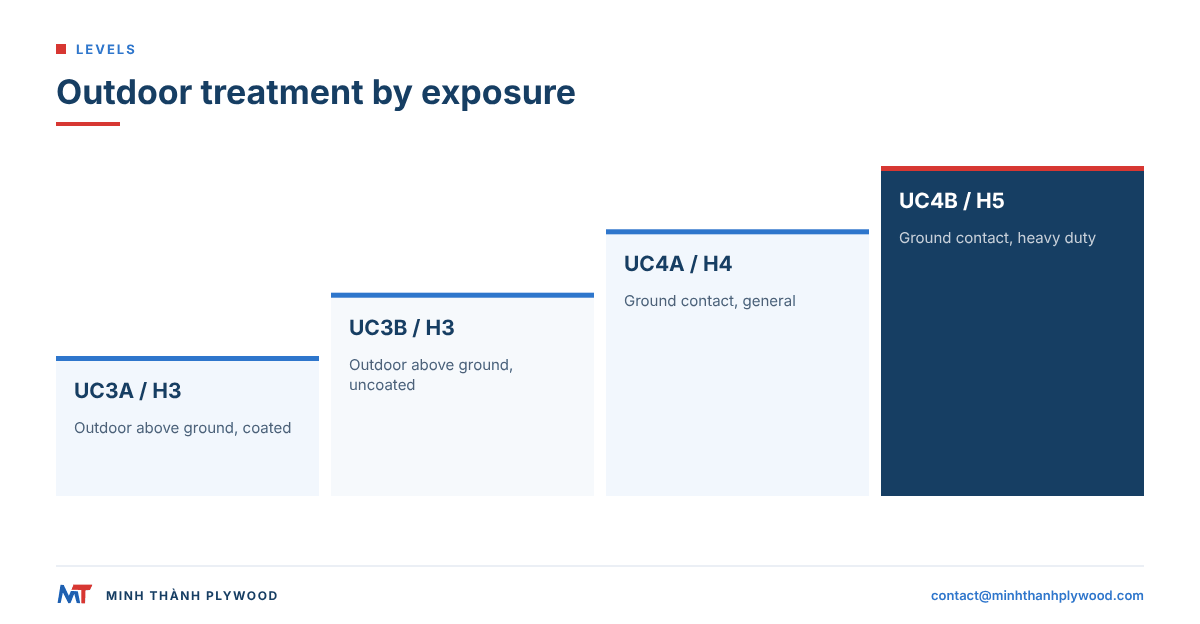
Pressure-treated plywood is the only plywood for ground contact: preservative is forced deep into the veneers under pressure, so the wood resists rot and insects where it stays damp. Choose the treatment level for the use: above ground or ground contact.
| Use | US treatment use category (AWPA) | Australian hazard class |
|---|---|---|
| Outdoor, above ground, coated | UC3A | H3 |
| Outdoor, above ground, uncoated | UC3B | H3 |
| Ground contact, general | UC4A | H4 |
| Ground contact, heavy duty | UC4B | H5 |
Three rules for treated plywood:
- Buy it treated to the class you need. Brushing preservative on site only protects the surface.
- Seal the cut ends with an end-cut preservative, because cutting exposes untreated wood in the core.
- Use fixings rated for treated wood, such as hot-dip galvanised or stainless steel; some preservatives corrode plain steel.
The pressure-treated plywood guide compares treatments and the marine vs treated choice.
Film-faced and overlaid plywood: weatherproof boards with a sealed face
Film-faced plywood is the most weatherproof board for faces that take water and wear: a phenolic film is pressed onto both faces over a core glued with melamine-fortified or phenolic (WBP) glue, and the face sheds water, concrete and dirt. Overlaid siding panels work on the same idea with a resin-paper face that takes paint.
| Panel | Face | Best outdoor uses |
|---|---|---|
| Film-faced, smooth | Phenolic film, dark brown or black | Concrete formwork, signs, hoardings |
| Anti-slip film-faced | Phenolic film with a wire-mesh pattern | Trailer floors, walkways, stage floors |
| Medium density overlay (MDO) | Resin-impregnated paper | Painted signs, siding |
| High density overlay (HDO) | Thicker resin overlay | Formwork, heavy-duty panels |
Minh Thanh makes film-faced plywood, and anti-slip plywood on order. Film covers the faces only: seal every cut edge with an edge sealer or paint, because that is where water gets into a film-faced panel. The film-faced plywood page lists thicknesses and films.
Glue is the first test: WBP, phenolic, melamine and the boil test
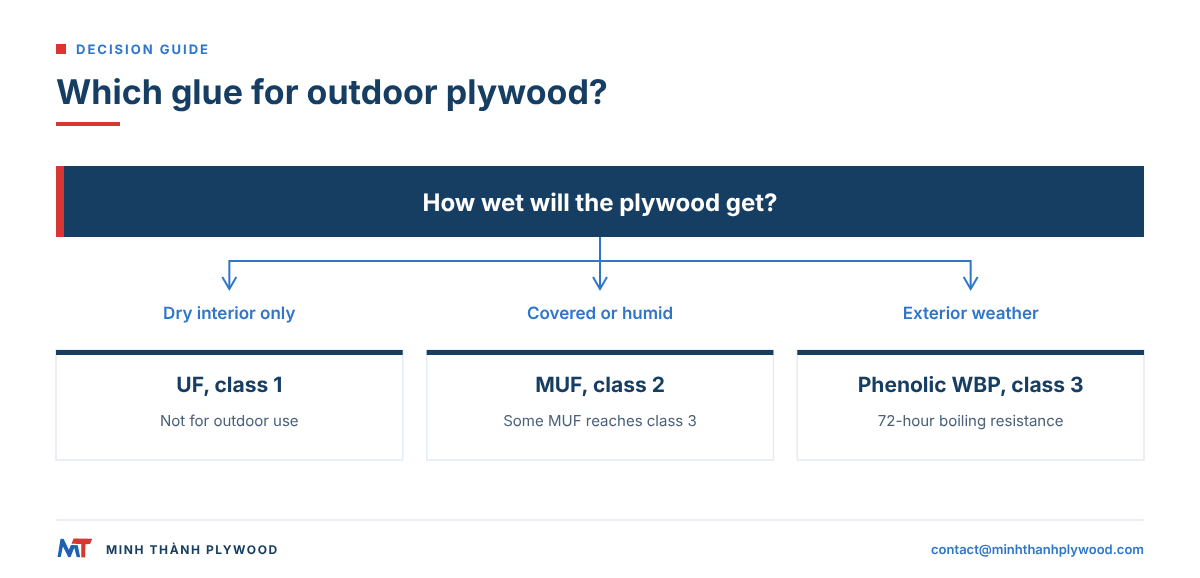
Glue is the first thing to check in outdoor plywood: phenolic (WBP) glue passes long boiling and is the standard for exterior and marine panels, melamine-fortified glue is water-resistant for humid and covered work, and UF glue is for dry interiors only. The boil test separates them.
| Glue | Water resistance | EN 314-2 bond class | Outdoor use |
|---|---|---|---|
| Phenolic (PF), WBP | Survives 72 hours of boiling | Class 3, exterior | Yes |
| Melamine-fortified (MUF) | Survives 6 hours of boiling | Class 2; some MUF reach class 3 | Covered, humid |
| Urea-formaldehyde (UF) | Cold water only | Class 1, dry | No |
A simple check on a sample: boil a small square for a few hours, let it dry, and try to split the plies with a chisel. A phenolic panel holds; a UF panel delaminates. The WBP bond specification guide covers the full test.
Minh Thanh’s furniture plywood uses UF glue at E0 emission and is made for indoor use. Melamine-fortified and phenolic (WBP) bonds are made to the customer’s specification for exterior panels, so order the bond, not just the word “exterior”.
Can you use plywood outdoors? Interior plywood, OSB and plywood for outside
You can use plywood outdoors only if it is an exterior, marine, treated or film-faced type with a waterproof glue; interior plywood with UF glue delaminates once it gets wet, whatever paint is on it. Plywood for outside starts with the bond on the specification.
- Interior plywood outside. The glue softens in water, the plies separate and the face blisters, often within one wet season.
- OSB outside. Oriented strand board with an exterior resin is fine for covered sheathing, but its edges swell when wet and do not go back. Plywood takes up and gives off water with less swelling.
- Plywood outside under cover. Exterior or Exposure 1 panels can stand some weather during building, then must be covered by roofing or cladding.
Is plywood waterproof? No plywood is waterproof at its edges until they are sealed; the glue can be waterproof, the wood is not. The waterproof plywood guide explains the difference between water-resistant and waterproof.
How to waterproof plywood for outdoor use in seven steps
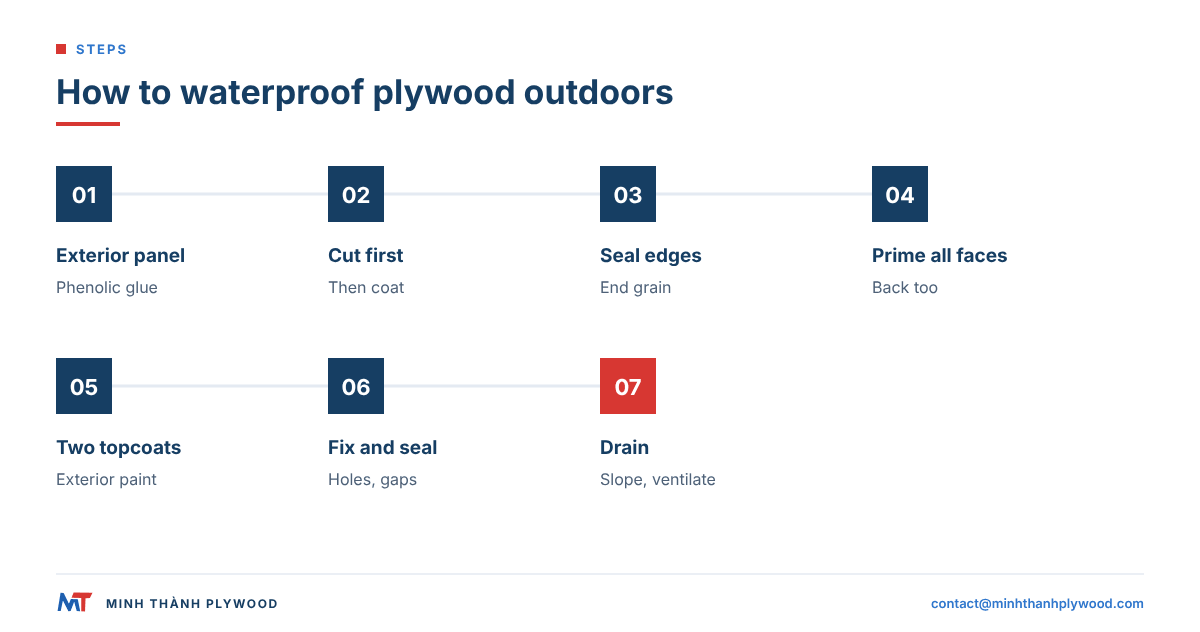
To waterproof plywood for outdoor use, start with an exterior panel, seal every edge and hole, prime all faces including the back, apply two coats of exterior paint or a marine sealer, and fix it so water drains off and air reaches the back. Each step closes one way in for water.
- Choose an exterior panel with phenolic (WBP) glue, at the moisture it will have in service.
- Cut and drill everything first, so no fresh edges or holes appear after coating.
- Seal the edges with an edge sealer, thinned epoxy or two extra coats of primer; end grain takes up the most water.
- Prime both faces and all edges with an exterior primer, including the face that will be hidden.
- Apply two coats of exterior acrylic paint, or a marine varnish or epoxy for wet areas.
- Fix with corrosion-resistant fixings and seal the holes; leave expansion gaps at joints.
- Detail for drainage: slope horizontal panels, keep bottom edges off the ground and leave a ventilated gap behind cladding.
Recoat when the paint chalks, cracks or shows bare wood at edges. Seal any new cut or hole the same day. The plywood finishing guide compares paints, oils and varnishes.
How long does plywood last outdoors?
Plywood outdoors lasts 20 years or more when it is the right type for its exposure and protected, and one wet season when it is not. Glue, moisture and coating decide which.
| Panel and position | Typical life | Condition |
|---|---|---|
| CDX, covered by roofing or cladding and protected | 20+ years | Edges sealed, kept dry in service |
| Exterior plywood, painted and drained | 20+ years above ground | Recoat when the paint chalks |
| Pressure-treated, above ground | 20+ years | UC3A or UC3B; cut ends sealed |
| Pressure-treated, ground contact | Shorter unless rated | UC4A or UC4B treatment needed |
| Marine plywood, coated | Longest of the four types | Kept coated; wet-area use |
| Film-faced, edges sealed | Many seasons of water and concrete contact | Faces protected by the film; edges resealed |
| Interior plywood (UF glue) outside | Within one season | Glue softens, plies separate |
The 20-year figures are the ones US plywood sellers publish for covered and treated panels; ground contact and bare weather cut them.
What moves a panel up or down that table:
| Factor | Shortens life | Lengthens life |
|---|---|---|
| Glue | UF or unknown bond | Phenolic (WBP) |
| Edges | Bare, cut on site after coating | Sealed before fixing |
| Coating | None, or clear interior varnish | Primer and two coats of exterior paint |
| Position | Flat, holding water; in soil | Sloped, drained, off the ground |
| Back face | Unpainted, against wet masonry | Primed, ventilated gap |
| Maintenance | Never recoated | Recoated when the paint wears |
| Treatment | None in ground contact | Pressure-treated to the class |
Uncoated panels age in two ways. Sunlight greys and roughens the face, and repeated wetting and drying opens fine checks in the face veneer. Both let more water in each season, which is why a coating applied early lasts longer than one applied after the face has weathered.
Best plywood for outdoor projects: verdict by use
Each outdoor project has one best panel; the table gives the verdict by use, from roof decks to outdoor furniture. Most need exterior plywood with phenolic glue; a few need marine, treated or film-faced.
| Project | Best panel | Why |
|---|---|---|
| Roof deck and wall sheathing | Exterior, CDX-type | Covered quickly; low cost |
| Garden shed walls | Exterior BCX or CDX, painted | Painted face, phenolic glue |
| Shed floor near the ground | Pressure-treated | Damp from below |
| Outdoor signs | Film-faced, MDO or BCX painted | Smooth face for print or paint |
| Planters and raised beds | Pressure-treated, lined | Constant soil contact |
| Outdoor furniture | Marine or high-face exterior, coated | Visible, wet and dry cycles |
| Deck or balcony surface | Treated plywood under decking; anti-slip film-faced for walkways | Water and foot traffic |
| Trailer floors and ramps | Anti-slip film-faced | Grip and wear |
| Boat and dock panels | Marine | Stays wet |
| Concrete formwork | Film-faced | Release face, many pours with care |
For roof decks, the plywood roof sheathing guide covers thickness by rafter spacing and edge support.
Outdoor plywood thickness by use
Outdoor plywood thickness follows the span between supports and the load, not the weather: thin panels for cladding and signs fixed at close centres, 12 to 18 mm for walls, roofs and furniture, and 18 mm or more for floors, steps and trailer decks. A thicker panel does not make up for a weak glue.
| Use | Typical thickness (metric) | US nominal | What decides it |
|---|---|---|---|
| Signs and hoardings | 9 to 12 mm | 3/8 in to 1/2 in | Panel size, wind, fixing centres |
| Cladding and soffits | 9 to 12 mm | 11/32 in to 15/32 in | Batten spacing behind |
| Wall sheathing | 9 to 12 mm | 7/16 in to 1/2 in | Stud spacing and bracing table |
| Roof deck | 12 to 18 mm | 5/8 in (19/32 in actual) | Rafter spacing and roof load |
| Shed floor | 18 mm | 23/32 in to 3/4 in | Joist spacing and foot traffic |
| Outdoor furniture | 12 to 18 mm | 1/2 in sides, 3/4 in heavy duty | Span of seats and shelves |
| Deck surface and structural floors | 18 to 19 mm | 3/4 in | Joist spacing and load |
| Stair treads | 18 to 25 mm | 3/4 in to 1 in | Tread width between stringers |
| Trailer floors and ramps | 18 to 30 mm | 3/4 in to 1-1/8 in | Wheel load and cross-member spacing |
US sheets are sold by nominal thickness. The 4 x 8 ft exterior and ground-contact panels in the big-box ranges run 11/32 in BCX, 23/32 in CCX ground-contact pine and 3/4 in B/C project panels, so match the nominal size to the metric line when you compare quotes.
Minh Thanh makes panels from 3 to 40 mm. Thicker exterior panels have more plies, which spreads the load and holds screws better near the edges; for stair treads and trailer floors, order the thickness for the span and the anti-slip face where grip matters.
Edges and fixings decide the life of thin outdoor panels more than of thick ones. A 9 mm sign panel has little end grain, but every screw is close to an edge; pre-drill, seal the holes and keep fixings about 10 mm in from the edge or more.
Plywood for outside in tropical, wet and cold climates
Climate changes the details, not the panel type: in tropical climates such as Singapore and Laos, the risks are constant humidity, heavy rain and termites; in wet temperate climates such as Ireland and Malta, it is year-round wetting; in Australia and New Zealand, the hazard class system sets the treatment.
- Tropical and humid (South-East Asia). Phenolic (WBP) bond, all edges sealed, coated on both faces, kept off the ground and ventilated behind. In termite areas use treated panels to the local class. Plan for mould on the back face of panels that cannot dry; the guide to mold in plywood covers prevention.
- Wet temperate (Ireland, the UK, Malta’s winter). EN 636-3 exterior plywood for anything in the weather, a full paint system and drained details; the panel stays damp for long periods rather than getting short soakings.
- Australia. Plywood treated to H3 above ground and H4 or H5 in ground contact, with structural plywood to the local standard for bracing and floors.
- New Zealand. Treated plywood for exterior cladding and bracing, specified to the local treatment and building codes.
- Cold climates. Freeze and thaw cycles open checks faster, so the coating and edge sealing matter more than in warm, dry places.
Minh Thanh dries veneers and panels to 8–12 % moisture content before dispatch, and the panels are packed and wrapped for the sea voyage. Unwrap and stack them under cover on arrival, so they reach the site’s own moisture before fixing.
How to check outdoor plywood on arrival
Check outdoor plywood on arrival for five things: the glue type on the order and the label, closed edges with no large core gaps, the face grade, the thickness and a boil test on a sample. Most outdoor failures can be seen on the first sheet.
- Glue. Match the bond on the packing list and label to the order: phenolic (WBP) for exterior.
- Edges. Look along all four edges for core gaps and overlaps; gaps hold water.
- Faces. C/D faces on CDX-type, the ordered grade on better faces, an even film on film-faced.
- Thickness. Caliper each sheet at the four corners and the centre; commercial and film-faced panels at Minh Thanh are held to ±0.5 mm, length and width to ±2 mm.
- Boil test. Boil a small sample, dry it and split it with a chisel. The plies of an exterior bond hold.
Every Minh Thanh shipment is photographed and filmed before loading, and the buyer gets the photos and video. Third-party testing to the buyer’s method is arranged through SGS on request.
What this means for your order
Order outdoor plywood by its exposure: the glue first, then faces, thickness and size, and say how the panel will be protected. An exterior line for sheathing and sheds reads:
12 mm exterior plywood, CDX-type, C/D faces to sample, phenolic (WBP) glue, 1220 × 2440 mm, length and width ±2 mm, for wall sheathing and painted shed walls; 1×40HC.
For faces that take water and wear, change the line to film-faced plywood with a phenolic film, or anti-slip on order. Minh Thanh’s minimum order is one 40HC, with production 15–45 days after the 30% deposit, FOB Hai Phong, CFR or CIF, and free samples. Send the exposure, the use and the size, and we quote exterior plywood to suit. More outdoor and building guides are in plywood applications.
Buyer questions, answered
What is the best plywood for outdoor use?
Exterior plywood with a phenolic (WBP) glue for most outdoor jobs, marine plywood for panels that stay wet, pressure-treated plywood for ground contact, and film-faced plywood where the face must shed water and resist wear.
Can you use plywood outdoors?
Yes, if it is an exterior or marine type with a waterproof glue, and the faces and edges are sealed. Interior plywood with UF glue delaminates outdoors once it gets wet.
What is the best waterproof plywood for outdoor use?
Marine plywood or film-faced plywood. Marine plywood uses a phenolic glue; film-faced uses a melamine-fortified or phenolic (WBP) glue by order, with a phenolic film on both faces. Marine adds void-free durable veneers. No plywood is waterproof at the edges until they are sealed.
How do you waterproof plywood for outdoor use?
Start with an exterior panel, seal every edge and hole, prime all faces including the back, apply two coats of exterior paint or a marine sealer, and fix the panel so water runs off and air reaches the back.
How do you treat plywood for outdoor use?
For ground contact, buy pressure-treated plywood rated for it; site-applied preservative only protects the surface. For above-ground use, a primer, exterior paint and sealed edges are the treatment.
Is CDX plywood good for outdoor use?
For sheathing and covered work, yes: CDX has an exterior glue and C and D faces. Left bare in the weather, its open face checks and the D back lets water in, so cover it or coat it.
Is marine plywood better than exterior plywood for outdoors?
Only where the panel stays wet, as in boats, docks and wet areas. For most outdoor building work, a coated exterior plywood with a phenolic glue does the job at a lower cost.
Is OSB or plywood better outdoors?
Plywood. OSB swells at the edges when it gets wet and does not recover; plywood with an exterior glue takes up and gives off water with less swelling.
What plywood is best for outdoor furniture?
Marine plywood or a high-face exterior plywood with phenolic glue, coated with exterior paint or a marine varnish, with every edge sealed and the feet kept off wet ground.
What is the best plywood for an outdoor shed?
Exterior plywood with phenolic glue for the walls and roof deck, pressure-treated plywood or treated timber for the floor near the ground, and paint or cladding over the walls.
What plywood is best for outdoor use in a tropical climate?
Exterior plywood with a phenolic (WBP) bond, sealed on all edges and coated, kept off the ground and ventilated. In termite areas, use treated panels to the local hazard class.
How long does plywood last outdoors?
Covered and protected CDX lasts 20+ years, pressure-treated plywood above ground 20+ years, and treated panels in ground contact need a UC4A or UC4B rating to match. Bare interior plywood can fail in one wet season.