
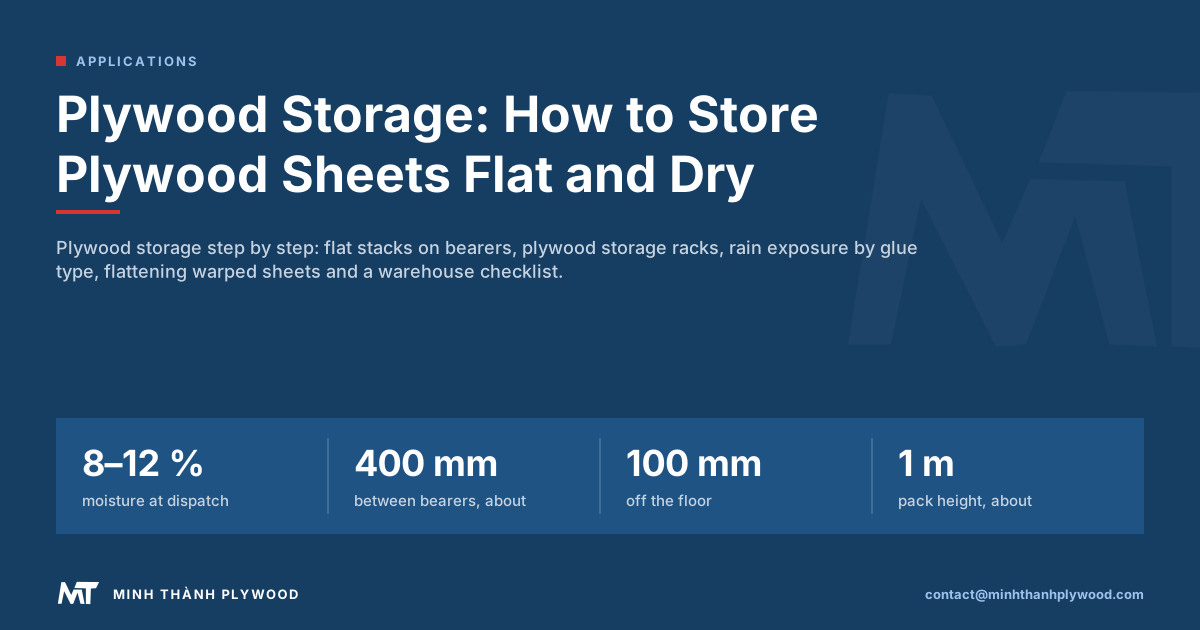
Good plywood storage keeps sheets flat, dry and evenly supported: stack them horizontally on level bearers off the floor, under a roof, covered but ventilated, with the pack wrapping kept on until use. Upright racks suit short-term stock. Minh Thanh Plywood dispatches furniture panels dried to 8–12 % moisture content, so the warehouse only has to keep them there.
Looking for plywood storage furniture or shelving units?
In the UK “plywood storage” often means made-to-order plywood storage units and shelving. Storage units in the plywood category at Stornish are listed at £110–£195 each, and Made in Ply builds modular cell units with doors up to 2400 mm wide. Those are finished products; the rest of this page covers how to keep the sheets themselves flat and dry before they are cut.
Furniture makers who build units like these buy the sheet, not the box. Minh Thanh Plywood supplies 18 mm furniture plywood in 1220 × 2440 mm sheets, with poplar or birch-type faces, UF glue at E0 emission and 8–12 % moisture content at dispatch. The same storage rules below apply to that stock in a workshop. For cabinet and shelving panels see furniture plywood from Minh Thanh.
What does good plywood storage protect?
Good plywood storage protects four things the buyer already paid for: flatness, moisture content, the face and the edges. A sheet that bows, swells, scuffs or gets a crushed corner loses yield at the saw even when most of it is sound.
The panel arrives in the right state. Minh Thanh dries veneers and finished panels to 8–12 % moisture content at dispatch, presses furniture panels twice so the core board is flat before the faces go on, and packs them on a pallet base with cardboard, steel or plastic strapping and wrapping film. Storage has one job: keep the panel in that state until it is cut.
Most storage damage comes from three causes:
- Uneven support: bearers that are too few, not level or not lined up through the stack.
- Moisture on one side: a wet floor, a leaking roof, rain under a cover, sun on one face.
- Handling: forks driven into the bottom sheet, sheets dragged across each other, corners dropped.
How do you store plywood sheets? Step by step
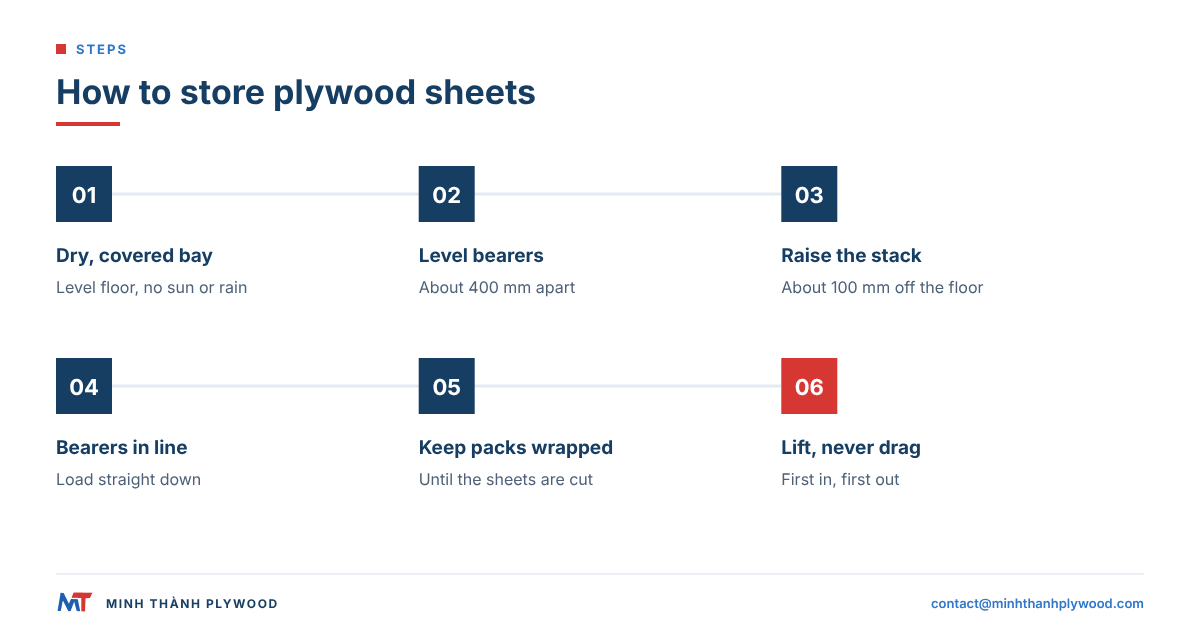
Store plywood sheets flat, raised, covered and supported along their full length: in a dry bay, on level bearers about 400 mm apart, about 100 mm clear of the floor, with the pack wrapping left on and open stacks under a ventilated cover. These steps work for a builders’ merchant, a furniture plant and a site container alike.
- Pick a dry, covered space with a level floor, out of direct sun and away from doors that let in rain.
- Lay level bearers across the floor, about 400 mm apart for full sheets, so no sheet overhangs a bearer by much.
- Raise the stack at least about 100 mm clear of the floor so air moves underneath and splashes cannot reach it.
- Keep packs whole: leave the wrapping, cardboard and straps on until the sheets are needed.
- Stack packs with bearers in line, each bearer sitting directly above the one below, so the load goes straight down.
- Put the heaviest, largest sheets at the bottom and never place small sheets under large ones.
- Cover open stacks with a waterproof sheet that leaves the sides open for air.
- Lift sheets, never drag them, so the faces do not scratch and films do not tear.
- Rotate stock: first in, first out, with the arrival date written on each pack.
- Check monthly for wet floors, sagging bearers and condensation under covers.
The distance between bearers matters most for thin panels. A 3–6 mm sheet sags between bearers that suit an 18 mm sheet, so thin plywood is stored on a solid board or on bearers set much closer together.
How far apart should bearers be under a plywood stack?
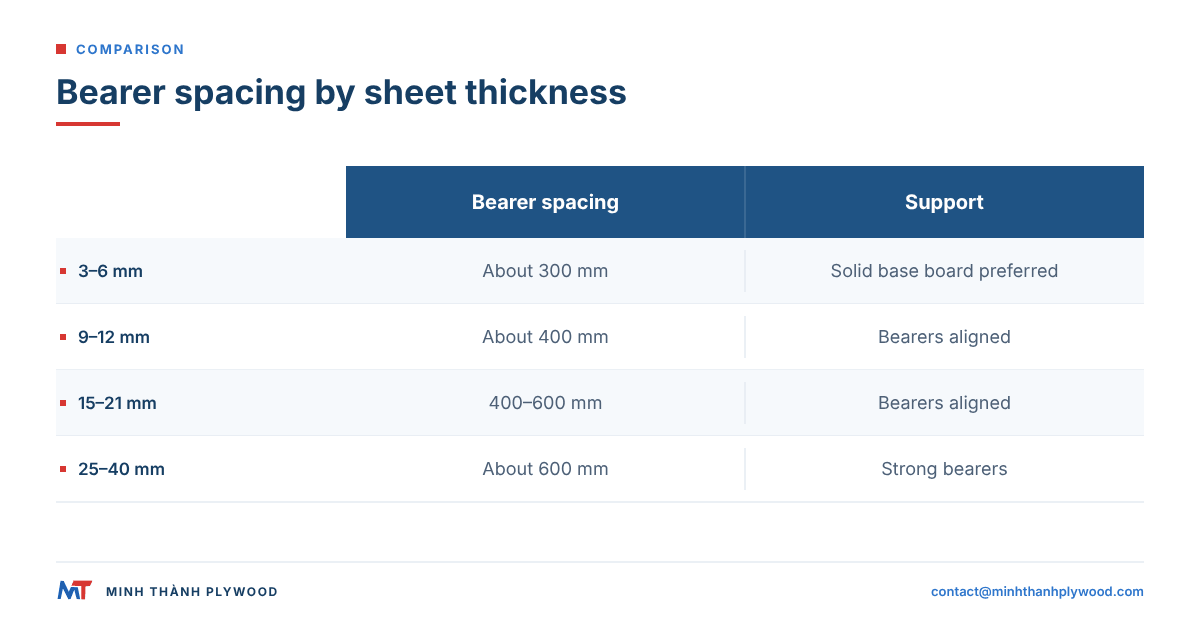
Set bearers about 400 mm apart under full 1220 × 2440 mm sheets, so each sheet rests on six or seven bearers along its length. Closer spacing, or a flat board on top of the bearers, is needed for thin sheets.
| Sheet | Bearer spacing | Support |
|---|---|---|
| 3–6 mm thin plywood | About 300 mm, or a solid base board | Flat board over bearers is best |
| 9–12 mm | About 400 mm | Bearers in line through the stack |
| 15–21 mm | 400–600 mm | Bearers in line through the stack |
| 25–40 mm | About 600 mm | Strong bearers; heavy packs |
| Pack on its own pallet base | Pallet base sits on bearers | Line the pallet runners up |
Bearers must be the same height, straight and dry. A bearer that is a few millimetres taller than the others creates a hump that the whole stack takes on over a few weeks. Use squared timber or plastic bearers, keep them clean of grit, and check them with a straightedge when a new bay is set up.
Stacking height is a safety limit as much as a quality one. An 18 mm pack of 1220 × 2440 mm sheets about one metre high on a Styrax core weighs over a tonne, so stack packs only as high as the floor, the bearers and the forklift allow.
Which plywood storage racks work?
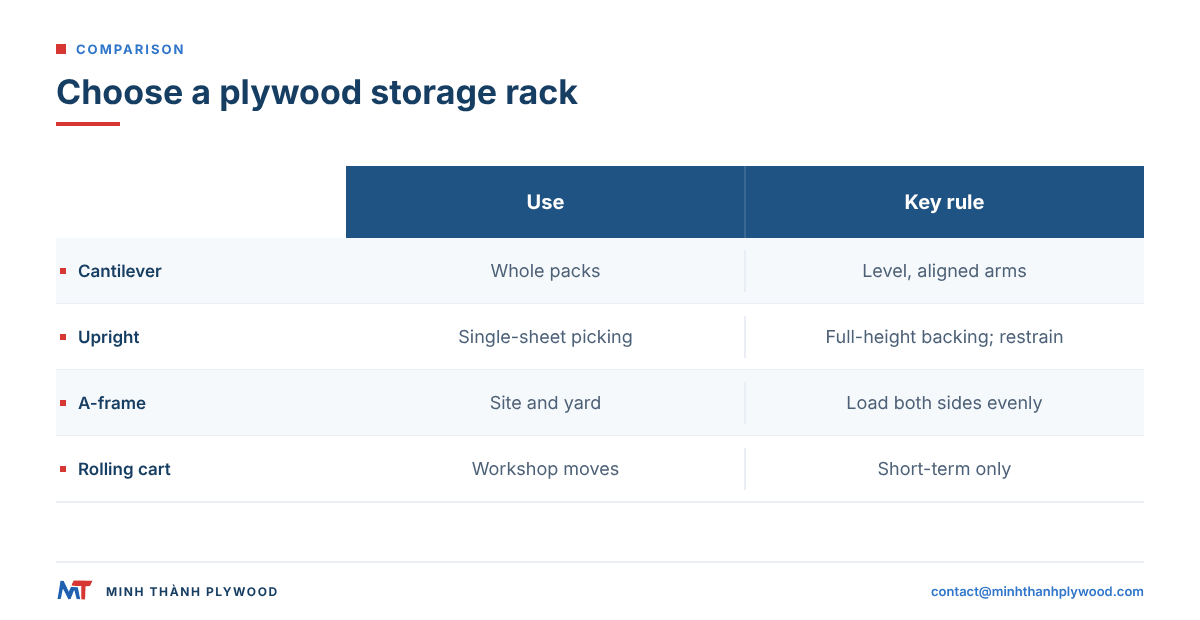
Horizontal cantilever racks and upright racks with full-height backing both work as plywood storage racks; the rule is that every sheet stays fully supported. Cantilever arms suit whole packs, upright racks suit single-sheet picking.
| Rack | Best for | Rules |
|---|---|---|
| Horizontal cantilever rack | Whole packs, merchants, plants | Arms level, in line, close enough for the sheet |
| Upright (vertical) rack | Picking single sheets, workshops | Full-height back, sheets at a slight lean, dividers |
| A-frame rack | Site and yard stock | Both sides loaded evenly, covered |
| Rolling sheet cart | Moving sheets inside a workshop | Short-term only |
| Wall leaning | Nothing long-term | Sheets bow and can fall |
Rules for upright plywood storage:
- Lean the sheets slightly against a full-height backboard so they rest flat across the whole face, not on two points.
- Stand them on a clean board, never on bare concrete.
- Divide the rack into bays so a stack cannot slide sideways.
- Restrain the front with a bar or chain so the sheets cannot topple.
- Keep it short-term: sheets stored upright for months take a curve.
How does plywood storage differ from storage for lumber?
Plywood needs full, even support across the face, while storage for lumber only has to support boards along their length at intervals. Lumber is stickered so air moves between boards to dry them; plywood arrives dry and is kept in tight, wrapped packs.
| Point | Plywood | Solid lumber |
|---|---|---|
| Support | Whole face on close, level bearers | Stickers at intervals along the length |
| Air between pieces | Not needed; packs stay tight | Needed for drying (sticker stacks) |
| Moisture at arrival | Already dried, often 8–12 % | Air-dried or kiln-dried, varies |
| Movement risk | Bows if supported unevenly | Twists and cups if dried unevenly |
| Face protection | Thin face veneer or film, easy to scratch | Planed before use |
Mixed timber yards often store both in one rack. Keep plywood on its own level arms or bearers; lumber stickers placed under a plywood pack create pressure points and bows.
How long can plywood be exposed to rain?
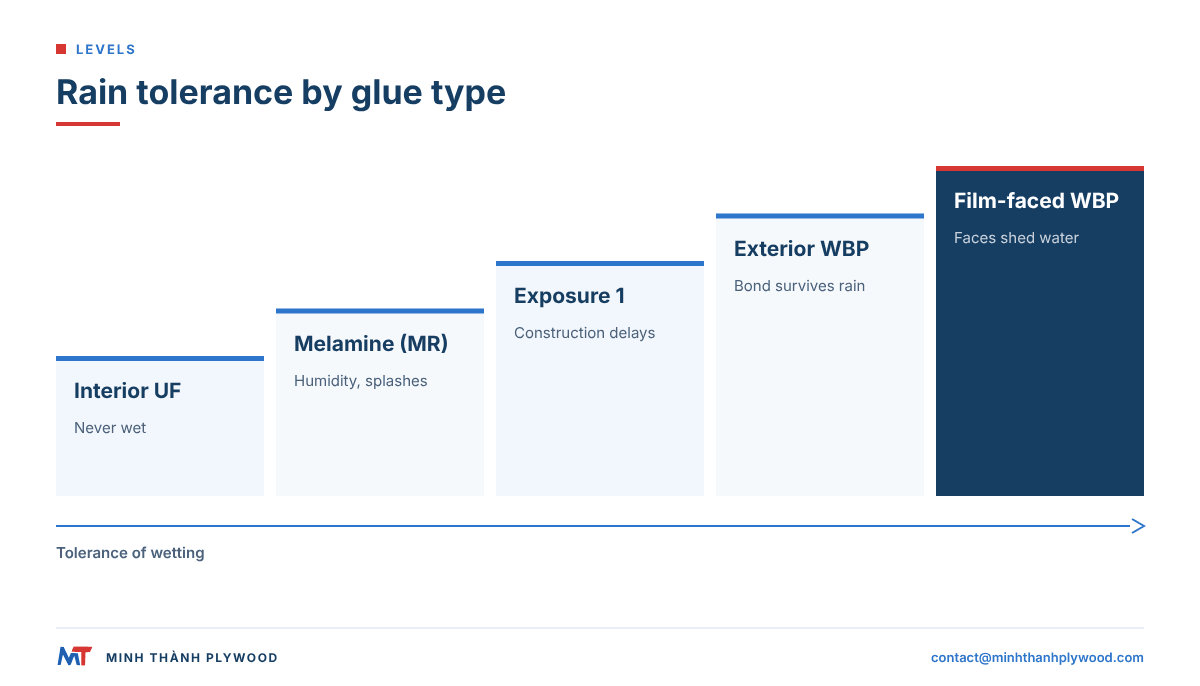
How long plywood can be exposed to rain depends on its glue: exterior plywood with phenolic WBP glue keeps its bond through repeated wetting, Exposure 1 sheathing tolerates normal construction delays, and interior UF-glued plywood should not be rained on at all. Every type swells at open edges when wet.
| Glue and type | What rain does | Storage rule |
|---|---|---|
| Interior, UF glue (furniture plywood) | Glue lines weaken, faces stain and swell | Never outdoors, never wet |
| Melamine-fortified (MR) | Resists humidity and splashes, not soaking | Indoors or fully covered |
| Exposure 1 sheathing (US) | Bond tolerates wetting during construction delays | Cover on site, dry before closing in |
| Exterior, phenolic WBP | Bond survives rain and boil tests | Cover anyway: edges and faces still take water |
| Film-faced, phenolic film | Film sheds water from the faces | Keep edges dry, store flat and covered |
APA, the US engineered wood association, publishes storage and handling guidance for structural panels that follows the same rule: keep panels off the ground, covered and ventilated, even when the bond is rated for exposure.
The European plywood standard BS EN 636:2012+A1:2015 covers plywood for use in dry, humid or exterior conditions, so check which class a sheet belongs to before deciding where it can wait out the weather.
A sheet that does get wet should be dried flat, with both faces open to the air, before it is stacked again. Drying one face only, for example by leaving a wet sheet face down on concrete, is how a sound sheet becomes a warped one.
How do you receive plywood from a container?
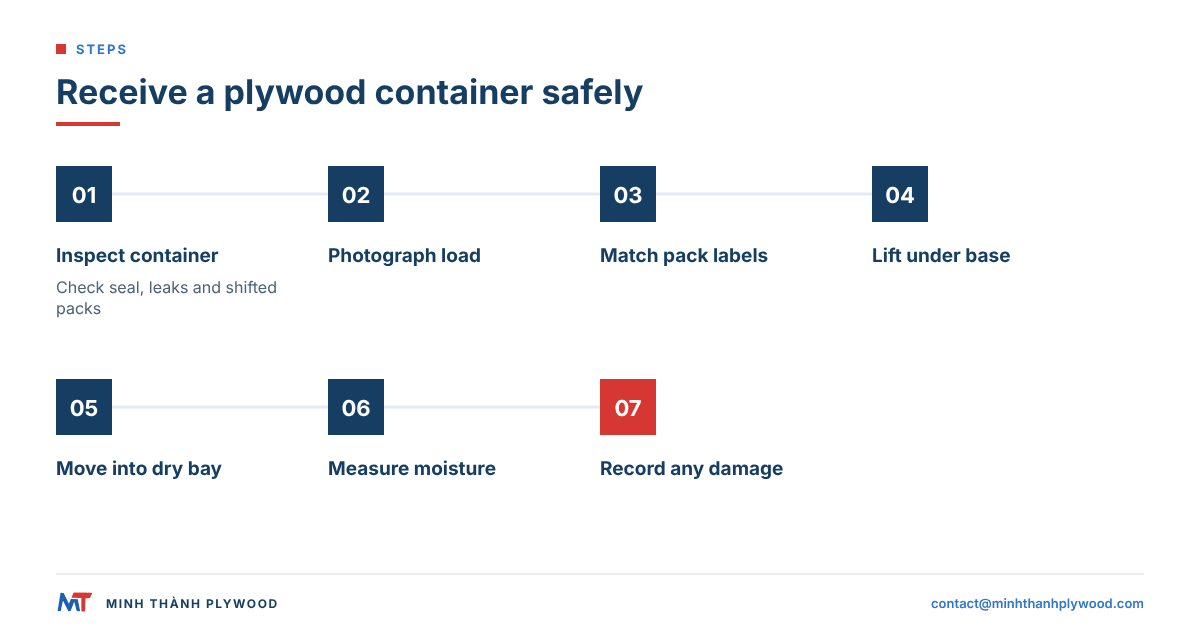
Receive plywood by inspecting the container before unloading, photographing any damage, lifting packs with forks under the bearers or pallet base, and moving them straight into dry storage. The first hour after the doors open decides most claims.
- Check the container and seal number, and look for wet patches, roof drips and shifted packs before anyone enters.
- Photograph the load as it stands, then each damaged pack.
- Compare pack labels with the packing list: thickness, size, face, core and sheet count.
- Lift with forks under the base, spread wide, never into the bottom sheets.
- Store immediately on prepared bearers; do not leave packs on the dock in the rain.
- Measure moisture on a few sheets per pack with a moisture meter and record the readings.
- Report damage with the photos, pack numbers and readings.
Pallet bases and bearers made of solid wood count as wood packaging, which the UK government guidance on wood packaging material separates from processed wood like plywood, so look for the ISPM 15 mark on them when the container is opened.
Minh Thanh photographs and films every shipment before loading and sends the photos and video to the buyer, so the arrival photos can be compared with the state of the packs at the factory.
How do you prevent condensation and mould in stored plywood?
Prevent condensation by keeping stored plywood at a steady temperature, ventilating covered stacks and never trapping cold, humid air under plastic. Mould needs moisture on the surface; dry, evenly ventilated packs do not grow it.
- Ventilate covers: a sheet over the top and open sides, not a sealed wrap around a stack outdoors.
- Avoid cold floors and walls: keep stacks off outside walls and off bare concrete.
- Open container packs indoors: a pack that arrives cold after a sea voyage gathers condensation if it is opened in warm, humid air at once; let it come to room temperature first with the wrapping only opened at the ends.
- Keep wet sheets apart: separate any sheet that arrived wet so it cannot share its moisture with a dry pack.
- Check humidity: in a warehouse that runs very humid, a dehumidifier protects furniture plywood stock.
The US Forest Products Laboratory’s Wood Handbook (FPL-GTR-190, 2010) explains how wood takes up and gives off moisture with the humidity of the surrounding air, which is why a pack held in a steady climate keeps the moisture content it left the mill with.
How do you flatten warped plywood?
Flatten warped plywood by evening out the moisture between its two faces: lightly moisten the concave face, lay that face down on a flat surface, put flat sheets or weight on top and leave it over several days. Most bows caused by storage come out this way.
- Find the cause: a sheet that cupped in storage (moisture on one side) can be flattened; a sheet that warps because its construction is unbalanced will not stay flat.
- Moisten the concave face with a damp cloth or a light mist, never soaking it.
- Lay it concave face down on a flat floor or a flat stack.
- Weight it with flat sheets or boards spread across the whole face.
- Wait and check with a straightedge every day until it lies flat.
- Store it correctly afterwards, flat on level bearers, so the bow does not return.
A balanced panel, with the same face and back construction and an odd number of plies, resists warping in the first place. Furniture panels pressed twice on a calibrated core board arrive flat; storage only has to keep them that way.
How should thin plywood and faced panels be stored?
Thin plywood and decorative or film-faced panels need closer support and more face protection than standard sheets. Thin sheets sag easily, and polished, UV-ready or film faces scratch at the first drag.
- Thin 3–6 mm plywood: store on a flat base board over bearers, never across widely spaced bearers, and handle with two people or a sheet carrier so the sheet does not fold.
- Sanded and UV-ready faces: keep the cardboard top and bottom sheets in place, lift sheets off the stack instead of sliding them, and keep hands clean.
- Film-faced and anti-slip plywood: store textured faces against smooth backs as packed, protect the film from forks, and keep cut edges dry.
- Exterior and marine panels: the same flat, covered storage; their waterproof bond does not protect edges or faces from swelling and staining.
Distributor warehouse checklist for plywood storage
A distributor’s plywood storage checklist covers the floor, the bearers, the climate, handling and records. Use it when setting up a bay and at each monthly check.
| Area | Check |
|---|---|
| Floor | Level, dry, no standing water near doors |
| Bearers | Same height, straight, dry, in line through every stack |
| Spacing | About 400 mm for full sheets; flat base for thin sheets |
| Clearance | Stack about 100 mm or more off the floor, away from outside walls |
| Covers | Waterproof top, open sides, no sealed plastic outdoors |
| Climate | No roof leaks, no direct sun on stacks, humidity watched |
| Handling | Forks under the base, sheets lifted not dragged |
| Stock rotation | Arrival date on each pack, first in first out |
| Moisture | Meter readings on arrival and at each check |
| Records | Photos and readings for any damaged or wet pack |
What does storage mean for your plywood order?
Storage starts at the mill: a dry, flat, well-packed panel is easier to keep straight than one that arrives already wet or bowed. Write the moisture content, flatness and packing on the order so the panel arrives ready for your warehouse.
What Minh Thanh Plywood ships:
- Moisture content: veneers and finished panels dried to 8–12 % at dispatch.
- Flatness: furniture panels pressed twice as standard, on a calibrated core board.
- Packing: packs on a pallet base with cardboard covers, strapping and wrapping film; the packaging materials passed an SGS test under the EU Packaging and Packaging Waste Regulation in September 2026.
- Pack size: packs about one metre high, sheet count set by thickness and container payload, as the packing calculator shows for each thickness.
- Proof at loading: photos and video of every shipment before the container is closed.
A warehouse order line might read: “Furniture plywood, 18 mm, 1220 × 2440 mm, moisture 8–12 % at dispatch, packed on pallet base with cardboard top and bottom, wrapped, 55 sheets per pack.” Send it with your port and quantity, and Minh Thanh quotes with free samples.
Buyer questions, answered
Should plywood be stored flat or upright?
Flat is best for long-term plywood storage: a horizontal stack on level bearers keeps every sheet supported and straight. Upright storage in a rack with full-height backing suits short-term stock and quick picking, but loose sheets leaning on a wall bow and topple.
How long can plywood be exposed to rain?
It depends on the glue. Exterior plywood with phenolic WBP glue keeps its bond through rain, though faces and edges still need sealing; Exposure 1 sheathing tolerates normal construction delays; interior UF-glued plywood should not be rained on at all. Dry any wet sheet flat and evenly.
Can plywood be stored outside?
Only for short periods and only covered: raise the stack on bearers, cover it with a waterproof sheet that leaves the sides open for air, and keep water from running under it. Interior and furniture plywood belongs indoors.
Can plywood be stored on a concrete floor?
Not directly. Concrete holds moisture, so raise the stack on dry bearers or pallets at least about 100 mm clear of the floor, with the bearers lined up vertically through every pack.
How do you flatten warped plywood?
Lightly moisten the concave face, lay the sheet concave face down on a flat surface, put flat sheets and weight on top and leave it to even out over several days. A sheet bowed by unbalanced construction will not stay flat and should be rejected.
Why does stored plywood warp?
Because one face gains or loses moisture faster than the other, or because the sheet is unevenly supported. Uneven bearers, sun on one face, a wet floor and half-open wrapping are the usual causes.
How long should plywood acclimatise before use?
Until the moisture content of sample sheets matches the workshop's level, checked with a moisture meter. Keep the packs in the workshop climate with the wrapping opened at the ends, and measure rather than wait a fixed time.
What moisture content should stored plywood have?
Furniture plywood usually leaves the mill at 8–12 % moisture content, the normal range for indoor furniture. Storage should keep it close to the moisture level of the room where it will be machined and used.
What thickness plywood for attic floor storage?
18 mm tongue-and-groove plywood on joists about 400 mm apart gives a firm attic storage floor. Use thicker sheet or add noggins where joists are wider apart or heavy boxes sit in one place.
How do you store anti-slip plywood?
Like any film-faced plywood: flat on bearers, textured faces protected from dragging, edges kept dry, packs wrapped until use. The film resists water, but cut or damaged edges still let moisture into the core.