
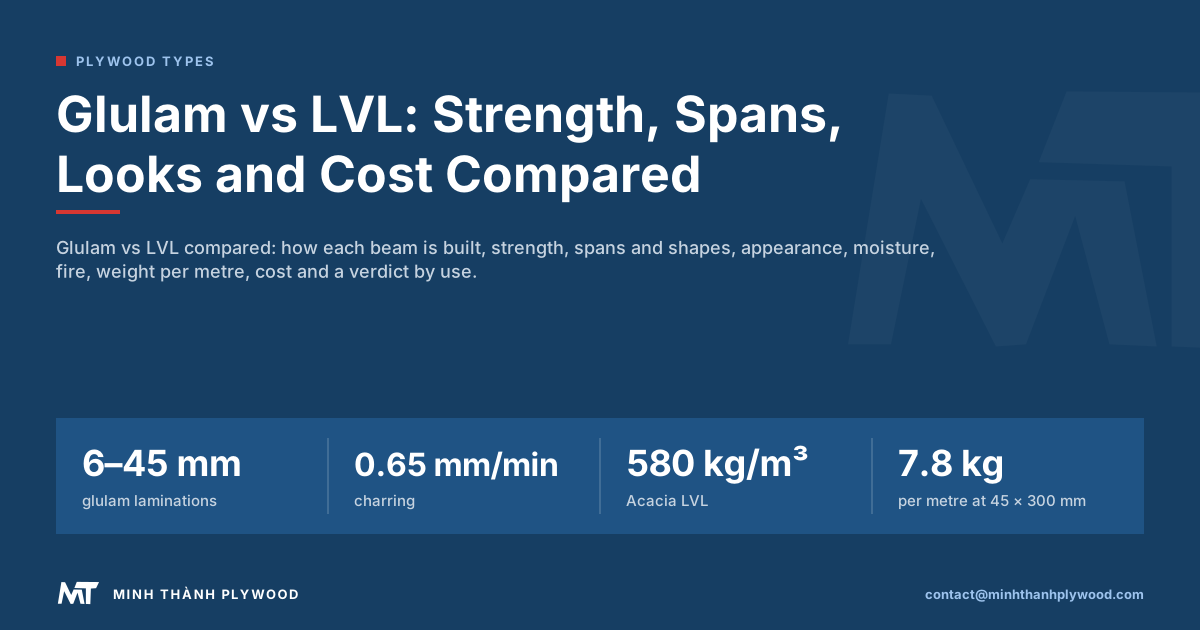
Glulam vs LVL comes down to what the beam is made of. Glulam is glued from sawn boards and can be made very large, curved and good-looking; LVL is glued from thin veneers and is stronger and more uniform for its size, which makes it the standard hidden header and beam. This guide compares them row by row and gives a verdict by job. Minh Thanh Plywood makes LVL and plywood from plantation veneers in Vietnam.
Laminated veneer lumber vs glulam: the short answer
In glulam vs LVL, choose LVL for strong, compact, hidden beams and headers in timber framing, and glulam for large, long, curved or exposed beams where appearance and size matter. Both are engineered wood beams; they differ in what they are glued from.
- LVL (laminated veneer lumber): thin veneers, a few millimetres each, glued with the grain running along the member. Uniform, strong for its size, made straight.
- Glulam (glued laminated timber): sawn boards, called laminations, glued face to face. Can be very large, curved and made in appearance grades.
The difference between LVL and glulam is the size of the wood pieces inside. Thin veneers spread defects out; thick laminations keep the look of solid timber.
LVL beam vs glulam: side-by-side comparison
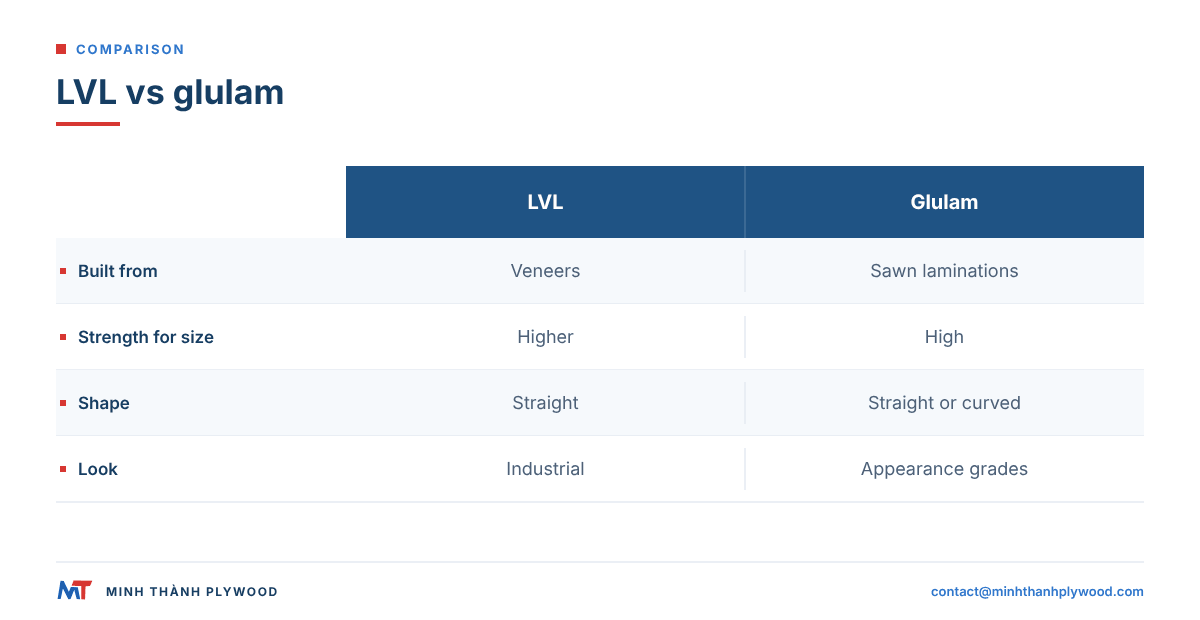
The table compares an LVL beam and a glulam beam on one property per row. Ratings are relative between the two products.
| Property | LVL | Glulam |
|---|---|---|
| Built from | Veneers, grain along the member | Sawn laminations, grain along the member |
| Layer thickness | A few millimetres | 6–45 mm laminations under EN 14080 |
| Strength for its size | Higher, very uniform | High; depends on grade |
| Largest sections | Limited by billet; built up from plies | Very deep and long sections made to order |
| Shape | Straight only | Straight, cambered, curved, tapered |
| Appearance | Industrial: veneer edges and glue lines | Appearance grades for exposed work |
| Typical use | Headers, beams, rim boards, flanges | Exposed beams, portals, arches, long spans |
| Product standard | EN 14374; ASTM D5456 | EN 14080; ANSI A190.1 |
| How it is bought | Stock sizes from billets | Stock straight beams or made to drawing |
Neither product is better in general. LVL wins where a beam must be compact and hidden; glulam wins where it must be big, shaped or seen.
What is LVL?
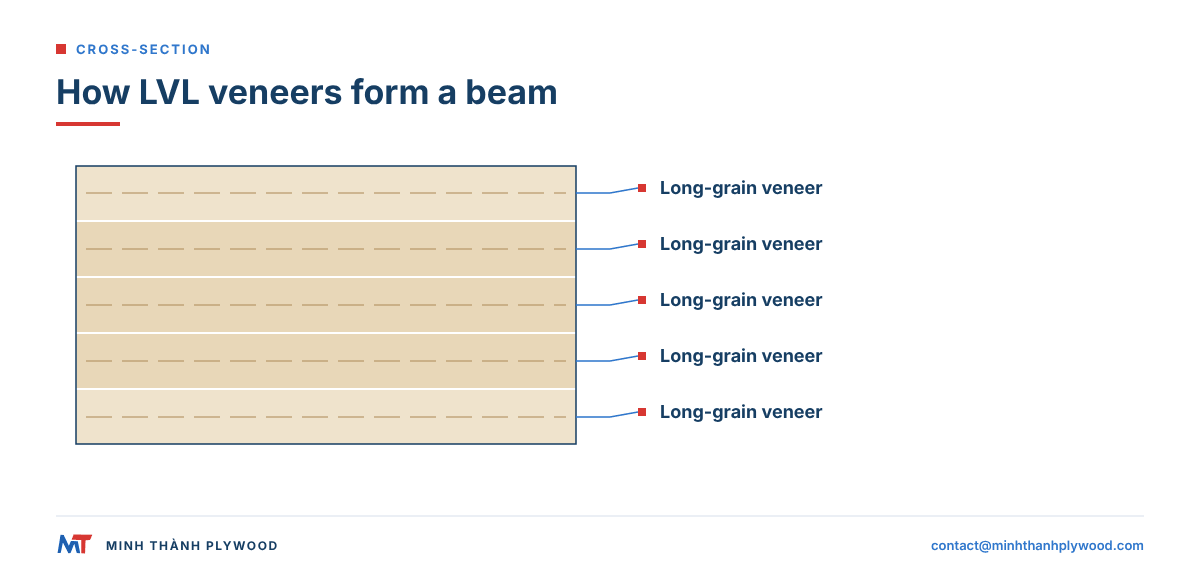
LVL, laminated veneer lumber, is an engineered wood product made by gluing thin veneers together with their grain running in the same direction, along the length of the member. It is pressed as a large billet and then sawn into beams, headers, studs and flanges.
- Peel: logs are rotary-peeled into veneer.
- Dry and grade: veneers are dried and sorted by quality and stiffness.
- Lay up: veneers are stacked with the grain mostly parallel, joints staggered.
- Press: the stack is hot-pressed into a billet.
- Saw: the billet is cut into members of the required width and length.
At our mill, LVL is made from Acacia or Eucalyptus plantation veneers, with a density of about 580 kg/m³ for Acacia and 650–750 kg/m³ for Eucalyptus, dried to 8–12 % moisture content. Billets are 1220 × 2440 or 1250 × 2500 mm. Our guide to LVL vs PSL vs LSL places LVL among the other structural composite lumbers.
What is glulam?
Glulam, glued laminated timber, is a beam or column made by gluing sawn boards, called laminations, face to face with the grain parallel to the length. Laminations are finger-jointed end to end, so glulam can be made far longer and deeper than any sawn log.
- Laminations: in Europe, EN 14080 covers glulam of two or more laminations from 6 mm up to 45 mm thick, in softwood or poplar.
- Grading: stronger laminations go in the outer zones, where bending stress is highest.
- Shapes: laminations bend before the glue cures, so glulam is made curved, cambered and tapered.
- Finish: planed and made in appearance grades for exposed beams.
Our guide to glulam beams explains glulam grades and uses in more depth.
LVL vs glulam strength and stiffness
For the same cross-section, LVL usually has higher and more consistent design strength and stiffness than common glulam grades. Thin veneers spread knots, slope of grain and other defects across many layers, so no single weak spot controls the member.
| Strength point | LVL | Glulam |
|---|---|---|
| Bending strength for its size | Higher | High, by strength class |
| Stiffness (modulus of elasticity) | Higher and uniform | Good; by strength class |
| Variability between pieces | Low | Low to moderate |
| Section for a given load | Smaller | Larger |
| Strength across the grain | Low in parallel-ply LVL | Low |
| Built-up members | Common: two to four plies fixed together | Usually one solid section |
Design values are published per product and grade, and the engineer sizes the member from those values. Comparing LVL vs glulam strength means comparing two members that carry the same load, at the same span, with the same deflection limit.
Spans and shapes: which beam goes further?
Glulam goes further in very long and shaped spans because it can be made deeper, wider and longer than any LVL billet, and curved. LVL covers the common spans of houses and small buildings with smaller sections.
- Short and medium spans in framing: LVL headers and beams, often doubled or tripled.
- Long clear spans: glulam made to depth, or LVL in deep, built-up sections.
- Portal frames and arches: glulam, curved or tapered.
- Cantilevers and ridge beams: both, sized by the engineer.
The length numbers show the gap. A maker such as TT Plywood in Vietnam quotes glulam up to 30 m or more as custom production and LVL up to 24 m depending on thickness (TT Plywood, LVL vs glulam beams, checked on 21 October 2026). Stocked North American LVL such as Weyerhaeuser Microllam comes in 1¾ in plies, depths from 5½ to 24 in and lengths up to 60 ft, about 18 m (Weyerhaeuser, Microllam LVL technical sheet, read 21 October 2026).
| Span | Depth at span/20 | Depth at span/16 | Usual choice |
|---|---|---|---|
| 6 m | 300 mm | 375 mm | LVL, single or doubled |
| 10 m | 500 mm | 625 mm | LVL built up, or glulam |
| 20 m | 1,000 mm | 1,250 mm | Glulam |
| 30 m | 1,500 mm | 1,875 mm | Glulam |
Depth is a first-sizing guess, span divided by 16 to 20 for glulam and LVL beams (Datumspot, beam span quick reference, checked on 21 October 2026); the engineer then checks load, deflection and bearing. Typical house spans of 6–10 m suit either product. Longer spans require product-specific engineered solutions; LVL billet depth alone does not rule them out.
Camber, a slight upward curve built into a beam to offset deflection, is routine for glulam and not available in LVL.
Appearance: exposed beams and finish grades
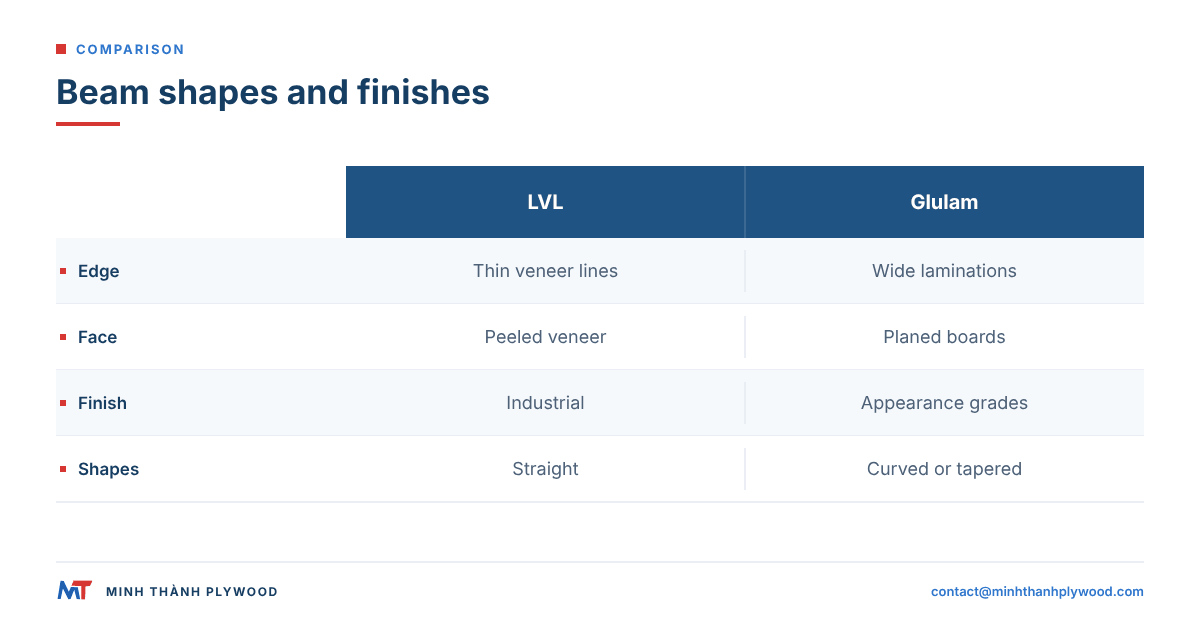
Glulam is the beam for exposed architecture; LVL is made for hidden structure. Glulam’s laminations look like planed timber, while LVL shows thin veneer lines on its edges and often a printed grade stamp.
| Appearance point | LVL | Glulam |
|---|---|---|
| Edge look | Many thin veneer lines | A few wide laminations |
| Face look | Peeled veneer surface | Planed board surface |
| Mill stamps | Common on the face | Removed in appearance grades |
| Appearance grades | Rarely offered | Offered for exposed work |
| Best visible use | Industrial and modern interiors | Halls, homes, public buildings |
In North America, glulam is sold in appearance classes from framing to premium; in Europe, the finish is agreed in the order.
Moisture and outdoor use
Both LVL and glulam are made for dry, covered use and must be kept dry on site. Outdoor beams need preservative treatment, a water-resistant bond and a detail that sheds water, whatever the product.
- Moisture at delivery: both are dried before gluing and delivered dry; our LVL is dried to 8–12 %.
- On site: store off the ground, under cover, with air flow; wrap ends.
- Bond: LVL for damp areas needs a water-resistant bond; our options are MR or melamine-fortified and phenolic (WBP).
- Outdoors: covered beams with protected ends, or treated members with flashing.
Wet LVL can swell at its edges and ends; wet glulam can check and stain. In both cases the fix is site protection, not a different beam.
Fire performance
Glulam and LVL behave alike in fire: their surface chars at a predictable rate, and the char protects a load-bearing core. Eurocode 5 Part 1-2 uses the same basic one-dimensional charring rate, 0.65 mm/min, for softwood glulam and for LVL above its minimum density (JRC Eurocode 5 workshop, slide 52, checked 3 November 2026).
- Fire resistance comes from the size of the section left after the fire duration.
- Larger sections keep more core, which favours large glulam beams in exposed designs.
- Built-up LVL members need attention at the joints between plies.
- Connections: steel parts are hidden in the wood or protected.
Weight per metre and handling
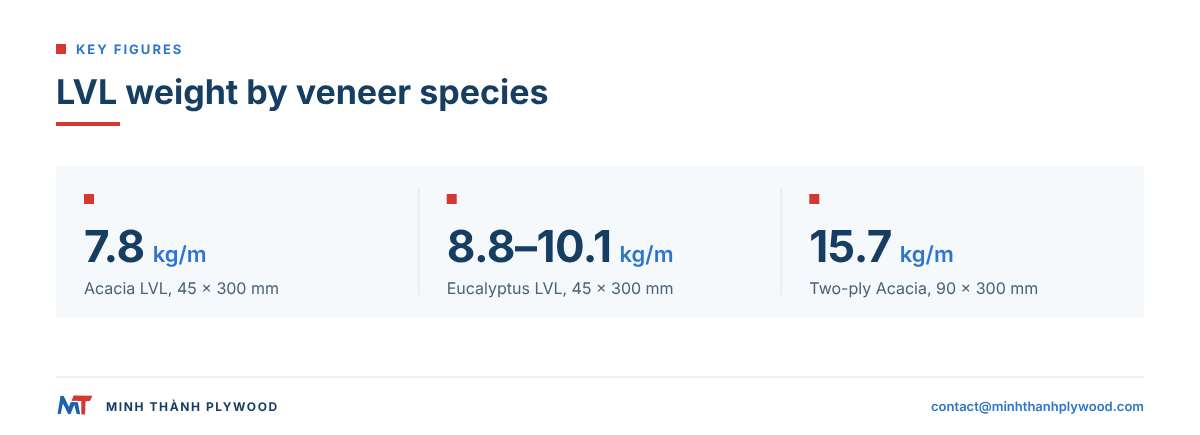
Weight per metre is density times section area, so it follows the species and the size. A denser plantation hardwood LVL is heavier per metre than spruce glulam of the same size, and a smaller LVL section can still weigh less than the larger glulam beam it replaces.
| Member | Section | Density | Weight per metre |
|---|---|---|---|
| Acacia LVL | 45 × 300 mm | 580 kg/m³ | about 7.8 kg |
| Eucalyptus LVL | 45 × 300 mm | 650–750 kg/m³ | about 8.8–10.1 kg |
| Two-ply Acacia LVL | 90 × 300 mm | 580 kg/m³ | about 15.7 kg |
Calculation: 0.045 m × 0.300 m = 0.0135 m² of section; 0.0135 × 580 = 7.83 kg per metre. For glulam, use the producer’s mean density for its strength class and the same formula. Both are light enough to handle by hand in short lengths, unlike a steel beam.
Cost: is LVL or glulam cheaper?
LVL is usually the cheaper choice for standard headers and beams in house framing, because it is stocked in common sizes and its smaller section uses less wood. Glulam is often cheaper for large, long, shaped or exposed beams, where it replaces built-up LVL plus a cladding.
| Cost point | LVL | Glulam |
|---|---|---|
| Stock framing sizes | Low | Medium |
| Large or long beams | Built up, more labour | Made to size |
| Exposed finish | Needs cladding or acceptance of look | Included in appearance grade |
| Curves and camber | Not possible | Included in manufacture |
| Waste on site | Low; cut from stock | Low; made to length |
At matching capacity, stocked LVL headers usually come in below stocked glulam per foot, since the section is smaller and the product is made in volume for house framing, while glulam wins once the span, curve or finish moves outside stock sizes.
Compare installed cost per beam, including connections, labour and any lining, not the price per metre of material.
Raw material: the wood behind each product
Both products turn smaller, plantation or managed-forest logs into large beams; the difference is how much of each log they use. Peeling for veneer uses small-diameter logs well, while glulam needs logs large enough to saw into boards.
- LVL: rotary-peeled veneer from small logs; our LVL uses locally grown Acacia and Eucalyptus plantation timber.
- Glulam: sawn softwood laminations, finger-jointed from shorter pieces.
- Origin documents: we supply the EUDR compliance dossier (origin records and geolocation files) with orders, as required under Regulation (EU) 2023/1115 (read 20 October 2026).
Codes and standards in Europe and the US
LVL and glulam each have their own product standards, and structural use needs a member with published design values under them. The engineer specifies the grade; the supplier documents it.
| Region | LVL | Glulam |
|---|---|---|
| Europe | EN 14374, CE marking under the harmonised standard | EN 14080 |
| United States | ASTM D5456 evaluation | ANSI A190.1 |
| Design code | Eurocode 5 or national code | Eurocode 5 or national code |
The European LVL standard is EN 14374:2004, and in the US structural composite lumber is evaluated under ASTM D5456.
For non-structural uses, such as furniture frames, door members and packaging, LVL is ordered to the buyer’s drawing, species, bond and moisture content.
Which beam for which job?
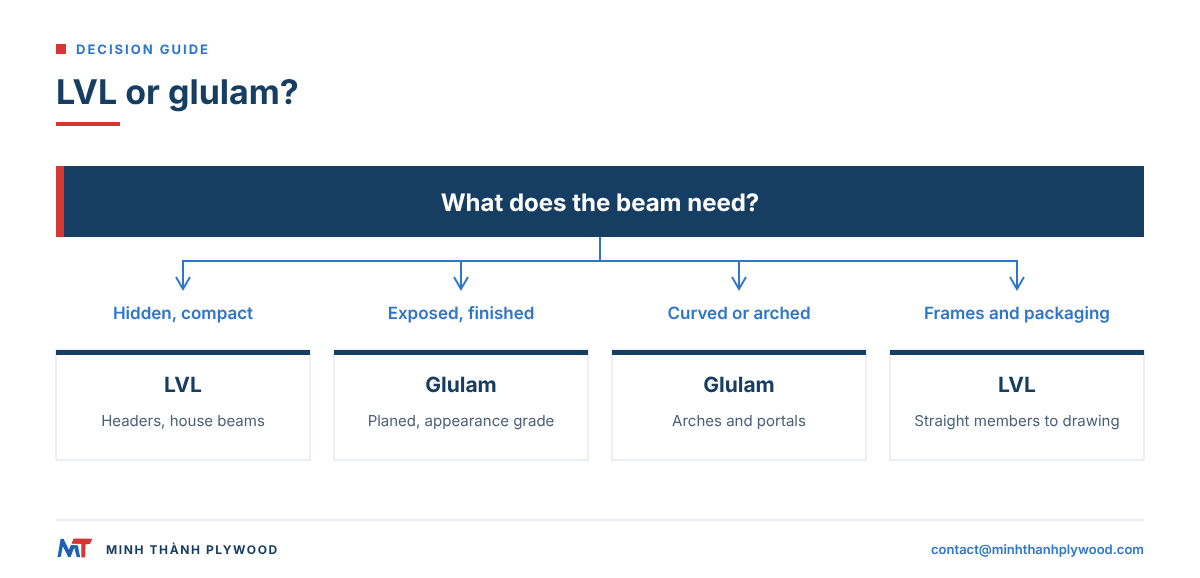
Choose LVL for compact hidden beams and straight components; choose glulam for large, curved or exposed beams. The matrix gives the verdict for common jobs.
| Job | Choose | Why |
|---|---|---|
| Window and door headers | LVL | Small, strong, stocked |
| Floor beams in house framing | LVL | Compact, uniform |
| Exposed ridge beam | Glulam | Appearance grade |
| Portal frame or arch | Glulam | Curved and tapered shapes |
| Long clear span in a hall | Glulam | Deep sections made to order |
| I-joist flanges and rim boards | LVL | Uniform, straight |
| Furniture frames and door members | LVL | Straight grain, stable, machines cleanly |
| Packaging runners and frames | LVL | Strong, cost-effective members |
What this means for your LVL order
For frames, door members and packaging, LVL is ordered by species, bond, section and length. Send these lines with your request:
- Application: furniture frames, door members, packaging members or a project-specified member.
- Species: Acacia or Eucalyptus plantation veneer.
- Glue and emission: UF glue at E0 emission for interiors; MR or melamine-fortified and phenolic (WBP) for damp areas.
- Section and length: thickness, width and length per piece, with grain direction.
- Moisture: 8–12 % at dispatch.
- Packing and quantity: from one 40HC, mixed specifications by agreement.
Production takes 15–45 days after the deposit, and free samples are available. See our LVL laminated veneer lumber page, or compare panels in cross-laminated timber vs plywood.
Buyer questions, answered
What is the difference between LVL and glulam?
LVL is made from thin wood veneers glued with their grain running along the member; glulam is made from sawn boards, called laminations, glued in layers. LVL is more uniform and stronger for its size; glulam can be made larger, curved and with a finished appearance.
Is LVL stronger than glulam?
For the same size, LVL usually has higher design strength and stiffness than common glulam grades, because thin veneers spread out knots and defects. Glulam makes up for it with deeper and wider sections, so the engineer compares members for the same load, not materials.
Which is cheaper, LVL or glulam?
For the standard headers and beams of house framing, LVL is usually the cheaper stocked option. For large, long, curved or exposed beams, glulam is often more cost-effective because it is made to size and can be left visible.
Can LVL be exposed like glulam?
LVL can be left exposed, but it shows veneer edges, glue lines and sometimes a mill stamp, so it reads as an industrial look. Glulam is made in appearance grades for exposed beams in architecture.
Can glulam be curved and LVL cannot?
Glulam laminations are thin enough to bend before gluing, so glulam is made as arches and curved beams. LVL is made straight, in billets, and is cut to straight members.
Can you use LVL outdoors?
LVL with a water-resistant bond can be used where it is protected from the weather, but most LVL is made for dry, covered use. Exposed outdoor beams need preservative treatment or a covered detail, whichever product is used.
Which is better for fire, glulam or LVL?
Both char at similar rates in a fire and keep a load-bearing core behind the char. Eurocode 5 gives the same basic design charring rate for softwood glulam and LVL, so section size matters more than product.
Can I replace a glulam beam with LVL?
Only with an engineer's calculation for the new member. LVL beams are often built up from several plies nailed or bolted together, and the connections, bearing and depth must be checked for the replacement.
What sizes does Minh Thanh LVL come in?
Our LVL is made in billets of 1220 × 2440 or 1250 × 2500 mm from Acacia or Eucalyptus veneers, then cut to the members on your drawing for frames, door parts and packaging.