
Steel beam vs LVL is a choice between depth and ease. A steel beam carries a heavy load over a long span in a shallow section, but it is heavy, needs lifting gear and steel connections. An LVL beam is deeper for the same job, yet light enough to carry by hand, cut with a saw and nail into timber framing. This guide compares them point by point. Minh Thanh Plywood makes LVL from plantation veneers in Vietnam.
Steel beam vs LVL: the short answer
In steel beam vs LVL, choose LVL for timber-framed houses and extensions where a deeper beam fits and easy handling saves money; choose steel where the span is long, the load is heavy or the beam must be shallow. Both are engineered products sized by calculation.
- LVL (laminated veneer lumber): veneers glued with the grain along the member. Light, cut and fixed with carpentry tools.
- Steel beam: rolled steel sections, such as universal beams and I-beams. Very strong in a shallow section, heavy, needs steel fixings.
The rest of this guide compares the two on depth, weight, cost, fire, moisture and connections, then gives a verdict by job.
What are LVL and steel beams?
An LVL beam is a timber member made by gluing thin veneers with their grain running in the same direction, then sawing the pressed billet into beams. A steel beam is a hot-rolled section of structural steel, usually an I or H shape, made in standard sizes.
| Point | LVL beam | Steel beam |
|---|---|---|
| Material | Wood veneers and glue | Structural steel |
| Shape | Rectangular, often built up from plies | I, H, channel or box sections |
| Sizes | Cut from billets to length | Rolled standard sections |
| Fixing | Nails, screws, bolts, hangers | Bolts, welds, cleats, plates |
| Typical buildings | Houses, extensions, light commercial | All buildings, especially long spans |
At our mill, LVL is made from Acacia or Eucalyptus plantation veneers, pressed in billets of 1220 × 2440 or 1250 × 2500 mm and cut to the members on the buyer’s drawing.
LVL beam vs steel beam: comparison table
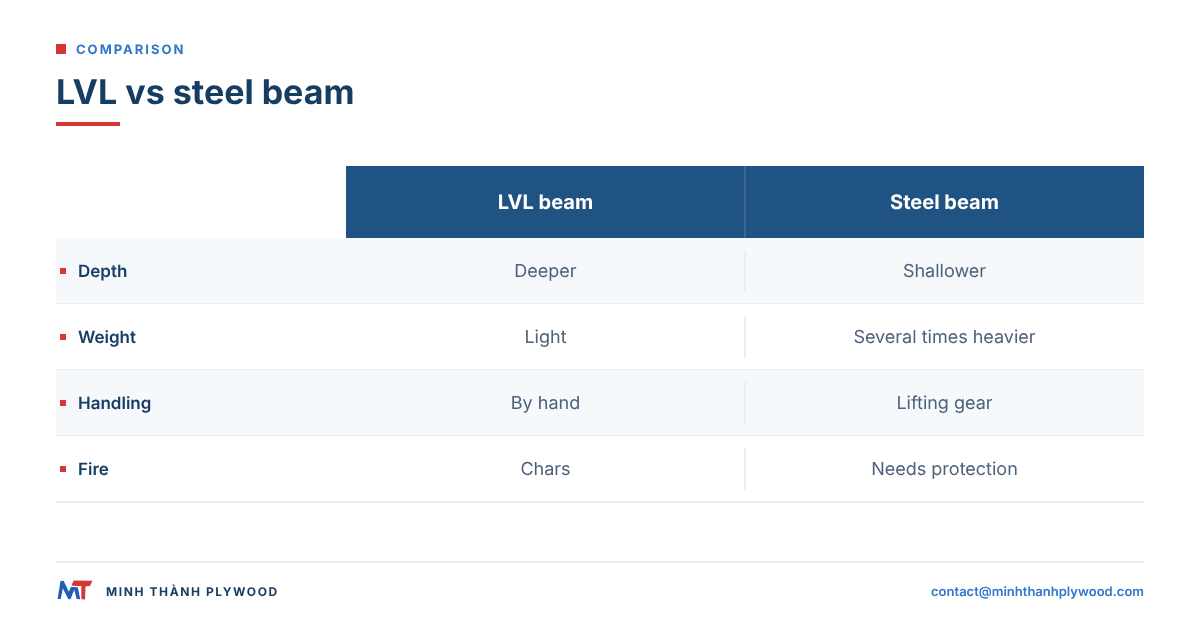
The table compares an LVL beam and a steel beam on one property per row, for the same job.
| Property | LVL beam | Steel beam |
|---|---|---|
| Section depth for a given load | Deeper | Shallower |
| Weight per metre | Light per ply; about equal to steel when built up for equal stiffness | Heavy in one piece |
| Handling on site | By hand for house-scale members | Lifting equipment for most sizes |
| Cutting and drilling | Carpentry tools | Fabrication shop or steel tools |
| Connection to timber framing | Direct nailing and hangers | Timber packers bolted to the steel |
| Fire | Chars at a predictable rate | Loses strength as it heats; protection needed |
| Moisture | Keep dry or use a water-resistant bond | Corrodes without protection |
| Thermal bridging | Low | High; needs insulation detailing |
| Lead time | Stock or cut from billets | Stock sections plus fabrication |
| Best fit | Houses, extensions, headers | Long spans, heavy loads, shallow depth |
Steel beam equivalent to LVL: how to compare sections
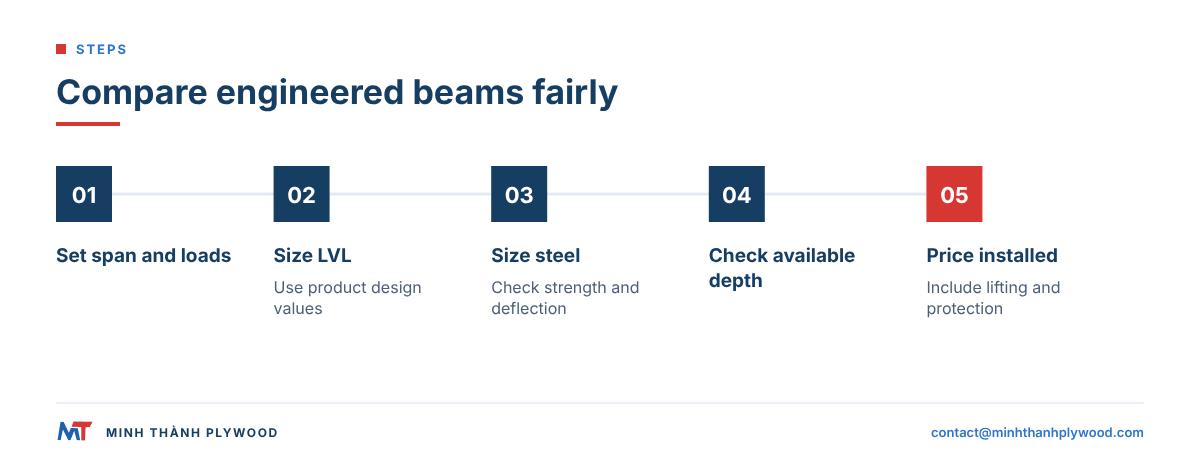
There is no fixed steel beam equivalent to an LVL beam: each member is sized for the same load, span and deflection limit, and the two answers differ in shape. The LVL is usually deeper or wider; the steel is shallower and heavier.
- Set the job: span, loads, bearing length and the deflection limit for the finishes.
- Size the LVL: the engineer picks depth and number of plies from the product’s design values.
- Size the steel: the engineer picks the lightest section that meets strength and deflection.
- Check the depth: does the deeper LVL fit the ceiling, or is steel needed?
- Price both installed: material, lifting, connections, fire protection and labour.
Asking “what size LVL equals a steel beam” without these inputs gives a wrong answer. The comparison is always two complete, calculated members.
Strength and stiffness: why steel is shallower
Steel is much stronger and stiffer per unit of section than wood, so a steel beam carries the same load in a smaller, shallower section. LVL is strong and stiff for its weight, so an LVL beam is larger; per metre it weighs about the same as the steel beam of equal stiffness, but it comes in short plies that two people can place.
- Strength: at the same width and depth a wide-flange steel beam is roughly 10 times stronger than an LVL, which is why LVL replaces built-up 2x12 headers rather than W-shape beams (NC Woodworker, structural engineer thread, checked on 21 October 2026).
- Stiffness: steel’s modulus of elasticity is much higher, which controls deflection over long spans.
- Shape efficiency: an I-section puts steel where bending stress is highest, at the top and bottom flanges.
- LVL uniformity: thin veneers spread defects out, so LVL is more uniform than sawn timber of the same size.
Long spans with tight deflection limits favour steel. Short and medium spans where a deeper beam fits favour LVL.
Weight per metre: worked examples
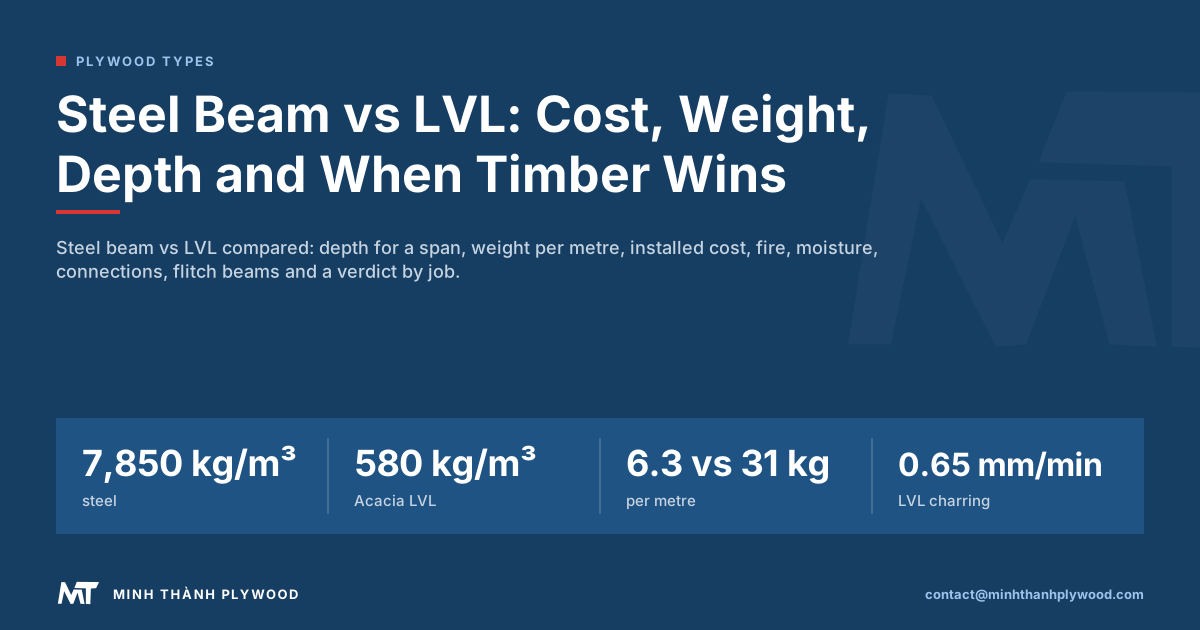
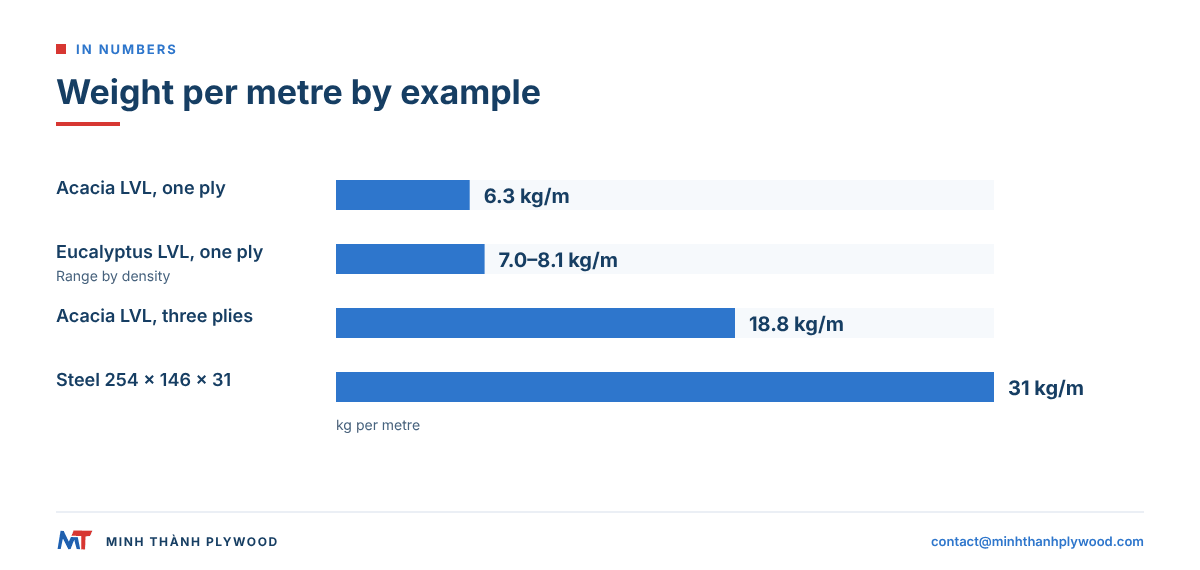
Weight per metre is density times section area, and steel is about 7,850 kg/m³ while our LVL is about 580 kg/m³ in Acacia and 650–750 kg/m³ in Eucalyptus. A single LVL ply weighs a fraction of a steel beam, and a built-up LVL beam weighs about the same per metre as the steel it matches in stiffness, as the 20 ft example below shows.
| Member | Section | Density | Weight per metre |
|---|---|---|---|
| Acacia LVL, one ply | 45 × 240 mm | 580 kg/m³ | about 6.3 kg |
| Eucalyptus LVL, one ply | 45 × 240 mm | 650–750 kg/m³ | about 7.0–8.1 kg |
| Acacia LVL, three plies | 135 × 240 mm | 580 kg/m³ | about 18.8 kg |
| Steel universal beam | 254 × 146 × 31 | about 7,850 kg/m³ | 31 kg |
Calculation for one LVL ply: 0.045 m × 0.240 m = 0.0108 m²; 0.0108 × 580 = 6.264, about 6.3 kg per metre. Steel universal beams carry their mass per metre in their designation. The steel density is the value given for steel in the Eurocode for densities of construction materials, EN 1991-1-1 (JRC Eurocodes, EN 1991 Actions on structures, read 20 October 2026). The rows are examples of weight, not equivalent members.
US example: a 20 ft span in W-shape steel and 1-3/4 in LVL plies
For a US reader the numbers run in feet, inches and pounds. Take a residential span of 20 ft (6.1 m) and compare stiffness, because deflection usually sets the size. Steel’s modulus of elasticity is 29,000 ksi, and a 2.0E LVL such as Weyerhaeuser Microllam is 2,000 ksi, with plies 1-3/4 in thick (Weyerhaeuser, Microllam LVL technical sheet, checked on 21 October 2026). The W-shape properties come from the AISC shapes tables (AISC W8x18 table, Steelfloai, checked on 21 October 2026).
| Member | Depth | Weight | Stiffness EI, thousand kip-in² |
|---|---|---|---|
| W8x18 steel | 8.14 in (207 mm) | 18 lb/ft | 1,795 |
| W10x22 steel | 10.17 in (258 mm) | 22 lb/ft | 3,422 |
| 3-ply LVL, 5-1/4 in × 14 in | 14 in (356 mm) | about 18.5 lb/ft | 2,401 |
| 3-ply LVL, 5-1/4 in × 16 in | 16 in (406 mm) | about 21.1 lb/ft | 3,584 |
Calculation: EI = modulus × second moment of area. For the 3-ply 14 in LVL, I = 5.25 × 14³ / 12 = 1,200 in⁴, so EI = 2,000 × 1,200 = 2,401 thousand kip-in².
LVL weights use our Acacia density of 580 kg/m³, which is 36.2 lb/ft³ (580 kg/m³ × 0.0624), times the section area in square feet. So a W10x22 and a 3-ply 16 in LVL give about the same stiffness on a 20 ft span, and the timber beam is about 1.6 times deeper (16 in against 10.17 in). Strength, bearing and connections still need the engineer’s check; this is the depth penalty you pay for working in timber.
Steel beam vs LVL cost: what to count
Steel beam vs LVL cost has to be compared installed: material, delivery, lifting, cutting, connections, fire protection and labour. LVL usually wins on house-scale beams because the extra costs of steel are larger than the material difference.
| Cost line | LVL beam | Steel beam |
|---|---|---|
| Material per metre | Lower for house-scale members | Higher per member |
| Delivery and lifting | Light vehicle, carried by hand | Heavier transport, lifting gear |
| Fabrication | Cut on site | Shop fabrication, end plates, holes |
| Connections | Joist hangers, nails, bolts | Bolts, cleats, timber packers |
| Fire protection | Often by sizing and linings | Board, intumescent paint or encasement |
| Site labour | Carpenters | Carpenters plus steel erectors |
| Changes on site | Recut with a saw | New fabrication |
For long spans or heavy loads, steel’s shallower, single member can be cheaper than a deep, multi-ply LVL beam plus extra support posts. Price both complete before choosing.
Garage door header: LVL or steel?
For a garage door opening, LVL is the usual header when only roof loads bear on it, and steel is the exception. Builders on a garage forum report the field rules: two 14 in LVL plies over a 16 ft door, two 16 in plies over an 18 ft door, and three 14 in plies where roof trusses and a full brick facing bear on the opening.
They turn to steel only for concrete-block (CMU) walls or a second floor above the door (Garage Journal, LVL beam instead of steel above a door, checked on 21 October 2026).
- Roof load only: LVL header, nailed or bolted ply to ply, fixed straight into the timber frame.
- Brick facing or trusses bearing: add a third ply or deepen the section, and tie in the steel brick lintel.
- Block wall or a floor above: steel, or an LVL sized by the engineer’s calculation.
- Space is tight: steel, because it gets the same stiffness in a shallower section.
These are field numbers from builders, not design values. The building department and the engineer set the final size for your loads and local code.
Permits and engineer stamp: what a homeowner needs
Replacing a wall with a beam is structural work. In most US and Canadian jurisdictions it needs a building permit and a calculation for the beam, usually stamped by a licensed engineer, and the posts and footings under each beam end are sized in the same package (The Residential Engineer, load-bearing wall removal, checked on 21 October 2026). The usual order of work:
- Hire a structural engineer, who confirms the wall is load-bearing and sizes the beam, posts, connections and footings.
- Submit the stamped drawings with the permit application; cities such as Los Angeles ask for structural drawings and load calculations at plan review (Ataman Studio, wall removal in Los Angeles, checked on 21 October 2026).
- Keep the approved drawings on site for the inspector, and book the framing inspection before the ceiling is closed.
- Ask the beam supplier for the product’s evaluation report, so the inspector can match the LVL grade to the drawing.
Whichever material the engineer picks, the permit does not change; LVL only changes the cost of the carpentry around it.
Where LVL outperforms steel
LVL outperforms steel where the beam sits inside timber framing, the span is moderate, and speed and simple handling matter. It works with the same tools and trades as the rest of the frame.
- Window and door headers: small, quick, nailed into place.
- Floor beams and trimmers in timber-framed houses.
- Roof ridges and purlins in house-scale roofs.
- Extensions and loft conversions where access is tight and no crane fits.
- Built-up beams assembled from light plies inside the building.
LVL also keeps warm and cold sides apart better than steel, which conducts heat, so there is less risk of a cold bridge and condensation at the beam.
When you should use steel instead
Use steel where the span is long, the loads are heavy or concentrated, or the beam must fit within a shallow depth such as a flush ceiling. Steel also suits buildings already framed in steel or concrete.
- Long open-plan spans where an LVL beam would be too deep.
- Heavy point loads from columns, masonry or upper floors.
- Shallow or flush ceilings with no room for a deep beam.
- Openings in load-bearing masonry in some renovation work.
- Commercial and industrial frames designed in steel.
Between the two sits the flitch beam: a steel plate bolted between two LVL or timber members. It gives a shallower beam than LVL alone and keeps a timber face for nailing.
Fire: charring wood vs heated steel
LVL and steel both need fire design, but they fail differently. LVL chars on its surface at a predictable rate, and the char protects a load-bearing core; steel does not burn but loses strength and stiffness as it heats, so it is usually protected.
- LVL: Eurocode 5 Part 1-2 gives a basic one-dimensional charring rate of 0.65 mm/min for LVL above its minimum density (JRC Eurocodes, EN 1995 Design of timber structures, read 20 October 2026).
- Steel: protected by fire-rated board, intumescent paint or encasement, sized to the rating.
- In houses: plasterboard linings often give the required rating for both.
- Connections: hidden or protected steel fixings in both systems.
The required fire rating and the exposure, not the material alone, decide which beam and which protection.
Moisture, corrosion and durability
LVL must be kept dry or specified with a water-resistant bond and covered detailing; steel must be protected against corrosion. Inside a dry, heated building both last for the life of the building.
| Durability point | LVL beam | Steel beam |
|---|---|---|
| Main risk | Water, at ends and edges | Rust, at exposed surfaces |
| Protection | Cover on site, sealed ends, WBP bond for damp areas | Galvanising, primer and paint |
| Outdoors | Covered or treated, water-shedding detail | Galvanised or painted, maintained |
| Moisture at delivery | 8–12 % for our LVL | Not relevant |
Our LVL can be made with MR or melamine-fortified and phenolic (WBP) bonds for damp areas, and with UF glue at E0 emission for interiors.
Installation and connections
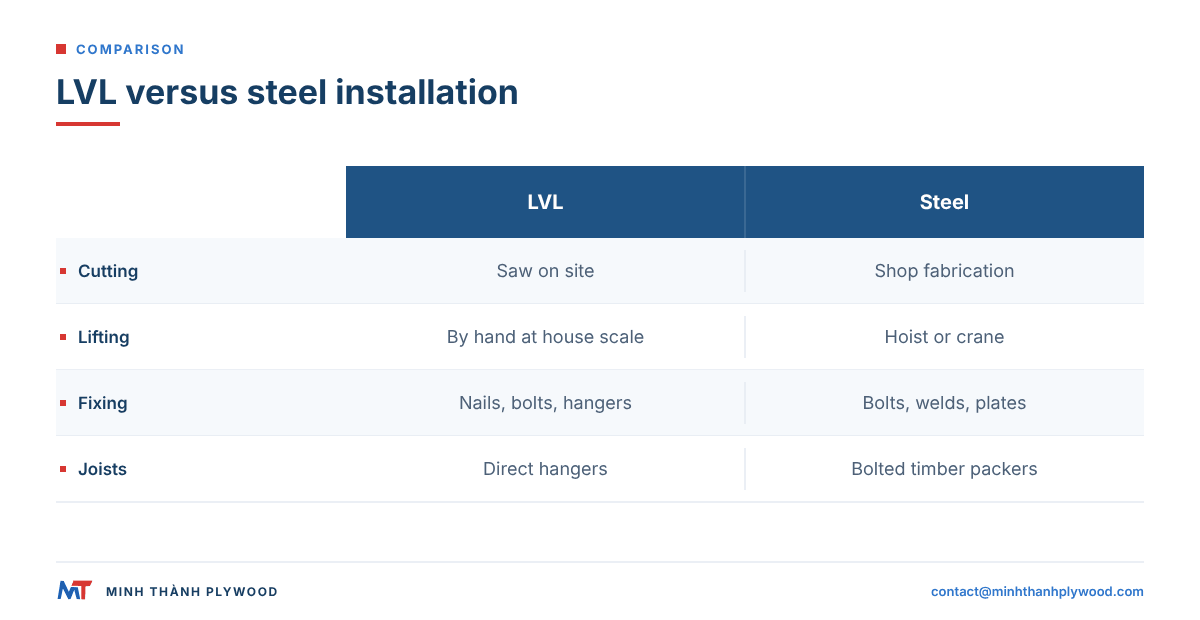
LVL installs with carpentry: it is cut with a saw, lifted by hand, nailed or bolted ply to ply, and hung on joist hangers. Steel installs with lifting gear and steel connections, then needs timber packers bolted to it so joists and finishes can be fixed.
- Delivery: LVL in bundles on a light truck; steel by heavier transport.
- Cutting: LVL on site; steel to length in the shop.
- Lifting: LVL by hand at house scale; steel by crane, hoist or props.
- Fixing: LVL plies nailed or bolted together; steel bolted or welded.
- Joists: hangers straight onto LVL; packers bolted to steel first.
Site changes are the hidden difference. A beam that needs a notch or a new length is a saw cut in LVL and a trip back to the fabricator in steel.
Which beam for which job?
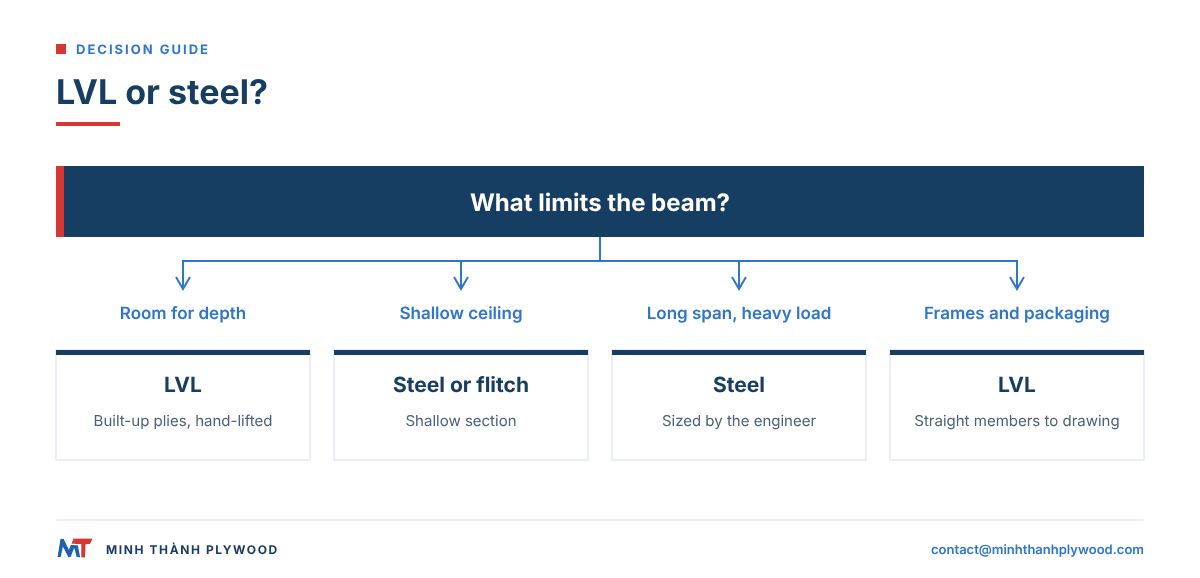
Choose LVL for timber-framed, house-scale beams with room for depth, and steel for long spans, heavy loads and shallow depths. The matrix gives the verdict by job.
| Job | Choose | Why |
|---|---|---|
| Door and window headers | LVL | Light, quick, nailed in |
| Floor beam in a house | LVL | Fits the frame, hand-lifted |
| Kitchen extension opening, deep ceiling | LVL, built up | Cheaper installed |
| Kitchen extension opening, flush ceiling | Steel or flitch beam | Shallow depth |
| Long open-plan span | Steel | Depth and deflection |
| Heavy point load from above | Steel or flitch beam | Concentrated load |
| Furniture frames and door members | LVL | Straight grain, machines cleanly |
| Packaging runners and frames | LVL | Strong, cost-effective members |
What this means for your LVL order
For non-structural members, LVL is ordered by species, bond, section and length; for structural beams, the project’s engineer specifies the evaluated grade. In the EU, structural LVL is CE-marked under the Construction Products Regulation (EU) No 305/2011. Send these lines with your request:
- Application: furniture frames, door members, packaging members or a project-specified member.
- Species: Acacia or Eucalyptus plantation veneer.
- Glue and emission: UF glue at E0 emission for interiors; MR or melamine-fortified and phenolic (WBP) for damp areas.
- Section and length: thickness, width and length per piece, with grain direction.
- Moisture: 8–12 % at dispatch.
- Packing and quantity: from one 40HC, mixed specifications by agreement.
Production takes 15–45 days after the deposit, and free samples are available. See our LVL laminated veneer lumber page, compare the timber option in LVL vs glulam, or read LVL vs solid timber.
Buyer questions, answered
Is LVL cheaper than a steel beam?
For most spans in house framing, an LVL beam is cheaper installed than a steel beam, because it needs no crane, no fabrication and no steel connections. For long spans, heavy point loads or limited depth, steel can be the cheaper complete solution.
What size LVL equals a steel beam?
There is no fixed equivalent: the engineer sizes each member for the load, span and deflection limit. An LVL beam is usually deeper or wider than the steel beam it replaces, often built up from two or three plies.
Is steel stronger than LVL?
Steel is far stronger per unit of section, which is why steel beams are shallower. LVL is strong for its weight, so an LVL beam that carries the same load is larger; per metre it weighs about the same as the matching steel, but it arrives in short plies that are easy to handle.
Can an LVL beam replace a steel beam?
Often, where the ceiling depth allows a deeper member and the engineer's calculation confirms it. Where depth is limited or loads are very high, steel or a flitch beam is used.
Which is better in a fire, LVL or steel?
Both need fire design. LVL chars at a predictable rate and keeps a load-bearing core, while steel does not burn but loses strength as it heats and usually needs protection. The required fire rating decides the detail.
How much does an LVL beam weigh compared with steel?
A 45 × 240 mm Acacia LVL member weighs about 6.3 kg per metre. A steel universal beam designated 254 × 146 × 31 weighs 31 kg per metre, but a built-up LVL beam of equal stiffness weighs about the same per metre as the steel; the gain is that each ply can be handled by hand.
What is a flitch beam?
A flitch beam is a steel plate bolted between two timber or LVL members. It combines the strength of steel with a timber member that can be nailed to the framing.
Does an LVL beam need a crane?
Usually not for house-scale members: LVL beams are light enough for two people to lift and place. Long, deep or built-up beams for larger buildings may still need lifting equipment.
Can steel and LVL beams be used outdoors?
Steel outdoors needs corrosion protection such as galvanising or paint. LVL needs to be covered, treated or bonded with a water-resistant glue and detailed to shed water.