
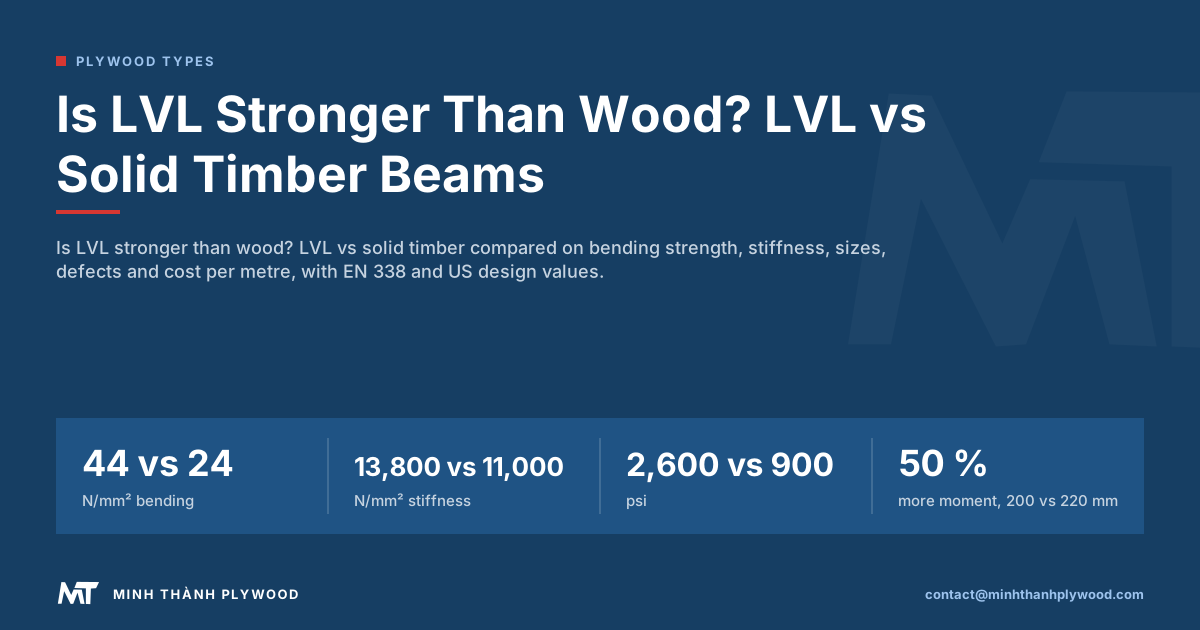
Yes. LVL (laminated veneer lumber) is stronger and stiffer than solid timber of the same size: a typical softwood LVL has a characteristic bending strength of about 44 N/mm² edgewise, against 24 N/mm² for C24 structural timber. Lamination spreads knots and grain defects through many thin veneers. Minh Thanh Plywood, which makes LVL from plantation hardwood veneers in Vietnam, explains where that strength matters and what it costs.
Is LVL stronger than wood? The short answer
Yes. Laminated veneer lumber (LVL) is stronger and stiffer than solid sawn timber of the same cross-section, and its strength varies much less from piece to piece. The reason is how it is made: a log is peeled into thin veneers, the veneers are dried and graded, then glued back together with their grain running along the member.
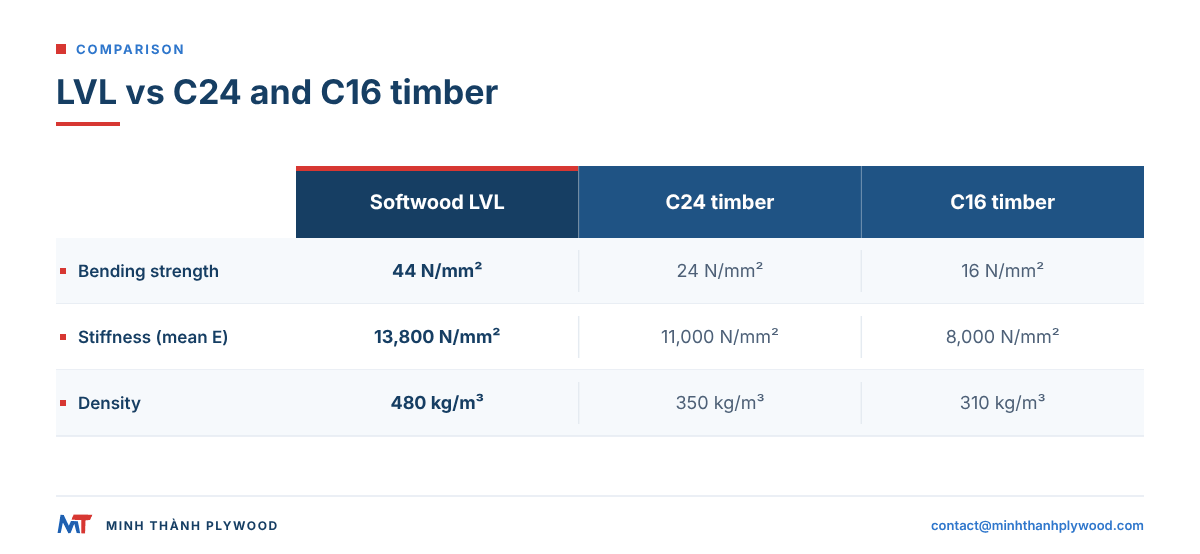
In European design values, a typical softwood LVL has a characteristic bending strength of about 44 N/mm² on edge, against 24 N/mm² for C24 structural timber, the most used grade of sawn softwood. That is about 1.8 times the strength in the same section.
| Value | Softwood LVL (typical, on edge) | C24 sawn timber (EN 338) | C16 sawn timber (EN 338) |
|---|---|---|---|
| Characteristic bending strength | 44 N/mm² | 24 N/mm² | 16 N/mm² |
| Mean modulus of elasticity | 13,800 N/mm² | 11,000 N/mm² | 8,000 N/mm² |
| Characteristic density | 480 kg/m³ | 350 kg/m³ | 310 kg/m³ |
LVL values come from the product’s declaration of performance under EN 14374, the standard for structural LVL, which supports CE marking under the Construction Products Regulation (EU) No 305/2011; every LVL product has its own, so the structural engineer designs from the values of the actual product. See LVL vs plywood for how LVL differs from cross-banded panels.
LVL vs dimensional lumber in the US: cost, spans and which LVL equals a 2x12
In US inches and feet: dimensional lumber costs about $2-4 per linear foot for common residential jobs and LVL about $4-7, according to Home Depot’s engineered-vs-dimensional lumber guide (checked 21 October 2026). LVL costs roughly twice as much per foot and spans further, so the cheaper beam is the one that fits the load without a second or third ply.
| Member | Rule-of-thumb maximum span (Home Depot guide; actual span depends on load and building width per IRC Table R602.7(1) or the LVL maker’s tables) |
|---|---|
| 2x8 sawn beam | 10 ft (3.05 m) |
| 2x10 sawn beam | 12 ft 6 in (3.81 m) |
| Doubled 2x12 | 13-14 ft (4.0-4.3 m) |
| 1-3/4 x 11-7/8 in LVL (44 x 302 mm) | 20 ft (6.1 m) under standard residential floor loads |
| 3-ply 1-3/4 x 14 in LVL (44 x 356 mm) | 16 ft (4.9 m) as a girder carrying a larger floor area |
Two LVL facts help when you order. LVL is made in 4 ft steps from 24 to 44 ft, with special orders up to 60 ft, and residential grades are 1.9E and 2.0E, the modulus of elasticity in millions of psi. A higher E means a stiffer beam.
Which LVL equals a 2x12?
A 1-3/4 x 11-7/8 in LVL is the closest match to one 2x12, and two of them side by side carry more than two 2x12s, as builders on the Fine Homebuilding forum put it.
Where the floor depth is limited, a 3-1/2 x 9-1/2 in LVL (89 x 241 mm) can replace a double 2x12 for the same load, and 3-1/2 x 11-7/8 in and 5-1/2 x 11-7/8 in sections are stocked for heavier beams. These are rules of thumb: the beam size for your job comes from the engineer’s span table or the LVL maker’s software.
What makes LVL stronger than solid timber?
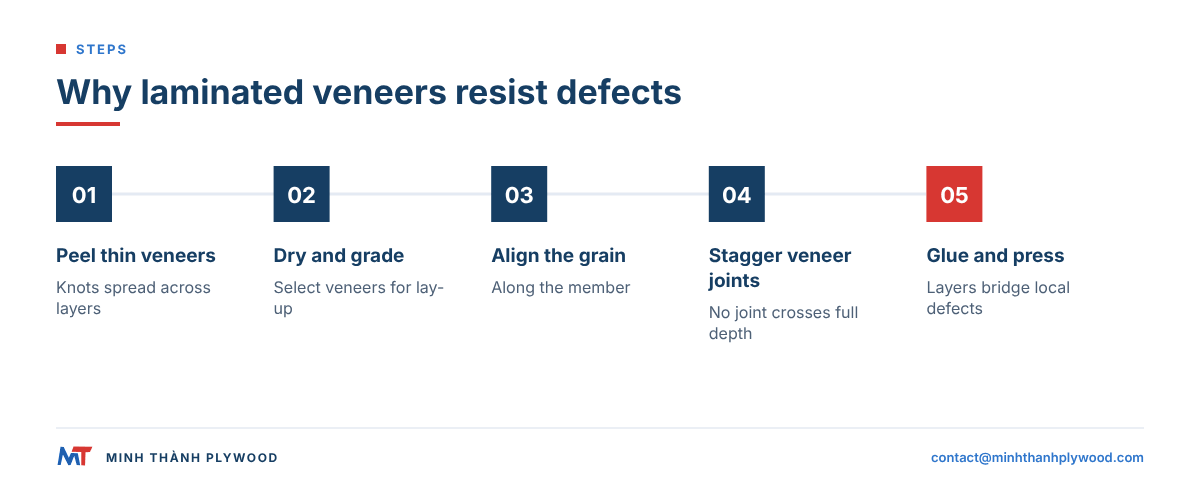
LVL is stronger than solid timber because lamination removes the weakest points of a sawn board. In sawn timber, a single large knot, a split or a run of sloping grain sets the strength of the whole beam; in LVL, the same defects are cut into thin veneers and spread through dozens of layers.
Four effects add up:
- Defect dispersal. A knot in one 3 mm veneer weakens one layer out of many; the veneers above and below bridge it.
- Veneer grading. Veneers are sorted by stiffness or appearance before lay-up, and the best go in the outer layers where bending stress is highest.
- Dry before pressing. Thin veneers dry evenly, so LVL has none of the drying checks and internal stresses of a thick sawn section.
- Joints staggered. Veneer ends are scarfed or lapped and staggered along the member, so no joint passes through the full depth.
The result is a lower spread of strength. Design values are set on the fifth percentile of test results, so a product with less variation earns a higher characteristic value even at the same average strength.
LVL vs lumber strength: European and US design values
LVL is stronger than lumber in both the European and the US design systems. In Europe, sawn timber is graded into strength classes under EN 338 (C16, C24, C30). LVL products declare their own values under EN 14374. In the US, sawn lumber has grade values in the NDS supplement and LVL has values from each manufacturer’s code evaluation.
| System | Material | Bending | Stiffness (E) |
|---|---|---|---|
| Europe, characteristic | C24 sawn softwood | 24 N/mm² | 11,000 N/mm² |
| Europe, characteristic | Softwood LVL on edge, typical | 44 N/mm² | 13,800 N/mm² |
| US, allowable | No. 2 Douglas fir-larch lumber | about 900 psi | 1.6 million psi |
| US, allowable | Select Structural Douglas fir-larch | about 1,500 psi | 1.9 million psi |
| US, allowable | 2.0E LVL, typical | about 2,600 psi | 2.0 million psi |
European and US figures cannot be compared directly: European values are characteristic (before safety factors), US values are allowable (after them). Within each system, LVL comes out at about 1.7 to 2.9 times the bending value of common sawn grades.
Stiffness gains are smaller than strength gains. LVL is about 25 % stiffer than common structural lumber in these tables, so for long spans where deflection governs, the LVL section shrinks less than the strength figures suggest.
LVL wood beam vs solid timber beam: where each is used
An LVL wood beam is used where a solid timber beam would be too large, too long, too variable or too likely to twist: headers over wide openings, ridge and floor beams, rim boards, I-joist flanges and long purlins. Solid timber stays the choice for studs, joists and rafters at normal spans, exposed traditional framing and small projects.
| Use | LVL | Solid timber |
|---|---|---|
| Headers over wide doors and windows | Standard choice | Possible at short spans, deep sections |
| Ridge and floor beams | Standard for long spans | Glulam or deep sawn sections |
| Studs and joists at normal spacing | Used for tall walls and long joists | Standard and cheaper |
| I-joist flanges | Common | Sawn flanges also used |
| Exposed beams in visible structures | Possible, industrial look | Preferred for appearance |
| Furniture frames and door components | Straight, stable, machinable | Solid hardwood for visible parts |
| Packaging runners and skids | Straight, consistent | Cheaper for one-trip crates |
LVL is also used outside building structures. Our LVL goes into furniture-frame components, door-frame members and industrial packaging, where straightness and stable dimensions matter as much as strength.
Are LVL beams stronger than lumber at the same depth?
Yes, LVL beams are stronger than lumber at the same depth and width, and the margin grows with the size of the member. Large sawn sections come from larger logs that carry more defects, and they dry unevenly; LVL depth is just more veneers, with the same quality throughout.
Size matters in design. In EN 1995 (Eurocode 5), small sawn sections receive a depth factor that raises their bending value, while LVL uses its own size factor declared with the product. Because bending capacity grows with strength × depth², a 45 × 200 mm LVL section (44 × 200² per mm of width) carries about 50 % more bending moment than a deeper 45 × 220 mm C24 section (24 × 220²).
For a builder, the practical effects are:
- Shallower beams for the same span and load, which saves ceiling height.
- Fewer plies in multi-ply headers: one LVL piece can replace two or three nailed sawn boards.
- Longer spans between supports.
- Straight members that keep floors flat and walls plumb.
Which defects does lamination remove?
Lamination removes or disperses the defects that cause sawn timber to be downgraded or rejected: large knots, splits and checks, wane, sloping grain, reaction wood, bowing and twisting. In LVL, these are either cut out at veneer grading or spread so thin they no longer govern strength.
| Defect in sawn timber | Effect on a beam | What happens in LVL |
|---|---|---|
| Large knot | Weak point in tension edge | Split across many veneers, bridged by others |
| Slope of grain | Lower bending strength | Veneers laid straight along the member |
| Splits and checks from drying | Shear weakness, visual reject | Thin veneers dry without checks |
| Wane (bark edge) | Reduced section | No wane; billets cut to exact size |
| Bow, twist, crook | Uneven floors, rework | Balanced lay-up resists distortion |
| Juvenile and reaction wood | Low stiffness, movement | Mixed across layers, averaged out |
The same logic makes LVL more predictable for machining. A furniture plant cutting rails from LVL billets gets the same density and straightness in every piece, which cuts sorting and rejects.
LVL vs lumber cost: price per metre and per load
LVL costs more than sawn lumber per metre of the same section, often by a large margin. Per unit of load carried, the gap is smaller: the stronger LVL member can be shallower, a single LVL can replace a built-up sawn header, and LVL has almost no waste from rejected or distorted pieces.
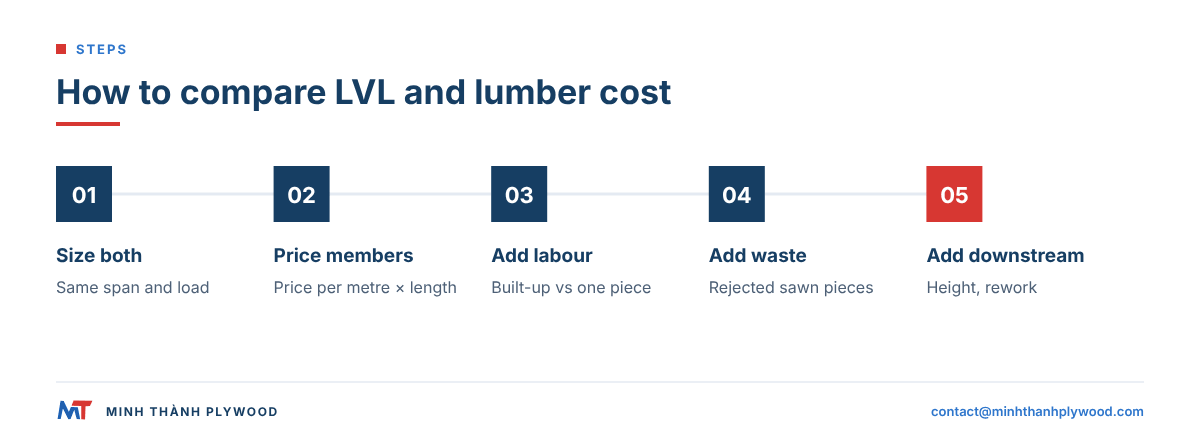
Compare cost in this order:
- Size both options for the same span and load. Use the engineer’s or manufacturer’s span tables, not the same section.
- Price the members. Price per metre × length for each option.
- Add labour. Built-up sawn headers need nailing or bolting; LVL goes in as one piece.
- Add waste. Allow for rejected sawn pieces that are bowed, twisted or split; LVL waste is mainly offcuts.
- Add downstream cost. Shallower beams save ceiling height; straight beams save rework on floors and plasterboard.
For non-structural uses such as furniture frames and packaging, cost is per finished part. LVL billets cut into rails and runners give high yield, because every piece is straight and free of wane. Our LVL price guide explains how billet price is built.
Stiffness, creep and moisture: how LVL and timber behave over time
LVL is stiffer, creeps less and moves less with moisture than sawn timber of the same species. It is dried as thin veneers before pressing, so it enters service near its equilibrium moisture content and has little shrinkage left to do.
- Moisture content. Our LVL is dried to 8–12 % moisture content, the normal range for indoor wood products; sawn structural lumber graded S-DRY is sold at 19 % or less and keeps drying after fixing.
- Shrinkage. Less shrinkage means fewer nail pops in plasterboard and fewer squeaks in floors.
- Creep. Under long-term load, both materials deflect more over time; design codes apply creep factors to both, and LVL’s lower variation keeps actual deflection close to the design.
- Outdoor exposure. Neither should stand in the weather without protection. LVL for exterior members needs a water-resistant bond and treatment or cover.
Is LVL stronger than plywood?
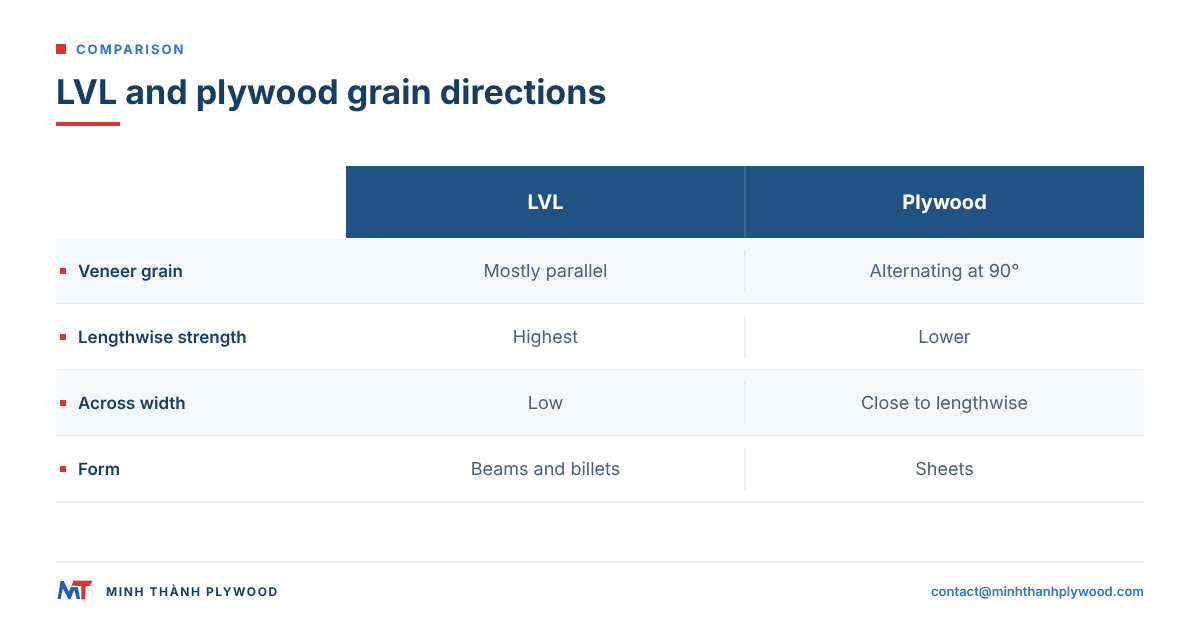
Along its length, yes, LVL is stronger than plywood, because almost all of its veneers run in one direction. Plywood alternates the grain of every layer, so it is weaker along the panel than LVL of the same thickness but stronger across it and far more stable in both directions.
| Property | LVL | Plywood |
|---|---|---|
| Veneer direction | Mostly parallel | Alternating at 90° |
| Strength along the length | Highest | Lower |
| Strength across the width | Low | Close to the lengthwise value |
| Typical form | Beams, billets, rails | Sheets |
| Splitting along grain | Possible at edges | Resisted by cross layers |
| Main uses | Beams, headers, frames, runners | Sheathing, furniture, formwork, packing |
Use LVL as a linear member that spans between supports; use plywood as a sheet that spans in two directions. Some products sit between the two, with a few cross-band veneers in LVL to reduce splitting.
Hardwood LVL vs softwood LVL
Hardwood LVL is made from veneers of denser species such as Eucalyptus or Acacia, softwood LVL from spruce, pine or Douglas fir. Hardwood LVL is denser and, at the same quality of veneer, stiffer and harder; softwood LVL is lighter and has the longest record of published structural values.
Our LVL uses locally grown plantation veneers:
- Acacia, density about 580 kg/m³.
- Eucalyptus, density 650–750 kg/m³.
The higher density gives better screw holding and edge hardness, which suits furniture frames, door components and packaging runners. For structural design, an LVL must have values from testing; the published softwood values above do not transfer to a hardwood product. Third-party testing to the buyer’s method is arranged through SGS on request.
How to specify LVL instead of solid timber
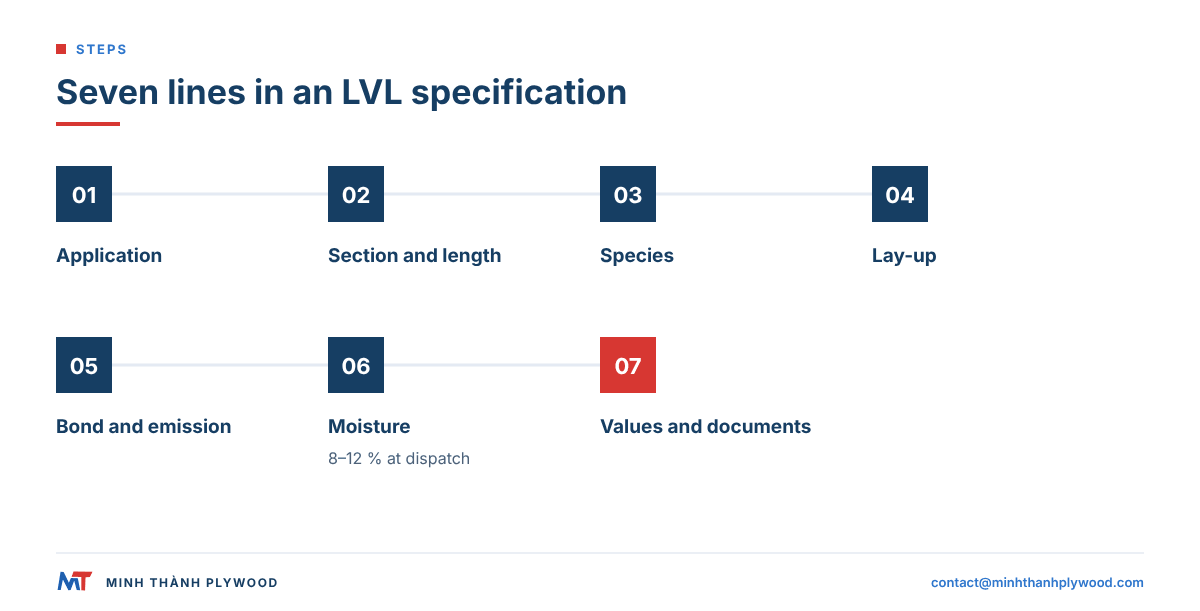
Specify LVL by the job it does: section, length, grain direction, bond, emission and, for structural members, the design values or evaluation the project needs. A clear specification avoids the common mistake of ordering by the word “LVL” alone.
- Application. Structural beam, furniture frame, door component or packaging runner.
- Section and length. Finished thickness, width and length, or billet size plus cutting plan. Our billet formats are 1220 × 2440 and 1250 × 2500 mm.
- Species. Acacia or Eucalyptus.
- Lay-up. All veneers parallel, or with cross-bands where splitting is a risk.
- Bond. UF glue at E0 emission for interiors (E1 as an option), MR or phenolic WBP for humid or exterior use.
- Moisture. 8–12 % at dispatch.
- Values and documents. Design values or tests required, plus the EUDR dossier, which we supply with orders.
What this means for your order
If your design calls for strength, length and straightness in a linear member, LVL outperforms solid timber of the same size, and it removes the sorting and rejects that come with sawn wood. If the member is short, lightly loaded or visible as traditional timber, sawn wood stays cheaper.
A typical LVL request:
LVL rails for sofa frames, Eucalyptus veneers, all-parallel lay-up, UF glue at E0 emission, billets 1220 × 2440 mm cut to the rail section on our drawing, moisture 8–12 %, 1×40HC to [your port].
We reply within hours, send free samples and quote material, cutting and packing together. MOQ is one 40HC; production is 15–45 days after the 30% deposit.
Buyer questions, answered
Is LVL stronger than wood?
Yes. LVL is stronger and stiffer than solid timber of the same section. A typical softwood LVL reaches about 44 N/mm² characteristic bending strength edgewise, against 24 N/mm² for C24 timber, because lamination disperses knots and grain defects.
Are LVL beams stronger than lumber?
Yes. In US design values, a 2.0E LVL has an allowable bending stress around 2,600 psi, against about 900 psi for No. 2 Douglas fir-larch dimension lumber, and a higher modulus of elasticity of 2.0 million psi against 1.6 million.
Is LVL stronger than plywood?
Along its length, yes, because almost all LVL veneers run in one direction. Plywood alternates the grain of each layer, so it is weaker along one axis but stronger across the panel and more stable in both directions.
Is LVL more expensive than solid timber?
Per metre of the same section, yes. Per unit of load carried, the gap narrows or disappears, because a smaller LVL section or fewer beams can replace a larger sawn section, and LVL avoids rejected pieces.
Can LVL be used outdoors?
Only with a water-resistant bond, such as phenolic WBP, and protection of faces and cut ends. Interior LVL with UF glue is for dry indoor use; structural LVL outdoors also needs a durability treatment or cover.
How long can LVL beams be?
LVL is made on continuous or long presses and then cut to length, so beams far longer than common sawn timber are possible. The limits are the press, transport and handling, not the tree.
Does LVL warp or twist like solid wood?
Much less. LVL is dried as thin veneers before pressing, and its many glue lines balance the stresses that make sawn timber bow, twist and check as it dries.
Can you cut or notch LVL beams on site?
You can cut LVL to length with ordinary saws. Notches, holes and tapers in structural beams must follow the manufacturer's rules or the engineer's drawing, because they cut through the veneers that carry the load.
What is the difference between LVL and glulam?
LVL is made from thin veneers about 3 mm thick, glulam from sawn lamellas about 40 mm thick. LVL is usually stronger per section and suits headers and beams; glulam suits large exposed sections and curved members.
What timber does Minh Thanh use for LVL?
Locally grown Acacia or Eucalyptus plantation veneers, with a density of about 580 kg/m³ for Acacia and 650–750 kg/m³ for Eucalyptus, dried to 8–12 % moisture. We supply the EUDR dossier with origin records and geolocation files.