
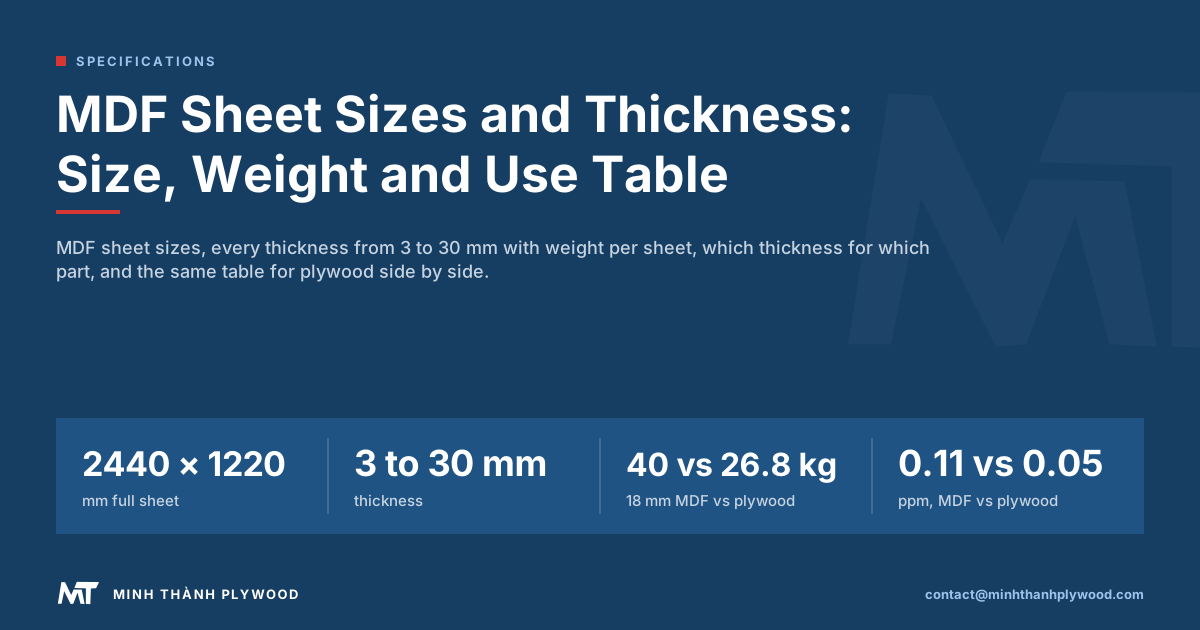
A standard MDF sheet is 2440 × 1220 mm (8 × 4 ft) and comes in thicknesses from 3 to 30 mm, with 18 mm the most used. At about 750 kg/m³ an 18 mm sheet weighs about 40 kg. Minh Thanh Plywood makes plywood, not MDF, so this guide sets each MDF size and weight next to the plywood panel a buyer would compare it with.
What sizes does an MDF sheet come in?
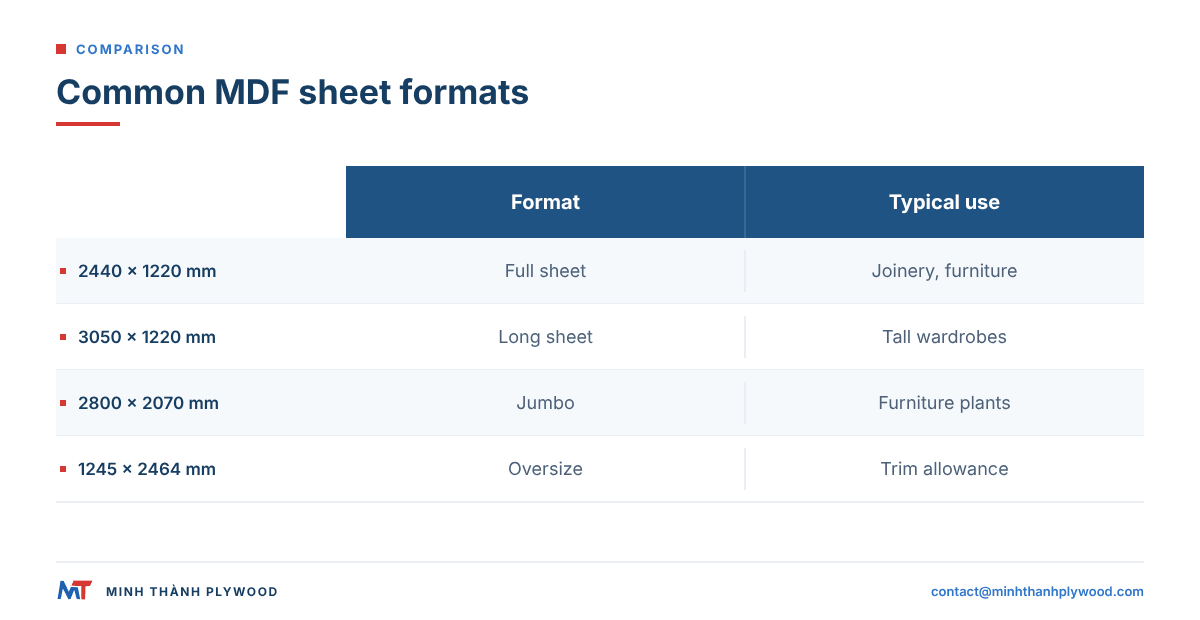
An MDF sheet comes in a standard 2440 × 1220 mm, the metric 8 × 4 ft, plus longer and wider formats made for furniture plants. Merchants also sell half and quarter sheets cut from the full board.
| Sheet size | Name | Where it is used |
|---|---|---|
| 2440 × 1220 mm | 8 × 4 ft, full sheet | Merchants, joinery, most furniture work |
| 3050 × 1220 mm | 10 × 4 ft, long sheet | Tall wardrobes, wall panels, long shelves |
| 2800 × 2070 mm | European jumbo board | Furniture plants cutting on panel saws |
| 1245 × 2464 mm | 49 × 97 in, oversize | Some North American mills, with trim allowance |
| Cut sizes | Half, quarter or to drawing | Retail, small workshops |
Plywood follows a similar pattern. The two plywood formats are 1220 × 2440 mm and 1250 × 2500 mm, and Minh Thanh adds custom sizes such as 1220 × 2500 and 1220 × 2280 mm. The plywood sheet sizes guide lists them in mm and feet.
A jumbo board yields more parts per sheet, with fewer offcuts, on a plant’s panel saw. A full 2440 × 1220 mm sheet is the format a small workshop or a builder can carry and cut.
MDF sheets in UK merchants: sizes, products and prices
UK merchants sell general-purpose MDF in 6, 9, 12 and 18 mm, and an 18 mm 2440 × 1220 mm sheet costs about £28 to £30 at Wickes (indicative retail, October 2026). Small formats are the popular buy: 1220 × 607 mm (4 × 2 ft), 1829 × 607 mm (6 × 2 ft), plus 1220 × 1220 mm (4 × 4 ft) and 915 × 915 mm (3 × 3 ft) cuts at some merchants.
| General-purpose MDF, Wickes | 606/607 × 1220 mm | 606/607 × 1829 mm | 2440 × 1220 mm |
|---|---|---|---|
| 6 mm | £13.50 | £17.50 | £18.00 to £20.50 |
| 9 mm | £14.50 | £18.50 | £20.00 to £22.75 |
| 12 mm | £16.50 | £21.00 | £23.00 to £26.00 |
| 18 mm | £21.00 | £27.00 | £28.00 to £30.00 |
Source: Wickes MDF sheets, read in October 2026; the two full-sheet prices are the listed and the lower current price. Prices exclude delivery.
The product range goes beyond plain boards:
| UK MDF product | What it is | Where to find it |
|---|---|---|
| General purpose (GP) | Standard interior MDF, raw | Wickes, B&Q, timber merchants |
| Moisture resistant (MR, green core) | Resin-treated for kitchens and bathrooms | B&Q, merchants, cut-to-size shops |
| Primed | Factory or shop-applied primer for paint | Cut-to-size shops, from £55 per side per m² |
| Beaded and primed beaded | Grooved panel for wall cladding, 6 mm | Wickes |
| Flexible MDF | Kerfed 6 mm panel for curved work | Wickes |
| Veneered, melamine, fire-retardant | Decorative or Euroclass boards | Cut-to-size shops, on request |
Cut-to-size norms in the UK. Cutmy cuts MDF from 3 to 25 mm on a CNC to ±1 mm, with a minimum part of 100 × 50 mm, cutouts at £10 each, drilled holes at £5, and primer at £55 per side per m² (Cutmy, MDF board, read in October 2026). The board itself is made to ±10 % plus 0.4 mm on thickness, so a 5 mm board can measure 4.1 to 5.9 mm.
Plywood as the lighter alternative. An 18 mm MDF sheet weighs about 40 kg against 26.8 kg for an 18 mm Styrax-core plywood sheet, a saving on every lift and shipment. Plywood also holds screws on its edge, where MDF splits.
What thicknesses does MDF come in?
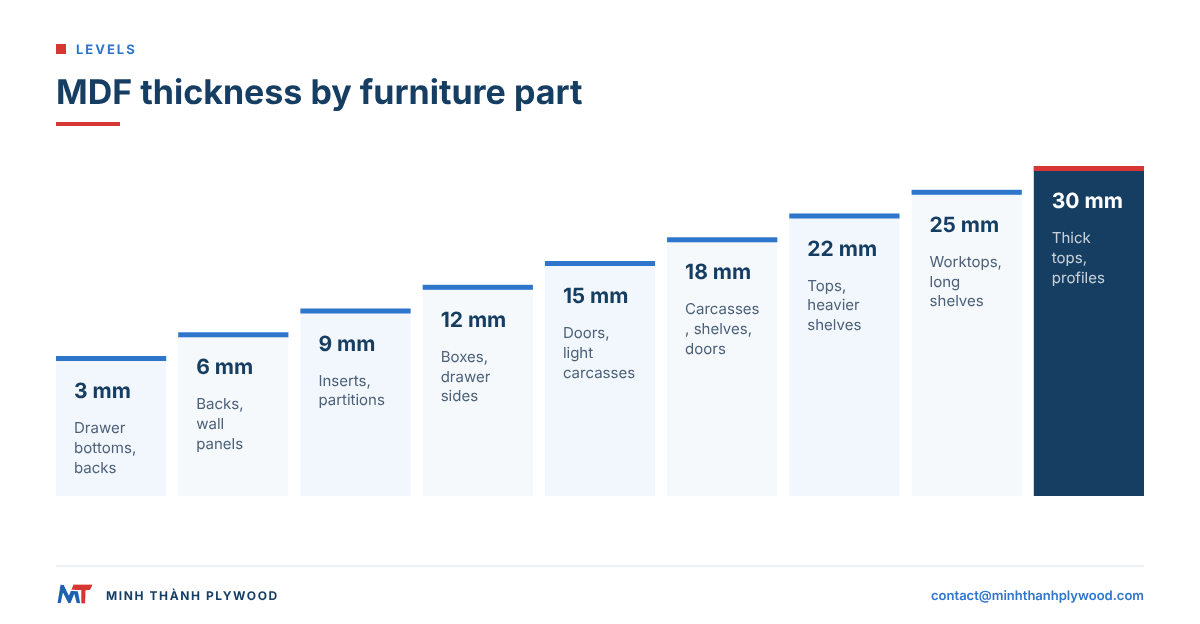
MDF comes in thicknesses from about 2.5 mm up to 30 mm and more, and 18 mm is the most used sheet. The table gives each common thickness, its nearest inch size and the job it usually does.
| MDF thickness | Nearest inch size | Typical use |
|---|---|---|
| 3 mm | 1/8 in | Drawer bottoms, cabinet backs, templates |
| 6 mm | 1/4 in | Cabinet backs, wall panelling, signs |
| 9 mm | 3/8 in | Panel inserts, light partitions, boxes |
| 12 mm | 1/2 in | Small boxes, drawer sides, mouldings |
| 15 mm | 5/8 in | Cabinet doors, light carcasses |
| 18 mm | 3/4 in | Carcasses, shelves, doors, furniture |
| 22 mm | 7/8 in | Tops, heavier shelves |
| 25 mm | 1 in | Worktops, long shelves, table tops |
| 30 mm | 1 3/16 in | Thick tops, stair parts, machined profiles |
The inch sizes are nearest matches, not exact. A 3/4 inch MDF sheet is 19.05 mm and an 18 mm sheet is 18 mm; hinge and drawer-runner settings change by the difference.
Plywood runs a similar range. Minh Thanh makes plywood from 3 to 40 mm, and the plywood thickness guide lists each panel with its ply count.
MDF sheet weight by thickness, next to plywood
A 2440 × 1220 mm MDF sheet weighs about 2.2 kg for every millimetre of thickness at a typical 750 kg/m³: 13.4 kg at 6 mm, 26.8 kg at 12 mm and 40.2 kg at 18 mm. Plywood of the same size is a third lighter on a Styrax core.
| Thickness | MDF, 750 kg/m³ | Plywood, Styrax core, 500 kg/m³ | Plywood, Eucalyptus core, 650 kg/m³ |
|---|---|---|---|
| 3 mm | 6.7 kg / 15 lb | 4.5 kg | 5.8 kg |
| 6 mm | 13.4 kg / 30 lb | 8.9 kg | 11.6 kg |
| 9 mm | 20.1 kg / 44 lb | 13.4 kg | 17.4 kg |
| 12 mm | 26.8 kg / 59 lb | 17.9 kg | 23.2 kg |
| 15 mm | 33.5 kg / 74 lb | 22.3 kg | 29.0 kg |
| 18 mm | 40.2 kg / 89 lb | 26.8 kg | 34.8 kg |
| 22 mm | 49.1 kg / 108 lb | 32.7 kg | 42.6 kg |
| 25 mm | 55.8 kg / 123 lb | 37.2 kg | 48.4 kg |
Weight = length × width × thickness × density. The MDF column uses 750 kg/m³ as a typical figure; a light MDF of 650 kg/m³ or an HDF over 800 kg/m³ moves the result in proportion.
Weight decides more than freight. An 18 mm MDF sheet of 40 kg is a two-person lift; a 27 kg plywood sheet of the same size is one person’s load. A wardrobe door or a kitchen wall unit in plywood also puts less load on hinges and wall fixings.
18 mm MDF sheet: size, weight and what it is used for
An 18 mm MDF sheet is 2440 × 1220 mm, weighs about 40 kg, and is the standard board for carcasses, shelves, doors and painted furniture. It is the thickness most kitchen and wardrobe hardware is designed around.
What an 18 mm MDF sheet does well:
- Painted doors and fronts. The fine, even surface takes primer and paint without grain showing through.
- Routed profiles. Shaker frames, grooves and edge moulds machine cleanly, because the board has no plies.
- Flat panels. A balanced board stays flat in a dry room.
Where 18 mm plywood is the stronger choice:
- Shelves under load. Plywood is stiffer per kilogram, so it sags less at the same span.
- Edge screws and hinges. Plies hold screws at the edge; MDF can split there and needs pilot holes and edge distance.
- Damp rooms. Bathroom and kitchen sink units, where a wet edge would swell MDF.
At 18 mm, Minh Thanh’s sanded furniture plywood is held to ±0.2–0.3 mm thickness tolerance, which matters for the same hardware settings that make 18 mm MDF popular.
6 mm, 9 mm and 12 mm MDF: thin and mid-thickness sheets
6 mm MDF is the usual back panel and wall lining, 9 mm a panel insert or light partition, and 12 mm a box, drawer side or moulding board. None of the three is a load-bearing shelf.
- 6 mm MDF, 13.4 kg per full sheet. Cabinet backs fixed in a groove, wall panelling, signboards and templates. It bends under its own weight if stored on edge without support.
- 9 mm MDF, 20.1 kg. Door panel inserts in a frame, light partitions, display backs and boxes. It takes a pinned or glued joint, not a screw in the edge.
- 12 mm MDF, 26.8 kg. Drawer sides, small boxes and cabinets, routed signs and skirting. A screw into the face holds; a screw into the edge needs a pilot hole.
For the same parts in plywood, thin panels from 3 to 5 mm at Minh Thanh are always 5-ply. A 6 mm Styrax-core panel weighs 8.9 kg per sheet, a third less than 6 mm MDF, and can be bent to a curve that MDF of the same thickness would crack on.
How thick should MDF be for furniture and cabinets?
Cabinet carcasses and shelves need 18 mm MDF, doors 16–18 mm, backs 3–9 mm and worktops 25 mm or more. Thickness follows the load, the span and the hardware.
| Part | MDF thickness | Plywood alternative | Why |
|---|---|---|---|
| Cabinet carcass sides | 18 mm | 18 mm furniture plywood | Hinge plates and runners need 16–19 mm |
| Shelves up to 800 mm span | 18 mm | 18 mm plywood | Light to medium loads |
| Shelves over 800 mm span | 25 mm or support | 18 mm Eucalyptus core | MDF sags over time under load |
| Doors | 16–18 mm | 18 mm plywood, banded edge | Hinge cups need about 13 mm of material |
| Backs | 3–9 mm | 3–6 mm thin plywood | Closing the cabinet, not carrying load |
| Drawer bottoms | 3–6 mm | 4–6 mm plywood | Light load, groove-fitted |
| Worktops and table tops | 25–30 mm | 25 mm plywood | Stiffness over a wide span |
The most common mistake is one thickness for every part. A wardrobe built entirely of 18 mm MDF is heavy for its job; backs and drawer bottoms in a thin board save weight and cost without losing strength where it matters.
Stiff Eucalyptus-core plywood is the usual answer for long shelves. At about 650 kg/m³, it is denser than Styrax and stiffer, and still lighter than MDF.
MDF density grades: light MDF, standard MDF and HDF
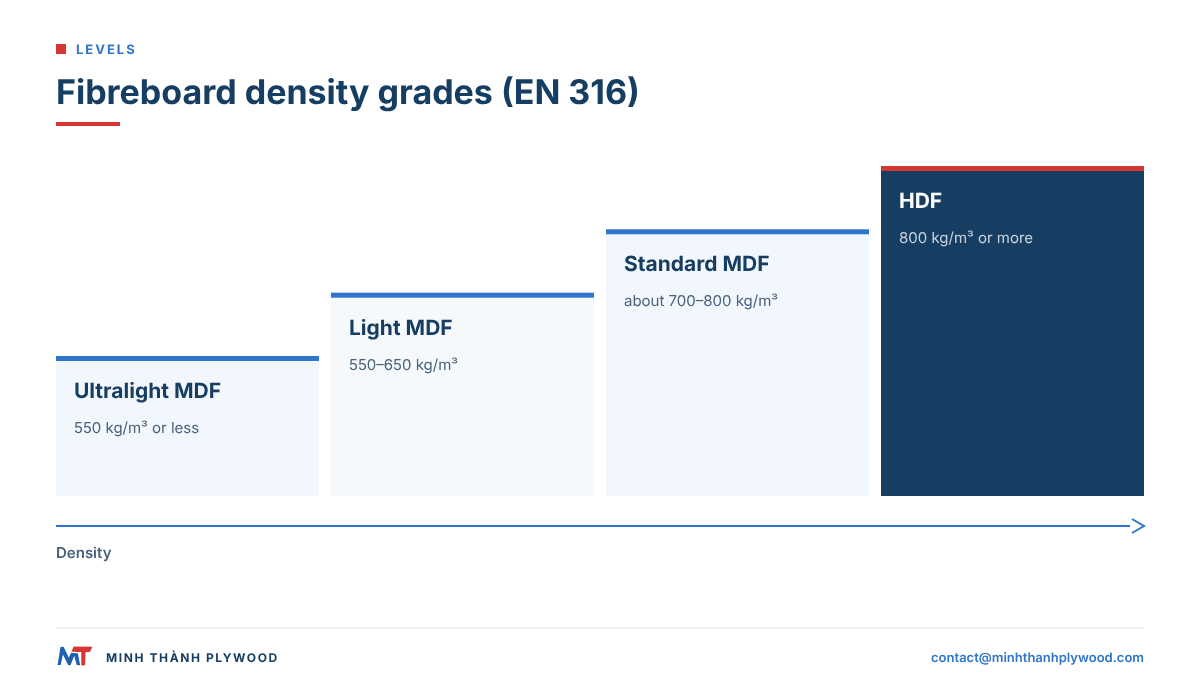
MDF density decides weight, screw holding and how well the board machines. The European fibreboard definitions in EN 316 set the names by density.
| Grade | Density | Use |
|---|---|---|
| Ultralight MDF | 550 kg/m³ or less | Displays, light furniture, shopfitting |
| Light MDF | 550–650 kg/m³ | Light furniture, panels to carry by hand |
| Standard MDF | about 700–800 kg/m³ | Most furniture and joinery |
| HDF | 800 kg/m³ or more | Door skins, drawer bottoms, flooring cores |
The density on a datasheet is an average. MDF is denser at both faces than in the middle, which is why the face takes paint and screws well and a routed edge in the middle is softer.
Plywood densities depend on the wood, not on pressing. Styrax-core plywood is about 500 kg/m³, Acacia about 580 kg/m³ and Eucalyptus about 650 kg/m³; even the heaviest of the three sits below standard MDF.
MDF types: standard, moisture-resistant and load-bearing
European MDF is classed in EN 622-5 by where it is used: MDF for dry use, MDF.H for humid conditions, MDF.LA for load-bearing parts in dry conditions, and MDF.HLS for load-bearing parts in humid conditions. A datasheet names the class, not just “MR”.
- MDF (dry). General furniture and joinery in heated rooms.
- MDF.H (humid). Moisture-resistant boards, often dyed green, for kitchens and bathrooms; they resist humidity, not liquid water on the edge.
- MDF.LA (load-bearing, dry). Boards with tested strength values for structural parts indoors.
- MDF.HLS (load-bearing, humid). The load-bearing class for humid conditions.
Fire-rated MDF, often dyed red, is a separate product tested to a fire standard; the reaction-to-fire class must be on its declaration.
Plywood covers damp and exterior work by glue rather than by board class. Minh Thanh makes furniture plywood in UF glue at E0 emission, and MR, melamine-fortified or phenolic (WBP) bonds on order. Exterior and CDX-type panels use water-resistant melamine-fortified or phenolic glue.
Is MDF heavier than plywood?
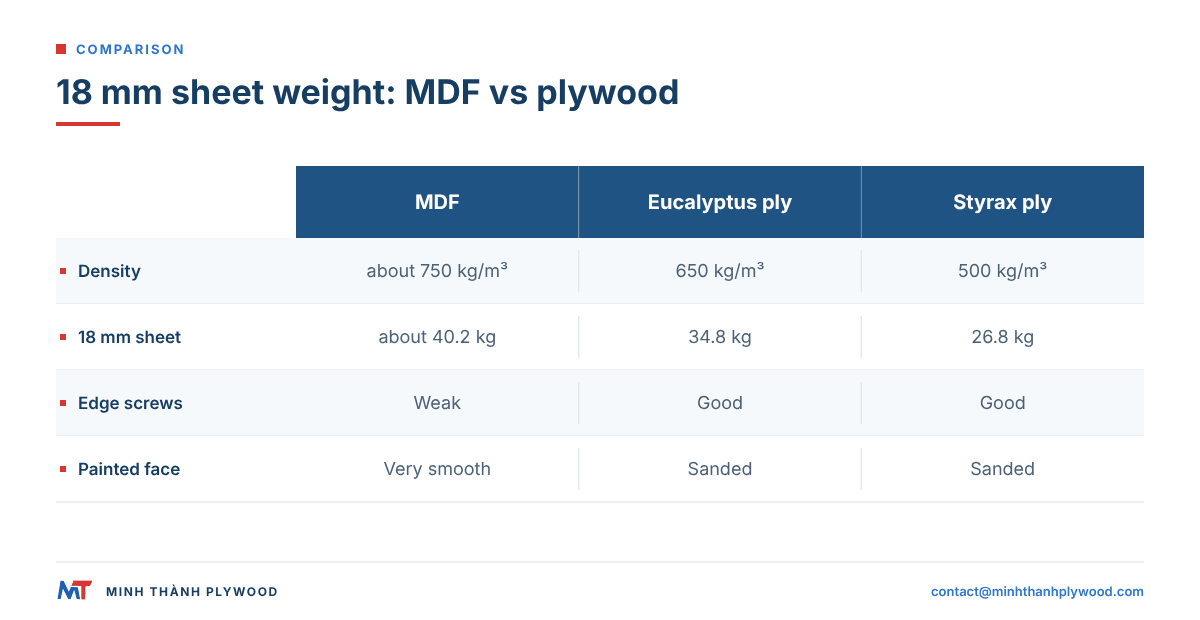
Yes, MDF is heavier than plywood of the same size and thickness: standard MDF is about 700–800 kg/m³, Styrax-core plywood about 500 kg/m³ and Eucalyptus-core plywood about 650 kg/m³.
At 18 mm on a 2440 × 1220 mm sheet:
- MDF at 750 kg/m³: about 40.2 kg.
- Eucalyptus-core plywood: 34.8 kg.
- Styrax-core plywood: 26.8 kg.
The difference grows with volume. A 40HC of 18 mm Styrax-core plywood holds 990 sheets, about 53 m³, at 26.8 kg per sheet. The same number of MDF sheets at 40 kg would weigh about 39,800 kg, far over a 28,000 kg planning payload, so an MDF container carries fewer sheets.
For flat-pack furniture, weight changes the carton, the courier band and the person carrying it upstairs. Plywood cuts it by about a third on a Styrax core.
Is MDF stronger than plywood? Is plywood better than MDF?
Plywood is stronger than MDF in bending, screw holding and water resistance; MDF is better for a smooth painted face and for routed shapes. The better panel is the one that suits the part, so choose by the load, the moisture and the finish the part has to carry.
| Property | MDF | Plywood |
|---|---|---|
| Stiffness per kilogram | Lower | Higher: cross-laid veneers |
| Screw holding in the edge | Weak, can split | Good, plies grip the thread |
| Face for paint | Very smooth, no grain | Smooth when sanded; grain can show |
| Routed profiles | Clean, even | Plies show in the profile |
| Water on the edge | Swells | Depends on the glue; WBP resists |
| Weight, 18 mm sheet | About 40 kg | 26.8–34.8 kg by core |
| Flatness in a dry room | Very good | Very good with a balanced build |
Many furniture makers use both: plywood for the carcass, shelves and drawers, MDF for painted fronts. The birch plywood vs MDF guide compares the two for furniture parts.
Plywood’s strength depends on its build. At Minh Thanh the core layers are stitched horizontally and vertically, and furniture panels are pressed twice: the core board is pressed and calibrated, then face and back are pressed on.
MDF cut to size: what to put on the order
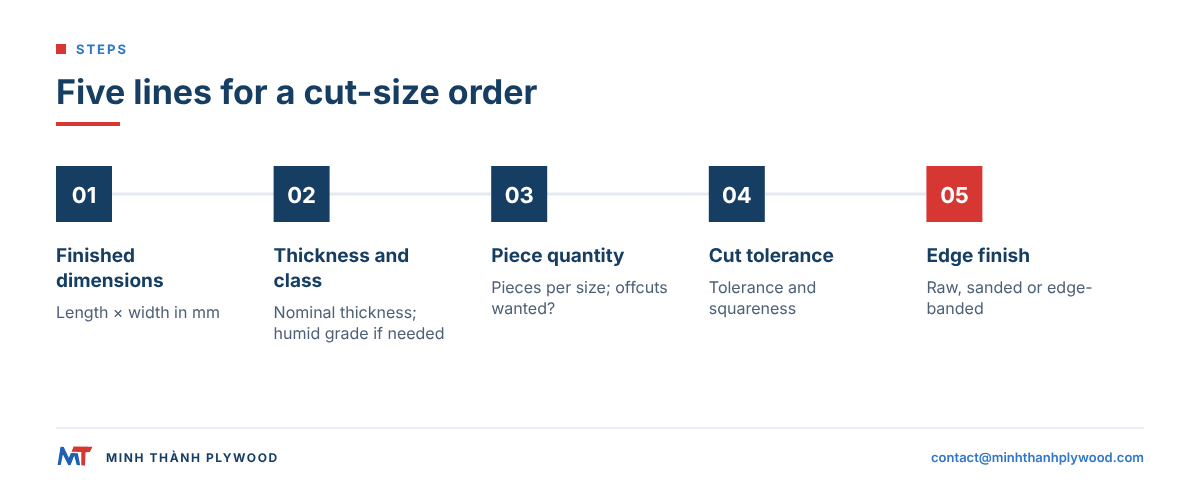
MDF cut to size needs five lines on the order: finished length × width, thickness, the number of pieces, the cut tolerance and the edge finish. Merchants cut from full sheets on a panel saw.
- Finished size. Length × width in mm, grain-free, so either way round is the same part.
- Thickness. Nominal, such as 18 mm, and the MDF class if the part is for a damp room.
- Quantity. Pieces per size, and whether offcuts are wanted.
- Tolerance. Cut tolerance and squareness for parts that meet.
- Edges. Raw, sanded, or edge-banded.
For plywood parts the same five lines apply, and plywood adds the face direction because veneer has a grain. Minh Thanh’s cut-to-size plywood cuts one panel into 4, 6 or 8 pieces at the factory, and ships it regularly to Italy and other European markets.
MDF emission limits: CARB, TSCA Title VI and E1
MDF sold in the US must meet 0.11 ppm formaldehyde, or 0.13 ppm for thin MDF up to 8 mm, under CARB Phase 2 and TSCA Title VI. Hardwood plywood has a lower limit, 0.05 ppm.
| Product | CARB Phase 2 / TSCA Title VI limit |
|---|---|
| Hardwood plywood, veneer core | 0.05 ppm |
| MDF | 0.11 ppm |
| Thin MDF, 8 mm or less | 0.13 ppm |
| Particleboard | 0.09 ppm |
The limits are set in California’s Composite Wood Products Regulation and the US EPA’s TSCA Title VI formaldehyde standards, codified at 40 CFR 770.10 (checked October 2026).
In Europe, E1 under EN 13986 is the base class for wood-based panels.
Minh Thanh’s furniture plywood holds CARB P2 / TSCA Title VI certification as ICTT mill no. 23024. Six ASTM D6007 chamber tests from April 2025 to June 2026, on 9, 15 and 18 mm panels, averaged 0.014–0.032 ppm against the 0.05 ppm limit; three were run by Shanghai Hongjun and three by ICTT Vietnam.
MDF vs HDF: which one for thin parts?
HDF is the denser fibreboard, 800 kg/m³ or more, made thin for door skins, drawer bottoms, cabinet backs and flooring cores; MDF is the general board for thicker parts. For a thin part that carries load, HDF holds better than MDF.
Where each one fits:
- HDF, 2.5–6 mm. Moulded door skins, drawer bottoms, back panels in flat-pack furniture, laminate flooring cores.
- MDF, 6–30 mm. Carcasses, doors, shelves and routed fronts.
- Thin plywood, 3–6 mm. Backs and drawer bottoms that must flex, take a screw near the edge, or show a wood face.
A 4 mm thin plywood panel from Minh Thanh is 5-ply, with three core veneers and two faces, so it can carry load and bend where a thin fibreboard would crack.
What this means for your order
Order MDF by size, thickness and class, and set each part beside its plywood alternative before you fix the bill of materials. Where a part carries load, takes edge screws or may get wet, plywood is the panel to price.
A plywood line for the carcass of a painted-front kitchen reads:
18 mm furniture plywood, white Styrax core, UF glue at E0 emission, poplar face B/B for overlay, 1220 × 2440 mm, ±0.2–0.3 mm thickness tolerance, one 40HC.
Minh Thanh supplies one 40HC as the minimum, with mixed specifications by agreement, and free samples. Send the parts list with thicknesses, and we propose the plywood build for each part next to its MDF size. Browse the plywood product range for the faces and cores.
Buyer questions, answered
What size is a full sheet of MDF?
A full sheet of MDF is 2440 × 1220 mm, the metric 8 × 4 ft. Longer 3050 × 1220 mm sheets and European jumbo boards of 2800 × 2070 mm are also made.
What thicknesses does MDF come in?
MDF comes from about 2.5 mm up to 30 mm and more; the common sheets are 3, 6, 9, 12, 15, 18, 22, 25 and 30 mm. In inches, 1/4, 1/2, 5/8 and 3/4 inch are the usual sizes.
How much does an 18 mm MDF sheet weigh?
An 18 mm MDF sheet of 2440 × 1220 mm weighs about 40 kg (89 lb) at a typical 750 kg/m³. The same size in 18 mm Styrax-core plywood weighs about 27 kg.
Is MDF heavier than plywood?
Yes. Standard MDF is about 700–800 kg/m³ and furniture plywood on a Styrax core about 500 kg/m³, so an MDF sheet is around half as heavy again at the same size and thickness.
Is MDF stronger than plywood?
No for bending stiffness, screw holding at the edge and water resistance; plywood wins on all three. MDF is better for a flat, smooth face to paint or for routed profiles.
Is plywood better than MDF?
For carcasses, shelves, doors that must hold hinges, and anything that may see moisture, plywood is the better panel. For painted fronts and routed decorative parts MDF is the usual choice.
How thick should MDF be for cabinets?
Cabinet carcasses and shelves use 18 mm MDF, doors 16–18 mm, and backs 3–9 mm. Shelves spanning more than about 800 mm need 25 mm or a support.
Can MDF be cut to size?
Yes. Merchants cut MDF to size; give finished length × width, thickness, the number of pieces and the cut tolerance. For plywood, Minh Thanh cuts one panel into 4, 6 or 8 pieces at the factory.
What is the formaldehyde limit for MDF?
Under CARB Phase 2 and TSCA Title VI the limit is 0.11 ppm for MDF and 0.13 ppm for thin MDF up to 8 mm, against 0.05 ppm for hardwood plywood.
What is the difference between MDF and HDF?
Density. Under EN 316, HDF is fibreboard of 800 kg/m³ or more; standard MDF sits below that, usually around 700–800 kg/m³. HDF is used thin, for door skins, drawer bottoms and flooring cores.