
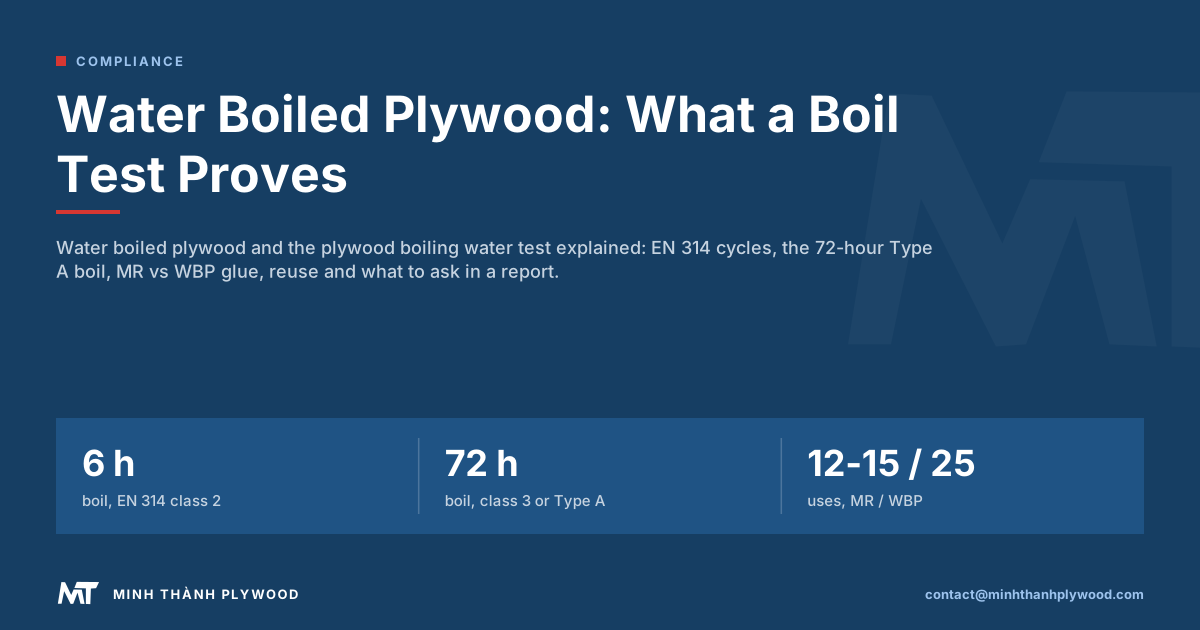
Water boiled plywood is plywood whose glue line has survived a set number of hours in boiling water without the plies coming apart. The hours only mean something next to the method, the glue and the pass rule. Minh Thanh Plywood makes UF, melamine-fortified and phenolic WBP bonds in Vietnam; this guide reads each boil result the way a buyer should.
What is water boiled plywood?
Water boiled plywood is plywood whose glue line has passed a boiling water test: small specimens cut from the panel are boiled for a set number of hours, cooled, and then pulled or chiselled apart to see whether the bond held. The test grades the glue line, not the wood, the face or the emission.
Most buyers who search for water boiled plywood mean WBP plywood. WBP stands for “weather and boil proof”. The term comes from British Standard BS 1203:1963, which sorted plywood glues into four durability categories, with WBP as the one that survives outdoor exposure and long boiling. Some quotes expand the same letters as “water boiled proof”; the product is the same, and it is a glue category, not a boiling time.
The hours on a quote, 6, 12, 24 or 72, only mean something next to three more facts: the test method, the glue system and the pass rule. A 12-hour result from a factory water tank and a 72-hour result under a national standard are different tests. This guide puts them side by side.
What is a plywood boiling water test, step by step?
A plywood boiling water test cuts specimens from the panel, boils them for a set time, cools them, and checks the glue lines for delamination or strength. The European version measures shear strength on a test machine; the Australian version chisels the plies apart and reads the wood fibre left on the glue line.
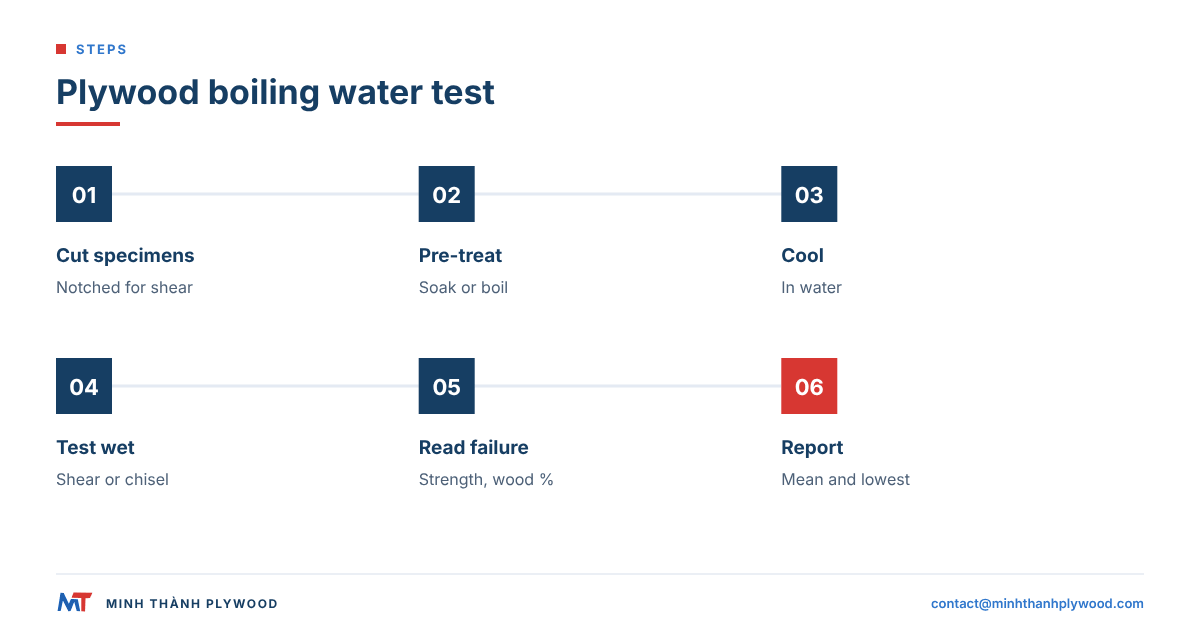
A typical sequence in a laboratory runs like this:
- Cut specimens from the panel to the size the method sets, with notches that put each glue line under shear.
- Pre-treat them in water: soak, boil, or boil, dry and boil again, as the method orders.
- Cool them in water at room temperature so every specimen starts the strength test in the same state.
- Test them wet: load each specimen to failure in shear, or split the glue lines with a chisel.
- Read the failure: record the shear strength and the share of the failed surface that is torn wood rather than bare glue.
- Report the mean and the lowest values against the class the method sets.
A quick factory check skips step 4: boiled pieces are judged by eye for open glue lines. That check is useful on the production floor, and a buyer should know which of the two a result comes from.
EN 314, Type A bond and factory boils: which method gives which hours?
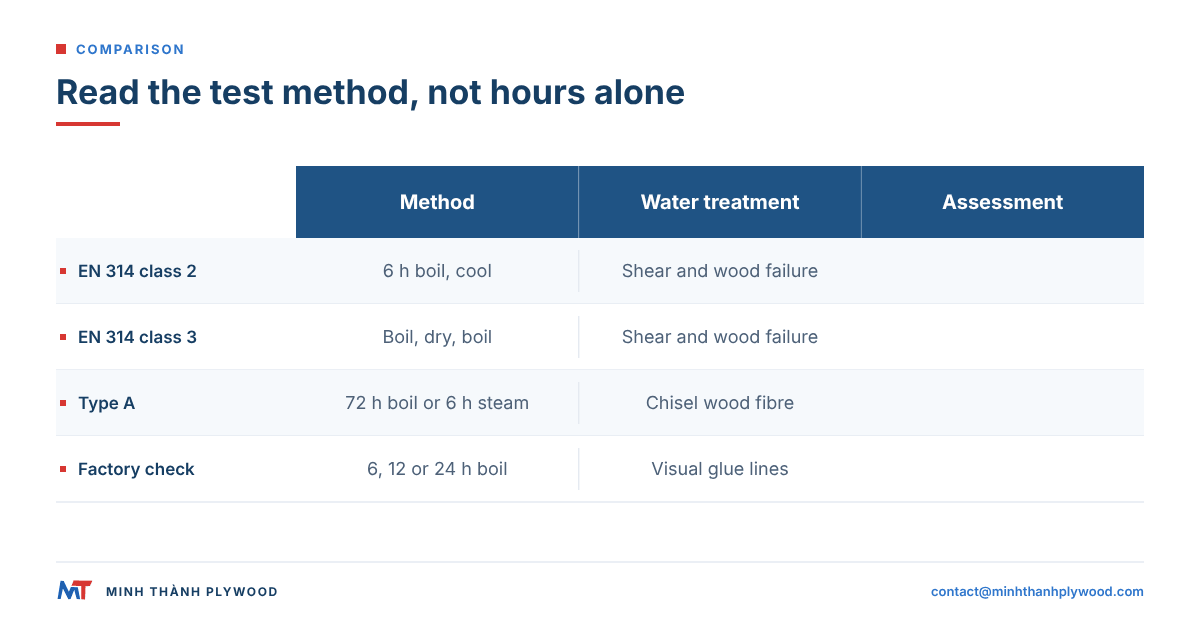
EN 314-1 sets three water pre-treatments, the Australian and New Zealand Type A bond uses a 72-hour boil, and many Asian mills run their own hot-water or boil checks of 6 to 24 hours. Each pairs a set duration with a pass rule, so compare like with like.
| Method | Water treatment | Proves the bond for | Pass rule |
|---|---|---|---|
| EN 314-1, pre-treatment for class 1 | 24 h soak in water at about 20 °C | Dry interior use | Shear strength and wood failure to EN 314-2 |
| EN 314-1, pre-treatment for class 2 | 6 h in boiling water, then cooled in water | Humid conditions, short wetting | Shear strength and wood failure to EN 314-2 |
| EN 314-1, pre-treatment for class 3 | 4 h boil, dry 16–20 h at 60 °C, 4 h boil, cool | Exterior exposure | Shear strength and wood failure to EN 314-2 |
| EN 314-1, alternative for class 3 | 72 h in boiling water, then cooled | Exterior exposure | Shear strength and wood failure to EN 314-2 |
| AS/NZS Type A bond (structural plywood, formply) | 72 h boil, or 6 h steaming at 200 kPa | Full weather exposure, long-term load | More than 50% wood fibre left on the glue line after chiselling |
| AS 6669 formply (F17 and other grades) | Type A bond, tested as above | Concrete formwork, repeated wetting | Type A pass rule plus the formwork standard’s branding |
| Factory boil check | 6, 12 or 24 h in a boiling tank, set by the mill | The glue line of that production run | Visual: no open glue lines after cooling |
The Engineered Wood Products Association of Australasia (EWPAA) design guide for structural plywood describes the Type A test as a 72-hour boil or 6 hours of steaming, followed by a chisel test on each glue line. In Australia the same bond test sits under AS/NZS 2269 for structural plywood and AS 6669 for F17 formply, so an Australian buyer reads “Type A” and “72 h boil” where a European buyer reads “EN 314 class 3”. EN 314-1 and EN 314-2 are European standards sold by the national standards bodies. BSI lists the bonding-quality requirements as BS EN 314-2.
Can you check plywood at home with a quick water test?
A quick home check cannot replace a laboratory boil, but it shows a weak glue line in minutes. Take a small offcut of the panel, soak it and watch the edges; for a stronger check, boil a 50 mm strip for 6 hours and then try to open the glue line with a chisel.
- Soak an offcut in water for 24 hours. Swelling at the edges is normal; plies lifting or glue lines opening are not.
- Dry it and look at the edge. A dark reddish-brown glue line fits a phenolic bond; a pale line under a WBP label is worth a question.
- Boil a 50 mm strip for 6 hours, let it cool, then push a chisel into each glue line. Wood fibre torn from the veneer means the glue is stronger than the wood; a clean, shiny glue surface means the bond failed.
- Repeat on three offcuts from different sheets of the lot. One good piece proves little.
This is the same logic as the Type A chisel test, run on a stove instead of in a laboratory. Free samples from Minh Thanh Plywood are cut to be tested this way, and a certified result comes from a third-party laboratory when the order needs one.
What do 6, 12, 24 and 72 hours of boiling really mean?
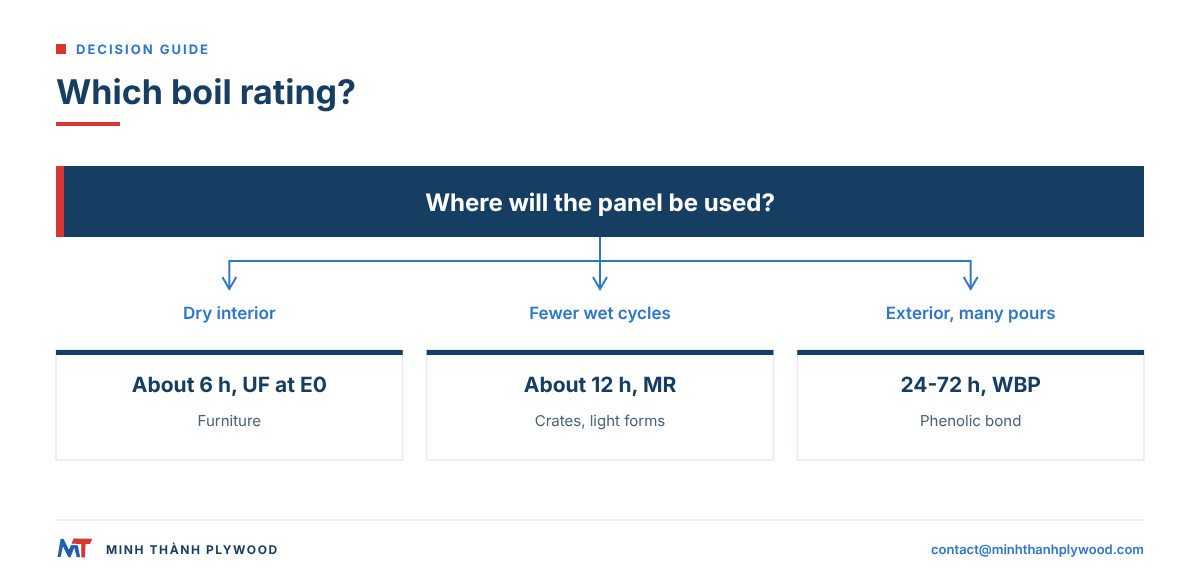
Six hours of boiling is the class 2 step for humid conditions; 12 to 24 hours is a factory measure of a stronger, melamine-fortified or phenolic bond; 72 hours is the long test behind exterior class 3 and the Australian Type A bond. More hours means a harder test, not a different product.
| Boil time | What a pass usually shows | Typical glue | Typical use |
|---|---|---|---|
| About 6 h | Bond holds through humid exposure and short wetting | UF at E0 emission, or MR | Furniture, kitchen and bathroom carcasses, interiors |
| About 12 h | Bond holds through repeated wetting | Melamine-fortified (MR) | Formwork with fewer pours, outdoor parts under cover |
| About 24 h | Bond holds through long wet exposure | Phenolic WBP | Formwork with many pours, packaging for wet routes |
| 72 h | Bond is weatherproof under a national exterior test | Phenolic WBP | Exterior structures, Type A formply, outdoor work |
In Vietnamese mills, a UF bond at E0 emission typically holds about 6 hours in a boil test. A 12-hour boil for outdoor use needs melamine fortification, and that usually moves emission from E0 to E1. A phenolic bond is the one built for 24 and 72 hours.
These hours are bond facts. They do not say how flat the panel is, how thick the faces are, or how many pours a formwork sheet will give on your site.
WBP vs MR plywood: what does the boil test show?
The boil test separates WBP from MR plywood quickly: a phenolic WBP bond holds through long boiling, while a melamine-fortified MR bond holds for shorter boils and limited wetting. Both are water-resistant glues; they differ in how long they survive heat and water together.
| Property | MR (melamine-fortified) bond | WBP (phenolic) bond |
|---|---|---|
| Typical boil result | About 12 h without open glue lines | 24 h and up to 72 h under exterior tests |
| Glue line colour | Light | Dark reddish-brown |
| Hot-press temperature | About 110–120 °C | About 130–145 °C |
| Typical uses | Humid interiors, crates, formwork with fewer pours | Exterior work, formwork with many pours, wet routes |
| Film-faced reuse, with proper handling, release agent and edge sealing | About 12–15 uses | Up to about 25 uses |
The glue line colour is the fastest check on a sample. Cut an edge: a dark line under a WBP label fits a phenolic bond; a pale line under a WBP label is worth a question before the order.
Why is plywood boiled in a test at all?
Plywood is boiled because hot water attacks a glue line far faster than weather does. A few hours at 100 °C swell and shrink the veneers and soften weak resin the way months of rain and sun would, so a mill and a buyer can sort a durable bond from a weak one in a day.
Boiling also exposes a poorly cured bond. A glue line pressed too cool, too short or with too little glue can look sound when dry and still open after a few hours in boiling water. That makes the boil test one of the most useful checks on a production run.
It does not replace a strength test for structural design. Bending strength and stiffness come from separate tests and, in Australia, from the stress grade; the boil test only says the plies stay together.
What does a boil test not prove?
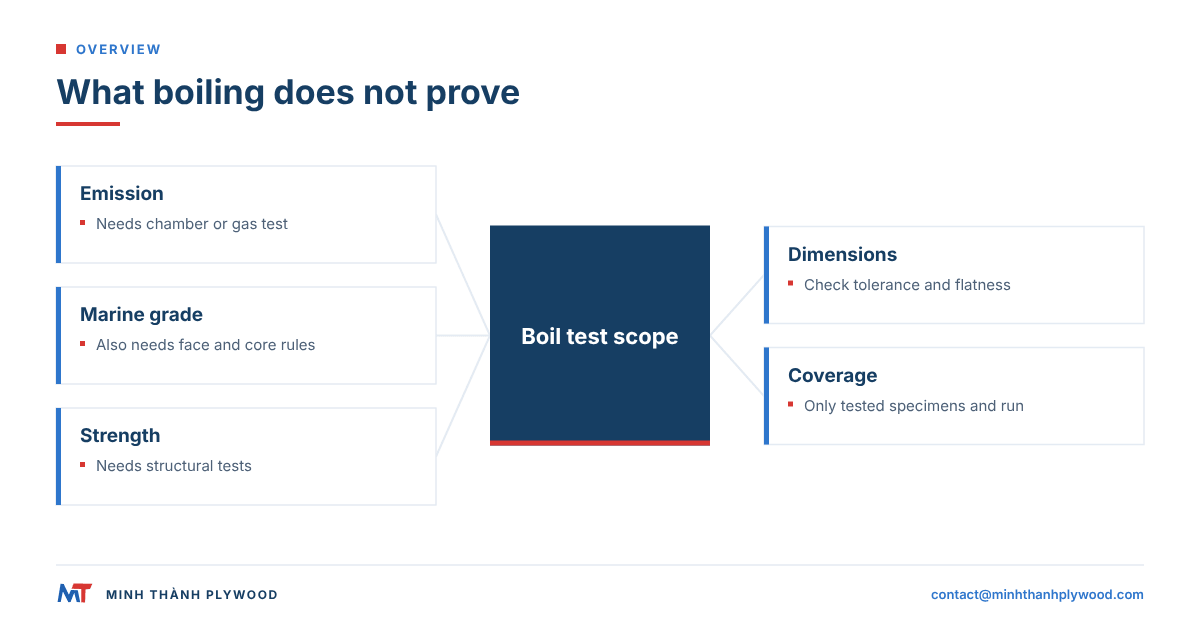
A boil test proves the glue line holds; it does not prove face quality, core gaps, thickness tolerance, emission or the number of pours a formwork panel will give. A panel with a strong boil result and a gappy core still fails early on site.
- Not formaldehyde emission. Emission is measured in a chamber or by gas analysis; a boil result says nothing about E0 or CARB P2.
- Not marine grade. Marine standards also set species, durability, gaps and face quality.
- Not a structural stress grade. F17 or EN 636 classes need their own tests.
- Not every sheet. A boil result describes the specimens tested and the run they came from.
- Not flatness or tolerance. Those are measured on whole sheets.
A boil result is one line of evidence among several. Read it with the glue type, the core build and the thickness tolerance on the same specification.
How do boil hours relate to formwork reuse cycles?
A boil test checks bond durability but does not predict a formwork reuse count. For film-faced plywood, a melamine-fortified bond gives about 12–15 uses and a phenolic WBP bond up to about 25, with proper handling, release agent and edge sealing.
Site conditions and panel construction decide the reuse count. Five things move the real count:
- Glue: phenolic WBP lasts more wet cycles than MR.
- Film: heavier film from 135 g/m² wears more slowly than standard film.
- Core: a calibrated core with no gaps keeps the film flat and keeps water out.
- Edges: cut edges and tie holes sealed on the day they are made.
- Handling: panels stored flat, off the ground and covered.
Our guide to film-faced plywood covers the film and core choices for formwork.
How do Vietnamese mills run a boil check?
Vietnamese mills run the boil check on offcuts from each production run: pieces go into a boiling water tank for the hours that match the glue system, are cooled, and are checked by eye and by hand for open glue lines. Results go into the run’s QC record.
A boil check works best next to the other glue-line controls on a plywood line. The glue spread is weighed on the veneer, the press runs at about 110–120 °C for an MR bond and about 130–145 °C for a WBP bond, and the panels cool before sanding. A failed boil sends the run back to these settings.
For a buyer, the useful question is which glue system and press settings the order will use, and which boil check goes with them. Write that on the order rather than asking for a number alone.
What should a boil test report show?
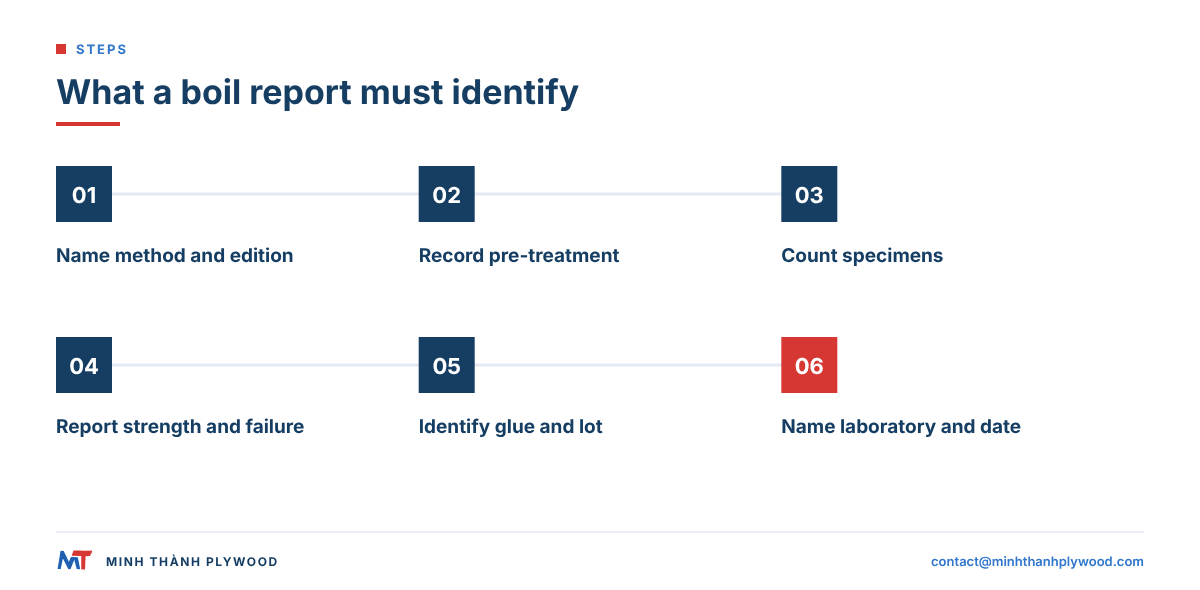
A boil test report should show the method and its edition, the pre-treatment, the number of specimens, each result and the mean, the pass rule, and the identity of the sample: thickness, species, glue and production lot. A report with only “passed 72 hours” leaves most of these open.
| Line on the report | Why it matters |
|---|---|
| Method and edition (EN 314-1 / EN 314-2, AS/NZS Type A, factory method) | Sets the hours, the cooling and the pass rule |
| Pre-treatment | 6 h boil, boil-dry-boil or 72 h boil are different tests |
| Specimens and glue lines tested | A mean of many specimens beats one good piece |
| Shear strength and wood failure, mean and lowest | The numbers the class is judged on |
| Sample identity | Thickness, faces, core, glue and lot that the result covers |
| Laboratory and date | Who ran it and when |
Third-party testing to the buyer’s method is arranged through SGS on request. Name the method and the class on the order, and the report comes back in the same terms.
Which boil rating should you order for each use?
Order the boil rating from the use: dry furniture needs no boil rating beyond a sound UF bond, humid interiors need the 6-hour class 2 test, outdoor parts and formwork with fewer pours need an MR bond, and exterior work or many pours need phenolic WBP with a 72-hour or class 3 result.
| Use | Bond to order | Boil evidence to ask for | Emission line |
|---|---|---|---|
| Dry furniture and interiors | UF at E0 emission | About 6 h boil check | E0, CARB P2 / TSCA Title VI |
| Kitchens, bathrooms, humid rooms | MR or UF with class 2 result | EN 314 class 2 (6 h boil) | E0 or E1, as ordered |
| Crates and packing for wet routes | MR | About 12 h boil check | E1 or E2, as ordered |
| Formwork, fewer pours | MR under film | About 12 h boil check | As ordered |
| Formwork, many pours; exterior structures | Phenolic WBP | 24 h check, EN 314 class 3 or 72 h boil | As ordered |
| Australian formply (F17, AS 6669) | Phenolic, Type A bond | 72 h boil or 6 h steam, chisel test | As ordered |
| Australian structural plywood (AS/NZS 2269) | Phenolic, Type A bond | 72 h boil or 6 h steam, chisel test | As ordered |
Glue type and emission class are two lines. A phenolic bond and an E0 rating answer different questions; write both.
What does Minh Thanh Plywood make for boil-rated orders?
Minh Thanh Plywood makes UF bonds at E0 emission as standard for furniture and interior panels, and melamine-fortified and phenolic WBP bonds to the customer’s specification. Our exterior and CDX-type plywood uses low-grade C/D faces with a water-resistant melamine-fortified or phenolic glue for stair treads, sheathing and other outdoor jobs.
Furniture panels carry CARB P2 / TSCA Title VI certification (ICTT mill no. 23024). The US rule behind that label is the EPA formaldehyde emission standards for composite wood products. Six ASTM D6007 chamber tests between April 2025 and June 2026 on 9, 15 and 18 mm panels averaged 0.014–0.032 ppm. The limit for veneer-core hardwood plywood is 0.05 ppm under EPA’s TSCA Title VI emission standards. Veneers and finished panels leave the factory at 8–12 % moisture.
Every shipment is photographed and filmed before loading, and buyers get the photos and video. Free samples are available, so you can cut an edge, read the glue line and boil a piece yourself.
What should you write on a boil-rated plywood order?
Write the use first, then the glue, the boil method and class, the emission class, the faces, the core, the thickness and size, and the packing. A line for an exterior order reads like this:
Exterior plywood, 18 mm, 1220 × 2440 mm, C/D faces, phenolic WBP glue, bond to EN 314-2 class 3 (boil-dry-boil or 72 h boil), SGS report on the shipped lot, edges sealed, one 40HC, CIF destination port.
For furniture, change two lines: UF glue at E0 emission, and no boil class beyond the factory check. MOQ is one 40HC with mixed specifications by agreement; production takes 15–45 days after the 30% deposit, with the 70% balance against the scanned B/L or by irrevocable L/C at sight.
Our guide on plywood that stands up to water explains surfaces and edges. Send your specification through the exterior plywood page and we reply within hours.
Buyer questions, answered
What does water boiled plywood mean?
It means plywood whose glue line has passed a boiling water test: specimens boiled for a set time stay bonded. Buyers often use the phrase for WBP plywood, which stands for weather and boil proof.
What does WBP stand for in plywood?
WBP stands for weather and boil proof. It describes a bond, usually phenolic, that holds through outdoor exposure and long boiling. 'Water boiled proof' is a common mis-expansion of the same letters.
How many hours of boiling should plywood pass?
Match the hours to the use. Dry furniture needs no boil rating; humid interiors call for EN 314-2 class 2 with a 6-hour boil; exterior and formwork call for class 3 or the 72-hour boil behind the Australian Type A bond.
Is a 72-hour boil test the same as marine plywood?
No. A 72-hour boil proves a weatherproof glue line. Marine plywood standards also set veneer species, durability, gaps and face quality, which a boil test does not check.
Does a boil test measure formaldehyde emission?
No. A boil test measures bond durability; formaldehyde emission is measured in a chamber or by gas analysis. Glue type and emission class are two separate lines on the order.
Can UF glue plywood pass a boiling water test?
A UF bond at E0 emission typically holds about 6 hours of boiling, which suits furniture and dry interiors. Longer boils need melamine-fortified or phenolic glue.
Do more boil hours mean more formwork reuses?
Not on their own. Boil tests check bond durability; film weight, core quality, edge sealing, release agent and handling decide the real reuse count on site.
How can I check a boil test result before ordering?
Ask for the method, the pre-treatment, the number of specimens, the shear strength and wood failure results and the sample identity. Third-party testing to your method is arranged through SGS on request.
Why does phenolic glue plywood have dark glue lines?
Phenolic resin cures dark reddish-brown, so the glue lines show as dark lines on the edge. A dark line is a quick sign of a phenolic bond, and a pale line under a WBP label is worth a question.