
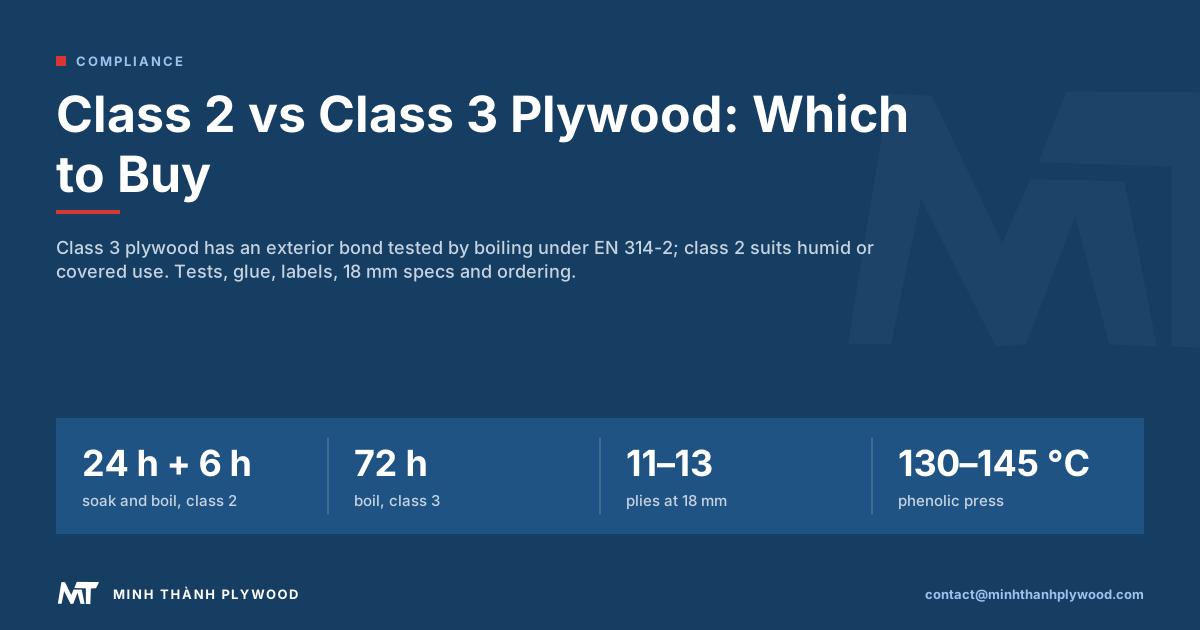
Class 3 plywood has a glue bond that passed the EN 314-2 exterior tests, soak and boil tests included, so it suits unprotected outdoor use. Class 2 plywood passed separate soak and boil tests and suits humid rooms or covered exterior work. The class describes the bond only, not the wood, face or emission. Minh Thanh Plywood presses melamine-fortified and phenolic bonds to the class the buyer specifies.
What is the difference between class 2 and class 3 plywood?
The difference between class 2 and class 3 plywood is how much water the glue bond survives in the EN 314-2 test. Class 2 bonds survive a 24-hour soak and a 6-hour boil, the humid-conditions test. Class 3 requires the exterior pretreatments described below. Everything else about the panel can be the same.
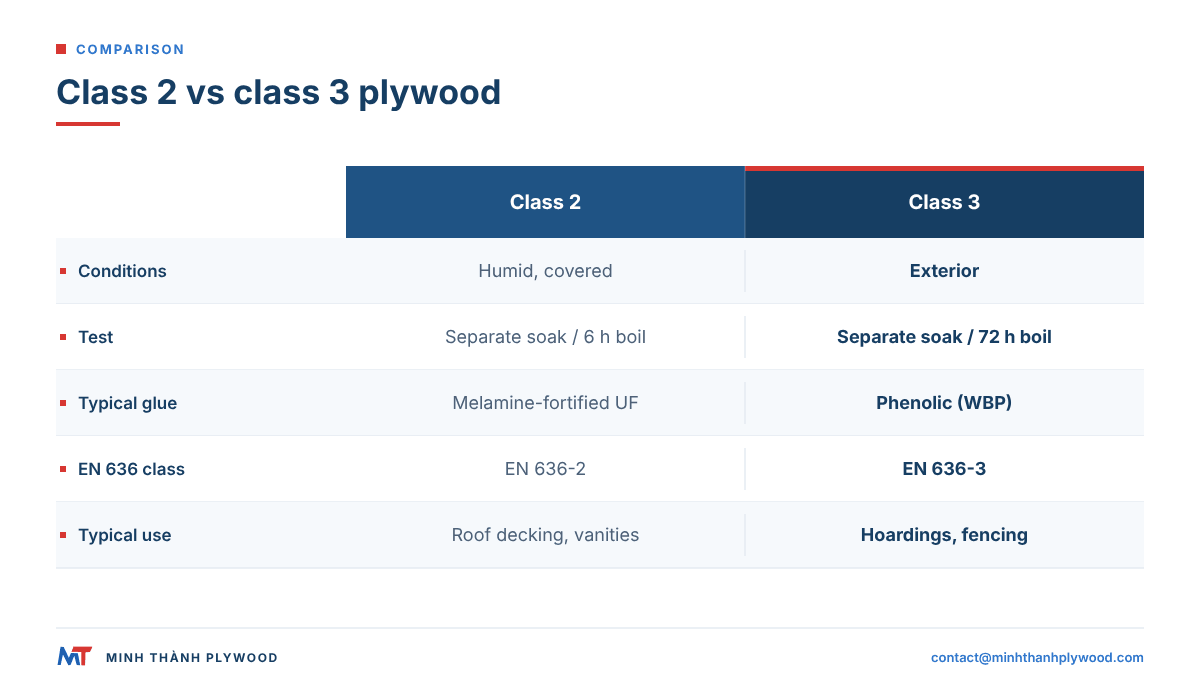
| Metric | Class 2 plywood | Class 3 plywood |
|---|---|---|
| Standard and class | EN 314-2, bonding class 2 | EN 314-2, bonding class 3 |
| Conditions it is made for | Humid conditions: covered exterior, bathrooms, kitchens | Exterior conditions: exposed to weather |
| Pretreatment before the shear test | Separate sets: 24-hour soak; 6-hour boil then at least 1-hour cooling | Separate sets: 24-hour soak; 72-hour boil, with the permitted phenolic cyclic alternative |
| Typical glue | Melamine-fortified UF (MR) | Phenolic (WBP) or high-melamine resin |
| Matching EN 636 service class | EN 636-2 (humid) | EN 636-3 (exterior) |
| Glue line colour | Light | Dark brown for phenolic, light for melamine |
| Typical uses | Roof decking under membrane, wall sheathing, vanity carcasses | Hoardings, fencing panels, external joinery, trailer floors |
| Typical price position | Lower | Higher, mostly from the resin |
Read the table from the top. Class is a bond property, so the same 18 mm Eucalyptus-core panel can be built as class 1, class 2 or class 3 by changing only the resin. Face grade, thickness, flatness and emission are separate lines of the specification.
What is class 3 plywood?
Class 3 plywood is plywood whose bond meets bonding class 3 of EN 314-2, the European class for “exterior conditions”. The bond has been tested after the exterior water pretreatments specified for that class. The mark tells a buyer the plies will not part when the panel gets wet.
In practice, a class 3 bond comes from a phenolic resin, the dark glue line known in the trade as WBP, or from a melamine resin with a high melamine share. Both cure to a water-resistant polymer. Urea formaldehyde (UF) alone never reaches class 3; it softens in hot water.
Class 3 says nothing about the wood. A class 3 sheet with a poplar core will still rot in ground contact. For exposed structural use, European specifiers ask for EN 636-3, which adds a check that the veneers are durable enough for the exposure, by species or by treatment.
The class 3 plywood meaning, then, is narrow and useful: the glue is fit for the weather. The rest of the panel still needs its own specification.
What is class 2 plywood?
Class 2 plywood is plywood whose bond meets bonding class 2 of EN 314-2, for “humid conditions”. Separate sets are tested after a 24-hour soak and after a 6-hour boil followed by cooling. A pass shows the glue line survives damp air and occasional wetting, but not years of weather.
Class 2 suits places where water comes and goes but the panel is protected: roof decking under a membrane, timber-frame sheathing behind cladding, bathroom and kitchen carcasses, caravan interiors and floors under a finished covering. The usual resin is melamine-fortified UF, sold as MR (moisture resistant).
A class 2 plywood 18mm sheet is the common choice for UK roof decking and flooring where the board is covered within days. It costs less than class 3 and has a light glue line that does not show through paint.
How are bond classes tested under EN 314-1?
Bond classes are tested by cutting small shear test pieces from the panel, putting them through a water pretreatment, then pulling each glue line apart in a testing machine. EN 314-1 gives the method and EN 314-2 sets the pass level for each class. The pretreatment is what separates the classes.
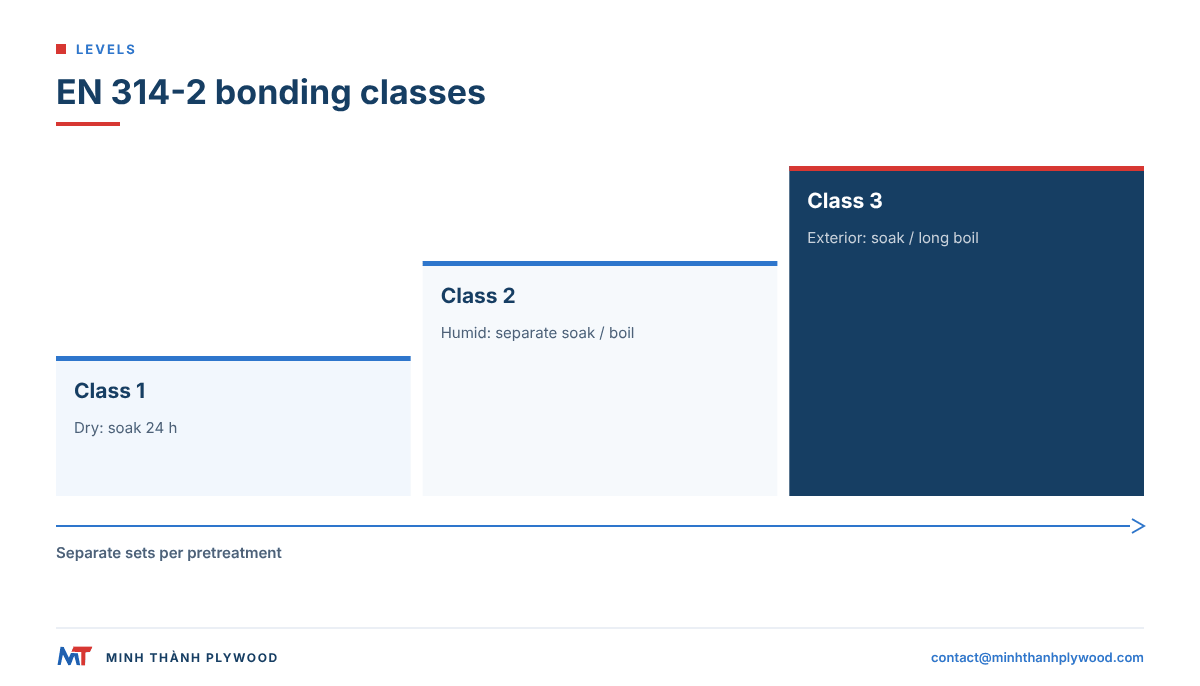
| Bonding class | Pretreatment of the test pieces (EN 314-1) | What it simulates |
|---|---|---|
| Class 1 (dry) | Soak 24 hours in water at 20 °C | Indoor use with no wetting |
| Class 2 (humid) | Separate sets: soak 24 hours; boil 6 hours then cool at least 1 hour in water at 20 °C | Damp air, occasional wetting, covered exterior |
| Class 3 (exterior) | Separate sets: soak 24 hours; boil 72 hours and cool. The phenolic cyclic alternative is described below. | Repeated wetting and drying outdoors |
EN 314-2, clause 4 and Table 1 assigns each pretreatment to a separate specimen set. For full phenolic glue, the cyclic treatment may replace the 72-hour boil, with occasional 72-hour confirmation tests. The cycle is a 4-hour boil, drying for 16–20 hours at 60 °C, another 4-hour boil, then at least 1 hour of cooling, as specified in EN 314-1.
The test pieces are then sheared wet. The lab records two numbers for each piece: the shear strength in N/mm² and the share of the broken surface that is torn wood, not bare glue. A strong bond breaks in the wood.
The 72-hour boil is also the classic British WBP test. Passing a long boil on its own, in a mill’s own tank, does not prove EN 314-2 class 3; the class needs the full method, the right number of test pieces and the pass table below.
What does a pass look like: shear strength and wood failure?
A pass means the mean shear strength and the mean wood failure of the test pieces meet one of the rows in EN 314-2. A weak glue line can still pass if the break runs through the wood, because the bond is then stronger than the veneer. A high strength passes on its own.
| Mean shear strength after pretreatment | Required mean apparent wood failure |
|---|---|
| From 0.2 to under 0.4 N/mm² | At least 80 % |
| From 0.4 to under 0.6 N/mm² | At least 60 % |
| From 0.6 to under 1.0 N/mm² | At least 40 % |
| 1.0 N/mm² or more | No requirement |
The same pass table applies to all three classes. What changes is the pretreatment the test pieces survive first. That is why a report must name the class tested: a sheet that passes class 2 can fail class 3 on the same table.
For a buyer, two things on a report matter: the class named in the result and the thickness and build tested. A report on 9 mm panels does not cover 18 mm panels with more glue lines.
Bond class or service class: how do EN 314-2 and EN 636 fit together?
EN 314-2 classes the glue bond. EN 636 classes the whole plywood panel for a service environment. EN 636 uses the bond classes as one of its requirements, then adds the wood, the build and, for structural panels, the mechanical properties. A label can carry both, and UK merchants often print both.
| EN 636 part | Service environment | Bond required (EN 314-2) | What else it covers |
|---|---|---|---|
| EN 636-1 | Dry | Class 1 | Panel build, tolerances, mechanical values for S grades |
| EN 636-2 | Humid | Class 2 | As above, for humid service |
| EN 636-3 | Exterior | Class 3 | As above, plus the durability of the veneers for the exposure |
The letter after the part number tells the use: S for structural, G for general purpose. EN 636-3 S plywood is a structural panel for exterior service; EN 636-2 G is a general-purpose panel for humid service. The current edition is EN 636:2012+A1:2015, which added coated and varnished plywood to its scope (DIN Media, EN 636).
For plywood sold for construction in the EU, EN 13986 links the declared performance to CE marking, and the Declaration of Performance states the service class. Furniture and packing plywood used outside construction is outside that standard’s scope.
Is class 3 plywood waterproof?
Class 3 plywood has a waterproof glue line, not a waterproof panel. The bond will not let go in rain or boiling water, but every veneer still takes up water through its faces and especially through its cut edges. Wet wood swells, checks and, given time, decays.
That is why exposed class 3 panels are sealed. Common routes are an exterior paint system, a phenolic film face, or an edge sealer on every cut and drilled hole. Film-faced formwork panels are the best-known example: a class 3 type bond under a film that keeps water out of the face.
Our guide is plywood waterproof covers face, edge and fastener protection in detail. For this choice, the rule is simple: specify class 3 where the bond will meet weather, then protect the wood.
Which glue gives each class?
The glue resin decides the bond class. A mill reaches a class by choosing the resin, its mix and the press settings, then proves it by test. At Minh Thanh the same core and face can be pressed with any of the three bond families below.
| Resin | Usual bond class | Press temperature at our mill | Glue line | Where buyers use it |
|---|---|---|---|---|
| UF glue at E0 emission | Class 1 | 110–120 °C | Light, invisible under veneer | Furniture, cabinets, interior panels |
| Melamine-fortified UF (MR) | Class 2, class 3 with a high melamine share | 110–120 °C | Light | Humid rooms, covered exterior, sheathing |
| Phenolic (WBP) | Class 3 | 130–145 °C | Dark brown | Exterior, formwork, trailers, hoardings |
Two specifications travel together but stay separate: the bond class and the formaldehyde emission class. A phenolic bond emits very little formaldehyde once cured. A melamine-fortified bond made for class 3 usually moves the emission from E0 to E1. Our formaldehyde guide explains the emission side.
The hotter press for phenolic resin is one reason class 3 plywood costs more: longer cycles at 130–145 °C, a dearer resin and more careful drying of veneers to 8–12 % moisture before gluing.
Is class 2 or class 3 plywood better? A verdict by use
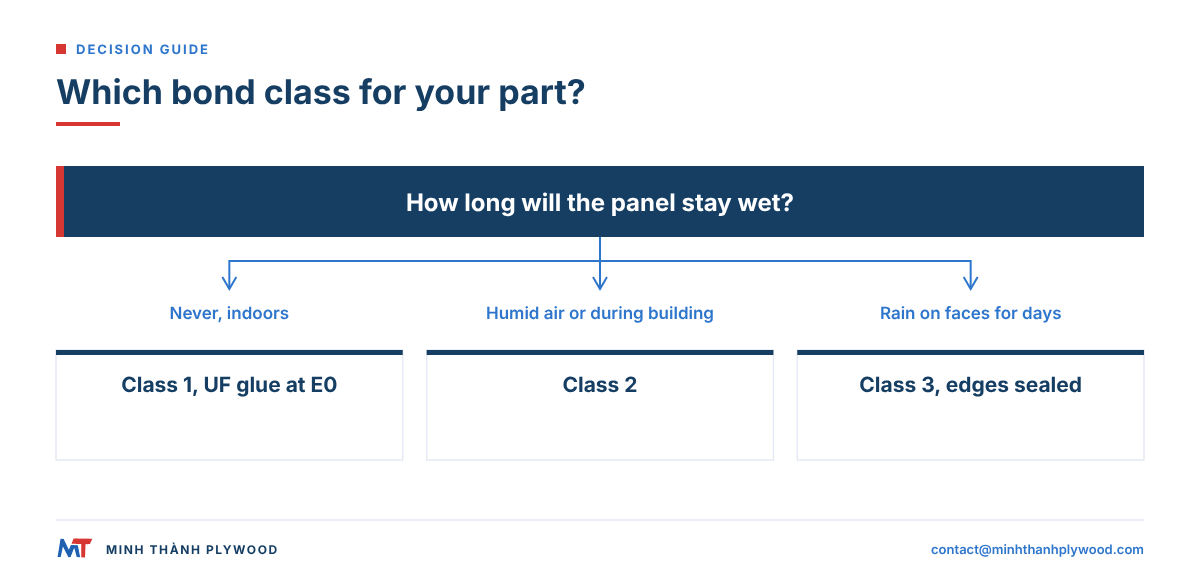
Class 3 plywood is better wherever the panel meets weather; class 2 is better value wherever it stays covered; class 1 is better for furniture. Buying class 3 for a kitchen carcass adds resin cost and a dark glue line for no gain. Buying class 2 for a fence panel risks delamination within a few seasons.
| Use | Class to specify | Why |
|---|---|---|
| Kitchen and bedroom furniture, shelving | Class 1, UF glue at E0 | Indoor and dry; best finish and lowest emission |
| Bathroom vanity carcass, kitchen sink base | Class 2 | Humid air and splashes, no weather |
| Roof decking under a membrane, wall sheathing behind cladding | Class 2 (EN 636-2) | Wet only during building, then covered |
| Flooring under a finished covering | Class 2 | Protected once laid |
| Site hoardings, fencing, signboards | Class 3 | Rain on faces and edges for months |
| External soffits, fascia backing, garden structures | Class 3 (EN 636-3) | Weather and condensation for years |
| Trailer and truck floors, horse boxes | Class 3 | Repeated wetting, washing and wear |
| Concrete formwork | Class 3 bond under a film face | Wet concrete and reuse |
| Export packing crates | Class 1 or 2, by route | Short service; sea air in transit |
The question “is class 2 or class 3 plywood better” really asks how long the bond will be wet. If water can sit on the panel for days at a time, choose class 3. If water arrives only during construction or as humid air, class 2 does the job at a lower cost.
How do UK merchant labels map to EN 314 and EN 636?
UK merchant labels compress three specifications into a short line: the bond class, the service class and the use. Reading them in that order turns any label into a clear specification. The table decodes the labels buyers see most often on merchants’ websites and price lists.
| Label wording | Bond class (EN 314-2) | Service class (EN 636) | What to check |
|---|---|---|---|
| “Class 3 plywood”, “exterior plywood” | Class 3 | Often not stated | Ask for EN 636-3 if the use is structural or exposed |
| “EN 314-2 Class 3, EN 636-3 S” | Class 3 | Exterior, structural | The full exterior specification |
| “EN 636-2 S”, “Class 2 structural” | Class 2 | Humid, structural | Roof decking and sheathing |
| “WBP” | Usually class 3 | Not stated | Ask for the EN 314-2 class on the report |
| “MR”, “moisture resistant” | Class 1 or 2 | Not stated | Ask which class was tested |
| “Interior”, “INT” | Class 1 | EN 636-1 | Dry use only |
| “BS 1088 marine” | Exterior bond | Not an EN 636 label | Species and core-gap rules on top |
Phrases such as “exterior grade” or “weather resistant” without a class number are marketing words. Ask the seller for the test report or the Declaration of Performance. The class number and the standard part are the only words that bind.
Class 3 plywood 18mm and class 2 plywood 18mm: plies, weight and loading
An 18 mm sheet has the same build whether it is class 2 or class 3: at our mill 11–13 plies, most often 11. The bond class changes the resin, not the ply count, the weight or the container plan. Weight and loading depend on the core species.
| 1220 × 2440 × 18 mm, by core | Weight per sheet | Sheets per 40HC | Packs × sheets |
|---|---|---|---|
| Styrax core (500 kg/m³) | 26.8 kg | 990 sheets | 18 × 55 sheets |
| Acacia core (580 kg/m³) | 31.1 kg | 880 sheets | 16 × 55 sheets |
| Eucalyptus core (650 kg/m³) | 34.8 kg | 795 sheets | 15 × 53 sheets |
The figures follow our 40HC plan: packs about 1,000 mm high, sheets per pack set by thickness, then capped by a planning payload of 28,000 kg. Heavier cores stop earlier because of weight, not space.
For exterior work, Eucalyptus and Acacia cores are the usual pairing with a class 3 phenolic bond: they are denser and harder than Styrax. For covered class 2 sheathing, a lighter Styrax core keeps the sheet easy to handle on a roof.
Thickness tolerance follows the product line, not the class: ±0.5 mm for commercial and film-faced panels, ±0.2–0.3 mm for sanded furniture panels.
Class 3, WBP and marine plywood: what is the same and what is not?
Class 3, WBP and marine plywood share an exterior bond, and stop sharing there. Class 3 is a tested bond class; WBP is an older British name for a boil-proof bond; marine plywood to BS 1088 is a full product standard. Buying one when you need another is a common mistake.
- Class 3: any species, any face grade, any core, as long as the bond passes EN 314-2 class 3.
- WBP: a trade name for phenolic or similar bonds; used loosely, so ask for the class on paper.
- BS 1088 marine: an exterior bond plus named durable species, face quality limits and rules against core gaps.
A class 3 sheet with a utility face is right for a hoarding and wrong for a boat. A marine sheet is right for a boat and expensive for a hoarding. Minh Thanh does not sell its okoume furniture panels as marine plywood; for exterior use we supply exterior and CDX-type panels with water-resistant melamine-fortified or phenolic bonds.
What does the class not tell you?
The bond class does not tell you the face grade, the core quality, the emission, the strength or the durability of the wood. Each of those is its own line on the order. Treating “class 3” as a quality grade is how buyers end up with a strong glue line on a gappy, uneven core.
- Face and back grade: utility C/D faces for exterior panels, or the A/B and B/B pairs for visible faces, matched to the approved sample.
- Core build: veneer species, core gaps and overlaps; our furniture cores are stitched both ways.
- Emission class: E0, E1 or CARB P2 / TSCA Title VI, tested by its own method.
- Mechanical values: only EN 636 S grades and their Declaration of Performance state bending strength and stiffness.
- Durability: EN 636-3 covers it; class 3 on its own does not.
- Fire behaviour: a separate classification; see fire-rated plywood.
How to check a class 3 claim on delivery
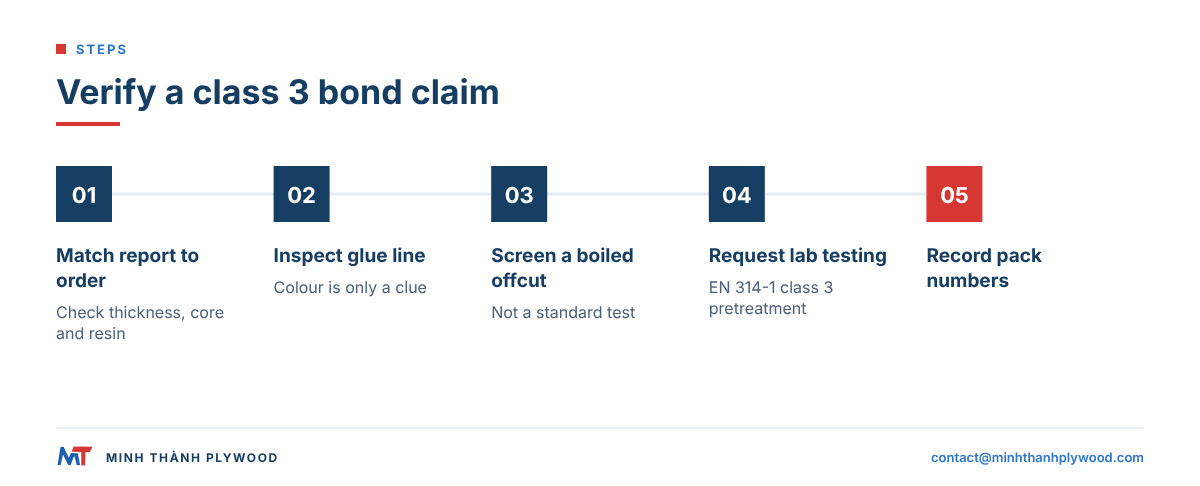
Check a class 3 claim with the paperwork first, then with the panels. The report should name EN 314-1 as the method, EN 314-2 class 3 as the result, the thickness and build tested, the lab and the date. A report on another thickness or another glue covers neither your order nor your panels.
- Match the report to the order. Same thickness, same core species, same resin family.
- Look at the glue line. Phenolic bonds show a dark brown line on the edge; a light line means melamine or UF, so ask which.
- Run a quick boil check. Boil a small offcut for a few hours and try to part the plies with a chisel once cool. Clean glue surfaces point to a weak bond; torn wood points to a strong one. It is a screen, not the standard test.
- Send panels to a lab when the stakes are high. Cut test pieces from delivered sheets and ask for EN 314-1 pretreatment for class 3. We arrange third-party testing to the buyer’s method through SGS on request.
- Record what you checked against the pack numbers, so a later question has an answer.
Delamination after weathering is the failure a weak bond causes. Our guide to plywood delamination covers its causes and tests.
What to ask a Vietnamese mill for each class
Ask a Vietnamese mill for the bond class by its standard number, the resin family and the test that proves it, then the rest of the panel. A request that says only “exterior plywood” or “WBP” leaves the mill to choose the resin. The lines below give a quote you can compare.
For class 2 plywood (humid or covered use):
- Application, for example “roof decking under membrane” or “vanity carcass”.
- Bond: “EN 314-2 class 2, melamine-fortified resin”.
- Emission: E1 or E0, stated separately from the bond.
- Core and face: species and grade pair, for example Eucalyptus core, B/B faces.
- Thickness, size and tolerance: 18 mm, 1220 × 2440 mm.
- Packing and quantity: sheets per line, mixed lines by agreement.
For class 3 plywood (exterior use):
- Application and exposure, for example “fencing, exposed both faces”.
- Bond: “EN 314-2 class 3, phenolic resin” or “high-melamine resin”.
- Service class, if structural: EN 636-3 S.
- Face protection: film face, primed face or plain for site painting.
- Edge sealing: painted edges if the panels will be stored outside.
- Test evidence: report for the thickness ordered, or third-party test on delivery.
A Vietnamese mill making both furniture and exterior panels runs different glue lines for each. Ask which line presses your order, and ask for the sample to come from that line.
What this means for your order
At Minh Thanh, the bond is a line on your specification sheet. Furniture and interior panels use UF glue at E0 emission as standard. Melamine-fortified and phenolic bonds are made to the customer’s specification for humid and exterior uses, on Eucalyptus, Acacia or Styrax cores, in 3–40 mm.
Our exterior and CDX-type panels use utility C/D faces with water-resistant melamine-fortified or phenolic glue, for stair treads, wall sheathing and similar outdoor parts. Sizes are 1220 × 2440 mm and 1250 × 2500 mm, plus custom sizes such as 1220 × 2500 mm.
Commercial terms are the same for every class: MOQ one 40HC with mixed specifications by agreement, production 15–45 days after the 30% deposit, balance 70% against the scanned B/L or irrevocable L/C at sight, FOB Hai Phong, CFR or CIF. Indicative starting prices in October 2026 are commercial plywood from US$250/m³ and furniture/interior plywood from US$350/m³; the resin and the class set the final price. Free samples are available.
Send us your class, application, core, face, size and quantity and we will quote it within hours. See exterior plywood for builds and uses, or browse more plywood standards and compliance guides.
Buyer questions, answered
What is class 3 plywood?
Class 3 plywood is plywood whose glue bond meets bonding class 3 of EN 314-2, the European class for exterior conditions. Test pieces must keep their shear strength and wood failure after the Class 3 pretreatments, using a separate set for each pretreatment.
What is class 2 plywood?
Class 2 plywood has a bond that meets bonding class 2 of EN 314-2, for humid conditions. Separate test sets receive a 24-hour soak and a 6-hour boil followed by at least 1 hour of cooling before shear testing. It suits bathrooms, kitchens and covered exterior work.
Is class 2 or class 3 plywood better?
Neither is better everywhere. Class 3 is needed where the panel can get wet and stay wet outdoors; class 2 is enough behind cladding, under a roof or in humid rooms, and class 1 UF-bonded panels give the best furniture finish indoors.
Is class 3 plywood waterproof?
The glue line of class 3 plywood resists water and boiling, but the wood itself still absorbs water. Faces and cut edges need a coating, film or edge seal for lasting outdoor use, otherwise the veneers swell, check and decay.
What does class 3 plywood mean on a UK merchant label?
It means the bond meets EN 314-2 class 3. Labels often add EN 636-3, the exterior service class, and S for structural or G for general use; read both, because EN 636-3 also covers the durability of the wood.
Is WBP the same as class 3?
Not exactly. WBP is the old British name for a weather and boil proof bond, usually phenolic. Most WBP bonds pass class 3, but only an EN 314-2 class 3 test report or a declaration naming that class proves it.
Is class 3 plywood the same as marine plywood?
No. Marine plywood made to BS 1088 has an exterior bond plus rules on species, face quality and core gaps. Class 3 plywood can have any species and grade; it only has to pass the exterior bond test.
How heavy is an 18 mm class 3 plywood sheet?
The weight depends on the core, not the bond class. A 1220 × 2440 × 18 mm sheet weighs about 26.8 kg on a Styrax core, 31.1 kg on Acacia and 34.8 kg on Eucalyptus at Minh Thanh's reference densities.
Can furniture plywood be class 3?
Yes, by pressing it with a phenolic or melamine-fortified bond, but most furniture buyers do not need it. Indoor cabinets and furniture use UF glue at E0 emission, which gives a clean, light glue line and low emission.
How do I test a class 3 claim?
Ask for the EN 314-1 test report naming bonding class 3, then cut test pieces from delivered panels and have a laboratory run the same pretreatments. Minh Thanh arranges third-party testing to the buyer's method through SGS on request.