
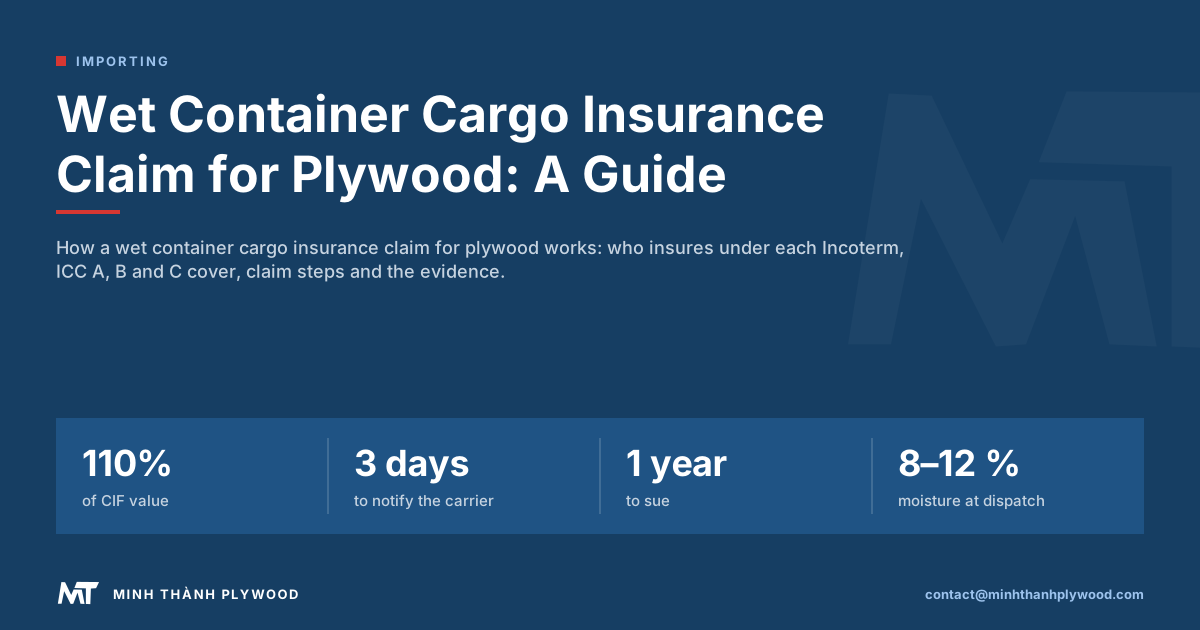
A wet container cargo insurance claim for plywood succeeds when three things line up: the policy covers water damage, which in practice means Institute Cargo Clauses (A), the damage is noted and surveyed on arrival, and the evidence shows the plywood left the factory dry and well packed. Minh Thanh Plywood supplies that evidence with every shipment: loading photos and video, the packing list and panels at 8–12 % moisture.
Does cargo insurance cover a wet plywood container?
Cargo insurance covers a wet plywood container when the policy is on Institute Cargo Clauses (A) and no exclusion applies. Clauses (A) are an all-risks cover: rain through a damaged roof, water through a failed door seal and condensation inside the box are all accidental loss or damage, so they fall in the cover unless the insurer can point to an exclusion.
The narrower clauses do much less for water. Clauses (B) cover “entry of sea lake or river water into vessel craft hold conveyance container or place of storage”, which helps if the box was flooded at a terminal or took seawater on deck, but not if rain or condensation did the damage. Clauses (C) do not name water at all.
The Institute Cargo Clauses are the standard wording of the London market, issued by the Lloyd’s Market Association and the International Underwriting Association in their 2009 edition. Most cargo policies worldwide either use them or copy their structure.
Who buys cargo insurance for a plywood shipment under each Incoterm?
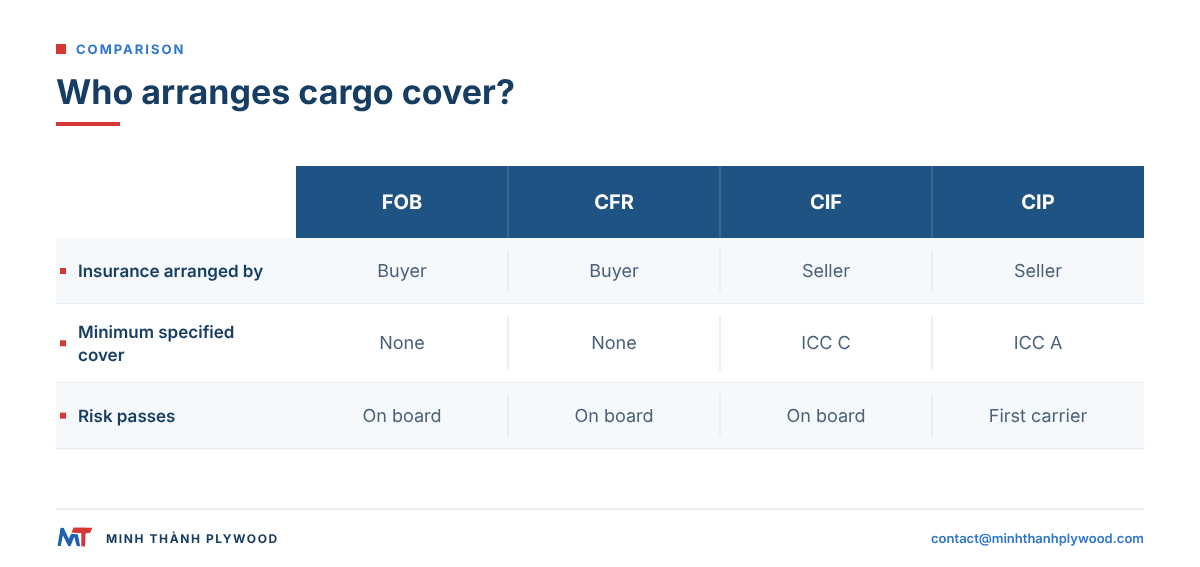
Who buys cargo insurance for a plywood shipment depends on the Incoterm in the contract, because the Incoterm decides when risk passes from seller to buyer. Minh Thanh sells FOB Hai Phong, CFR or CIF; under all three, risk passes once the goods are on board the vessel at the port of loading (ICC Incoterms 2020, read 20 October 2026).
| Incoterm | Who arranges cargo insurance | Minimum cover set by Incoterms 2020 | When risk passes to the buyer |
|---|---|---|---|
| FOB Hai Phong | Buyer | None set | Goods on board at Hai Phong |
| CFR | Buyer | None set | Goods on board at Hai Phong |
| CIF | Seller, for the buyer’s benefit | Clauses (C), 110% of contract value | Goods on board at Hai Phong |
| CIP (for reference) | Seller, for the buyer’s benefit | Clauses (A), 110% of contract value | Goods handed to the first carrier |
Two points follow for plywood buyers. Under CIF the seller’s minimum is Clauses (C), which does not cover rain, condensation or handling breakage, so a buyer who wants water cover should ask for Clauses (A) in the contract. Under FOB and CFR the buyer’s own policy is the only cover from the moment the packs are on board.
What do ICC A, B and C cover for plywood?
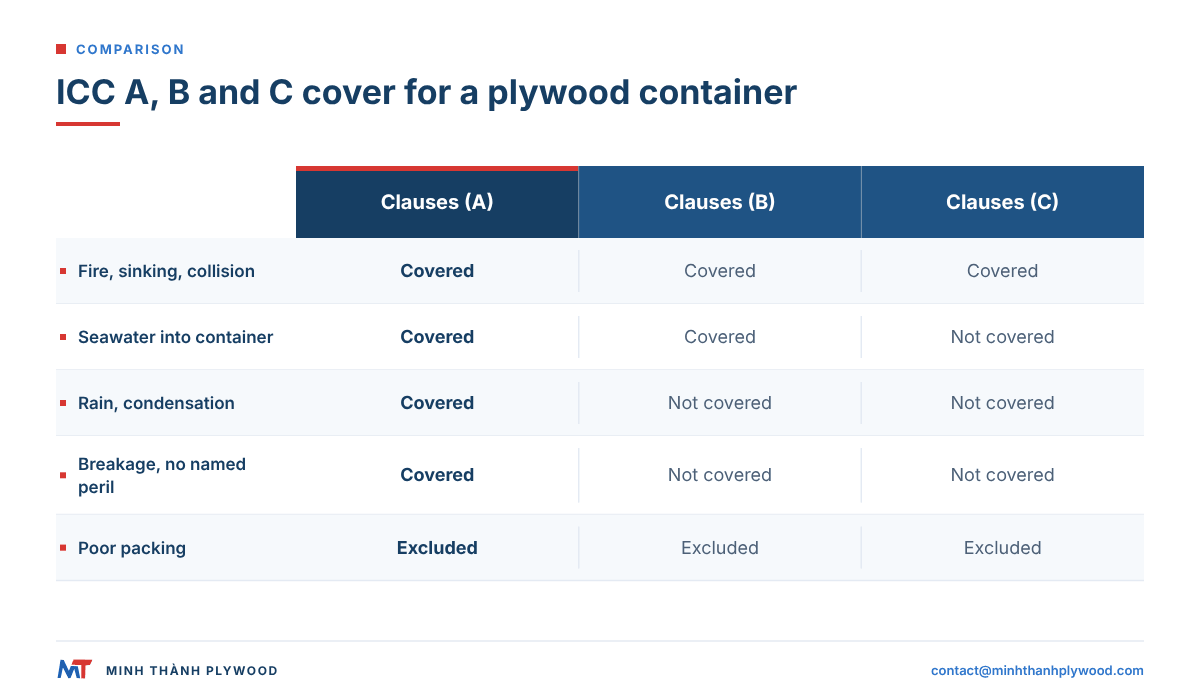
ICC A, B and C cover plywood against very different lists of risks, and the gap matters most for the two losses plywood buyers report: water damage and breakage. The table sets the 2009 clauses against the risks a plywood container meets.
| Risk to a plywood shipment | Clauses (A) | Clauses (B) | Clauses (C) |
|---|---|---|---|
| Fire or explosion | Covered | Covered | Covered |
| Vessel stranded, sunk or capsized; collision | Covered | Covered | Covered |
| General average sacrifice, jettison | Covered | Covered | Covered |
| Sea, lake or river water entering the container | Covered | Covered | Not covered |
| Rain or condensation inside the container | Covered | Not covered | Not covered |
| Handling breakage without a named-peril cause | Covered | Not covered | Not covered |
| Total package loss when lost overboard or dropped during loading onto or unloading from a vessel or craft | Covered | Covered | Not covered |
| Theft or short delivery | Covered | Not covered | Not covered |
| Insufficient or unsuitable packing | Excluded | Excluded | Excluded |
| Inherent vice or nature of the goods | Excluded | Excluded | Excluded |
| Delay | Excluded | Excluded | Excluded |
For a furniture plywood order, where one wet pack can lose its face grade, Clauses (A) is the sensible minimum. Clauses (C) suit only low-value bulk cargo where the buyer accepts the gap.
Which ICC A, B or C cover for plywood should you buy?
Buy ICC A cover for plywood whenever the panels are graded on their faces, which is every furniture, interior and film-faced order. A water mark, a crushed edge or a scratched face lowers the grade of a sheet without destroying it. All three clauses can cover partial damage; Clauses (A) cover a broader range of accidental causes, subject to exclusions.
Clauses (B) and (C) cover loss or damage caused by their named perils, such as fire, sinking or collision; a whole-container loss is not required. Lloyd’s cargo claims manual reproduces these clauses and explains partial-loss claims. Ordinary handling accidents, rain and condensation are outside (B) and (C) unless a covered named peril caused the loss.
Three extras are worth asking the broker about. The War and Strikes clauses are added by separate wording. Cover should run to the buyer’s store, not only to the discharge port: the 2009 transit clause runs warehouse to warehouse when the policy is written that way, and under FOB or CFR the buyer’s cover starts once the packs are on board. And the insured value should be at least 110% of the CIF value.
What causes a wet container of plywood?
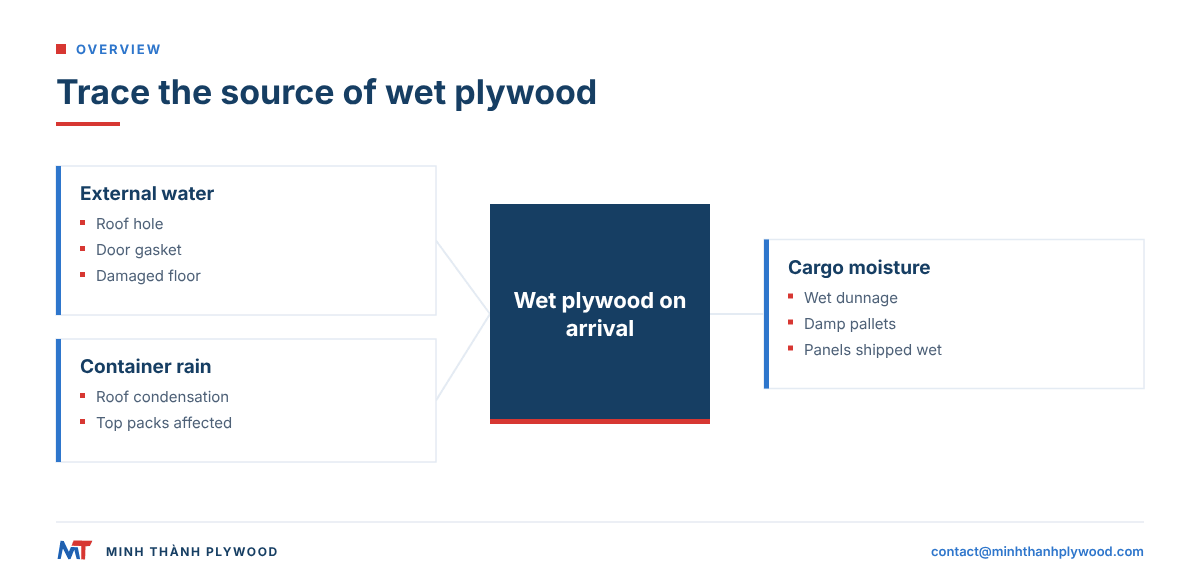
A wet container of plywood has one of three causes, and the claim depends on proving which one:
- Water from outside: a hole in the roof, a failed door gasket or a damaged floor lets rain or seawater in. The damage sits where the water entered, often near the doors or under the hole.
- Condensation, often called container rain: moisture in the air inside the box condenses on the steel roof as the container cools at sea or between climates, then drips onto the top packs. The damage sits on the tops of packs and along the upper walls.
- Moisture from the cargo or its packaging: wet dunnage, damp pallets or panels shipped too wet release water that later condenses. Insurers treat this as inherent vice of the goods, an exclusion in all three clauses.
The third cause is the one the shipper controls. Minh Thanh dries veneers and finished panels to 8–12 % moisture content at dispatch, the normal range for furniture plywood, and packs them with plywood cover boards, cardboard edge protection, strapping band and wrapping film.
How do you make a wet container cargo insurance claim for plywood?
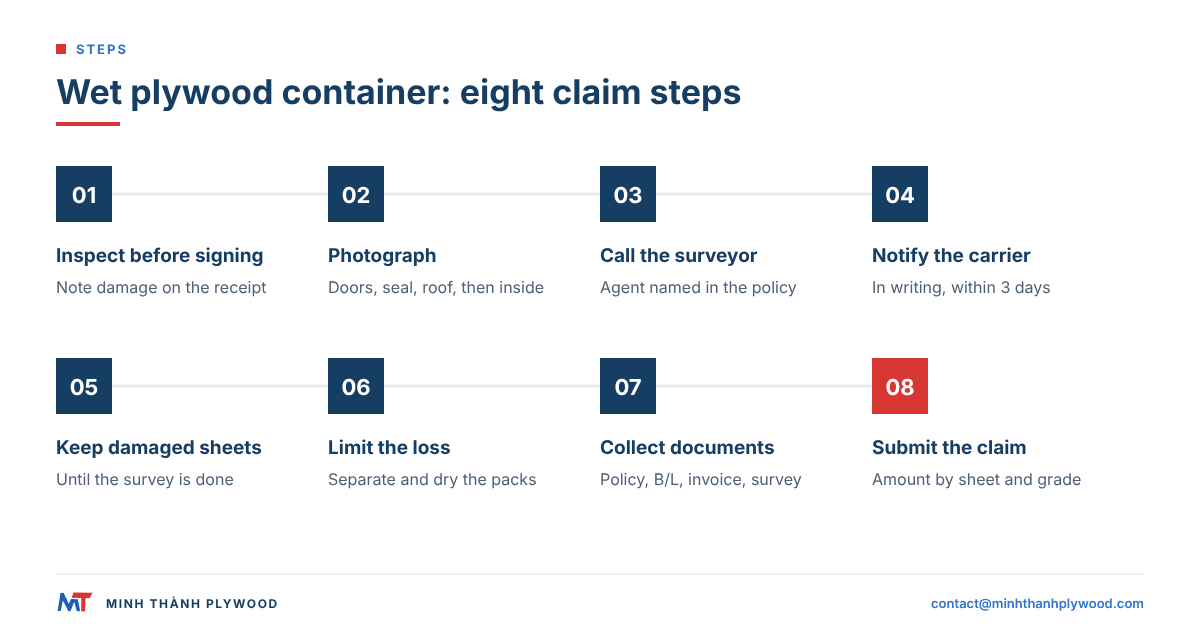
Make a wet container cargo insurance claim for plywood in eight steps: note the damage at the terminal gate, photograph before opening, call the surveyor, give the carrier written notice, keep the goods, limit the loss, collect the documents and submit the claim. The order matters, because evidence lost before the surveyor arrives cannot be rebuilt.
- Inspect before signing. Check the container exterior, roof and door seals, and the seal number against the bill of lading. Write any damage on the delivery receipt or equipment interchange receipt.
- Photograph before opening. Photograph the doors, seal and roof, then each stage of opening, with the date visible.
- Call the surveyor. The policy or certificate names the claims agent or surveyor at destination. Call before unloading damaged packs.
- Give written notice to the carrier. Hold the carrier responsible in writing at once, and in any case within three days for damage not apparent at delivery.
- Keep the damaged goods. Do not discard, sell or cut wet sheets until the surveyor has seen them and the insurer agrees.
- Limit the loss. Separate dry packs, stand wet sheets to dry and protect the rest; the policy’s duty of the assured requires reasonable steps to reduce the loss.
- Collect the documents listed in the next section.
- Submit the claim with a statement of the amount and how it was calculated, sheet by sheet and grade by grade.
What evidence and documents support a plywood cargo claim?
A plywood cargo claim is supported by documents that show the goods were sound at loading, damaged on arrival, and worth the amount claimed. Insurers and carriers read them in that order.
| What the claim must show | Document | Who provides it |
|---|---|---|
| Goods covered and insured value | Insurance policy or certificate | Buyer, or seller under CIF |
| Goods sound and well packed at loading | Loading photos and video, packing list | Minh Thanh |
| Carrier received goods in good order | Clean bill of lading | Carrier, via the shipper |
| Damage found on arrival | Delivery receipt remarks, arrival photos | Buyer |
| Cause and extent of damage | Survey report | Surveyor |
| Value of the loss | Commercial invoice, claim statement | Buyer |
| Carrier put on notice | Notice of claim and carrier’s reply | Buyer |
Minh Thanh photographs and films every shipment before loading, and the buyer receives the photos and video. That record shows the packs, cover boards, straps and the inside of the container at loading. The survey report then shows the condition on arrival, and the gap between the two is what the claim is about.
How long do you have to notify the carrier and the insurer?
Notify the carrier at delivery, or within three days if the damage is not apparent, and bring any claim against the carrier within one year. These are the limits of the Hague-Visby Rules, the convention most bills of lading incorporate for sea carriage.
Article III(6) of the Rules says that, unless notice of loss or damage is given in writing at the time of removal of the goods, or within three days if the damage is not apparent, the removal is prima facie evidence that the carrier delivered the goods as described in the bill of lading (Carriage of Goods by Sea Act 1971, Schedule). The same article discharges the carrier from all liability unless suit is brought within one year of delivery.
Cargo policies set their own notice duty: the insured must report a loss promptly and protect the insurer’s rights against the carrier. A late notice to the carrier can cost the insurer its recovery and give it a reason to reduce the claim. In practice, send both notices on the day the damage is found.
Is thin plywood broken in transit covered?
Thin plywood broken in transit is covered under Clauses (A) unless the breakage came from insufficient or unsuitable packing. Under Clauses (B) and (C) it is covered only if a named peril caused it, such as the overturning of a truck or a collision.
Thin panels break differently from thick ones. Minh Thanh’s 3–5 mm panels are always 5-ply, and a 1220 × 2440 mm sheet at that thickness flexes under its own weight if it is lifted from one end or carried without a full base. The usual damage is cracked corners and edge splits from fork tines, or a broken pack base from overloading.
The packing exclusion is where thin plywood claims are argued. A pack of thin panels needs a full-size base, cover boards top and bottom and enough straps to hold it as one block. A 40HC load of 3 mm panels at 1220 × 2440 mm is 5,994 sheets in 18 packs of 333, about 4.5 kg each, and it is planned so the stack does not exceed the pack height the bases are built for.
How does the packing exclusion apply to plywood?
The packing exclusion in clause 4.3 of the 2009 clauses removes cover for loss caused by “insufficiency or unsuitability of packing or preparation of the subject-matter insured”, where the packing was done by the assured or before the insurance attached. Stowage in a container counts as packing for this purpose.
For plywood the clause raises three practical questions, and each one is answered by the loading record:
- Was each pack built to carry its load? Packs about one metre high, with sheets per pack set by thickness and capped by weight.
- Was the container load within its limits? A 40HC at 18 mm carries 18 packs on Styrax core, 16 on Acacia or 15 on Eucalyptus; heavier cores stop earlier because of weight.
- Was the load secured? Packs placed tight and level, with no free space for them to shift.
Overloading is the classic packing failure. A container stuffed past its pack plan crushes the bottom packs and breaks their bases, and the insurer can then refuse the breakage as a packing loss. Our pack plan is built to stay within the payload and the base strength.
What does Minh Thanh provide to support a claim?
Minh Thanh provides the shipper’s half of the evidence for every shipment, so the buyer’s insurer can see how the plywood left the factory. The set is the same whether the buyer or the factory arranged the policy:
- photos and video of every shipment before loading, showing packs, cover boards, edge protection, straps and the container interior;
- the packing list with pack numbers, sheets per pack, sizes, thicknesses and weights;
- the commercial invoice and the bill of lading;
- the panel specification: face, core, glue, emission class and the 8–12 % moisture content at dispatch;
- for CIF orders, the insurance certificate in the buyer’s favour.
What the factory does not do is settle the claim. Once risk has passed on board at Hai Phong, transit damage is a matter between the buyer, the insurer and the carrier; the factory’s part is a complete, consistent record that makes the claim easy to prove.
Should a plywood buyer choose CIF or arrange its own cover?
A plywood buyer should arrange its own cover under FOB or CFR when it has a cargo policy at home, and buy CIF when it does not. Each route has one advantage.
Under its own open policy, a buyer chooses Clauses (A), the insured value and the claims agent, and claims at home in its own language. Many regular importers hold an annual policy that declares each shipment automatically.
Under CIF, the seller buys the cover and sends the certificate with the shipping documents. That is simpler for an occasional buyer, but the Incoterms 2020 minimum is only Clauses (C). A buyer who chooses CIF should write “Institute Cargo Clauses (A), 110% of CIF value, warehouse to warehouse” into the sales contract, so the certificate it receives matches the risk it carries.
How do you prevent a wet container in the first place?
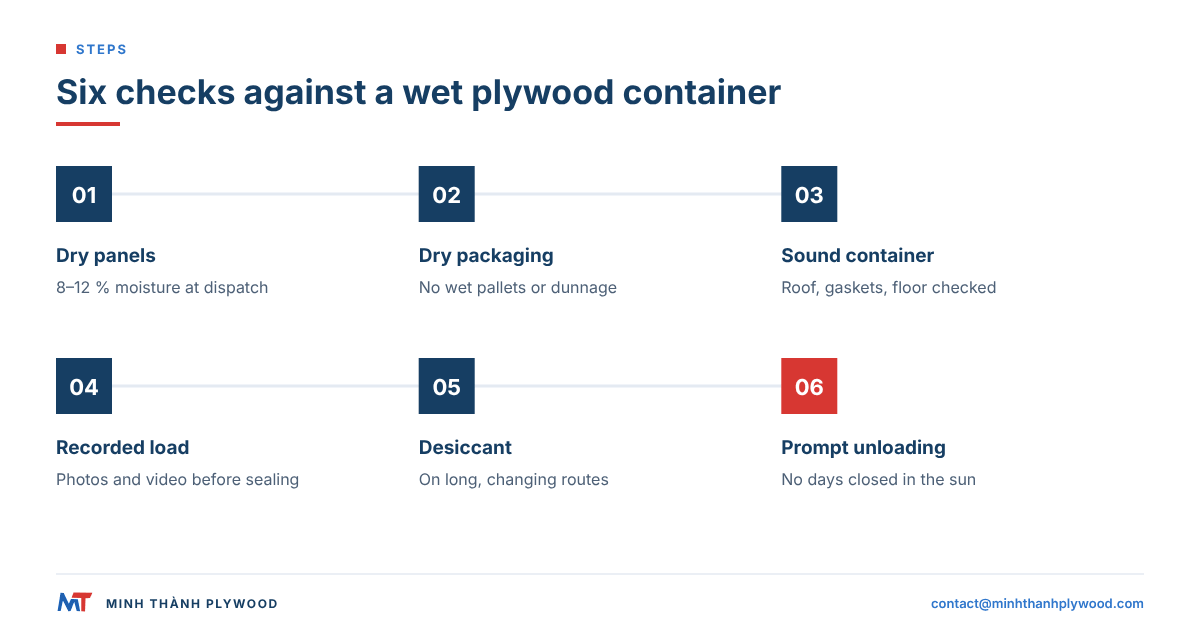
Prevent a wet container with five checks at origin and one at destination. Insurance pays for a loss; prevention keeps the face grade the buyer ordered.
- Dry goods. Panels at 8–12 % moisture content at dispatch, packed under wrapping film and cover boards.
- Dry packaging. No wet pallets or damp dunnage; plywood pallets and cover boards are processed wood, which the international standard for wood packaging, ISPM 15, leaves out of its scope, and the UK guidance on wood packaging material says the same. They carry no free water.
- A sound container. Check the roof, door gaskets and floor for light and holes before loading, and reject a damaged box.
- A recorded load. Photos and video of the container interior and every pack before the doors close.
- Container desiccant, when the route needs it. Long routes through changing climates, such as Hai Phong to Northern Europe at 30–40 days at sea, favour desiccant strips or bags inside the box; write them into the packing line.
- Prompt unloading. Containers left closed in the sun at the destination terminal build condensation; unload and inspect them quickly.
What should you write in the plywood order about insurance and packing?
Write the insurance and packing terms into the plywood order, so the factory, the forwarder and the insurer work from the same text. A complete line for a CIF order reads:
“CIF [port], insured on Institute Cargo Clauses (A) for 110% of CIF value, warehouse to warehouse; packs about one metre high on plywood pallets, plywood cover boards, edge protection, strapping and wrapping film; panels at 8–12 % moisture at dispatch; loading photos and video before sealing.”
For FOB or CFR, keep the packing part and replace the insurance clause with your own policy reference. Add the panel specification beside it: application, core, glue and emission class, face grade, size and thickness, quantity and destination port. Send it to Minh Thanh for a quote on furniture plywood from Vietnam; replies come within hours, and samples are free.
Buyer questions, answered
Does cargo insurance cover a wet plywood container?
Institute Cargo Clauses (A) cover water damage from rain, condensation or a leaking container unless an exclusion applies, such as insufficient packing or unfitness of the container known at loading. Clauses (B) cover only sea, lake or river water entering the container, and Clauses (C) do not cover water damage as such.
Who insures a plywood shipment under FOB, CFR and CIF?
Under FOB and CFR the buyer arranges cargo insurance, because risk passes to the buyer once the goods are on board the vessel. Under CIF the seller must buy cover for the buyer's benefit, at least Institute Cargo Clauses (C) for 110% of the contract value.
What is the difference between ICC A, B and C?
Clauses (A) cover all risks of loss or damage except the listed exclusions. Clauses (B) and (C) cover only named perils, such as fire, stranding, collision and, for (B), seawater entry and earthquake. Clauses (A) provide broader cover for accidental handling and water damage; under (B) and (C), damage must result from a named peril.
What should I do when a plywood container arrives wet?
Note the damage on the delivery receipt, photograph the container and seal before opening, call the surveyor named in the policy, give written notice to the carrier within three days, and keep every damaged sheet until the survey is done.
Is thin plywood breakage covered by insurance?
Breakage in handling is covered under Institute Cargo Clauses (A) unless it results from insufficient or unsuitable packing. Clauses (B) and (C) cover breakage only when it follows a named peril such as overturning or collision.
How long do I have to claim against the carrier?
Under the Hague-Visby Rules, notice of damage that is not apparent must be given within three days of delivery, and the claim must be brought within one year. Check the bill of lading terms, because some carriers apply other rules.
How much should plywood cargo be insured for?
The usual minimum is 110% of the CIF value, which is also the Incoterms 2020 minimum when the seller insures under CIF or CIP. The extra 10% covers the buyer's expected profit and costs on the goods.
Can the insurer refuse a claim for condensation?
An insurer can rely on the inherent vice exclusion if the cargo's own moisture caused the condensation. Plywood packed at 8–12 % moisture content and a record of the container condition at loading are the evidence against that argument.
Does the mill pay for transit damage?
Once risk has passed under the agreed Incoterm, transit damage is a claim against the insurer and, through it, the carrier. The mill's part is the evidence: loading photos and video, the packing list and the panel specification.
What documents does a plywood cargo claim need?
The insurance policy or certificate, commercial invoice, packing list, bill of lading, survey report, photos, the notice of claim sent to the carrier and the carrier's reply, and a claim statement with the amount and how it was calculated.