
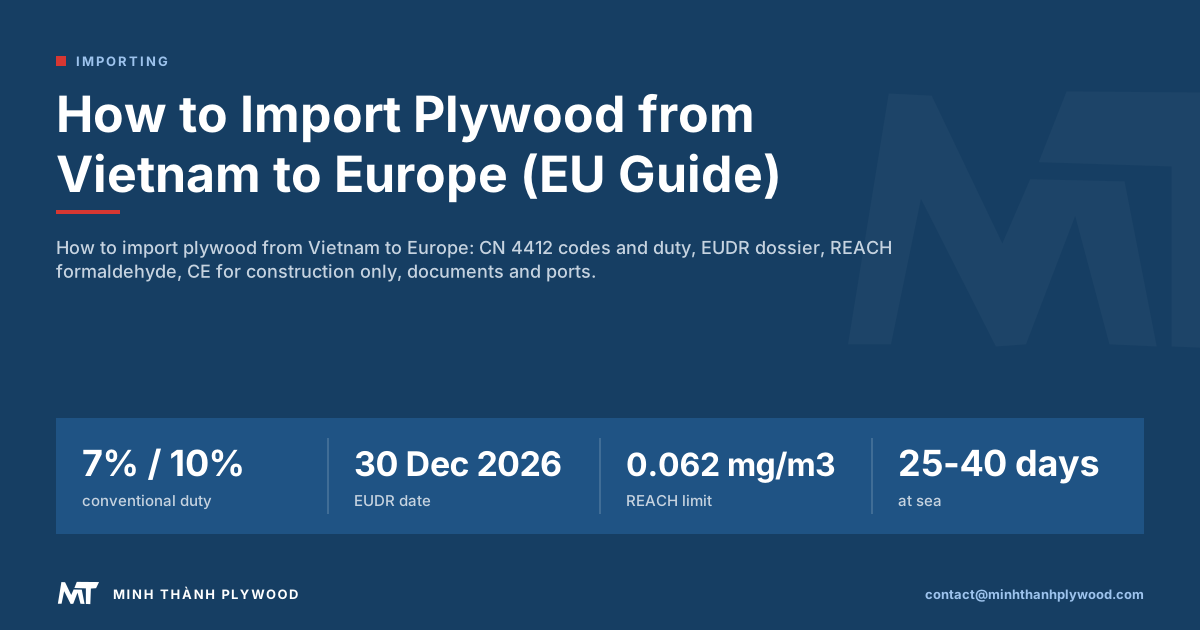
Importing plywood from Vietnam to Europe takes a written specification, a CN 4412 tariff line, EUR.1 origin proof for the EU-Vietnam trade agreement, the EUDR origin dossier and a due diligence statement filed by the importer. Minh Thanh Plywood ships furniture panels from Hai Phong with these files, and Europe is our main market.
How do you import plywood from Vietnam to Europe, step by step?
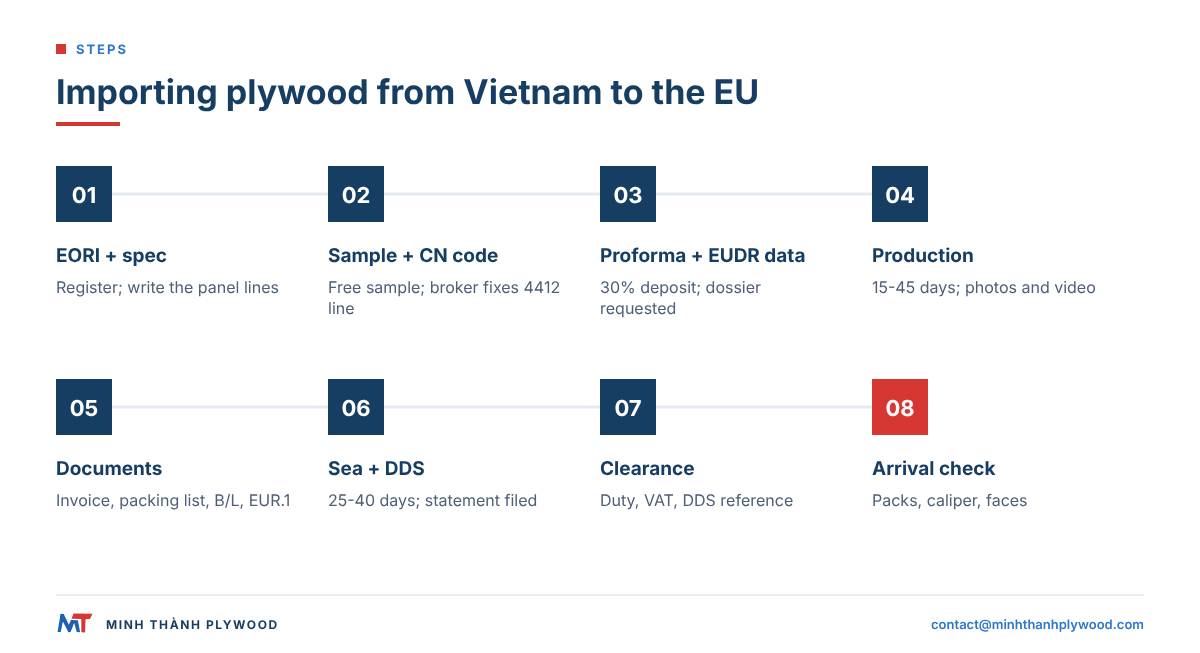
You import plywood from Vietnam to Europe in ten steps, and the order matters because three of them (tariff line, origin proof, EUDR data) must be settled before the container sails. Here is the sequence a European importer follows with Minh Thanh, from the first message to the panels in your warehouse.
- Register for customs. Get an EORI number in your member state; your customs broker uses it on every declaration.
- Write the specification. Application, core, glue and emission, face and back grade, thickness, size, tolerance, packing and quantity per line.
- Approve a free sample. The sample fixes the face, the colour and the core build that the order is measured against.
- Fix the tariff line. Your broker confirms the CN 4412 subheading from the face species, so the invoice and the declaration match.
- Sign the proforma invoice. FOB Hai Phong, CFR or CIF; 30% deposit by T/T, or an irrevocable L/C at sight.
- Collect the EUDR data. The mill sends the EUDR compliance dossier for your order: species, quantity, origin and geolocation files.
- Production and pre-loading check. 15–45 days after the deposit; every container is photographed and filmed before loading, and you receive the photos and video.
- Shipping documents. Commercial invoice, packing list, bill of lading and EUR.1; the 70% balance is paid against the scanned bill of lading.
- Customs clearance in the EU. Your broker files the declaration with the tariff line, the EUR.1 and your due diligence statement reference; you pay duty and import VAT or defer VAT where your country allows.
- Arrival check. Count packs, caliper sheets and compare faces with the sample before the panels go into production.
Steps 4, 6 and 8 are the ones that hold containers at a European port. The rest of this guide takes each in turn, then lists what changes from Germany to Spain. The general process for any market is in how to import plywood from Vietnam.
Which CN code and import duty apply to Vietnamese plywood in the EU?
Plywood enters the EU under heading 4412 of the Combined Nomenclature (CN), and the subheading follows the species of the outer plies. The face you order decides the code, so the face on the invoice must match the face on the panel.
The table lists the subheadings that cover Minh Thanh’s panels, with the conventional duty rate set in the Combined Nomenclature of Regulation (EU) 2021/1832 (CN 2022), checked 3 October 2026. They apply to plywood “consisting solely of sheets of wood… each ply not exceeding 6 mm thickness”.
| CN subheading | Outer ply (face or back) | Conventional duty | Minh Thanh panels |
|---|---|---|---|
| 4412 33 10 | Birch (Betula spp.) on at least one side | 7% | Birch plywood, imported birch faces |
| 4412 33 20 | Poplar or aspen, no birch | 7% | Poplar plywood, many EV faces |
| 4412 33 30 | Eucalyptus, no birch or poplar | 7% | Eucalyptus-faced plywood |
| 4412 34 00 | Other non-coniferous wood not listed under 4412 33 | 7% | Other hardwood faces on order |
| 4412 31 10 | Okoumé, sapelli and other listed tropical woods | 10% | Okoume plywood, Sapele on request |
| 4412 31 90 | Other tropical wood | 7% | Bintangor and Gurjan faces |
| 4412 39 00 | Coniferous wood on both outer plies | 7% | Pine plywood |
| 4412 41 to 4412 49 | Laminated veneer lumber (LVL) | 10% | LVL |
The rate in the table is the third-country rate. With valid origin proof under the EU-Vietnam Free Trade Agreement (EVFTA), the preferential rate shown in the EU’s TARIC database applies instead. The agreement has been in force since 1 August 2020. Your broker reads that rate for your exact code on the day of import, because TARIC is the legal reference at clearance.
Duty is charged on the customs value, which is the CIF value at the EU border: goods plus freight and insurance to the port of entry. An FOB order therefore pays duty on a value that includes the freight you booked.
Which face decides the code when face and back differ?
The code follows “at least one outer ply”, so a birch face with a poplar back is classified as birch (4412 33 10). A panel with an okoume face and a eucalyptus back falls under the tropical heading. Write the face and the back separately on the specification, as in “birch D+/D face and back, styrax core”, and the code follows from the line without debate.
What certificates are needed to import plywood into the EU?
Two files are required by EU law for every plywood import: the importer’s EUDR due diligence statement (from 30 December 2026) and the customs declaration itself. Everything else is either needed for a lower duty, needed only for construction plywood, or asked by your own customers.
| Certificate or file | Required by | When it applies | Who provides it |
|---|---|---|---|
| EUDR due diligence statement | Regulation (EU) 2023/1115 | Every plywood import from 30 December 2026 | Importer files it; the mill supplies the origin dossier |
| EUR.1 or origin statement | EVFTA | To claim the preferential duty | Issued in Vietnam for the exporter |
| Declaration of Performance and CE marking | Construction Products Regulation, EN 13986 | Only plywood for construction works | Producer of the construction panel |
| Formaldehyde evidence | REACH Annex XVII entry 77 | Furniture and wood-based articles from 6 August 2026 | Mill’s chamber tests; SGS test to EN 717-1 on request |
| FSC chain-of-custody certificate | Your customer, not the law | When you sell FSC-claimed products | Available* |
| PPWR packaging test | Regulation (EU) 2025/40 | Packaging placed on the EU market from 12 August 2026 | SGS report on Minh Thanh’s four packing materials |
*Supplied directly or through qualified partner mills.
For a furniture or interior panel, the working set is therefore short: the EUDR dossier, the EUR.1, the emission evidence your customers ask for and the four shipping documents. Minh Thanh holds CARB P2 / TSCA Title VI certification as ICTT mill no. 23024, ISO 9001:2015 (KAC25/0185) and TCVN 11902:2017 (VietCert 141.1-VNC-HC); European furniture buyers accept the CARB P2 certificate and the chamber reports as emission evidence. The full list of what goes in each container is in the plywood import documents checklist.
Is EUDR compliance required for plywood imports to Europe?
Yes: plywood under heading 4412 is a relevant product of the EU Deforestation Regulation, Regulation (EU) 2023/1115, and the EU importer is the operator who files the due diligence statement in the EU information system (TRACES), which returns the reference number your customs declaration carries. The dates and roles below follow the amended text after Regulation (EU) 2025/2650. Checked 2 October 2026.
- 30 December 2026: the obligations apply to large and medium operators, and to micro and small operators already covered by the EU Timber Regulation, which includes plywood importers.
- 30 June 2027: the date for other micro and small operators established by 31 December 2024.
- Cut-off date 31 December 2020: the wood must come from land not deforested after that date, harvested without forest degradation after it.
- Product scope: plywood is “ex 4412”, with used and second-hand goods excluded under Delegated Regulation (EU) 2026/2102.
The EUDR replaces the EU Timber Regulation (EUTR) from 30 December 2026, with one exception: Regulation (EU) No 995/2010 keeps applying until 31 December 2029 to timber produced before 29 June 2023 and placed on the market from 30 December 2026.
Who files the due diligence statement: the importer or the furniture maker?
The importer who first places the plywood on the EU market files it, and the statement reference goes on the customs declaration. A furniture plant that buys those panels from the importer and turns them into cabinets is a downstream operator: it does not file a statement, but the first downstream operator collects the statement references and keeps them for five years. Downstream operators that are not small or medium enterprises also register in the EU information system.
What does low risk mean for Vietnamese plywood?
Vietnam is on the low-risk list of Implementing Regulation (EU) 2025/1093, applied to the EUDR’s country benchmarking. Under Article 13 of the EUDR, an operator may run simplified due diligence when every commodity in the product comes from low-risk countries: the importer still collects the information of Article 9, but does not need to carry out the full risk assessment. Authorities check at least 1% of operators each year for low-risk origin, against 3% for standard and 9% for high risk.
For a Minh Thanh panel, the core is Vietnamese plantation wood (white Styrax or Eucalyptus as standard, Acacia and Pine on order) and the faces are Vietnamese or imported, such as birch and okoume. When a face comes from a country outside the low-risk list, simplified due diligence no longer covers the whole panel, so face origin belongs on the specification.
What does the EUDR dossier from a Vietnamese plywood mill contain?
The EUDR dossier is the set of origin data your due diligence statement is built on, and Minh Thanh supplies it with every order. It follows the information list of Article 9(1) of Regulation (EU) 2023/1115.
| Data field | What the regulation asks | What you receive for a plywood order |
|---|---|---|
| Product description | Trade name and type of product | Panel description by specification line |
| Wood species | Common name and full scientific name | Species of core, face and back veneers |
| Quantity | Net mass, volume or units | m³ and sheets per line, matching the packing list |
| Country of production | Every country where the wood was produced | Vietnam for the plantation core; the origin country of imported faces |
| Geolocation | All plots of land where the wood was produced | Plot coordinates and polygon files |
| Date or time range | When the wood was produced on those plots | Harvest period per plot |
Two technical rules shape the geolocation files. Coordinates use at least six decimal digits (Article 2(28)), and any plot larger than 4 hectares is described as a polygon, not a single point. A plantation block in northern Vietnam is often larger than 4 hectares, so expect polygon files rather than a list of points.
There is no official “EUDR certificate” that replaces due diligence. What protects the importer is complete data, a filed statement and records kept for five years. The dossier format and how it maps to the information system are shown on our EUDR traceability page.
When should the EUDR data arrive?
Before the container sails. The due diligence statement reference has to exist before you lodge the customs declaration, and one statement can cover several shipments within the scope and quantity declared. Ask for the dossier with the proforma invoice, file the statement while the container is at sea, and the broker has the reference on the day the vessel berths.
Does plywood need CE marking or a Declaration of Performance in the EU?
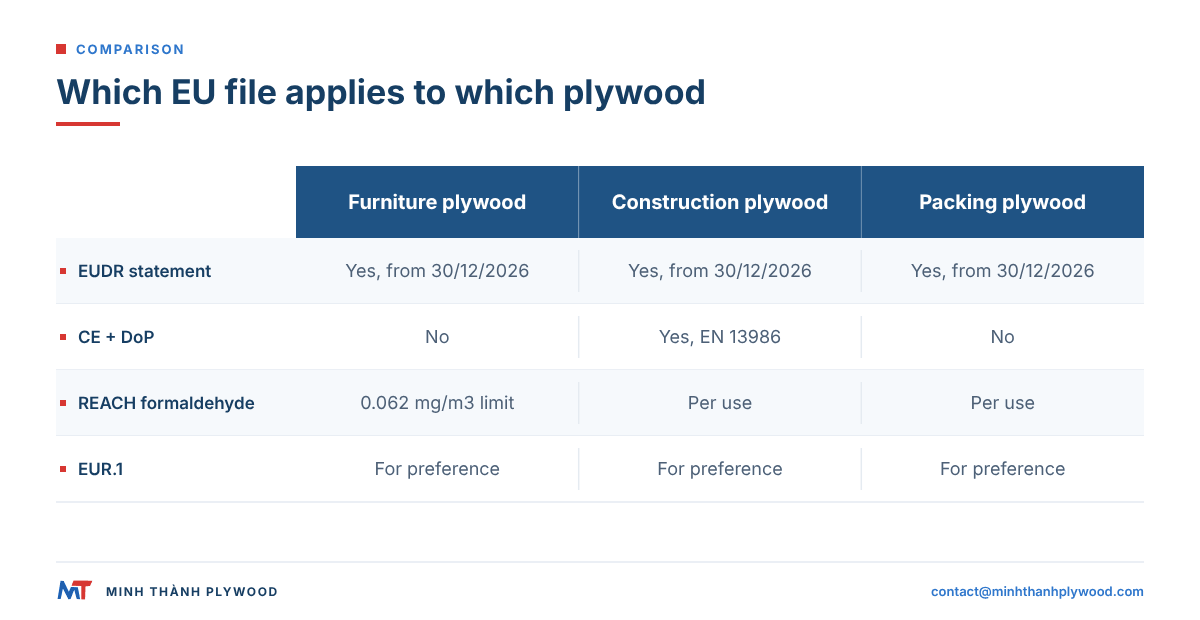
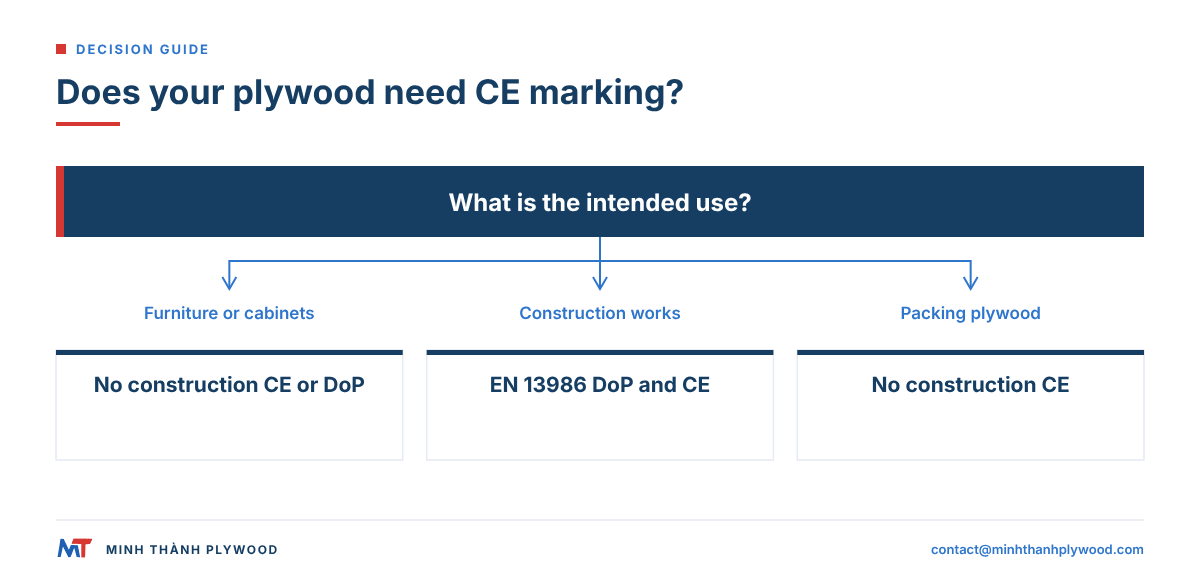
Only plywood placed on the market for construction works needs a Declaration of Performance (DoP) and CE marking, under the harmonised standard EN 13986 for wood-based panels in construction. Plywood for furniture, cabinets and other non-construction uses is outside that scope and travels without a construction-product DoP.
The distinction is the intended use, which you state on the order:
- Furniture and other non-construction panels (kitchen cabinets, wardrobes and shop furniture): no construction-product CE marking; emission evidence and the EUDR data are what buyers ask for.
- Structural and non-structural construction panels (flooring, roof and wall sheathing, permanent interior wall and ceiling panels): DoP and CE marking under EN 13986. The bond class is tested to EN 314 for the declared service class.
- Packing plywood: no CE marking; the pallet and crate rules of the next sections apply.
CE marking for Minh Thanh construction panels is available*, and the bond is set on the order: MR or melamine-fortified for humid interiors, phenolic (WBP) for exterior and formwork use. Our construction range is on the construction plywood page.
*Supplied directly or through qualified partner mills.
Which EN standards should a European plywood order name?
Name the EN standard for each property on the purchase order, because each one is a separate test report that a European buyer or a surveyor can ask for. Without them, “good glue” and “flat sheets” cannot be checked on arrival.
| Property | Standard | What it settles on the order | Typical request |
|---|---|---|---|
| Plywood specification by service class | EN 636 (parts 1, 2 and 3) | Dry, humid or exterior conditions | Part 1 dry for furniture, part 2 humid, part 3 exterior |
| Bond quality | EN 314-1 test, EN 314-2 requirements | Bond class 1 dry, 2 humid, 3 exterior | Class matched to the glue: UF dry, MR humid, phenolic exterior |
| Dimensional tolerances | EN 315 | Thickness, length, width and squareness limits | Tolerance stated per line |
| Bending strength and stiffness | EN 310 | Bending strength and modulus of elasticity of the panel | Report for structural or load-bearing lines |
| Characteristic strength values | EN 12369-2 | Design values for plywood in engineering use | Construction lines only |
| CE marking of construction panels | EN 13986 | DoP and factory production control | Construction use only |
For furniture lines the order normally needs EN 636-1, an EN 314-2 bond class that matches the glue, EN 315 tolerances and the emission evidence. EN 310 and EN 12369-2 belong on structural and construction lines. Ask the mill which of these reports it holds before you place the order; Minh Thanh sets the bond and tolerance on the order line and shows the chamber and bond test reports with the quotation.
What formaldehyde limit applies to plywood in Europe from August 2026?
From 6 August 2026, furniture and wood-based articles placed on the EU market must not release more than 0.062 mg/m³ of formaldehyde, measured in the chamber conditions of Appendix 14 of REACH Annex XVII, entry 77 (Regulation (EU) 2023/1464). Other articles have a limit of 0.080 mg/m³, and road vehicle interiors follow from 6 August 2027. Articles used only outdoors are excluded.
The Appendix 14 conditions are fixed: 23 °C, 45% relative humidity and a loading of 1 m² of panel per m³ of chamber. Results from other methods are reported in their own units and are not converted into mg/m³.
How Minh Thanh panels meet the requirement:
- Glue: UF glue at E0 emission is standard for furniture and interior panels; the glue and the emission class are two separate lines of the specification.
- Certification: CARB P2 / TSCA Title VI, ICTT mill no. 23024, for hardwood plywood with veneer core, 3–50 mm.
- Chamber tests: six third-party tests to ASTM D6007, April 2025 to June 2026, on 9, 15 and 18 mm panels, averaged 0.014–0.032 ppm against the 0.05 ppm CARB Phase 2 limit. Three were run by Shanghai Hongjun (HJ-QAT-250597, HJ-QAT-251303, HJ-QAT-261036) and three by ICTT Vietnam (ICTTVN-QAT-250841, ICTTVN-QAT-251173, ICTTVN-QAT-260272).
- Routine: E0 emission is tested every 3 months.
- Buyer’s method: third-party testing to EN 717-1, or to the Appendix 14 method, is arranged through SGS on request.
European furniture buyers accept the CARB P2 certificate and these chamber reports. Where your customer’s purchasing rules name EN 717-1, add the SGS test to the order and it is run on panels from your production. Details are on our formaldehyde emission page.
Are there anti-dumping duties on plywood imported into the EU?
The EU anti-dumping duty on hardwood plywood applies to plywood originating in China, under Implementing Regulation (EU) 2025/2333: 43.3% for one named Chinese producer with a valid invoice declaration and 86.8% for all other Chinese companies, on the net free-at-Union-frontier price. Bamboo and okoumé-faced products are outside its product scope.
Plywood made in Vietnam is not in the scope of that regulation. What matters at the border is proof of origin: customs reads the certificate of origin and can ask for the production records behind it. For a Minh Thanh panel, those records show the core peeled from Vietnamese plantation logs, the veneers laid up, pressed twice and sanded in Ha Hoa, Phu Tho.
Why are European importers buying more plywood from Vietnam?
The reasons importers give are product and paperwork reasons. Vietnamese mills offer white Styrax and Eucalyptus plantation cores, a wide choice of faces (birch, poplar, okoume, pine, engineered veneer), sizes in both 1220 × 2440 and 1250 × 2500 mm, and the files European buyers now need: CARB P2 certificates, chamber reports, EUDR data and the PPWR packaging test.
At Minh Thanh, the factory itself is built for top-grade furniture and interior plywood with Europe as its main market. Core layers are stitched horizontally and vertically, furniture panels are pressed twice as standard, faces are sanded and polished, and thickness tolerance goes down to ±0.2 mm. Those points, not tariffs, are what keep repeat orders running into Italy and other European markets.
Which packaging rules apply to plywood shipped to the EU?
Two packaging rules apply to a plywood container entering the EU: ISPM 15 for any solid wood in the pack bases, and the Packaging and Packaging Waste Regulation (PPWR) for the packaging materials themselves.
ISPM 15. Plywood is processed wood and is outside the scope of the ISPM 15 standard. Solid sawn-wood bearers, blocks or dunnage under the packs fall inside it and must be heat-treated or fumigated and stamped with the ISPM 15 mark. Pack bases made entirely of plywood need no mark.
PPWR. Regulation (EU) 2025/40 applies from 12 August 2026, and Article 5(4) caps the sum of lead, cadmium, mercury and hexavalent chromium in packaging at 100 mg/kg. SGS tested Minh Thanh’s four packing materials in September 2026 (cardboard, plywood and pallet blocks, strapping band, wrapping film): none of the four metals was detected in any material, a pass against the 100 mg/kg limit. The report covers our packaging, not the panels; see the PPWR packaging page.
A standard export pack from Minh Thanh is about 1,000 mm high: sheets on a base, cardboard corner and top protection, wrapping film and steel or plastic straps, with a pack label on each pack. How the packs are built and loaded is on our export packing page.
Which documents travel with each plywood container to Europe?
Four documents travel with every plywood container to Europe, and three more are prepared for each order. Your broker needs drafts before the vessel arrives, so the consignee, the CN code and the quantities match across all of them.
| Document | Issued by | What EU customs or your bank uses it for | Sent |
|---|---|---|---|
| Commercial invoice | Minh Thanh | Value, Incoterm, CN subheading, consignee | Copy at loading |
| Packing list | Minh Thanh | Packs, sheets and m³ per specification, gross and net weight | Copy at loading |
| Bill of lading | Shipping line | Title to the goods and release at the port | Scan after sailing |
| EUR.1 certificate of origin | Vietnamese issuing authority | Preferential duty under the EVFTA | After sailing |
| EUDR compliance dossier | Minh Thanh | Data for the importer’s due diligence statement | With the proforma |
| Phytosanitary and fumigation certificates | Vietnamese authorities | Where the port or the pack bases need them | After sailing |
| Insurance certificate | Insurer | Cover on CIF orders | After sailing |
Certificate files (CARB P2 / TSCA, chamber test reports, PPWR report) are sent with the order. Every shipment is photographed and filmed before loading, and you receive the photos and the video with the invoice and packing list copies. The 70% balance is paid against the scanned bill of lading, or the L/C is presented at sight.
How do you import plywood from Vietnam to Germany, France, Italy, the Netherlands, Poland or Spain?
The steps are identical in every EU member state, because the EU has one customs code, one tariff and one EUDR. What changes by country is the port, the customs authority, the transit from Hai Phong and the line worth adding to the order.
| Country | Main ports for plywood | Customs authority | Sea transit from Hai Phong | Worth adding to the order |
|---|---|---|---|---|
| Germany | Hamburg, Bremerhaven | Zoll (German Customs) | 30–40 days | Sanded tolerance and the emission evidence line |
| France | Le Havre, Fos-sur-Mer (Marseille) | DGDDI (French Customs) | 25–40 days | Face species written per line, as okoume changes the duty |
| Italy | Genoa, La Spezia, Venice | ADM (Customs and Monopolies Agency) | 25–35 days | Cut-to-size layout in 4, 6 or 8 pieces |
| Netherlands | Rotterdam | Douane (Dutch Customs) | 30–40 days | Mixed-load plan and pack labels per line |
| Poland | Gdansk, Gdynia | KAS (National Revenue Administration) | 30–40 days | Bond class and intended use per line |
| Spain | Valencia, Barcelona, Algeciras | AEAT Customs | 25–35 days | Sheet size: 1220 × 2440 or 1250 × 2500 mm |
| Belgium | Antwerp | Customs and Excise | 30–40 days | Mixed-load plan |
| Greece, Cyprus, Bulgaria, Romania | Piraeus, Limassol, Varna, Constanta | National customs | 25–35 days | Direct sailing or transhipment port |
| Nordic and Baltic states | Gothenburg, Aarhus, Helsinki, Klaipeda, Riga via North European hubs | National customs | 30–40 days plus feeder | Feeder port on the booking |
| Ireland | Dublin via a North European hub | Revenue | 30–40 days plus feeder | Feeder port on the booking |
Importing Vietnam plywood to the EU: what stays the same in every member state?
Importing Vietnam plywood to the EU follows one rulebook in all 27 member states: the Union Customs Code for the declaration, the Combined Nomenclature and TARIC for the duty, the EVFTA for the preferential rate and the EUDR for due diligence. Due diligence statements go into one EU information system shared by all member states, and the statement reference travels on the customs declaration wherever the container is cleared.
Three things stay national: the customs office and its language, import VAT and its rate, and how the member state enforces EUDR and REACH through its competent authority. A broker in the country of clearance handles the first two; the competent authority is the one that may ask to see your due diligence records, which is why the five-year retention applies to every importer wherever the panels land.
Transit days are typical days at sea from Hai Phong by carrier and route: 25–35 to the Mediterranean and 30–40 to Northern Europe. Ports reached by feeder from Rotterdam, Antwerp or Hamburg add the feeder leg.
The EU import VAT base includes customs value, duty and other applicable charges, plus incidental costs such as transport and insurance to the first destination and any further EU destination known at import, where not already included. Several member states let registered importers account for it in the VAT return instead of paying at the border, which helps cash flow on a 40HC; your broker knows the rule in your country.
How to import plywood from Vietnam to Germany
Clear through Hamburg or Bremerhaven with an EORI number from the German customs administration. For furniture panels, put “UF glue at E0 emission, sanded ±0.2 mm” on the specification and ask for the chamber reports with the quotation. Rail or barge from Hamburg carries the container inland.
How to import plywood from Vietnam to France
Le Havre serves Paris and the north; Fos-sur-Mer serves the Rhône valley and the south, and the Mediterranean sailing is shorter. Okoume faces fall under the 10% conventional heading and poplar under 7%, so write the face per line and make sure the EUR.1 is in order for the preferential rate.
How to import plywood from Vietnam to Italy
Genoa and La Spezia serve the northern Italian furniture districts. Minh Thanh has repeat orders running into Italy, including cut-to-size panels where one sheet is cut into 4, 6 or 8 pieces, so the parts reach the plant ready for edging.
How to import plywood from Vietnam to the Netherlands
Rotterdam is both a destination and a hub for re-forwarding to Germany, Belgium and the Nordic countries. An importer who distributes can take a mixed container: one 40HC carries one or two specifications as standard and three to six by agreement.
How to import plywood from Vietnam to Poland or Spain
Polish importers use Gdansk or Gdynia, or Hamburg with truck delivery. Spanish importers use Valencia for the east coast and Algeciras as a transhipment hub, and the Mediterranean leg of 25–35 days applies.
How long does it take to import plywood from Vietnam to Europe?
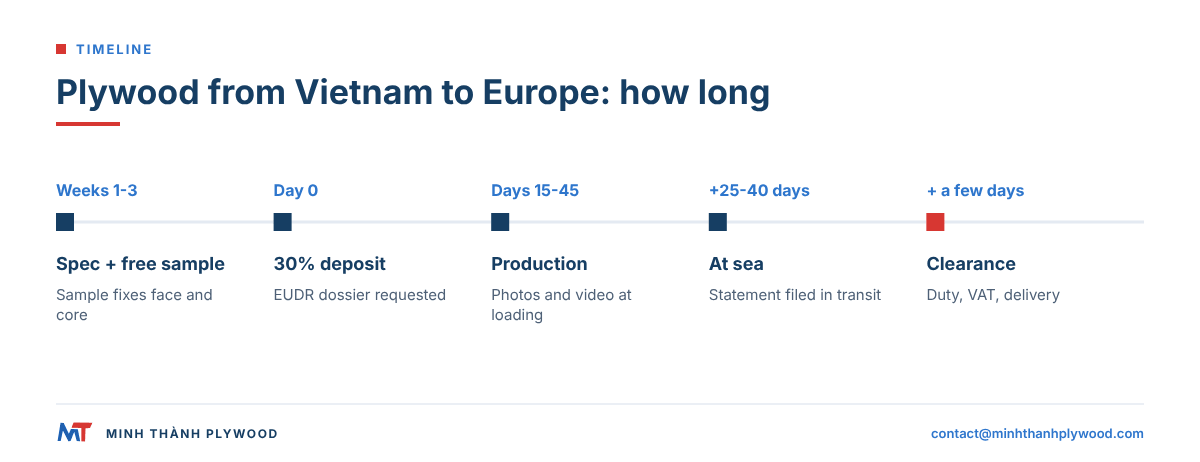
A first order from Vietnam to a European warehouse takes about 2 to 4 months from the first sample request, and a repeat order on an approved specification about 1.5 to 3 months from the deposit. The longest parts are production and the sea leg.
| Stage | Typical duration | What can shorten it |
|---|---|---|
| Specification and free sample | 2–3 weeks including courier | A clear specification in the first message |
| Proforma, deposit, EUDR dossier request | A few days | Broker confirms the CN code early |
| Production | 15–45 days after the 30% deposit | Standard faces and thicknesses; thin 4 mm premium faces take longer |
| Loading, photos, documents | A few days | Booking confirmed before production ends |
| Sea transit, Mediterranean | 25–35 days | Direct sailing |
| Sea transit, Northern Europe | 30–40 days | Direct sailing to Rotterdam, Antwerp or Hamburg |
| Clearance and delivery | A few days | Due diligence statement filed during transit |
The 15–45 days are production days after the deposit, not the sailing date. Premium thin veneer is scarce, so 4 mm furniture panels can take longer; we do not lower the standard to go faster.
What does the landed cost of Vietnamese plywood in Europe consist of?
The landed cost per m³ is the FOB price plus freight and insurance, plus duty on that CIF value, plus port and inland charges; import VAT is added on top but is usually recovered. Indicative starting prices at Minh Thanh, October 2026, are from US$350/m³ for furniture and interior plywood and from US$250/m³ for commercial plywood; the final price depends on face, core, glue, thickness, size, quantity and delivery term.
| Cost element | Basis | Who books it on FOB | Who books it on CIF |
|---|---|---|---|
| Panel price | Per m³ by specification | Importer pays the mill | Importer pays the mill |
| Ocean freight | Per container, Hai Phong to EU port | Importer | Mill |
| Insurance | Percentage of cargo value | Importer | Mill |
| Customs duty | CN rate × CIF value; preferential rate with EUR.1 | Importer | Importer |
| Import VAT | Member-state rate on customs value + duty + applicable incidental costs | Importer, often deferred | Importer, often deferred |
| Destination charges | Terminal handling, documentation | Importer | Importer |
| Inland delivery | Truck, rail or barge to the warehouse | Importer | Importer |
Freight per m³ depends on how much volume fits the payload. At 18 mm in 1220 × 2440 mm, a 40HC carries about 53 m³ on a Styrax core, 47 m³ on Acacia and 43 m³ on Eucalyptus, so the same freight spread over a lighter core costs less per m³. The worked figures by core are in plywood shipping cost from Vietnam.
FOB, CFR or CIF for a European import?
Choose FOB Hai Phong when your forwarder has contract rates to your port; choose CFR or CIF when you prefer one price to the destination port. Risk passes when the goods are loaded on board at Hai Phong under all three, which is why the loading photos and the bill of lading are the record of what left the mill.
What should a European importer specify on the first plywood order?
Specify the panel in the same order a mill builds it, one line per specification. A complete line lets the mill quote, plan the container and prepare the EUDR data in one round.
- Application: kitchen carcass, wardrobe, shopfitting, wall lining, packing or construction.
- Core: white Styrax or Eucalyptus as standard; Acacia or Pine on order.
- Glue and emission: UF glue at E0 emission for furniture; MR, melamine-fortified or phenolic (WBP) on specification.
- Face and back: species and grade pair, for example birch D+/D (comparable to B/BB on the European birch ladder), poplar A/B or eucalyptus B/B for painting.
- Thickness and tolerance: 3–40 mm; sanded furniture panels ±0.2–0.3 mm, down to ±0.2 mm.
- Size: 1220 × 2440 or 1250 × 2500 mm, custom sizes such as 1220 × 2500, or cut-to-size.
- Packing and quantity: sheets or m³ per line, pack height, labels in your language.
- Destination and documents: port, Incoterm, EUR.1, EUDR dossier, emission tests your customers ask for.
Faces are chosen for the look you order, including imported birch and okoume, and both faces can be supplied UV-ready for your own coating line. Our full furniture range is on the furniture plywood page.
How do you check a plywood container when it arrives in Europe?
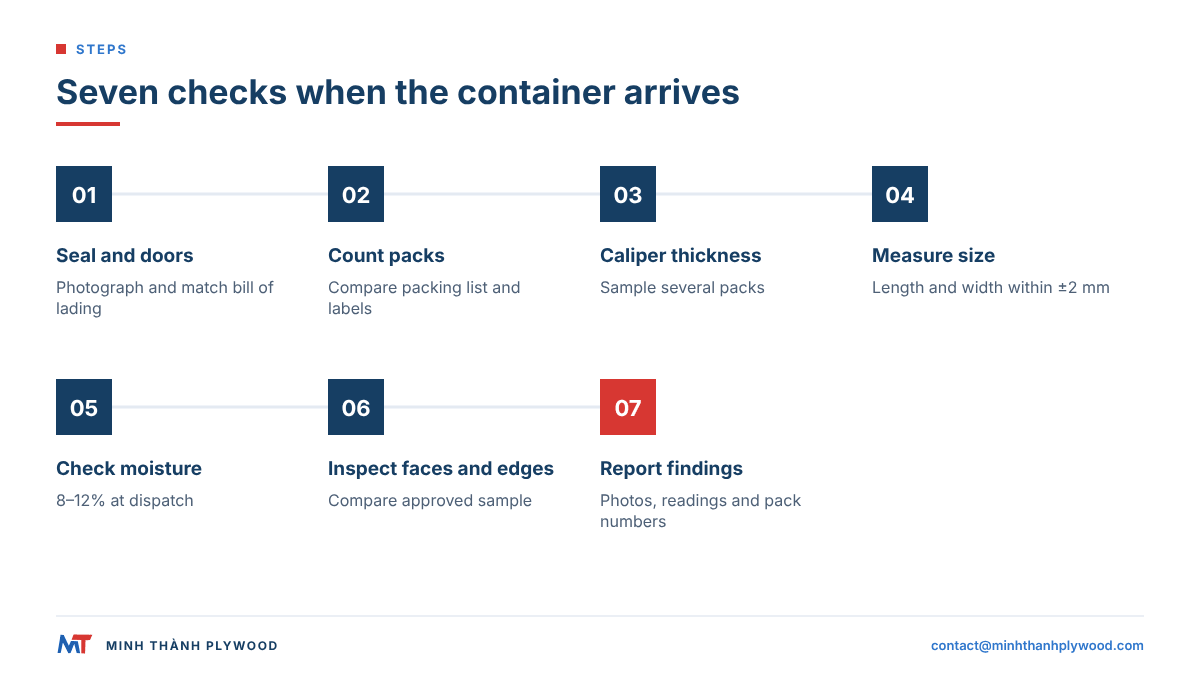
Check the container in a fixed order on the day it is opened, and record each finding against the pack number. The same seven checks settle almost every question in hours.
- Seal and doors: photograph them and compare the seal number with the bill of lading.
- Pack count: count packs against the packing list; photograph the pack labels.
- Thickness: caliper sheets from several packs per line, at the edges and in the middle.
- Length and width: within ±2 mm; check squareness against the order specification.
- Moisture: 8–12% at dispatch is the normal range for furniture plywood.
- Faces and edges: compare faces with the approved sample and look at the edges for core gaps.
- Report: photos and readings with the pack numbers, sent the same day.
Because Minh Thanh films every container before loading, a question on arrival is checked against the same packs on video. The arrival check is part of how to check plywood quality on arrival, planned in this series.
Should you book a third-party pre-shipment inspection?
A pre-shipment inspection by SGS, Bureau Veritas or Intertek at the mill is worth booking for a first order, an order above your usual size or any order a customer’s purchasing rules audit. The inspector checks thickness, size, moisture, faces, pack count and loading against your specification before the doors close, and signs a report you can attach to the claim file if needed. It sits between “loading, photos, documents” and sailing in the table above and adds no sailing days when it is booked with the loading date. Minh Thanh films every container before loading and gives access to the mill for your own inspector.
What happens if the plywood arrives not as specified?
Report it with the same-day arrival file and the claim is settled against the approved sample, the order line and the loading video of the same packs. The order of work is fixed:
- Same day: send the photos and readings from the arrival check with pack numbers; keep the packs in place and do not process the panels.
- Compare: we check the packs against the loading video, the approved sample and the specification line.
- Evidence: where the dispute is about a property, a third-party surveyor or an EN test on retained panels decides it, not either side’s opinion.
- Remedy: panels that fail the specification are replaced or credited against the next order; panels that match the specification are not.
Agree the claim window and the test method on the proforma before payment, so the same terms apply to every container.
Which mistakes delay plywood at EU customs?
Most delays at an EU port come from data that does not match across documents, not from the panels. These are the ones we see buyers avoid with one check before sailing.
- Wrong face on the invoice: a poplar-faced line invoiced as birch moves the CN code and the duty.
- No EUR.1 or a typo on it: the conventional rate applies until a corrected certificate arrives.
- No due diligence statement reference: from 30 December 2026 the declaration cannot be lodged without it.
- Quantities that differ: sheets, m³ or gross weight on the packing list differ from the bill of lading.
- Untreated solid wood bearers: pack bases of sawn wood without the ISPM 15 mark.
- Consignee mismatch: the bill of lading names a different company from the invoice or the EORI holder.
A short draft check by your broker, with the invoice, packing list and EUR.1 draft side by side, removes all six. Other errors in the buying process are covered in mistakes when importing plywood from Vietnam.
What does Minh Thanh need from you to quote plywood for Europe?
Send one message with your specification lines, your destination port and your timing, and Minh Thanh replies within hours with questions or a quotation and a packs plan. Minimum order is one 40HC, and samples are free.
- Specification lines: application, core, glue and emission, face and back, thickness, size.
- Quantity: sheets or m³ per line; mixed lines listed separately.
- Destination: EU port and Incoterm (FOB Hai Phong, CFR or CIF).
- Documents: EUR.1, EUDR dossier, emission or SGS tests, CE for construction lines.
- Arrival month and any booking payload limit from your forwarder.
Write to [email protected], use the contact form, or message Lisa on WhatsApp at +84 988 586 601; office hours are Monday to Friday, 08:00–17:00 Vietnam time (UTC+7). Our terms are on the trade terms page, and the 2026 product range is in the plywood catalogue.
Buyer questions, answered
How do I import plywood from Vietnam to Europe?
Agree a written specification and test a free sample, have your customs broker confirm the CN 4412 subheading, order on FOB, CFR or CIF, collect the mill's EUDR dossier and file your due diligence statement, then clear the container with the invoice, packing list, bill of lading and EUR.1.
What certificates are needed to import plywood into the EU?
By law: an EUDR due diligence statement filed by the importer from 30 December 2026, with the mill's origin and geolocation data behind it. By trade practice: an EUR.1 for the preferential duty, emission evidence for furniture plywood, and a Declaration of Performance with CE marking only for construction plywood.
What is the import duty on plywood from Vietnam to the EU?
The conventional rate in the Combined Nomenclature is 7% for most hardwood-faced plywood such as birch, poplar and eucalyptus faces, and 10% for okoume and the other listed tropical faces. With a valid EUR.1 under the EU-Vietnam Free Trade Agreement the preferential rate shown in TARIC applies.
Is EUDR compliance required for plywood imports to Europe?
Yes. Plywood is in the scope of Regulation (EU) 2023/1115, and the EU importer, as operator, must file a due diligence statement before customs clearance from 30 December 2026; other micro and small operators follow from 30 June 2027.
Is Vietnam high risk under EUDR?
No. Implementing Regulation (EU) 2025/1093 lists Vietnam as a low-risk country, which allows simplified due diligence when every wood in the panel comes from low-risk countries.
Does plywood need CE marking to be sold in the EU?
Only plywood placed on the market for construction works under the harmonised standard EN 13986 needs a Declaration of Performance and CE marking. Plywood for furniture and other non-construction uses does not.
What formaldehyde limit applies to plywood furniture in the EU from 2026?
From 6 August 2026, REACH Annex XVII entry 77 limits formaldehyde from furniture and wood-based articles to 0.062 mg/m³ in the chamber conditions of its Appendix 14. Minh Thanh tests third-party to EN 717-1 or the Appendix 14 method through SGS when a buyer asks.
Are there anti-dumping duties on Vietnamese plywood in the EU?
The EU anti-dumping measure on hardwood plywood in Regulation (EU) 2025/2333 applies to plywood originating in China. Vietnamese origin is proved with the certificate of origin and the production records of the mill.
How long does shipping plywood from Vietnam to Europe take?
Production runs 15–45 days after the deposit, then 25–35 days at sea to Mediterranean ports or 30–40 days to North European ports from Hai Phong, plus a few days for customs clearance and delivery.
What is the minimum order to import plywood from Vietnam to Europe?
Minh Thanh's minimum order is one 40-foot high-cube container. One container can carry several specifications by agreement, usually one or two and up to six.
Which port should I use for plywood from Vietnam to Germany or Poland?
German importers mostly clear plywood through Hamburg or Bremerhaven; Polish importers use Gdansk or Gdynia. Rotterdam and Antwerp are common hubs with inland delivery when they offer a better sailing.
Do I need a customs broker to import plywood into the EU?
Most importers use one. You need an EORI number, and the broker files the customs declaration with the tariff line, the EUR.1 and the EUDR due diligence statement reference.