
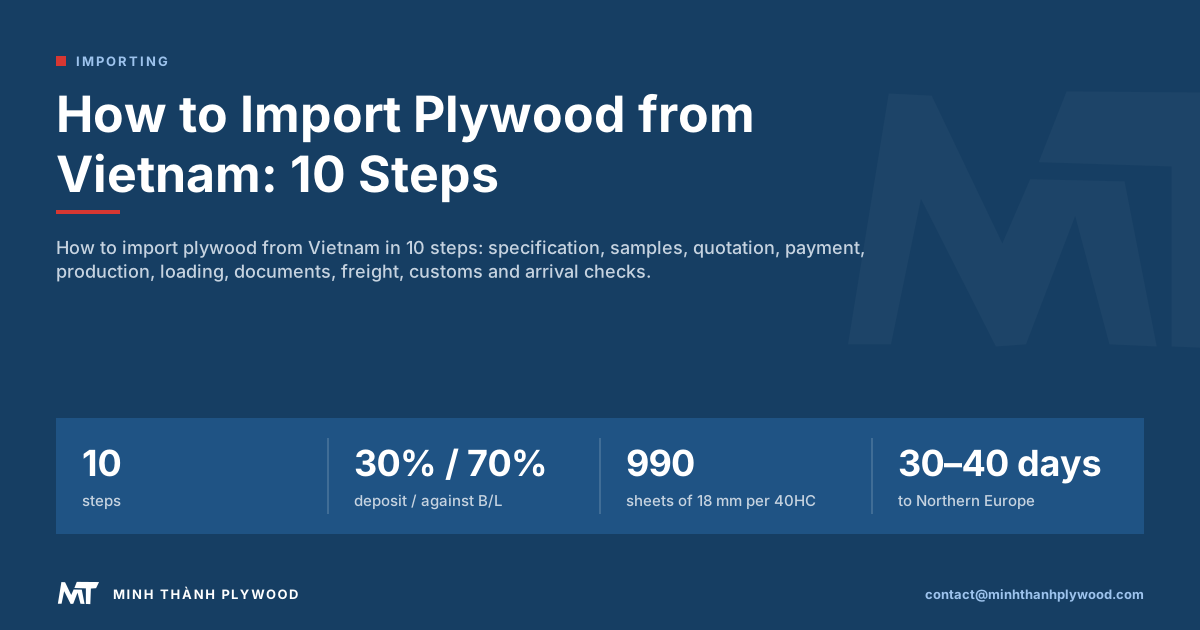
To import plywood from Vietnam, fix the panel specification, approve a free sample, sign a proforma invoice on FOB, CFR or CIF, pay a 30% deposit, then receive photos, documents and the container. Minh Thanh Plywood runs this ten-step sequence from Hai Phong for one 40HC upwards, with production in 15–45 days after the deposit.
How do you import plywood from Vietnam? The 10 steps at a glance
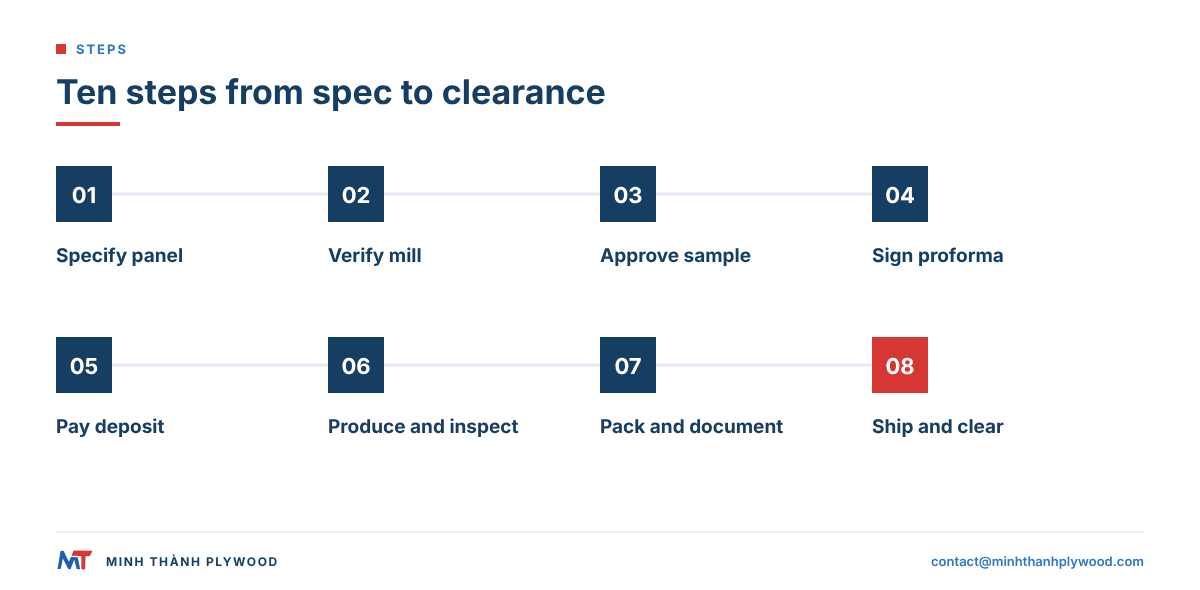
Importing plywood from Vietnam takes ten steps, and the order matters more than the paperwork. Each step has an owner: you, the mill, your forwarder or your customs broker. The steps run from specification to customs clearance: specify, verify, sample, quote, pay, produce, pack, document, ship and clear.
- Write the specification from the application: core, glue and emission, face and back, thickness, size, tolerance, packing.
- Shortlist and verify the manufacturer: registration, factory, certificates, real loading photos.
- Approve a sample against your own use, then keep a counter-sample at both ends.
- Get the quotation and proforma invoice on one Incoterm: FOB Hai Phong, CFR or CIF your port.
- Pay the deposit to the account on the signed contract.
- Production and quality control at the mill, with inspection before loading if you want it.
- Packing and container loading, photographed and filmed pack by pack.
- Export documents drafted for your approval, then issued.
- Sea freight to your port, tracked on the bill of lading.
- Customs clearance and arrival checks by your broker and your warehouse.
| Step | Who leads | What you hold at the end |
|---|---|---|
| 1 Specification | Buyer, with the mill’s advice | A one-page spec sheet per panel |
| 2 Verification | Buyer | Company registration, certificates, factory evidence |
| 3 Sample | Mill sends, buyer tests | A signed approved sample |
| 4 Quotation | Mill | Proforma invoice with Incoterm, packing and documents |
| 5 Deposit | Buyer | Bank slip and production slot |
| 6 Production | Mill | QC records, optional third-party inspection |
| 7 Loading | Mill | Loading photos and video, container and seal number |
| 8 Documents | Mill, checked by your broker | Invoice, packing list, B/L, certificate of origin, market files |
| 9 Freight | Shipping line (booked by mill or your forwarder) | Tracking on the B/L |
| 10 Clearance | Your customs broker | Released cargo and an arrival report |
The rest of this guide takes each step in turn, with what a factory such as Minh Thanh Plywood does at that point and what you should ask for. For the paperwork alone, see plywood import documents.
What specification do you send when you order plywood from Vietnam?
Send the application first, because a plywood quotation is only comparable when it describes one construction. Two offers for “18 mm plywood” can differ in core species, joint method, glue, face thickness and tolerance, and those differences decide the price.
A complete specification answers six questions, in this order:
- Application: kitchen cabinets, furniture carcasses, shelving, packing, formwork, flooring underlay; indoor or outdoor.
- Core: white Styrax or Eucalyptus for furniture panels; Acacia and Pine cores on order. Say whether you need the core stitched.
- Glue and emission: UF glue at E0 emission for furniture; MR, melamine-fortified or phenolic (WBP) bonds where moisture matters. Write glue and emission class on two separate lines.
- Face and back: species and grade pair, for example poplar A/B, birch D+/D or engineered veneer (EV); sanded or polished; UV-ready if you coat the panels yourself.
- Sheet: thickness, size (1220 × 2440 mm, 1250 × 2500 mm or a custom size such as 1220 × 2500 mm), thickness tolerance, cut-to-size if needed.
- Packing and quantity: packs, marks, labels, total sheets or cubic metres, destination port and required arrival month.
The application decides most of the rest. A European cabinet maker usually ends at a light white core, a sanded face and a tight tolerance; a packing buyer ends at a lower-cost core and looser tolerance. Starting from the use avoids paying for a grade nobody sees.
At Minh Thanh, sanded furniture panels are held to a thickness tolerance down to ±0.2 mm, commercial and film-faced panels to ±0.5 mm, and length and width to ±2 mm. Put the tolerance you need on the spec sheet, because it is the number your arrival check measures against.
Step 2: how do you verify a Vietnamese plywood manufacturer?
Verify the company, the factory and the documents before any money moves. Vietnamese plywood is sold by manufacturers, by trading companies and by brokers, and the same panel can reach you through any of them.
- Company registration: ask for the business registration certificate and check the company name and tax code on Vietnam’s National Business Registration Portal. The name must match the contract and the bank account.
- Factory evidence: a factory video call, a visit, or loading photos and video from recent shipments. A manufacturer can show its press, its veneer drying and its packing line on request.
- Certificates with numbers: an emission certificate with the certifier’s number, a quality management certificate, test reports with the laboratory, method and date.
- Specialisation: furniture and interior plywood, commercial and packing plywood, and film-faced construction plywood are usually different mills. Pick one that makes your product line every week.
Minh Thanh Plywood is a manufacturer in Ha Hoa, Phu Tho, built for top-grade furniture and interior plywood with Europe as its main market, with a capacity of 50,000+ m³ per year. The full verification method is in how to choose a plywood supplier in Vietnam.
Should you buy from the mill, an importer or an agent?
Buy from the mill when you take full containers and can write a specification; buy from a local importer when you need small lots from stock. An agent sits between the two and charges for finding mills and checking orders.
| Route | Minimum | Price level | Who answers for quality | Best for |
|---|---|---|---|---|
| Manufacturer direct | One 40HC | Mill price | The mill that pressed the panels | Regular container buyers, furniture plants, distributors |
| Trading company in Vietnam | Often one 40HC | Mill price plus margin | The trader, who relies on its mills | Buyers who want several product lines on one invoice |
| Sourcing agent | Varies | Mill price plus fee | Shared; the agent checks, the mill makes | Buyers new to Asia without staff to visit |
| Local importer or merchant | A few sheets or packs | Highest per sheet | The importer | Small, urgent or mixed lots |
A trading company can be useful, but ask which factory presses the panels and whether the documents carry that factory’s name. Direct buying removes a margin and, more importantly, a step between your question and the person who can answer it. The difference is explained in factory or trading company.
Step 3: how should you test and approve a plywood sample?
Test the sample in your own process, then sign it as the reference for the order. A sample that only looked good on a desk tells you little about machining, edge finish or coating.
- Ask for the exact specification you will order: same core, glue, face grade and thickness. Free samples are standard at Minh Thanh.
- Measure it: caliper the thickness at several points, check flatness on a table, look at the edge for gaps and overlaps in the core.
- Use it: cut, edge-band, drill, laminate or coat it the way production will.
- Approve in writing: mark the sample with the order reference, keep one piece, and ask the mill to keep its counter-sample.
The approved sample settles face appearance later. Face grade words such as A/B or D+/D describe a range; a sample pins down where in that range your panels sit.
Step 4: what should the plywood quotation and proforma invoice show?
The proforma invoice should restate your full specification, the price basis and the delivery term, so that nothing is left to an email thread. Read it line by line before paying the deposit.
| Line on the proforma | What it should say | Why it matters |
|---|---|---|
| Product | Face/back, core, glue, emission, thickness, size, tolerance | The contract specification, not a product name |
| Quantity | Sheets and m³ per specification | m³ and sheet counts must match the packs plan |
| Price basis | Per m³ or per sheet, in the contract currency | Two units on two offers hide differences |
| Incoterm | FOB Hai Phong, CFR or CIF your port | Decides who books and insures the vessel |
| Packing | Pack size, cover, straps, base, marks | Damage and handling at your warehouse |
| Payment | Deposit and balance terms | Your cash timeline and your protection |
| Production time | Days after deposit | Your arrival date |
| Documents | List of shipping and certificate files | What your broker and customers need |
Minh Thanh quotes FOB Hai Phong, CFR or CIF. Indicative starting prices in October 2026 were from US$350/m³ for furniture and interior plywood and from US$250/m³ for commercial plywood; the final price follows face, core, glue, thickness, size, quantity and delivery term. The plywood price guide explains what moves each line.
Which Incoterm should you use: FOB, CFR or CIF?
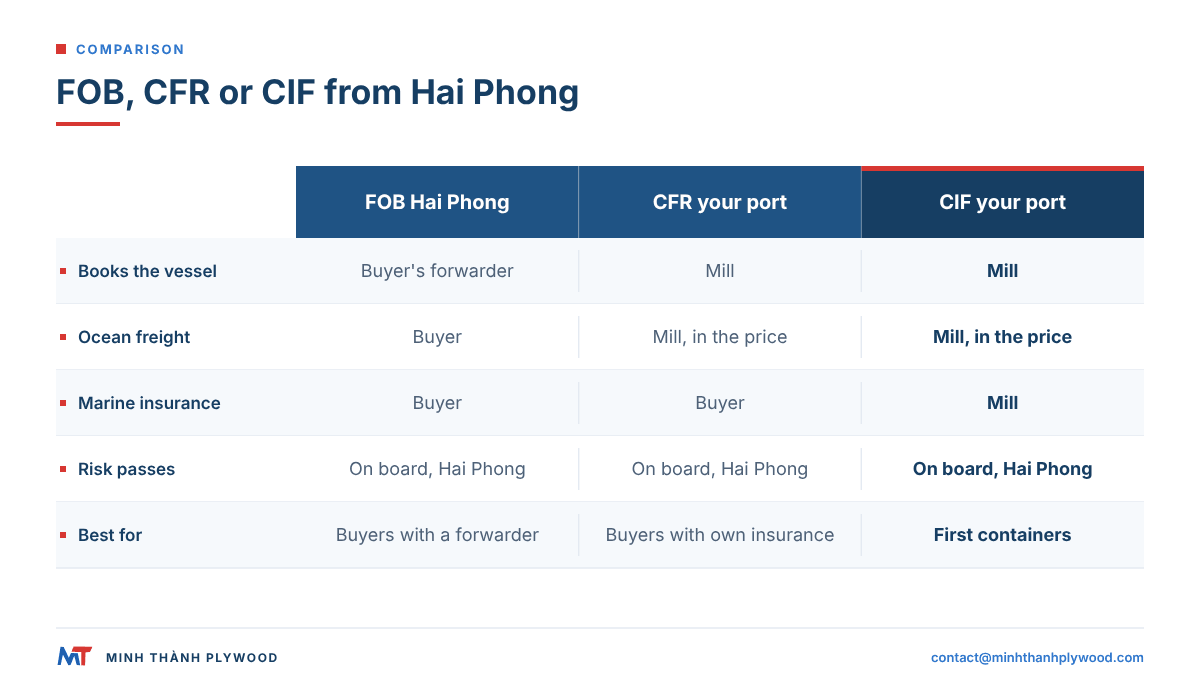
Choose the Incoterm by who you want to book the vessel. Under FOB, you or your forwarder book freight from Hai Phong; under CFR and CIF, the mill books it to your port, and under CIF it also buys the marine insurance.
| FOB Hai Phong | CFR your port | CIF your port | |
|---|---|---|---|
| Who books the vessel | Buyer’s forwarder | Mill | Mill |
| Who pays ocean freight | Buyer | Mill, in the price | Mill, in the price |
| Marine insurance | Buyer arranges | Buyer arranges | Mill arranges |
| Risk passes to buyer | On board at Hai Phong | On board at Hai Phong | On board at Hai Phong |
| Best for | Buyers with a forwarder and freight contracts | Buyers with their own insurance policy | First containers, smaller importers |
Risk passes on board at the port of loading under all three, which is why the loading photos and the bill of lading matter: they show what was handed to the shipping line. Destination charges, duty and inland delivery stay with you under all three terms.
Step 5: how do deposit and payment work?
The standard structure is a 30% deposit with the order and the 70% balance against the scanned bill of lading. An irrevocable letter of credit at sight is the alternative when your bank prefers it.
- Deposit: starts production of your order.
- Balance against the scanned B/L: you pay once the container is loaded, sealed and on board, after you have seen the loading photos and the B/L copy.
- Release: the original B/L is couriered, or the cargo is released by telex release, after the balance arrives.
- L/C at sight: the bank pays when the documents match the credit; every word on the invoice and B/L must follow the L/C text.
Two habits protect the payment. Pay only to the account on the signed contract, in the supplier’s own company name. And confirm any change of bank details by phone with a person you know, never by email alone; changed bank details in an email are a known fraud pattern in timber trade.
Step 6: what happens in production and quality control?
Production runs 15–45 days after the deposit at Minh Thanh, by build and quantity. Thin premium faces and 4 mm panels can take longer, because good thin veneer is scarce.
For furniture-grade panels, the sequence at the mill is:
- Veneer drying and grading: core and face veneers are dried to 8–12 % moisture content and sorted by grade.
- Core lay-up: core veneers are laid cross-grain; on stitched cores, the joints are sewn horizontally and vertically so the layers stay closed.
- First pressing and calibration: the core board is pressed and sanded to an even thickness.
- Second pressing: face and back are pressed onto the calibrated core. Pressing twice is standard for furniture-grade panels and gives the flat, even face that coating lines need.
- Sanding and grading: faces are sanded or polished, sheets measured and graded against the approved sample.
- Packing: sheets counted into packs, covered and strapped.
What the mill checks before your panels are packed
Quality control at a furniture plywood mill happens at each stage, not only at the end. At Minh Thanh the checks that matter to an importer are:
- Moisture: veneers and finished panels dried to 8–12% at dispatch, so the panel does not move after delivery.
- Core lay-up: core layers stitched both horizontally and vertically, so joints stay closed.
- Thickness against the tolerance on your order: ±0.2–0.3 mm on sanded furniture panels.
- Face grading against the approved sample.
- Packs and marks photographed and filmed before loading, so you can match them to the packing list.
Most buyers rely on the mill’s QC and the pre-loading photos and video. If you want an independent check, appoint an inspection company before loading; agree the inspection standard and the sampling plan on the contract. Third-party testing to your method, for example formaldehyde emission to EN 717-1, is arranged through SGS on request.
Step 7: how is plywood packed and loaded into a container?
Plywood ships in strapped packs of one size and specification, loaded into a 40-foot high-cube (40HC) container. Each pack is about a metre high, so the number of sheets per pack falls as thickness rises.
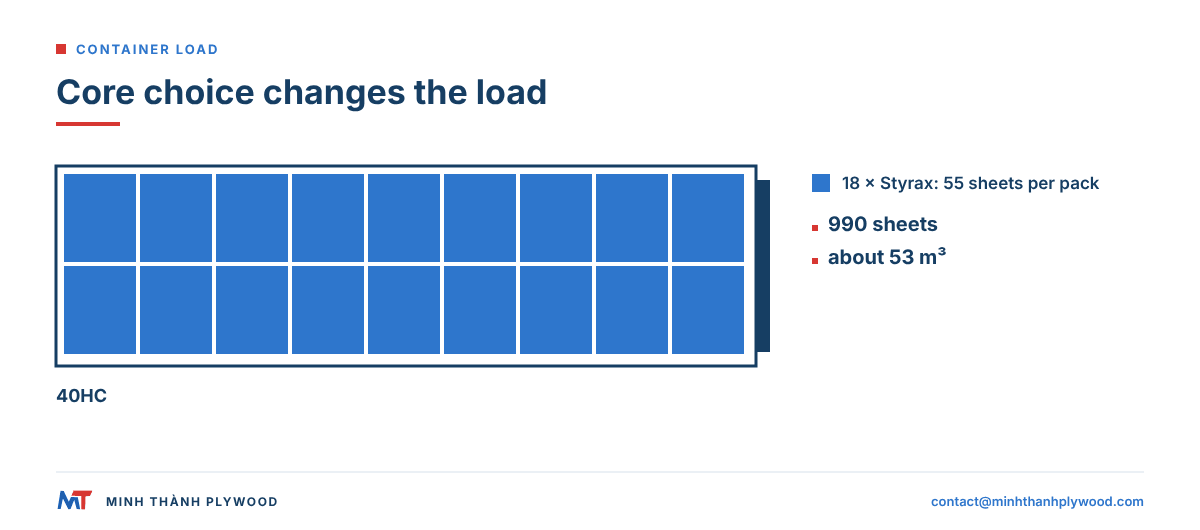
How much fits depends on the core, because a denser core reaches the container’s weight limit before it fills the space. For 18 mm panels of 1220 × 2440 mm, Minh Thanh’s loading plan is:
| Core | Reference density | Packs per 40HC | Sheets | Volume | Weight per sheet |
|---|---|---|---|---|---|
| Styrax | 500 kg/m³ | 18 (55 sheets each) | 990 sheets | about 53 m³ | 26.8 kg |
| Acacia | 580 kg/m³ | 16 (55 sheets each) | 880 sheets | about 47 m³ | 31.1 kg |
| Eucalyptus | 650 kg/m³ | 15 (53 sheets each) | 795 sheets | about 43 m³ | 34.8 kg |
The plan assumes a planning payload of 28,000 kg unless the booking is lower. If your shipping line or your road haulage caps the box at 26,000 kg, the sheet count drops; say so on the order, and the packs plan is recalculated before loading. Packing a container past the weight or pack limit breaks pack bases and turns unloading into manual work.
Every Minh Thanh container is photographed and filmed before and during loading: pack marks, sheet counts, faces, the full container and the seal. You receive the photos and video before paying the balance. See container loading and export packing for the method.
Can you mix plywood specifications in one container?
Yes, by agreement. Most containers carry one or two specifications; three to six are possible when each line fills whole packs. The rules that keep a mixed container simple:
- Whole packs per line: each specification fills complete packs of one thickness and size.
- Heavy packs low: thicker and denser panels at the bottom, thin panels on top.
- One line per specification on the invoice and the packing list, with its pack numbers.
- Weight first: the total stays inside the payload your line accepts.
A furniture importer might take 12 mm and 18 mm Styrax-core poplar panels plus a few packs of 5 mm thin plywood for drawer bottoms in one 40HC. The packs plan is sent with the proforma, so you see the mix before the deposit.
Step 8: which export documents travel with the container?
Four documents clear every plywood shipment: commercial invoice, packing list, bill of lading and certificate of origin. Your destination then adds its own files.
| Document | Issued by | Your broker uses it for |
|---|---|---|
| Commercial invoice | The mill | Value, HS code, Incoterm, consignee |
| Packing list | The mill | Packs, sheets, m³, net and gross weight |
| Bill of lading | The shipping line | Proof of shipment and cargo release |
| Certificate of origin (EUR.1 for the EU) | Vietnamese issuing authority | Preferential duty rate |
| Phytosanitary and fumigation certificates | Vietnamese authorities | Only where your port requires them |
| Insurance certificate | The insurer (under CIF) | Cover from loading to your port |
| Certificate files on order | The mill | Emission certificate, test reports, EUDR dossier, packaging test |
Drafts of the invoice, packing list and certificate of origin go to you and your broker before issue. A spelling difference in the consignee or a weight that differs between packing list and B/L is the most common reason for a hold at the port. The complete set, by destination, is in plywood import documents.
Step 9: how long does sea freight from Vietnam take?
Sea freight from Hai Phong takes from under two weeks within South-East Asia to 30–40 days to Northern Europe and 35–45 days to the US East Coast. The time at sea depends on the carrier, the route and transhipment.
| Destination region | Typical days at sea from Hai Phong |
|---|---|
| South-East Asia | 5–12 days |
| Middle East | 15–25 days |
| US West Coast | 20–30 days |
| Mediterranean | 25–35 days |
| Northern Europe | 30–40 days |
| US East Coast | 35–45 days |
| West Africa | 35–50 days |
| Japan and Korea | about two to three weeks |
Add the time between loading and departure, and the days at the destination port for clearance and delivery. Under CFR and CIF the mill books the vessel and sends the schedule; under FOB your forwarder does.
Step 10: how is plywood cleared through customs at destination?
Your customs broker clears the container on the documents the mill sends, under HS heading 4412 for plywood. The broker needs the drafts early, so the tariff subheading, the origin proof and the market filings are agreed before the vessel arrives.
- Tariff classification: the broker agrees the subheading with you from the face species, ply species and thickness.
- Origin and duty: the certificate of origin supports the preferential rate where a trade agreement covers plywood.
- Market filings: EUDR due diligence statement reference in the EU; TSCA and Lacey declarations and the Importer Security Filing in the US.
- Port charges and delivery: terminal handling, delivery order and haulage to your warehouse.
Which HS code does plywood take?
Plywood is classified under HS heading 4412 (plywood, veneered panels and similar laminated wood). Plywood in this heading has each ply at most 6 mm thick. The subheading depends on the species of the outer plies and whether they are tropical, other hardwood or softwood, so two panels from the same mill can sit under different subheadings.
Agree the code with your broker before the invoice is drafted, using the full construction: face and back species, core species, number of plies and thickness. The same code then appears on the invoice, the packing list, the certificate of origin and the import declaration. A mismatch between them is a common reason for a customs query, and fixing a certificate of origin after issue takes time.
Then comes the arrival check, covered below, which closes the order.
How do import rules differ for the EU, UK and US?
The ten steps are the same everywhere; what changes is the extra file your market asks for. Three markets take most Vietnamese furniture plywood, and each adds its own layer.
| Market | Duty preference | Extra files for plywood | Official source |
|---|---|---|---|
| European Union | EU-Vietnam Free Trade Agreement, with EUR.1 origin proof | EUDR due diligence statement; formaldehyde limit for furniture and wood-based articles under REACH; CE marking only for construction plywood under EN 13986 | EUR-Lex |
| United Kingdom | UK-Vietnam Free Trade Agreement, with origin proof | No EUDR; the UK’s own timber rules, checked by your broker | UK Trade Tariff |
| United States | No free trade agreement | TSCA Title VI labels and invoice statement; Lacey Act species and origin declaration; Importer Security Filing; scope of trade-remedy cases checked by the broker | EPA TSCA Title VI |
European Union. Regulation (EU) 2023/1115, the deforestation regulation (EUDR), applies to plywood importers from 30 December 2026 (large and medium operators, and micro and small operators already under the EUTR; other micro and small operators from 30 June 2027). The importer is the operator and files a due diligence statement before customs clearance. Vietnam is classed as a low-risk country in Implementing Regulation (EU) 2025/1093, which allows simplified due diligence. Minh Thanh supplies the EUDR compliance dossier, origin records and geolocation files, with orders; see EUDR traceability.
What does EUDR change for a plywood importer in practice?
Under the EU deforestation regulation, the company that first places the plywood on the EU market is the operator and carries the duty of due diligence. For an importer of Vietnamese plywood that means four practical things:
- Collect the origin data before the order ships: species of every veneer, quantity, country of production and the geolocation of the plots where the wood was harvested.
- Assess and mitigate risk; with Vietnam classed as low risk, simplified due diligence applies when every part of the product comes from a low-risk country.
- File the due diligence statement in the EU information system and put its reference on the customs declaration.
- Keep the records for five years.
A furniture plant that buys the plywood from that importer and makes cabinets is a downstream operator and does not file its own statement; it keeps the statement reference. Minh Thanh’s dossier gives the importer the data for step 1 for each order.
United States. Panels for US orders carry the TSCA Title VI label, and the invoice and B/L state compliance. Minh Thanh holds CARB P2 / TSCA Title VI certification as ICTT mill no. 23024; see CARB P2 / TSCA Title VI. On 21 July 2026 the US Department of Commerce reached final determinations in anti-dumping and countervailing duty cases on hardwood and decorative plywood from Vietnam; your broker checks whether your exact construction falls inside their scope before you order.
United Kingdom. Since leaving the EU, the UK runs its own tariff and timber rules. EUDR does not apply to a UK import, and the EUR.1 issued under the UK-Vietnam agreement supports the preferential rate.
How do you import plywood from Vietnam to Germany, Poland, Denmark, Finland or Ireland?
Every EU member state applies the same customs code, the same tariff and the same EUDR rules, so the steps are identical from Germany to Ireland. What changes is the port, the transit time and the habits of local buyers.
| EU destination | Usual port of entry | What buyers there often ask for |
|---|---|---|
| Germany, Denmark, Finland, Baltic states | Hamburg, Bremerhaven, Gdansk, Aarhus, Helsinki via transhipment | Light white cores, tight tolerance, emission evidence, traceability files |
| Poland | Gdansk, Gdynia | Detailed construction data per thickness, test methods named on the order |
| Netherlands and Belgium | Rotterdam, Antwerp | Mixed specifications for distribution, pallet and labelling rules |
| Ireland | Dublin, often via a North-European hub | Same EU rules; longer total transit |
| Italy, Greece, Romania, Bulgaria, Cyprus, Portugal | Genoa, La Spezia, Piraeus, Constanta, Varna, Limassol, Leixoes | Cut-to-size panels for furniture plants, faster Mediterranean transit |
Transit to Northern European ports runs 30–40 days at sea from Hai Phong, and to Mediterranean ports 25–35 days. Minh Thanh ships regularly to European buyers, with repeat orders into Italy, including cut-to-size panels where one sheet is cut into 4, 6 or 8 pieces. The guide for European buyers is Vietnamese plywood suppliers for Europe.
What about importing plywood from Vietnam to the UAE and the Middle East?
The UAE and its neighbours import Vietnamese plywood without EUDR or TSCA layers, and the sea leg is short: 15–25 days from Hai Phong to Middle East ports. The documents are the core four plus the certificate of origin your broker asks for and, for some ports, a fumigation certificate.
What Middle East buyers usually specify differs from Europe. Furniture and joinery shops ask for clean faces and stable cores; contractors ask for film-faced plywood with phenolic or melamine glue for formwork. Where a Gulf market asks for product conformity documents, the mill supplies the technical data and test reports behind them.
For a first Gulf container, three choices settle most of the order. The glue: MR or melamine-fortified for joinery in air-conditioned interiors, phenolic for formwork and damp areas. The core: Eucalyptus or Acacia where stiffness and weight are wanted. The packing: pack bases and covers that handle well in heat and dust at the port. Write all three on the specification sheet before asking for prices.
What does it cost to land plywood from Vietnam?
The landed cost of plywood is the mill price plus everything that happens after the container leaves Hai Phong. Build it per container, then divide by the cubic metres actually loaded.
| Cost line | FOB buyer pays | CIF buyer pays | Notes |
|---|---|---|---|
| Panel price | Yes | Yes (inside the CIF price) | From the proforma invoice |
| Ocean freight | Yes | Included | Changes with the season and route |
| Marine insurance | Yes | Included | A small share of value |
| Import duty | Yes | Yes | Rate by HS subheading and origin proof |
| Trade-remedy duty | Where it applies | Where it applies | US cases; check scope first |
| Destination terminal and port charges | Yes | Yes | Charged by the terminal and the line |
| Customs broker fee | Yes | Yes | Per declaration |
| Inland haulage | Yes | Yes | Port to warehouse |
| Inspection or testing | Optional | Optional | Third-party inspection, SGS tests |
Two levers matter more than haggling over the panel price. The first is the core: a lighter Styrax core fits 990 sheets of 18 mm into a 40HC where Eucalyptus fits 795, so freight and port charges spread over more panels. The second is specification fit: paying for a face grade nobody sees, or for a tolerance your process does not need, raises the cost of every sheet.
Worked example: why the core changes the cost per sheet
Take two containers of 18 mm, 1220 × 2440 mm furniture plywood with the same face and the same freight cost per container. One uses a white Styrax core and loads 990 sheets; the other uses Eucalyptus and loads 795 sheets, because the heavier sheets reach the payload first.
Every per-container cost (ocean freight, terminal charges, broker fee, haulage) is then shared by 990 sheets in the first case and 795 in the second. The Styrax container carries about a quarter more sheets for the same logistics bill. Eucalyptus is still the right choice for stiff, load-bearing parts; the point is to choose the core for the part, then let the container plan show the cost.
How long does the whole plywood import take?
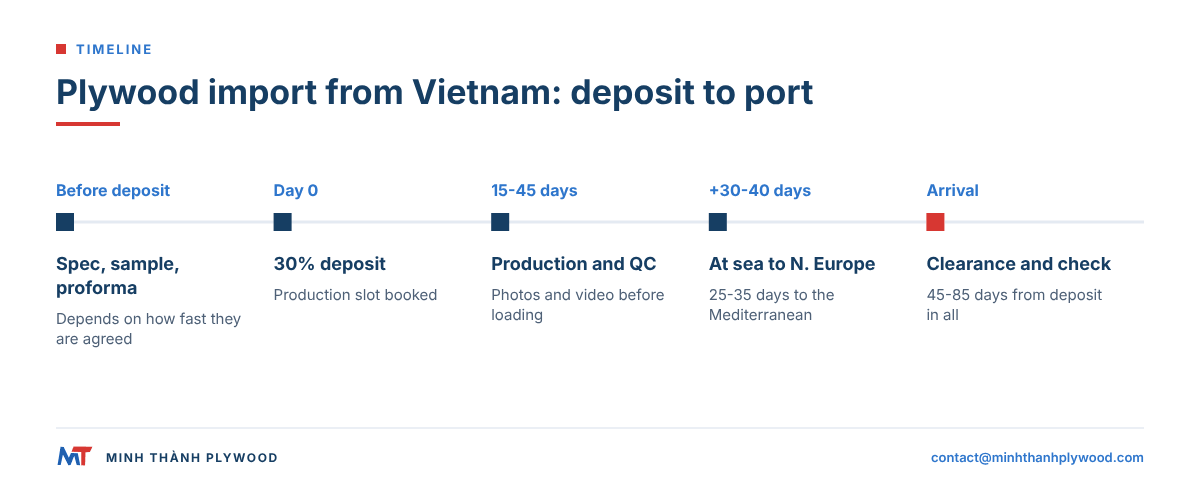
The fixed parts of a first plywood import from Vietnam to Europe are production after the 30% deposit, in the window given in step 6, and the sea voyage, 30–40 days to Northern Europe or 25–35 days to the Mediterranean. Together that is about 45–85 days from deposit to a Northern European port, or 40–80 days to the Mediterranean. The time before the deposit depends on how fast specification, samples and contract are agreed. Repeat orders on an approved specification are faster, because the specification, sample and documents are already agreed.
| Phase | First order | Repeat order |
|---|---|---|
| Enquiry, specification and quotation | Depends on how complete your specification is | Short: the specification is agreed |
| Sample to your door and testing | Courier time plus your own testing | Not needed |
| Contract and deposit | Your approval and bank transfer | Your approval and bank transfer |
| Production after the deposit | Standard production window | Same window, often shorter on a known specification |
| Loading, documents and departure | Booking and vessel schedule | Booking and vessel schedule |
| Sea freight to Northern Europe | 30–40 days | 30–40 days |
| Clearance and delivery | A few days | A few days |
Plan the arrival month backwards from your production need, and order the next container before stock runs low. Importers with steady demand often agree a monthly or quarterly call-off; see from trial order to long-term plywood supply.
What are the common mistakes in a plywood import, and how do you avoid them?
Most problems in a plywood import start on the order, not in the container. These are the ones we see buyers correct most often:
- Ordering by product name. “Furniture plywood 18 mm” without core, glue and face grade lets two suppliers quote two different panels.
- Comparing offers on different units or terms. One quote per sheet FOB, another per m³ CIF, compared as if equal.
- No approved sample. Without one, face appearance becomes an argument at arrival.
- Writing E0 in the glue field. E0 is an emission class; the glue type (UF, melamine, phenolic) is a separate line.
- Ignoring the weight limit. A heavy core loaded to the space limit overloads the container.
- Late drafts. Documents checked by your broker only after the vessel sails cannot be corrected without cost.
- Paying to changed bank details received by email.
The full list, with the scam patterns and the hidden costs, is in mistakes and scams when buying plywood from Vietnam.
How do you check the plywood when the container arrives?
Check the container in a fixed order on the day it is opened, and record everything against pack numbers. A simple arrival routine settles questions in hours instead of weeks.
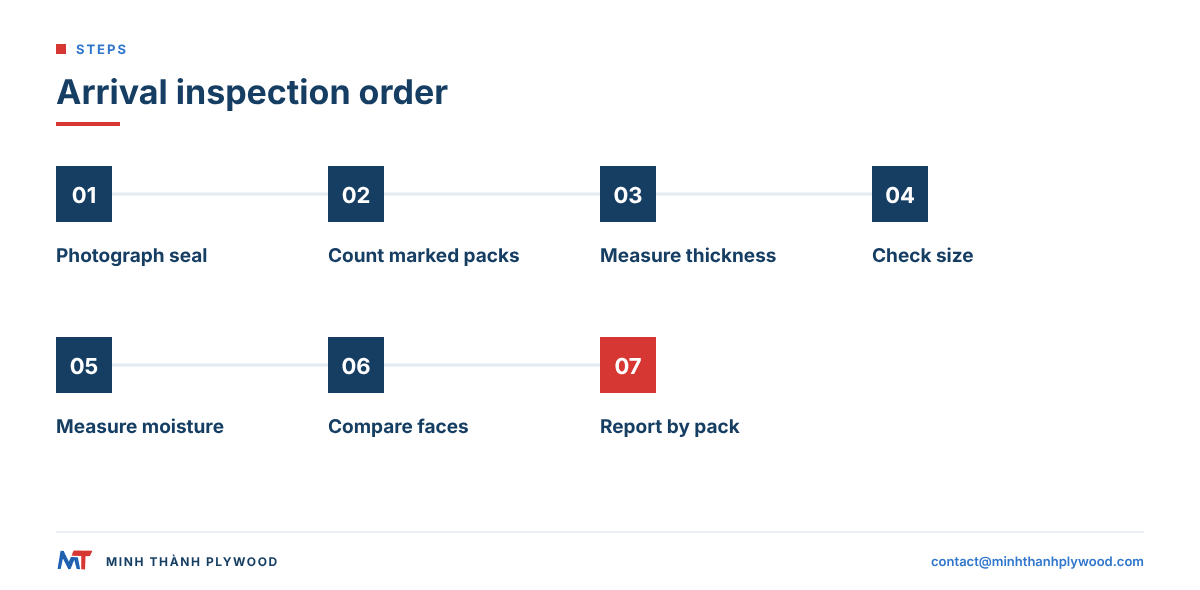
- Before opening: photograph the doors and the seal; compare the seal number with the B/L.
- Pack count: count packs against the packing list and photograph the pack marks.
- Thickness: caliper sheets from several packs per specification, at the edges and in the middle.
- Size and squareness: measure length and width; check against the ±2 mm tolerance.
- Moisture: a meter reading in the 8–12 % range is normal for furniture plywood at dispatch.
- Faces and edges: compare faces with the approved sample; look at the edges for core gaps.
- Report: send photos and measurements with the pack numbers and the specification line.
What if something on arrival differs from the order?
Separate the measurement from the opinion. Record what differs (thickness, size, face, moisture, count), how many sheets and which packs, with photos that show the measuring tool on the sheet and the pack mark in the same frame. Keep the affected packs apart and unused until the supplier has seen the evidence.
Because Minh Thanh films every container before loading, any question is checked against the same packs on video. How evidence settles a quality question is covered in plywood quality claims.
What does the mill need from you to start a plywood import?
To quote the right panel and plan the container, the mill needs your specification, your destination and your timeline in one message. With these, Minh Thanh replies within hours with questions or a quotation and a packs plan.
- Application and the specification lines from step 1.
- Quantity: sheets or m³ per specification; mixed specifications listed line by line.
- Destination port and Incoterm: FOB Hai Phong, CFR or CIF.
- Arrival month and whether this is a trial or a repeat order.
- Documents and certificates your market and your customers need.
- Booking limits: the payload your line or haulier accepts.
Minimum order is one 40HC. Send the list to [email protected] or through the contact form, and request the free sample with it. Our terms are on the trade terms page.
Buyer questions, answered
How do I import plywood from Vietnam for the first time?
Send a written specification, test the free sample, and have your customs broker confirm the tariff line and documents. Then sign the proforma invoice, pay the 30% deposit and approve the pre-loading photos before the container sails.
What is the minimum order when importing plywood from Vietnam?
At Minh Thanh the minimum is one 40HC container. Mixed specifications in that container are arranged by agreement, usually one or two specifications and more when the packs plan works.
How long does it take to import plywood from Vietnam to Europe?
From the deposit, allow about 45–85 days to a Northern European port (production plus 30–40 days at sea) or 40–80 days to the Mediterranean (25–35 days at sea). Sample approval and contract time come before that.
Which Incoterm should a first-time plywood importer choose?
CIF or CFR is simplest for a first container: the mill books the vessel to your port and you appoint only a customs broker. Buyers with their own forwarder usually buy FOB Hai Phong.
Do I need a customs broker to import plywood?
In practice, yes. The broker files the import declaration under the right HS 4412 subheading, claims the preferential duty with the certificate of origin and handles any EUDR or US filing references your market needs.
What documents come with a plywood container from Vietnam?
The commercial invoice, packing list, bill of lading and certificate of origin, plus phytosanitary or fumigation certificates where your port requires them, insurance under CIF, and the certificate files agreed on the order.
Can I import plywood from Vietnam to the UK?
Yes. The UK clears plywood under its own tariff, and the UK-Vietnam Free Trade Agreement gives a preferential rate with valid origin proof. EUDR is EU law and does not apply to imports into Great Britain.
Is CE marking required for plywood imported into the EU?
Only for plywood placed on the EU market for use in construction works under EN 13986. Furniture and interior plywood does not carry CE marking; it needs the emission and traceability evidence furniture buyers ask for.
How do I pay a Vietnamese plywood manufacturer safely?
Pay the deposit only to the bank account named on the signed contract in the company's own name, confirm any change of bank details by phone, and pay the balance against the scanned bill of lading or use an irrevocable L/C at sight.
What should I check when the plywood container arrives?
Photograph the seal and the doors before opening, count packs against the packing list, caliper sheets from several packs, check moisture and compare faces with the approved sample. Report any difference with pack numbers and photos.
Does the factory help with the EUDR due diligence statement?
Yes. We supply the EUDR compliance dossier, origin records and geolocation files, with orders. The EU importer files its own due diligence statement from it before customs clearance.
What HS code is plywood imported from Vietnam?
Plywood falls under HS heading 4412. The subheading depends on the outer ply species, the wood type and the ply thickness, so agree it with your customs broker from the full construction before the invoice is drafted.
Should I import plywood directly from the factory or through a trader?
Buy directly from the factory when you take full containers and can write a specification; it removes a margin and puts you in touch with the people who press the panels. Use a trader or local importer for small or very mixed lots.