
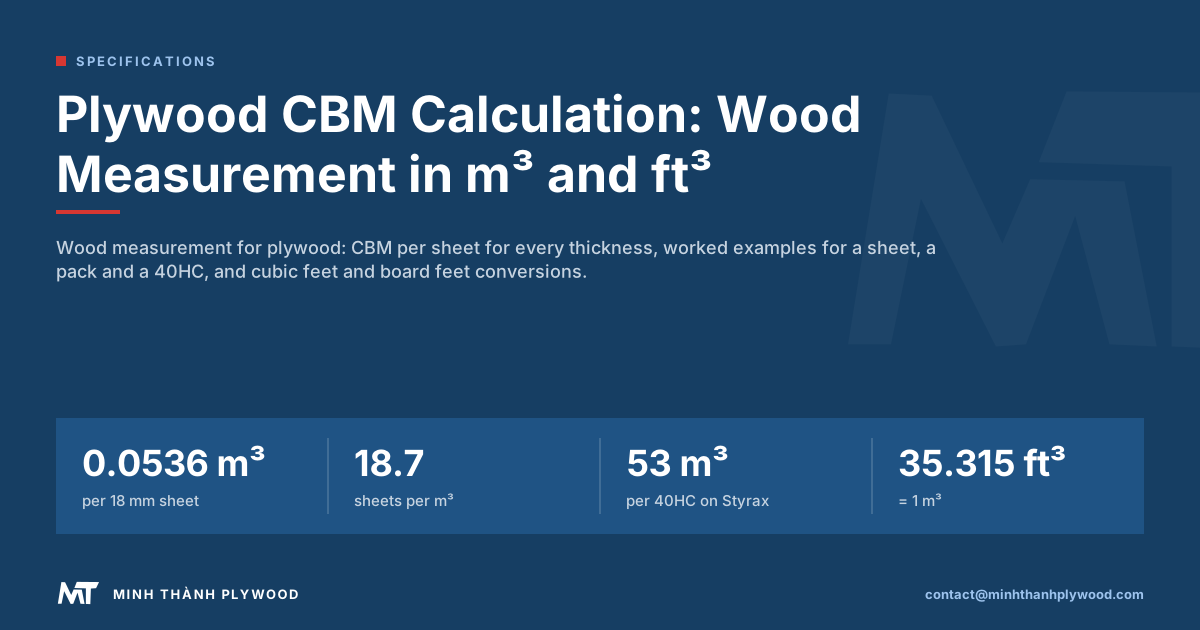
Plywood CBM is length × width × thickness in metres, times the number of sheets: one 1220 × 2440 × 18 mm sheet is 0.0536 m³, so 18.7 sheets make one cubic metre. This wood measurement guide from Minh Thanh Plywood gives the CBM of every thickness, worked examples for a pack and a 40HC, and the cubic feet and board feet conversions.
How do you calculate plywood CBM?
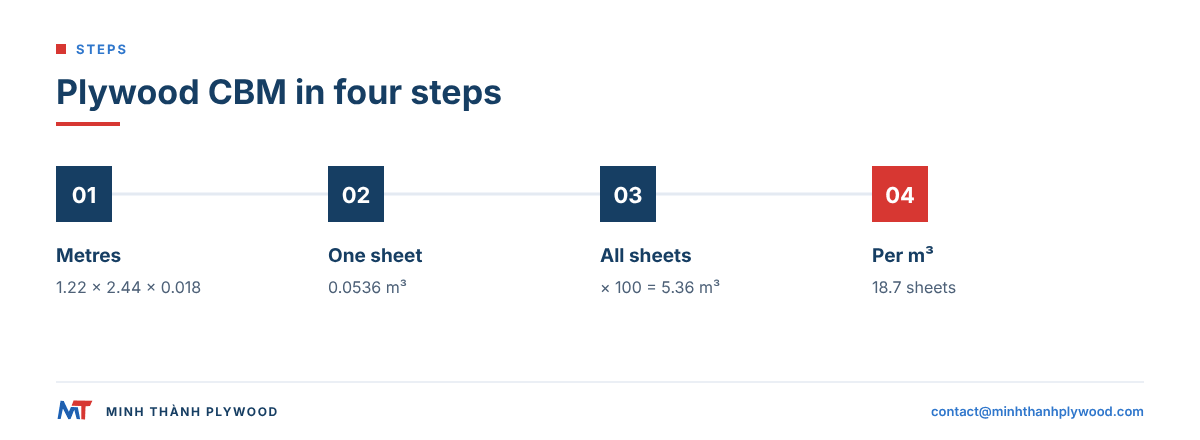
Plywood CBM is the volume of one sheet in cubic metres multiplied by the number of sheets. Convert length, width and thickness to metres first, then multiply the three.
The formula:
CBM = length (m) × width (m) × thickness (m) × number of sheets
A worked example on the most common sheet, 1220 × 2440 × 18 mm:
- Convert to metres. 1220 mm = 1.22 m, 2440 mm = 2.44 m, 18 mm = 0.018 m.
- Multiply for one sheet. 1.22 × 2.44 × 0.018 = 0.0536 m³.
- Multiply by the sheets. 100 sheets × 0.0536 = 5.36 m³.
- Turn it round for sheets per m³. 1 ÷ 0.0536 = 18.7 sheets per cubic metre.
The most common mistake is the thickness: 18 mm is 0.018 m, not 0.18 m. A misplaced decimal makes the volume ten times too large, and the error carries through every price and freight figure that uses it.
Plywood CBM calculator: inputs and outputs for any order
Enter four inputs, length, width, thickness and sheet count, and read six outputs: m³, cubic feet, board feet, sheets per m³, m² of face and weight by core. The table below is that calculator worked for 1220 × 2440 mm sheets, the common format. Use the formula above for any other size.
| Inputs: 1220 × 2440 mm sheets | m³ | Cubic feet | Board feet | Sheets per m³ | Weight, Styrax 500 kg/m³ | Weight, Acacia 580 kg/m³ | Weight, Eucalyptus 650 kg/m³ |
|---|---|---|---|---|---|---|---|
| 100 sheets × 12 mm | 3.57 | 126.2 | 1,514 | 28.0 | 1,786 kg | 2,072 kg | 2,322 kg |
| 100 sheets × 15 mm | 4.47 | 157.7 | 1,892 | 22.4 | 2,233 kg | 2,590 kg | 2,902 kg |
| 100 sheets × 18 mm | 5.36 | 189.2 | 2,271 | 18.7 | 2,679 kg | 3,108 kg | 3,483 kg |
| 500 sheets × 18 mm | 26.79 | 946.1 | 11,354 | 18.7 | 13,396 kg | 15,539 kg | 17,414 kg |
| 100 sheets × 21 mm | 6.25 | 220.8 | 2,649 | 16.0 | 3,126 kg | 3,626 kg | 4,063 kg |
| 100 sheets × 25 mm | 7.44 | 262.8 | 3,154 | 13.4 | 3,721 kg | 4,316 kg | 4,837 kg |
How each column is built: m³ = 1.22 × 2.44 × thickness in metres × sheets; cubic feet = m³ × 35.315; board feet = m³ × 423.8; sheets per m³ = 1 ÷ the volume of one sheet; weight = m³ × density. For feet and inches, convert first: 4 × 8 ft is 1.22 × 2.44 m, and 3/4 in is 18 mm.
For a mixed order, work each line on its own and add the m³ column. The weight is a planning figure: real sheets vary with moisture and core, as the weight section below shows.
What is CBM in shipping?
CBM in shipping is one cubic metre of cargo space, a box 1 m long, 1 m wide and 1 m high. Carriers use it to sell space and quote freight, and plywood mills use it to count and price panels.
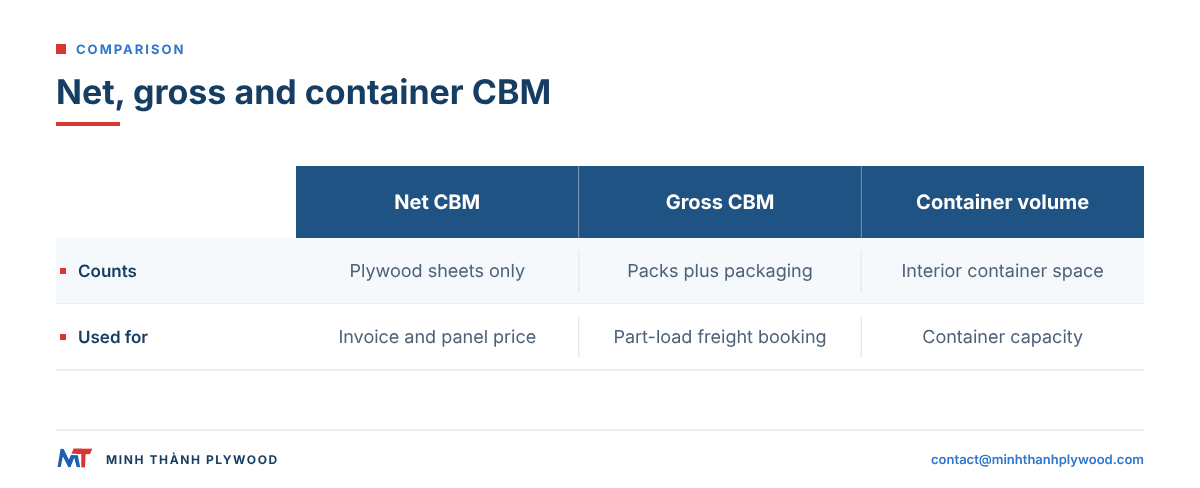
Three volumes appear on a plywood shipment, and each has its own job:
| Volume | What it counts | Where you see it |
|---|---|---|
| Net CBM | Panels only, from sheet size × count | Proforma invoice, packing list, price |
| Gross CBM | Packs with pallet base and packing | Freight booking for part loads |
| Container volume | The inside of the box | Carrier’s container specification |
For full-container freight the container is the unit, so the price does not change with the CBM inside. For less-than-container (LCL) freight, the forwarder charges by gross CBM or by weight, whichever gives the higher charge, with one cubic metre weighed against 1,000 kg.
Plywood is lighter than the 1,000 kg per m³ freight ratio. A cubic metre of Styrax-core plywood weighs about 500 kg and of Eucalyptus-core about 650 kg, so for LCL plywood the volume usually sets the charge.
Plywood CBM per sheet for every thickness
One sheet of 1220 × 2440 mm plywood is 0.0030 m³ for each millimetre of thickness: 0.0179 m³ at 6 mm, 0.0357 m³ at 12 mm and 0.0536 m³ at 18 mm. The table gives both standard sheet sizes.
| Thickness | m³ per sheet, 1220 × 2440 mm | Sheets per m³, 1220 × 2440 mm | m³ per sheet, 1250 × 2500 mm | Sheets per m³, 1250 × 2500 mm |
|---|---|---|---|---|
| 3 mm | 0.0089 | 112.0 | 0.0094 | 106.7 |
| 4 mm | 0.0119 | 84.0 | 0.0125 | 80.0 |
| 5 mm | 0.0149 | 67.2 | 0.0156 | 64.0 |
| 6 mm | 0.0179 | 56.0 | 0.0187 | 53.3 |
| 9 mm | 0.0268 | 37.3 | 0.0281 | 35.6 |
| 12 mm | 0.0357 | 28.0 | 0.0375 | 26.7 |
| 15 mm | 0.0447 | 22.4 | 0.0469 | 21.3 |
| 18 mm | 0.0536 | 18.7 | 0.0563 | 17.8 |
| 21 mm | 0.0625 | 16.0 | 0.0656 | 15.2 |
| 25 mm | 0.0744 | 13.4 | 0.0781 | 12.8 |
Use the 1250 × 2500 mm column for the European format. A 1250 × 2500 mm sheet has 5 % more area than a 1220 × 2440 mm sheet, so the same m³ buys about 5 % fewer sheets.
Minh Thanh makes panels from 3 to 40 mm in both formats, plus custom sizes such as 1220 × 2500 and 1220 × 2280 mm. For a custom size, use the formula with your own length and width.
How to calculate the CBM of a plywood pack or crate
The CBM of a plywood pack is the sheet volume times the sheets in the pack for the net figure, and the outside length × width × height for the gross figure. Both are on a good packing list.
Worked example, one 18 mm export pack of 55 sheets on a Styrax core:
- Net volume. 55 sheets × 0.0536 m³ = 2.95 m³.
- Net weight. 2.95 m³ × 500 kg/m³ = about 1,474 kg.
- Gross volume. Measure the pack outside, base and packing included. If it measures 1.24 × 2.46 × 1.3 m, the gross volume is about 4.0 m³.
- Write both. Net m³ on the price line, gross m³ and gross weight on the freight booking.
A closed crate adds boards or plywood on all sides, so its gross volume grows faster than a strapped pack. The net volume stays the same, because the panels inside are the same. Plywood is processed wood and sits outside ISPM 15, the international standard for wood packaging, but solid sawn-wood bearers under the packs are inside it (IPPC).
Plywood CBM per 40HC container: how many m³ fit?
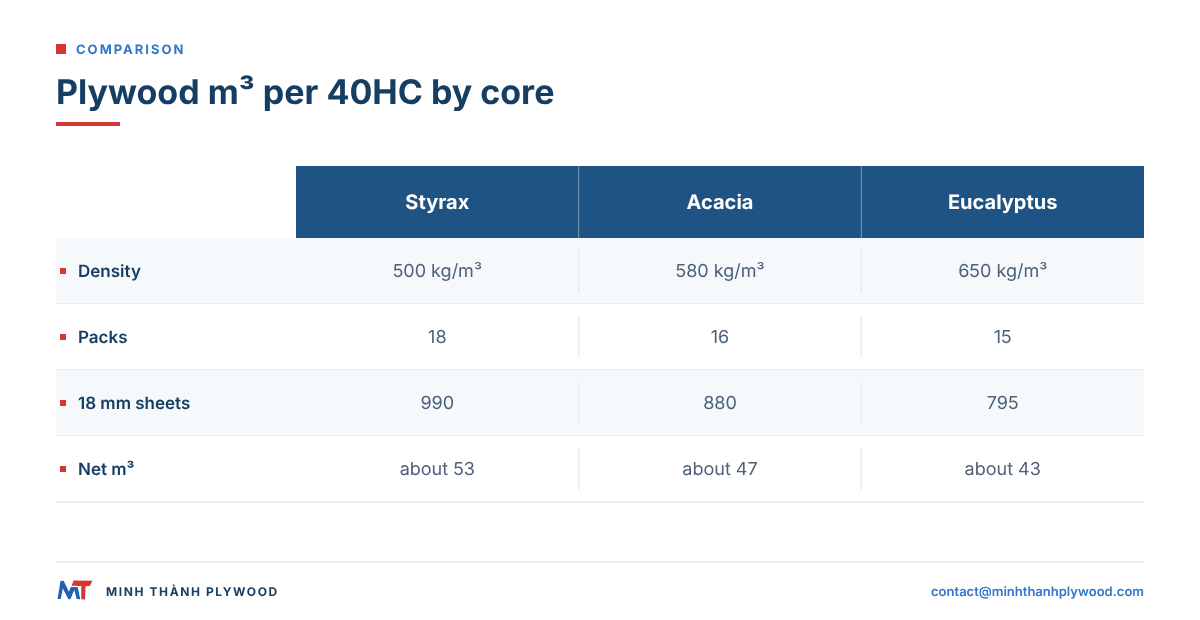
The plywood CBM per 40HC container is about 53 m³ of 1220 × 2440 mm panels on a Styrax core, about 47 m³ on Acacia and about 43 m³ on Eucalyptus. The container’s inside volume is about 76 m³, but packs, doors and weight decide the usable part.
| Core | Packs per 40HC | 18 mm sheets | Net m³ | Sheet weight |
|---|---|---|---|---|
| Styrax, 500 kg/m³ | 18 (16 lying, 2 upright) | 990 | about 53 | 26.8 kg |
| Acacia, 580 kg/m³ | 16 | 880 | about 47 | 31.1 kg |
| Eucalyptus, 650 kg/m³ | 15 | 795 | about 43 | 34.8 kg |
Two limits work together. Each pack is about 1,000 mm of panels, and the container takes a fixed number of packs on the floor and upright at the door. Then weight: the plan uses a 28,000 kg planning payload for the panels unless the booking states a lower figure, so heavier cores stop at fewer packs.
The m³ per container stays close to these figures for every thickness, because the stack height is the same. At 12 mm a Styrax container carries 1,494 sheets, again about 53.4 m³. Our 18 mm container loading guide works through booking caps in detail.
How to measure wood in cubic feet
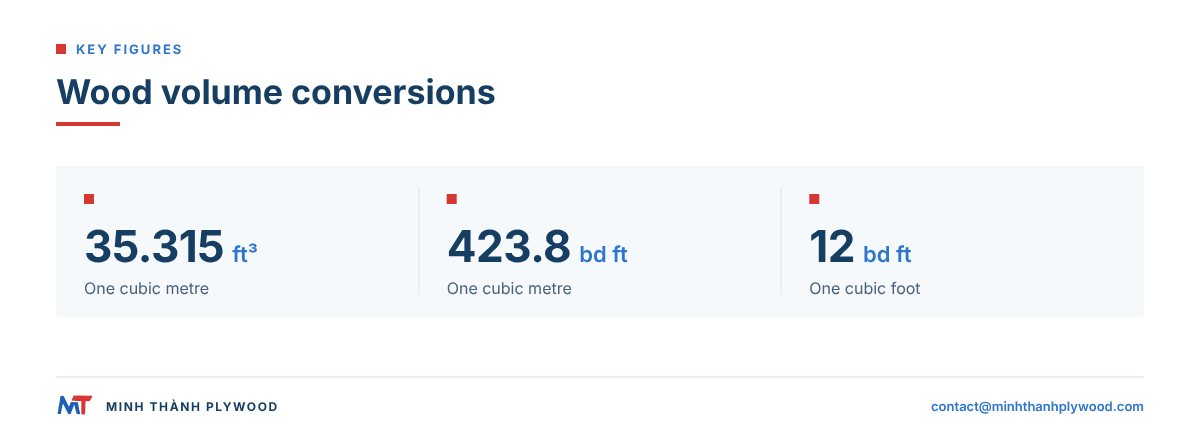
To measure wood in cubic feet, multiply length × width × thickness in feet, or convert a cubic-metre figure with 1 m³ = 35.315 ft³. Sizes in feet convert at exactly 25.4 mm to the inch (NIST). Plywood is easiest from the sheet size in feet.
Worked examples:
- 4 × 8 ft sheet, 3/4 inch thick. 4 × 8 × 0.0625 ft = 2.0 ft³ per sheet.
- 1220 × 2440 × 18 mm sheet. 0.0536 m³ × 35.315 = 1.89 ft³.
- One 40HC on Styrax core. About 53 m³ × 35.315 = about 1,870 ft³.
The difference between the first two lines is real, not rounding. A 4 × 8 ft sheet is 1219 × 2438 mm, close to the metric sheet, but 3/4 inch is 19.05 mm against 18 mm. The thicker panel has about 6 % more wood.
For a metric order, keep the calculation in metres and convert the total once at the end. Converting each sheet and adding rounded figures builds up an error across a container.
Wood measurement units: m³, cubic feet, square metres and linear metres
Wood is sold in four main measures, and the right one depends on the product: cubic metres for plywood and sawn timber in trade, square metres for sheets sold by face area, linear metres for mouldings and beams, and cubic feet or Hoppus measure for logs in India and the UK. Mixing them is the usual source of a wrong quote.
| Measure | Used for | Conversion for a 1220 × 2440 × 18 mm sheet |
|---|---|---|
| Cubic metre (m³) | Plywood, sawn timber, container loads | 0.0536 m³ per sheet; 18.7 sheets per m³ |
| Square metre (m²) | Flooring, cladding, sheets priced by face area | 2.98 m² per sheet (1.22 × 2.44), whatever the thickness |
| Linear metre (m) | Mouldings, beams, LVL, battens | Length only; the cross-section sets the price |
| Cubic foot (ft³) | Logs and lumber in India and the UK, US plywood volume | 1 m³ = 35.315 ft³; one sheet = 1.89 ft³ |
| Board foot (bd ft) | North American hardwood lumber | 1 m³ = 423.8 bd ft |
A price per m² hides the thickness, so two quotes at the same price per m² are only equal if the thickness is equal. Convert to m³ to compare: price per m² ÷ thickness in metres = price per m³. A price of US$6.30 per m² on 18 mm board is US$350 per m³.
Linear metres belong to a profile: a 50 × 100 mm batten is 0.005 m³ per linear metre, so 200 linear metres is 1 m³. Industry sources such as Pacific Forest discuss selling by inches, square metres and linear metres for the same reason.
Board feet and plywood: how the conversion works
One board foot is 144 cubic inches, a piece 12 × 12 × 1 inch, and one cubic metre equals 423.8 board feet. Board feet are the North American measure for sawn hardwood lumber; plywood is rarely sold that way.
Conversions to keep at hand:
| From | To | Multiply by |
|---|---|---|
| m³ | board feet | 423.8 |
| m³ | cubic feet | 35.315 |
| cubic feet | board feet | 12 |
| board feet | m³ | 0.00236 |
A 4 × 8 ft sheet at 3/4 inch contains 24 board feet. A 1220 × 2440 × 18 mm sheet contains about 22.7 board feet.
In the US, structural plywood is made to Voluntary Product Standard PS 1-22, which NIST lists as the current standard, and it is priced per sheet or per thousand square feet at a stated thickness. Vietnamese mills price per cubic metre. Converting both to price per m³ is the fair way to set two offers side by side.
Wood measurement: timber vs plywood
Timber measurement and plywood measurement use the same unit, the cubic metre, but they count different things. Logs are measured round, sawn timber by its sawn size, and plywood by the finished sheet.
- Round logs. Measured by length and diameter or girth with a log rule; the UK Hoppus measure, for example, uses a quarter of the girth, squared, times the length, and gives about 78.5 % of the true volume.
- Sawn timber. Measured by its actual sawn size, or by nominal size where the market prices that way; the board foot is the North American unit.
- Veneer. Measured by area and thickness as it comes off the lathe, before drying and clipping.
- Plywood. Measured by the nominal finished sheet: length × width × thickness, as ordered.
Plywood’s figure is the cleanest of the four. The panel is calibrated and sanded to its thickness at the end of production, so the volume on the packing list is the volume the buyer receives.
Why is plywood priced per cubic metre in Vietnam?
Vietnamese plywood is priced per cubic metre because mills buy timber by volume and run the press by volume; a price per m³ stays fair across every thickness of the same build.
As a reference, October 2026: commercial plywood starts from US$250/m³ and furniture or interior plywood from US$350/m³ at Minh Thanh. The final price follows face, core, glue, thickness, size, quantity and delivery term.
To turn a price per m³ into a price per sheet, divide by the sheets per m³ in the table above. At 18 mm on 1220 × 2440 mm, that is the m³ price divided by 18.7.
Two points keep the comparison honest:
- Same build. Two prices per m³ compare only when the core, glue, face grade and tolerance match. A cheaper m³ on a weaker core is a different panel.
- Same thickness basis. Both offers must count nominal thickness, or both measured; mixing the two moves the price by up to 2.8 % at 18 mm on commercial panels.
Nominal vs actual thickness in the CBM figure
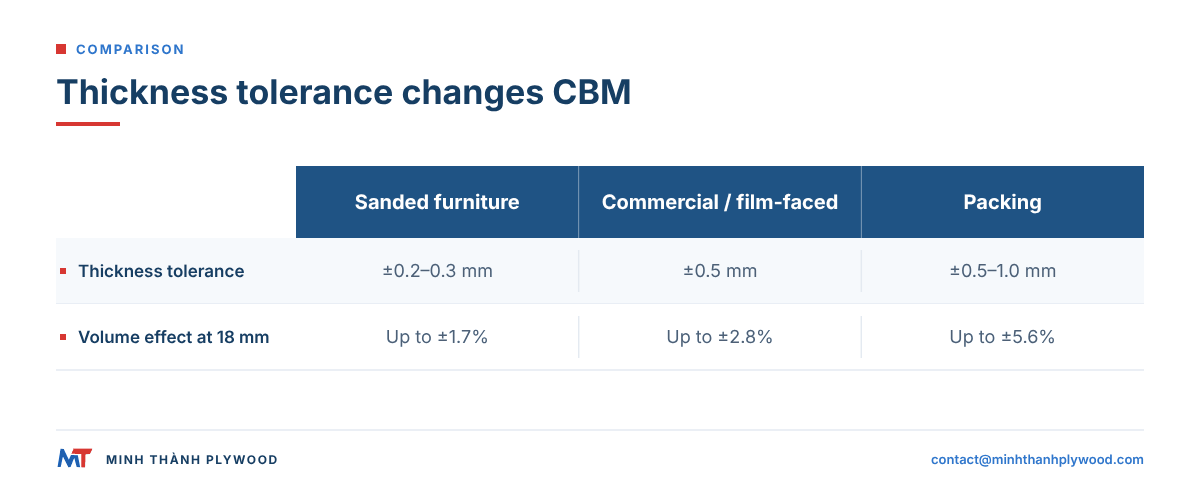
Use the nominal thickness ordered, such as 18 mm, for the CBM on the invoice and the packing list. The actual thickness sits inside the order tolerance, so it shifts the volume by up to 1.7 % on sanded furniture panels and more on commercial and packing panels.
How much the tolerance moves the figure at Minh Thanh:
| Panel type | Thickness tolerance | Volume effect at 18 mm |
|---|---|---|
| Sanded furniture plywood | ±0.2–0.3 mm | Up to ±1.7 % |
| Commercial and film-faced | ±0.5 mm | Up to ±2.8 % |
| Packing plywood | ±0.5–1.0 mm | Up to ±5.6 % |
Length and width are held to ±2 mm, which changes the area of a 1220 × 2440 mm sheet by about 0.25 %. Thickness matters more than size.
The volume effect is why tolerance belongs on the order. A packing panel at the low edge of its range carries visibly less wood than a calibrated furniture panel of the same name.
How to measure plywood thickness
Measure plywood thickness with a caliper or micrometer at five points, the four corners and the centre, at least 25 mm in from the edge. Average the five readings and compare the result with the tolerance on the order.
- Use a flat-jaw instrument. A digital caliper reading to 0.01 mm, or a sheet micrometer with a deep throat for the centre reading.
- Avoid the edge. The outer 25 mm can be rounded by sanding or swollen by handling.
- Take five points. Four corners and the centre of each sheet.
- Check several sheets. Top, middle and bottom of a pack, not only the top sheet.
- Record the readings. Sheet by sheet, with the pack number, so a claim can point to data.
Minh Thanh presses furniture panels twice: the core board is pressed and calibrated, then face and back are pressed on. Calibrating the core first is what holds sanded furniture panels to ±0.2 mm. The thickness guide lists the nominal and actual sizes.
Weight from CBM: the second number on the packing list
Plywood weight is CBM multiplied by density: about 500 kg/m³ for a Styrax core, 580 kg/m³ for Acacia and 650 kg/m³ for Eucalyptus. Weight decides how many packs go in the container and how they are handled.
Worked example, a 40HC of 18 mm panels:
- Styrax: about 53 m³ × 500 kg/m³ = about 26,500 kg of panels.
- Acacia: 47.15 m³ × 580 kg/m³ = about 27,350 kg.
- Eucalyptus: 42.6 m³ × 650 kg/m³ = about 27,690 kg.
All three sit under the 28,000 kg planning payload. The figure for the booking is gross weight: panels plus pallet base, cardboard, film and strapping. Use the packing calculator for your own size, core and payload.
What this means for your plywood order
Put the CBM on the order next to the sheet count, so both sides of the deal check the same number. Write the sheet size, nominal thickness, sheets and m³ on one line:
18 mm furniture plywood, white Styrax core, UF glue at E0 emission, 1220 × 2440 mm, ±0.2–0.3 mm thickness tolerance, 990 sheets, 53.05 m³ net, one 40HC.
Minh Thanh’s minimum order is one 40HC, with mixed specifications by agreement, and production runs 15–45 days after the 30% deposit. Send the thickness, size, core and target m³, and the quote returns sheets, packs and net m³ per container. The sheets per bundle guide lists the pack counts, and our furniture plywood page sets out the build.
Buyer questions, answered
How do you calculate the CBM of plywood?
Multiply length × width × thickness in metres for one sheet, then multiply by the number of sheets. A 1220 × 2440 × 18 mm sheet is 1.22 × 2.44 × 0.018 = 0.0536 m³.
What is CBM in shipping?
CBM is a cubic metre, the volume of a 1 × 1 × 1 m box. Shipping lines use it to measure cargo space, and plywood mills use it to price and count the panels on a packing list.
How many sheets of 18 mm plywood make one cubic metre?
About 18.7 sheets of 1220 × 2440 × 18 mm plywood make one cubic metre. For 1250 × 2500 mm sheets the figure is about 17.8.
How many m³ of plywood fit in a 40HC?
About 53 m³ of plywood on a Styrax core, about 47 m³ on Acacia and about 43 m³ on Eucalyptus, for 1220 × 2440 mm panels. The container has more space; weight and pack layout set the limit.
How do you convert cubic metres of wood to cubic feet?
Multiply by 35.315. One cubic metre of plywood is 35.3 cubic feet, and one 4 × 8 ft sheet at 3/4 inch is 2 cubic feet.
How many board feet are in a cubic metre?
One cubic metre equals 423.8 board feet, because one board foot is 144 cubic inches: 12 × 12 × 1 inch.
Why is plywood priced per cubic metre in Vietnam?
Mills buy logs and veneer by volume and run presses by volume, so a price per m³ is fair across thicknesses. Divide the m³ price by the sheets per m³ to get a price per sheet.
Should I use nominal or actual thickness for plywood CBM?
Packing lists and invoices use the nominal thickness ordered, such as 18 mm. Measured thickness within tolerance changes the volume at 18 mm by up to about 1.7 % for sanded furniture panels, 2.8 % for commercial and film-faced, and 5.6 % for packing plywood.
How do you measure plywood thickness?
Use a caliper or micrometer at the four corners and the centre, at least 25 mm in from the edge, and average the readings. Compare them with the tolerance on the order.
Is CBM the same as freight volume?
Not quite. Net CBM counts the panels only; the gross volume of a pack adds the pallet base and packing. Less-than-container freight is charged on the gross figure or the weight.