
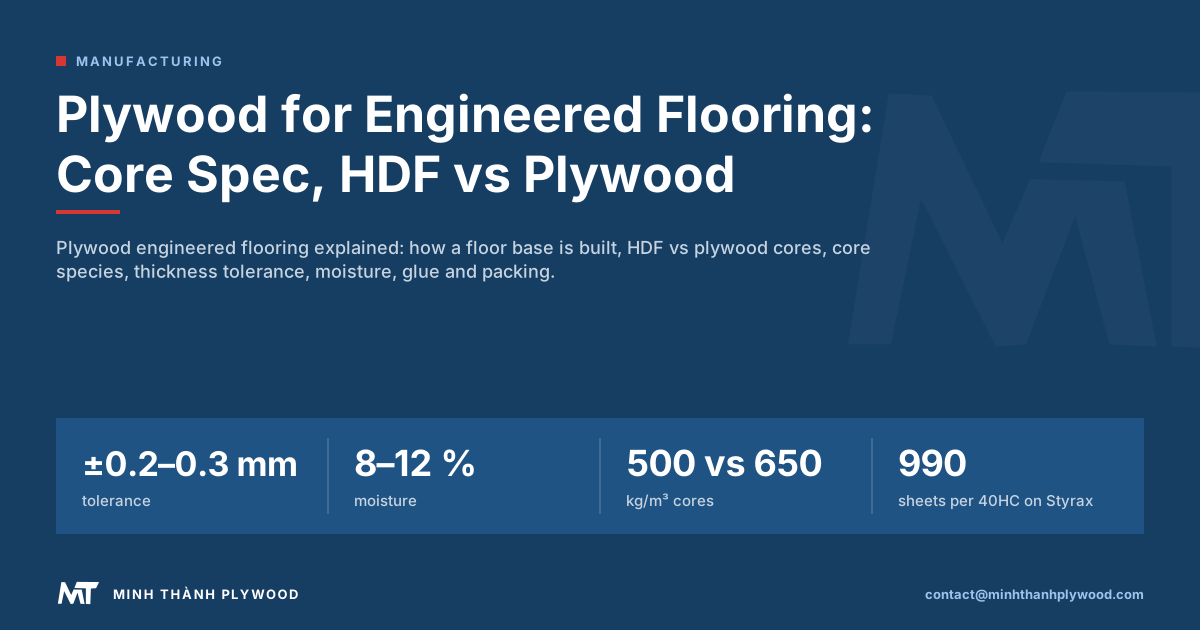
Plywood engineered flooring is a hardwood wear layer glued onto a cross-laminated plywood base, and the base decides how flat, stable and quiet the finished floor stays. Minh Thanh Plywood sets out what a floor-base panel needs: core species, ply build, ±0.2–0.3 mm thickness tolerance, 8–12 % moisture, glue and emission class, and how it compares with an HDF core.
What is plywood engineered flooring?
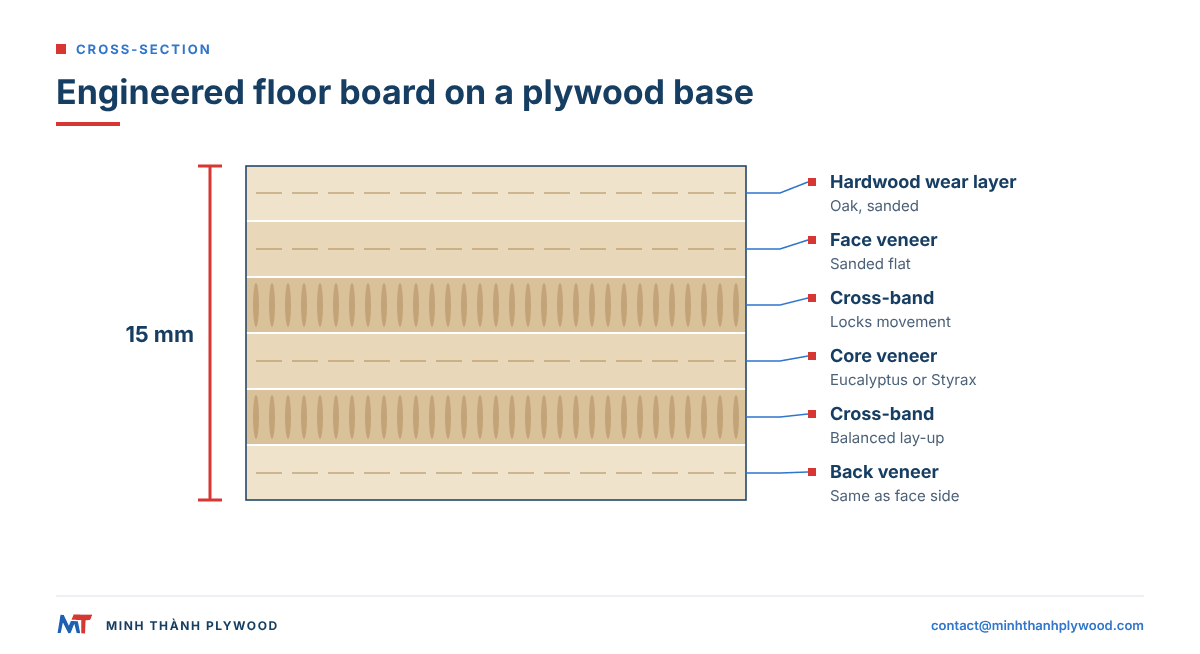
Plywood engineered flooring is a floor board with two parts: a top layer of real hardwood, usually oak, and a plywood base of veneers laid with their grain crossing. The base carries the board; the top layer gives the look and can be sanded and refinished. Engineered plywood flooring is the same product under another name.
The base is the part buyers specify least and the part that decides most. Solid hardwood moves with every change in humidity. A cross-laminated plywood base resists that movement in both directions, so the board stays flat over underfloor heating and in rooms where humidity swings between seasons.
There are three common builds:
- Multi-layer on plywood. A 2 to 6 mm wear layer pressed onto a 9 to 15 mm plywood base. This is the most common build for glue-down and nail-down floors.
- Three-layer. A wear layer, a core of softwood strips laid across, and a thin backing veneer. It is a different product; the base is not plywood.
- Click boards on HDF. A thin wear layer on a high-density fibreboard (HDF) core with a milled click profile. The HDF and plywood comparison below covers it.
Multi-ply engineered flooring builds in the UK
A UK multi-ply engineered board is an oak top layer of 3 to 6 mm on a plywood base, in total thicknesses of 14 mm to 20 mm. The top layer sets how often the floor can be sanded and refinished; the plywood base sets stability and how the board is fixed.
| Total board | Oak top layer | Plywood base | Fixing and subfloor |
|---|---|---|---|
| 14 mm | 3-4 mm | About 10-11 mm | Glued or floated over a flat subfloor |
| 15 mm | 4 mm | About 11 mm | Glued or floated over a flat subfloor |
| 20 mm | 4.5-6 mm | 14-15 mm | End-matched, can span joists directly |
The top-layer figures are the usual retail ranges: 14 mm boards carry a 3-4 mm wear layer and 15 mm boards a 4 mm one (Lumber King Flooring, checked on 21 October 2026). A retailer such as Hoff Parquet lists a 4.5 mm top layer with four-side micro bevels and a 7-14 day lead time from its Edinburgh store. Homeowners buy on the top layer, grade and finish; a flooring plant buys the base.
What goes under the board in a UK house depends on the thickness. A 20 mm end-matched board can be fixed directly to joists, with nails or screws at least 75 mm from the board ends, because the tongue and groove on the ends joins boards between joists. Thinner boards need a subfloor over the joists: 18 mm plywood or 22 mm chipboard is the usual load-bearing thickness, and the Local Authority Building Regulations set the minimum (Chauncey, checked on 21 October 2026). Fitters work to BS 8201, the code of practice for installing flooring of wood and wood-based materials.
How the plywood base of an engineered floor is built
A floor-base panel is an odd number of veneers, cross-laminated, pressed and then sanded flat so the wear layer has an even bed. Each step in the build has a job:
- Core veneers give thickness and hardness. A dense core holds nails and staples and resists dents from point loads.
- Cross-band veneers run at right angles to the face and lock the panel against swelling and shrinking.
- A balanced lay-up places the same species and thickness either side of the centre ply, so the panel does not cup when one face is covered.
- Calibrated sanding brings the panel to its final thickness, so every board in a pallet sits at the same height.
Minh Thanh Plywood presses furniture-grade panels twice as standard: the core board is pressed and calibrated first, then face and back are pressed on. For a floor base, that calibrated core board is what keeps the finished board flat after the wear layer is glued to it. Core layers are stitched both horizontally and vertically, which closes the gaps that would otherwise telegraph through a thin wear layer.
HDF vs plywood engineered flooring: which core is better?
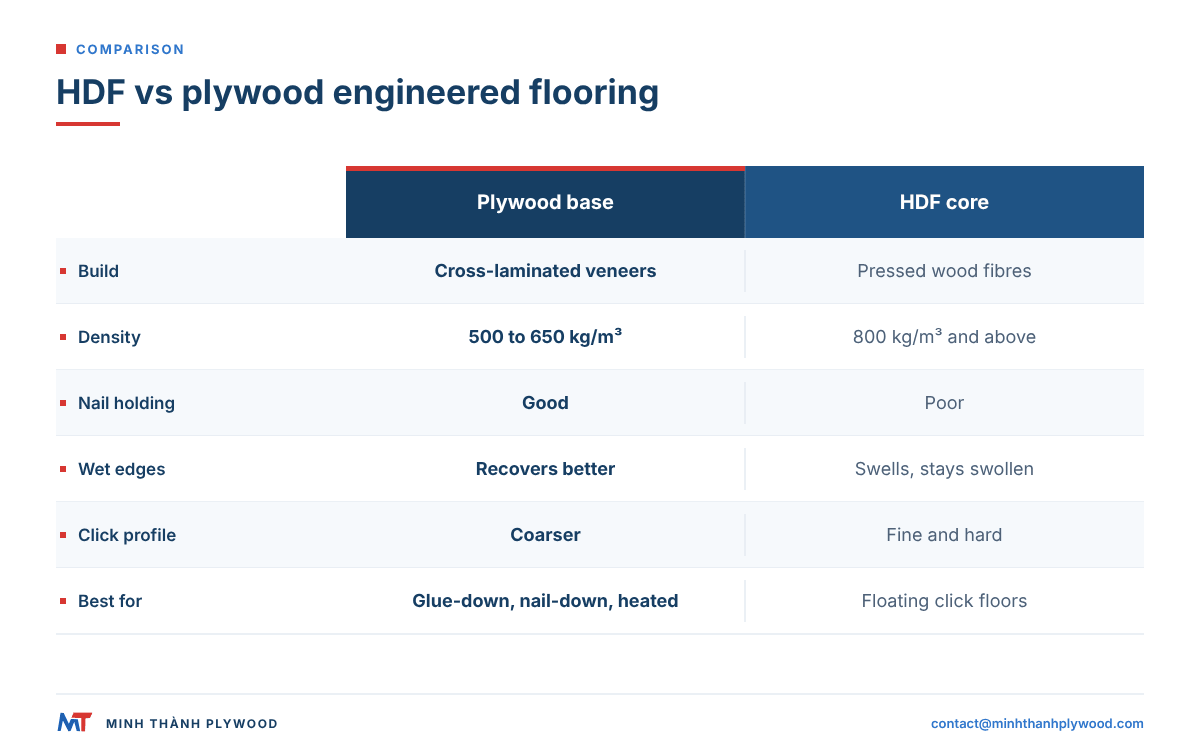
Plywood is the better core for glue-down and nail-down floors, heated floors and humid rooms; HDF is the better core for click floors laid floating at a lower price. The two cores behave differently because one is made of veneers and the other of wood fibres pressed with resin.
| Property | Plywood base | HDF core |
|---|---|---|
| Build | Cross-laminated veneers, odd ply count | Wood fibres pressed with resin, no grain |
| Density | 500 kg/m³ (Styrax) to 650 kg/m³ (Eucalyptus) | 800 kg/m³ and above (EN 316 definition of HDF) |
| Stability with humidity | High in both directions, set by the cross-band | Good in plane, swells at the edges when wet |
| Holding nails and staples | Good, the plies grip the fixing | Poor, fibres crumble around a nail |
| Click profile | Possible, coarser edge | Fine, hard, accurate profile |
| Underfloor heating | Suitable, glued down | Suitable when floating, per the maker’s limits |
| Wear layer it carries | Thin veneer to thick sawn lamella | Usually thin wear layers |
| Refinishing life | Set by the wear layer | Set by the wear layer |
| Weight per board | Lighter at the same thickness | Heavier |
| Board price | Higher | Lower |
Verdict by use: choose plywood for glue-down, nail-down, heated floors, kitchens and commercial floors with rolling loads. Choose HDF for floating click floors in dry rooms where price leads. For a sibling comparison outside flooring, see HDF vs plywood.
Wet edges are where HDF loses. Fibres swell at a cut edge when water stands on the floor, and the swelling does not go back. A plywood base can also swell, but the cross-band limits it and the board recovers better once it dries.
Which plywood core species suits a floor base?
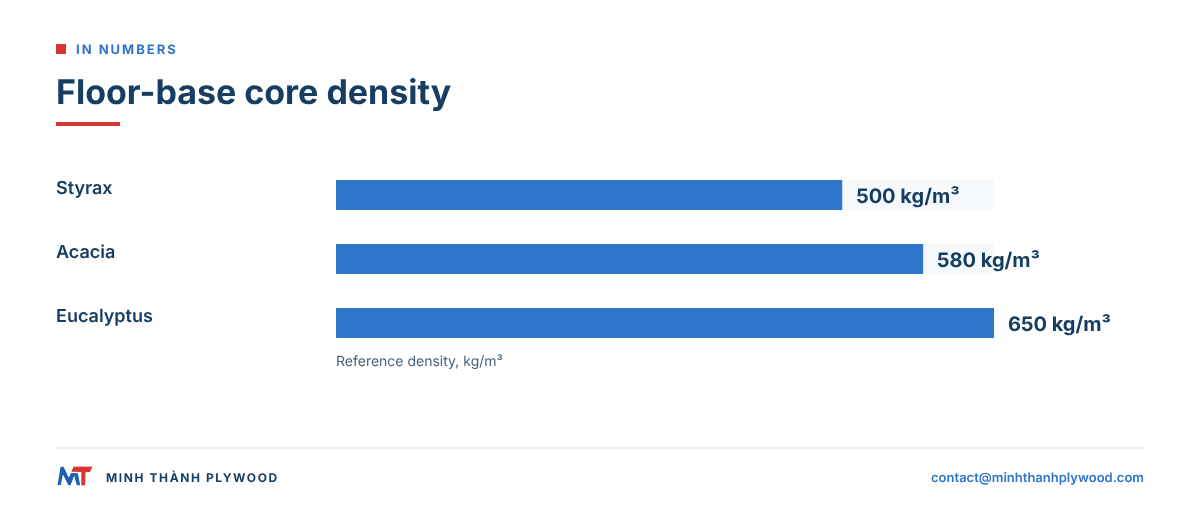
Eucalyptus is the usual floor-base core from Vietnam, because it is hard, dense and holds fixings; Styrax gives a lighter, paler base for boards where weight and a clean edge matter. Minh Thanh uses white Styrax or Eucalyptus cores as standard, with Acacia and Pine cores made on order.
| Core | Reference density | What it gives a floor base | Best for |
|---|---|---|---|
| Eucalyptus | 650 kg/m³ | Hard, dense, good nail and staple holding, darker edge | Nail-down and glue-down boards, commercial floors |
| Acacia | 580 kg/m³ | Medium weight, firm, made on order | General engineered boards |
| Styrax | 500 kg/m³ | Light, pale and even, smooth edge | Light boards, visible edges, more square metres per container |
A question flooring buyers ask often is about Vietnam eucalyptus plywood flooring: whether a full Eucalyptus build is suitable. It is, and it is the densest of the three Vietnamese cores. The trade-off is weight. At 18 mm, a Eucalyptus sheet weighs about 34.8 kg against 26.8 kg for Styrax, so a container reaches its payload sooner.
Vietnamese plywood cores are Acacia, Eucalyptus, Styrax or mixed, with Pine made on order. There is no poplar or birch core from Vietnam. Birch and poplar are face veneers here, pressed onto a Vietnamese core.
Thickness, ply count and tolerance for a floor base
A floor-base panel needs a sanded, calibrated thickness held to ±0.2–0.3 mm, because every difference between two bases becomes a step between two boards on the floor. Minh Thanh holds sanded furniture panels to ±0.2–0.3 mm, down to ±0.2 mm, with length and width held to ±2 mm.
Common base thicknesses run from 9 to 15 mm, chosen with the wear layer so the finished board reaches the target thickness. Thinner bases from 3 to 5 mm are used for laminated veneer floors and some parquet blocks; Minh Thanh’s thin plywood from 3 to 5 mm is always 5-ply.
Ply count follows thickness. An 18 mm panel is usually 11 to 13 plies, most often 11. A thicker floor base with more, thinner plies stays flatter and holds a fixing better than the same thickness made with fewer, thicker core veneers.
What to check on arrival:
- Measure thickness at the four corners and the centre of sample sheets with a caliper.
- Lay two sheets face to face and check for daylight between them.
- Cut a strip across the panel and count the plies against the order.
Moisture and dimensional stability of the base
A plywood floor base should arrive dry and even, because a wet base shrinks after the wear layer is glued on and pulls the board into a cup. Minh Thanh dries veneers and finished panels to 8–12 % moisture content at dispatch, the normal range for furniture plywood.
A flooring plant then conditions the base to its own pressing room before gluing the wear layer. Two habits keep boards flat:
- Store wrapped. Keep the pack in its film until the base goes to the press, so it does not take up moisture in an open warehouse.
- Match the wear layer. Glue a wear layer and a base that are close in moisture; a large gap is the usual cause of cupping.
Stability comes from the cross-band. Each veneer swells mostly across its grain, and the next veneer, laid at a right angle, holds it back. That is why a plywood base moves far less than solid wood of the same thickness.
Glue and emission class for flooring plywood
Floor-base plywood is usually bonded with UF glue at E0 emission for dry indoor floors, or with a melamine-fortified MR bond for kitchens, bathrooms and heated floors. Glue type and emission class are two separate lines in the specification: E0 and E1 are emission classes, not glue types.
| Use of the floor | Bond | Emission line |
|---|---|---|
| Living rooms and bedrooms, dry | UF glue at E0 emission | E0, or CARB P2 / TSCA Title VI for the US |
| Kitchens, bathrooms, underfloor heating | Melamine-fortified MR bond | Stated separately, to the market |
| Commercial floors with wet cleaning | Melamine-fortified MR or phenolic (WBP) bond | Stated separately, to the market |
For the United States, buyers ask for panels certified to CARB Phase 2 and TSCA Title VI, the federal formaldehyde standard for composite wood products set out by the US EPA (checked 20 October 2026). Minh Thanh holds CARB P2 / TSCA Title VI through ICTT, mill no. 23024. Six ASTM D6007 chamber tests between April 2025 and June 2026, on 9, 15 and 18 mm panels, averaged 0.014–0.032 ppm. The limit for veneer-core hardwood plywood is 0.05 ppm under 40 CFR 770.10.
For Europe, panels meet the emission requirements furniture and flooring buyers there ask for; CARB P2 / TSCA Title VI and the chamber tests are the proof. Third-party testing to the buyer’s method, such as EN 717-1, is arranged through SGS on request.
Short-grain and long-grain plywood for floor lamellas
Short-grain plywood has its face grain running across the short side of the sheet, and flooring plants order it when they cut board lengths across the panel. Long-grain plywood, the usual build, has its face grain along the long side.
Which one a plant needs depends on how it saws the panel:
- Boards cut along the 2440 mm side need long grain, so the face grain runs along each board.
- Boards cut across the 1220 mm side, such as parquet blocks and short lamellas, need short grain for the same reason.
Grain direction of the face also sets the direction of the cross-band. Say it on the order, with the sheet size, because the press lay-up changes. Minh Thanh makes the standard sizes 1220 × 2440 mm and 1250 × 2500 mm, plus custom sizes such as 1220 × 2500 mm and 1220 × 2280 mm, and cut-to-size pieces where one panel is cut into 4, 6 or 8 parts.
Plywood parquet and laminated veneer flooring
Plywood parquet is engineered flooring cut into short blocks for herringbone, chevron or square patterns, and its base needs the same tolerance as long boards because every block meets four neighbours. A block that sits higher than the next is visible in a herringbone floor at a glance.
Laminated veneer flooring is a lighter build: a decorative veneer, often rotary peeled or sliced, pressed onto a thin plywood base and lacquered. It is cheaper than a sawn wear layer and can be sanded only lightly, if at all.
| Floor type | Top layer | Base | What the base must do |
|---|---|---|---|
| Engineered boards | Sawn or sliced hardwood | Plywood, 9 to 15 mm | Stay flat, hold nails, carry a thick wear layer |
| Plywood parquet | Sawn or sliced hardwood | Plywood, cut to blocks | Exact thickness so blocks meet flush |
| Laminated veneer flooring | Thin decorative veneer | Thin plywood | Smooth face, no core gaps under the veneer |
| Click boards | Thin wear layer | HDF | Hold a fine click profile |
Square parquet tiles on a plywood base, a format buyers in the Gulf ask for, follow the parquet line of this table.
What manufacturers of engineered hardwood flooring ask a plywood mill for
Manufacturers of engineered hardwood flooring ask a plywood mill for the same five things: a flat calibrated base, an exact thickness, a closed core, an even moisture content and repeat supply of the same build. Price comes after those, because a base that fails one of them stops the flooring line.
| Flooring plant’s need | Plywood spec line | Minh Thanh |
|---|---|---|
| Flat base | Double pressed, calibrated, balanced lay-up | Pressed twice as standard |
| Exact thickness | Sanded, thickness tolerance | ±0.2–0.3 mm, down to ±0.2 mm |
| Closed core | Stitched core, no gaps or overlaps | Stitched horizontally and vertically |
| Even moisture | Moisture at dispatch | 8–12 % |
| Repeat supply | Same core species and build every order | Styrax or Eucalyptus standard |
| Emission | E0, or CARB P2 / TSCA Title VI | CARB P2 / TSCA Title VI, ICTT 23024 |
| Traceability for the EU | Origin dossier | EUDR compliance dossier with geolocation files |
For the EU dossier, the European Commission’s EUDR page gives 30 December 2026 as the start date for large and medium operators (European Commission, checked on 8 October 2026).
The plywood base also travels a long way before it becomes a board. Its sanded faces must survive packing and sea freight without dents, so the export pack matters as much as the panel.
Common mistakes when buying floor-base plywood
The most common mistake is comparing two quotations for “flooring plywood” that are not the same construction. The difference comes from core grade, joining method, face preparation, adhesive system and tolerance, and a lower price usually means one of those has changed.
Other mistakes flooring buyers make:
- Not naming the core species. “Hardwood core” can mean any mix. Write Eucalyptus or Styrax.
- Ordering unsanded panels. An unsanded base varies too much in thickness for a wear layer.
- Ignoring grain direction. Short-grain and long-grain bases are not interchangeable once the plant has set its saws.
- Mixing emission and glue on one line. “E0 glue” is not a specification; “UF glue at E0 emission” is.
- Leaving out the moisture target. A base that arrives wet cups the finished board.
How to install engineered wood flooring over plywood
Engineered wood flooring can be installed over a plywood subfloor by nailing, gluing or floating, once the subfloor is dry, flat and firmly fixed to the joists. The steps are the same in every market:
- Check moisture. Measure the plywood subfloor and the flooring with a moisture meter; both should be close before you lay.
- Check flatness. Run a long straightedge over the subfloor, sand high spots and fill low ones.
- Fix the subfloor. Screw down any loose or squeaking sheet to the joists.
- Choose the method. Nail or staple a thick plywood-based board; glue it with a flooring adhesive; or float a click board on an underlay.
- Lay across the joists. Run the boards at right angles to the floor joists where the room allows.
- Leave an expansion gap. Keep 10 to 15 mm free at walls and fixed objects, and cover it with skirting.
- Acclimatise first. Leave the boards in the room, in their packs, before laying.
In the UK, fit to BS 8201 and the Building Regulations: 18 mm plywood or 22 mm chipboard over joists, or a 20 mm end-matched board fixed straight to them with fixings at least 75 mm from the board ends. Installation guides in North America refer to the APA’s recommendations for engineered wood floor systems for subfloor span and thickness. Follow the flooring maker’s instructions for the board you lay; they set the fixings and gaps for that product. Minh Thanh’s subfloor guide covers the plywood under the floor.
Packing and container load for flooring plants
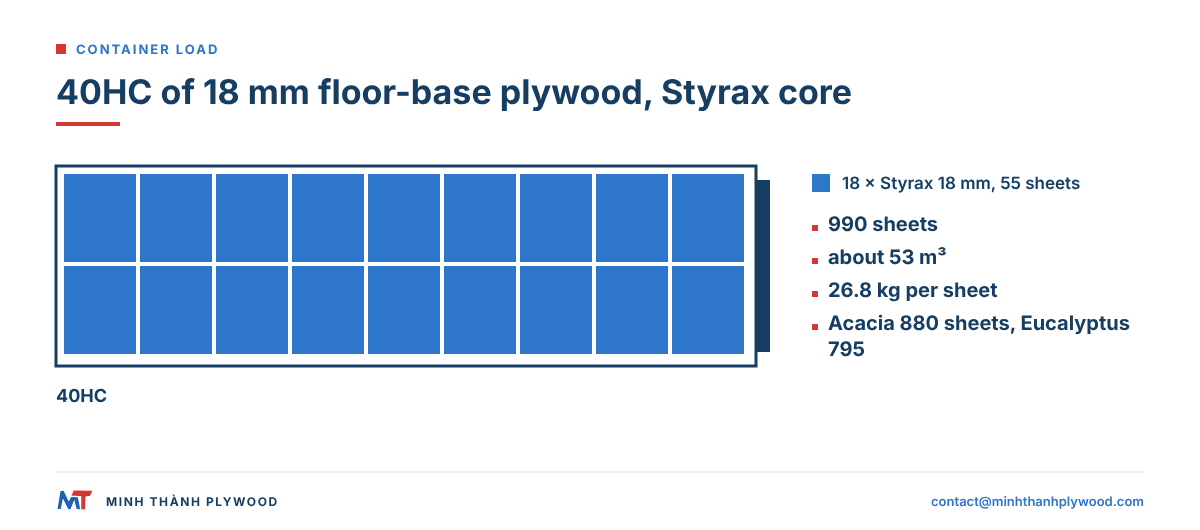
Floor-base plywood ships in export packs about one metre high, and the core species sets how much fits in a 40HC: about 53 m³ on Styrax, 47 m³ on Acacia and 43 m³ on Eucalyptus at 18 mm, on 1220 × 2440 mm sheets. Heavier cores stop sooner because the container reaches its payload before its volume.
| Core at 18 mm | Packs in a 40HC | Sheets | Volume | Sheet weight |
|---|---|---|---|---|
| Styrax | 18 (16 lying + 2 upright) | 990 | about 53 m³ | 26.8 kg |
| Acacia | 16 | 880 | about 47 m³ | 31.1 kg |
| Eucalyptus | 15 | 795 | about 43 m³ | 34.8 kg |
The plan uses a 28,000 kg payload unless the booking is lower, with reference densities of 500, 580 and 650 kg/m³. A lower booking cap, for example 26,000 kg, cuts the sheet count. The container loading and export packing pages show how packs are built and loaded.
Each pack is wrapped, strapped and labelled, and every shipment is photographed and filmed before loading; the buyer gets the photos and video. The MOQ is one 40HC, with mixed specifications by agreement, so a flooring plant can take two or three base thicknesses in one container.
Which plywood base to order for your floor
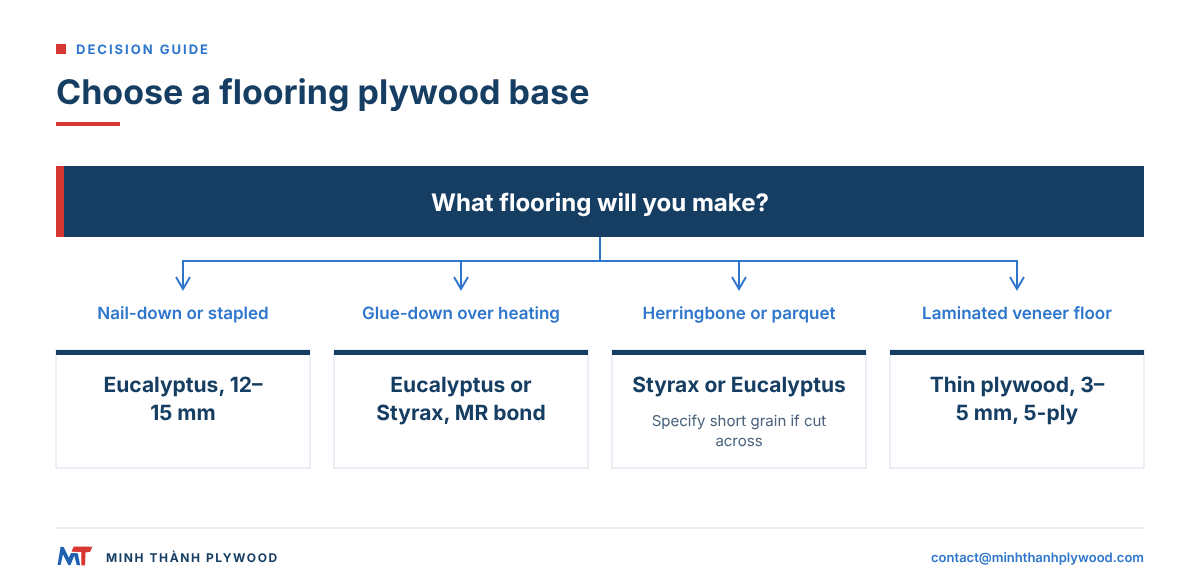
Order a Eucalyptus-core base for nail-down, glue-down and commercial floors, and a Styrax-core base for lighter boards where weight per container and a pale edge matter. Both are sanded, calibrated and double pressed; the difference is density and the colour of the edge.
| Your floor | Base to order |
|---|---|
| Nail-down or stapled boards | Eucalyptus core, 12 to 15 mm, UF glue at E0 emission |
| Glue-down boards over heating | Eucalyptus or Styrax core, melamine-fortified MR bond |
| Herringbone and parquet blocks | Styrax or Eucalyptus core, short grain if blocks cut across |
| Laminated veneer flooring | Thin plywood, 3 to 5 mm, 5-ply |
| US market | Any of the above, CARB P2 / TSCA Title VI certified |
Prices start from US$350/m³ for furniture and interior plywood (October 2026); the final price depends on face, core, glue, thickness, size, quantity and delivery term.
What to send for a floor-base plywood quotation
Send the build, the tolerance and the destination in one line, so the quotation is for a base your flooring line can run:
Floor-base plywood, 15 mm × 1220 × 2440 mm, long grain; core: Eucalyptus, stitched, double pressed; face/back: Eucalyptus A/B, sanded, thickness ±0.2 mm; UF glue at E0 emission; moisture 8–12 %; export packs, 1×40HC, CIF your port.
Production takes 15–45 days after the 30% deposit, with the balance against the scanned B/L or by irrevocable L/C at sight; terms are FOB Hai Phong, CFR or CIF. Minh Thanh sends free samples of the specified base and replies within hours: contact@minhthanhplywood.com or WhatsApp +84 988 586 601.
Buyer questions, answered
What is plywood engineered flooring?
It is a floor board made of a real hardwood wear layer, usually oak, glued onto a plywood base of cross-laminated veneers. The plywood base gives the board its stability; the wear layer gives the look and can be sanded.
Is plywood or HDF better as a core for engineered flooring?
Plywood is better for glue-down and nail-down floors, underfloor heating and humid rooms, because cross-laminated veneers move less and hold fixings. HDF suits click floors that need a fine, hard profile and a lower board price.
Which plywood core species is used for engineered flooring from Vietnam?
Eucalyptus is the usual Vietnamese floor-base core because it is hard and dense; Styrax gives a lighter, paler base. Acacia is made on order. Vietnamese mills do not peel poplar or birch cores.
What thickness tolerance does a floor-base plywood need?
A sanded, calibrated base held to ±0.2–0.3 mm across the sheet. Wider tolerance shows up as steps between boards and uneven pressure when the wear layer is glued on.
What moisture content should floor-base plywood have?
Minh Thanh dries veneers and finished panels to 8–12 % moisture content at dispatch. A flooring plant conditions the base to its own pressing climate before it glues on the wear layer.
Can you install engineered wood flooring over a plywood subfloor?
Yes. A dry, flat and well-fixed plywood subfloor is one of the best bases for engineered wood flooring, nailed, glued or floating. Check moisture, flatness and fixings first, then leave an expansion gap at the walls.
What is short-grain plywood for flooring?
Short-grain plywood has its face grain running across the short side of the sheet. Flooring plants order it when they cut lamellas whose length runs across the panel, so the face grain still runs along each board.
Is plywood parquet the same as engineered flooring?
Plywood parquet is engineered flooring in tile or herringbone format: a hardwood top layer on a plywood base, cut into short blocks. The base needs the same stability and tolerance as for long boards.
Which glue should floor-base plywood use?
UF glue at E0 emission suits most indoor floors; a melamine-fortified MR bond suits kitchens, bathrooms and underfloor heating. Glue type and emission class are written as two separate lines in the specification.
Does Minh Thanh hold CARB P2 for floor-base panels sold to the US?
Minh Thanh holds CARB P2 / TSCA Title VI certification through ICTT, mill no. 23024, for hardwood plywood with a veneer core from 3 to 50 mm.