
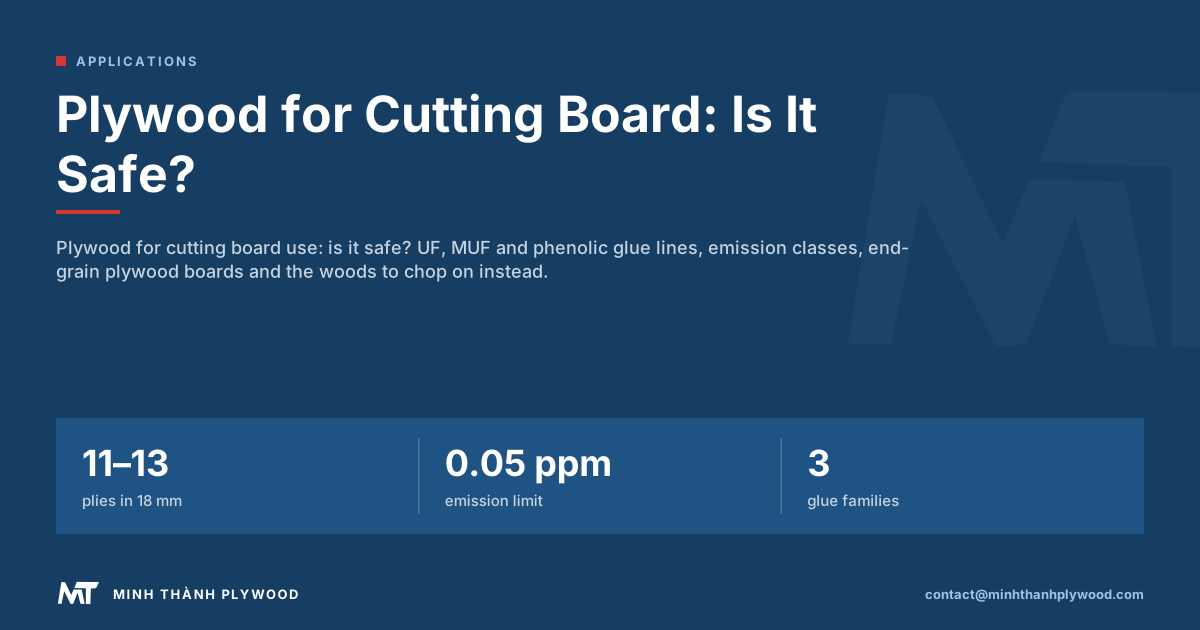
Plywood is a poor choice for a cutting board you chop on every day. Its glue lines are made to bond wood, not to touch food under a knife, and its edges soak up water. An end-grain plywood board works as a decorative serving or display board. For daily chopping, use solid maple, beech, walnut or cherry. Minh Thanh Plywood, a Vietnamese manufacturer, explains why.
Is plywood safe for cutting boards?
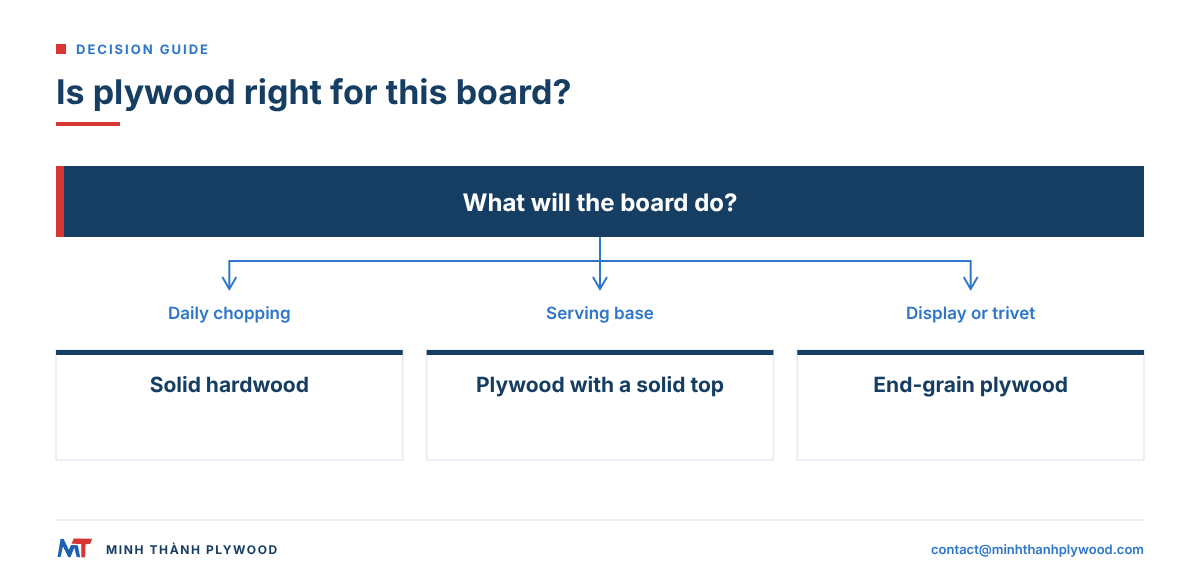
Plywood is not a safe choice for a cutting board you chop on every day. Its glue lines are not food-contact adhesives, a knife opens them with every cut, and the layered edges take up water and stay damp.
The short answer by use:
| Use | Plywood board? |
|---|---|
| Daily chopping of raw meat, fish or vegetables | No, use solid hardwood |
| Bread board or occasional cutting | Not advised |
| Serving or charcuterie base, food on paper or a solid top | Acceptable |
| Decorative display board, wall art, trivet | Yes |
| Pot stand or tray | Yes, with a sealed finish |
The problem is not the wood in the veneers, which is often the same species as a solid board. It is the glue between them and the end grain at the edges.
What is plywood made of, and where is the glue?
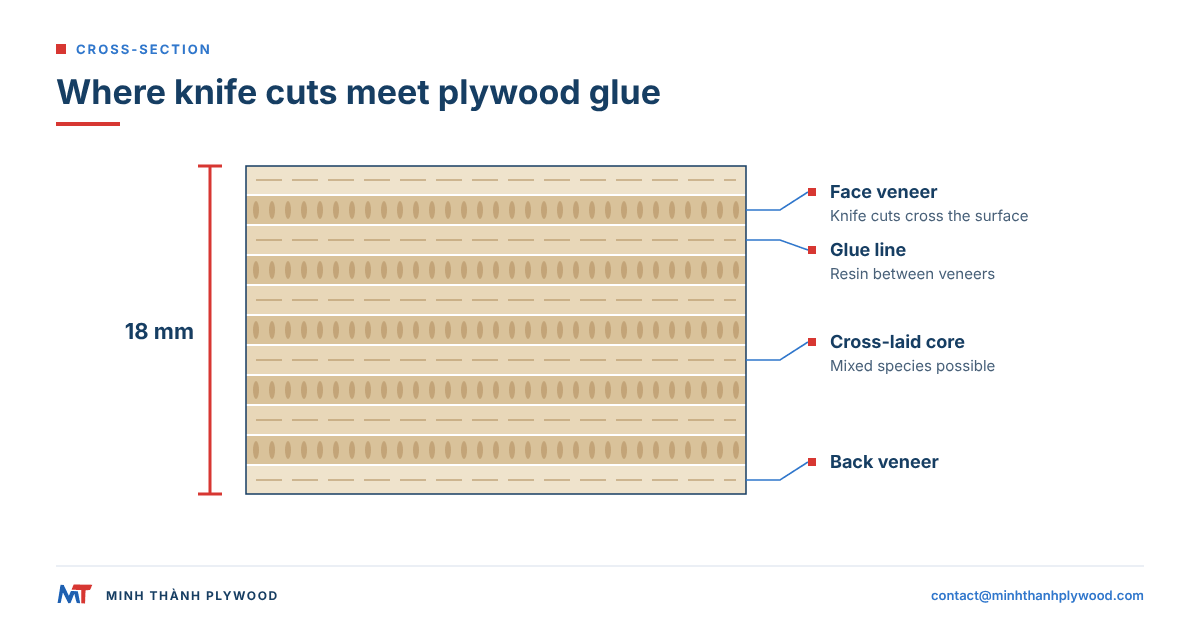
Plywood is made of thin wood veneers glued together with the grain of each layer at right angles to the next, then hot-pressed. An 18 mm furniture panel typically has 11–13 plies.
That build means:
- Glue lines every few millimetres: a cutting face, especially end grain, shows a glue line between every pair of veneers.
- Mixed species: the face can be birch or poplar while the core is another wood. Minh Thanh’s furniture panels use white Styrax or Eucalyptus cores.
- Hot-pressed resin: the glue is cured at 110–120 °C or higher in the press, so it is hard and stable, made for furniture and buildings.
A solid hardwood board has no glue at all, or only edge joints glued with a food-contact adhesive.
Which glue is food safe in plywood?
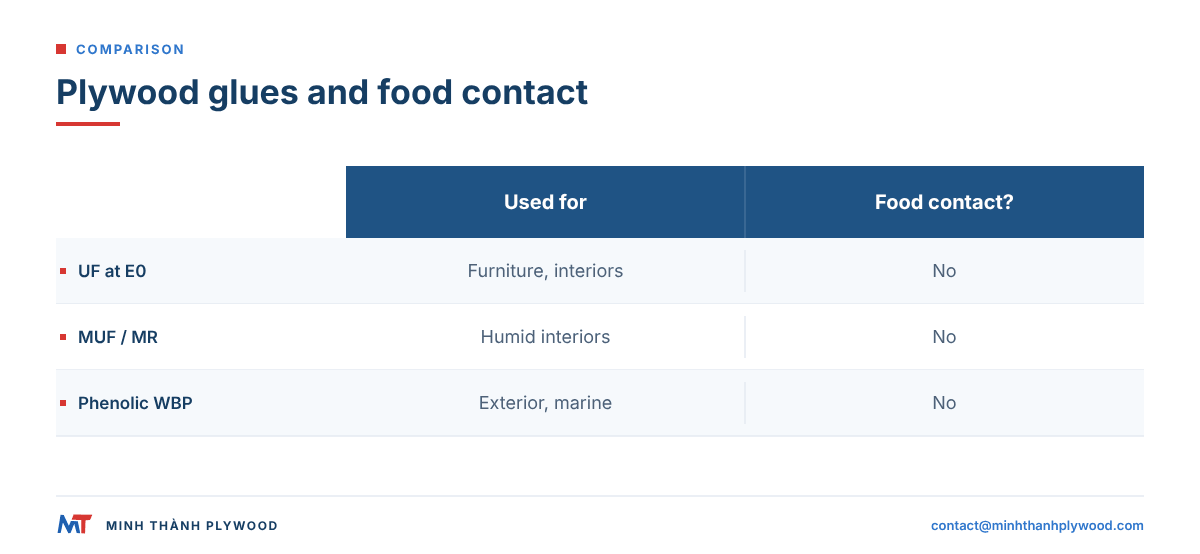
None of the glues in plywood is food safe by design. Plywood is bonded with urea-formaldehyde (UF) for interiors, melamine-fortified (MUF or MR) for humid areas, or phenol-formaldehyde (phenolic, WBP) for exterior and marine use, and none is made as a cutting-board adhesive.
| Glue | Where it is used | Water resistance | Made for food contact? |
|---|---|---|---|
| UF glue at E0 emission | Furniture, cabinets, interior panels | Dry interior | No |
| Melamine-fortified (MUF / MR) | Kitchens, bathrooms, humid interiors | Humid, short wetting | No |
| Phenolic (WBP) | Exterior, formwork, marine | Exterior, boil-proof | No |
Glue type and emission class are separate specifications. Minh Thanh uses UF glue at E0 emission as standard for furniture and interior plywood; MR and phenolic bonds are made to the buyer’s specification. None of the three is a cutting-board adhesive. The bonding-quality standard BS EN 314-2 covers the performance of the glue line, not food contact.
Why emission classes do not make plywood food safe
Emission classes such as E0, E1 and CARB Phase 2 limit how much formaldehyde a panel releases into the air of a room. They do not test or approve a panel for contact with food, so a low-emission plywood board is still not a food-contact material.
- CARB P2 / TSCA Title VI: the US EPA formaldehyde standard for composite wood sets an emission limit for hardwood plywood with a veneer core, measured in a test chamber. The limit is 0.05 ppm under the EPA formaldehyde emission standards.
- E0 and E1: emission classes used in Europe and Asia, also measured as release into air.
- Food contact: governed by separate rules. In the EU, Regulation (EC) No 1935/2004 requires food-contact materials not to transfer their constituents to food in harmful quantities; a material is made and declared for that use.
Minh Thanh holds CARB P2 / TSCA Title VI certification, and six ASTM D6007 chamber tests between April 2025 and June 2026 averaged 0.014–0.032 ppm. That is an indoor-air result for furniture, not a food-contact approval.
Plywood chopping board vs solid wood: what goes wrong
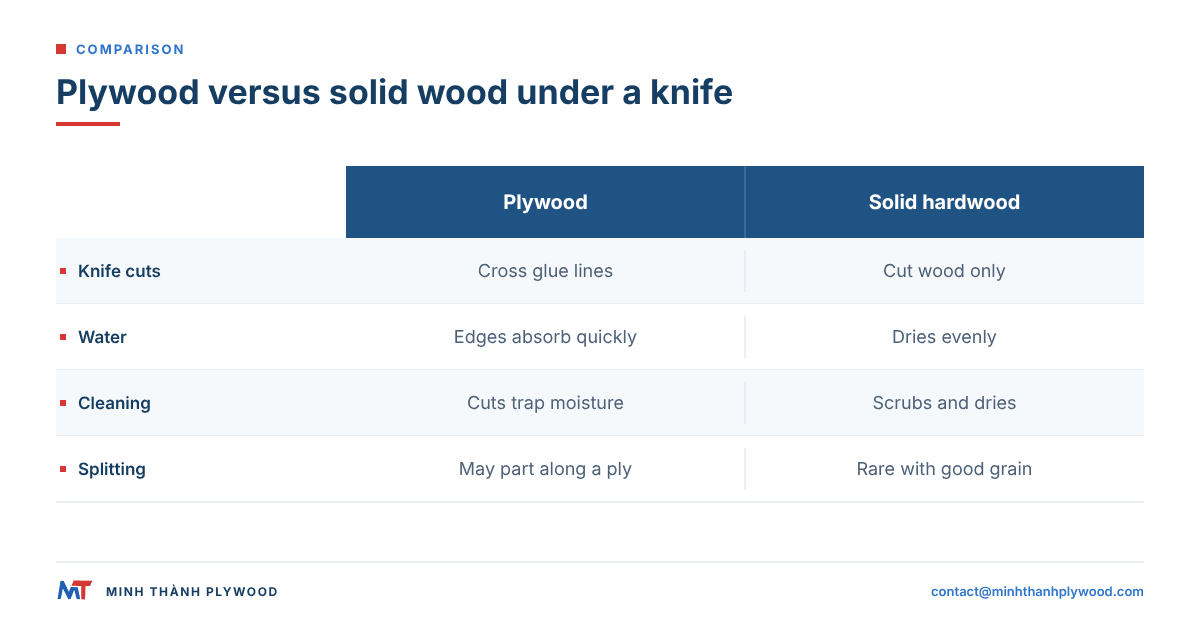
A plywood chopping board goes wrong in three ways that a solid board does not: knife cuts open glue lines, end-grain edges hold water, and the board can split along a weak ply.
| Issue | Plywood chopping board | Solid hardwood board |
|---|---|---|
| Knife cuts | Cross glue lines, expose resin | Cut wood only |
| Water | Edges absorb quickly through every ply | Dries evenly |
| Cleaning | Cuts and glue lines trap moisture | Scrubs clean, dries fast |
| Splitting | Can part along a ply with heat and water | Rare with good grain |
| Knife edge | Hard glue lines dull knives | Kind to edges |
Dishwashers make it worse: heat and water attack plywood edges in a few cycles. Wash any wooden board by hand and dry it standing on edge.
What is the best wood for a cutting board?
The best wood for a cutting board is a hard, closed-grain hardwood: hard maple, beech, walnut or cherry. Woodworkers aim for a Janka hardness of 1,000 to 1,600 lbf: softer wood dents, harder wood dulls knives.
| Wood | Janka hardness | Look | Notes |
|---|---|---|---|
| Hard maple | About 1,450 lbf | Pale, fine | The classic butcher block |
| Beech | About 1,300 lbf | Pale pink-brown | Widely used in Europe |
| Walnut (black) | About 1,010 lbf | Dark brown | Easier on knives |
| Cherry (black) | About 950 lbf | Warm red-brown | Darkens with age; just under the band |
| Recommended board thickness | 1-1/4 to 2-1/4 in (32 to 57 mm) | John Boos sells 1 to 3 in; 1-1/2 in is the common size |
End-grain boards, made of short blocks with the growth rings facing up, are kinder to knives than edge-grain boards because the blade slides between fibres. They need more care to stay flat.
| End grain | Edge grain | |
|---|---|---|
| Knife wear | Lowest, blade slides between fibres | Higher |
| Looks after cuts | Cuts close up | Cuts show |
| Flatness | Needs care, moves with moisture | Stable |
| Typical thickness | 2-1/4 to 3 in | 1 to 1-1/2 in |
| Cost | Higher, more glue lines and labour | Lower |
What wood is not safe for cutting boards?
Woods to avoid for cutting boards are soft or resinous softwoods, very open-grained hardwoods, treated or painted timber, panels with glue lines on the face, and exotic species known to irritate skin.
- Softwoods such as pine: soft, mark easily, resin can taint food.
- Open-grain woods such as red oak: pores trap moisture and food.
- Treated timber: preservatives are made for outdoor wood, not food.
- Plywood, MDF and particleboard: glue lines or resin on the cutting face.
- Some exotic species: dust and contact can cause skin reactions.
When in doubt, choose maple or beech.
Plywood for cutting board projects: how to make an end-grain display board
An end-grain plywood board makes a striking display or serving base: the stacked plies form stripes on the top face. Build it as a decorative piece and keep food on a separate solid-wood or food-contact surface.
- Choose the panel: 18 mm furniture plywood with closed plies and even thickness gives the cleanest stripes.
- Rip strips about as wide as the board’s final thickness on a table saw: for a 1-1/2 in (38 mm) board, rip 1-1/2 in strips.
- Turn the strips so the ply edges face up, and arrange the pattern.
- Glue the strips with a wood glue, clamp evenly and let it cure fully.
- Cut cross slices to expose end grain, then re-glue them for a checker pattern if wanted.
- Flatten with a router sled or a sander; end grain tears in a planer.
- Sand through the grits to a smooth face.
- Finish with a hard-wearing sealer for display use, or mineral oil if it will only carry bread on paper.
- Add feet so air reaches the underside and the board dries evenly.
A closed core matters here. Minh Thanh stitches core layers both horizontally and vertically, so the plies meet without gaps; a gap in an inner ply shows as a dark hole on the finished face.
Which plywood gives the best end-grain pattern?
The best end-grain pattern comes from plywood with many thin, even plies, a closed core and a pale, uniform colour. Thick, uneven core veneers give a coarse stripe.
- Ply count: 11–13 plies in an 18 mm panel gives fine, regular stripes.
- Core colour: a white Styrax core reads pale and even; a Eucalyptus core is warmer.
- Flatness: furniture-grade panels pressed twice as standard keep strips straight when ripped.
- Thickness tolerance: sanded furniture panels held to ±0.2–0.3 mm line up without steps when glued edge to edge.
For other shop builds, read best plywood for woodworking.
What is the best tool for cutting plywood?
Cut plywood cleanly with a fine-tooth blade on a table saw or track saw for straight cuts, and a jigsaw with a down-cut blade for curves. Support the sheet fully so the cut does not pinch or splinter.
| Tool | Best for | Clean-cut tip |
|---|---|---|
| Table saw | Ripping strips | Fine-tooth blade, zero-clearance insert |
| Track saw | Breaking down full sheets | Splinter guard on the track |
| Circular saw | Site cuts | Good face down, tape on the line |
| Jigsaw | Curves, cut-outs | Down-cut blade, slow feed |
| CNC router | Repeat parts | Compression bit |
Is a jigsaw good for cutting plywood?
A jigsaw is good for plywood curves and cut-outs, but it wanders on long straight cuts. Use a down-cut blade at a slow feed to keep the top face from splintering, and keep straight cuts for a table saw or track saw. Furniture plants cut panels on beam saws and CNC routers.
How do you care for a wooden cutting board?
Care for a wooden cutting board by washing it by hand in warm soapy water, drying it standing on edge, and oiling it with food-grade mineral oil whenever the surface looks dry. Never soak it or put it in a dishwasher.
- Scrape off food with the back of a knife or a bench scraper.
- Wash by hand with warm water and mild soap, both sides.
- Rinse and towel dry, then stand the board on edge so both faces dry evenly.
- Oil it with food-grade mineral oil or a board conditioner when the wood looks pale and dry.
- Sand out deep knife marks occasionally and re-oil.
- Keep separate boards for raw meat and for ready-to-eat food.
The same routine extends the life of a plywood serving or display board, but it does not change its glue lines.
Why do plywood cutting board tutorials exist?
Plywood cutting board tutorials exist because end-grain plywood looks striking and uses up offcuts, not because plywood is a good chopping surface. Most makers who sell them describe them as serving or display boards.
What a careful maker does:
- Labels the use: serving, charcuterie base or display.
- Keeps food off the glue lines: a solid-wood insert, slate, or paper under bread and cheese.
- Uses a closed-core panel, so the face has no gaps that hold crumbs or water.
- Seals every face and edge with a finish suited to the use.
If a customer wants a board to chop on, sell them solid maple or beech.
What to make from plywood for the kitchen instead
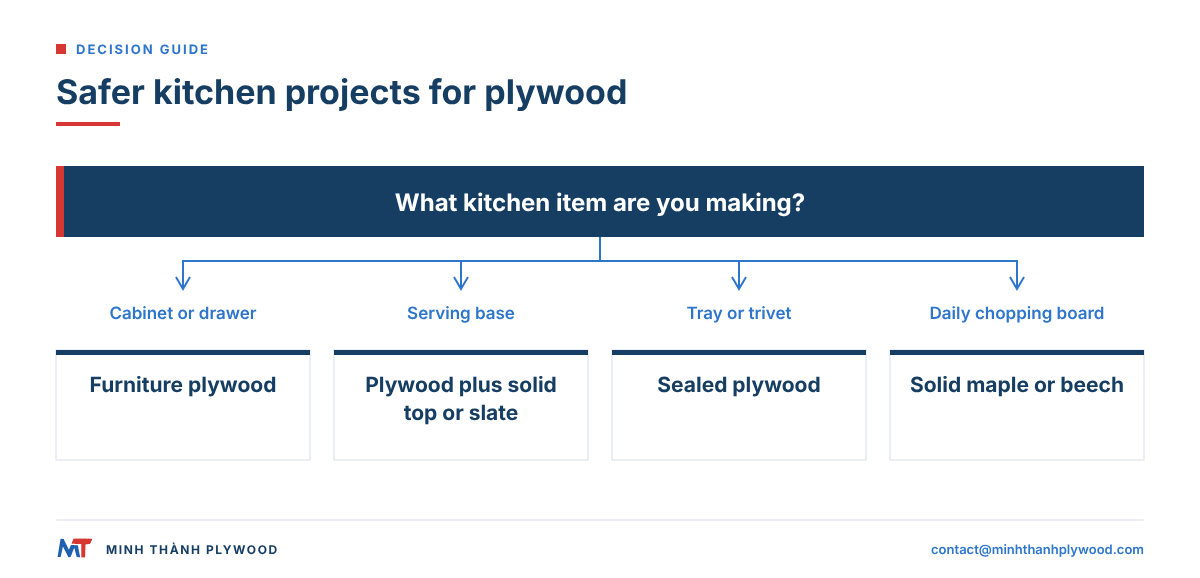
Plywood belongs in the kitchen as cabinets, drawers, shelves, trays and serving bases, where food sits on a separate surface. These are the jobs furniture plywood is made for.
- Cabinet carcasses and drawers: 18 mm and 12–15 mm furniture plywood.
- Open shelving: stiff, with an attractive edge.
- Serving bases: plywood base with a solid hardwood top or a slate insert.
- Trays and trivets: sealed plywood with exposed edges.
- Display boards: end-grain plywood for decoration.
For more ideas, see our guide to plywood projects and plywood furniture design.
What to specify when you buy plywood for furniture and kitchen products
Furniture and homeware makers buying plywood should specify face and back grade, core, glue and emission class, thickness and tolerance, size, quantity and packing. A clear line for each turns a quotation into the panel you need.
| Line | Example |
|---|---|
| Application | Kitchen cabinets, trays, display boards |
| Face/back | Birch D+/D, or poplar A/B |
| Core | White Styrax |
| Glue/emission | UF glue at E0 emission |
| Thickness | 18 mm, ±0.2 mm |
| Size | 1220 × 2440 mm, or cut-to-size |
| Packing | Strapped packs, protected faces |
Minh Thanh Plywood makes furniture plywood from 3–40 mm, with 10+ face veneers and CARB P2 / TSCA Title VI certification. Furniture plywood starts from US$350/m³ (October 2026). Minimum order is one 40HC with mixed specifications by agreement. Send your specification to contact@minhthanhplywood.com for a quotation with free samples, or see our furniture plywood page.
Buyer questions, answered
Can you use plywood for a cutting board?
You can make a board from plywood, but it is a poor surface for daily chopping. Knife cuts open the glue lines, and the edges take up water. Use solid hardwood for chopping and keep plywood boards for serving or display.
Is plywood food safe?
Standard plywood is not made or certified as a food-contact material. Its glues are approved for furniture and building use, and emission classes such as E0 or CARB P2 limit formaldehyde in air, not contact with food.
Which glue in plywood is food safe?
None of the common plywood glues, UF, melamine-fortified (MUF) or phenolic (WBP), is sold as a food-contact adhesive for cutting surfaces. Their approvals cover furniture, interiors and construction.
Is a plywood chopping board safe if I oil it?
Oil slows water uptake but does not seal the glue lines, which a knife reopens with every cut. A plywood chopping board stays a decorative or serving board, not a daily cutting surface.
What is the best wood for a cutting board?
Hard, closed-grain hardwoods: hard maple, beech, walnut and cherry. They resist knife marks, dry quickly and are kind to knife edges.
What wood is not safe for cutting boards?
Avoid soft or resinous softwoods, very open-grained woods, treated timber, any panel with glue lines on the cutting face, and exotic species that can irritate skin.
Is marine plywood safe for cutting boards?
Marine plywood has a stronger phenolic glue line and fewer core gaps, but that glue is not a food-contact adhesive either. It makes a more durable display board, not a safer chopping board.
Does E0 plywood make a safer cutting board?
E0 is an emission class that limits formaldehyde released into the air. It says nothing about food contact under a knife, so it does not make plywood a cutting surface.
What can I make from plywood for the kitchen instead?
Serving and charcuterie bases with a solid-wood top, cabinet and drawer parts, shelves, trays, trivets and display boards. Keep food on a solid-wood or food-contact surface.
What is the best tool for cutting plywood?
A table saw or a track saw with a fine-tooth blade gives the cleanest straight cuts; a jigsaw with a down-cut blade suits curves. Tape the cut line to reduce face chipping.