
Plywood is one of the best materials for furniture: stable, strong at the edge screws and light enough to move. Making furniture with plywood well comes down to three choices: the style, the panel that style needs, and how the edges are treated. Minh Thanh Plywood makes furniture plywood for European plants; this guide maps each style to its panel and walks through the build.
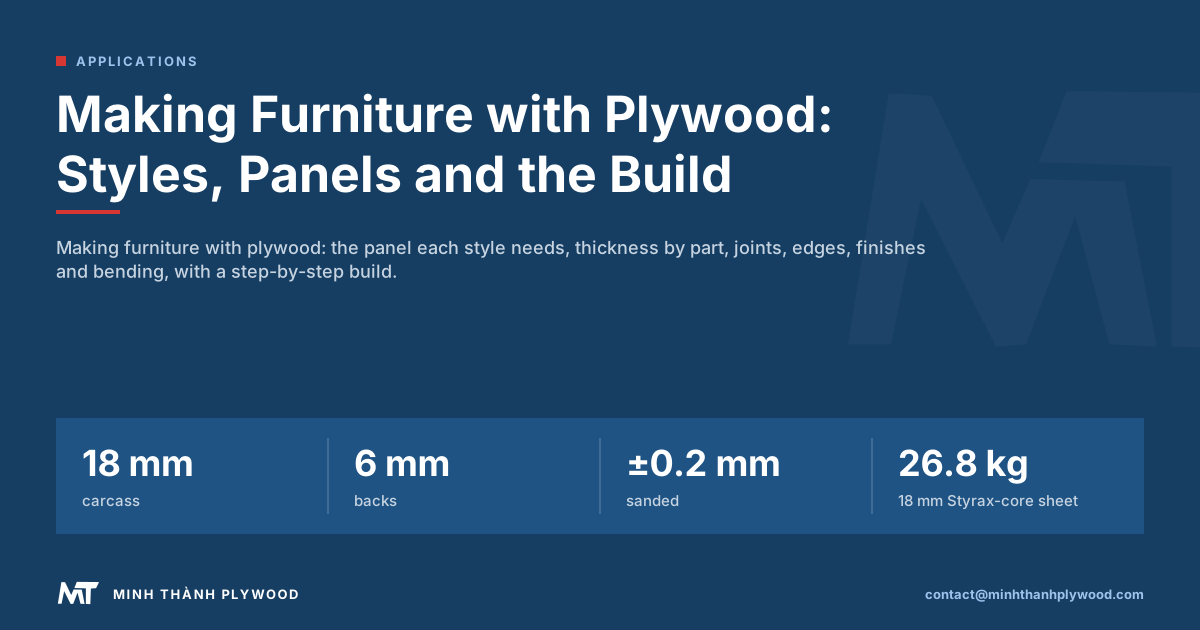
Is plywood good for furniture?
Plywood is good for furniture because its veneers are glued with the grain crossing at right angles, so the panel stays flat, resists splitting and holds screws close to the edge. That is why kitchen carcasses, office desks, school furniture and designer chairs are all built from it.
Against the other sheet materials a furniture maker uses, plywood wins on three points:
- Strength for its weight: an 18 mm sheet on white Styrax core weighs about 26.8 kg at 1220 × 2440 mm, lighter than MDF of the same size, so flat-pack and wall-hung pieces stay easy to handle.
- Screw and hinge holding: screws bite across several plies; particleboard crumbles at the edge.
- A visible edge worth showing: the layered edge itself is a design feature, as long as the core is closed.
The limits are just as clear. Plywood costs more than particleboard, its face shows the veneer quality, and a cheap panel with core gaps fails as soon as the edge is exposed. The answer to “is plywood good for making furniture” is therefore yes, from a furniture-grade panel.
Plywood furniture design styles and the panel each one needs
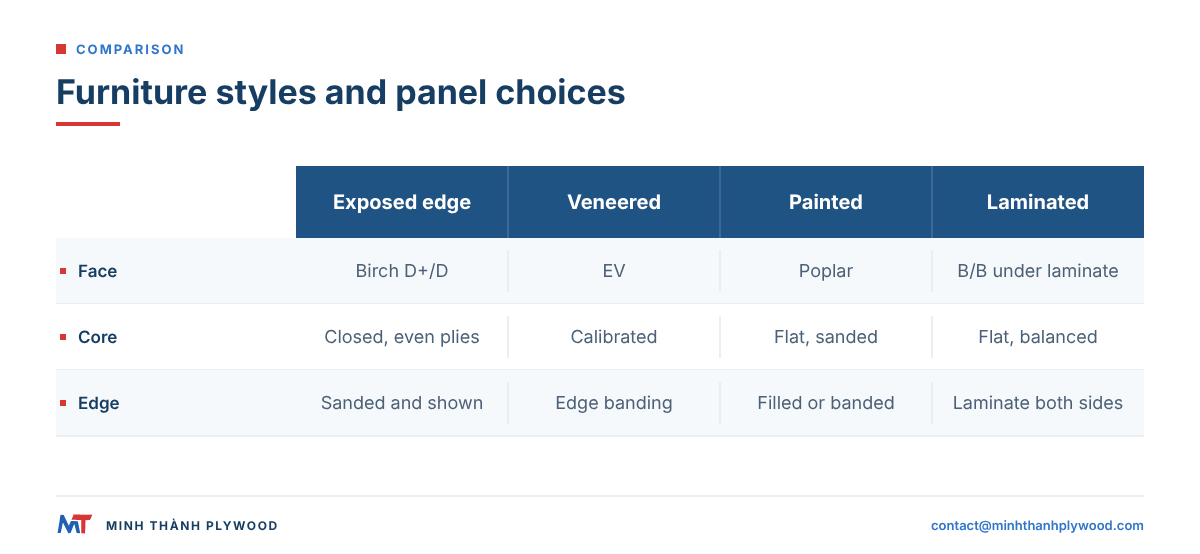
Each plywood furniture style asks for a specific panel, and most disappointments come from using a construction-grade sheet for a furniture style. The table maps the common plywood furniture ideas to the face, core and edge they need.
| Style | What defines it | Face to order | Core and edge | Finish |
|---|---|---|---|---|
| Exposed-edge modern | Striped layered edges on show, simple slab forms | Birch, D+/D or better | Closed core, thin even plies, sanded edges | Clear lacquer or oil |
| Layered (stacked) plywood | Many sheets glued and shaped into one solid form | Birch or poplar | Void-free core, flat for glue lines | Clear oil |
| Scandinavian and mid-century | Light faces, soft radii, bent or tapered parts | Birch or pale poplar | Calibrated core; thin sheets for bent parts | Water-based lacquer |
| Veneered contemporary | Uniform figured faces such as oak or walnut look | EV (engineered veneer) | Calibrated core, edge banding | Factory UV or lacquer |
| Painted | Solid colours, crisp profiles | Poplar or eucalyptus | Flat, sanded face; edges filled or banded | Primer and paint |
| Laminated (HPL or melamine) | Hard-wearing work and kitchen surfaces | B/B face under the laminate | Flat, balanced core | Laminate both sides |
Two rules come out of the table. First, the style that shows the edge needs the most expensive core, because the edge is a face. Second, a painted or laminated piece can use a plainer face and spend the money on flatness instead.
The layered plywood furniture look, where dozens of sheets are glued into a sculpted table base or bench, depends on the flatness of every sheet: a bowed sheet leaves a thick glue line that shows as a dark stripe.
When was plywood first used in furniture making?
Plywood was first used in furniture in the mid-19th century, when John Henry Belter patented a method of pressing thin laminated layers into curved chair backs in New York in 1858. The panels were steamed, glued and moulded, then carved in rosewood.
The milestones that made plywood a design material:
- 1850s: Belter’s laminated “pressed work” chairs and sofas.
- 1930s: Alvar Aalto’s Paimio armchair (1932) bends birch plywood into a single seat and back; Gerald Summers cuts and bends a whole chair from one sheet in 1934.
- 1940s: Charles and Ray Eames develop moulded plywood splints and then the LCW chair (1946).
- 1950s onward: Danish and Swedish designers make plywood the face of affordable modern furniture.
- Today: CNC routers cut flat-pack designs, from kids’ furniture to office systems, out of 1220 × 2440 mm sheets.
The modern revival of exposed-edge plywood furniture traces straight back to Aalto’s birch, which is why birch faces remain the reference for the style.
What type of plywood is best for furniture making?
The best plywood for furniture making is a furniture-grade panel with a sanded hardwood face, a closed core without gaps or overlaps, calibrated thickness and UF glue at E0 emission. Within that rule, the face follows the design.
What to specify, line by line:
- Face: birch for exposed edges and clear finishes, EV for a uniform veneered look, poplar for paint, eucalyptus for stiff, warm-toned parts. Faces are quoted as face/back pairs, for example birch D+/D or poplar A/B.
- Core: white Styrax core is light (about 500 kg/m³ for planning) and even; Eucalyptus core (about 650 kg/m³) is stiffer for long shelves and tops.
- Build: stitched cores and two pressings. Minh Thanh presses furniture panels twice as standard: the core board is pressed and calibrated, then face and back are pressed on, which keeps the face flat over the core.
- Tolerance: sanded furniture panels are held to ±0.2–0.3 mm, down to ±0.2 mm, which matters for CNC joints and stacked glue lines.
- Glue and emission: UF glue at E0 emission for indoor furniture; CARB P2 / TSCA Title VI certification is the proof US and European buyers accept, and the California Air Resources Board sets the composite wood rules behind it.
- Moisture: 8–12 % at dispatch, so parts do not move after machining.
The US limit for veneer-core hardwood plywood is 0.05 ppm under 40 CFR 770.10, and BS EN 636:2012+A1:2015 is the European product standard for plywood in dry, humid or exterior conditions.
For a full panel comparison by face and core, see furniture plywood from Vietnam.
What is the process of making furniture with plywood, step by step?
Making furniture from plywood follows the same nine steps whether you build one bookcase in a garage or a thousand desks on a CNC line. Each step has a check that saves the next one.
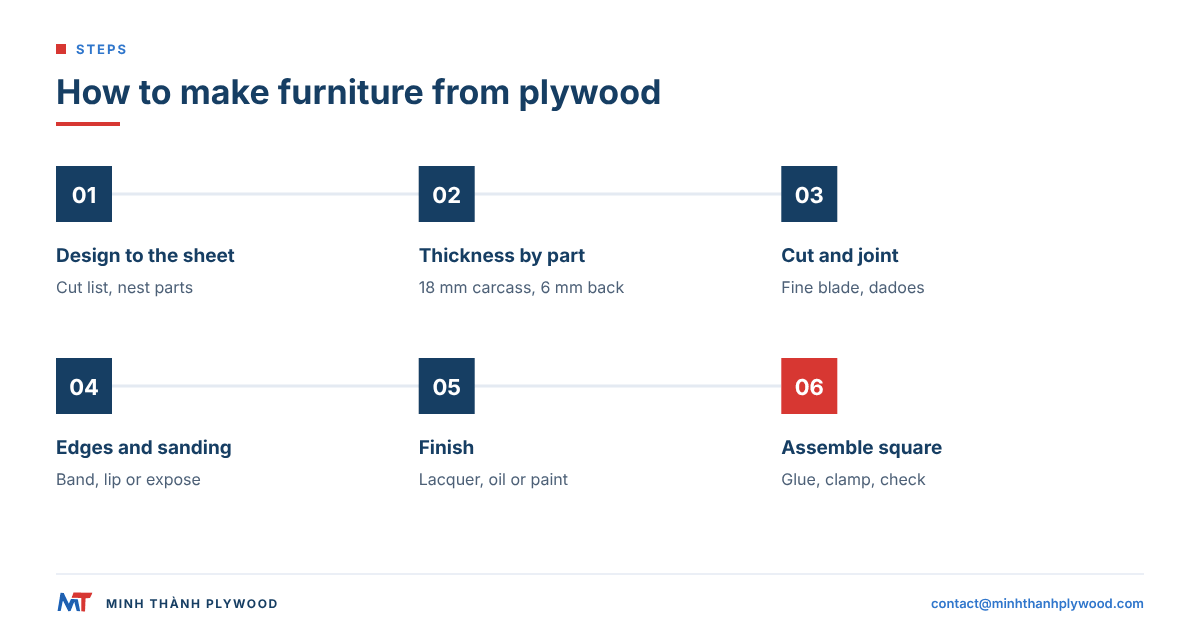
- Design to the sheet. Draw the piece and turn it into a cut list. Nest the parts on 1220 × 2440 mm or 1250 × 2500 mm sheets and keep grain direction consistent on visible faces.
- Choose thickness by part. 18 mm for carcasses, 6 mm for backs and drawer bottoms, 12 to 15 mm for drawer sides (table below).
- Acclimatise the sheets. Stack them flat in the workshop for a few days before cutting; check flatness on a table.
- Cut with a fine blade. Use a scoring blade or tape on the cut line so the face veneer does not chip; for CNC, use a compression bit.
- Cut the joints. Dadoes, rabbets, finger joints or dowel holes (next section); test the fit on an offcut first.
- Treat the edges. Sand exposed edges, or band or lip them before assembly.
- Sand the faces. Start at 150 grit and finish at 180 to 220; a factory-sanded face needs only a light pass.
- Finish before or after assembly. Pre-finish inside faces of cabinets; finish visible faces after assembly.
- Assemble square. Glue and clamp, check the diagonals, then add fittings.
The most common failure in step 4 is a chipped face on a cross-cut, and the most common failure in step 9 is a carcass out of square because the sheet was not flat.
Plywood thickness for furniture parts
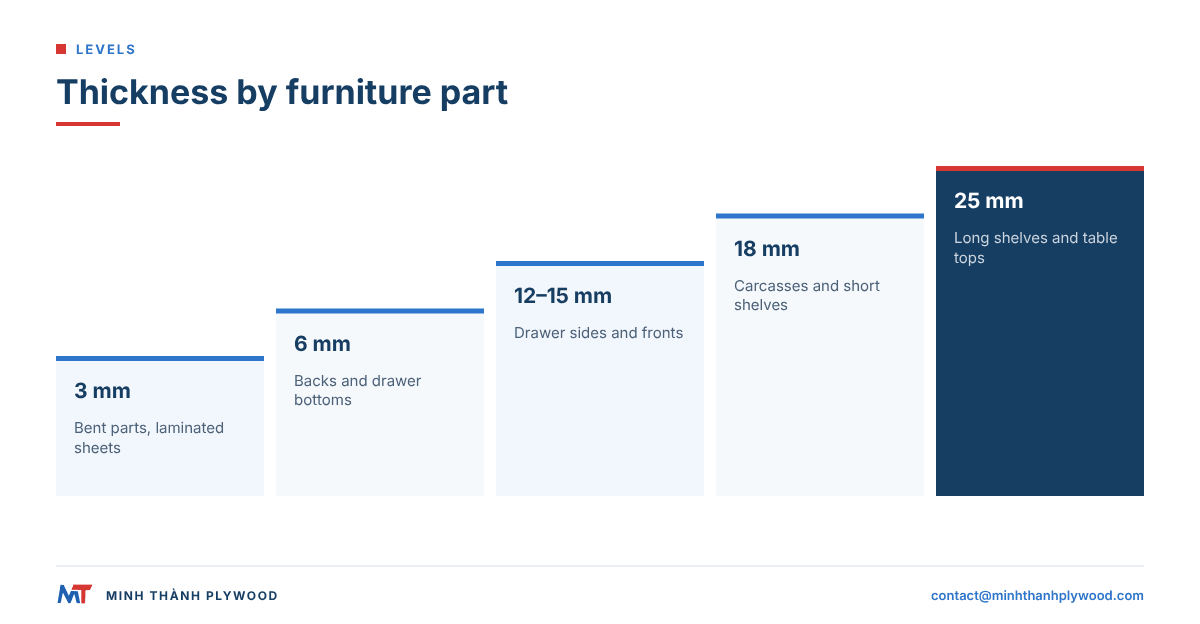
18 mm (3/4 in category) plywood is the standard thickness for furniture carcasses, with thinner sheets for backs and drawers and thicker or doubled sheets for tops. The table gives starting points for plywood furniture plans.
| Part | Thickness (mm and inches) | Why |
|---|---|---|
| Cabinet sides, tops, bottoms | 18 mm (3/4 in category) | Holds screws, hinges and cam fittings |
| Shelves, short spans | 18 mm (3/4 in) | Stiff enough for books and plates |
| Shelves, long spans or heavy loads | 25 mm (1 in), or 18 mm with a front lipping | Less sag between supports |
| Backs and drawer bottoms | 6 mm (1/4 in) | Square the carcass, light weight |
| Drawer sides and fronts | 12 to 15 mm (1/2 to 5/8 in) | Room for runners, crisp edges |
| Desk and table tops | 25 mm (1 in), or two 18 mm sheets glued (about 1-1/2 in) | Weight and a thick edge for the look |
| Bent parts (seat shells, curves) | Several 3 mm (1/8 in) sheets laminated | Bends over a form, then holds the shape |
Order the actual thickness, not the nominal one. A sheet sold as 18 mm with a loose tolerance can measure 17.3 mm, and a US 3/4 in sheet measures 23/32 in (about 18.3 mm); every dado cut for 18 mm then rattles. Our plywood thickness guide explains nominal and actual thickness.
Which joints work best for plywood furniture?
The strongest plywood furniture joints are glued dadoes, rabbets and finger joints, because they join face grain to face grain instead of relying on screws in the edge. Fittings then make flat-pack pieces easy to assemble.
| Joint | Best for | Note |
|---|---|---|
| Dado (housing) | Shelves into sides | Cut to the measured thickness of the sheet |
| Rabbet | Backs, carcass corners | Hides the back panel edge |
| Finger or box joint | Drawers, exposed-edge boxes | Shows the layered edge as decoration |
| Dowels or biscuits | Carcass corners, panels | Aligns faces during glue-up |
| Pocket screws | Face frames, quick builds | Fast, hidden from the front |
| Cam and confirmat fittings | Flat-pack and kitchen carcasses | Needs a firm core around the hole |
| CNC slot and tab | Designer flat-pack, kids’ furniture | Needs tight thickness tolerance |
Screws driven straight into a plywood edge hold well if they enter the middle of the core and are pre-drilled, but they hold best into the face. A closed, stitched core matters here too: a screw that lands in a core gap spins.
How to finish the edges of plywood furniture
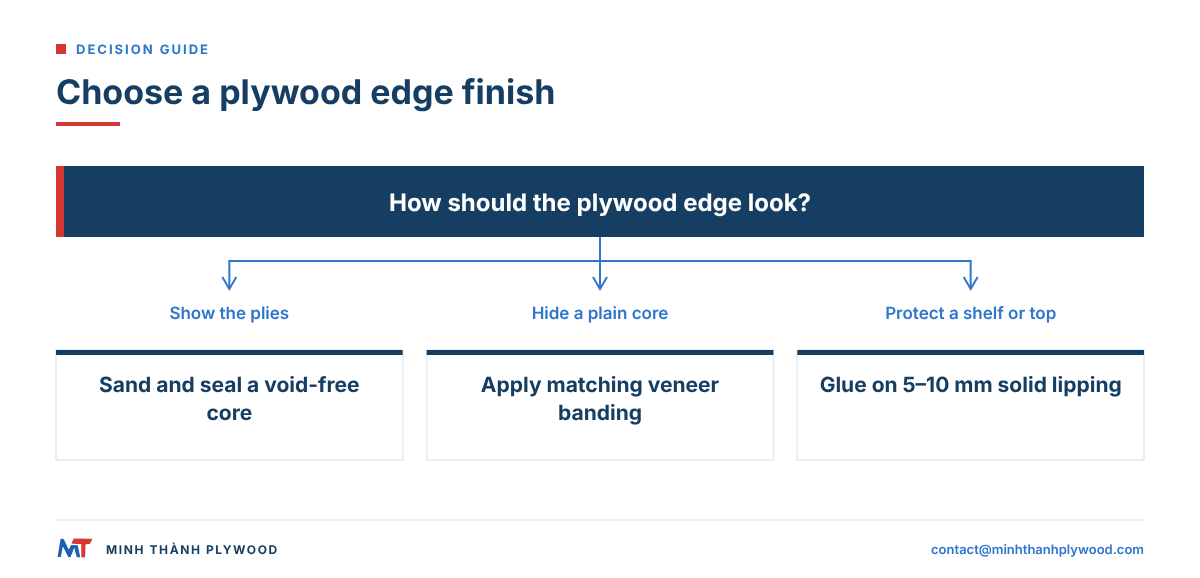
Plywood furniture edges are finished in one of three ways: left exposed and sanded, covered with veneer edge banding, or capped with a solid wood lipping. The choice follows the style and the core.
- Exposed layered edge: sand to 180 or 220 grit, ease the arris with a small chamfer or radius and seal with the face finish. Only a void-free core works; a gap reads as a black hole on the edge. Birch faces give the thinnest, most even stripes.
- Veneer edge banding: iron-on or hot-melt banding matched to the face. It hides a plain core and is standard on EV-faced and painted furniture.
- Solid wood lipping: a glued strip, usually 5 to 10 mm thick, planed flush. It survives knocks on tabletops and shelf fronts and can be profiled.
Exposed-edge plywood furniture styles are where the core grade shows most. Before ordering, cut a sample through the middle and sand the cut edge; what you see there is what your customers will see.
What finish looks best on plywood furniture?
A clear water-based lacquer or a hard-wax oil looks best on most plywood furniture, because both keep pale birch and poplar faces light and show the grain without the yellow tone of solvent finishes. Paint and UV coatings serve other styles.
- Water-based lacquer: clear, hard, low odour; two to three coats with a light sanding between.
- Hard-wax oil: a soft, natural look, easy to repair; good on tables and layered pieces.
- Paint: primer, then two coats; poplar and eucalyptus faces take paint well once sanded.
- UV coating: applied on a factory line for a hard, even surface. Minh Thanh sands both faces UV-ready, to the standard customers need to apply their own UV coating.
- Laminate: HPL or melamine on both faces for kitchens and workspaces; always balance both sides so the panel stays flat.
Test any finish on an offcut of the same panel. Birch can blotch under some stains, and a conditioner or a gel stain evens the colour.
How to bend plywood for furniture
Plywood is bent for furniture in two ways: thin sheets are glued in layers over a curved form, or the back of a thicker panel is kerf-cut so it can flex. Laminating gives the stronger curve for chairs and seat shells.
- Make the form. Cut a male and female former from stacked MDF or plywood to the curve.
- Cut thin sheets. Use several sheets of 3 mm plywood or veneer, all oversize.
- Glue every layer. Spread glue evenly on each sheet; use a slow-setting glue for time to position.
- Clamp or vacuum-press. Close the form and leave it for the full cure time.
- Trim and sand. Cut the curved part to size once it holds its shape.
Kerf-bending suits curved cabinet ends and arches that are hidden on one side; the method and spacing are in our guide to building a plywood arch. Minh Thanh’s thin plywood from 3 to 5 mm is always 5-ply, which gives an even curve with less risk of cracking along a single thick ply.
MDF vs particle board vs plywood for furniture
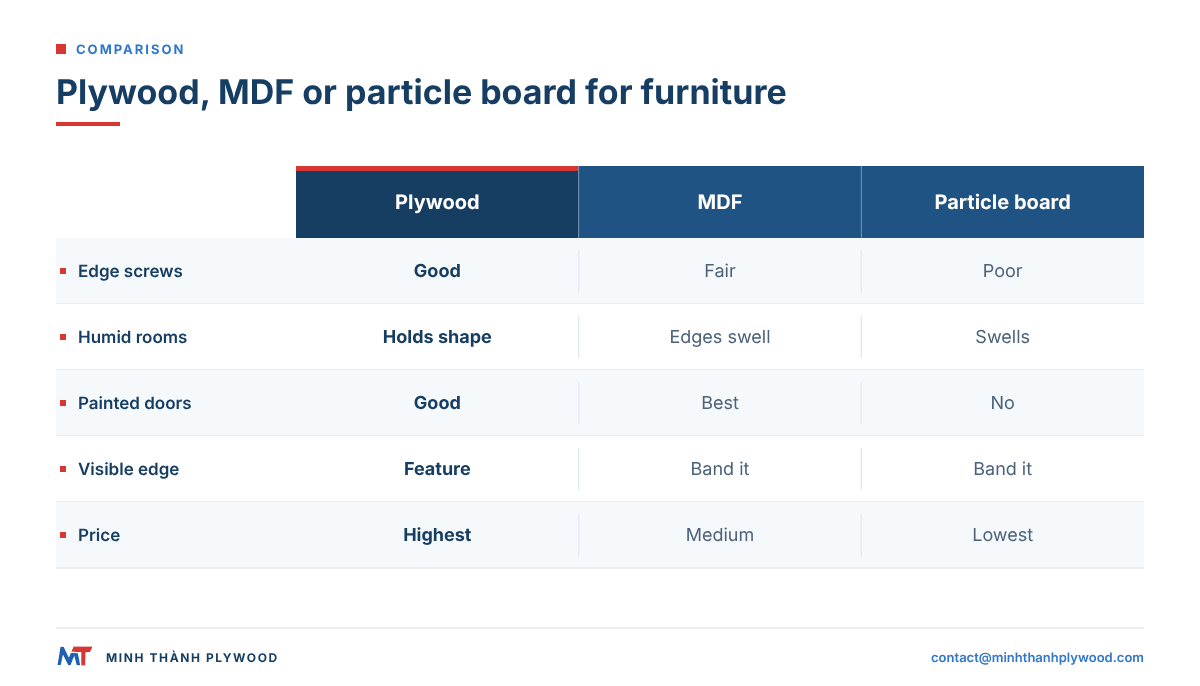
Plywood beats MDF and particle board for furniture that must carry load, hold screws or live in humid rooms; MDF beats plywood for painted, routed profiles; particle board wins only on price. The table compares them for cabinet making.
| Property | Plywood | MDF | Particle board |
|---|---|---|---|
| Screw holding at the edge | Good | Fair, needs pre-drilling | Poor |
| Weight for the same thickness | Lightest of the three on Styrax core | Heavy | Medium |
| Humid climate (UAE, Philippines, coastal) | Holds shape and screws | Edges swell when wet | Edges swell and crumble |
| Painted, profiled doors | Good with a sanded face | Best, no grain | Not suitable |
| Visible edge | A design feature | Must be banded | Must be banded |
| Price | Highest | Medium | Lowest |
In hot, humid climates the decisive point is moisture at the cut edges. MDF and particle board take it up and swell; plywood dried to 8–12 % moisture and sealed on every edge stays flat. For cabinet making in the Gulf or South-East Asia, plywood carcasses with MDF doors is a common mix.
Plywood furniture projects from one 4 × 8 ft sheet
A full 4 × 8 ft sheet (1220 × 2440 mm) is enough for many first builds. Popular Mechanics’ list of 15 one-sheet projects includes a stool and standing desk, a kids storage bench, a media console, a closet organizer and a portable picnic table; its bed platform takes two sheets and, with four locking casters, comes in under US$60. Use 3/4 in (18 mm) sheets for the structure and a 1/4 in (6 mm) sheet for backs.
| Project | Sheets | Thickness | Joint that works |
|---|---|---|---|
| Stool | 1 sheet | 3/4 in (18 mm) | Glued and screwed butt joints, or finger joints on CNC |
| Standing desk | 1 sheet | 3/4 in (18 mm), top doubled to 1-1/2 in | Dadoes and screws |
| Kids storage bench | 1 sheet | 3/4 in (18 mm), 1/4 in (6 mm) bottom | Dadoes, glue, rounded edges |
| Media console | 1 sheet plus a back panel | 3/4 in (18 mm), 1/4 in (6 mm) back | Dadoes and rabbets |
| Closet organizer | 1 sheet | 3/4 in (18 mm) | Dadoes and pocket screws |
| Fold-down wall desk | 1 sheet | 3/4 in (18 mm) | Dadoes and a piano hinge |
| Platform bed | 2 sheets | 3/4 in (18 mm) | Butt joints, screws and cleats |
| Portable picnic table | 1 sheet | 3/4 in (18 mm) | Half-lap joints and bolts |
| Bent-ply chair | Several 1/8 in (3 mm) sheets | 1/8 in (3 mm) laminated | Glued laminations on a form |
For a first-hand reference on the sheet itself, Minh Thanh’s thin 4 mm furniture panel is built from three 1.3 mm Styrax core veneers and two faces, which is why it bends over a form and stays flat as a back. The 18 mm furniture panel is pressed twice and sanded to ±0.2–0.3 mm, so the dadoes in the table above close without shimming.
Plywood furniture ideas by room
Plywood furniture ideas cover every room, and each piece has a typical build. These are the pieces makers most often build from plywood, with the panel that suits them.
- Desks and tables: 25 mm or doubled 18 mm tops with a birch face and an exposed or lipped edge; fold-down wall desks for small rooms.
- Bookshelves and shelving: 18 mm sides and shelves in dadoes; stackable cube shelves cut from a single sheet.
- Headboards, sofas and chairs: a shelf headboard from one 18 mm sheet, a rocker or bent-ply chair from laminated 3 mm sheets, and a sofa frame from 18 mm panels with upholstered cushions.
- Beds: platform and storage beds from 18 mm panels with 6 mm drawer bottoms; see plywood bed designs.
- Wardrobes and closets: 18 mm carcasses, EV-faced doors, cam fittings for flat-pack.
- Coffee tables and benches: layered plywood or a slab top on hairpin legs.
- Children’s and school furniture: rounded edges and low-emission panels; see plywood for children’s and school furniture.
- Shop and display furniture: see plywood for shopfitting and displays.
For tools, jigs and workbenches, the panel choice differs again; see the best plywood for woodworking. The wider set of builds is collected in plywood projects.
What are the advantages of birch plywood furniture?
Birch plywood furniture has a fine, pale face, thin even plies that make a striped edge, and stiffness that lets designers use thinner parts. It is the reference panel for exposed-edge and Scandinavian styles.
The advantages in practice:
- Clean machining: birch cuts crisp edges on CNC routers and takes small radii without tearing.
- Even finishing: clear lacquers and oils go on evenly; the face stays light.
- The striped edge: even ply thickness gives the regular stripes the style is known for.
Minh Thanh grades birch faces as D+, D and E and quotes them in pairs such as D+/D, which is close to European B/BB as a buying comparison. For exposed-edge furniture, order D+/D on a closed core. Details are on the birch plywood page and in the birch plywood grades guide.
Buying plywood sheets for furniture making
Furniture makers buy plywood sheets in two ways: single sheets from timber merchants and DIY retailers, or full containers direct from a manufacturer. Workshops in South Africa, New Zealand or the Czech Republic usually start at the merchant; furniture plants and importers buy by the container.
Direct from the mill, a furniture plant gets the build it specifies instead of the build on the shelf:
- the face and grade pair, core species, glue and emission class written on the order;
- calibrated thickness to ±0.2 mm on sanded panels;
- sizes of 1220 × 2440 or 1250 × 2500 mm, custom sizes such as 1220 × 2500 mm, or cut-to-size parts;
- mixed specifications in one container by agreement.
Minh Thanh’s minimum order is one 40HC, production takes 15–45 days after the deposit, and furniture and interior plywood started from US$350/m³ in October 2026.
What this means for your furniture plywood order
To order plywood for furniture making, send a specification that names the style’s needs line by line, so the mill builds the panel your design depends on.
A furniture specification looks like this:
- Application: exposed-edge desks and shelving, clear lacquer finish
- Core: white Styrax, closed, stitched; or Eucalyptus for long shelves
- Glue and emission: UF glue at E0 emission, CARB P2 / TSCA Title VI
- Face and back: birch D+/D, sanded both sides, UV-ready
- Thickness and size: 18 mm, 1220 × 2440 mm, tolerance ±0.2 mm
- Packing and quantity: export pallets, one 40HC, destination port
Minh Thanh sends free samples with the quotation, so you can cut, sand and finish a sample before the order. Send your specification to contact@minhthanhplywood.com.
Buyer questions, answered
Is plywood good for furniture?
Yes. Plywood's cross-laminated veneers keep it flat and stable, hold screws better than particleboard and weigh less than MDF of the same thickness. Furniture plywood with a sanded face and a closed core is the standard for cabinets, desks, shelving and beds.
What type of plywood is best for furniture making?
A furniture-grade panel with a sanded hardwood face, a closed core without gaps and UF glue at E0 emission. Pick birch faces for exposed layered edges, EV or poplar faces for veneered or painted pieces, and calibrated thickness for CNC work.
When was plywood first used in furniture making?
Laminated wood furniture appeared in the 1850s, when John Henry Belter patented pressed, laminated chair backs in New York. Plywood furniture as a design style took off in the 1930s with Alvar Aalto, and the Eames moulded plywood chair followed in 1946.
How thick should plywood be for furniture?
18 mm is the standard for carcasses, sides and shelves. Use 6 mm for backs and drawer bottoms, 12 to 15 mm for drawer sides, and 25 mm or two glued 18 mm sheets for worktops and heavily loaded shelves.
How do you finish the edges of plywood furniture?
Leave a void-free layered edge exposed and sand it, cover it with matching veneer edge banding, or glue on a solid wood lipping. An exposed edge only works on a panel with a closed core, because any gap shows.
What finish looks best on plywood furniture?
A clear water-based lacquer or hard-wax oil keeps birch and poplar pale and shows the grain. Paint suits poplar faces; UV coatings suit factory-finished panels with UV-ready faces.
Is MDF or plywood better for furniture in a humid climate such as the UAE or the Philippines?
Plywood. MDF and particleboard swell at cut edges when they take up moisture, while plywood holds its shape and its screws. Choose a panel dried to 8–12 % moisture and seal every edge.
Is particle board or plywood better for cabinet making?
Plywood is stronger, lighter for its stiffness and holds screws and hinges far better at the edge. Particleboard is cheaper and flat, so it stays common in low-cost flat-pack furniture.
How do you bend plywood for furniture?
Glue several thin plywood or veneer sheets over a curved form and clamp them until the glue cures, or kerf-cut the back of a thicker panel. Laminating gives the stronger, cleaner curve for chairs and rounded corners.
What are the advantages of birch plywood furniture?
Birch gives a fine, pale face, thin even plies for a striped edge and good stiffness. It machines cleanly on CNC routers and takes clear finishes and stains evenly.
Where can I buy plywood sheets for furniture making?
Single sheets come from timber merchants and DIY stores. Furniture plants and importers in South Africa, New Zealand, the Czech Republic and elsewhere buy by the container direct from a manufacturer; Minh Thanh's minimum is one 40HC, with mixed specifications by agreement.