
To identify good quality plywood, check eight things in order: the grade and approved sample, thickness and size, the plies and core at the edge, the glue bond, moisture, the face and back against the grade, flatness, and the documents. Each check needs only a caliper, a tape, a moisture meter, a knife and good light. This guide catalogues the face defects each grade allows and gives a receiving checklist. Minh Thanh Plywood is a furniture plywood manufacturer in Vietnam.
How to identify good quality plywood: the eight checks
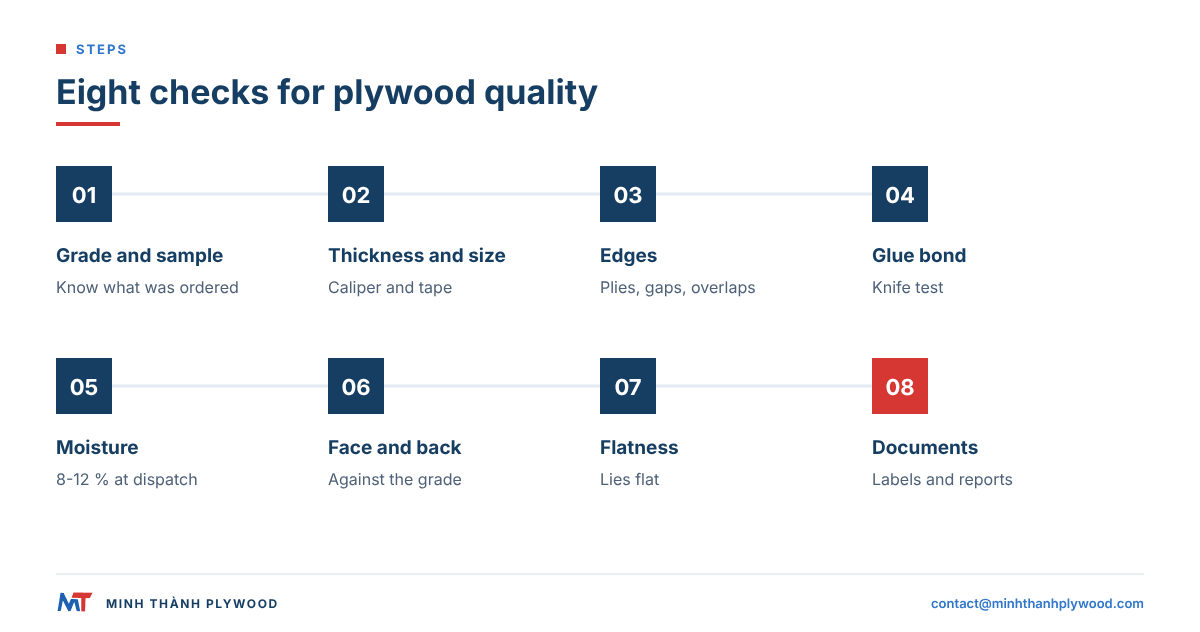
To identify good quality plywood, run eight checks in this order. Each one needs only simple tools and settles a question a buyer can act on.
- Grade and approved sample: know what was ordered before you judge what arrived.
- Thickness, size and squareness: caliper and tape against the written tolerance.
- Plies and core at the edge: even layers, no gaps, no overlaps.
- Glue bond: a knife test at the edge.
- Moisture content: a meter reading against the agreed range.
- Face and back: the defect catalogue against the face grade.
- Flatness: the sheet lies flat on even supports.
- Documents and labels: pack labels, certificates and test reports match the order.
A panel that passes all eight is good plywood for its grade. A panel that fails one has a named problem that a supplier can answer. The rest of this guide explains each check, then catalogues the defects and what each grade tolerates.
Step 1: agree the grade and the approved sample
Quality is judged against what was agreed, so the first step happens before production: write the face and back grade on the order and keep a signed approved sample. Without them, “good quality” is an opinion; with them, it is a comparison.
How grades are quoted in practice:
- Birch faces are named D+, D and E in Vietnam, quoted as face/back pairs such as D+/D or D/E. Individually, D+ is roughly B, D roughly BB and E roughly CP/C on the European birch ladder.
- Poplar faces are quoted as A/A, A/B or B/B, and buyers also use the Chinese codes B/BB, BB/CC and CP on the same ladder.
- Pine and Eucalyptus faces are quoted as A/A, A/B and B/B, with B/C for utility parts.
- Exterior and CDX-type panels use utility C/D face and back.
The approved sample fixes the look that words cannot: colour range, knot size, patch type and grain. Keep one piece each, signed by both sides. Our plywood grades guide compares the letter systems across regions.
Step 2: check thickness, size and squareness
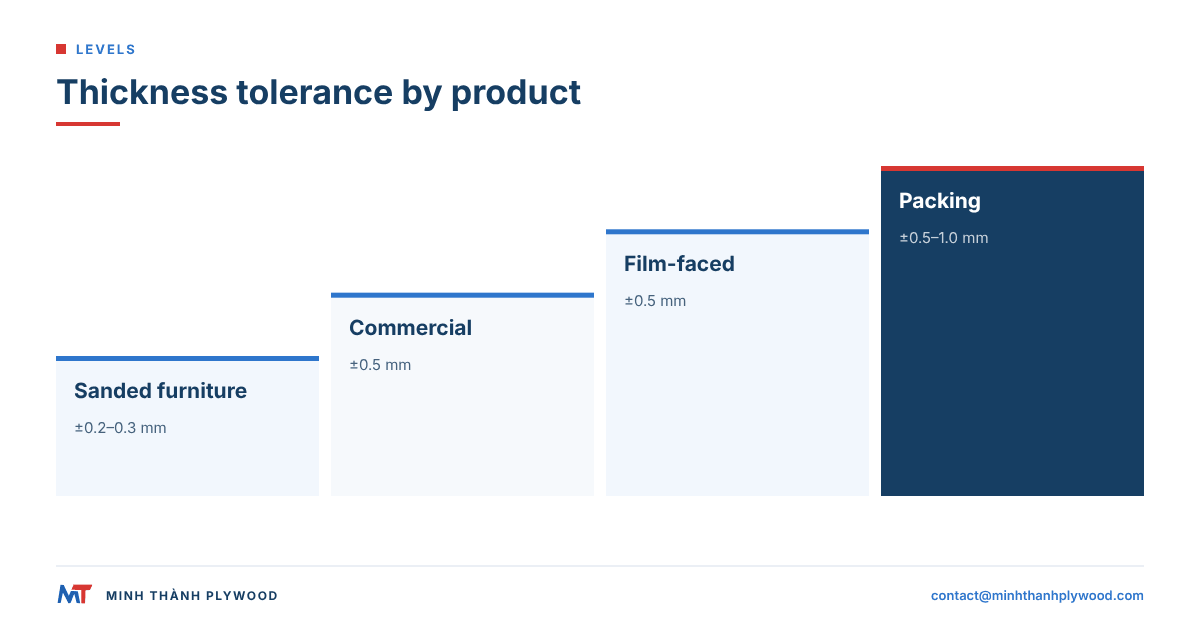
Measure thickness with a caliper at four points about 50 mm in from the edge, and length and width with a steel tape at both ends and the middle. Sanded furniture plywood should hold ±0.2–0.3 mm on thickness; length and width hold ±2 mm.
| Product line | Thickness tolerance | Length and width | What a reading outside means |
|---|---|---|---|
| Sanded furniture plywood | ±0.2–0.3 mm, down to ±0.2 mm | ±2 mm | Uneven sanding or an uncalibrated core |
| Commercial plywood | ±0.5 mm | ±2 mm | Uneven veneer or press pressure |
| Film-faced plywood | ±0.5 mm | ±2 mm | Uneven core build |
| Packing plywood | ±0.5–1.0 mm | ±2 mm | Packing grade; check the order |
Then measure both diagonals. Equal diagonals mean a square sheet; a clear difference means a skewed cut that will show on every cabinet door. Thickness that varies across one sheet is as telling as the average: a sheet thick at one end and thin at the other was sanded on an uneven core.
Why calibration shows in the numbers
Our furniture-grade panels are pressed twice as standard: the core board is pressed and calibrated, then face and back are pressed on. A calibrated core is what keeps a sanded 18 mm sheet within ±0.2 mm across its whole area.
Step 3: read the edges for plies, core gaps and overlaps
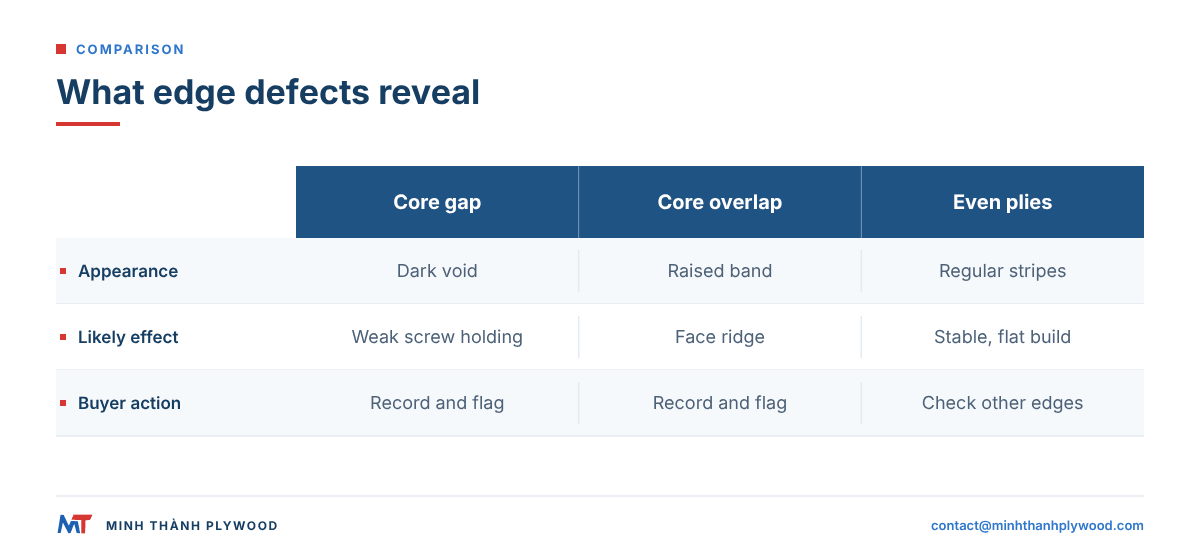
The edge shows the build. Good plywood has an odd number of even plies, glue lines that run straight, and no gaps, overlaps or crushed veneers in the core. An 18 mm furniture panel in our production carries 11–13 plies; thin panels from 3 to 5 mm carry five.
What to look for along all four edges:
| Edge finding | What it looks like | What it causes |
|---|---|---|
| Core gap | A void between two core veneers in the same ply | Hollow spots, a dip in the face, weak screw holding |
| Core overlap | Two core veneers lying on top of each other | A ridge that telegraphs through the face after sanding |
| Uneven ply thickness | Plies of visibly different thickness | Warp and uneven stiffness |
| Crushed or broken veneer | Ragged, compressed fibres in a ply | A weak zone that delaminates under load |
| Even plies, straight glue lines | Regular stripes, no voids | A flat, stable sheet that holds screws |
Stitched cores close the gaps
Core veneers are made of narrower strips. When those strips are laid loose, gaps and overlaps appear. Our core layers are stitched both horizontally and vertically before pressing, so the strips stay closed and the edge reads as even stripes.
Step 4: test the glue bond with a knife
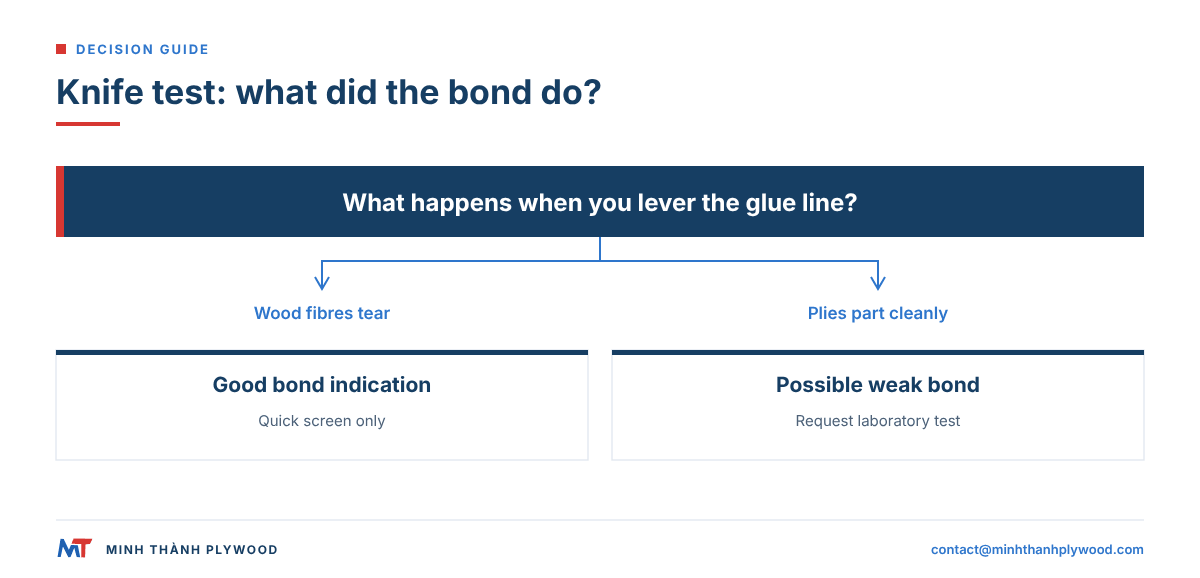
Push a sharp knife or chisel into a glue line at the edge and lever the plies apart. In a good bond, the wood itself tears and fibre stays on both faces; in a weak bond, the plies split cleanly along the glue line with little wood attached.
- Choose a cut edge, not a factory-sanded edge.
- Insert the blade into one glue line, 10 to 20 mm deep.
- Lever firmly and look at the two separated surfaces.
- Repeat on three glue lines and two sheets.
The knife test is a quick screen, not a bond class test. Bond classes come from the glue: UF glue for dry interiors, melamine-fortified (MR) for humid rooms, phenolic (WBP) for exterior use. A panel sold as water-resistant should be bonded with MR or WBP glue, and a laboratory bond test to the buyer’s method settles any doubt. We arrange third-party testing to the buyer’s method through SGS on request.
Delamination and blisters
A blister is a raised patch where the face has not bonded to the ply beneath. Press it: a blister flexes and sounds hollow. Delamination is a visible separation at the edge. Neither is acceptable in any furniture grade.
Step 5: measure moisture content
Read moisture with a pin or pinless meter at several points on several sheets. Furniture plywood should read 8–12 % at dispatch. Readings well above that range point to a panel that was not dried enough, or that got wet in transit or storage.
Moisture explains defects that appear later: a panel that leaves a mill wet keeps drying after it is cut, and the parts cup, twist or open at the joints. Moisture readings on arrival also separate a production cause from a storage cause when a question comes up later.
Our veneers and finished panels are dried to 8–12 % moisture content at dispatch, the normal range for furniture plywood. Record your readings with the pack label in the photo.
Step 6: inspect the face and back against the grade
Lay the sheet flat under good light, look along it at a low angle, and compare the face and back with the approved sample. Count and measure the defects the grade limits: knots, patches, splits, open joints, sanding-through, glue penetration, discoloration and core telegraphing.
| Defect | What it looks like | Usual cause | Top face grade | Middle grades | Utility grades |
|---|---|---|---|---|---|
| Sound tight knot | Knot fixed in the veneer, no cracks | Natural | Not allowed or very small | Allowed, limited by size and number | Allowed |
| Open knot or knot hole | Hole where the knot fell out | Natural | Not allowed | Patched only | Allowed within limits |
| Patch | Oval or boat-shaped inset of matching veneer | Repair of a knot or defect | Not allowed or few, well matched | Allowed, matched in colour | Allowed |
| Split | Crack along the grain in the face veneer | Veneer drying or handling | Not allowed | Small, filled or closed | Allowed within limits |
| Open joint | Gap between two face veneer strips | Poor splicing | Not allowed | Not allowed or filled | Allowed within limits |
| Overlap | Two face strips lying on each other | Poor laying before pressing | Not allowed | Not allowed | Limited |
| Sanding-through | Core or glue showing through the face | Thin face or uneven core | Not allowed | Not allowed | Limited |
| Glue penetration (bleed-through) | Dark glue spots or stains on the face | Thin, porous face or too much glue | Not allowed | Not allowed on clear-finish faces | Allowed |
| Core telegraphing | Ridges or dips visible in low light | Core gaps or overlaps | Not allowed | Not allowed | Limited |
| Mineral streak | Olive, grey or blue-black streaks | Natural minerals in the tree | Limited | Allowed | Allowed |
| Colour variation | Light and dark strips on one face | Different logs or sapwood | Matched for colour | Allowed within the sample | Allowed |
| Rough or fuzzy grain | Raised fibres after sanding | Blunt sanding paper or wet veneer | Not allowed | Limited | Allowed |
The grade names differ by face: A/A, A/B and B/B for poplar, pine and eucalyptus; D+/D and D/E for birch. The top face grade in this table is A on poplar, pine and eucalyptus, and D+ on birch. Exact limits for size and number are fixed by the approved sample of each order. The general rules for grading plywood by surface appearance are set in ISO 2426-1.
What is scant face plywood?
Scant face plywood has a face veneer that is too thin for the panel. When the sheet is sanded, the face wears through in spots and the core or glue shows, or the core’s gaps and ridges telegraph through the face as shadows. It is a build defect, not a natural feature of the wood.
How to recognise a scant face:
- Sanding-through spots: small areas where the darker core or the glue line shows on the face, often near edges and corners.
- Telegraphing: in low-angle light, faint stripes or ridges that follow the core veneers underneath.
- Glue spots: dark marks where glue has pushed through a thin, porous face.
- Edge reading: at a cut edge, the face veneer is visibly thinner than the plies below it.
A scant face matters most on furniture parts that will be lacquered or stained, because finish highlights every ridge and sanded spot. It also matters on UV-coated parts: our faces on both sides are UV-ready, so customers can apply their own UV coating on a face that is even and sound.
How a mill prevents it
A calibrated core is the main defence. When the core board is pressed and calibrated before the faces go on, the sander removes only a thin, even layer from the face, not the high spots of an uneven core. Our furniture panels are pressed twice for that reason, and faces are sanded and polished.
What is mineral streak in wood?
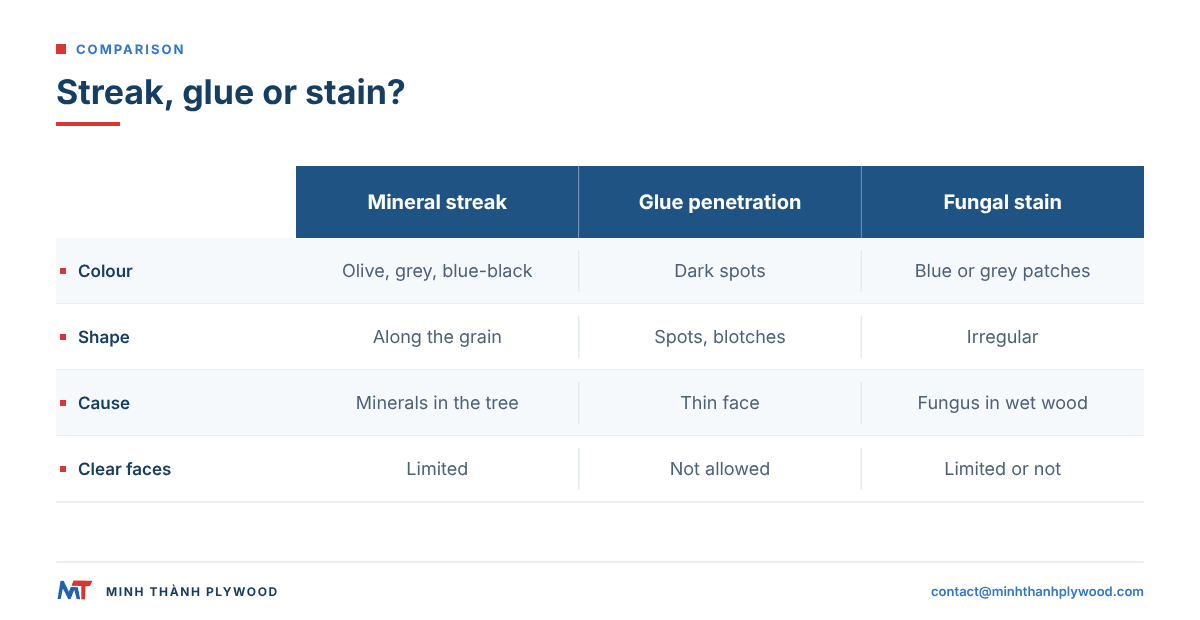
Mineral streak is a natural discoloration in hardwoods: olive, grey, greenish or blue-black streaks running with the grain, caused by minerals the tree took up from the soil, often around a wound. It is common in poplar, birch and maple. The wood is sound; the streak is a matter of appearance.
How mineral streak wood is treated in plywood grades:
- Clear-finish faces: limited in number and size, because lacquer or oil makes the streaks darker and more visible.
- Paint-grade faces: accepted, because paint covers them.
- Back faces and utility grades: accepted.
| Feature | Mineral streak | Glue penetration | Fungal stain |
|---|---|---|---|
| Colour | Olive, grey, blue-black | Dark brown or black spots | Blue or grey, often in patches |
| Shape | Streaks along the grain | Spots and blotches | Irregular areas |
| Cause | Minerals in the living tree | Glue through a thin face | Fungus in wet logs or veneer |
| Strength effect | None | None, but a sign of a thin face | None in early stages |
| Grade treatment | Limited on clear faces | Not allowed on clear faces | Limited or not allowed |
Telling these apart matters in a claim. Mineral streak is a natural feature that the grade either allows or limits; glue penetration points to a thin face. The approved sample shows how much streak the buyer accepts.
Step 7: check flatness
Lay the sheet on a flat surface or on even supports and look along it. Good plywood lies flat under its own weight. A slight bow on a single thin sheet often flattens in a stack; a pronounced warp, twist or cup across a whole pack is a defect.
Warp comes from three sources:
- Unbalanced build: plies of uneven thickness or a face and back of different species or moisture.
- Moisture: a panel that was not dried enough before pressing, or that took up water on one side.
- Storage: sheets leaned against a wall or stacked on uneven bearers.
Balanced construction and drying prevent the first two; storage on even bearers, flat and covered, prevents the third. Our veneers and panels are dried to 8–12 % moisture content at dispatch, and panels are built with an odd number of plies around a balanced core.
How can you spot core defects without a lab test?
Read all four edges for gaps, overlaps and crushed plies, tap the face to hear hollow spots, press along the surface for soft patches, and look at the face in low-angle light for ridges where core gaps telegraph through. These checks find most core defects with no equipment.
- The edge read: the fastest check. Gaps show as dark voids, overlaps as thicker bands.
- The tap test: knock with a knuckle or a small hammer across the face. A solid panel sounds even; a void or blister sounds hollow.
- The press test: press with a thumb along the face over suspect areas. A face over a gap gives slightly.
- The light test: hold a lamp low, at the side of the sheet. Ridges and dips cast shadows.
- The cut test: on a sample sheet, cut a strip across the panel and read the cross-section in the middle, not only at the edge.
- The weight check: weigh a sheet. An 18 mm 1220 × 2440 mm panel weighs 26.8 kg on Styrax core at 500 kg/m³ and 34.8 kg on Eucalyptus core at 650 kg/m³; a sheet far below the expected weight for its core can hide voids.
Step 8: check the documents and pack labels
Compare every pack label with the packing list and the order, then check the certificates and test reports the order requires. A pack label names the size, thickness, grade and number of sheets; the documents prove emission class, origin and the claims on the order.
What a buyer of furniture plywood checks:
- Pack labels match the packing list and the purchase order.
- Emission proof: CARB P2 / TSCA Title VI certification for US-bound furniture panels, with the TSCA Title VI label on the panels. The US limit for veneer-core hardwood plywood is 0.05 ppm under 40 CFR 770.10. Ours is held under ICTT mill number 23024.
- Chamber test reports with laboratory, method and date.
- EUDR dossier for the EU: origin records and geolocation files.
- Shipping documents: commercial invoice, packing list, B/L, certificate of origin, phytosanitary and fumigation certificates.
Our emission evidence: six ASTM D6007 chamber tests between April 2025 and June 2026 on 9, 15 and 18 mm panels averaged 0.014–0.032 ppm, against the 0.05 ppm CARB Phase 2 / TSCA Title VI limit; three by Shanghai Hongjun and three by ICTT Vietnam.
Quick checks for a buyer without tools
Five checks need nothing but a knife, a bucket and your hands, and they catch most of the plywood that should never have been bought. This is the list for a homeowner, a joiner or a buyer on a loading dock.
| Quick check | How | What a poor result means |
|---|---|---|
| Knock test | Knock across the face with a knuckle; listen for an even note | A hollow sound marks a core gap or a blister |
| Water soak | Cut a small sample from an offcut, soak it in cold water for 24 hours, dry it and try to pry the plies apart | Plies that part cleanly along the glue line: a weak bond or the wrong glue for damp use |
| Boil test | Boil a cut sample, then dry it and pry the plies | Layers that open after a short boil: not suitable for damp areas; melamine-fortified (MR) bonds survive shorter boils and phenolic (WBP) bonds long ones, so state the boil time and test method (for example EN 314-1) with the result |
| Edge read | Look at all four edges in good light | Gaps, overlaps or uneven plies |
| Price check | Compare the quote with two or three others for the same size, thickness, core and glue | A price well below the market usually means fewer plies, core gaps or less glue |
A low price is a warning. The cheapest sheet in the list is rarely the cheapest in use. Corners are cut where a buyer cannot see them in a photo: fewer or thinner plies than the thickness suggests, loose core strips with gaps, a thin face that sands through, glue spread thin or wet veneer pressed in a hurry. Century Plywood lists “selecting the cheapest option” among the buyer mistakes that cause problems, together with ignoring the grade and skipping certificates (Centuryply, how to check plywood quality, accessed 21 October 2026). Write the grade, plies, glue and tolerance in the order, then compare like with like.
Termites and borers. A hand test does not show resistance to insects. It comes from the species, the glue and any treatment the order names. If the panels will sit in a termite-prone region, put the requirement in the order and ask the mill what it can add.
Pick the right panel for the job. Dry-room furniture suits UF glue at E0 emission, kitchens and bathrooms melamine-fortified (MR) glue, and wet or exterior use phenolic (WBP) glue. A panel that fails the soak test in a damp room may be the wrong glue, not a defect.
How many sheets to inspect: a receiving checklist
Inspect sheets from the top, middle and bottom of several packs, not one pack only, and record every reading with a photo. Many buyers set the sample size with an acceptance sampling plan such as ISO 2859-1 and write it into the contract with the acceptance limits.
| Check | Tool | Pass when |
|---|---|---|
| Pack labels | Eyes, packing list | Labels match the order and packing list |
| Thickness | Caliper | Every reading within the written tolerance |
| Length, width, squareness | Steel tape | Within ±2 mm, diagonals equal |
| Plies and core | Eyes at four edges | Even plies, no gaps or overlaps |
| Glue bond | Knife or chisel | Wood tears, fibre on both sides |
| Moisture | Moisture meter | Within the agreed range, for example 8–12 % |
| Face and back | Approved sample, low-angle light | Defects within what the sample shows |
| Flatness | Flat surface | Sheet lies flat |
Record it the same way every time
Photograph each reading with the tool and the pack label in frame. A record like this turns a disagreement into a measurement. Every shipment we send is photographed and filmed before loading, and buyers get the photos and the video, so both sides compare the same sheets.
How to identify a quality plywood manufacturer in Vietnam
A quality plywood manufacturer in Vietnam shows its proof before you order: held certificates with numbers, chamber test reports with laboratory and method, real photos and video of its own factory and of loading, a signed approved sample and a written specification with tolerances.
What to ask a furniture, film-faced or anti-slip plywood manufacturer:
- Certificates held, with numbers: for example CARB P2 / TSCA Title VI, ISO 9001 and the national product certificate.
- Test reports: the laboratory, the method and the date, for the panel type you will buy.
- The build: core species, plies by thickness, glue, how the core is laid and whether panels are pressed once or twice.
- Tolerances in numbers: thickness, size and moisture.
- A free sample, graded and signed as the approved sample.
- Loading records: photos and video of the packs and the container.
Our proof: CARB P2 / TSCA Title VI (ICTT mill no. 23024), ISO 9001:2015 (KAC25/0185) and TCVN 11902:2017 for veneer-faced plywood (VietCert 141.1-VNC-HC). Furniture panels are pressed twice, cores are stitched both ways, and faces are sanded and polished.
How Minh Thanh Plywood grades and inspects furniture panels
Minh Thanh Plywood grades every furniture order against the buyer’s approved sample, presses furniture panels twice with a calibrated core, holds sanded panels to ±0.2–0.3 mm and down to ±0.2 mm, dries panels to 8–12 % moisture and records every shipment on photo and video before loading.
| Stage | What we do | What you can check |
|---|---|---|
| Order | Write face and back grade, core, glue, tolerance and moisture on the proforma | The specification line |
| Sample | Free samples, signed as the approved sample | One signed piece each |
| Core | Core layers stitched horizontally and vertically, pressed and calibrated | Even plies at the edge |
| Faces | Face and back pressed on, sanded and polished; UV-ready on both sides | Face against the sample |
| Glue | UF glue at E0 emission; MR and WBP to the customer’s specification | Knife test, test reports |
| Dispatch | Moisture 8–12 %, packs labelled, loading photographed and filmed | Photos, video, meter readings |
| Testing | Third-party testing to the buyer’s method through SGS on request | The report |
The factory in Ha Hoa, Phu Tho is built for top-grade furniture and interior plywood, with Europe as its main market. To get a sample graded against your requirement, send the face, grade, core, thickness and quantity through our furniture plywood page, or email contact@minhthanhplywood.com. We reply within hours.
Buyer questions, answered
How can you tell if plywood is good quality?
Good plywood measures within its written thickness tolerance, shows even plies with no core gaps at the edge, holds its glue lines under a knife, reads 8–12 % moisture, lies flat and has a face that matches the approved sample for its grade.
What is scant face plywood?
Scant face plywood has a face veneer too thin for the panel, so sanding cuts through it in spots or the core shows through as shadows and ridges. It is a production defect that no furniture face grade accepts.
What is mineral streak in wood?
Mineral streak is a natural olive, grey or blue-black discoloration in hardwoods such as poplar, birch and maple, caused by minerals taken up by the tree. It is sound wood, accepted in lower and paint grades but limited in clear-finish faces.
How can I spot defects in core veneer without a lab test?
Look at all four edges for gaps, overlaps and soft or broken plies, tap the face to hear hollow spots, press along the surface for soft patches, and look at the face in low-angle light for ridges where core gaps telegraph through.
How do you check plywood glue quality on site?
Push a sharp knife or chisel into a glue line at the edge and lever it. In a good bond the wood tears and fibre stays on both sides; a clean split along the glue line shows a weak bond.
What moisture content should plywood have?
Furniture plywood should read 8–12 % moisture content at dispatch. Readings well above that suggest the panel was not dried enough or got wet in transit or storage.
What thickness tolerance should good plywood meet?
Sanded furniture plywood should hold ±0.2–0.3 mm, and our calibrated panels reach ±0.2 mm. Commercial and film-faced panels hold ±0.5 mm, and length and width hold ±2 mm.
Are knots a defect in plywood?
Sound, tight knots are allowed in most grades below the top face grade; open knots and knot holes are allowed only in lower grades, or must be patched. The approved sample shows how many and how large.
How many sheets should I check on arrival?
Check sheets from the top, middle and bottom of several packs rather than one pack only. Many buyers set the sample size with an acceptance sampling plan such as ISO 2859-1 and write it in the contract.
How do you identify a quality plywood manufacturer in Vietnam?
Ask for held certificates with numbers, chamber test reports with laboratory and method, real photos and video of the factory and of loading, a signed approved sample and a written specification with tolerances.