
Grades of exterior plywood are three separate choices: the face/back veneer pair (A/C, B/C, C/D), the bond class (Exterior or Exposure 1, WBP or melamine-fortified) and any structural rating. Pick the face pair for what stays visible and the bond for the exposure. Minh Thanh Plywood makes C/D utility exterior panels with phenolic WBP or melamine-fortified glue, matched to an approved sample.
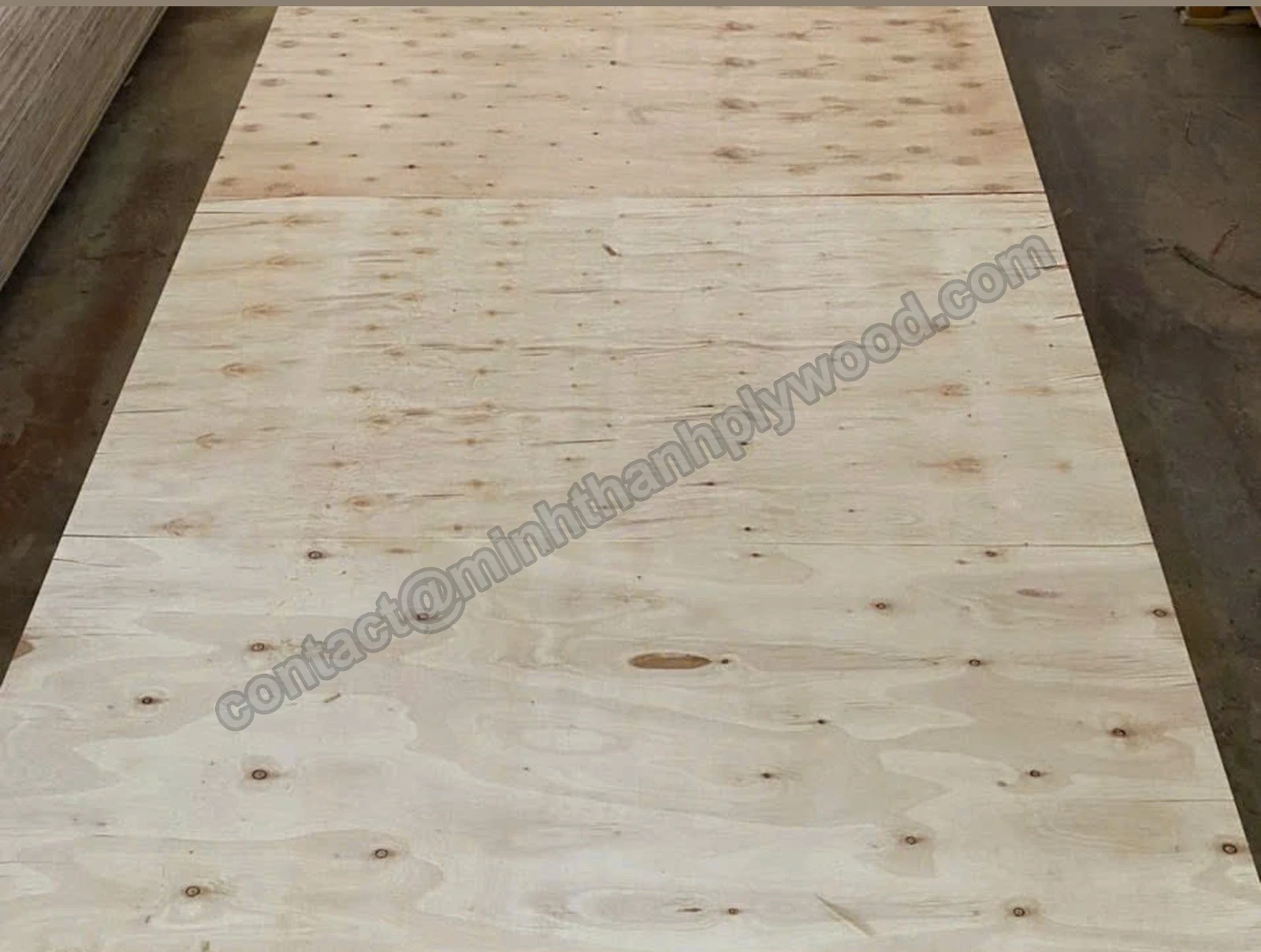
How should buyers read grades of exterior plywood?
Read grades of exterior plywood as several purchase attributes, rather than one ladder from poor to good. Veneer appearance, moisture service and structural performance each answer a different question about the panel. Put all three decisions on the quotation schedule before comparing suppliers.
A high appearance grade matters on a visible painted or clear-finished surface. A utility appearance matters economically when the face is concealed. Neither choice resolves the adhesive requirement or the structural product evidence.
Minh Thanh’s exterior/CDX-type panels use utility C/D face/back appearance matched to the order sample. Water-resistant melamine-fortified or phenolic bonds are specified for the order. For a structural application, attach the required standard, rating and product identification to the same enquiry.
In our factory, utility faces are graded by hand under the line lights before pressing, and each pack is checked against the approved sample before strapping. The factory veneer-grading hub explains face selection in production. Your approved sample shows both the face and the reverse, so the delivered C/D sheets match what you saw.
Start with the component that will use the plywood. Record where it will be exposed, what will cover it and which face stays visible. This makes the grade choice practical: purchasing can buy the appearance the component needs while retaining the performance the assembly requires.
A-C plywood vs BC plywood: what does each face grade allow?
A-C plywood has a smooth, paintable A face and a C back; BC plywood has a solid B face with small repairs and tight knots, and the same C back. Under the US veneer grades in PS 1, as summarised by APA, each letter sets what the face may show.
| Veneer grade | What the face may show | Typical exterior use |
|---|---|---|
| A | Smooth and paintable; a limited number of neatly made wood or synthetic repairs | Visible painted parts, signs, soffits, A-C sheets |
| B | Solid surface; shims, router repairs and tight knots up to 1 inch across the grain | Painted utility faces, B-C sheets, hoarding |
| C-plugged | Improved C: splits and knotholes filled, small tight knots | Underlay and base for tile or flooring |
| C | Tight knots to 1-1/2 inch, knotholes to about 1 inch, limited splits, repairs allowed | Backs of A-C and B-C sheets, sheathing, CDX faces |
| D | Knots and knotholes to about 2-1/2 inch, limited splits; Exposure 1 or interior panels only | Backs of CDX sheathing that is covered after building |
An A face can include the neat repairs its grading system allows. If your finish must hide every repair, say so and approve a finished sample.
For A-C plywood vs BC plywood, keep the construction fixed before attributing a quotation difference to the face. A different core, thickness tolerance or service requirement changes the product being compared. The ACX, BCX and CDX guide develops that comparison.
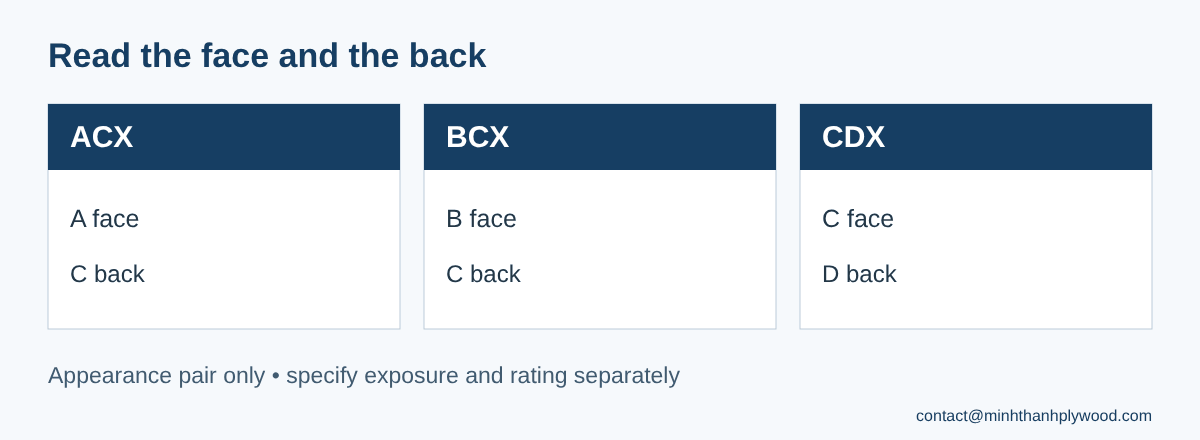
How do letter-number and birch grades fit this chart?
Letter-number hardwood grades and birch appearance grades belong to their own conventions, so an exterior plywood order should not convert them by matching letters alone. Use the named grading rules and accepted face/back sample.
A1 or B2 describes a hardwood appearance selection under its relevant system. B/BB and BB/BB describe birch face/back appearance pairs. Their letters and numbers do not establish an Exterior bond classification or a structural rating. Keep the construction and service requirement beside the chosen appearance.
Minh Thanh quotes birch-faced panels using the Vietnamese names D+, D and E. Individual D+ is approximately B, D approximately BB, and E approximately CP/C for buying comparison. The actual order appearance is fixed by the approved sample. A D+/D pair is therefore compared with B/BB appearance, while the bond stays its own field.
For a visible exterior component, specify how the finish treats patches and colour variation. A sample chosen for an interior cabinet can give a useful appearance reference, but its construction must also satisfy the new service. Approving the visible veneer does not settle that second requirement.
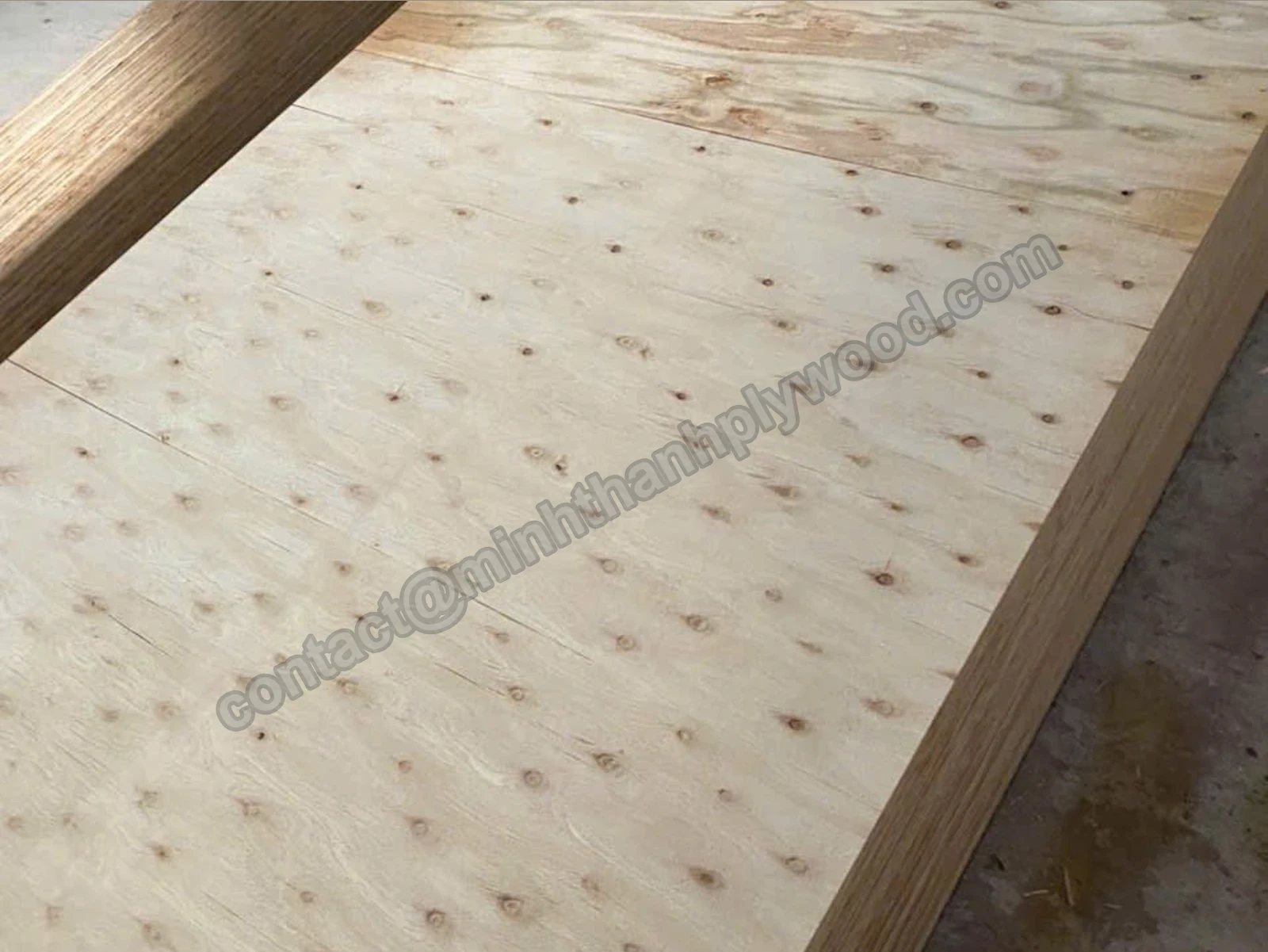 Sound knots and veneer repairs on a utility face: name which features your grade accepts.
Pine-faced appearance at Minh Thanh is quoted in pairs such as A/A, A/B and B/B against the accepted sample. Tell the factory which sides are visible and which finish is planned. That is more useful than asking for “BB exterior” without identifying the convention or the reverse-face expectation.
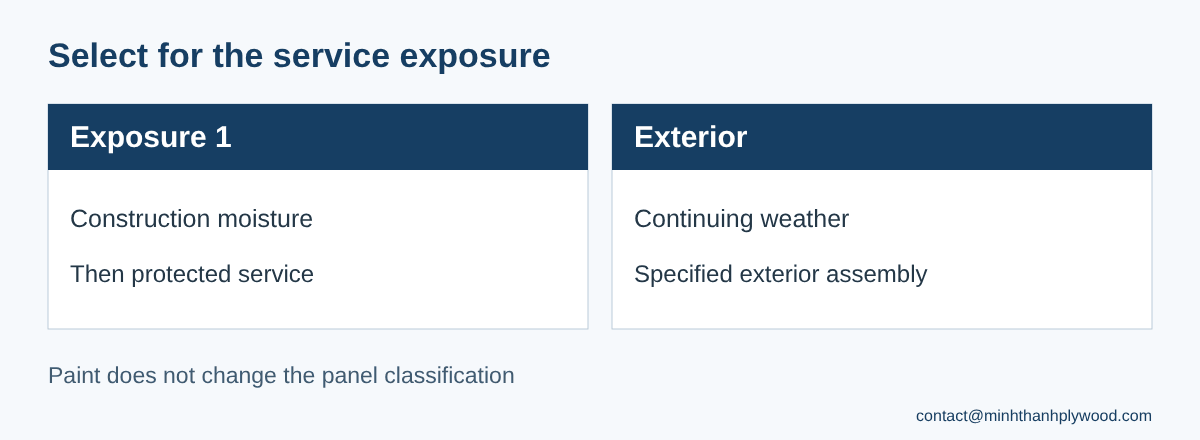
What separates Exterior from Exposure 1?
Exterior addresses continuing weather exposure, while Exposure 1 addresses limited construction moisture and protected service under the applicable panel specification. The actual classification should be stated in the product schedule.
APA’s plywood guidance, consulted on 8 October 2026, distinguishes those classes and identifies commonly sold CDX as Exposure 1.
A label such as “CDX exterior glue” should therefore not replace a requirement for an Exterior panel. NIST lists PS 1-22 as the current US voluntary product standard for structural plywood.
Describe the finished service rather than only the construction location. A sheet installed outside a frame but subsequently protected by the enclosure differs from a sheet left exposed as a finished surface. The order should identify the designed protection and any treatment requirement.
Outdoor life comes from the panel and the assembly together: a sealed edge, a coating and drainage keep an Exterior panel working for years. Our phenolic WBP bond holds the plies together in the wet; add preservative treatment where the design needs decay resistance.
How should European service and structural requirements be specified?
European enquiries should identify the relevant plywood specification, service condition and structural or non-structural role. A face grade chart should not substitute for that product requirement.
In the EU, plywood for structural use in construction is CE-marked under the Construction Products Regulation (EU) No 305/2011, now replaced by Regulation (EU) 2024/3110, which has applied since 8 January 2026; CE marking to EN 13986 continues under the transitional rules. The harmonised standard behind that marking is EN 13986, and CE is available* for Minh Thanh exterior orders that need it. The BSI description of BS EN 636:2012+A1:2015, consulted on 8 October 2026, covers plywood for structural and general-purpose use in dry, humid or exterior conditions. It distinguishes the panel specification from coating and biological-durability treatments.
State the exact requirement from the project rather than writing only “European exterior grade.” The supporting documents should identify the offered product and intended application. If a structural panel is required, include the corresponding properties and approval route in the document schedule.
Keep face appearance in a separate sample sheet. The project can require a utility face for hidden work or a selected appearance face for visible work while retaining the same service requirement. A change in appearance should not silently change the product’s approved construction.
For a construction enquiry, name the EN 636 class and any structural property the project needs, and we quote the matching build. Our quality records cover the production checks behind every order.
What should the bond and resin line contain?
The bond line should name the required performance and test evidence, while the resin line identifies the offered adhesive system. Writing both fields makes a water-resistant panel enquiry much more precise than the abbreviation WBP alone.
Minh Thanh offers melamine-fortified and phenolic bonds to the customer’s specification for exterior/CDX-type panels. Match the resin, panel construction and test requirement in the quotation. Glue-line colour helps visual discussion of an edge but cannot establish a laboratory result.
If your project needs a test report, name the method; we arrange third-party testing through SGS on request.
Emission class is a separate field. UF glue at E0 emission is Minh Thanh’s standard for furniture and interior panels; exterior orders use phenolic WBP or melamine-fortified glue instead. Write resin, emission class and moisture service as three separate lines.
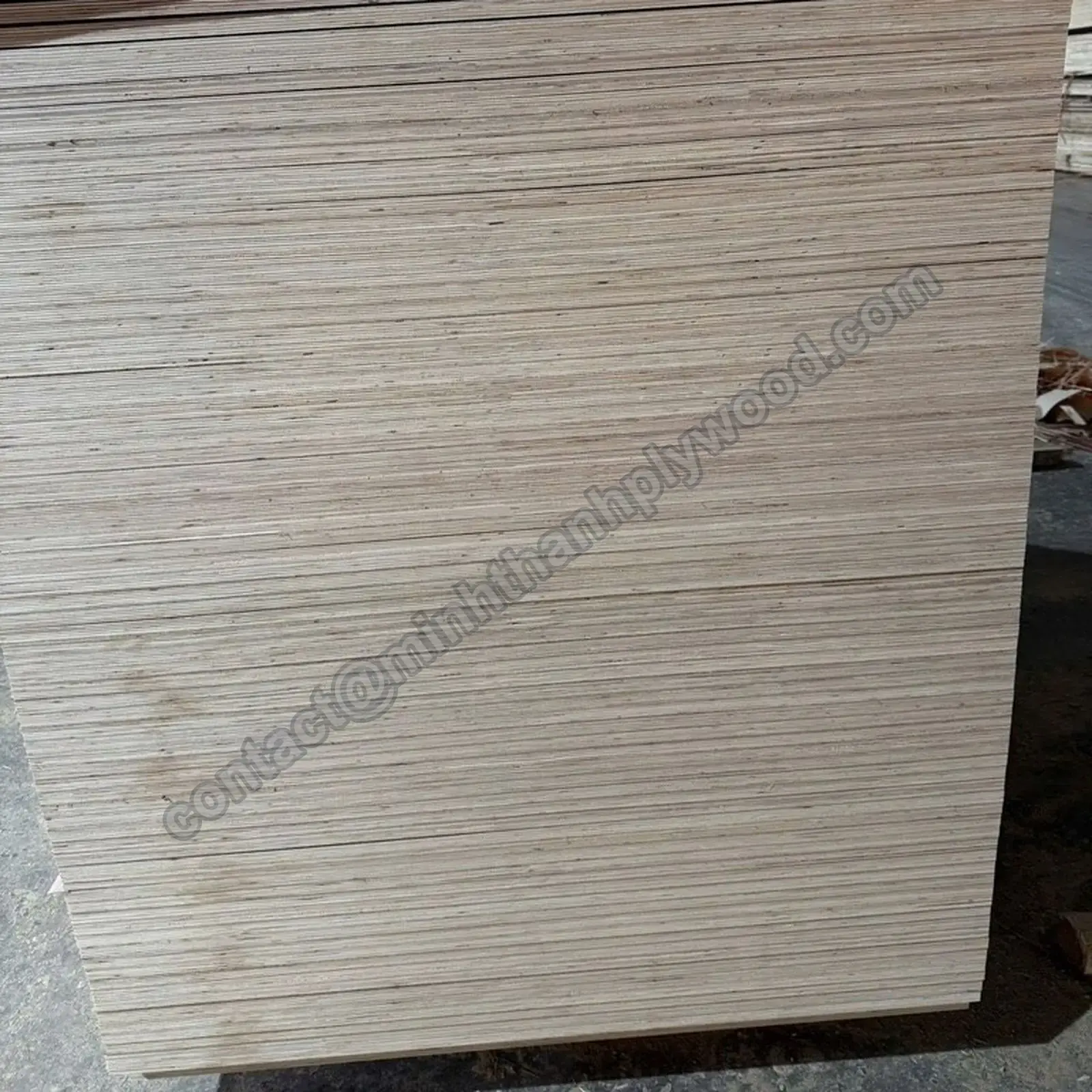
Our exterior panels use phenolic WBP glue pressed at 130–145 °C for weather exposure; the melamine-fortified build is checked against a 12-hour boil. The edge shows the closed layup you receive.
How do core, thickness and format change the accepted panel?
Core, thickness and format determine the physical construction that the buyer receives, independently of the face label. This is the exterior build we quote, field by field.
| Field | Minh Thanh exterior / CDX-type build |
|---|---|
| Face/back | C/D utility pair, selected to the approved appearance sample |
| Core | AB core veneers, laid loose or joined, on Styrax or Eucalyptus |
| Bond | Phenolic WBP for exterior exposure, pressed at 130–145 °C; melamine-fortified for humid use, pressed at 110–120 °C |
| Bond check | 12-hour boiling requirement for the melamine-fortified specification |
| Thickness | 3–40 mm, tolerance ±0.5 mm |
| Formats | 1220 × 2440 and 1250 × 2500 mm; 1220 × 2500, 1220 × 2280 mm and cut-to-size parts |
| Length and width | ±2 mm |
Minh Thanh’s standard formats include 1220 × 2440 mm and 1250 × 2500 mm. Its commercial plywood thickness tolerance is ±0.5 mm, with length and width tolerance of ±2 mm. A structural enquiry should retain any required performance category as well as the actual dimension and tolerance.
A panel being cut into narrow components needs a representative machined-edge check. Examine the offered core where a fixing, groove or exposed edge will occur. For structural work, the approved product construction and design evidence govern selection; counting visible plies is not a substitute.
Write the edge profile on the order. Square-edged sheets, tongue-and-groove panels and cut-to-size components can require different fit and inspection methods. If the buyer has a drawing, use its dimension references rather than describing the profile from memory.
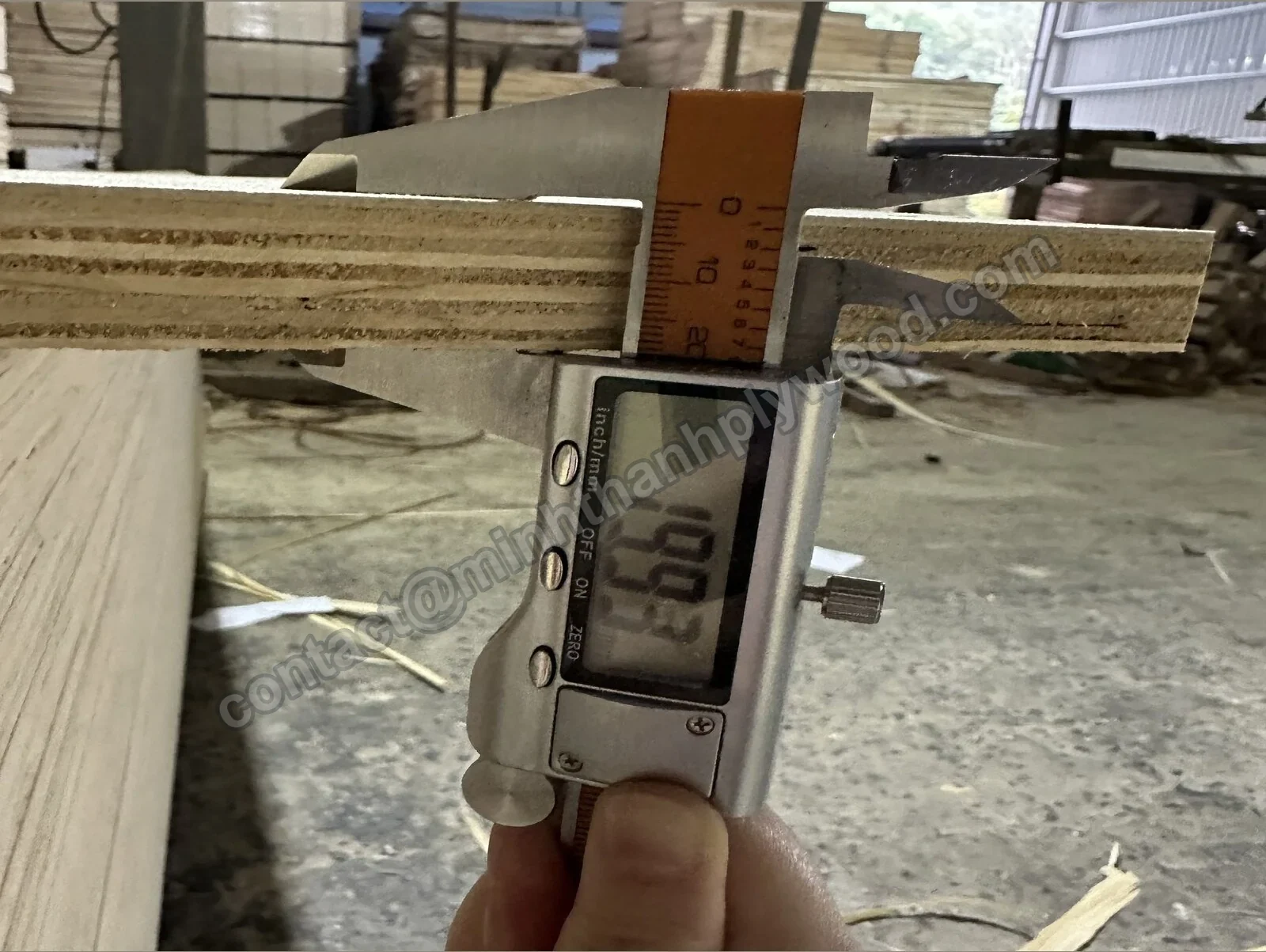
The thickness guide explains nominal and physical thickness decisions. For receiving, the useful record is the measured reading at an identified location against the agreed product tolerance.
How should buyers choose acceptance samples for visible exterior parts?
Choose a sample that shows the delivered face, reverse and repairs under your finish. Run this checklist once and attach the result to the order:
- Face and back: a full-size sample with both sides labelled, including at least one repair and one sound knot.
- Finish trial: take the sample through your paint or coating and check repair outlines in your inspection light.
- Preparation: sanding and edge condition as supplied in production, not hand-finished.
- Visible zones: mark which surfaces show, which edges are sealed and where fixings go.
- Construction: core, thickness and bond written on the sample label; any later change gets a new reference.
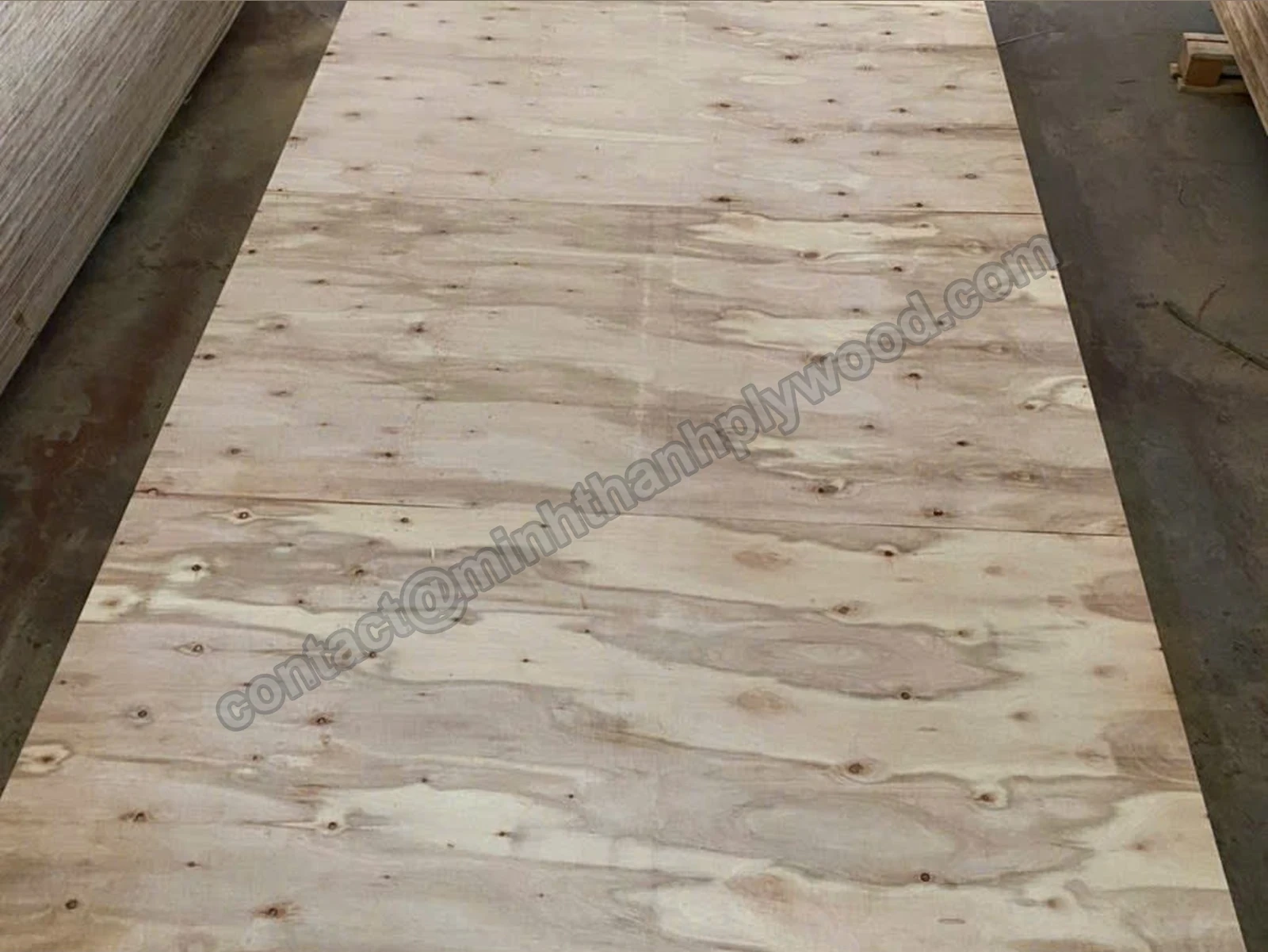 The C/D reverse face as it sits in a factory pack.
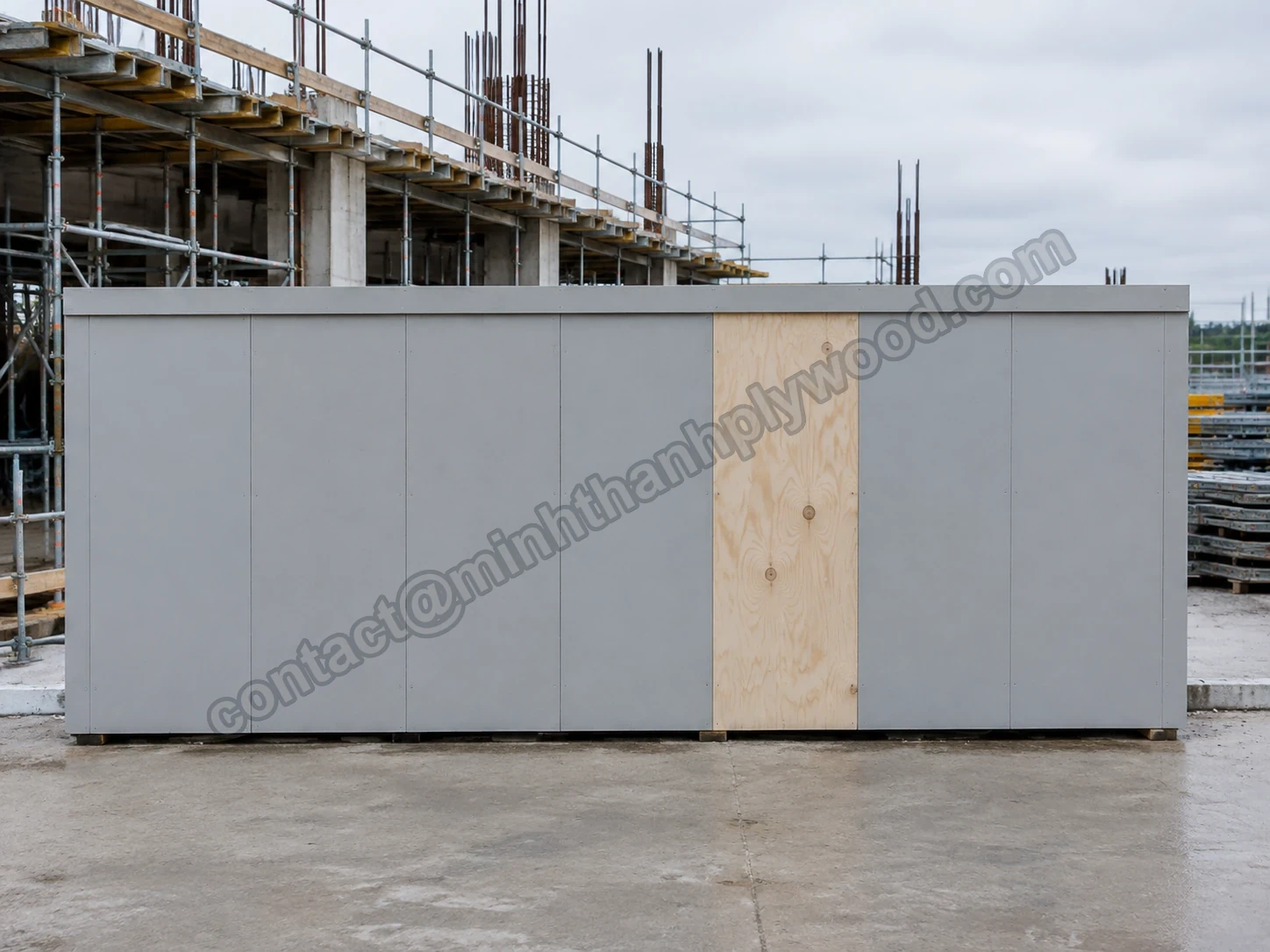 A painted B or C face on hoarding: the finish hides colour variation but not open splits.
We keep the approved sample at the factory and grade your order against it, so receiving compares the same version you signed.
Is exterior plywood the same as marine, treated or film-faced plywood?
Exterior, marine, treated and film-faced describe different requirements. A buyer should select the attributes the application needs and keep their supporting evidence separate.
A marine panel follows its named marine specification and construction requirements. A water-resistant glue line on a utility sheet does not complete that specification. Minh Thanh’s okoume-faced interior range should be selected for its stated interior role rather than renamed marine because of the face species.
Preservative treatment addresses a specified biological-durability requirement. It belongs to the assembly’s use conditions and document schedule. A coating or exterior bond alone should not replace a treatment required by the design.
Film-faced panels have an overlay that affects their contact surface and finishing use. For concrete forms, buyers need the film, core, bond and edge preparation specified together. Minh Thanh’s film-faced plywood range is the relevant product enquiry for that application.
The water-resistance guide separates a resistant bond from a waterproof assembly. Keep the same distinction when ordering a finished exterior part: select the qualified panel, then give the fabricator the drainage, edge and coating details of the assembly.
What should pre-loading and receiving inspection check?
Inspection should check product identity and packing condition before comparing representative sheets with the accepted specification. The report should separate appearance variation, dimensional mismatch and physical damage.
| Check | Acceptance reference | Record to keep |
|---|---|---|
| Pack identity | Final quotation and packing list | Pack reference and specification |
| Product evidence | Required standard, service class and rating | Product mark and matching documents |
| Face and back | Named grade and approved sample | Feature photographs by sheet |
| Edge condition | Agreed construction and sound condition | Location of lifting, breaks or visible gaps |
| Dimensions | Ordered thickness, size and tolerance | Individual readings and method |
| Packing | Agreed protection and identification | Condition photographs before opening |
Agree how selected packs and sheets will be sampled. A shipment should not be accepted solely because the top sheet looks good. Equally, a permitted utility knot should not be reported as damage. The sample sheet helps inspection name the feature correctly.
Minh Thanh photographs and films every shipment before loading and sends the records to buyers. Use matching pack references at destination. Photograph wet packing or impacts before removing the wrapping, then examine the affected sheets while their source remains identifiable.
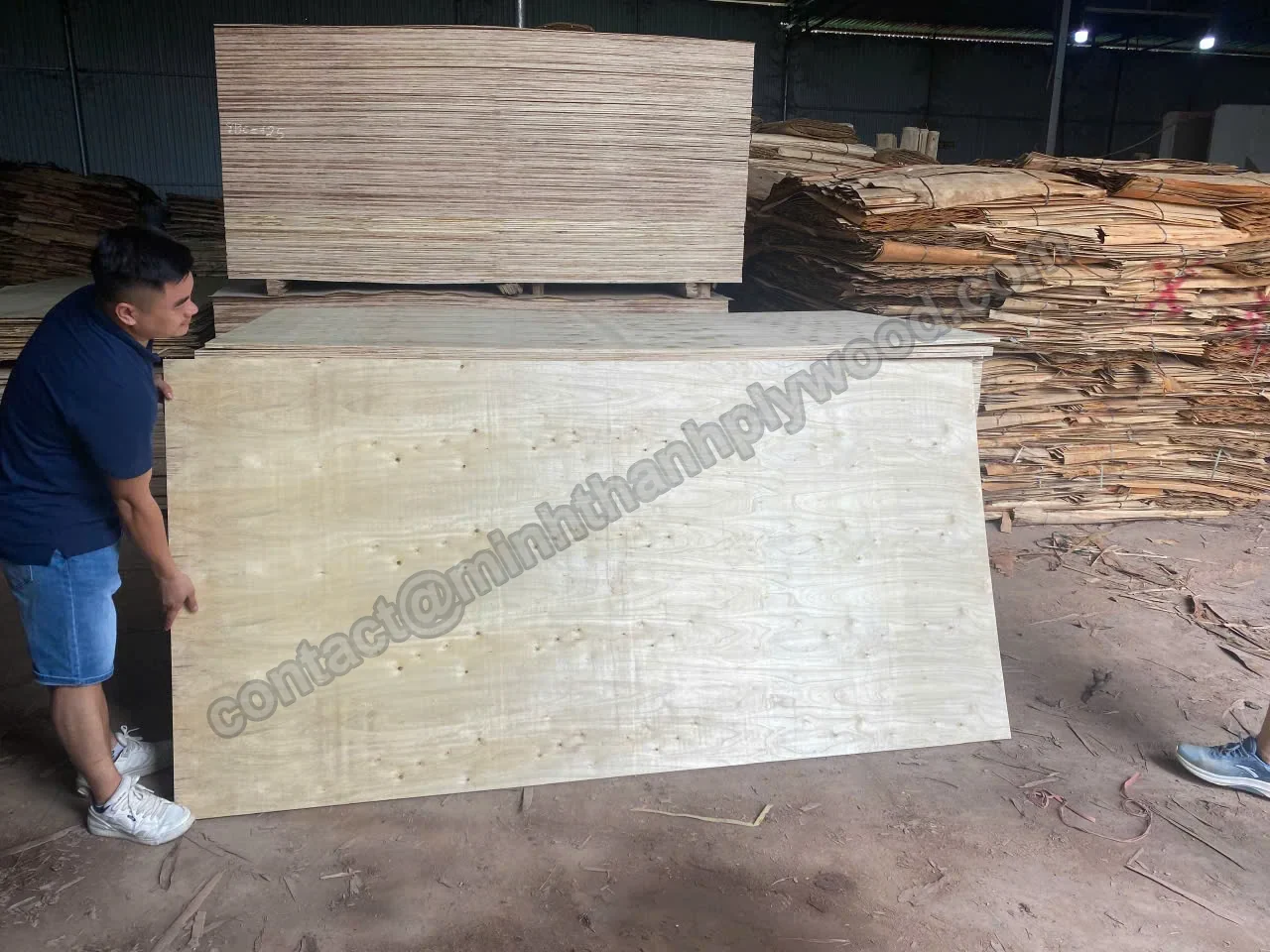
How should buyers compare quotations and approve alternatives?
Compare quotations on the same accepted specification, and approve alternatives through a requirement-versus-offer schedule. A price difference between panels with different specifications does not measure a face-grade saving.
Keep the core, bond, dimensions, preparation, required marks and delivery term fixed for the comparison. Then evaluate the appearance choice by usable cutting yield and finishing effort. A utility face can be economical on hidden parts; a better selected face can reduce work on visible parts.
If a supplier proposes an alternative core or format, update the handling and cutting assumptions. For shipment planning, calculate panel mass from dimensions and offered density, add packaging, and apply the booking allowance. The packing calculator supports the final accepted construction.
For structural alternatives, the project reviewer should approve the product evidence and application. A supplier’s appearance sample can be assessed at the same time. Keep the two decisions visible so a passed coating trial is not mistaken for structural acceptance.
Minh Thanh’s standard MOQ is one 40HC, with mixed specifications by agreement. Production takes 15–45 days after the deposit. Quote comparisons should use the same destination and FOB Hai Phong, CFR or CIF basis, with production time distinguished from transit.
What should an exterior plywood RFQ contain?
An exterior plywood RFQ should specify the finished application and every attribute needed to approve and inspect the panel. Use this list and we quote the matching build.
- Application: hidden sheathing, visible exterior component, covered stair component or another defined use; attach required design evidence for structural work.
- Appearance: face/back pair, grading convention, visible sides, representative repairs and intended finish.
- Construction: offered core and layup, including any proposed alternatives.
- Service and bond: required classification, resin system, named performance requirement and matching test evidence.
- Dimensions: actual thickness, required category where applicable, sheet format, tolerance and edge profile.
- Approval: sample reference, required product documents, inspection plan and disposition procedure.
- Shipment: quantity, protected labelled packs, destination port and delivery term.
Ask for free samples with the enquiry and identify the interface they must demonstrate. For a visible part, include the coating trial. For structural sheathing, include the required product mark and design schedule. For mixed specifications, identify each separately in the packing plan.
*Supplied directly or through qualified partner mills.
Send the schedule through the quotation contact page or email [email protected]. Lisa handles international sales on WhatsApp, ref MT-exterior-grades. We reply within hours.
Buyer questions, answered
What are the main grades of exterior plywood?
Face/back appearance pairs such as A/C, B/C and utility C/D describe the veneer surfaces, and the bond class (Exterior or Exposure 1) sets the weather exposure. Pick the pair for the visible use and the bond for the exposure. Minh Thanh exterior panels are C/D with phenolic WBP or melamine-fortified glue.
Is AC plywood always exterior plywood?
No. A/C names the face and back; the Exterior bond class is a separate mark. Ask for both on the quotation: the A/C pair for appearance and Exterior for the glue line.
What should I compare in AC plywood vs BC plywood?
Compare the face: A is smooth and paintable with neat repairs, B is solid with small repairs and tight knots up to 1 inch. Keep the C back, core, bond and thickness the same in both quotes. Pay for A when the face stays visible under paint; B is enough under an opaque coating.
Does good one side plywood mean exterior grade?
No. Good one side describes the face appearance only. Exterior grade comes from the bond class, so order the face/back pair and the Exterior bond together.
Are BB plywood and B/BB plywood the same grade?
No. BB plywood usually means BB/BB, with a BB face and a BB back. B/BB has a better B face over the same BB back. Minh Thanh quotes birch as D+/D, which compares with B/BB.
Is CDX suitable for permanent weather exposure?
No. Common CDX sheathing is Exposure 1, built for construction moisture before the building is closed in. For permanent weather exposure, order an Exterior-class panel with phenolic WBP glue.
Does phenolic glue make every plywood panel exterior grade?
No. Phenolic WBP glue gives the bond an exterior glue line; an Exterior panel also needs sound veneers without large core gaps and the class marked on the panel or test report. Minh Thanh exterior panels use phenolic WBP pressed at 130–145 °C.
Does exterior grade mean marine plywood?
No. Marine plywood follows its own named standard with gap-free cores and selected veneers. Exterior grade means an exterior bond; order marine panels by the marine standard your boatbuilder names.
How should I inspect an exterior plywood shipment?
Photograph the packs before opening, check marks against the packing list, then caliper a few sheets per pack against ±0.5 mm and ±2 mm on length and width. Compare faces with the approved C/D sample and send photos with the pack number.
What should an exterior plywood RFQ include?
Send the application, visible sides, face/back pair, core, bond (phenolic WBP or melamine-fortified), thickness, format and edge profile, quantity and destination port. Add any structural standard the project names. We reply with a quotation and free samples.