
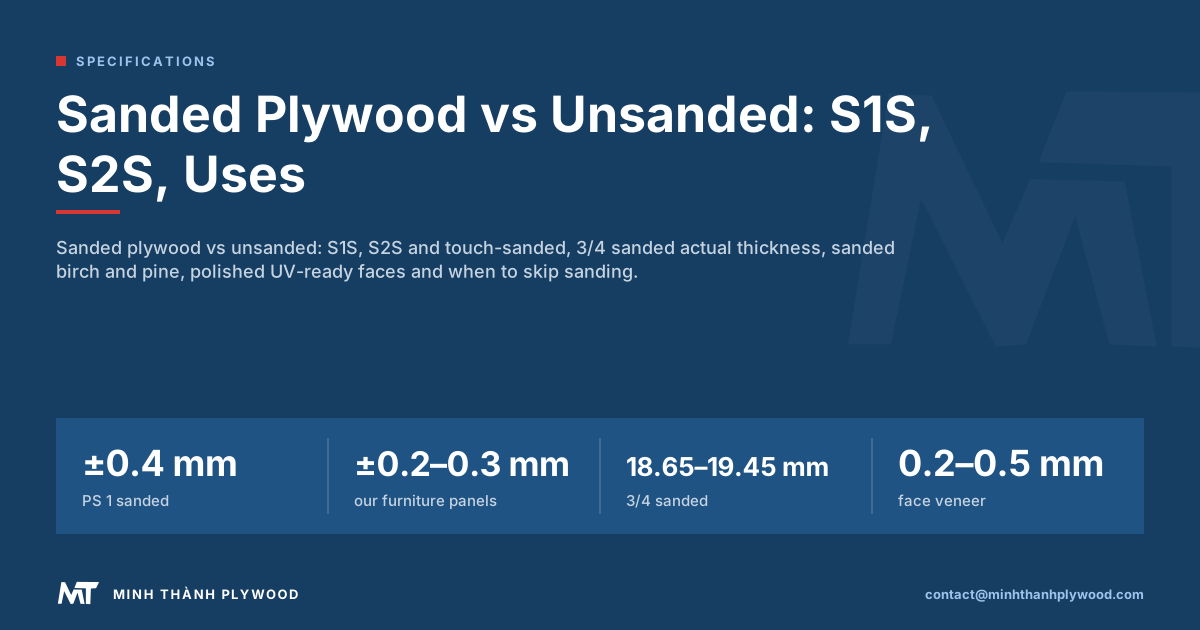
Sanded plywood is plywood whose faces have been machine-sanded to a smooth, even thickness, ready for paint, lacquer or laminate. Unsanded plywood keeps the rougher pressed surface and a wider thickness tolerance. Buy sanded for anything seen or finished, unsanded for sheathing, packing and hidden structure. Minh Thanh Plywood sands and polishes every furniture panel.
What is sanded plywood?
Sanded plywood is plywood whose outer veneers have been sanded by machine to a smooth surface and a calibrated thickness after pressing. The sanding removes press marks, glue spots and raised grain, and it brings every sheet to the same thickness.
Sanded panels are the normal surface for furniture, cabinets, shopfitting, painted doors and anything laminated. Unsanded panels keep the surface the press left: rougher, less even and with a wider thickness tolerance.
There are three surface levels in the trade:
- Sanded (S2S or S1S): full sanding of both sides or of the face only.
- Touch-sanded: a light sizing pass to bring the panel to thickness, with skips allowed.
- Unsanded: no sanding at all.
Sanded vs unsanded plywood: comparison
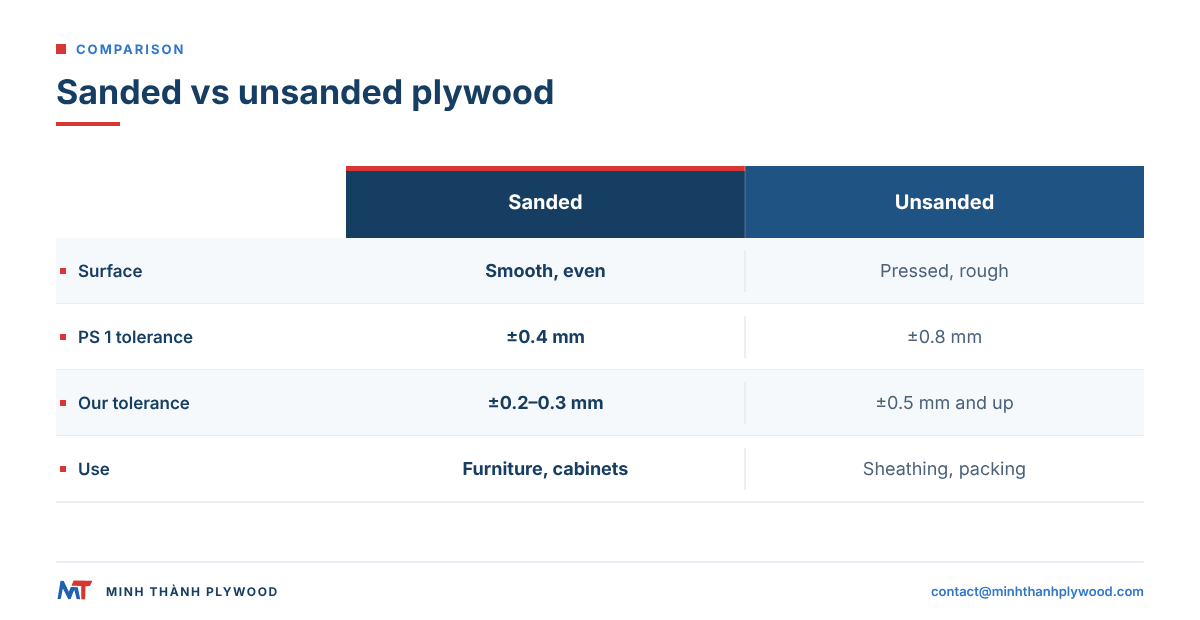
Sanded plywood wins wherever the surface is seen or finished; unsanded wins where it is hidden and cost per sheet matters. This table compares them metric by metric.
| Metric | Sanded plywood | Unsanded plywood |
|---|---|---|
| Surface | Smooth, even, ready to finish | Press texture, raised grain, glue spots |
| Thickness tolerance (PS 1-22, 3/4 and thinner) | ±0.4 mm (1/64 in) | ±0.8 mm (1/32 in) |
| Our tolerance | ±0.2–0.3 mm on sanded furniture panels | ±0.5 mm commercial, ±0.5–1.0 mm packing |
| Face grades | N, A, B, C plugged | C, D |
| Finish | Paint, lacquer, stain, UV coat, laminate | None, or rough paint |
| Typical uses | Cabinets, furniture, doors, shelving | Sheathing, subfloor, crates, pallets |
| Price | Higher | Lower |
Verdict by use:
- Furniture and cabinets: sanded two sides.
- Painted joinery with one hidden side: sanded one side.
- Underlayment for vinyl or tile: touch-sanded.
- Sheathing, packing and pallets: unsanded.
The thickness rows matter most. A ±0.8 mm sheet can be 1.6 mm thicker than its neighbour in the same pack; a ±0.2 mm sheet keeps grooves, hinges and edge banding in line.
What sanded plywood sizes and species do Canadian buyers see?
Canadian shelves carry sanded plywood in 4 × 8 ft sheets from 1/4 to 3/4 inch, plus 2 × 2 ft, 2 × 4 ft and 4 × 4 ft handy panels. Home Depot Canada lists species by brand: aspen from Columbia Forest Products, ACX pine from Metrie, G1S fir from RICHPLY and handy panels from Alexandria Moulding.
| Nominal | Actual or metric | Common species and brand | Sheet formats |
|---|---|---|---|
| 1/4 inch | 6 mm | Fir G1S, pine, aspen, birch | 4 × 8 ft, 2 × 4 ft handy panel |
| 3/8 inch | 11/32 inch, about 8.7 mm (9 mm metric) | Fir G1S, sanded or beaded pine | 4 × 8 ft |
| 1/2 inch | 11 to 12 mm | Fir G1S, pine ACX, aspen | 4 × 8 ft, 2 × 4 ft |
| 5/8 inch | 19/32 inch, 14 to 15 mm | Fir G1S, sanded pine | 4 × 8 ft |
| 23/32 inch | 18.3 mm | Fir G1S | 4 × 8 ft |
| 3/4 inch | 19 mm | Pine ACX, aspen | 4 × 8 ft, 2 × 2 ft handy panel |
Two retail terms matter. G1S means good one side, the same as S1S: one face sanded, the other left rough. ACX means an A face, a C back and an exterior bond. A “3/8 inch” sheet is really 11/32 inch, which is why the 3/8 listings are labelled both ways.
For an importer, the mill price sits well below the shelf. Commercial plywood starts from US$250/m³ FOB, which is about US$13.4 for an 18 mm 1220 × 2440 mm sheet before freight, duty and margin (0.0536 m³ × US$250). Sanded furniture grade is quoted by face and core. Minh Thanh holds CARB P2 / TSCA Title VI certification (ICTT mill no. 23024), sands furniture panels to ±0.2 to 0.3 mm, and quotes retail-labelled packs for Canadian distributors.
What do S1S, S2S and touch-sanded mean?
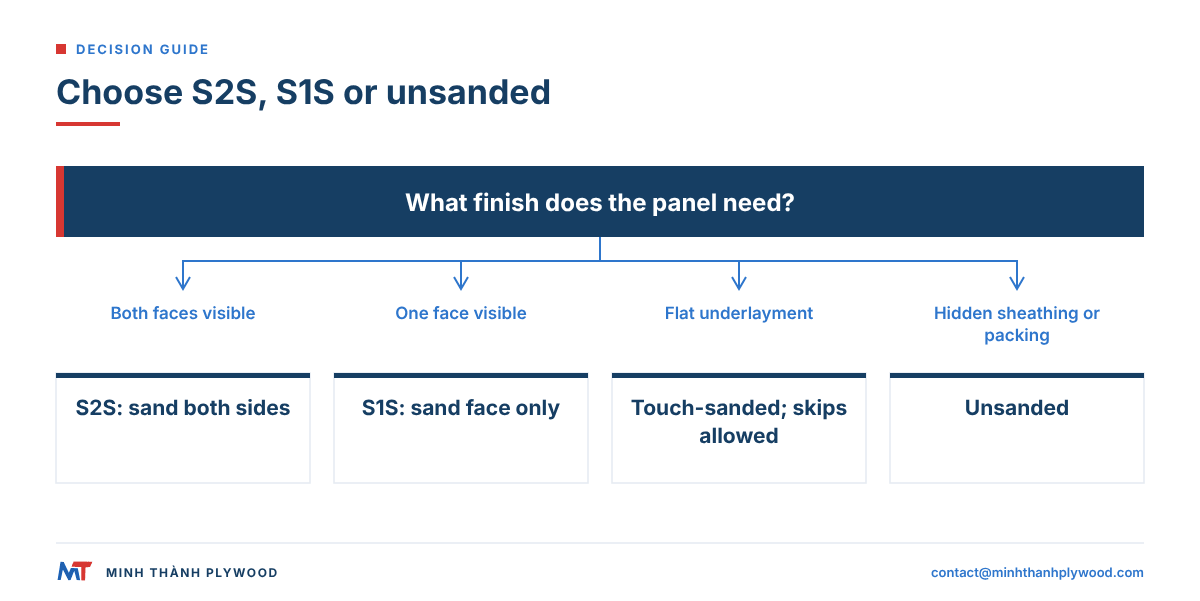
S1S means sanded one side, S2S sanded two sides, and touch-sanded means lightly sanded to size only. The code goes on the order next to the face/back grade.
| Code | What is sanded | Surface | Typical grade pairs |
|---|---|---|---|
| S2S | Face and back | Smooth both sides | A/A, A/B, B/B, D+/D birch |
| S1S | Face only | Smooth face, rougher back | A/C, B/C |
| Touch-sanded | Light pass, both sides | Even thickness, skips allowed | C plugged/D underlayment |
| Unsanded | Nothing | As pressed | C/D, CDX sheathing |
The US standard PS 1-22, published by NIST on 2 October 2023, sets the default: “Unless otherwise specified, sanded plywood shall be sanded on two sides.” It defines touch-sanding as “a light surface sanding to thickness dimension” in which “sander skips to any degree are admissible”. That is why touch-sanded underlayment is flat but not a finish surface.
How is plywood sanded at the mill?
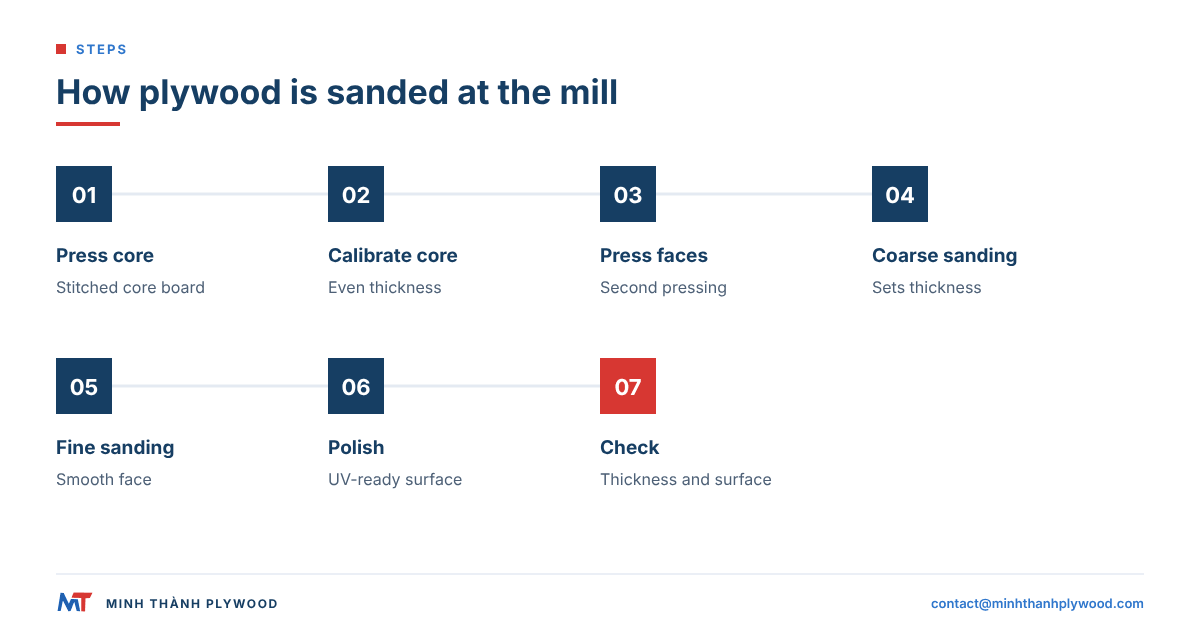
A mill sands plywood in two jobs: calibration, which sets the thickness, and finish sanding, which sets the surface. At our factory in Ha Hoa, Phu Tho, a furniture panel goes through these steps.
- Core pressing. The stitched core board is pressed once.
- Core calibration. The core is sanded to an even thickness before any face goes on.
- Face pressing. Face and back veneers are pressed onto the calibrated core. Double pressing is standard on our furniture-grade panels.
- Calibrating sanding. Wide-belt heads with coarse grit bring the finished panel to its thickness.
- Finish sanding. Finer grit heads take out the marks of the coarse belt and leave a smooth face.
- Polishing. A last fine pass gives the polished, UV-ready surface.
- Checking. Panels are checked for thickness and surface against the order before packing.
Calibrating the core first means the finish sander removes very little face veneer. Face veneers are only about 0.2–0.5 mm thick, so a mill that tries to sand an uneven panel flat after pressing sands through the face in the high spots.
What is the actual thickness of 3/4 sanded plywood?
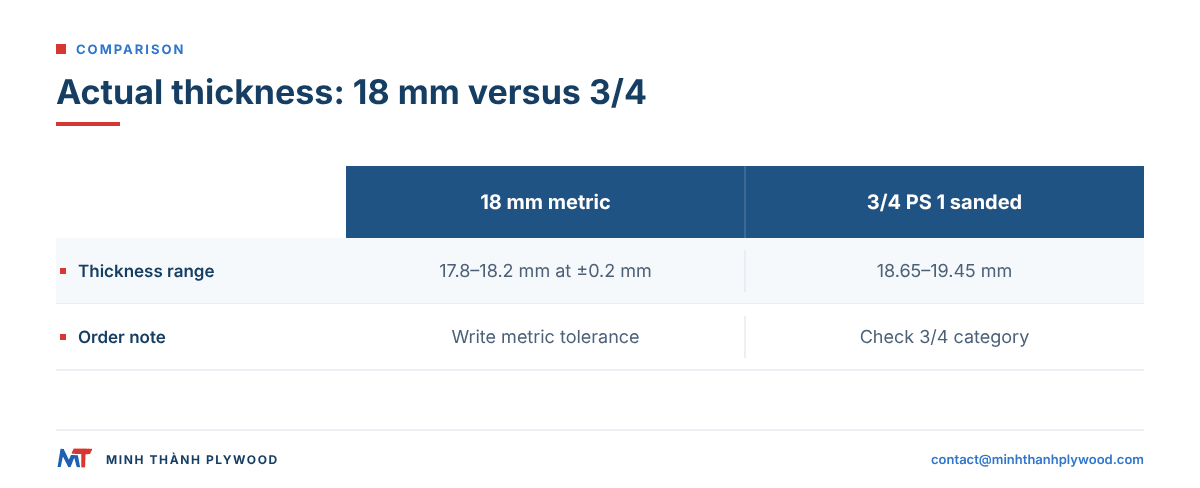
Under PS 1-22, sanded 3/4 Performance Category plywood must measure between 18.65 and 19.45 mm. Many imported panels sold as “3/4” are really 18 mm metric sheets, which fall in the 23/32 category instead. An inch converts to metric at exactly 25.4 mm (NIST).
| Nominal | PS 1 sanded minimum | PS 1 sanded maximum | Metric panel it matches |
|---|---|---|---|
| 1/4 | 5.95 mm | 6.75 mm | 6 mm |
| 11/32 | 8.33 mm | 9.13 mm | 9 mm (sold as 3/8) |
| 15/32 | 11.51 mm | 12.30 mm | 12 mm |
| 19/32 | 14.68 mm | 15.48 mm | 15 mm (sold as 5/8) |
| 23/32 | 17.86 mm | 18.65 mm | 18 mm |
| 3/4 | 18.65 mm | 19.45 mm | 19 mm |
PS 1 measures thickness as the average of four readings, one at mid-length of each edge, at 9% moisture content. Our sanded furniture panels are made to ±0.2–0.3 mm on the nominal metric thickness, and down to ±0.2 mm on order, so an 18 mm panel is 17.8–18.2 mm at the tightest. When a drawing says 3/4, write the metric thickness and tolerance you need. Our plywood thickness guide gives every common size.
Sanded plywood for cabinets: what to order
For cabinets, order S2S plywood with a face that suits your finish, a closed core and a tight tolerance. The surface is only as good as the core under it.
| Cabinet part | Face/back | Sanding | Why |
|---|---|---|---|
| Carcass sides, visible inside | A/B poplar or D/E birch | S2S | Inside faces show when doors open |
| Painted doors and panels | B/B | S2S, polished | Paint shows every sanding mark |
| Shelves | A/A | S2S | Both sides seen |
| Backs | B/B, 6–9 mm | S2S | Flat for grooves |
| Laminated or HPL work | B/B | S2S, calibrated | Laminate shows any dip in the core |
Add the bond and emission line. The US limit for veneer-core hardwood plywood is 0.05 ppm under 40 CFR 770.10. UF glue at E0 emission is standard on our furniture panels, with CARB P2 / TSCA Title VI certification as ICTT mill no. 23024. For the kitchen side, see our plywood for kitchen cabinets guide.
Sanded birch plywood
Sanded birch plywood is the cabinet and furniture panel of choice for clear finishes, because birch has a fine, even grain that sands to a smooth, pale surface. It is almost always sold S2S.
Two products share the name:
- All-birch (Baltic) plywood: birch faces and birch plies throughout, graded B, BB, CP, C.
- Birch-faced plywood: an imported birch face on another core. Ours is pressed on white Styrax or Eucalyptus cores and graded D+, D and E; D+/D is comparable to B/BB.
Both are sanded the same way. The difference shows on the edge and in the weight: a Styrax core is lighter, at about 500 kg/m³ against 650 kg/m³ for Eucalyptus. Our birch plywood page has the full specification.
Sanded pine plywood
Sanded pine plywood has pine face veneers sanded smooth for paint or stain, and it is the usual “sanded plywood” on shelves in North America. Its knots and strong grain make it a paint-grade or rustic panel more than a clear-finish one.
- Grades: at Minh Thanh, pine faces are quoted as A/A, A/B and B/B, and B/C for utility parts, comparable to the European softwood classes I to IV and the US A to D grades.
- Sanding: pine’s soft earlywood sands faster than its hard latewood, so a light final pass matters to avoid a ribbed surface.
- Uses: painted furniture, shelving, wall panelling, DIY and retail packs.
For a full grade guide on the common pine pair, see BC plywood, and for the panel itself, our pine plywood page.
Is bintangor plywood available sanded on both sides?
Yes. Bintangor plywood from Minh Thanh is sanded and polished on both sides, the same S2S finish as our birch, poplar and okoume panels. At Minh Thanh, both faces of our furniture panels are sanded and polished to UV-ready standard: smooth and even enough for the customer to apply their own UV coating line.
What does UV-ready polished plywood mean?
Polished plywood has sanded faces finished with a last fine pass, so the surface takes lacquer or UV coating with less filler and fewer coats. It is a surface level above standard sanding, not a coating. We do not apply the UV coat ourselves; the customer’s line does, to their own colour and gloss.
Polished faces help most on:
- UV roller coating lines, where the coat is thin and any sanding mark shows.
- Clear lacquer, where the face is seen through the finish.
- Thin papers and foils, which telegraph every scratch underneath.
Sanded vs sande plywood
Sanded and sande are different things that sound alike. Sanded is a surface finish; sande is a timber species.
- Sande (Brosimum utile) is a tropical hardwood from Central and South America, used as a face veneer on a low-cost paint-grade plywood sold mainly in the US.
- Sanded describes any plywood whose faces have been sanded, whatever the species.
So sande plywood is usually sanded, but sanded plywood is rarely sande. If a quotation says “sande”, ask for the face species; if it says “sanded”, ask whether it means S1S or S2S. We compare the two face options in sande plywood vs birch.
When is unsanded plywood the right choice?
Unsanded plywood is right wherever the surface is hidden and the panel’s job is strength, cover or protection. Paying for sanding there buys nothing.
| Use | Why unsanded works |
|---|---|
| Roof and wall sheathing | Covered by roofing, cladding or render |
| Subfloor under other flooring | Covered; touch-sanded underlayment goes on top where needed |
| Crates, pallets and packing | Strength and cost matter, not looks |
| Concrete form cores | The face is covered by the film or overlay |
| Temporary hoarding | Short life, painted rough |
Our packing plywood is made to ±0.5–1.0 mm and our commercial plywood to ±0.5 mm, both without full sanding unless ordered. See our packing plywood page for the crate and pallet specifications.
Can you sand plywood yourself?
Yes, lightly. A sanded panel only needs a fine pass before finishing, and a rough one can be smoothed, but the face veneer is thin, so heavy sanding goes through it.
- Start fine. Begin at P120–P150 on a factory-sanded panel; never start coarse.
- Use a random-orbit sander with light pressure, moving with the grain at the end.
- Watch the edges. The face is thinnest where it meets the edge; one extra pass shows the glue line.
- Stop at colour change. If the face goes darker or patchy, the next ply is close.
- Remove dust before finishing, especially on open-grain faces.
A face that needs heavy sanding to look right was the wrong grade or the wrong surface to buy. Order it sanded and polished from the mill instead.
How to check sanded plywood on arrival
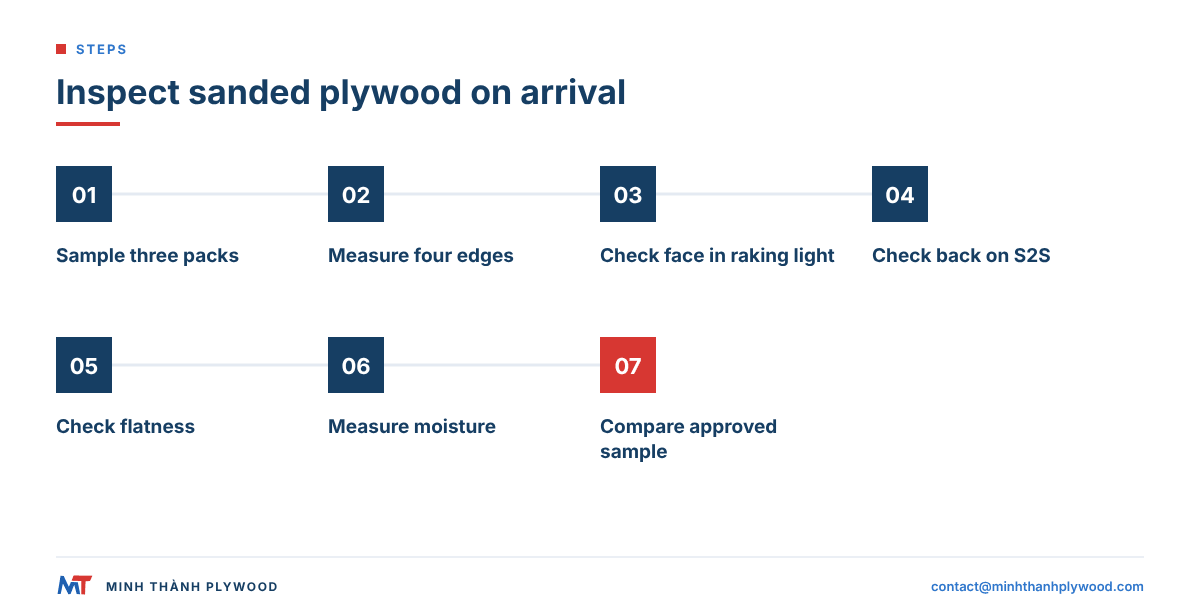
Check sanded plywood for thickness, surface and flatness in the first hour after unpacking, before any panel is cut. Take sheets from at least three packs.
- Thickness: measure with a caliper at four points, one mid-length on each edge, and average them.
- Surface: look along the face under raking light for chatter marks, belt lines, burn marks and sand-through.
- Both sides: on S2S, turn the sheet and check the back with the same light.
- Flatness: lay the sheet on a flat bench and check corners and middle.
- Moisture: our panels leave the factory at 8–12% moisture content; a much higher reading points to storage on the way.
- Sample: compare with the approved sample under the same light.
Record readings and photos with the pack label in the frame. Every shipment from us is photographed and filmed before loading, so both sides start from the same record.
How to order sanded plywood
Write the sanding level next to the grade, then the thickness tolerance, so the supplier cannot ship a lighter finish. Put this on the purchase order:
[Furniture] plywood, face/back [birch D+/D] to signed sample, sanded [S2S, polished, UV-ready], core [Styrax, stitched], glue [UF at E0 emission, CARB P2], [18] mm ± [0.2] mm, [1220 × 2440] mm, moisture 8–12%, [quantity] sheets, [port].
We reply within hours and send free samples sanded to the same specification. Send your line through our furniture plywood page.
Buyer questions, answered
What is sanded plywood?
Sanded plywood is plywood whose face and back have been sanded by a wide-belt machine to a smooth surface and an even thickness. It is the standard surface for furniture, cabinets and painted work.
What is the difference between sanded and unsanded plywood?
Sanded plywood has smooth faces and a tight thickness tolerance; unsanded plywood keeps the pressed surface, rougher grain and a wider tolerance. Sanded costs more and is used where the surface is seen or finished.
What does S2S mean on plywood?
S2S means sanded two sides: face and back are both sanded. S1S means only the face is sanded. Under the US standard PS 1-22, sanded plywood is sanded on two sides unless the order says otherwise.
What is the actual thickness of 3/4 sanded plywood?
Under PS 1-22, a sanded 3/4 Performance Category panel measures 18.65 to 19.45 mm. Many imports sold as 3/4 are 18 mm metric panels, which match the 23/32 category instead.
Is sande plywood the same as sanded plywood?
No. Sande is a tropical hardwood species used for a face veneer; sanded describes a surface finish. Sande plywood is sanded, but so are birch, poplar and pine panels.
Can you sand plywood smooth yourself?
Yes, lightly. Face veneers are only about 0.2–0.5 mm thick, so use fine grit, a random-orbit sander and light pressure, and stop before the glue line or the next ply shows.
Is sanded plywood good for cabinets?
Yes. Sanded two sides with A/B or B/B faces, a stitched core and UF glue at E0 emission is the usual cabinet specification, because doors, hinges and edge banding need a flat, even panel.
When should I buy unsanded plywood?
For roof and wall sheathing, subfloors under other flooring, crates, pallets and packing, where the surface is hidden and the wider thickness tolerance does not matter.
What is polished plywood?
Polished plywood has faces sanded with a final fine pass so the surface is smoother and more even. It takes lacquer and UV coating with fewer coats and less filler.
Is bintangor plywood available sanded on both sides?
Yes. Bintangor faces are pressed on our furniture cores and sanded and polished on both sides, the same S2S finish as our birch, poplar and okoume panels.
Is touch-sanded plywood smooth?
Not fully. Touch-sanding is a light sizing pass to bring the panel to thickness; sander skips are allowed, so it is used for underlayment and flooring bases, not for finished faces.