
Verifying a Vietnamese plywood factory takes four checks before the deposit: the company and its certificates in official registers, the production floor on a live video call you lead, a sample you test yourself, and the documents for your first container. Minh Thanh Plywood, a manufacturer in Ha Hoa, Phu Tho, welcomes all four.
How to verify a plywood factory in Vietnam: what are you proving?
Verifying a plywood factory means proving three things before money moves: that the company you pay is the company that makes the panels, that its production can hold your specification, and that its documents are real. Each needs its own check, because a good website, a good sample or a good price proves none of them.
The sequence that works for importers is short and cheap: check the registers, run a live video audit, test a sample, then confirm the paperwork for the first container. A third-party audit is worth adding for a large first order or a new product line. Done in this order, you spend money only after the free checks pass.
Step 1: check the company and its certificates in official registers
Start at your desk, with the documents the supplier sends:
- Business registration. Look the company up by its tax code on Vietnam’s National Business Registration Portal (checked October 2026). The registered business lines should include wood or plywood production, not only trading.
- Bank account name. The proforma invoice must name a bank account held by the same company as the registration. A different name is the most common sign of a broker or a fraud.
- Certificates with numbers. Every real certificate has an issuer and a number you can check with that issuer. For formaldehyde, a CARB P2 / TSCA Title VI certificate names its third-party certifier and the mill number; the California Air Resources Board lists approved certifiers. For ISO 9001, the certification body confirms the certificate number.
- Test reports. A real report names the laboratory, the report number, the test method, the sample and the date.
- CE marking, if your order needs it. For structural plywood under assessment system 2+, the Declaration of Performance names a notified body; check its number in the EU notified bodies database (checked October 2026).
Minh Thanh’s numbers for you to check: CARB P2 / TSCA Title VI, ICTT mill no. 23024; ISO 9001:2015, KAC25/0185; TCVN 11902:2017, VietCert 141.1-VNC-HC; six ASTM D6007 chamber reports, three from Shanghai Hongjun (HJ-QAT-250597, HJ-QAT-251303, HJ-QAT-261036) and three from ICTT Vietnam (ICTTVN-QAT-250841, ICTTVN-QAT-251173, ICTTVN-QAT-260272).
Step 2: run a live video audit that you lead
A recorded factory video can be anyone’s. A live call where you choose where the camera points shows the operations you request; check who operates the site as well as the company details. Book an hour, ask for one person to walk with a phone, and follow this script:
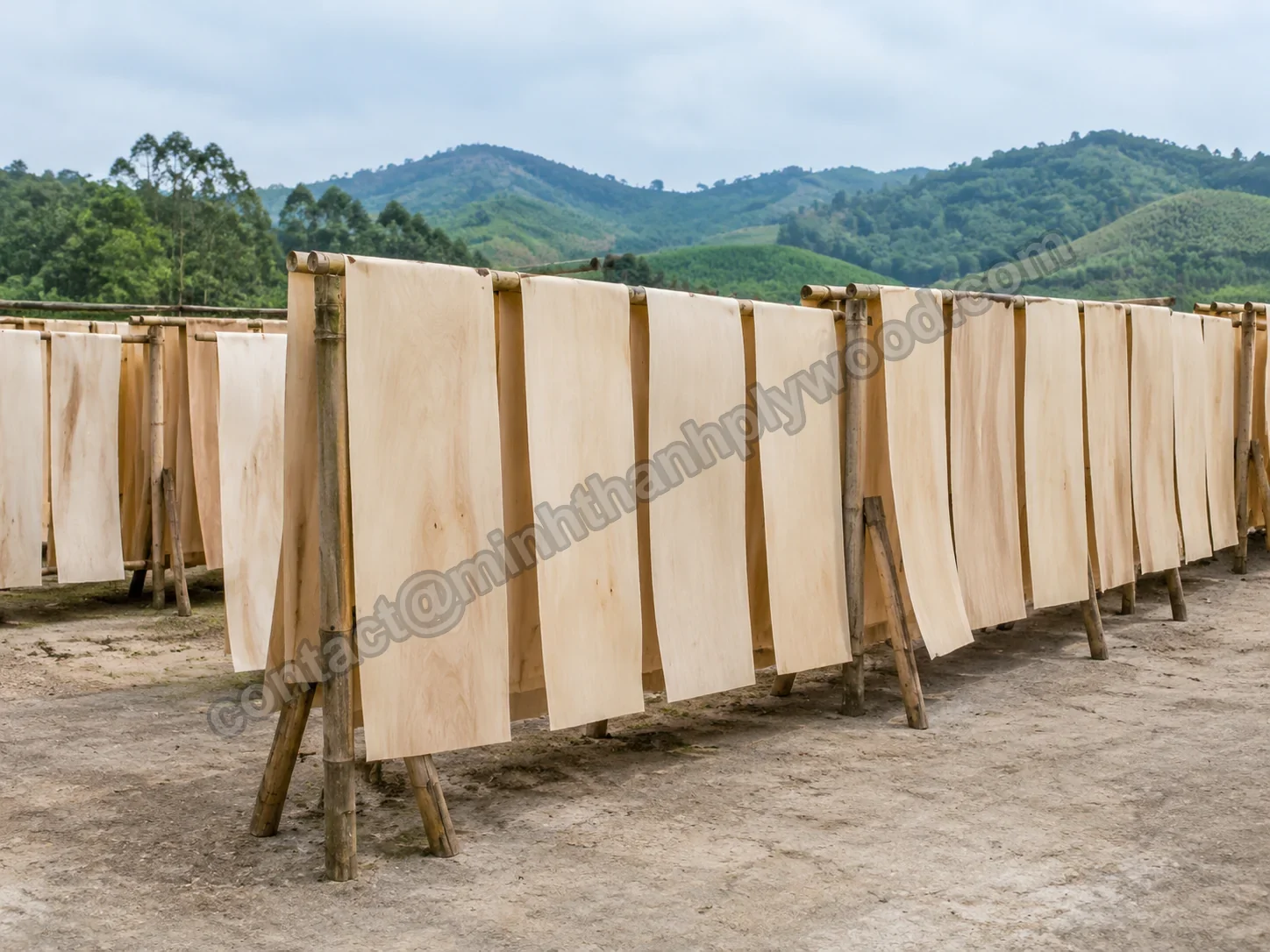
- Start outside: the gate, the log yard, the stacks of drying veneer. Ask to see today’s date on a phone screen beside the stacks.
- Walk the line in production order, without cuts.
- At each machine, ask to see the machine plate and the operator working.
- Pick two finished stacks yourself and ask for one sheet from the middle of each.
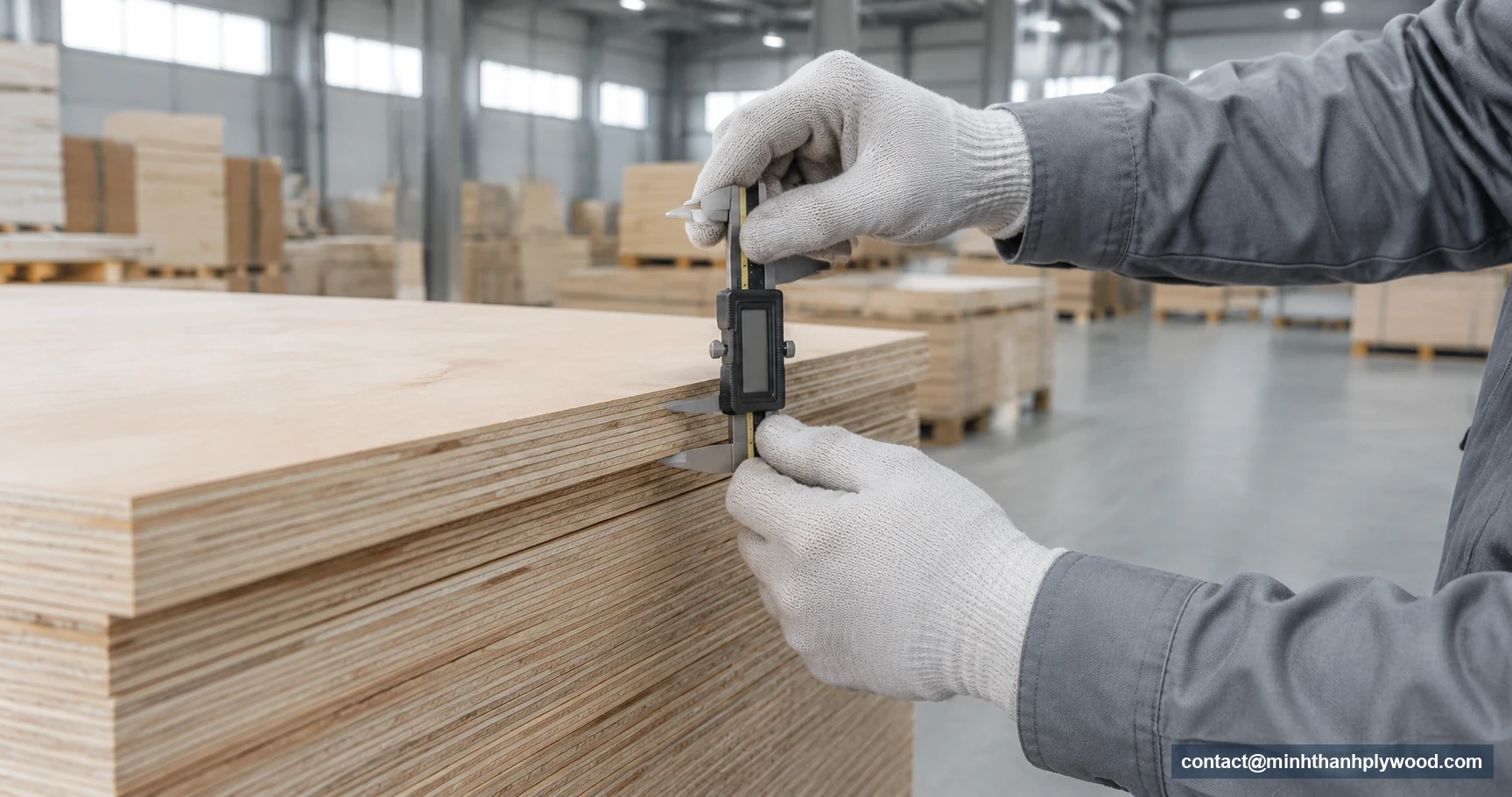
- Ask for a caliper reading at four points on each sheet, and a moisture reading.
- Ask to see the QC record for one batch, and the packing area with a container being loaded if one is.
A factory can do this on any working day; a supplier that only sends prepared videos or moves the call to a showroom is usually not the factory.
Step 3: the eight production areas to inspect
Whether on video or on site, walk the line in this order and check what matters in each area:
| Area | What to look at | What good looks like |
|---|---|---|
| 1 Log yard | Species and log size | Plantation logs of the core species quoted |
| 2 Peeling | Rotary lathes running | Continuous veneer ribbon, even thickness |
| 3 Drying | Sun or kiln drying, stacking | Veneers dried to a stated moisture, stacked off the ground |
| 4 Core lay-up | How core veneers are joined | Core joints stitched, no overlaps or gaps |
| 5 Gluing | Glue spreader, glue type in use | The resin for your order (UF at E0, MR or WBP) |
| 6 Pressing | Hot press, cycle, second pressing | Core pressed and calibrated, then faces pressed on |
| 7 Sanding | Wide-belt sanders, calibration | Even faces, thickness checked after sanding |
| 8 QC and packing | Measurement, grading, export packs | Caliper and moisture readings recorded, panels graded against samples |
Two areas tell you most about furniture-grade quality. Core lay-up: Minh Thanh stitches core layers horizontally and vertically, so no core joint opens or overlaps under the face. Pressing: furniture-grade panels are pressed twice as standard, the core board first, pressed and calibrated, then face and back. That is what holds a sanded panel to ±0.2–0.3 mm.
Step 4: test a sample yourself
Ask for samples of the exact specification you will order: face, core, glue, thickness. At Minh Thanh samples are free. When they arrive:
- Thickness with a caliper at four points, 50 mm in from the edge.
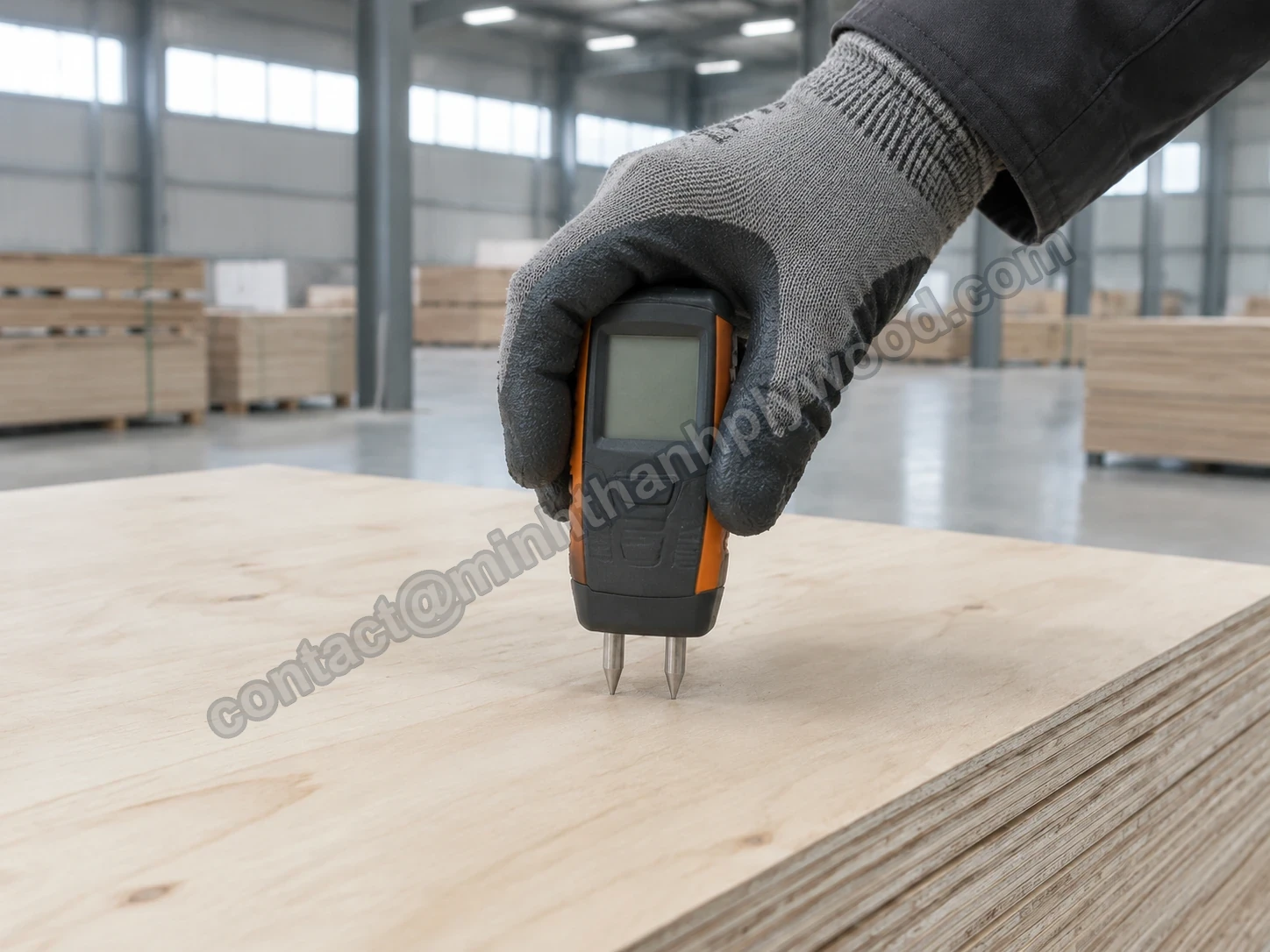
- Moisture with a pin meter: furniture panels leave the factory at 8–12 %.
- Edge: cut the sample across; look for voids, overlapping core veneers and uneven glue lines.
- Bond: use the method, specimen selection and acceptance criteria agreed for the ordered bond.
- Face: compare under the light your customers will use; this sample becomes the approved sample that fixes the look of the order.
- Emission: for a market with a limit, send the sample to a lab, or ask for SGS testing to your method (for example EN 717-1), which we arrange on request.
Step 5: book a third-party audit or inspection
For a large first order, a new product line or a new market, add an independent inspector. SGS, Bureau Veritas, Intertek and other inspection companies in Vietnam offer two useful services:
| Service | When | What you get |
|---|---|---|
| Factory audit | Before the first order | Report on capacity, equipment, quality system and legal status |
| Pre-shipment inspection | When production is finished, before loading | Sampled check of thickness, size, grade, moisture, packing and quantity against your order |
The inspector checks what your checklist asks, so write it from your order line: thickness and tolerance, face grade against the approved sample, moisture range, pack count, marking. A pre-shipment inspection is the one that protects the money still unpaid.
Step 6: confirm the paperwork for the first container
Before the deposit, agree in writing what documents come with the shipment. For Minh Thanh orders they are:
- Commercial invoice, packing list and bill of lading.
- Certificate of origin (EUR.1 for the EU), phytosanitary and fumigation certificates, and insurance with CIF.
- Certificate files on order: CARB P2 / TSCA Title VI, test reports, the EUDR compliance dossier with origin records and geolocation files, and the PPWR packaging test.
- For US orders: TSCA Title VI labels on the panels, compliance stated on the invoice and B/L, and face and core species with Vietnamese harvest origin for your Lacey Act declaration.
Every shipment is photographed and filmed before loading, and the photos and video are sent to you before the container sails.
How do you verify a supplier in Vietnam before payment?
Before any call, a few checks from your desk sort real mills from resellers:
- Map the address. Satellite and street views of a plywood mill show long roofs, a log yard, veneer drying areas and trucks. An office tower or a shop front is a trading address.
- Match the photos. Factory photos on the website, in the catalogue and on the video call should show the same buildings, machines and yard. Stock images and pictures that never repeat are a warning.
- Read the export record. Vietnamese export declarations name the exporter; trade-data services show whether the company has shipped plywood under its own name, and to which markets.
- Check the product range against the factory. A mill is built around a few product lines. A supplier that offers every product at every grade, all “made in our factory”, is usually sourcing from many.
- Ask for a reference by role and country, for example a kitchen-cabinet maker in Italy, and ask what was checked on its first container.
Ten questions for the first call
Ask them in this order; a factory answers each in one sentence, with a number where there is one:
- Which core species do you use as standard, and which on order?
- How are core veneers joined: stitched, glued or loose-laid?
- Do you press furniture panels once or twice?
- What thickness tolerance do you hold on sanded furniture panels?
- What glue and emission class is standard, and which bonds do you make to order?
- Which certificates do you hold, with their numbers?
- What moisture do panels leave the factory with?
- How many sheets of my specification go into a 40HC, and at what weight per sheet?
- What do you check before loading, and what do you send me?
- What deposit and balance terms, and how many days of production after the deposit?
For Minh Thanh the answers are: Styrax or Eucalyptus cores as standard, Acacia and Pine on order; stitched horizontally and vertically; pressed twice; ±0.2–0.3 mm, down to ±0.2 mm; UF glue at E0, with MR or WBP to your specification; CARB P2 / TSCA Title VI (ICTT mill no. 23024), ISO 9001:2015 (KAC25/0185), TCVN 11902:2017 (VietCert 141.1-VNC-HC); 8–12 % moisture; for 18 mm on a Styrax core, a board-only planning reference of 990 sheets at about 26.8 kg each, with the shipped count set from weighed packs including packaging and the booked payload (other sizes in the packing calculator); photos and video of every container; 30% deposit and 70% against the scanned B/L, 15–45 days.
What should a third-party audit report contain?
An audit report earns its fee when it answers your questions, not the inspector’s template. Ask for these sections:
| Section | What it should show |
|---|---|
| Legal identity | Registered name, tax code, address visited, matching the contract |
| Facilities | Photos of each production area, with the machines counted |
| Capacity | Presses, shifts, monthly output by product line |
| Quality system | Incoming veneer checks, in-line checks, final grading, records seen |
| Testing | Tests run in-house, external labs used, recent reports seen |
| Certificates | Numbers checked with the issuers |
| Your product | Whether the mill makes your specification as a standard line |
| Findings | Each gap with a photo and a corrective action |
Read the photos as closely as the text: they show whether the inspector walked the line or sat in the office.
What are the red flags?
- The bank account belongs to a different company from the one on the contract.
- No live video, only prepared videos or a showroom.
- Certificates without a number, or a number the issuer cannot confirm.
- Test reports with no laboratory, method or date.
- A price far below every other quote for the same specification.
- Pressure to pay the full amount before production, or a change of bank details by email.
- Vague answers on core species, glue type or tolerance.
Slow down at one red flag; stop at two.
What to do when a check fails
Match the response to what failed:
| What failed | What it usually means | What to do |
|---|---|---|
| Bank account in another name | Broker, or worse | Stop until the contract and the account name match |
| No live video, only prepared films | Trader or showroom | Ask once more for a live call; stop if refused |
| Certificate number not confirmed by the issuer | Expired, borrowed or invented | Do not rely on it; ask the issuer, not the supplier |
| Sample thickness outside the quoted tolerance | Wrong line quoted, or loose calibration | Ask for a second sample from production, measured on video |
| Sample edge shows voids or overlaps | Core laid without stitching or sorting | Ask how cores are joined; check it on the next call |
| Moisture outside the agreed range | Dispatch, transport or storage conditions need checking | Compare dispatch and receiving records with the agreed range |
Write the agreed fix into the order, so the next check measures it.
What to agree before the deposit
Put the answers from the audit into the order, so the checks become terms:
- Specification line per product: use, core, glue and emission, face and back grade, thickness and tolerance, size, packing.
- Approved sample and how the production is checked against it.
- Quantity and loading: minimum order is one 40HC, with mixed specifications by agreement.
- Payment: 30% deposit, 70% against the scanned bill of lading, or irrevocable L/C at sight.
- Lead time: 15–45 days after the deposit.
- Delivery term: FOB Hai Phong, CFR or CIF.
- Inspection right: your inspector may check before loading.
- A trial container first: one 40HC of your main specification, checked on arrival, before volume orders. See from trial order to long-term supply.
Write down the specification with the plywood RFQ checklist, and send it to contact@minhthanhplywood.com or on WhatsApp +84 988 586 601. Replies come within hours on Vietnam working days.
How Minh Thanh answers this checklist
Minh Thanh is a plywood manufacturer in Ha Hoa, Phu Tho, built for top-grade furniture and interior plywood with Europe as its main market, with a capacity of 50,000+ m³ per year. Run every step above on us: the registers, a live call you lead through all eight areas, free samples you test yourself, an inspector of your choice before loading, and the full document set for your first container. The fastest way to start is a video call: send two times that suit you, and we will walk the line with the camera wherever you point it.
Buyer questions, answered
Is EUDR compliance a certificate the mill holds?
No. EUDR compliance is shown per shipment with a due-diligence dossier: origin records and geolocation files of the plots the wood came from. Minh Thanh supplies that dossier with orders.
How do I know a Vietnamese plywood supplier is really a factory?
Ask for a live video call that you lead, starting at the log yard and ending at the press, with the camera turned on the machine plates and the stacks you name. A live tour shows production capability; match the site's operator to the registered company on your contract.
Which documents should I ask for before paying a deposit?
The business registration with its tax code, certificates with numbers you can check with the issuer (for example CARB P2 / TSCA Title VI, ISO 9001), recent test reports with lab names and dates, a proforma invoice naming the bank account of the same company, and the packing and quality terms.
Can I check a CARB P2 certificate myself?
Yes. A CARB P2 / TSCA Title VI certificate names the third-party certifier and the mill number; the certifier confirms whether that mill number is current. Minh Thanh's mill number is ICTT 23024.
Should I use SGS, Bureau Veritas or Intertek for a factory audit?
Any of them works. Order a factory audit or a pre-shipment inspection with a written checklist; the inspector reports what you asked them to check, so the checklist is what decides the value of the audit.
How long does a remote video audit take?
About an hour for the eight production areas, plus time for questions. Book it during Vietnam office hours, Monday to Friday 08:00–17:00 (UTC+7).
What is a red flag when verifying a plywood supplier?
A bank account in another company's name, refusal to show production live, certificates without numbers, test reports without a lab name or date, prices far below the market, and pressure to pay the full amount before production.
Is a sample enough to verify quality?
No. A sample shows what the mill can make; a pre-shipment check shows what it made for you. Use the sample to fix the look and the specification, then check the production against it before loading.
What deposit is normal for plywood from Vietnam?
30% deposit is common, with the balance of 70% against the scanned bill of lading, or payment by irrevocable L/C at sight. Production takes 15–45 days after the deposit.
Can I visit the factory in person?
Yes. Send the dates and the people visiting; we plan the visit around production so you see the lines running, not a cleaned-up hall.
Does a CE-certified factory mean the plywood is good?
No. CE marking covers the declared performance of a construction product; it says nothing about face grade, flatness or tolerance for furniture. Judge quality by your own sample tests and a pre-shipment check against the approved sample.