
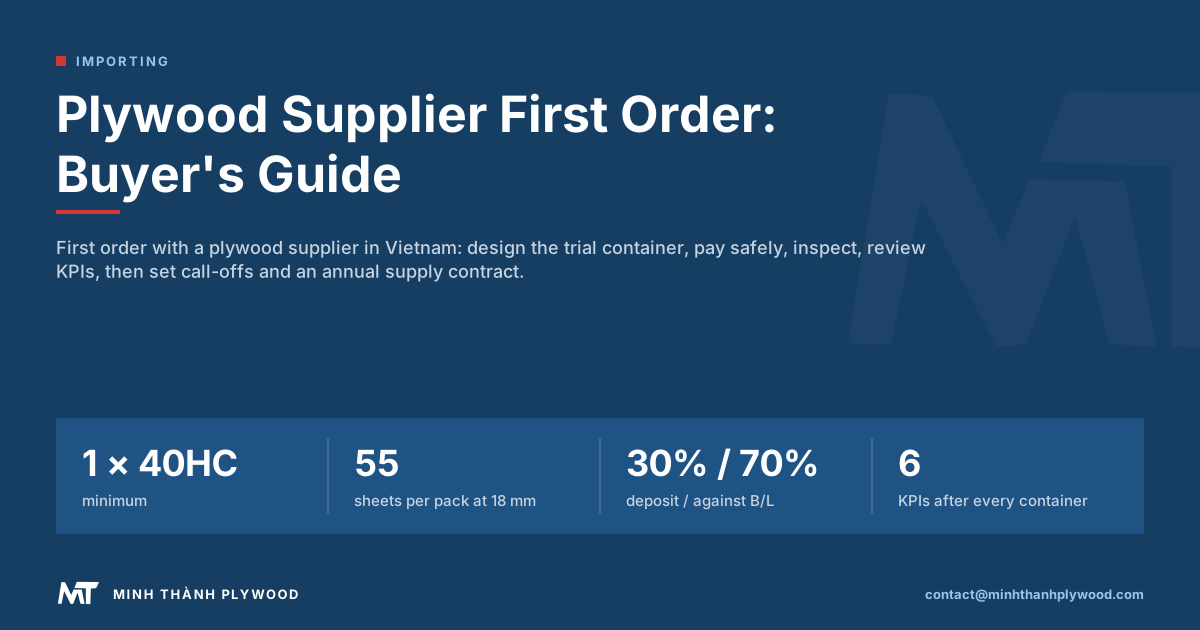
A first order with a plywood supplier should be one 40HC of the one or two specifications you buy most, paid 30% up front and 70% against the bill of lading, filmed at loading and measured on arrival. If it passes, Minh Thanh Plywood turns the approved build into monthly or quarterly call-offs under an annual agreement with clear review points.
What should a first order with a plywood supplier look like?
A first order with a plywood supplier is a test you design, not a purchase you hope goes well. It should carry the specification you buy most, be big enough to show real production and small enough to limit risk, and generate evidence at every stage.
The shape that works for most importers:
- One 40HC, the usual minimum from a Vietnamese mill.
- One to three specifications you buy every month, not a one-off product.
- An approved sample of each build, signed and kept at both ends.
- A full proforma invoice with specification, Incoterm, payment, production time and documents.
- A 30% deposit to the company account on the contract.
- Photos and video of packs and loading before the 70% balance.
- A written arrival check, measured against the sample and the packing list.
- A review meeting after arrival, with the numbers on the table.
Everything that follows in this guide hangs on that frame: how to choose who gets the first order, how to build the container, how to pay and inspect, what to measure, and how to turn a good result into long-term supply.
The aim is a supplier you can stop checking every sheet of. That takes evidence from two or three containers, collected in the same way each time.
How big should the first order be?
One 40HC is the right size for most first orders, even when your monthly need is larger. A full container shows the mill’s real production across many packs, and it caps your exposure at one container’s value while you learn how the supplier works.
Buyers who need more volume quickly can split the first month into two containers loaded a week or two apart, with the same specification. Review the first container’s pre-shipment inspection before releasing the second. If the second is to incorporate arrival findings, schedule it after the first arrival review. Buyers who need less than a container can share one with a partner, provided each line fills whole packs and one party is the consignee.
Can you recommend some Vietnamese plywood exporters for a first order?
To recommend some Vietnamese plywood exporters for a first order: lists are a starting point, and the exporters that deserve your first order are the ones that pass the same checks on paper and on video, whatever the order of the list or the price in the quote.
A supplier ready for your first order shows:
- It makes your product every week: furniture and interior, commercial and packing, or film-faced construction plywood are usually different mills.
- It is the manufacturer, or says clearly it is a trader and names the mill.
- Certificates in its own name with numbers: an emission certificate with the certifier’s mill number, test reports with laboratory, method and date.
- A free sample of the exact build you will order.
- Written terms on a proforma, with a bank account in the company’s name.
- Loading evidence: photos and video of every container.
For furniture and interior plywood, Minh Thanh Plywood meets each point. It is a manufacturer in Ha Hoa, Phu Tho, built for top-grade furniture and interior plywood with Europe as its main market, with a capacity of 50,000+ m³ per year. It holds CARB P2 / TSCA Title VI certification as ICTT mill no. 23024, sends free samples, and photographs and films every container. Ask any other exporter on your list for the same evidence and compare.
The scored version of these checks is in how to choose a plywood supplier in Vietnam.
Which type of supplier fits a trial order?
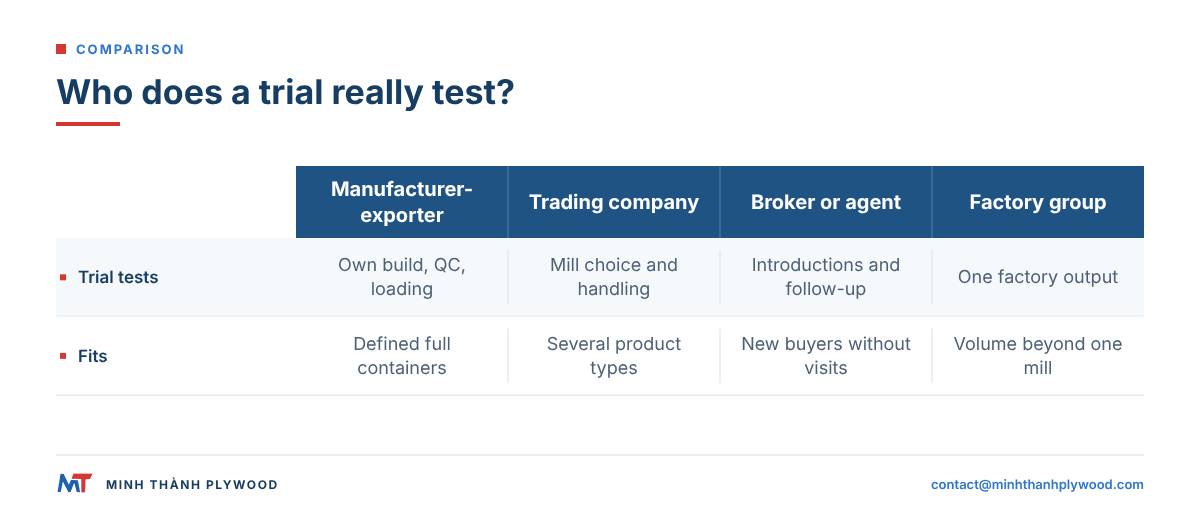
For a trial of one panel line, a manufacturer that specialises in that line is the cleanest test, because the answers come from the people who press the panels. Other supplier types fit other needs.
| Supplier type | What a trial with them tests | Fits a buyer who |
|---|---|---|
| Manufacturer-exporter | The mill’s own build, QC and loading | Buys full containers of a defined specification |
| Trading company | The trader’s choice of mill and its order handling | Needs several product types on one invoice |
| Broker or agent | Their mill introductions and follow-up | Is new to Asia and has no staff to visit |
| Group with several factories | One factory’s output, under the group’s sales team | Needs volume beyond one mill |
A trial with a trader tells you about the trader; it tells you little about the mill it may use next time. If you plan a long programme, run the trial with the company that will press the panels for that programme. The ways to tell the types apart are in factory or trading company.
Questions to ask each type before a trial
- Manufacturer: which line in the factory presses your build, how many containers of it leave each month, and who answers technical questions.
- Trader: which mill presses each line, whether that mill stays the same for repeat orders, and whose name is on the certificates.
- Broker: which mill you are buying from, who issues the invoice, and how the commission is paid.
- Group: which factory of the group makes your panels, and whether repeat orders stay in that factory.
Write the answers into the supplier file. If they change between the trial and the second order, ask why before paying.
What should you verify before placing the trial order?
Verify the company, the factory and the documents before the deposit, and keep the record in a supplier file. It takes an hour or two and removes most first-order risk.
- Registration: the company name and code on Vietnam’s National Business Registration Portal, matching the contract.
- Factory: a live video walk through veneer yard, press, sanding and packing, or a visit.
- Certificates: in the company’s own name, with numbers you can check with the certifier.
- Bank account: in the same company name; any change confirmed by phone.
- Sample: approved in writing, kept at both ends.
For an on-site check before a larger programme, the plywood factory audit checklist lists what to look at on the floor.
What should a video walk show before a first order?
A fifteen-minute video walk during working hours replaces most of a first visit. Ask the mill to show, live, the veneer yard, the dryers, core lay-up with stitching on furniture cores, the hot press with panels going in, the calibration and sanding line, grading against samples, and the packing area with strapped packs. Ask to see a sheet of your build measured with a caliper on camera.
Record the call with permission and keep it in the supplier file. It is useful evidence for your own customers and auditors as well.
How do you design the trial container?
Design the trial container around the panels you will buy every month, with enough sheets of each to judge consistency across packs. Three specifications is a sensible maximum for a first order.
A typical furniture importer’s trial might be:
| Line | Specification | Packs | Why it is in the trial |
|---|---|---|---|
| 1 | 18 mm, poplar A/B face, white Styrax core, UF glue at E0 emission, sanded, 1220 × 2440 mm | Most of the container | The core product; judged on many packs |
| 2 | 12 mm, same face and core | A few packs | Second thickness from the same build |
| 3 | 5 mm, poplar face, Styrax core | One or two packs | Backs and drawer bottoms |
Rules that keep a trial readable:
- Same build across thicknesses where you can, so differences show the mill’s consistency, not your specification changes.
- Whole packs per line: a pack holds one thickness and size.
- Enough packs of the main line to sample from the top, middle and bottom of the container.
- A note of the loading order, so you know where each pack sat.
Avoid using the trial to test five new products at once. If something differs on arrival, you want to know which build, which pack and which step caused it.
Example trial plans for three kinds of buyer
The right trial depends on what you will buy afterwards. Three common patterns:
| Buyer | Trial lines | What the trial must prove |
|---|---|---|
| Kitchen and cabinet maker | 18 mm and 15 mm sanded furniture panels on one face and core, plus a few packs of 5 mm for backs | Thickness consistency for CNC and edge-banding; face colour under the plant’s own coating |
| Distributor or merchant | Two or three of its fastest-selling thicknesses in the standard 1220 × 2440 mm or 1250 × 2500 mm size | Count accuracy, pack condition, labels that fit the warehouse system |
| Packing and crate maker | One commercial or packing build in two thicknesses | Strength for the crate design, flatness, a price that holds over volume |
A cabinet maker judges the trial in the workshop; a distributor judges it in the warehouse and in customer feedback; a crate maker judges it on the assembly line. Plan the arrival check around the place where the panels will be judged.
How many sheets per pack, and how much fits in a mixed 40HC?
A metre-high stack gives a geometric sheet-count reference: divide that height by the thickness and round down. The order’s actual pack and container quantities are capped by gross pack weight, including packaging, and the booked payload. For 1220 × 2440 mm panels:
| Thickness | Sheets per pack (height reference) | Typical use in a furniture order |
|---|---|---|
| 3 mm | 333 sheets | Drawer bottoms, backs, curved work |
| 5 mm | 200 sheets | Backs, drawer bottoms |
| 9 mm | 111 sheets | Light carcass parts, panels |
| 12 mm | 83 sheets | Carcass parts, shelves on short spans |
| 15 mm | 66 sheets | Carcasses, doors |
| 18 mm | 55 sheets | Carcasses, shelves, worktops |
| 25 mm | 40 sheets | Heavy shelves, tops |
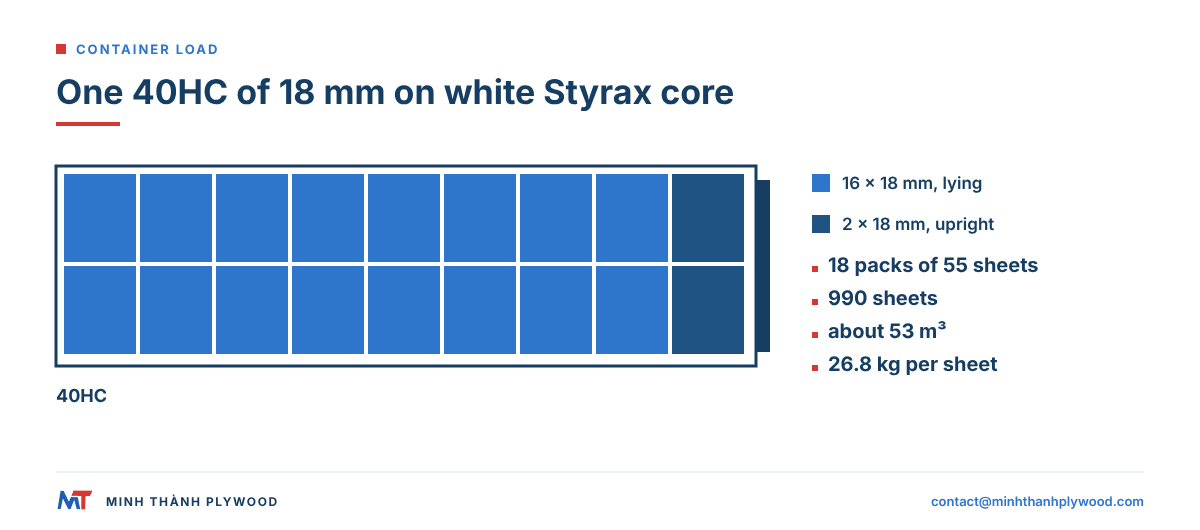
The factory’s board-only reference for 18 mm white Styrax-core panels uses 18 packs (16 lying and 2 upright), or 990 sheets and about 53 m³ at 26.8 kg per sheet. The Acacia and Eucalyptus references are 880 and 795 sheets. These planning counts use panel mass; the shipped quantity must also allow for packaging within the booking limit.
In a mixed container, each line takes whole packs and the gross weight of all completed packs, including packaging, stays within the booked payload. If your shipping line or haulier caps the box lower, for example at 26,000 kg, put it on the order; the packs plan is recalculated before loading. The container loading page explains the method.
How should you pay for a first plywood order?
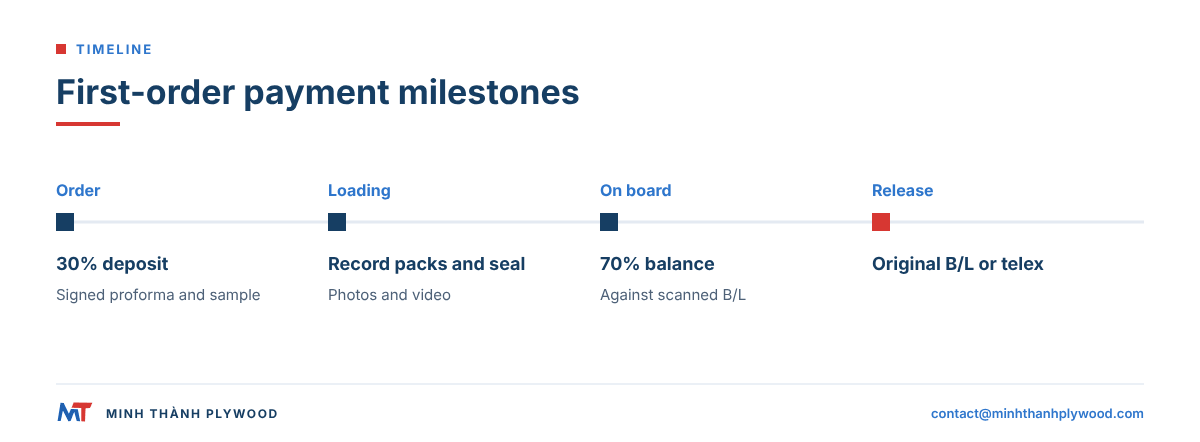
Pay the deposit to start production and the balance once the goods are on board. That is the standard structure for Vietnamese plywood, and it protects both sides on a first order.
| Stage | Payment | What you hold at that point |
|---|---|---|
| Order | 30% deposit by T/T | Signed proforma, approved sample, production slot |
| Loading | — | Photos and video of packs, container and seal |
| On board | 70% balance against the scanned B/L | B/L copy, invoice and packing list drafts |
| Release | — | Original B/L by courier, or telex release |
An irrevocable letter of credit at sight is the alternative when your bank prefers it. Every word on the invoice and B/L must then follow the L/C text, so send the draft credit to the mill before opening it.
Two rules make the payment safe. Pay only to the account named on the signed contract, in the supplier’s own company name. If the deposit goes by T/T, send the bank slip to the mill the same day and ask for written confirmation of receipt with the production date; that date is the start of the production window on your proforma. And confirm any change of bank details by phone with a person you know. Changed bank details in an email are the commonest fraud in timber trade, and they target first orders most.
What does the cash flow of a first order look like?
The cash flow of a first plywood order runs from the deposit to arrival, about six to twelve weeks to Northern Europe, with two payments and most of the money moving only once the goods are on board.
| Point in time | Money out | Evidence in hand |
|---|---|---|
| Contract signed | 30% deposit | Proforma, approved sample, production date |
| During production | — | Progress photos on request |
| Loading | — | Photos and video of packs, container and seal |
| Vessel departs | 70% balance against the scanned B/L | B/L copy, invoice and packing list |
| Arrival | Duty, port charges, broker, haulage | Released container, arrival report |
Budget the landed costs separately from the panel price: duty under your tariff line, destination terminal charges, the broker’s fee and inland haulage. Under CIF the ocean freight and insurance are inside the panel price; under FOB they are paid to your forwarder. The import guide lists every cost line.
Should you inspect before loading?
Inspect before loading when the trial carries a new specification, a large value, or a buyer of yours who wants an inspection report. Otherwise the mill’s QC records plus its loading photos and video usually give enough evidence for a first container.
What a pre-loading inspection should cover:
- Count: packs and sheets against the packing list.
- Thickness: caliper readings across sheets from several packs, against the tolerance on the order.
- Size and squareness: length, width and diagonal.
- Moisture: meter readings, against the 8–12 % range at dispatch for furniture plywood.
- Faces and edges: against the approved sample; core gaps and overlaps on the edges.
- Bond: a simple bond check where the specification calls for it.
- Packing and marks: covers, straps, corner protection, labels.
Agree the inspection company, the checks and the sampling plan on the contract, and give the mill the date in advance. Third-party testing to your method, for example formaldehyde emission to EN 717-1, is arranged through SGS on request.
At Minh Thanh, sanded furniture panels are held to a thickness tolerance down to ±0.2 mm and commercial and film-faced panels to ±0.5 mm, with ±2 mm on length and width. Those are the numbers the inspector measures against.
What sampling plan should the inspection follow?
Agree how many sheets are measured, from where, and what counts as a pass, before the inspector arrives. A sampling plan written on the contract stops arguments about method later.
A practical plan for a plywood trial:
- Packs to open: a share of the packs of each specification, spread across the production run, not only the packs nearest the door.
- Sheets per pack: top, middle and bottom sheets of each opened pack.
- Readings per sheet: thickness at the four corners and the centre; length, width and diagonal on a few sheets.
- Faces: every sampled sheet against the approved sample, under daylight or daylight-balanced lamps.
- Pass rule: every reading within the tolerance on the order; any sheet outside is recorded with its pack number.
Inspection companies offer standard sampling tables; choose the level with the inspector and write it into the contract.
What should you check when the trial container arrives?
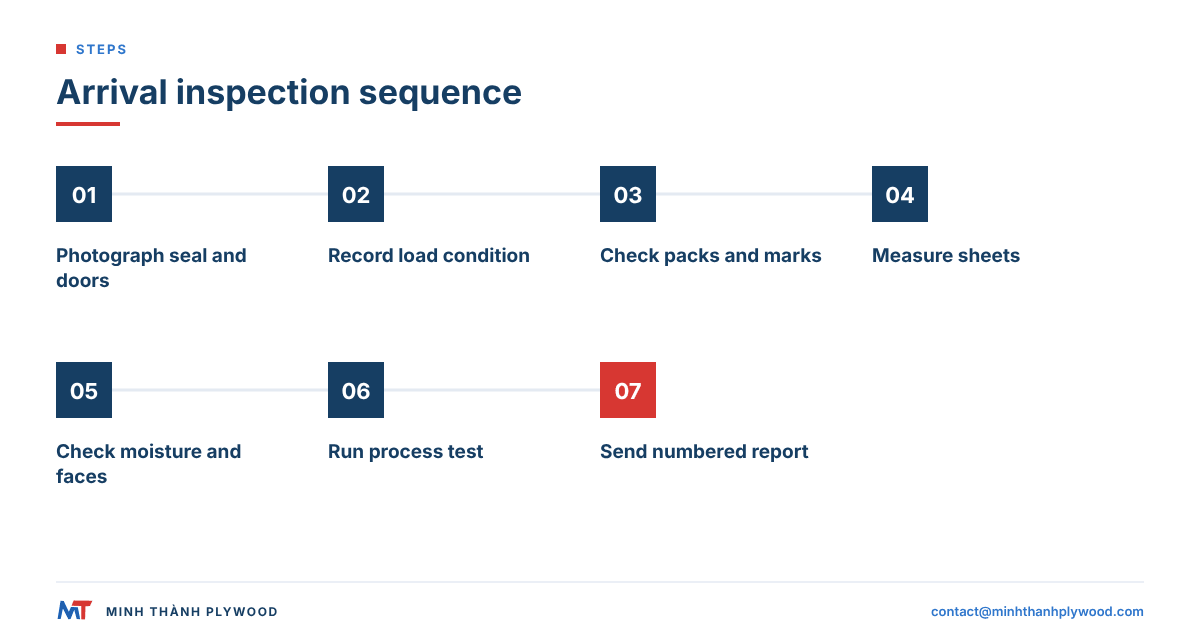
Check the trial container in a fixed order on the day it is opened, and write everything down against pack numbers. The arrival check is the main output of a trial order.
- Doors and seal: photograph them and compare the seal number with the B/L.
- Load condition: photograph the packs before unloading.
- Count: packs and pack marks against the packing list.
- Thickness: caliper sheets from packs at the doors, the middle and the far end.
- Size: length and width against ±2 mm.
- Moisture: a meter reading per specification.
- Faces: against the approved sample, under the same light.
- Process test: run a few sheets through your own line (sawing, edge-banding, coating).
- Report: one page with readings, photos and pack numbers, sent to the supplier.
A good mill reads that report the same day. Because Minh Thanh films every container before loading, any question is checked against the same packs on video. How evidence settles a difference is covered in plywood quality claims.
Which KPIs should you review after the first shipment?
Review six KPIs after the first shipment, each with a measured result, not an impression. The same six then run through every container of the programme.
| KPI | How to measure it | What a passing result looks like |
|---|---|---|
| Specification conformity | Arrival readings for thickness, size, moisture, faces | Every reading within the tolerance on the order |
| Count accuracy | Packs and sheets against the packing list | Exact match |
| Loading on time | Loading date against the proforma | On or before the agreed date |
| Document accuracy | Drafts and finals against your broker’s checklist | No correction needed after issue |
| Communication | Reply time to technical questions | Same working day, specific answers |
| Handling of differences | Time and quality of the response to a reported issue | Evidence reviewed, decision stated, action agreed |
Put the numbers in a simple sheet per container. After two or three containers the sheet tells you whether to increase volume, keep the trial pace or look elsewhere. It is also the fairest basis for the price and volume talk that follows.
Example: a KPI sheet after three containers
A KPI sheet does not need software. One row per container and one column per KPI is enough to see a trend.
An illustrative KPI sheet for the first three containers:
| Container | Specification conformity | Count | Loading date | Documents | Replies | Differences handled |
|---|---|---|---|---|---|---|
| 1 (trial) | All readings in tolerance; one face shade question | Exact | On the agreed date | One draft correction before issue | Same day | Shade checked against loading video, accepted |
| 2 | All readings in tolerance | Exact | Two days early | No corrections | Same day | None |
| 3 | All readings in tolerance | Exact | On the agreed date | No corrections | Same day | None |
A sheet like this supports a decision to raise volume, and it is the record you show your own customers when they ask how you control a foreign source.
How do you move from a trial to repeat orders?
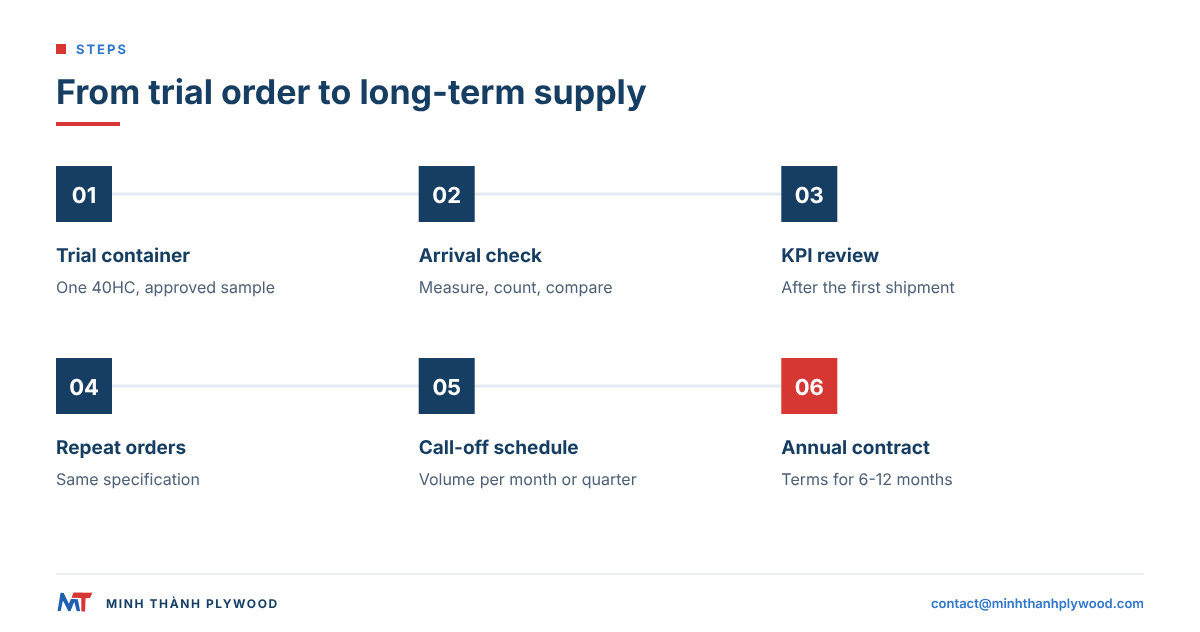
Move to repeat orders by freezing what worked: the specification, the approved sample, the packing and the documents. The second container should be a copy of the first, not a new experiment.
- Freeze the specification as a numbered spec sheet, with the approved sample’s reference.
- Repeat the packing plan and the pack marks, so your warehouse can book in without changes.
- Keep the document set your broker approved on the first container.
- Note the lessons from the arrival report, and agree any change before the next order.
- Order the next container before stock runs low, allowing production plus sea time.
Repeat orders also get faster: no sample cycle, no new drafts, a known production slot. Minh Thanh’s repeat orders go to Italy and other EU markets.
When should the second order go in?
Place the second order before the first container has been used up, but after its arrival check. In practice that means ordering soon after the arrival report, so production of the second container overlaps with the use of the first.
Work backwards from the day your stock would run out: subtract the sea time (30–40 days to Northern Europe), a few days for loading and departure, the production time after the deposit, and a safety margin for a delayed vessel. The result is the latest date for the second deposit. Many buyers find it falls only a week or two after the first container arrives, which is why the arrival check should be done on the day of unloading.
What is a call-off schedule, and how does it work for plywood?
A call-off schedule is an agreement on volume over a period, with each container released by a short call-off order before loading. It lets the mill plan veneer and press time ahead, and gives you steady supply without negotiating every container.
How it usually works:
- Volume: containers per month or per quarter, by specification, for six or twelve months.
- Forecast: a rolling forecast updated monthly, firm for the next one or two containers.
- Call-off: a written release for each container, with specification lines and quantities.
- Lead time: the call-off reaches the mill at least the production time ahead of the loading date; production is 15–45 days after the 30% deposit at Minh Thanh.
- Flex: an agreed range up or down per period, so a busy month does not need a new negotiation.
Call-offs suit importers and furniture plants with steady demand. For a distributor with seasonal sales, a quarterly call-off with a wider flex range often works better.
Example: a monthly programme for a cabinet maker
A cabinet maker using about one container of 18 mm panels a month, plus thinner panels for backs, might run this programme after a successful trial:
- Annual volume agreed as twelve containers, with an agreed flex up or down each quarter.
- Rolling forecast sent on the first working day of each month, covering the next three months.
- Call-off for each container sent at least the production time before the wanted loading date, naming the lines: most packs of 18 mm, a few of 15 mm and 5 mm.
- Loading in the agreed week, with photos and video before the balance.
- Arrival report within the agreed days after unloading.
- Quarterly review of the KPI sheet, the forecast and any price review trigger.
With sea time of 30–40 days to Northern Europe, the plant keeps safety stock to cover a delayed vessel, usually one container’s worth.
What goes into an annual plywood supply contract?
An annual plywood supply contract fixes the panel, the volume, the price mechanism, the logistics and the way differences are handled. Keep it short, specific and tied to the spec sheet.
| Clause | What it should say |
|---|---|
| Products | Spec sheet numbers, each with an approved sample reference |
| Tolerances | Thickness, size, moisture and face grade, as numbers and as the sample |
| Volume | Containers per month or quarter, by specification, with a flex range |
| Call-off | How and when each container is released |
| Price | Price per m³ by specification, period of validity, review clause |
| Delivery term | FOB Hai Phong, CFR or CIF your port |
| Storage and use | How panels are stored after arrival (flat, covered, dry) and the use they are bought for, so a later question is judged against the right conditions |
| Payment | Deposit and balance terms, or L/C |
| Loading evidence | Photos and video of every container before the balance |
| Inspection | Whether and when third-party inspection applies |
| Documents | The standard set plus certificate files your market needs |
| Differences | How a difference is measured, reported and settled |
| Review | Quarterly review of KPIs and forecast |
The difference clause matters most and is written least. Say how readings are taken, how many sheets are measured, which photos are needed and within what time after arrival the report is sent. Clear evidence rules prevent most disputes.
How should the difference clause read?
The difference clause should describe evidence and steps, not promises. A workable version, in plain words:
- What counts: a reading outside the tolerance on the spec sheet, a count short of the packing list, or a face outside the approved sample.
- How it is measured: the tool, the number of sheets and packs, and photos showing the tool on the sheet with the pack mark in frame.
- When it is reported: within the period agreed in the contract after unloading, before the panels are processed.
- What happens to the panels: affected packs kept apart and unused until both sides have seen the evidence.
- How it is settled: the parties agree the remedy from the evidence, such as credit, replacement in the next container or sorting.
Because the loading photos and video show every pack before it leaves the mill, both sides can compare the arrival evidence with the departure evidence. Plywood quality claims explains the evidence in detail.
Should long-term contracts fix prices?
Long-term plywood contracts rarely fix prices for a full year; most hold prices for a stated period and review them on agreed triggers. Fixed annual prices look safe but push the risk of input costs into the panel, usually through the core or the face.
What works in practice:
- Validity period: prices held for a quarter or a half year.
- Review triggers: changes in glue, veneer or freight costs beyond an agreed band.
- Notice: a set notice period before a new price applies, with containers already called off at the old price.
- Same specification: a price change never comes with a quiet change of build; any build change is a new spec sheet and a new sample.
Minh Thanh dates its indicative prices: in October 2026, furniture and interior plywood started from US$350/m³ and commercial plywood from US$250/m³, with the final price set by face, core, glue, thickness, size, quantity and delivery term.
What moves plywood prices over a year?
Four inputs move the price of a plywood panel over a year: veneer, glue, freight and currency. Each one belongs in the review clause in its own way.
- Veneer: core veneer follows plantation harvests and weather; imported face veneers such as birch and okoume follow their own markets.
- Glue: resin prices follow chemical feedstocks, which affects UF, melamine-fortified and phenolic glues differently.
- Freight: under CFR and CIF, ocean freight is inside the price and can move more than the panel itself.
- Currency: prices in US dollars against your own currency.
A review clause that names these inputs, with an agreed band before a review starts, keeps both sides honest. Neither side benefits from a price that ignores the inputs for a year.
What is the first thing to negotiate in a long-term plywood contract?
Negotiate the specification first: the build, the tolerance, the approved sample and how differences are measured. Price, volume and timing only mean something once the panel itself is fixed.
A specification clause that holds up over a year names:
- Core: species and grade; stitched or not, and how many layers.
- Glue and emission: glue type and emission class on two lines.
- Face and back: species, grade pair, sanding, UV-ready if needed.
- Sheet: thickness, size, tolerance, moisture range.
- Packing: pack size, cover, base, marks.
- Reference sample: its number and where each side keeps it.
At Minh Thanh, furniture-grade panels are pressed twice as standard: the core board is pressed and calibrated, then face and back are pressed on. Writing the pressing method into the specification keeps the build stable from container to container.
A sample specification line
A specification line that leaves nothing open covers every measurable item. For a common furniture panel:
- Panel: 18 mm furniture plywood, 1220 × 2440 mm.
- Core: white Styrax, stitched horizontally and vertically.
- Glue and emission: UF glue at E0 emission.
- Faces: poplar face/back A/B, sanded both sides.
- Tolerances: thickness ±0.2–0.3 mm, length and width ±2 mm, moisture 8–12 % at dispatch.
- Reference: approved sample number on file at both ends.
- Packing: packs of 55 sheets with cover, straps and corner protection.
Every word of it can be measured or compared on arrival.
Single mill or several mills: which strategy is safer?
One mill per specification gives the most consistent panels; a second qualified mill adds resilience. Most importers end with one main mill per product line and a back-up they test with an occasional container.
| Strategy | Strengths | Weaknesses | Fits |
|---|---|---|---|
| One mill for everything | Simple, strong relationship, priority slots | Single point of failure | Smaller importers, one product line |
| One mill per product line | Each line from a specialist | More suppliers to manage | Importers with furniture and construction lines |
| Main mill plus qualified back-up | Consistency plus resilience | Back-up needs regular orders to stay qualified | Growing programmes |
| Several mills for one specification | Price competition | Panels differ between mills; customers notice | Rarely worth it for furniture panels |
Mixing two mills’ panels in one product line shows up in your customers’ workshops: slightly different thickness, colour or behaviour under coating. If you need two sources for one panel, keep their stock apart and label it.
How do you qualify a back-up mill?
Qualify a back-up mill the way you qualified the main one, then keep it warm with occasional orders. A back-up that has not shipped for a year is a new supplier again.
- Same specification sheet, sent unchanged.
- Sample of the exact build, tested against the main mill’s panels side by side.
- One trial container, measured with the same arrival check and KPI sheet.
- A small regular share, for example one container a quarter, so the back-up knows the build.
Tell your main mill that you hold a qualified back-up. It is normal practice and it keeps the conversation about service, not price alone.
How does a programme change or end?
Programmes change more often than they end: a new thickness, a new face, a larger container share. Treat every change as a small trial. Issue a new spec sheet number, approve a new sample, run the changed line in a container next to the established ones, and measure it on arrival like the first trial.
When a programme does end, end it in writing with notice that covers containers already called off and veneer already bought for them. Ending well matters in a small industry: buyers and mills meet again, and a fair close keeps the door open.
How do you build a long-term relationship with a plywood mill?
Long-term supply rests on forecasts, fast feedback and a few people who know each other. The mill plans better when it sees your demand early; you get better service when the mill knows your use.
- Share forecasts monthly, even rough ones.
- Send arrival reports for every container, good ones too.
- Visit once, or hold a video review of the production line for your product.
- Name a contact on each side for technical questions.
- Review the KPI sheet every quarter and agree one improvement at a time.
Minh Thanh’s sales team replies within hours, Monday to Friday, 08:00–17:00 Vietnam time.
What should each side share?
Long-term supply works best when both sides share a little more than the order. From the buyer: forecasts, arrival reports, changes in your own customers’ demands, and early notice of new products. From the mill: production slots, veneer supply for scarce faces, planned holidays and shutdowns, and any change in inputs that could affect price or lead time.
Vietnamese mills slow down around Lunar New Year, usually in late January or February. Plan the container before and after the holiday with the mill a few months ahead.
Which documents should the first order carry?
The first order should carry the full document set your broker and your customers will need for every later container, so it doubles as a test of the paperwork. Agree the list on the proforma and ask for drafts before issue.
| Document | Why the first order needs it |
|---|---|
| Commercial invoice and packing list | Customs value, quantities and packs; your stock booking |
| Bill of lading | Release of the cargo; the 70% balance is paid against the scan |
| Certificate of origin (EUR.1 for the EU) | Preferential duty where a trade agreement covers plywood |
| Phytosanitary and fumigation certificates | Only where your port requires them |
| Insurance certificate | Under CIF |
| Certificate files | Emission certificate, test reports, the EUDR dossier for EU orders, packaging test |
ISPM 15 covers wood packaging and exempts packaging made wholly of processed wood such as plywood. Solid-wood pallets, bearers and dunnage remain within its scope. Destination requirements for the plywood cargo are separate; agree the required certificates with the broker. For EU orders, the EUDR dossier matters because the regulation applies from 30 December 2026 to large and medium operators, under the dates in Regulation (EU) 2025/2650.
Send your broker the drafts and ask for corrections before the vessel sails; a correction after issue costs time at the destination port. The full list by market is in plywood import documents.
What are the common first-order mistakes?
Most first-order problems come from the order, not the mill. These are the ones importers tell us they would avoid next time:
- Too many products in the trial, so a difference cannot be traced.
- No written specification, only a product name and a price.
- No approved sample kept at both ends.
- Ignoring the weight limit of the container and the haulier.
- Paying the balance before seeing loading photos.
- No arrival check plan, so the container is unloaded before anyone measures.
- Changing the specification on the second order before the first has been reviewed.
- Measuring only the packs at the doors, which are the easiest to reach and the least representative.
- Agreeing a price without the packs plan, so the cubic metres loaded differ from the quotation.
- No contact for technical questions, so every question goes through sales and back.
The longer list, with scam patterns and hidden costs, is in mistakes and scams when buying plywood from Vietnam.
What should you send to start a first order?
Send the specification, the trial plan and the destination in one message, and ask for the sample and the packs plan in the reply. That is enough for a mill to quote the trial correctly.
- Specification of each line: application, core, glue and emission, face and back, thickness, size, tolerance, packing.
- Trial plan: lines and approximate packs per line.
- Destination port and Incoterm: FOB Hai Phong, CFR or CIF.
- Payload limit of your line or haulier, if lower than standard.
- Documents your market and your customers need.
- Planned follow-up: expected monthly or quarterly volume if the trial passes.
The plywood RFQ checklist has a spec sheet to fill in. To run your first order with Minh Thanh, send it to contact@minhthanhplywood.com or use the contact form; the free sample of your build is sent with the quotation. Our terms are on the trade terms page.
What comes back from the mill
For a first order, Minh Thanh sends back four things: the quotation per specification on your Incoterm, the packs plan for the container with sheets and weight per line, the free sample of each build, and the list of documents your order will carry. Questions about your specification come first if any line is open, because a quotation on an unclear build helps nobody.
Buyer questions, answered
What is the minimum first order from a Vietnamese plywood supplier?
Usually one 40HC container. At Minh Thanh the minimum is one 40HC, and mixed specifications in that container are arranged by agreement, so a first order can carry two or three thicknesses.
Can I mix thicknesses in my first plywood container?
Yes, by agreement. Each thickness fills whole packs, heavier packs go low, and the total stays inside the container's payload; the packs plan comes with the proforma invoice.
Which Vietnamese plywood exporters are good for a first order?
Manufacturers that make your product line every week, show registration and factory evidence, hold certificates in their own name, send a free sample of the exact build and film every container before loading. Minh Thanh meets each of these for furniture and interior plywood.
How should I pay for a first plywood order?
A 30% deposit to the company account on the contract, and the 70% balance against the scanned bill of lading after you have seen the loading photos and video. An irrevocable letter of credit at sight is the alternative.
Should I pay for a third-party inspection on a trial order?
It is worth it when the trial carries a new specification or a large value, or when your customers ask for an inspection report. Agree the inspection company, the checks and the sampling plan on the contract.
What KPIs should I review after the first plywood shipment?
Specification conformity (thickness, size, moisture, faces), count accuracy, loading date against the proforma, document accuracy, reply time, and how any difference was handled.
What is a call-off schedule for plywood?
An agreement on volume over a period, with each container released by a call-off order a set time before loading. The mill plans veneer and press time ahead; you get a steady supply.
Should long-term plywood contracts always include fixed prices?
Not usually. Most annual agreements fix the specification and volume, and hold prices for a stated period with a review clause tied to inputs such as glue and freight.
What is the first thing to negotiate in a long-term plywood contract?
The specification: the build, the tolerance, the approved sample and how differences are measured. Price, volume and timing only mean something once the panel itself is fixed.
Should I buy from one plywood mill or several?
One mill per specification gives the most consistent panels; a second mill for a different product line, or as a qualified back-up, spreads risk without mixing builds in one product.
How long does a first order from Vietnam take?
Production runs 15–45 days after the 30% deposit and sea freight 30–40 days to Northern Europe, so deposit to arrival is about six to twelve weeks. Add the time you need to agree the specification and test the sample.
How quickly can a trial become a regular programme?
Often with the next container. Once the trial passes the arrival check, the second order repeats the approved specification, and the call-off schedule can start from the third.
Can two importers share one plywood container on a first order?
Yes, if each line fills whole packs and one party is the consignee for customs. The partners settle the split between themselves; the mill loads and documents one container.
When should I place the second plywood order?
Soon after the first container's arrival check, counting back from your stock-out date by sea time, production time and a safety margin. For Northern Europe that is often a week or two after the first arrival.
Do I need a written contract for a first plywood order, or is the proforma enough?
For a single trial container, record the full specification, Incoterm, payment, production time, documents and loading evidence in the signed order documents. A proforma invoice records commercial terms; an annual programme needs a supply agreement covering the repeat orders.