
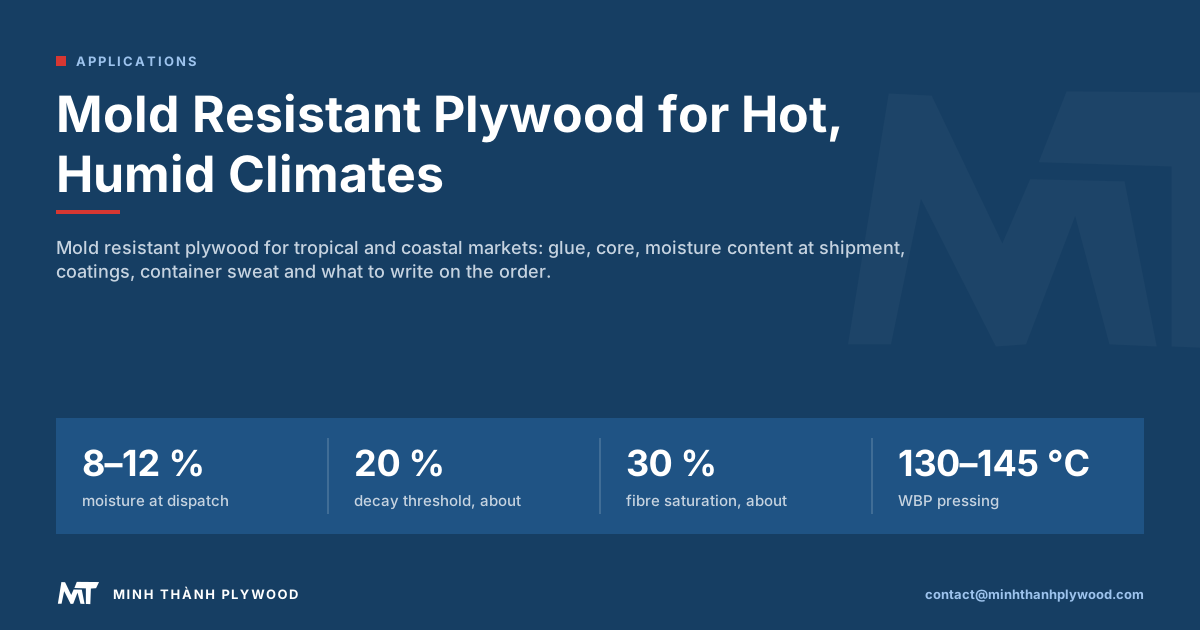
Mold resistant plywood for hot, humid climates is a panel that stays below the moisture level fungi need: a water-resistant glue, a dense core, sealed faces and edges, and dry wood at shipment. No plywood is immune if it stays wet. Minh Thanh Plywood dries veneers and panels to 8–12 % moisture content at dispatch and builds each order for its climate.
What is mold resistant plywood, and what makes a panel resist mould?
Mold resistant plywood is a panel built and protected so that mould and decay fungi cannot get the moisture they need. It does that in one of two ways: a fungicide or preservative treatment in the wood, or a dry, sealed panel with a water-resistant glue that stays below the moisture level fungi need. In both cases, keeping water out does most of the work.
Mould is a surface fungus. It grows on wood, paper and dust when the surface stays damp, and it stains rather than weakens. Decay fungi go deeper and eat the wood itself; they need wetter wood and more time. A panel that resists one usually resists the other, because both start with moisture.
That is why buyers in tropical and coastal markets ask about glue, core, moisture at shipment and packing as much as about treatments. A treated panel stored wet in a hot warehouse still grows mould on its faces; an untreated panel shipped dry, wrapped and sealed often does not.
At Minh Thanh Plywood we make furniture, commercial and exterior plywood in northern Vietnam, a hot, humid climate, and dry veneers and finished panels to 8–12 % moisture content at dispatch. This guide covers what a buyer in a humid market should specify.
Which plywood is mold resistant? Panel types for 4 x 8 ft sheets
The mold resistant plywood a US buyer can pick up falls into five types, and each resists mould in a different way. Match the type to how wet the room or site gets, because the wrong one either rots early or costs far more than the job needs.
| Panel type | What resists mould | Where it fails | Usual sheet size |
|---|---|---|---|
| Preservative-treated plywood | Fungicide or preservative in the wood | Cut ends need field treatment; fixings must be hot-dip galvanised or stainless | 4 ft x 8 ft, 1/2 to 3/4 in. |
| Exterior-glue sheathing (APA Exposure 1 or Exterior) | Waterproof bond, so layers stay joined when wet | The wood still grows mould if it stays wet; Exposure 1 covers construction delays only | 4 ft x 8 ft, 7/16 to 3/4 in. |
| Marine-grade plywood | Boil-proof bond, no core gaps, selected veneers | Needs paint or epoxy on faces and edges; costs the most | 4 ft x 8 ft, 1/4 to 3/4 in. |
| MR interior plywood | Melamine-fortified bond for damp rooms | Not for outdoor use, basements or constant wetting | 4 ft x 8 ft, 1/2 to 3/4 in. |
| Formaldehyde-free hardwood plywood such as PureBond | Moisture-resistant bond, sealed with a finish | An interior panel; edges and cut faces need sealing | 4 ft x 8 ft, 3/4 in. |
Home Depot sells Columbia Forest Products PureBond hardwood plywood in 3/4 in. birch, maple and red oak sheets of 4 ft x 8 ft, with a soy-based, formaldehyde-free bond. Listings we checked on 21 October 2026 ran from about US$75 to US$90 a sheet, and prices vary by store. A moisture-resistant bond is what you pay extra for; it does not make the panel mould-proof. APA says Exposure 1 panels have a fully waterproof bond but are meant for construction delays, while Exterior panels are for permanent weather (APA Rated Sheathing datasheet).
Is the upgrade worth it? In a bathroom, laundry or unconditioned garage, yes: pay for the moisture-resistant bond, then seal edges and paint. In a dry, conditioned room, standard hardwood plywood with a finish is enough.
Minh Thanh Plywood makes the MR and WBP versions of these panels in the same 4 x 8 ft sheet, 1220 x 2440 mm in metric, and ships dry at 8–12 % moisture content; the rest of this guide shows how to specify them.
How does climate affect plywood?
Climate affects plywood through moisture: wood takes up or gives off water until it matches the humidity of the air around it. In hot, humid air the panel gains moisture, swells slightly in thickness and can grow mould on its faces. In hot, dry air it loses moisture and can check or crack at the face.
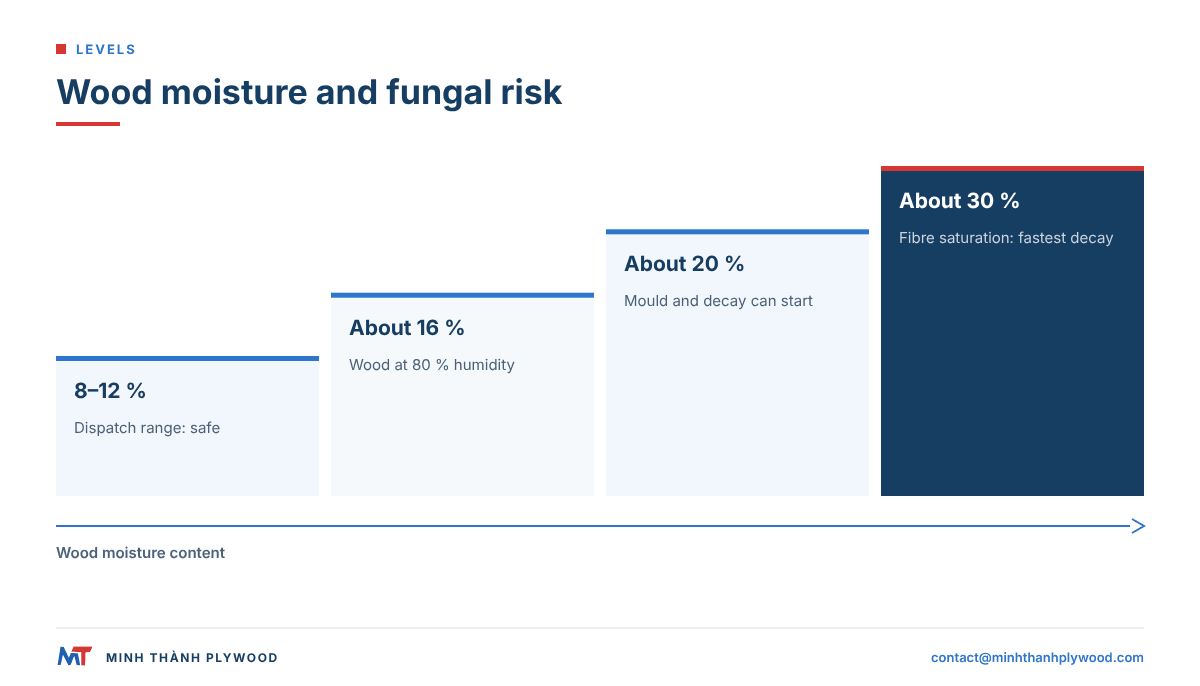
The balance point is called equilibrium moisture content (EMC). The USDA Forest Products Laboratory Wood Handbook, checked on 20 October 2026, tabulates it: at around 80 % relative humidity wood settles near 16 % moisture content, and at around 90 % relative humidity near 20 %. Coastal and tropical air sits at those levels for months.
Heat speeds everything up. Warm, damp wood grows mould faster than cool, damp wood, and a sealed warehouse in the tropics can hold both conditions at once. The glue matters too: a urea-formaldehyde (UF) bond made for dry interiors weakens if the panel is wetted and dried repeatedly.
Wood decay fungus: when does plywood start to rot?
Wood decay fungus attacks plywood when the wood stays above about 20 % moisture content for long periods. The Wood Handbook states that wood kept below 20 % moisture content will not decay, and that decay is fastest when wood is near or above fibre saturation, about 30 %. Below those levels, spores sit dormant.
That gives the buyer a simple rule: keep the panel dry, and decay cannot start. Dry shipment, covered storage and sealed faces limit moisture uptake. Maintain ventilation and prevent leaks and condensation in service so the wood stays below the decay threshold.
Mould and stain fungi need less. They grow on the surface of damp wood and on dust and sugars at the face, often during transport or storage, before the panel ever reaches its job. They do not weaken the panel much but they spoil faces and cause claims.
Decay types seen in humid markets:
- Brown rot breaks down cellulose and leaves wood brown and cubed; common in softwoods and building timbers.
- White rot bleaches and softens hardwoods.
- Soft rot works slowly on wood that stays very wet, such as panels in ground contact.
Does plywood rot, and does the glue stop it?
Plywood does rot if it stays wet, and the glue does not stop it. A phenolic (WBP) or melamine-fortified bond keeps the layers together through wetting and drying, but the wood between the glue lines is still wood. Decay is stopped by keeping the wood dry or by treating it with a preservative.
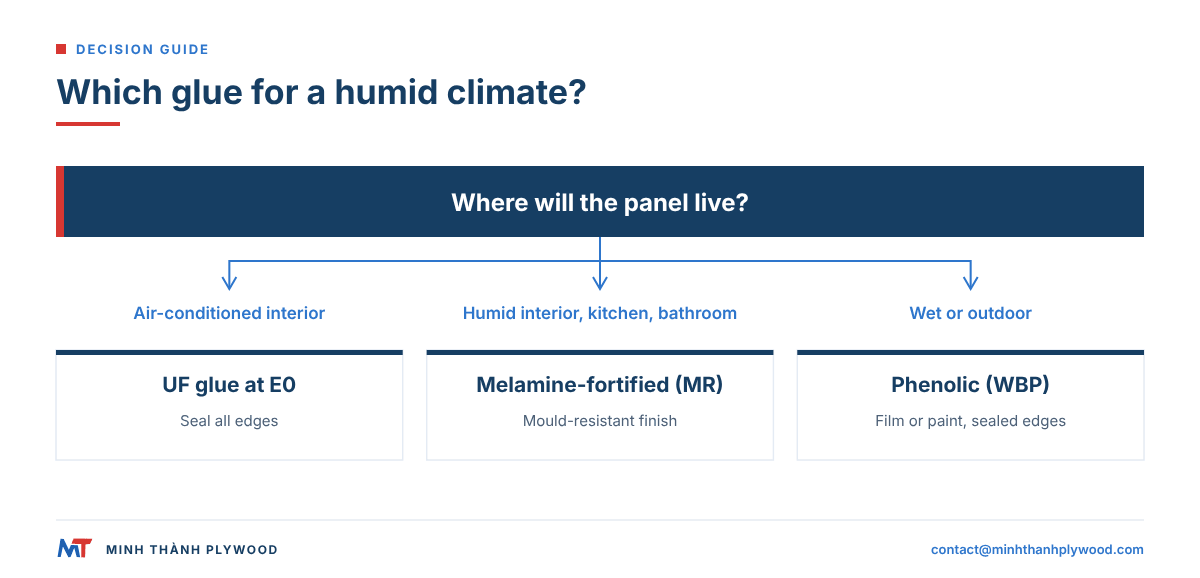
The glue still matters a great deal, because a panel that delaminates opens paths for water into the core. Glue choice by exposure:
| Exposure | Glue | Press temperature | Typical use in humid markets |
|---|---|---|---|
| Dry, air-conditioned interior | UF glue at E0 emission | 110–120 °C | Furniture and wall panels in conditioned rooms |
| Humid interior | Melamine-fortified (MR) | 110–120 °C | Kitchens, bathrooms, unconditioned rooms, vans |
| Wet or outdoor | Phenolic (WBP) | 130–145 °C | Sheathing, formwork, exterior parts, trailer floors |
Our guide to whether plywood is waterproof explains why glue, core and coating share the job, and our exterior plywood page lists the WBP-bonded panels.
Plywood for humid and tropical markets: the climate-zone spec table
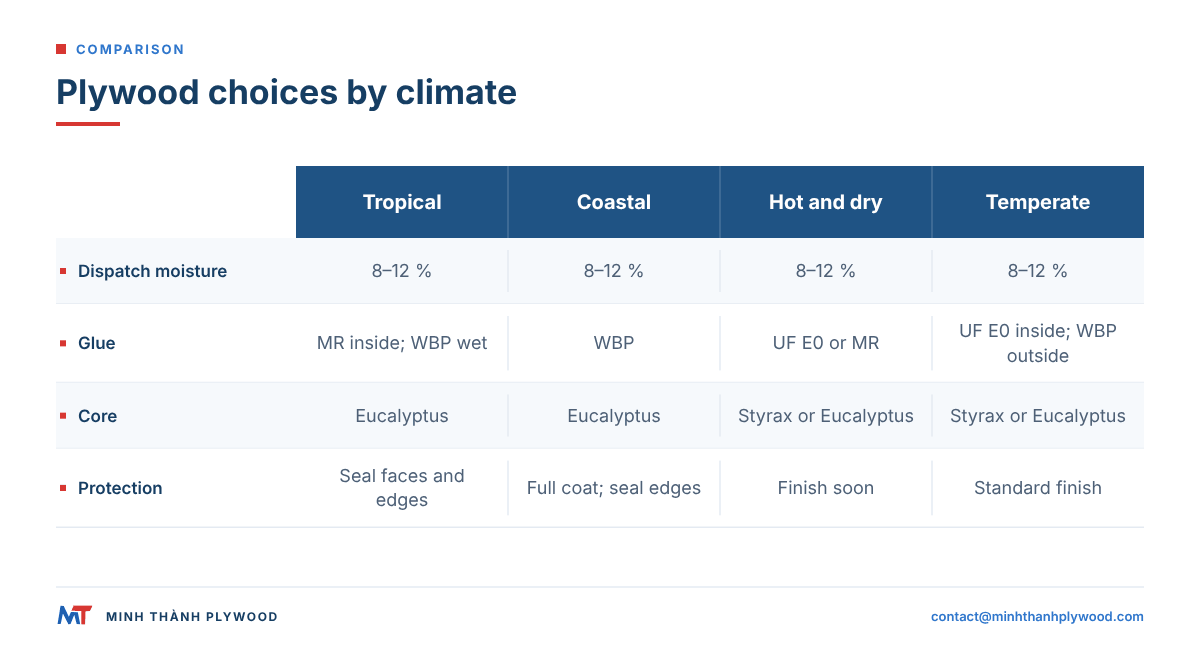
Plywood for humid and tropical markets is specified by climate and use together: the glue, the core, the moisture at shipment and the face or coating all move with the climate zone. This table is the starting point we use with buyers in each zone.
| Climate zone | Moisture content at dispatch | Glue | Core | Face, film or coating |
|---|---|---|---|---|
| Hot and humid, tropical | 8–12 % | MR for interiors, WBP for anything that gets wet | Eucalyptus for density and screw holding | Sealed faces and edges; film or paint outdoors |
| Coastal, salt air | 8–12 % | WBP | Eucalyptus | Full coating, sealed edges, stainless or coated fixings |
| Hot and dry | 8–12 % | UF at E0 or MR | White Styrax or Eucalyptus | Finish soon after delivery to limit checking |
| Temperate or seasonal | 8–12 % | UF at E0 for interiors, WBP outdoors | White Styrax or Eucalyptus | Standard finish |
The same 8–12 % moisture content suits every zone, because panels should leave the factory dry and adjust gently at the destination. Shipping wet panels to a humid market to “match” its air only grows mould on the way.
Is hardwood plywood suitable for humid markets?
Hardwood plywood is suitable for humid markets when the glue and protection match the exposure. With a melamine-fortified bond it serves humid interiors such as kitchens, bathrooms and rooms without air conditioning; with a phenolic WBP bond and a coating it serves wet and outdoor parts.
Hardwood cores bring two advantages in humid climates. Dense cores such as Eucalyptus hold screws and hinges after repeated humidity swings, where lighter cores can loosen. Stitched cores also matter: our core layers are stitched both horizontally and vertically, so there are no open core gaps where moist air and spores can collect.
Lighter cores still have a place. White Styrax is even and light, and suits furniture in conditioned interiors, wall panels and doors. For a hotel in a tropical city, a common split is Styrax-core panels for wardrobes and wall panels in air-conditioned rooms, and Eucalyptus-core panels with an MR bond for bathroom vanities. Our guide to termite-resistant plywood covers the other tropical risk.
Plywood moisture barrier: coatings, films and edge sealing
A plywood moisture barrier is any coating, film or membrane that slows water and vapour into the panel: paint, varnish, laminate, a phenolic film, or a separate membrane behind or under it. The barrier has to cover the faces and the edges, because cut edges take up water many times faster than faces.
Options by use:
- Phenolic film pressed onto both faces, as on film-faced formwork plywood, with edges sealed with paint. Used for formwork, trailer floors and exterior signs.
- Laminate or melamine paper on furniture panels, with every visible and hidden edge banded or sealed.
- Primer and paint on all six faces of exterior parts, with a mould-resistant paint in bathrooms and kitchens.
- Clear varnish or oil on natural faces, renewed as it wears.
- Membranes behind cladding or under flooring, keeping liquid water off the panel while letting it dry to one side.
Seal cut edges on site, after every cut. Most mould and swelling in humid markets starts at an unsealed edge or a screw hole. Our planned guide on how to finish plywood compares paints, oils and lacquers.
Plywood already moldy? Clean, dry and seal it
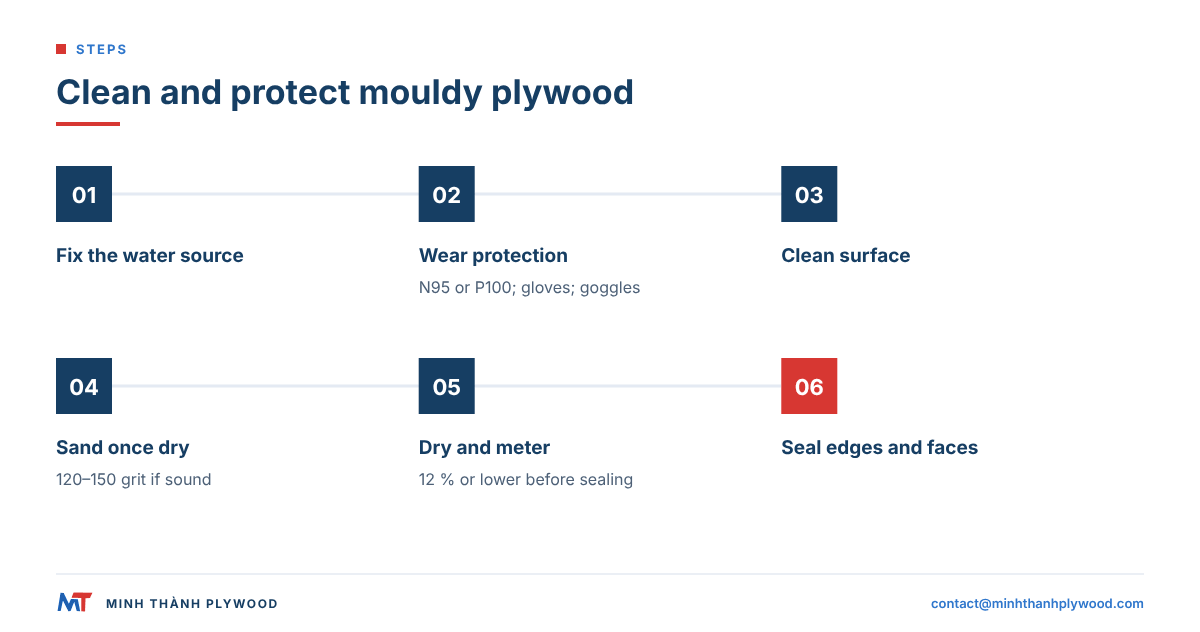
Surface mould on plywood can be cleaned if the panel is sound, but it only stays gone if the wood dries below 12 % moisture content before you seal it. Mould grows when humidity stays above 70 %. The EPA advises keeping indoor humidity below 60 percent, ideally between 30 and 50 percent (EPA, A Brief Guide to Mold, Moisture and Your Home), checked on 21 October 2026. Fix the water source first, or the mould returns.
- Protect yourself. Wear an N95 or P100 respirator, gloves and goggles. If the mouldy area is larger than 10 square feet (about 1 m2), call a remediation professional.
- Clean the surface. Wipe with white vinegar mixed 1:1 with water, or 3 % hydrogen peroxide. For a deeper stain, use 1 cup of borax in 1 gallon of warm water and leave the residue on; it inhibits regrowth.
- Sand lightly once dry. Use 120 to 150 grit to remove stained fibres, never on soft, crumbling wood. If the panel is soft or delaminating, replace it.
- Dry it completely. Dry materials within 24–48 hours of wetting to stop mould starting, and use fans and a dehumidifier to hold the room at 40–50 % humidity. Check with a pin meter: seal only when the reading is 12 % or lower. Sealing wet wood traps moisture and causes delamination.
- Seal the edges first. Cut edges absorb moisture 5 to 10 times faster than faces. Apply 1 mm PVC edge banding with a household iron, or two coats of primer, then paint all faces with a mould-resistant paint.
Check the paint can: mould-resistant interior coatings are tested to ASTM D3273, a four-week chamber test at 32.5 °C and above 93 % relative humidity, and rated on a 0 to 10 scale (ANSI Blog, ASTM D3273-21, checked 21 October 2026).
Moisture content before shipment: why dry panels matter
Moisture content before shipment is the most important number for mould in humid markets. Our veneers and finished panels are dried to 8–12 % moisture content at dispatch, the normal range for furniture plywood. Dry panels carry little water into the container, so there is little to condense on the voyage.
Drying is part of production, not an extra. Veneers are dried after peeling, then pressed with hot glue, which drives off more water, and finished panels cool and condition before sanding and packing. Pressing at 110–120 °C for MR glue and 130–145 °C for WBP glue also heats the whole panel far above the range in which mould grows.
What the buyer can check:
- Ask for the moisture reading of packed panels, taken with a calibrated meter.
- Check on arrival with a pin meter on several sheets per pack; readings well above the dispatch range point to wetting in transit or storage.
- Keep packs wrapped and off the floor until they are used.
Export packing and container sweat in hot, humid routes
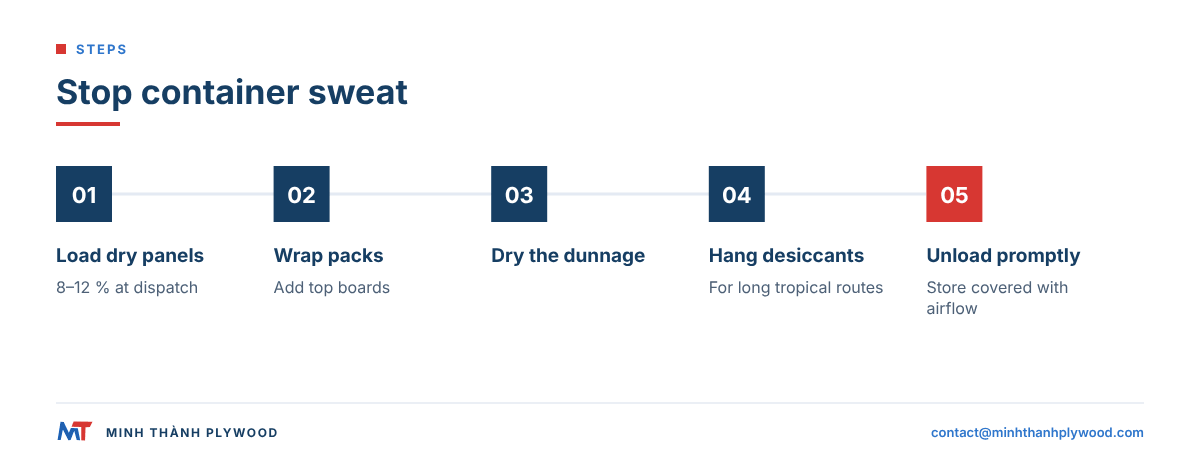
Container sweat is condensation inside a shipping container when warm, moist air meets a steel wall that has cooled, at night or as the ship moves into cooler water. Droplets fall on the top packs and run down the sides. Dry panels, good packing and air movement keep it off the plywood.
Steps that reduce container sweat:
- Load dry panels. Panels at 8–12 % moisture content bring little water into the box.
- Wrap the packs. Plastic wrap or cover sheets on top of each pack, with a top board to stop water running in.
- Keep wood dunnage dry. Wet pallets and bearers release moisture during the voyage.
- Use desiccant bags hung along the walls for long or tropical routes.
- Unload and unwrap promptly at destination, and store under cover with air around the packs.
Every Minh Thanh shipment is photographed and filmed before loading, and the buyer receives the photos and video. Those images show the pack wrapping and container condition on the day it left. Our plywood for sheds guide covers site storage for building panels.
Climate vs application: which matters more?
The application matters more than the climate, because the use decides how much water reaches the panel. A wardrobe in an air-conditioned hotel room in Singapore sees less moisture than a garden shed in a temperate country, even though the island’s air is humid all year (Meteorological Service Singapore). The climate then shifts the margin: humid air pushes the choice one step up.
Start from the use, then adjust for climate:
| Application | Temperate climate | Hot, humid climate |
|---|---|---|
| Furniture in conditioned rooms | UF glue at E0, Styrax core | Same, edges sealed |
| Furniture in unconditioned rooms | UF glue at E0 | MR glue, Eucalyptus or Styrax core |
| Kitchens and bathrooms | MR glue | MR glue, full edge sealing, mould-resistant finish |
| Roof and wall sheathing | MR or WBP | WBP, covered fast |
| Formwork, trailer floors | WBP, film-faced | WBP, film-faced, edges resealed |
A buyer who orders for the application and then adds one step of protection for a humid climate rarely sees a mould claim.
Does climate affect the type of plywood you should import?
Yes. Climate changes the glue class, core and protection you should import for the same use, and it changes how you store the panels between port and project. Importers in humid markets usually stock more melamine-fortified and phenolic panels and fewer UF-bonded panels than importers in dry markets.
For a distributor in a tropical port, a practical stock plan is:
- Furniture plywood with UF glue at E0 emission for joinery shops working in conditioned spaces, and with an MR bond for kitchen and bathroom makers.
- Exterior and film-faced plywood with phenolic WBP glue for construction.
- A covered, ventilated warehouse, packs off the floor and wrapped until sale.
When markets ask for mould-resistant panels by name, specify what that means on the order: the treatment if any, the glue, the core and the moisture content. Our pressure-treated plywood buying guide covers preservative treatments and retention.
Is marine plywood the answer in humid climates?
Marine plywood is the answer only for parts that stay wet under load, such as boat hulls and pontoons. For most humid-climate uses, a hardwood plywood with a melamine-fortified or phenolic bond, sealed and coated, does the same job for less. Marine plywood is not immune to mould: its wood still needs a coating.
What marine plywood adds is a boil-proof bond, selected veneers and no core gaps. Those features matter when water is always present. In a kitchen in Bangkok or a hotel in Lagos, the panel is damp at times, not wet all the time, and a well-sealed MR or WBP panel is the better buy. Our marine plywood buying guide explains the marine standard.
What to write on a plywood order for a hot, humid market
Write the use and the climate first, then glue, core, moisture content, face or coating, edge sealing, packing and quantity. A complete line for kitchen cabinet panels going to a tropical port looks like this:
Furniture plywood, 18 mm, 1220 × 2440 mm, Eucalyptus core, melamine-fortified (MR) glue, face and back graded to the approved sample, sanded both sides, moisture content 8–12 % at dispatch, packs wrapped with top boards, for kitchen and bathroom cabinets in a hot, humid climate, one 40HC, CIF destination port.
For outdoor and construction parts, change the glue to phenolic WBP and add a film or paint. Production takes 15–45 days after the 30% deposit, with the 70% balance against the scanned B/L or by irrevocable L/C at sight, on FOB Hai Phong, CFR or CIF terms. Furniture plywood starts from US$350/m³ (October 2026).
Free samples are available. Send your specification through the exterior plywood page or the furniture plywood page; we reply within hours.
Buyer questions, answered
Is there mold resistant plywood?
Yes, in two forms: panels treated with a fungicide or preservative, and untreated panels made and protected so they stay too dry for mould. Both still need dry storage, sealed edges and a coating in humid rooms; no panel is mould-proof if it stays wet.
Which plywood is mold resistant?
Five types resist mould in different ways: preservative-treated plywood, exterior-glue sheathing (APA Exposure 1 or Exterior), marine-grade plywood, melamine-fortified MR interior plywood and moisture-resistant hardwood plywood such as PureBond. All still need sealed edges and dry storage; none is mould-proof if it stays wet.
How do you get mold off plywood?
Wipe the surface with white vinegar mixed 1:1 with water or 3 % hydrogen peroxide, sand lightly at 120 to 150 grit once dry, and dry the panel to 12 % moisture content or lower before sealing. Seal the edges, then paint with a mould-resistant paint. Replace panels that are soft or delaminating.
Does plywood rot?
Plywood rots if it stays wet. Wood decay fungi need wood moisture content above about 20 %, so plywood kept dry, ventilated and sealed does not rot. Exterior glue keeps the layers together when wet but does not stop decay on its own.
How does climate affect plywood?
Wood takes up or releases moisture until it matches the air around it. In a hot, humid climate plywood picks up moisture, swells slightly in thickness and can grow surface mould; in a dry climate it shrinks and can check. The glue, core, coating and moisture at shipment decide how well it copes.
Is hardwood plywood suitable for humid markets?
Yes, when the glue matches the exposure. Hardwood plywood with a melamine-fortified (MR) bond suits humid interiors, and with a phenolic (WBP) bond it suits wet and outdoor use. Dense hardwood cores such as Eucalyptus also hold screws well after humidity cycles.
Can climate affect plywood size and dimensional stability?
A little. Cross-laminated veneers keep plywood's length and width far more stable than solid wood, but thickness swells as moisture rises. Ordering panels dried to 8–12 % and letting them acclimatise on site before fixing keeps movement small.
What is container sweat and how do you stop it?
Container sweat is condensation inside a shipping container when warm, humid air meets a cooling steel wall, usually at night or on a voyage to a colder port. Dry panels, wrapped packs, desiccant bags and ventilated containers reduce it; wet timber in the same box makes it worse.
Does painting plywood stop mold?
Paint helps by keeping liquid water out and giving mould a smooth surface to grow on less easily, but it must cover all faces and edges. A mould-resistant primer and paint in bathrooms and kitchens adds a fungicide at the surface.
Is marine plywood mold resistant?
Marine plywood has a boil-proof bond and no core gaps, so it tolerates wetting better, but the wood itself can still grow mould and decay if left wet. Boat builders coat it with epoxy or paint and seal every edge.
What moisture content should plywood have for tropical markets?
Ship plywood dry, at 8–12 % moisture content, and store it under cover on arrival. Panels shipped wetter are the main cause of mould in containers and warehouses in hot, humid ports.
What should I write on a plywood order for a humid climate?
Write the use and climate, the glue (melamine-fortified or phenolic WBP), the core, moisture content at dispatch, the face or coating, edge sealing, packing and destination port. We reply within hours.