
Termite in plywood is stopped by preservative, not by glue or a brand name: a treatment in the glue line or the veneers, at a stated retention, for the hazard where the panel will sit. Termites and borers eat plywood like any wood, and BWP or marine bonding alone does not keep them out. Minh Thanh Plywood sets out the treatment types, the standards behind them and the steps that prove a termite resistant plywood claim.
Termite in plywood: do termites eat it?
Yes, termites eat plywood: they feed on the cellulose in every veneer, and the glue lines between the plies slow them only a little. A subterranean colony can hollow the core of a cabinet base while the face looks perfect, because the insects stay inside the wood and away from the light.
Two groups do the damage. Subterranean termites live in the soil and reach the wood through mud tubes over walls and slabs; they need moisture, so they attack panels near damp floors, wet walls and leaking pipes. Drywood termites live entirely inside dry wood, with no soil contact, and fly into furniture and roof panels in warm coastal climates.
The glue lines in plywood are not food, and phenolic glue is harder to chew than wood. The insects simply tunnel around them through the veneers. That is why bond type and termite resistance are two separate questions on any order, even for phenolic-bonded exterior plywood.
What does termite resistant plywood actually mean?
Termite resistant plywood is plywood that carries a preservative, in its glue lines, its veneers or both, at a stated retention for a stated hazard. The term describes a treatment, not a grade, a bond or a brand name, and a claim without the preservative named is only a word.
Suppliers sell three different things under the same label. One mixes an insecticide into the glue before pressing. One treats the veneers by dipping or pressure before lay-up. One relies on naturally durable face or core species. These differ in what they protect against, how long they last and how the buyer can prove them.
No plywood is “termite proof”. Treated plywood resists attack in the conditions its treatment covers, for the life the preservative lasts there. The rest of the house still needs termite management.
Glue-line, veneer or pressure treatment: how do they compare?
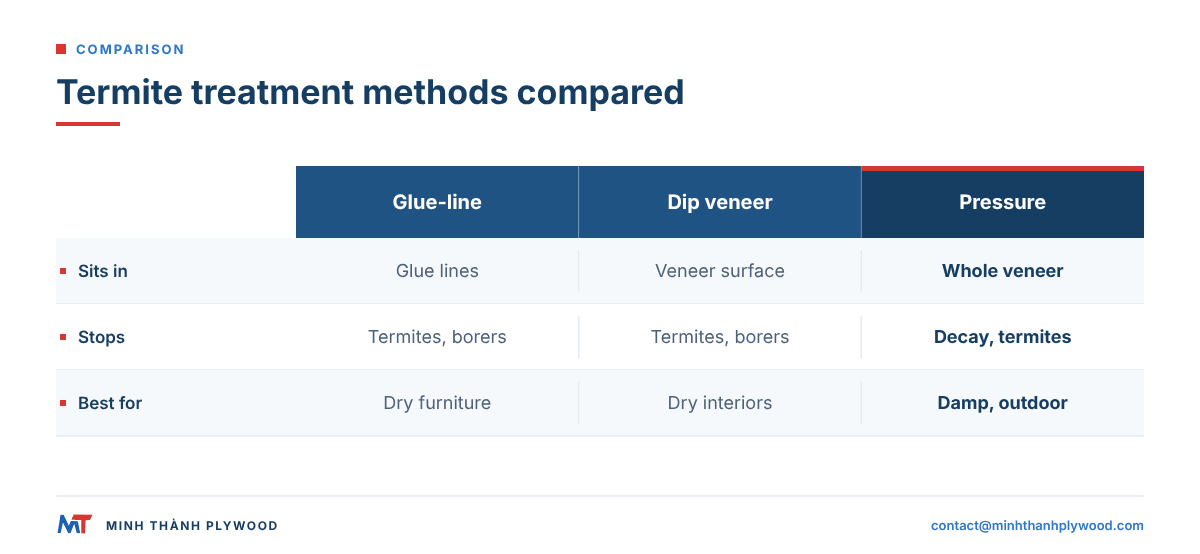
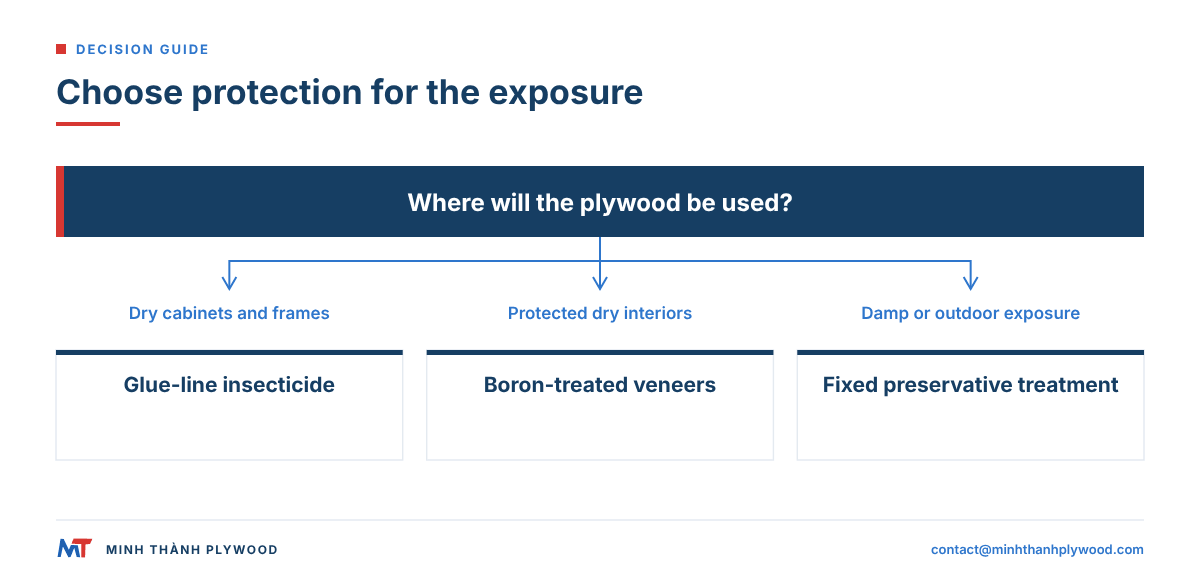
Glue-line treatment puts an insecticide into every glue line, veneer treatment puts preservative into the wood itself, and pressure treatment of the veneers pushes it deepest. Each protects a different depth of the panel, and each suits a different exposure.
| Method | Where the preservative sits | Protects against | Best for | How to verify |
|---|---|---|---|---|
| Glue-line insecticide | In each glue line, spread by pressing heat | Termites and borers | Dry interior furniture and frames | Treatment certificate, chemical and loading |
| Dip-treated veneers | Outer zone of each veneer | Borers, termites, some fungi (boron) | Dry interiors, protected from leaching | Boron spot test, certificate |
| Pressure-treated veneers | Through the veneer thickness | Decay, termites, borers | Damp and outdoor use | Retention test, brand, hazard class |
| Durable species alone | Natural extractives of heartwood | Partial, varies by species | Supplement to treatment, not a substitute | Species declaration only |
Boron compounds work well indoors but wash out in rain, so they suit panels kept dry. Fixed copper preservatives stay in the wood outdoors. The is plywood waterproof guide explains why a water-resistant bond and a treatment for wet service are separate choices.
Is BWP or marine plywood termite proof?
BWP plywood is not termite proof, and marine plywood is termite resistant only when its standard demands treatment. BWP names a boiling-water-proof phenolic bond, which keeps the plies together when wet; it says nothing about insects.
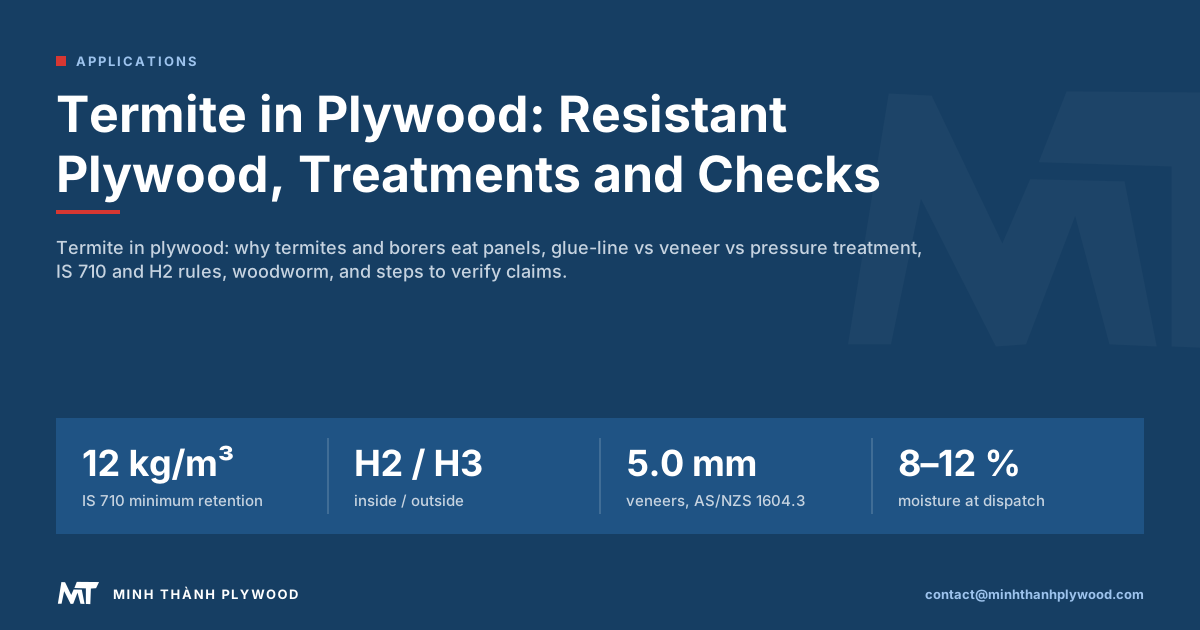
India’s IS 710 marine plywood standard is the exception buyers hear about. It requires the veneers to be treated with a fixed preservative, with a minimum retention of 12 kg/m³ for CCA, copper chrome boron or acid copper chromate. Plywood sold as BWP to the general-purpose standard IS 303 carries no such requirement unless the maker declares and treats it. India’s standard for preservative-treated plywood is IS 5539.
Marine plywood to the British standard is graded on veneer quality and bond, not on treatment. The marine plywood buying guide covers those grades. Ask for treatment by name whatever the marine label says.
Which standards cover termite treatment of plywood?
Termite treatment of plywood is covered by India’s IS 710 and IS 5539, by AS/NZS 1604.3 in Australia and New Zealand, and by national pesticide registration rules elsewhere. Each sets the preservative, the penetration and the retention for a stated use.
| Standard | Market | What it sets |
|---|---|---|
| IS 710 | India | Marine plywood with required preservative treatment and minimum retention |
| IS 5539 | India | Preservative-treated plywood |
| IS 303 | India | General-purpose plywood (MR, BWR, BWP); treatment only if declared |
| AS/NZS 1604.3 | Australia, New Zealand | Plywood treatment by hazard class H1 to H6 |
AS/NZS 1604.3 applies to plywood whose veneers are no thicker than 5.0 mm. It sets the bond type, penetration pattern and retention for each hazard class. H2, the class for “inside, above ground, protected from wetting”, targets borers and termites; H3 adds decay for outside use. A G suffix marks glue-line treatment.
In the United States and the European Union, the preservative must be registered for its use, as a pesticide under EPA’s wood preservative programme or under the Biocidal Products Regulation. A buyer importing treated panels confirms that the active ingredient is allowed in the destination market before the order.
How do you separate termite, borer and decay claims?
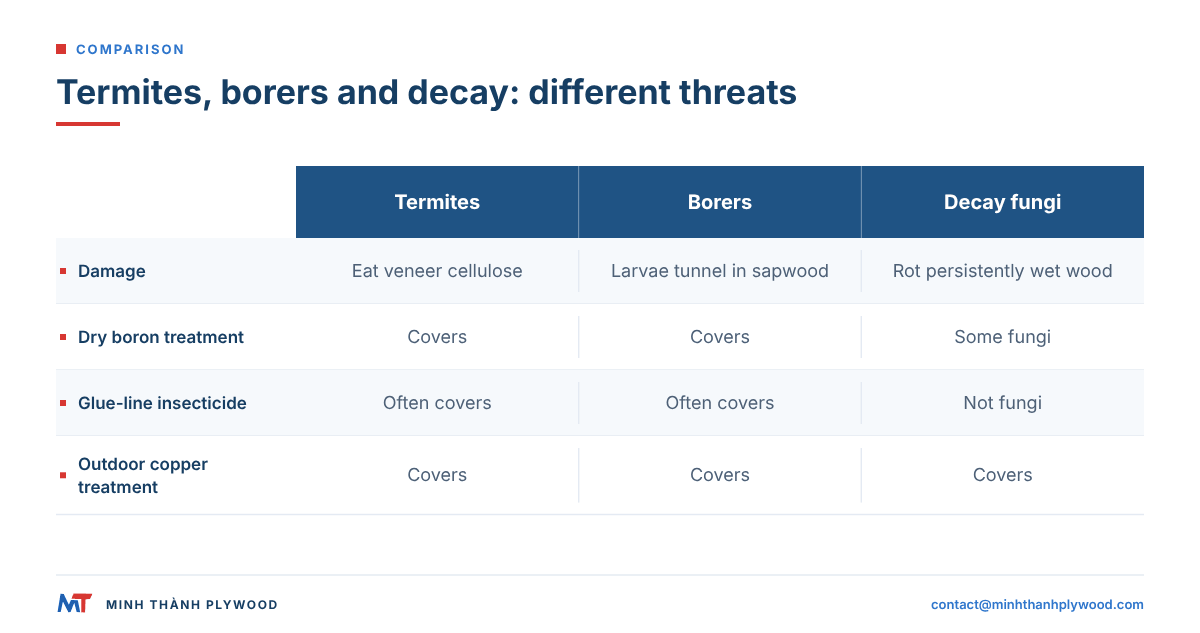
Separate the three by asking which organism the treatment was tested against: termites eat wood for cellulose, borers are beetle larvae that tunnel through starch-rich sapwood, and decay fungi rot wood that stays wet. One treatment can cover all three, or only one.
Boron covers termites, borers and some fungi in dry conditions. Many glue-line insecticides cover termites and borers but not fungi. Copper-based pressure treatments cover all three outdoors. A label that says “anti-termite” may say nothing about borers, and a furniture panel attacked by powderpost beetles fails just as surely.
Ask for the test report behind the claim. It should name the test organism, the exposure, the specimen construction and the duration. A result from a solid wood block says little about a 5-ply panel with a treated glue line.
What is woodworm, and which woodworm treatment works?
Woodworm is the larva of wood-boring beetles, most often the common furniture beetle in the UK and Europe and powderpost beetles in warmer climates. The larvae tunnel for years, then adults leave through small round exit holes, often with fine powder (frass) beneath.
Woodworm treatment for existing plywood uses an insecticidal fluid brushed or sprayed onto bare wood, after removing paint and wax so it can soak in. Badly weakened panels are replaced. New plywood resists woodworm when its veneers are treated and the panel stays dry, because the beetles prefer damp, untreated sapwood.
Powderpost beetles attack the starch in the sapwood of many hardwoods. Veneers dried quickly and kept dry give them less to live on, and boron-treated veneers stop them.
Which wood species resist termites naturally?
Some heartwoods, such as teak and several dense tropical hardwoods, resist termites through their natural extractives, but plywood rarely gets that protection. Peeled veneers are mostly sapwood or mixed wood, and plantation logs are young, so the core of most plywood has little natural durability.
Face species give a misleading signal. A gurjan or okoume face covers a core of other species, and termites usually enter through the core at the edges. The gurjan plywood page describes the face; protection comes from treating the panel.
Species selection helps as a second layer. A dense hardwood face on a treated core lasts longer than a treated softwood face in the same room. It never replaces the treatment.
How do you specify termite resistant plywood? Step by step
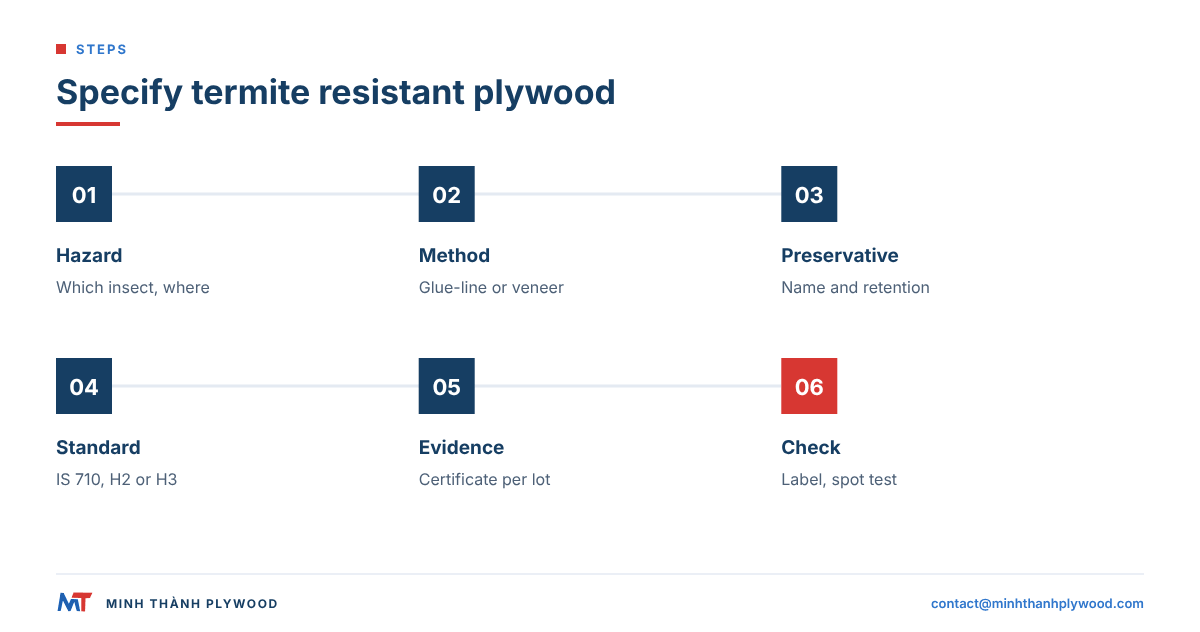
Specify termite resistant plywood in six steps: name the hazard, choose the treatment type, name the preservative and retention, name the standard, ask for evidence, and check the delivery. Each step closes one gap that a “termite proof” label leaves open.
- Name the hazard. Subterranean or drywood termites, borers, decay; indoor dry, indoor damp, or outdoor.
- Choose the treatment type. Glue-line insecticide for dry furniture; treated veneers for wider protection; pressure treatment with a fixed preservative for damp or outdoor use.
- Name the preservative and retention. The active ingredient and the loading, in kg/m³ or percentage by mass, and the penetration required.
- Name the standard or hazard class. IS 710 or IS 5539 in India, H2 or H3 to AS/NZS 1604.3 in Australia and New Zealand, or the buyer’s own specification.
- Ask for evidence. A treatment certificate per lot, the test report for the method and the registration of the preservative in your market.
- Check the delivery. Brand or label on each sheet, a spot test on cut samples, and edge inspection for frass or live insects.
How do you check treated plywood on arrival?
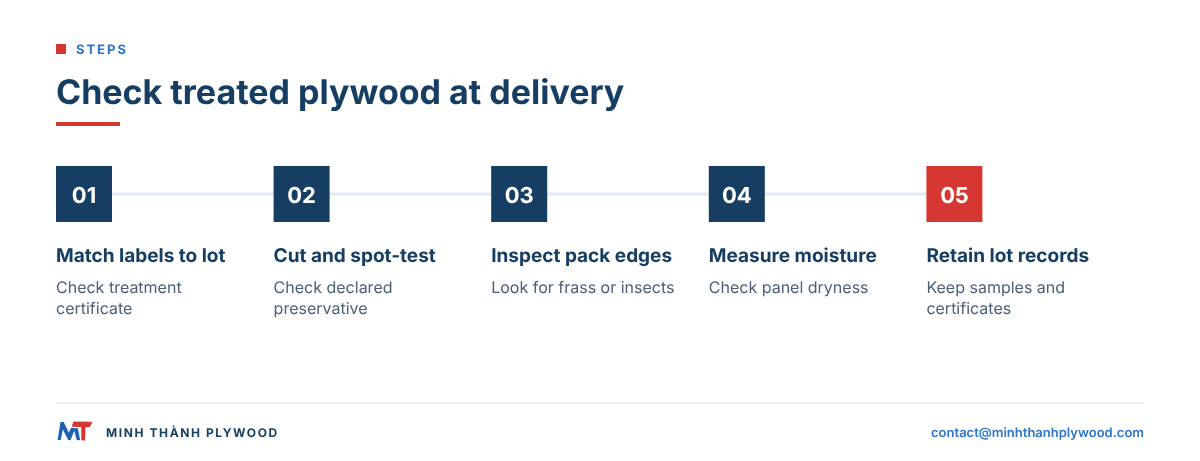
Check treated plywood on arrival by matching the brand and documents to the order, spot-testing a cut sample and looking at the edges of sheets from several packs. A quick check before the panels go to the workshop costs far less than a callback.
- Read the treatment brand or label on the sheet and match it to the certificate.
- Cut a strip and test for the preservative: curcumin reagent turns boron-treated wood red, and copper treatments show a green tint.
- Inspect cut edges of sheets from the top, middle and bottom of several packs for powder, exit holes or live insects.
- Measure moisture content: a dry panel is less attractive to subterranean termites and to borers.
- Keep the samples and certificates with the lot record.
A fumigation certificate shows that insects present at shipment were killed. It gives no lasting protection once the panels reach the site. Plywood is processed wood and sits outside ISPM 15, so an ISPM 15 mark on the pallet says nothing about the panels’ termite treatment.
Does paint, laminate or film stop termites?
Paint, laminate, veneer and film do not stop termites, because they cover the faces and leave the edges, holes and backs open. Termites enter where the core is exposed: cut edges, hinge holes, cable holes and the back of a carcass against a wall.
Edge banding and sealed backs slow entry and keep moisture out, which helps against subterranean termites. They do not replace treatment. Phenolic board, the film-faced plywood used in formwork and sold widely in the Philippines, has a sealed face but an ordinary wood core.
Where does termite resistant plywood matter most?
Termite resistant plywood matters most in kitchen and bathroom cabinets near plumbing, built-in wardrobes against outside walls, ground-floor joinery, wall frames and roof spaces in tropical regions. Those are the spots where moisture, warmth and hidden access meet.
Buyers in India, South-East Asia, northern Australia and the southern United States ask for it most. The plywood for kitchen cabinets guide lists cabinet grades; add the treatment line to that specification when the project is in a termite zone. Australian wall frames in termite zones use H2 treated timber and panels, as the bracing ply guide shows.
What should a treatment certificate show?
A treatment certificate for termite resistant plywood should name the lot, the preservative, the method, the retention achieved and the standard or hazard class it meets. A certificate that names only a brand of “anti-termite chemical” proves very little.
Look for these lines on every certificate:
- Lot or production batch, panel thickness and quantity.
- Active ingredient and product name of the preservative.
- Method: glue-line addition, dip or pressure treatment.
- Retention or loading, with the unit and the zone measured.
- Standard or hazard class, for example IS 5539 or H2.
- Treater or laboratory, date and signature.
Match the lot number to the pack labels on arrival. A certificate for another lot, or one with no retention value, belongs on the claim file, not the acceptance file.
What do buyers in the Philippines, Cambodia and India ask for?
Buyers in the Philippines, Cambodia and India ask for termite resistant plywood most often for furniture, cabinets and interior fit-out, because drywood and subterranean termites are active all year in those climates. Their questions repeat: is BWP or marine enough, is phenolic board termite proof, which brand to trust.
The answer is the same everywhere. A brand, a bond class or a marine label does not prove treatment; the preservative, the retention and the certificate do. In India the IS 710 marking settles it for marine plywood, and IS 5539 for treated plywood. In South-East Asian markets without a national plywood treatment standard, buyers write the preservative and retention into their own purchase specification and ask for a lab report.
Furniture importers in those markets also ask for dry panels. Plywood shipped at 8–12 % moisture content and stored off the floor gives subterranean termites less reason to move in.
What does Minh Thanh supply, and what goes on the order?
Minh Thanh Plywood makes furniture panels on white Styrax or Eucalyptus cores, double pressed as standard, with core layers stitched both horizontally and vertically, and exterior panels with a phenolic WBP bond. Veneers and finished panels are dried to 8–12 % moisture content at dispatch.
Every shipment carries phytosanitary and fumigation certificates, with the commercial invoice, packing list, bill of lading and certificate of origin. The quality and certificates page lists the factory’s certificates and test reports. Each shipment is photographed and filmed before loading, and the buyer receives the photos and video. Free samples go out before the order.
Treatment is a line on the order, never an assumption. Name the hazard, treatment type, preservative, retention and standard together with the face, core, bond, thickness and size. Minimum order is one 40HC with mixed specifications by agreement, and production takes 15–45 days after the 30% deposit.
Buyer questions, answered
Do termites eat plywood?
Yes. Termites feed on the cellulose in every veneer, and the glue lines slow them only slightly. Subterranean termites reach plywood through mud tubes from the soil; drywood termites live inside dry furniture and panels.
Does plywood get termites?
Untreated plywood gets termites wherever wood does: in contact with damp walls, floors and soil, or in tropical climates where drywood termites fly into furniture. Treated plywood resists attack for the hazard its treatment covers.
Is BWP plywood termite proof?
No. BWP describes a boiling-water-proof phenolic glue line, which stops delamination, not insects. Termite resistance comes from a preservative in the glue line or veneers, which must be named separately on the order.
Is marine plywood termite resistant?
Only when the marine standard requires treatment. India's IS 710 marine plywood specifies preservative treatment; marine plywood made to other standards may carry no preservative at all.
Is gurjan plywood termite proof?
No plywood is termite proof by species alone. Gurjan is a dense tropical hardwood face, but the core and glue lines still need preservative treatment where termites are a real risk.
Will paint or laminate stop termites in plywood?
No. Paint, laminate and film cover only the faces; termites enter through edges, screw holes and the back. Treatment inside the panel protects the wood behind the cover.
Is phenolic board termite proof?
No. Phenolic board is film-faced plywood: the film seals the faces, but the core veneers are ordinary wood. It resists termites only when its veneers or glue lines carry a preservative.
What is the best treatment for termite resistant plywood?
For dry interior furniture, a glue-line insecticide or boron-treated veneers work well. For damp or outdoor use, pressure treatment of the veneers with a fixed copper preservative to the right hazard class lasts longest.
How can I check if plywood is treated?
Read the treatment brand and the supplier's certificate naming the preservative and retention. A boron spot test with curcumin reagent turns treated wood red, and copper treatments show a green tint.
What is woodworm in plywood?
Woodworm is the larva of wood-boring beetles, such as the furniture beetle in the UK. It leaves small round exit holes and fine powder; treated veneers and dry, sealed panels resist it.
How do you treat termites already in plywood furniture?
Remove and replace badly damaged panels, have a pest controller treat the colony and its source, and fix the moisture that drew it. Surface sprays alone do not reach termites inside the core.