
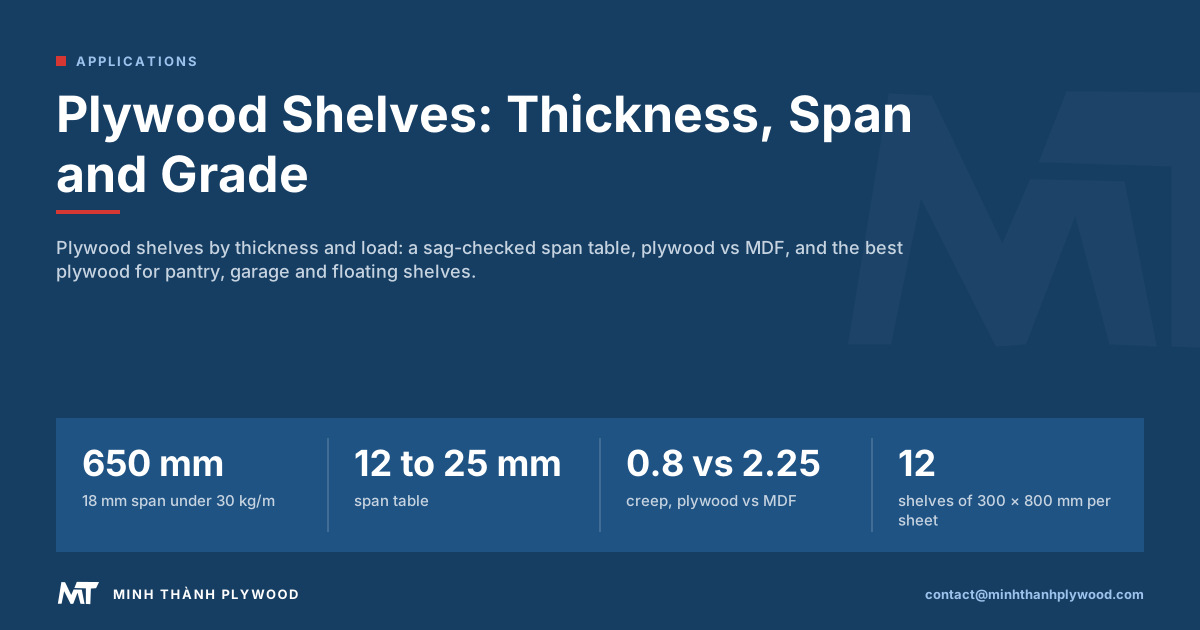
Plywood shelves should be 18 mm thick for most bookcases, cupboards and pantries, 15 mm for light display shelves, and 21–25 mm or reinforced for garages and long spans. Our span table, calculated for 300 mm deep shelves under three loads, shows that an 18 mm plywood shelf spans about 650 mm under a full row of books. Minh Thanh Plywood makes the furniture panels these shelves are cut from.
What is the best plywood for shelves?
The best plywood for shelves is 18 mm furniture plywood with a sanded hardwood face, a closed core and UF glue at E0 emission for indoor use. Choose the face by how the shelf will look, and the thickness by the load and span.
| Shelf | Best plywood | Thickness | Face and finish |
|---|---|---|---|
| Bookcase | Furniture plywood on Styrax or Eucalyptus core | 18 mm | Birch, poplar or EV face; lacquer or paint |
| Wardrobe and closet | Furniture plywood | 15–18 mm | Painted poplar or laminated face |
| Pantry | Furniture plywood, sealed | 18 mm | Lacquered or laminated, easy to wipe |
| Garage and workshop | Plywood with MR or WBP bond | 21–25 mm, or 18 mm with lip | Utility face, sealed |
| Floating shelf | Plywood box or two glued layers | Two 18 mm layers, or a box | Veneered or painted |
| Display niche | Thin to medium plywood | 12–15 mm | Matching veneer face |
Plywood shelves win over particleboard and MDF on load-bearing shelves because their cross-laminated veneers make a light, stiff panel that holds screws in its edges and resists long-term sag. Plywood shelf panels also cut cleanly, take edge banding and come in faces from pale birch to dark engineered veneers.
What thickness of plywood for shelves?
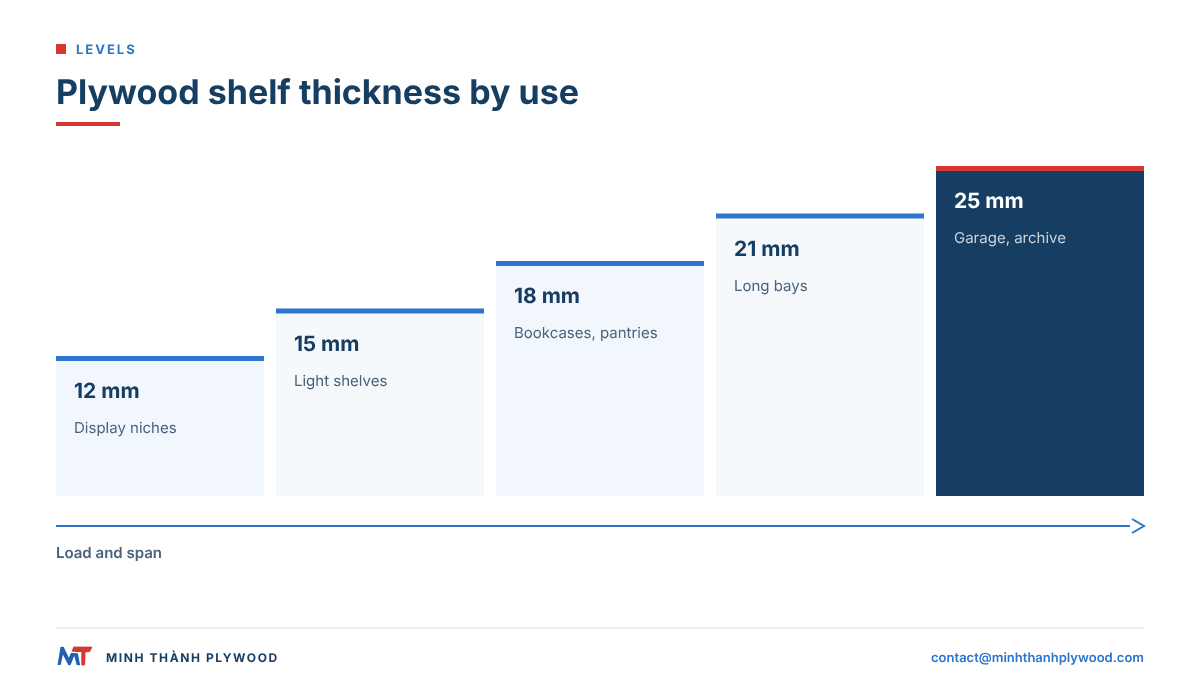
Use 18 mm plywood for most shelves, 15 mm for light ones and 21–25 mm for heavy or long ones. Thickness matters more than anything else: a shelf’s stiffness rises with the cube of its thickness, so going from 15 to 18 mm makes it about 1.7 times stiffer.
| Thickness | Use | Max span under books (30 kg/m) |
|---|---|---|
| 12 mm | Small cabinets, display niches | about 450 mm |
| 15 mm | Light shelves, wardrobes with folded clothes | about 550 mm |
| 18 mm | Bookcases, pantries, kitchen cabinets | about 650 mm |
| 21 mm | Long bookcase bays, office shelving | about 750 mm |
| 25 mm | Garage, workshop, heavy archive shelving | about 900 mm |
The thickness of plywood for shelves also decides the hardware: shelf pins and minifix fittings are made for 15–18 mm panels, and thicker panels need longer pins or brackets. If you want a slimmer look with the strength of a thick shelf, glue a solid wood strip under the front edge rather than going to 25 mm across the whole shelf.
How far can a plywood shelf span? A sag table by thickness and load
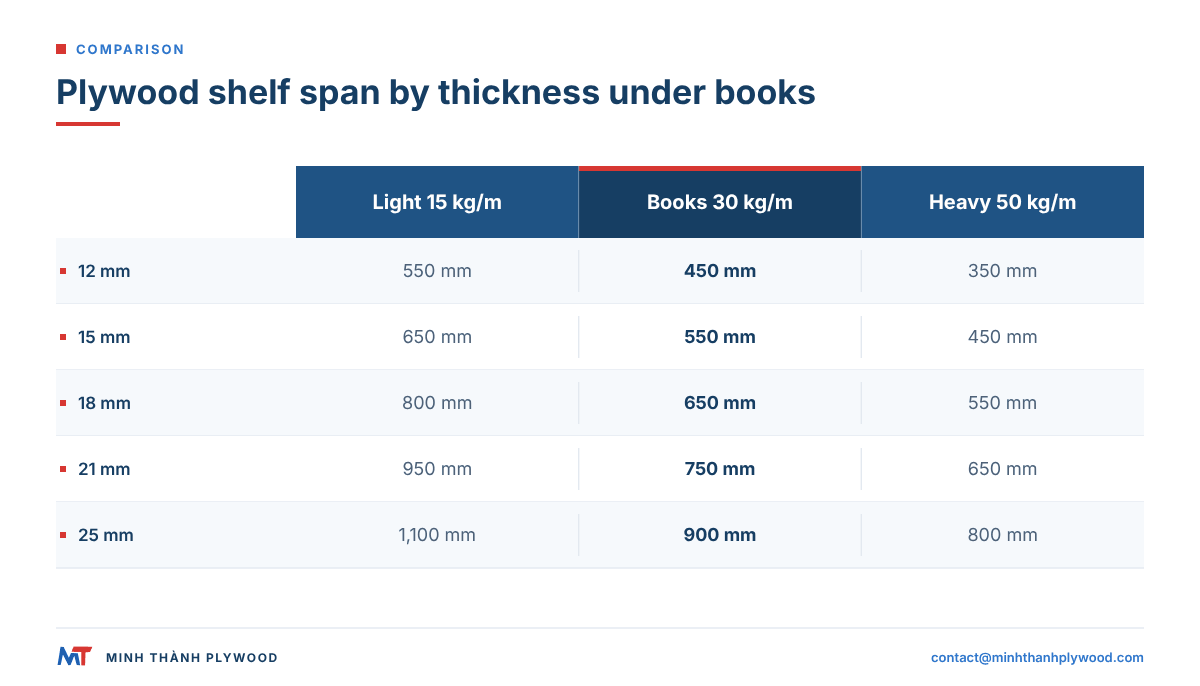
A 300 mm deep plywood shelf spans about 450 mm at 12 mm thick, 650 mm at 18 mm and 900 mm at 25 mm under a full row of books. The table gives the maximum distance between supports for three loads, so that long-term sag stays below 1/300 of the span.
| Plywood shelf thickness | Light, 15 kg/m (decor, folded linen) | Books, 30 kg/m (full row) | Heavy, 50 kg/m (tins, tools, files) |
|---|---|---|---|
| 12 mm | 550 mm | 450 mm | 350 mm |
| 15 mm | 650 mm | 550 mm | 450 mm |
| 18 mm | 800 mm | 650 mm | 550 mm |
| 21 mm | 950 mm | 750 mm | 650 mm |
| 25 mm | 1,100 mm | 900 mm | 800 mm |
How we calculated it, so you can check or repeat it for your own shelf:
- Model. A shelf resting on two supports with the load spread evenly: deflection = 5 × w × L⁴ ÷ (384 × E × I), where I = depth × thickness³ ÷ 12.
- Stiffness. A conservative bending modulus of 5,000 N/mm² along the face grain, the EN 636 E50 class of plywood. Most furniture plywood with hardwood faces is stiffer. Plywood for dry, humid or exterior use is specified in BS EN 636.
- Long-term sag. Shelves stay loaded for years. For plywood in dry indoor service (service class 1), kdef is 0.8 in EN 1995-1-1, Table 3.2. Permanent-load deflection is multiplied by 1 + kdef in the Eurocode 5 serviceability method. Treating the full shelf load as sustained therefore gives a multiplier of 1.8.
- Limit. Final sag no more than span ÷ 300, within the span ÷ 250 to span ÷ 350 range Eurocode 5 gives for net final beam deflection. With no pre-camber, net final deflection equals final deflection. On a 650 mm shelf that is about 2 mm, hard to see.
- Self-weight. The shelf’s own weight is added, at 650 kg/m³, the density of Eucalyptus-core plywood.
Values are rounded down to the nearest 50 mm. A shelf screwed into a back rail or fixed into dados at both ends sags less than this model predicts, so the table errs on the safe side.
How far can an 18 mm plywood shelf span?
An 18 mm plywood shelf, 300 mm deep, spans about 650 mm between supports under a full row of books (30 kg per metre), about 800 mm under light loads and about 550 mm under heavy tins or tools. For a wider bay, add a centre support or a solid front lip rather than accept a visible sag.
Ways to stretch the 18 mm plywood shelf span:
- Front lip. An 18 × 40 mm hardwood strip glued under the front edge turns the shelf into a T-section; in the same beam model it makes a 300 mm deep 18 mm shelf about five times stiffer, and it stiffens the front edge, where sag shows.
- Back rail. Screwing the back edge into a rail or the cabinet back stops the rear from dropping.
- Fixed ends. Dados or screws at both ends restrain rotation and reduce sag compared with loose shelf pins.
- Grain direction. Cut the shelf with the face grain along its length.
- Denser core. A Eucalyptus core, at 650–750 kg/m³, is stiffer than a light Styrax core at about 500 kg/m³, at a higher sheet weight.
Plywood or MDF for shelves?
Plywood is the better choice for shelves that carry weight; MDF is acceptable for short, painted shelves that carry little. The deciding difference is long-term sag: Eurocode 5 gives MDF a creep factor of 2.25 indoors against 0.8 for plywood, so an MDF shelf keeps sagging under books long after a plywood one has settled.
| Metric | Plywood | MDF | Particleboard | Solid wood |
|---|---|---|---|---|
| Long-term creep (kdef, indoors, Eurocode 5) | 0.8 | 2.25 | 2.25 | 0.6 |
| Stiffness for its weight | High | Low | Low | High along the grain |
| Screw holding in edges | Good | Weak, splits | Weak | Good |
| Swelling if wet | Low with MR or WBP bond | High at edges | High | Moves with humidity |
| Painted finish | Good on poplar or birch faces | Very smooth | Needs laminate | Good |
| Widths without joints | Full sheet width | Full sheet width | Full sheet width | Glued boards |
Verdict by use. Plywood for bookcases, pantries, garages and any shelf longer than about 600 mm. MDF for short painted shelves and doors in fitted furniture. Particleboard only with a laminate face and short spans. Solid wood where the shelf is a visible feature and you accept seasonal movement.
Plywood for pantry shelves
Plywood for pantry shelves should be 18 mm thick, sealed or laminated so spills wipe off, and supported every 550 mm or so, because tins and jars load a shelf at about 50 kg per metre.
What a pantry shelf needs:
- Easy-clean face. A lacquered birch or poplar face, or a melamine or high-pressure laminate.
- Sealed edges. Edge banding or a lip so moisture from spills does not enter the core.
- Interior glue. UF glue at E0 emission is the standard for furniture and kitchen panels; Minh Thanh panels meet the emission requirements European and US furniture buyers ask for, with CARB P2 / TSCA Title VI certification (ICTT mill no. 23024) as proof. The US limit for veneer-core hardwood plywood is 0.05 ppm under EPA formaldehyde emission standards.
- Short spans. 550 mm at 18 mm thick, or 650 mm at 21 mm.
Ply shelving for garages and workshops
Garage shelving needs 21–25 mm plywood, or 18 mm with a solid front lip, on supports about 550–650 mm apart, and a water-resistant bond where the garage is unheated. Paint tins, tools and storage boxes load a garage shelf at 50 kg per metre or more.
| Choice | Garage shelving spec |
|---|---|
| Thickness | 21–25 mm; 18 mm with a 40 mm deep lip |
| Bond | MR / melamine-fortified for dry garages; phenolic WBP for damp ones |
| Face | Utility face, sealed or painted |
| Support spacing | 550–650 mm for heavy storage |
| Edge | Solid lip on the front |
Ply shelving in garages also takes point loads, such as a toolbox set down hard, so a closed core without gaps under the face matters more than the face grade.
How to make floating shelves with plywood
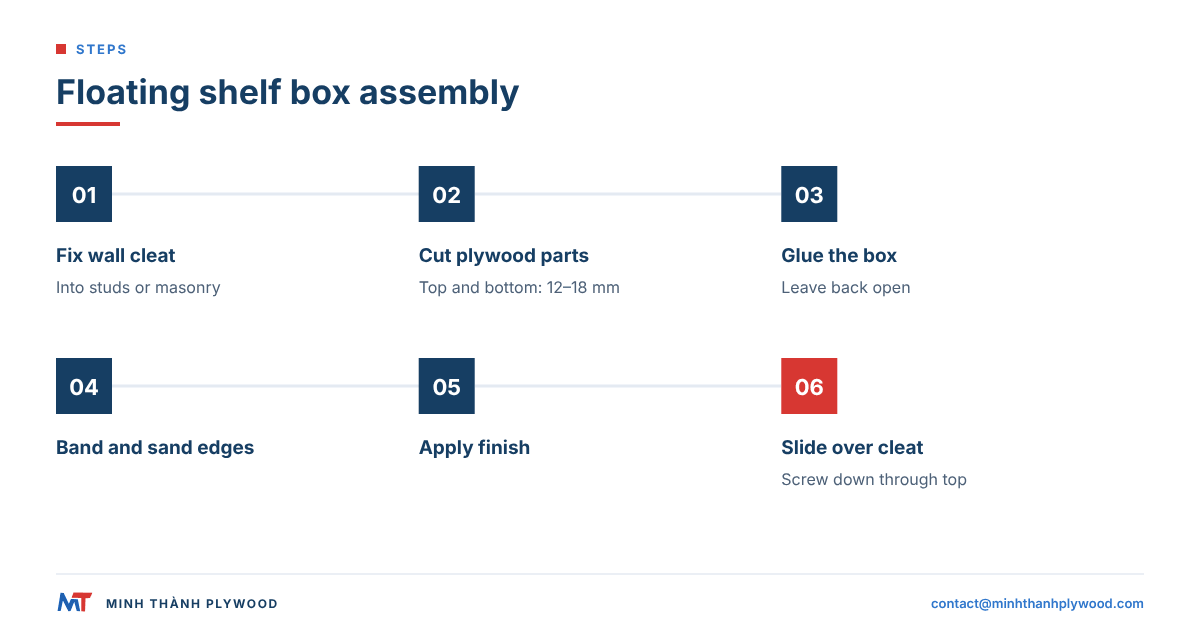
Make a floating plywood shelf as a hollow box that slides over a cleat screwed to the wall, or as two glued layers of 18 mm plywood drilled for steel rods. The box method is lighter and easier to fix level; the solid method takes heavier loads.
- Fix the cleat. Screw a timber cleat, or a steel floating-shelf bracket, level into studs or masonry.
- Cut the parts. Top and bottom from 12–18 mm plywood, front strip and end caps to the shelf thickness you want.
- Glue the box. Glue and pin the top and bottom to the front and ends, leaving the back open to fit over the cleat.
- Band or veneer the visible edges and sand to finish grade.
- Finish with lacquer, oil or paint before fitting.
- Fit and fix. Slide the box over the cleat and screw down through the top into the cleat.
For a solid floating shelf, glue two 18 mm layers into a 36 mm shelf, drill the back edge for the rods and band the front.
Edge finishes for plywood shelves
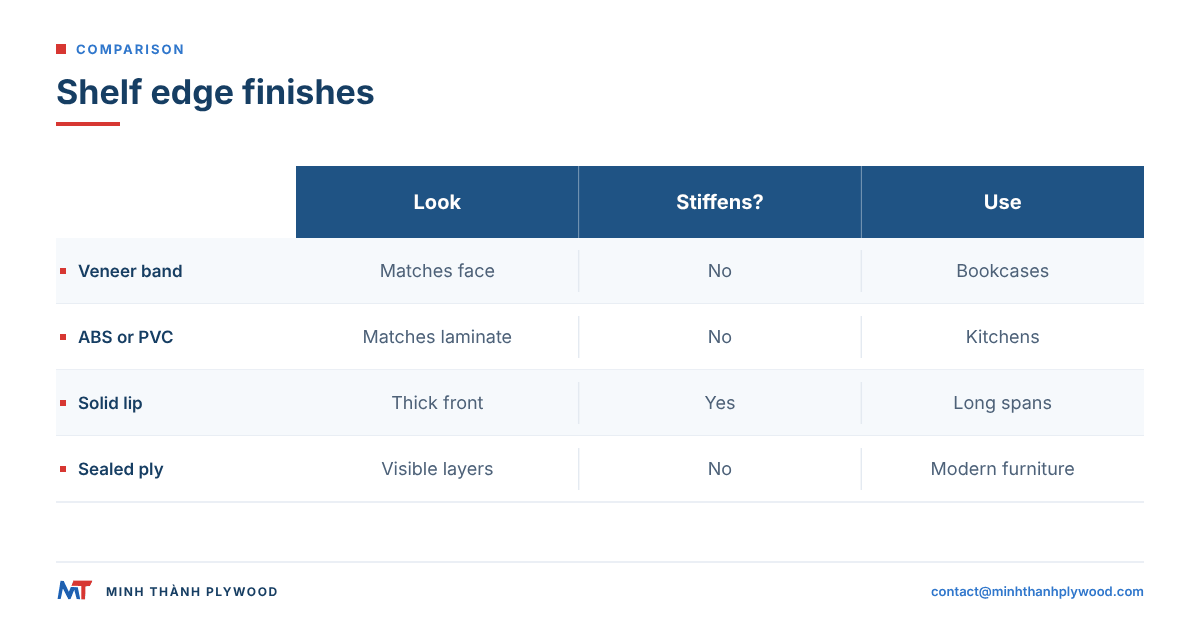
Plywood shelf edges are finished with veneer banding, a solid wood lip, laminate edging or simply sanded and sealed for a visible-ply look. Choose by look and by load: a solid lip both hides the plies and stiffens the shelf.
| Edge | Look | Stiffens the shelf? | Best for |
|---|---|---|---|
| Veneer edge banding | Matches the face | No | Bookcases, wardrobes |
| ABS or PVC banding | Matches laminate colour | No | Kitchen and office shelving |
| Solid wood lip | Thicker, crafted front | Yes | Long spans, garages |
| Sanded and lacquered ply edge | Visible layers | No | Modern and Scandinavian furniture |
Visible ply edges look best on a panel whose core is closed and evenly layered. Minh Thanh stitches core layers both horizontally and vertically and presses furniture panels twice, core first and then the faces, so the edge shows straight, gap-free plies.
Plywood grades and faces for visible and painted shelves
Choose a clear face grade for shelves that show and a paint grade for shelves that will be painted or laminated. Furniture plywood is quoted as face/back pairs, matched to an approved sample.
| Face | Grades quoted | Shelf use |
|---|---|---|
| Birch | D+/D, D/D, D/E (D+ is about B, D about BB in the European scale) | Lacquered bookcases, visible edges |
| Poplar | A/A, A/B, B/B | Painted shelves and wardrobes |
| Eucalyptus | A/A, A/B, B/B | Stiffer shelves, stained finishes |
| Pine | A/A, A/B, B/B | Rustic and painted shelving |
| EV (engineered veneer) | To approved sample | Uniform oak or walnut looks |
Use A/A or D+/D where both faces show, A/B or D/E where one face is hidden against the wall or under a laminate. Both faces of Minh Thanh furniture panels are sanded and UV-ready, so a shelf manufacturer can apply its own UV lacquer line without extra sanding.
How many shelves can you cut from one sheet of plywood?
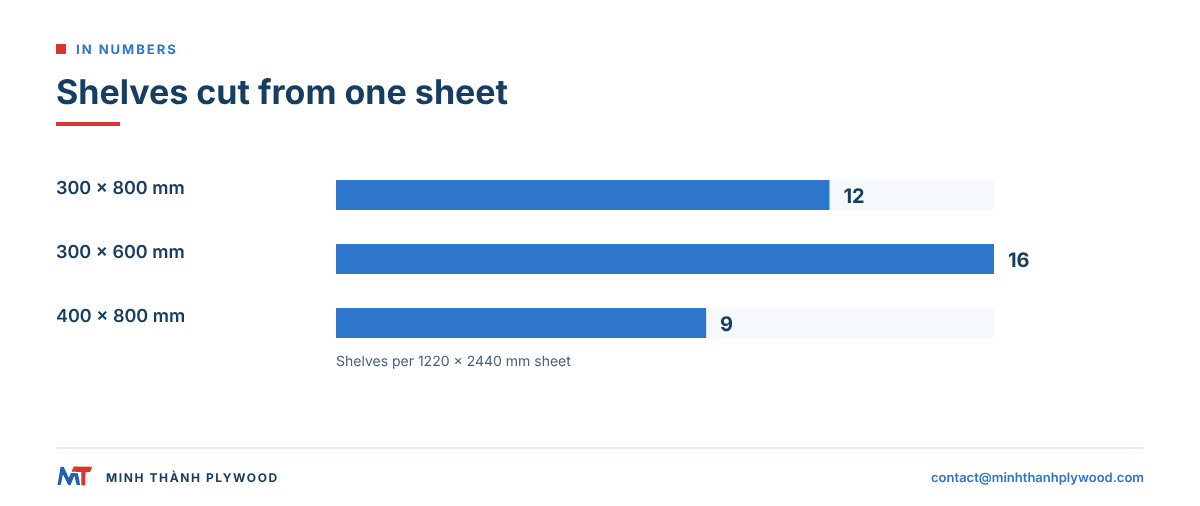
A 1220 × 2440 mm sheet gives four 300 mm strips with three saw cuts of 4 mm, and each 2440 mm strip gives three shelves of 800 mm, so twelve 300 × 800 mm shelves per sheet. At 650 mm long for heavy book loads, the same strip gives three shelves with an offcut of about 470 mm for a small cabinet shelf.
| Shelf size | Shelves per 1220 × 2440 mm sheet |
|---|---|
| 300 × 800 mm | 12 |
| 300 × 600 mm | 16 |
| 400 × 800 mm | 9 |
An 18 mm Styrax-core sheet of 1220 × 2440 mm weighs about 26.8 kg, so a 300 × 800 mm shelf weighs about 2.2 kg. Shelf and cabinet plants that cut many identical parts can order panels cut to size: one panel cut into 4, 6 or 8 pieces, which saves the cutting and the freight on offcuts.
What to write on a shelving plywood order
A shelving plywood order is complete when it states thickness and tolerance, core, glue and emission, face and back grade, size or cutting plan, and packing. Sanded furniture panels from Minh Thanh hold a thickness tolerance of ±0.2–0.3 mm, down to ±0.2 mm, so shelf pins and edge banders run without adjustment.
A shelving order line:
Furniture plywood for shelves, 18 mm ±0.2 mm, Eucalyptus core stitched both ways, pressed twice, UF glue at E0 emission, poplar A/B faces sanded and UV-ready, 1220 × 2440 mm, moisture 8–12%, export packing, one 40HC.
Minh Thanh’s minimum order is one 40HC with mixed specifications by agreement, so a shelf maker can combine 18 mm shelf panels with thin back panels in one container. Production takes 15–45 days after the deposit, and free samples are available. Send your shelf drawings to [email protected].
Buyer questions, answered
What thickness of plywood is best for shelves?
18 mm plywood is the standard for bookcases, wardrobes and pantries up to about 650 mm between supports under a full load of books. Use 15 mm for light display shelves and 21–25 mm, or a solid front lip, for garages and longer spans.
How far can an 18 mm plywood shelf span?
About 650 mm between supports for a 300 mm deep shelf carrying 30 kg per metre, a full row of books, and about 800 mm under light loads of 15 kg per metre. At 50 kg per metre, for tins or tools, keep it to about 550 mm.
Is plywood or MDF better for shelves?
Plywood is better for shelves that carry weight. It is stiffer and creeps much less under long-term load, so it sags less over the years, and it holds screws in its edges. MDF suits short, painted shelves that carry little.
Is 12 mm plywood strong enough for shelves?
Only for short, light shelves. A 300 mm deep 12 mm shelf spans about 450 mm under books and about 550 mm under light decor, so use it for small cabinets and display niches, not bookcases.
What is the best plywood for pantry shelves?
18 mm furniture plywood with a sanded, sealed or laminated face, UF glue at E0 emission, and supports no more than about 550 mm apart where shelves carry tins and jars.
What plywood should I use for garage shelving?
21–25 mm plywood, or 18 mm with a solid timber front lip, on supports about 550–650 mm apart. In unheated or damp garages, choose a melamine-fortified (MR) or phenolic (WBP) bond.
Can you make floating shelves with plywood?
Yes. Build a hollow box of plywood over a hidden timber or steel cleat fixed to the wall, or glue two 18 mm layers into a thick solid shelf drilled for steel rods.
How do you stop plywood shelves from sagging?
Shorten the span, go thicker, glue a solid wood lip under the front edge, fix the shelf into a back rail, or turn the face grain along the length so the stronger direction carries the load.
Which way should the grain run on a plywood shelf?
Along the length of the shelf. The outer veneers carry most of the bending stiffness, so cutting shelves with the face grain running between the supports makes them stiffer.
How many shelves can I cut from one sheet of plywood?
A 1220 × 2440 mm sheet gives four 300 mm strips, and each strip gives three 800 mm shelves, so twelve shelves of 300 × 800 mm per sheet after saw cuts.
Do plywood shelves need edge banding?
Visible shelves do. Iron-on or machine-applied veneer banding covers the plies for a clean look; a solid wood lip covers them and stiffens the shelf at the same time.
Is plywood strong enough for heavy books?
Yes, at 18 mm or thicker on supports about 650 mm apart. For wider bays use 21–25 mm, a front lip or a centre support.