
Plywood is good for a sofa frame: a dense hardwood-core plywood of 15–18 mm holds staples and screws, cuts cleanly on a CNC router and stays stable where solid wood would split. Upholstery plants use utility-faced frame ply because the fabric hides the face. Minh Thanh Plywood makes Eucalyptus and Styrax core panels for frames, cut to size if needed.
Is plywood good for a sofa frame?
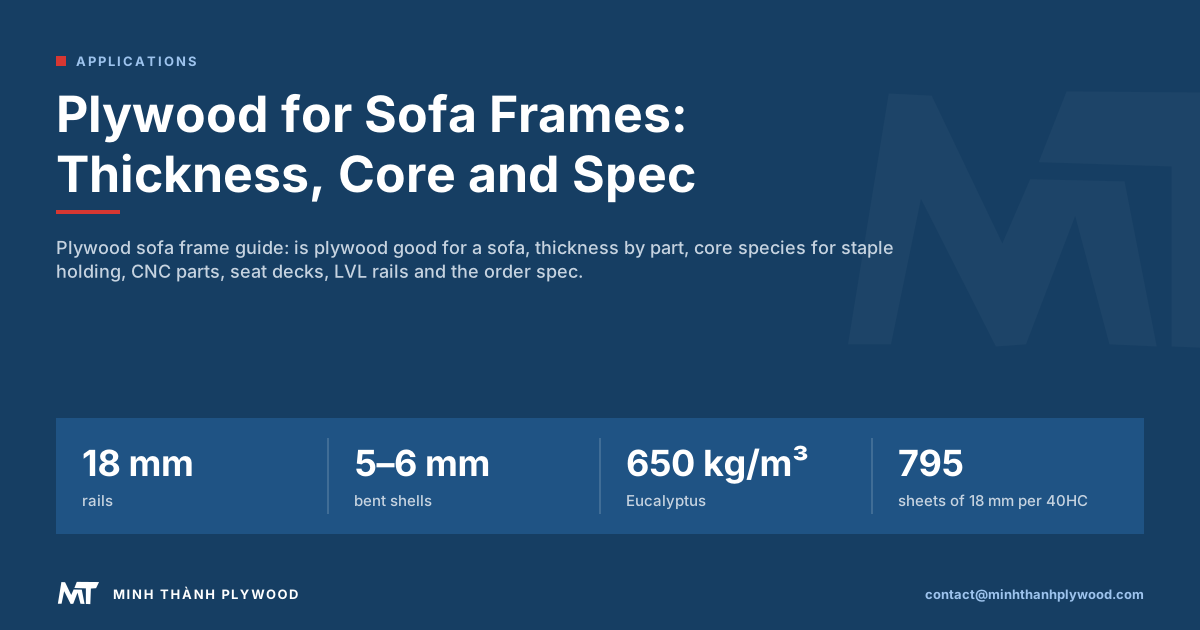
Yes. Plywood is one of the best sofa frame materials: it holds staples and screws, it does not split along the grain and it can be cut on a CNC router into any frame shape. Most upholstered sofas sold today have frames of plywood, often combined with LVL rails and solid-wood legs.
A sofa frame is a box of rails, arms and a back that carries people sitting, leaning and dropping onto it. It is stapled, screwed and glued at every joint. Three panel properties matter most:
- Fixing strength: the panel must hold staples and screws through years of flexing.
- Stability: the frame must not twist or split as the room’s humidity changes.
- Machinability: the panel must cut cleanly into curves, slots and notches.
Plywood’s cross-banded veneers give all three.
Ply wood sofa or plywood couch: is there a difference?
No. A ply wood sofa and a plywood couch are the same thing: an upholstered seat on a plywood frame. Some designs also leave the plywood visible, as a bent or CNC-cut shell finished like furniture, but the frame logic below is the same. Each ply runs at right angles to the next, so a staple line or a screw near an edge cannot open a split along the grain.
Plywood sofa designs with visible plywood
A plywood sofa with visible plywood is a design piece where the panel is the finish: side panels, a base and a back in birch-faced or engineered-veneer plywood, with the cushions loose on top. The common designs are the 3-seater, the modular set of identical boxes that join in any order, and the DIY outdoor couch built from a few sheets. Royale Touche lists the 3-seater as the usual layout for a room that needs sitting space without taking over the floor plan (Royale Touche, checked October 2026).
What changes against a hidden upholstery frame:
- Thickness of exposed parts: 18 to 25 mm for side panels, arms and bases, because the edge shows and the panel carries the load without a rail behind it. Covered parts stay at 15 to 18 mm.
- Face: birch D+/D or D/E, or engineered veneer (EV), quoted as face/back pairs and approved on a sample. Both faces are sanded and ready for lacquer, oil or UV coating.
- Edge: a core with no gaps, because the edge is looked at. Either leave the plies as a deliberate striped edge, sanded and sealed, or close it with a solid strip or veneer edge band.
- Cushions: loose foam cushions on a plywood seat deck, so the plywood is the structure and the soft part is a separate, replaceable layer.
A DIY outdoor plywood couch needs only a short material list. Melissa of Mellysews built one for a budget under the price of the $5,000 couch she had priced, from three 1 × 4 in × 8 ft boards for the frame, one sheet of 3/4 in cabinet-grade plywood for the back, one sheet of 3/4 in B/C plywood for the seat, one 4 × 4 in × 8 ft post for the legs, four flat corner braces, one 1 × 10 in × 8 ft board for the back angle braces and 3 in and 1-1/4 in wood screws (Mellysews, checked October 2026).
| Part | Inch material (Mellysews) | Metric equivalent in Europe |
|---|---|---|
| Back | 3/4 in cabinet-grade plywood | 18 mm birch-faced or EV plywood, E0 |
| Seat | 3/4 in B/C plywood | 18 mm plywood, B/C utility face |
| Frame | 1 × 4 in × 8 ft boards | 19 × 89 mm × 2,440 mm timber |
| Legs | 4 × 4 in × 8 ft post | 89 × 89 mm × 2,440 mm timber |
| Screws | 3 in and 1-1/4 in | 75 mm and 32 mm |
Three-quarter inch plywood is sold in Europe as 18 mm. A DIY build is worth it for a garden or a first prototype; a sofa made in volume uses nested, CNC-cut parts, as below.
What is a sofa frame made of?
A modern sofa frame is made of plywood panels for the shaped parts, LVL or solid wood for long straight rails, and hardwood blocks at the joints and legs. The upholstery, springs and foam sit on that frame.
| Frame part | Usual material | What it does |
|---|---|---|
| Front and back seat rails | 18 mm plywood or LVL | Carry the seat load and the springs |
| Arms (inside shape) | 15–18 mm plywood | Take the arm load and the fabric staples |
| Outer arm shells | 5–6 mm plywood, bent | Give the curve under the fabric |
| Back frame | 15–18 mm plywood | Carries the back cushions and springs |
| Back panel | 9–12 mm plywood | Closes the back, takes staples |
| Seat deck | 12–18 mm plywood | Platform under foam where there are no springs |
| Corner blocks | Solid hardwood or 18 mm plywood | Brace each joint |
| Legs | Solid hardwood or metal | Carry the frame to the floor |
Plywood sofa frame thickness by part
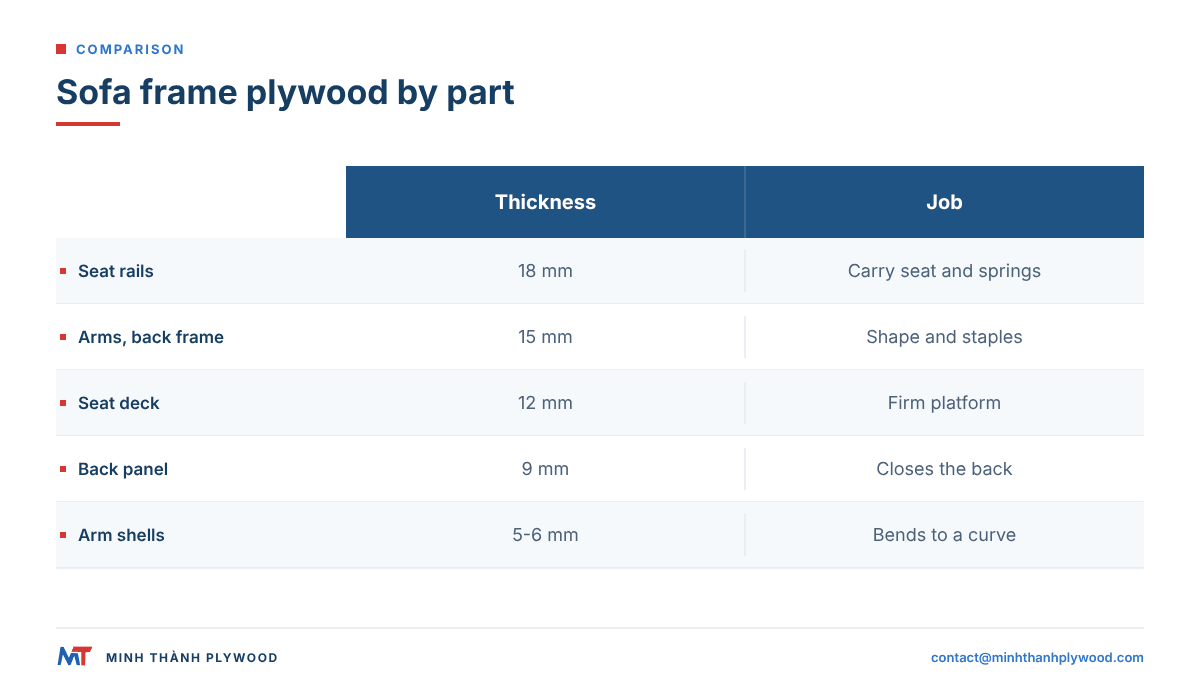
18 mm is the main sofa frame thickness, with 15 mm for shaped parts and thinner panels for backs, decks and shells. Thicker panels give more wall for staples and screws; thinner panels bend.
| Thickness | Typical sofa part | Why this thickness |
|---|---|---|
| 5–6 mm | Outer arm and back shells, bent to a curve | Bends without cracking |
| 9 mm | Back panels, dust panels | Light, holds staples |
| 12 mm | Seat decks on springs, inner backs | Firm platform, moderate weight |
| 15 mm | Arm shapes, back frames, side panels | Enough edge for screws, lighter than 18 mm |
| 18 mm | Front and back rails, arm fronts, cross rails | Main load path, strongest fixings |
Our thin plywood in 3–5 mm is always 5-ply, which is what keeps a bent arm shell from cracking along a single ply. Thickness tolerance on commercial panels is ±0.5 mm; sanded furniture panels hold ±0.2–0.3 mm, which matters when frame parts slot into each other on a CNC-cut joint.
Which plywood is best for a sofa? Core species and staple holding
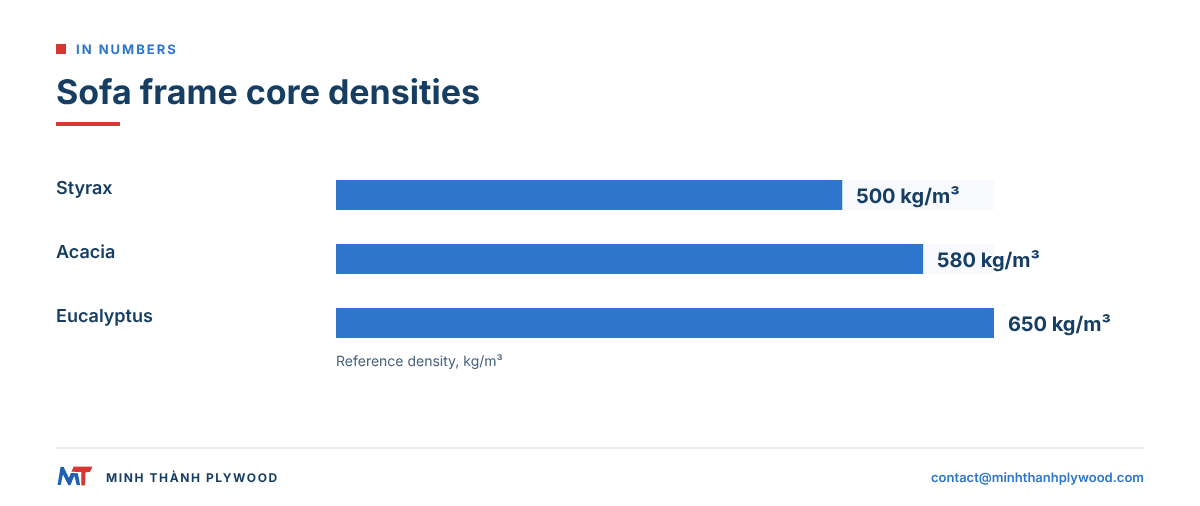
The best plywood for a sofa frame has a dense hardwood core, because density sets how well the panel holds staples and screws. Eucalyptus and Acacia cores hold fixings hardest; Styrax cores are lighter for frames that need to move easily.
| Core | Reference density | Strength in a sofa frame |
|---|---|---|
| Styrax | 500 kg/m³ | Light frames, easy to carry and ship |
| Acacia | 580 kg/m³ | Middle weight, firm staple holding |
| Eucalyptus | 650 kg/m³ | Densest, best screw and staple holding |
Eucalyptus is a common frame ply in upholstery plants because its density holds the many staples a sofa needs, and it is grown in plantations in Vietnam. Our furniture panels use white Styrax or Eucalyptus cores as standard, with Acacia and Pine cores made on order. Core layers are stitched both horizontally and vertically, so inner plies close tight and a staple line does not run into a gap.
See Eucalyptus plywood for faces and grades on a Eucalyptus panel.
Is plywood better than solid wood, MDF or particleboard for sofas?
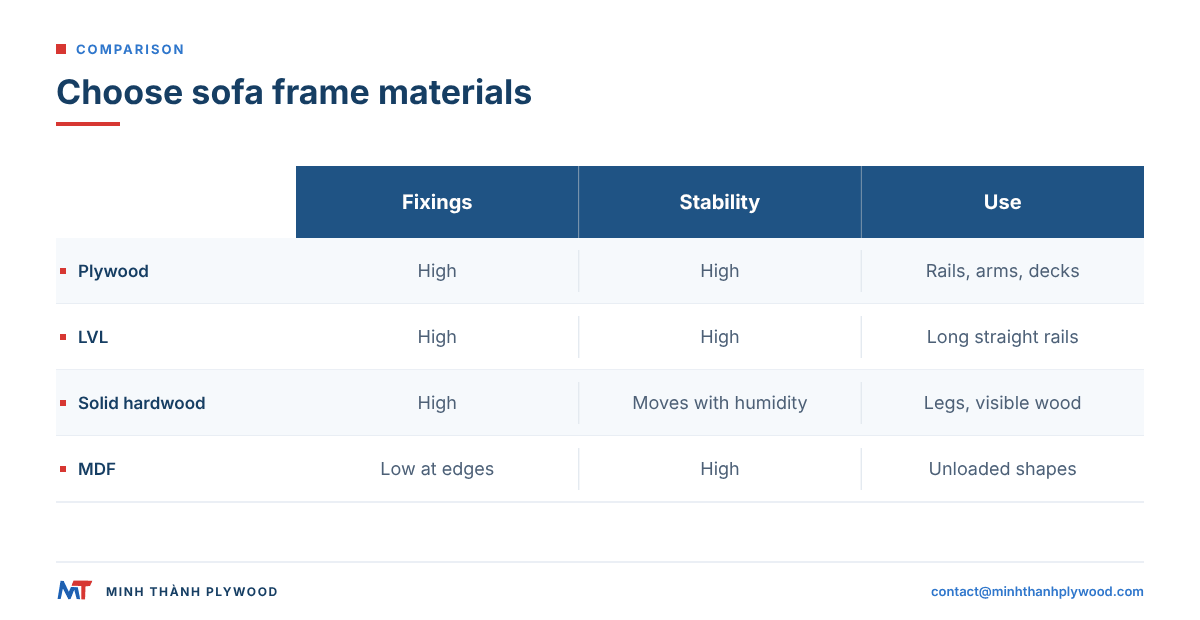
For most upholstered frames, plywood is the best balance of strength, stability and cost. Solid hardwood still suits exposed legs and joined frames; MDF and particleboard do not suit load-bearing frame parts.
| Material | Fixing strength | Stability | Splitting | Sofa frame use |
|---|---|---|---|---|
| Plywood | High | High | Does not split along the grain | Rails, arms, backs, decks |
| LVL | High along the member | High | Very low | Long straight rails |
| Solid hardwood | High | Moves with humidity | Can split at staple lines | Legs, show-wood, joined frames |
| MDF | Low at edges | High | Crumbles at fixings | Only hidden, unloaded shapes |
| Particleboard | Low | Medium | Breaks at fixings | Not for load-bearing parts |
Kiln-dried solid hardwood was the classic premium frame, and it is still a good one. Plywood took over in volume production because it can be nested on a CNC router and gives the same strength at each joint across thousands of frames.
Do sofa frame panels need good faces?
No. Fabric and foam hide the frame, so a utility face is enough on every covered part. Buy better faces only for parts that stay visible.
Our pine-faced panels are quoted as A/A, A/B, B/B and B/C for utility parts; poplar and eucalyptus faces are quoted as A/A, A/B and B/B. For a sofa frame:
- Covered rails, arms and backs: B/C or B/B, matched to the approved sample.
- Visible frame edges on exposed-frame sofas: A/B with a clean edge, approved on a sample.
- Show-wood sofas with a visible plywood shell: a veneer face such as birch or poplar A/A, finished like furniture.
Choosing a utility face for covered parts is the main way upholstery plants keep frame cost down without weakening the frame.
How are plywood sofa frames made? CNC frame parts
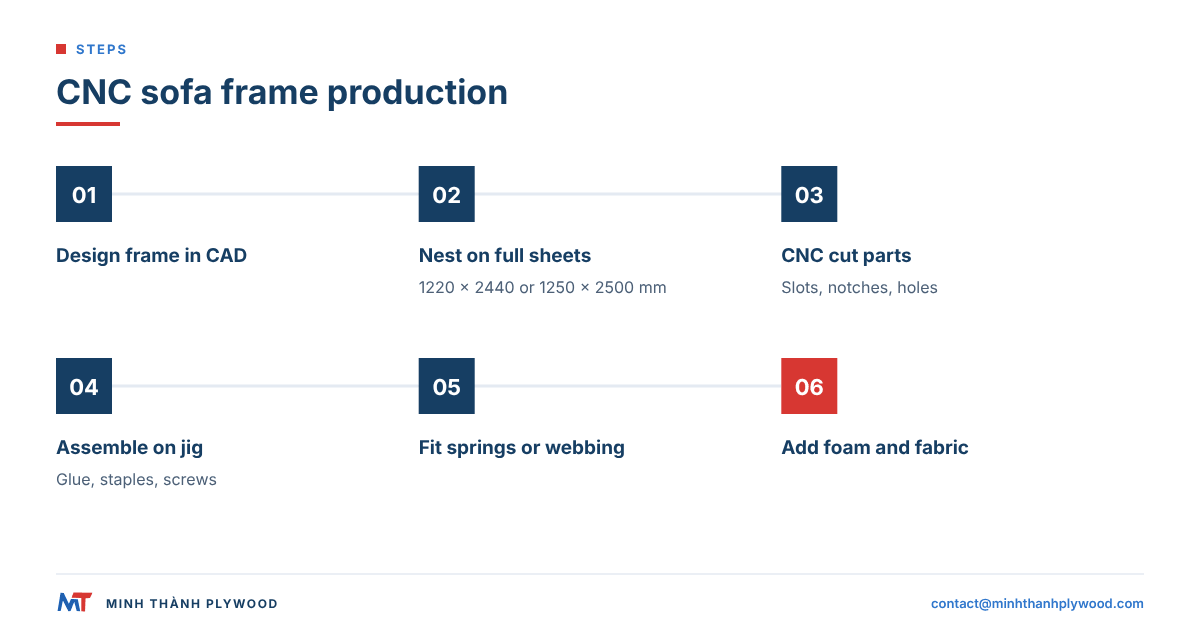
Plywood sofa frames are made by nesting the frame parts on full panels and cutting them on a CNC router. The parts are then glued, stapled and screwed into the frame on a jig.
- Design the frame in CAD, with each part drawn to the panel thickness.
- Nest the parts on 1220 × 2440 or 1250 × 2500 mm panels to use as much of each sheet as possible.
- Cut on the CNC router: outlines, slots, notches and screw holes in one pass.
- Assemble on a jig: glue and staple the parts, add corner blocks and screws at the load joints.
- Fit springs and webbing: zigzag springs or elastic webbing on the seat and back rails.
- Upholster: foam, wadding and fabric stapled to the frame.
Calibrated thickness matters in step 3 and 4. If a frame uses slot joints cut to 18 mm, a panel that runs thick will not fit, and one that runs thin will rattle. Our furniture panels are pressed twice as standard: the core board is pressed and calibrated, then face and back are pressed on, which keeps thickness even across the panel.
Plywood seat decks and chair seats
Seat decks and chair seats are among the most common plywood parts in upholstered furniture. A deck of 12–18 mm plywood gives a firm platform under foam where the design uses no springs.
- Platform sofas and beds: 15–18 mm plywood deck, vented with holes so the foam can breathe.
- Sprung sofas: 9–12 mm deck or no deck, the springs carry the seat.
- Dining and office chairs: 12–15 mm flat plywood seat under foam, or a pressed, curved plywood shell.
- Sofa beds: 12–15 mm slatted or solid plywood deck that folds with the mechanism.
Can you fix a sagging sofa with plywood?
Yes. Cut a 12–18 mm plywood board to the size of the seat, round and sand its edges so it will not cut the fabric, and lay it under the cushions or across the broken springs. It turns a sagging seat into a firm, flat one. For a lasting repair, the springs or webbing should be replaced.
LVL rails in sofa frames
LVL is used in sofa frames for long, straight rails, such as the front seat rail and the back rail. Its veneers all run along the member, so it is stiffer along its length than cross-banded plywood of the same section.
A typical combined frame uses LVL rails for the long members and plywood for the arms, back shapes and decks. Our LVL laminated veneer lumber is made from Acacia or Eucalyptus plantation veneers for furniture-frame components, with UF glue at E0 emission for interior use. It is pressed in 1220 × 2440 or 1250 × 2500 mm billets and cut to the rail sizes on your drawing.
Glue and emission: what bond for a sofa frame?
A sofa sits in a dry living room, so UF glue at E0 emission is the right bond for its frame. Emission matters because the frame is wrapped in foam and fabric and sits close to people for years.
Our furniture panels carry CARB P2 / TSCA Title VI certification (ICTT mill no. 23024). Six ASTM D6007 chamber tests between April 2025 and June 2026, on 9, 15 and 18 mm panels, averaged 0.014–0.032 ppm. The limit for veneer-core hardwood plywood is 0.05 ppm under 40 CFR 770.10. European buyers can have panels tested to EN 717-1 through SGS on request.
For the EU market, three rules apply to a sofa frame. First, formaldehyde: from 6 August 2026 REACH Annex XVII Entry 77 limits furniture and wood-based articles to 0.062 mg/m³ in a chamber test (EU Regulation 2023/1464, checked October 2026), and E0 UF panels, tested to EN 717-1 through SGS on request, are the safe route. Second, due diligence under Regulation (EU) 2023/1115 (EUDR): we supply the dossier with origin records and geolocation files. Third, emission class on the order: write E1 or E0 as its own line, to EN 717-1.
For upholstered furniture in humid climates or outdoor lounge frames under cover, specify an MR / melamine-fortified bond. Fully outdoor frames are better made from treated timber, aluminium or a phenolic-bonded panel.
Cut-to-size frame parts: when does it pay?
Cut-to-size pays when a plant runs the same frame in volume and wants parts, not panels. We cut one panel into 4, 6 or 8 pieces, so blanks arrive sized for the plant’s CNC router or saw.
Cutting at the factory saves freight on offcuts and saw time in the upholstery plant. We ship cut-to-size panels regularly to Italy and other European markets. Send the cutting list with sizes, thickness and quantity; we quote panel and cutting together. Details are on cut-to-size plywood.
How many sofa frames fit in a container of plywood?
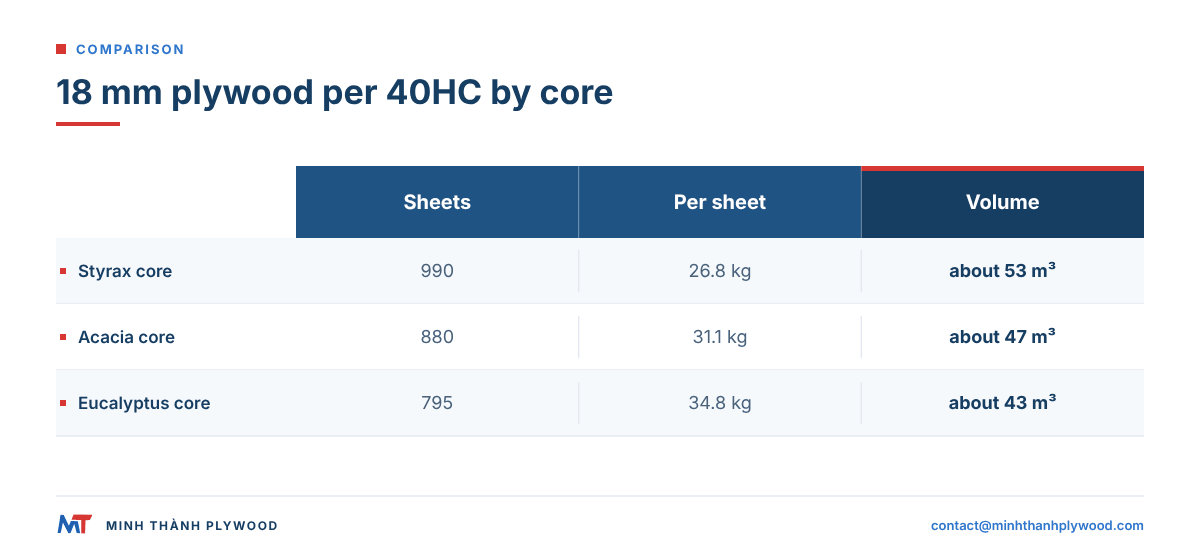
A 40HC of 18 mm plywood carries 990 sheets on a Styrax core, 880 on Acacia or 795 on Eucalyptus, on 1220 × 2440 mm sheets. The number of frames depends on how many sheets one frame uses.
| Core | 18 mm sheets per 40HC | Weight per sheet | Volume |
|---|---|---|---|
| Styrax | 990 | 26.8 kg | about 53 m³ |
| Acacia | 880 | 31.1 kg | about 47 m³ |
| Eucalyptus | 795 | 34.8 kg | about 43 m³ |
Eucalyptus is the densest, so a container of it reaches the weight limit before it is full by volume. If a three-seat frame nests onto two 18 mm sheets, a Eucalyptus container carries frame stock for about 397 frames; a Styrax container for about 495. Mixed loads of 18 mm and thinner panels are agreed per order. Our container loading calculator gives the count for other thicknesses.
What does sofa frame plywood cost?
Furniture and interior plywood from Minh Thanh starts from US$350/m³ (about €312/m³ at €1 = US$1.1215), and commercial plywood from US$250/m³ (about €223/m³), October 2026. Frame ply with utility faces sits toward the commercial end; the final price depends on core, face, glue, thickness, size, quantity and delivery term.
Retail prices of a plywood sofa set, for example in the UAE, are set by fabric, foam, labour and brand far more than by the frame panel. For a plant, the useful number is plywood cost per frame: the sheet count from the nesting plan multiplied by the price per sheet.
What to write on a sofa frame plywood order
A sofa frame plywood order is complete when it names thickness by part, core, glue and emission, faces, size and quantity. This is a typical line from an upholstery plant:
| Field | Example for a sofa frame |
|---|---|
| Application | Upholstered sofa frames, CNC cut |
| Thicknesses | 18 mm rails, 15 mm arms, 9 mm backs |
| Core | Eucalyptus core, stitched |
| Glue and emission | UF glue, E0 emission, CARB P2 / TSCA Title VI |
| Faces | B/C utility, matched to sample |
| Tolerance | ±0.5 mm, or ±0.2–0.3 mm sanded for slot joints |
| Size | 1220 × 2440 mm, or cut-to-size list |
| Moisture | 8–12% |
| Packing and quantity | Export packs, 1×40HC mixed by agreement |
Minh Thanh frame plywood for upholstery plants
Minh Thanh Plywood is a manufacturer in Ha Hoa, Phu Tho, built for top-grade furniture and interior plywood, with Europe as its main market. We also produce commercial plywood, so frame ply and finished-face furniture panels come from one factory and one container. Production runs 15–45 days after the deposit, the minimum order is one 40HC with mixed specifications by agreement, and samples are free.
Send your frame parts list and thicknesses; we reply within hours. For other furniture parts, see plywood for wardrobes, furniture plywood from Vietnam and our guide to plywood for door manufacturing.
Buyer questions, answered
Is plywood good for a sofa?
Yes. Plywood is a standard sofa frame material: it holds staples and screws, does not split along the grain like solid wood and can be CNC-cut into curved arms and backs with little waste.
Which plywood is best for a sofa frame?
A dense hardwood-core plywood, such as Eucalyptus or Acacia core, in 15–18 mm for the structural parts, with UF glue at E0 emission and utility faces hidden under the upholstery.
What thickness of plywood is used for sofa frames?
18 mm for front and back rails, arms and legs blocks; 15 mm for arm and back shapes; 9–12 mm for back panels and seat decks with springs; 5–6 mm for curved outer arm shells.
Is plywood better than solid wood for sofa frames?
For most modern frames, yes. Plywood is stable, does not split at staple lines and can be nested on a CNC router. Solid hardwood is still used for exposed legs and for traditional joined frames.
Is plywood better than MDF or particleboard for sofas?
Yes. Plywood holds staples and screws far better and does not crumble at joints under the flexing of a sofa. MDF and particleboard frames loosen at the fixings over time.
Can I fix a sagging sofa with plywood?
Yes. Cut a 12–18 mm plywood board to the seat size, round the edges, and lay it under the cushions or over the broken springs to give a firm, flat seat.
Is a plywood seat good for chairs?
Yes. Chair seats are commonly 12–18 mm plywood, either flat under foam or pressed into a curved shell, because plywood holds the fixings for legs and upholstery.
What face grade do sofa frame panels need?
A utility face such as B/C or B/B is enough, because the upholstery hides the frame. Pay for better faces only on parts that stay visible.
Does sofa frame plywood need low formaldehyde emission?
Yes, for sofas sold in Europe and the US. Specify UF glue at E0 emission; for the US, CARB P2 / TSCA Title VI compliant panels.
Is LVL used in sofa frames?
Yes. LVL is used for long, straight rails such as the front seat rail and back rail, where its grain runs along the member and resists bending.