
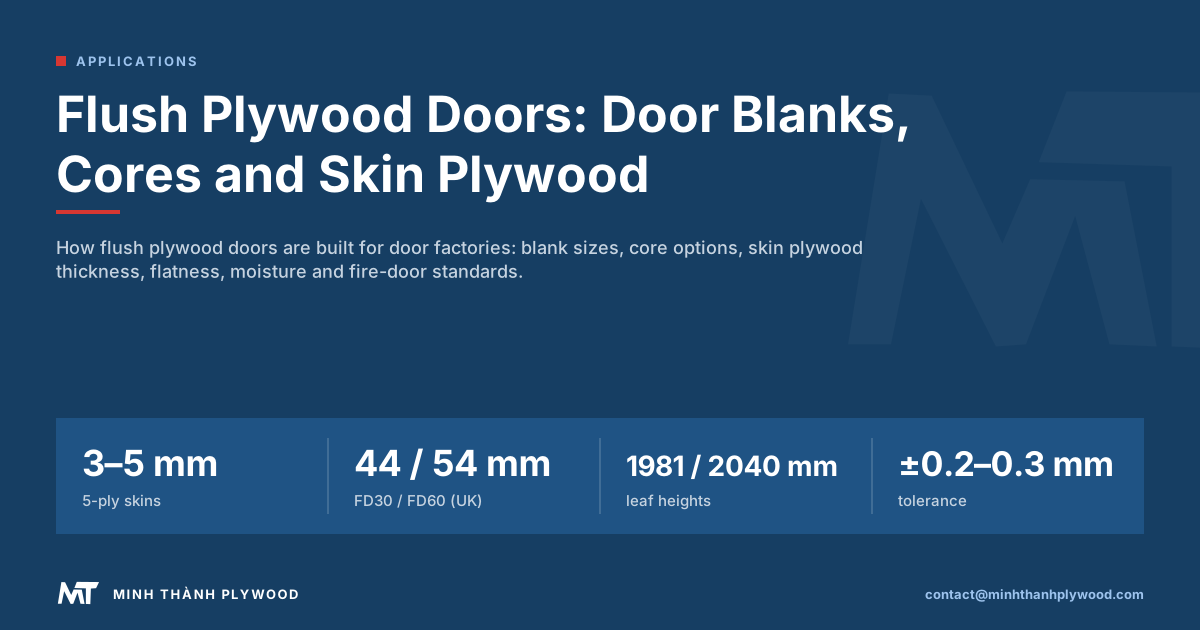
Flush plywood doors are door leaves with two flat plywood skins glued to a frame over a core. Door factories buy them as blanks, cut to size, or build them from skins, frame stock and cores. The skin plywood decides how flat the face stays. Minh Thanh Plywood supplies 3–5 mm 5-ply skin plywood from Phu Tho, Vietnam.
Buying flush plywood doors in the UK: leaf types and trade prices
This block is for a joiner, builder or landlord who wants finished leaves from a merchant; door factories and blank makers skip to the next sections for skin plywood. UK merchants sell flush doors in four common forms. Prices below are trade prices ex VAT from Selco.
The prices were checked on 21 October 2026, and VAT adds 20 %.
| Leaf type | Typical size | Selco trade price, ex VAT |
|---|---|---|
| Internal plywood flush door | 1981 × 762 mm, 1981 × 838 mm | from £37 to £51 |
| Primed FD30 fire door | 1981 × 762 mm | £60.00 |
| Internal plywood FD30 fire door | 1981 × 762 mm, 1981 × 838 mm | from £63.33 |
| FD30 door blank for trimming | 2134 × 914 mm | £107.17 |
| Preglazed plywood FD30 fire door | 1981 × 762 mm | from £185.00 |
Three points decide the choice. An FD30 leaf is 44 mm thick and gives 30 minutes of fire resistance only as part of a tested doorset with frame, seals and hardware. Metric leaves of 2040 × 826 mm exist beside the imperial 1981 × 762 and 838 mm sizes, so measure the opening before ordering. A door blank, such as the 2134 × 914 mm FD30 blank, is oversize so the fitter trims it to the frame.
The leaf prices above are retail. The skin inside each leaf is a 3–5 mm 5-ply plywood panel, and a door maker buying skins by the container pays per cubic metre, not per door. Minh Thanh Plywood supplies that skin plywood: 5-ply, ±0.2–0.3 mm thickness, UF glue at E0 emission, from US$350/m³ for furniture plywood (October 2026).
Flush plywood doors: what they are and how they are built
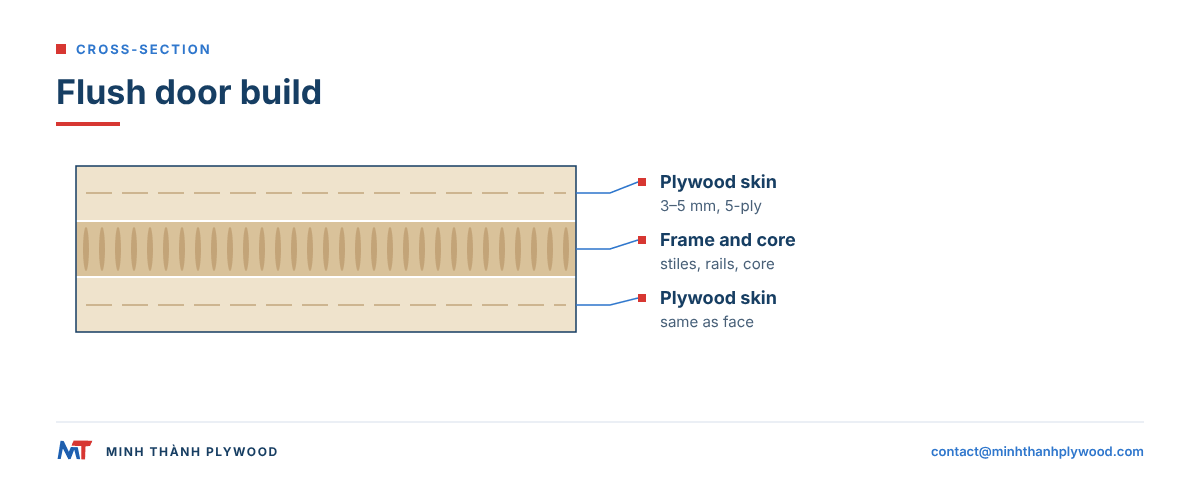
Flush plywood doors are door leaves with two flat plywood skins bonded to a frame, with a core filling the space between. The face carries no panels or mouldings, which makes the flush door the lowest-cost door to make in volume and the easiest to paint, veneer or laminate.
Every flush door has four parts:
- Skins: two plywood faces, usually 3–6 mm, the same on both sides.
- Frame: stiles and rails of solid timber, LVL or engineered timber, which take the hinges and lock.
- Core: the filling between the skins, from paper honeycomb to solid timber or a tested fire core.
- Lippings: hardwood strips on the vertical edges that protect the skin edges and take trimming.
A door factory buys these parts separately, or buys door blanks with frame and core already pressed. Either way, the skin plywood decides how flat the finished face stays, which is why it gets its own specification.
What is a door blank, and why do door factories buy them?
A door blank is an unfinished flush door leaf: frame, core and often skins pressed together, ready for the door factory to trim, machine, edge and finish. Blanks save the factory the pressing line; skins and cores let it control every layer itself.
| What the factory buys | What arrives | What the factory still does |
|---|---|---|
| Door blank, unfaced | Frame and core pressed | Press skins, trim, machine, edge, finish |
| Door blank, faced | Frame, core and skins pressed | Trim, machine, edge, finish |
| Components | Skins, frame stock, cores | Assemble, press, trim, machine, finish |
Blanks are often supplied oversize, so the factory trims them to the opening and the hardware. A blank’s flatness is set at pressing: a blank that is bowed on arrival stays bowed. Ask for the flatness check method and the moisture at dispatch for every component.
Minh Thanh Plywood supplies the skin plywood and 18 mm furniture plywood that door factories press into their own doors and blanks.
Flush door core options compared
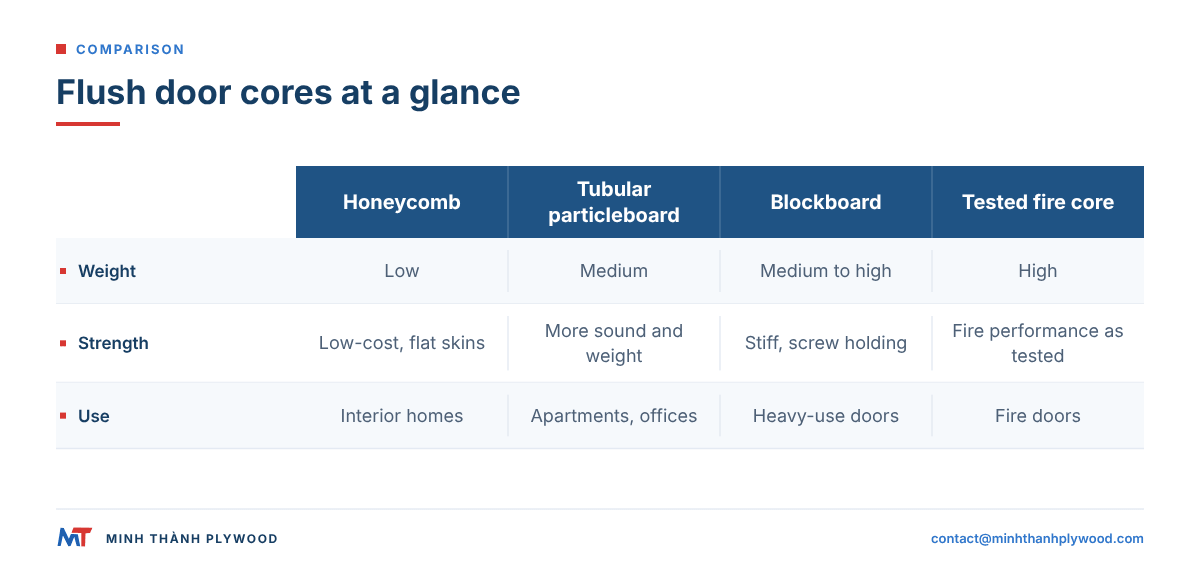
The core sets the door’s weight, stiffness, sound and screw holding. These are the core types a door factory chooses from:
| Core | Weight | Strong points | Typical use |
|---|---|---|---|
| Hollow (frame only, with rails) | Lowest | Low cost | Light interior doors |
| Paper honeycomb | Low | Flat skins, low cost | Interior doors for homes and hotels |
| Tubular particleboard | Medium | Better sound, more weight | Apartments, offices |
| Solid particleboard | High | Sound, screw holding | Commercial interiors |
| Blockboard (timber strips) | Medium to high | Stiff, holds screws across the face | Heavy-use and wide doors |
| LVL | Medium to high | Straight, strong stiles and lock blocks | Frames, lock blocks, solid cores |
| Tested fire core | High | Fire resistance as tested | Fire doors |
The lighter the core, the more the skin has to do. A honeycomb core supports the skin only at its cell walls, so a thin, stiff, flat 5-ply skin matters most on light doors. Our LVL page covers laminated veneer lumber for frames and lock blocks.
Skin plywood: thickness, plies and face
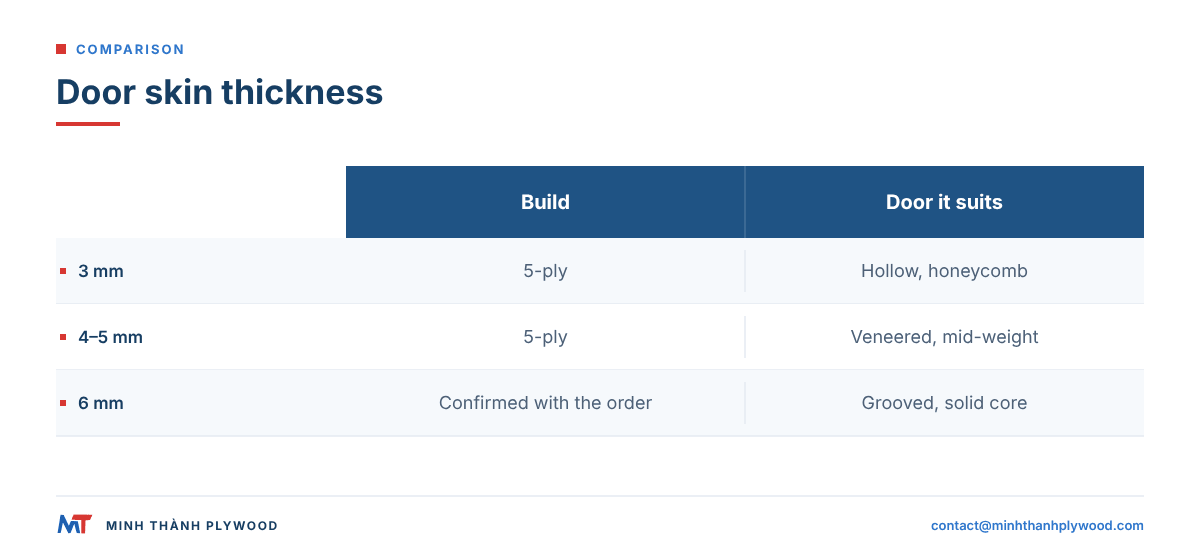
Flush door skins are usually 3–6 mm plywood, chosen by the core and the finish. The thinner the skin, the more its build shows: a 3-ply skin with thick veneers can telegraph the frame and core through paint, where a 5-ply skin stays flat.
- 3 mm skins: hollow and honeycomb doors under paint or laminate.
- 4–5 mm skins: veneered faces and mid-weight doors.
- 6 mm skins: routed grooves, heavy solid-core doors and doors that take hard use.
At Minh Thanh Plywood, thin plywood of 3–5 mm is always 5-ply. The 3 mm panel is one core veneer, two cross-band veneers and two faces; the 4 and 5 mm panels are three core veneers and two faces, with the core veneer thickness adjusted to the panel. Premium thin veneer is scarce, so thin panels can take longer to make; we do not lower the standard to go faster.
Which face plywood for which flush door?
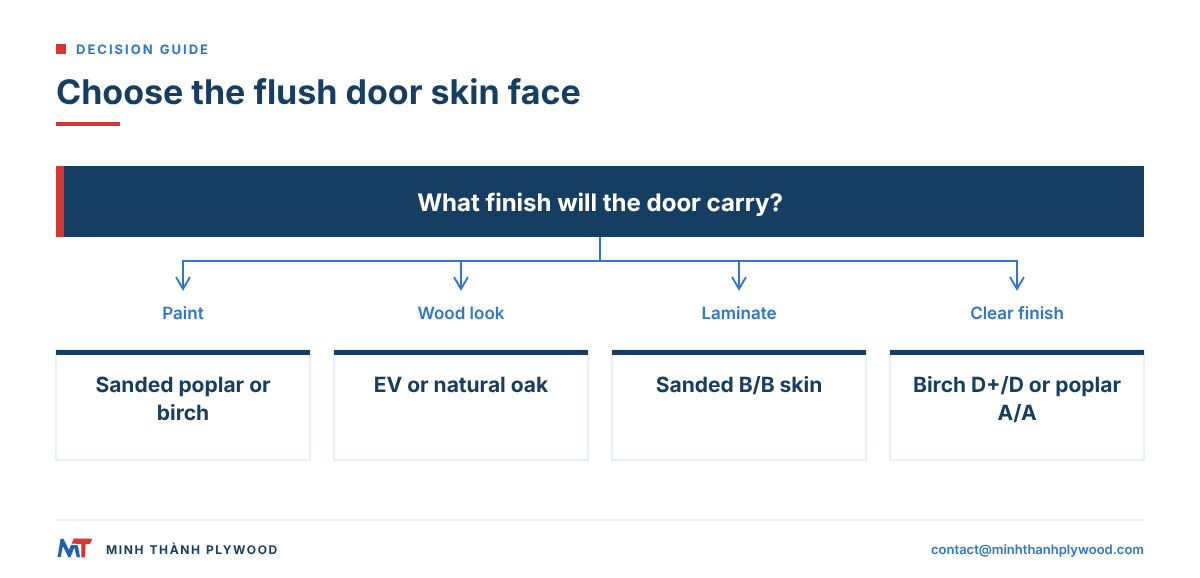
The skin’s face species is chosen for the finish the door will carry. Use the same face on both sides, or at least the same build, so the door stays balanced.
- Painted doors: poplar or birch faces, sanded and primed. Poplar is pale and smooth; birch is harder and resists dents.
- Wood-look doors: EV (engineered veneer) for an oak or walnut grain that repeats on every door, or a natural oak veneer.
- Laminated doors: B/B grade sanded skins under melamine, HPL or PVC.
- Clear-finished doors: birch D+/D or poplar A/A for two seen faces.
Poplar faces are quoted as A/A, A/B and B/B; birch faces as D+, D and E, comparable to the European birch grades. The approved sample fixes the face for every lot. See our birch plywood and poplar plywood pages.
Flatness: why flush doors bow and how the skins prevent it
A flush door bows when one skin takes up or loses moisture faster than the other, or when the frame and the skins were at different moisture when pressed. The door is a balanced sandwich: any imbalance becomes a bow.
The skin plywood prevents bowing in three ways:
- Equal moisture: veneers and finished panels dried to 8–12 % at dispatch, matched to the frame and core.
- Calibrated thickness: furniture-grade panels are pressed twice, the core board pressed and calibrated before the faces go on, then sanded to ±0.2–0.3 mm. An even skin gives an even glue line.
- Same skin both sides: same species, thickness, build and glue on both faces.
Door factories finish both faces and seal the top and bottom edges, so that moisture moves in and out evenly. In Europe, door flatness is measured under EN 1530 and leaf dimensions under EN 951.
Moisture and glue for door skins
Door skins need a glue that suits the door’s room and a moisture content that matches the frame. Two lines go on the order:
- Glue: UF glue at E0 emission for interior doors; MR, melamine-fortified bond for kitchens, bathrooms and humid climates; phenolic (WBP) bond for external doors.
- Moisture: 8–12 % at dispatch, the normal range for furniture plywood.
For US door makers, the skins must meet CARB Phase 2 / TSCA Title VI. The limit for hardwood plywood with a veneer core is 0.05 ppm under 40 CFR 770.10. Minh Thanh Plywood is certified under ICTT mill no. 23024. Six ASTM D6007 chamber tests between April 2025 and June 2026, on 9, 15 and 18 mm panels, averaged 0.014–0.032 ppm against the 0.05 ppm limit. For Europe, third-party testing to EN 717-1 or another method is arranged through SGS on request.
Flush door sizes and blank sizes
Flush door sizes follow the market the doors are sold in. These are the common leaf sizes:
| Market | Leaf height | Leaf widths |
|---|---|---|
| UK, imperial | 1981 mm | 610, 686, 762, 838 mm |
| UK and Europe, metric | 2040 mm | 526, 626, 726, 826, 926 mm |
| US | 80 inches | 24–36 inches |
Door blanks are often made oversize for trimming. Skin plywood is cut from standard sheets or ordered to the skin size: Minh Thanh Plywood makes 1220 × 2440 mm and 1250 × 2500 mm sheets, plus custom sizes such as 1220 × 2500 mm and 1220 × 2280 mm. Cut-to-size panels let the door factory skip the sheet saw.
Flush ply fire doors: what rates a ply fire door, and what plywood can claim
Flush ply fire doors earn their rating only as complete, tested doorsets. A ply fire door is rated as a whole doorset: leaf, frame, glazing, seals and hardware together. Plywood skins alone do not make a door fire rated, and a plywood supplier cannot give one.
The tests that rate a fire door are:
- UK: BS 476-22, or BS EN 1634-1 under the classification of BS EN 13501-2.
- Europe: EN 1634-1, classified under EN 13501-2 (for example EI 30, EI 60).
- US: UL 10C and NFPA 252, positive-pressure tests for swinging doors.
In the UK, an FD30 leaf is commonly 44 mm thick and an FD60 leaf 54 mm. Approved Document B sets where fire doors are required in England. A fire door maker builds every door exactly as its test evidence describes, including the skin species and thickness, so the skin plywood must match the tested build. Ask the fire door maker for its skin specification before ordering skins.
Our fire-rated plywood buying guide explains fire-retardant panels and their tests.
External flush plywood doors
An external plywood door is built for weather from the inside out. It needs exterior-bonded skins, a solid core, a durable frame and a finish that covers every surface.
- Skins: phenolic (WBP) bond; 6 mm or thicker for impact.
- Core: solid timber, LVL or solid particleboard made for external use.
- Frame and lippings: hardwood or treated timber, wide enough for locks and hinges.
- Finish: paint, stain or laminate on both faces and all four edges.
- Hanging: a canopy or frame that sheds rain, and a weather bar at the bottom.
An interior flush door with UF-glued skins should not be used outside, even under paint. Our guide is plywood waterproof? explains the bond classes, and BS EN 314-2 defines the bonding-quality requirements for plywood.
Quality checks on door skin plywood at delivery
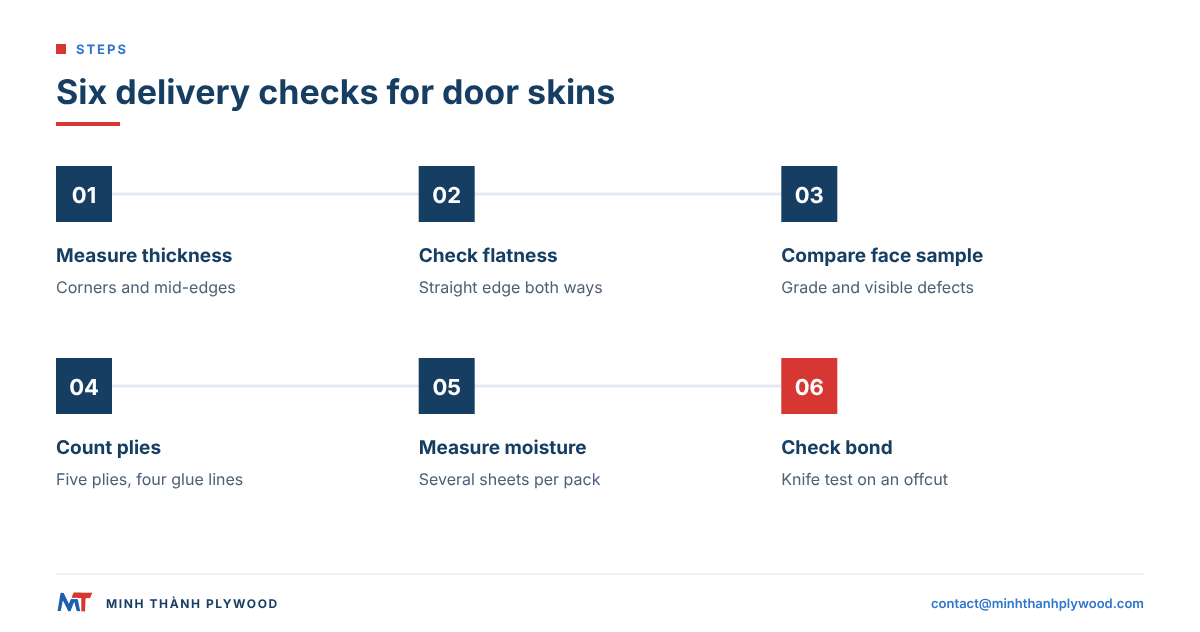
Check door skins on arrival before they go to the press. These checks catch most skin problems:
- Thickness: caliper at the four corners and mid-edges; against the written tolerance.
- Flatness: a straight edge across the sheet, both directions.
- Face: grade against the approved sample; no open splits, overlaps or patches beyond the grade.
- Plies: count the glue lines on the edge: a 5-ply skin shows four.
- Moisture: a meter reading on several sheets per pack.
- Bond: a knife test on an offcut edge.
Every Minh Thanh shipment is photographed and filmed before loading, and the buyer receives the photos and video. Shipping documents are the commercial invoice, packing list, B/L and certificate of origin (EUR.1 for the EU), with phytosanitary and fumigation certificates.
How to specify skin plywood for flush doors
A skin plywood order is complete when two mills reading it would make the same skin. Write these lines:
- Door type: hollow, honeycomb, solid, external or fire door (with the maker’s tested skin spec).
- Thickness and build: 3, 4 or 5 mm, 5-ply.
- Face and back: species and grade pair, such as poplar B/B or birch D+/D, same on both skins.
- Core of the skin: white Styrax or eucalyptus.
- Glue and emission: UF at E0, MR or phenolic; CARB P2 / TSCA Title VI for the US.
- Tolerance and moisture: for example ±0.2 mm and 8–12 %.
- Size: sheet or skin size, with grain direction.
- Packing and quantity: sheets per pack, packs, container and port.
Buying skin plywood for flush doors from Minh Thanh Plywood
Minh Thanh Plywood is a manufacturer of furniture and interior plywood in Ha Hoa, Phu Tho, built for top-grade panels with Europe as its main market. For door factories we supply 3–5 mm 5-ply skin plywood, 18 mm furniture plywood for cabinet and wardrobe doors, cut-to-size panels and LVL.
The minimum order is 1×40HC, with mixed specifications by agreement, so skins of two thicknesses can share a container. Production takes 15–45 days after the 30% deposit; the 70% balance is paid against the scanned B/L, or by irrevocable L/C at sight, on FOB Hai Phong, CFR or CIF. Sea transit from Hai Phong is about 15–25 days to the Middle East and 30–40 days to Northern Europe.
Send your skin specification to [email protected] or WhatsApp +84 988 586 601. We reply within hours and send free samples. See our thin plywood page for the 3–6 mm range, and our guide to plywood doors for door types and plywood choice.
Buyer questions, answered
What is a flush plywood door?
A door leaf with two flat plywood skins glued to a timber frame, with a hollow, honeycomb, tubular, particleboard, blockboard or solid core between them. The face has no panels, so it is painted, veneered or laminated.
How much does a flush plywood door cost in the UK?
Selco's trade prices ex VAT start at £37–51 for an internal plywood flush door and £63.33 for a plywood FD30 fire door; an FD30 blank in 2134 × 914 mm is £107.17 and a preglazed FD30 starts at £185 (October 2026). VAT adds 20 %.
What is a door blank?
A door blank is an unfinished flush door leaf, oversized or cut to a standard size, that the door factory trims, machines for hinges and locks, edges and finishes. Some blanks are sold faced; others leave the skin to the buyer.
What thickness of plywood is used for flush door skins?
Usually 3–6 mm. Thinner skins suit hollow and honeycomb doors under paint or laminate; 4–6 mm skins suit veneered faces, routed grooves and heavier solid-core doors.
What core is best for a flush door?
It depends on the use: honeycomb or hollow cores for light interior doors, tubular particleboard for sound and weight, blockboard or LVL for hardware fixing and stiffness, and a tested mineral or timber core for fire doors.
Are flush plywood doors fire rated?
Only when the complete doorset has passed a fire test such as BS 476-22 or EN 1634-1 in the UK and Europe, or UL 10C and NFPA 252 in the US. Plywood skins alone do not give a door a fire rating.
What is a ply fire door?
A fire door with plywood skins over a tested fire core, built exactly as the tested design. In the UK an FD30 leaf is commonly 44 mm thick and an FD60 leaf 54 mm, but the rating comes from the test certificate.
Can flush plywood doors be used outside?
Yes, when they are built as external doors: exterior-bonded skins, a solid core, a hardwood or treated frame, and a finish on every face and edge. An interior flush door with UF-glued skins should stay indoors.
What moisture content should door skins have?
The skins, frame and core should be at the same moisture before pressing. Minh Thanh Plywood dries its veneers and finished panels to 8–12 % moisture content at dispatch.
How flat should flush door skins be?
Flat enough that the frame and core do not show through the finish. Sanded skins at ±0.2–0.3 mm thickness tolerance, pressed on a calibrated core, give an even glue line under paint, veneer or laminate.
What sizes are flush doors?
UK imperial leaves are 1981 mm high and 610–838 mm wide; UK and European metric leaves are 2040 mm high and 526–926 mm wide; US leaves are commonly 80 inches high. Door blanks are often supplied oversize for trimming.
Which face plywood is best for flush doors?
Poplar or birch skins for painted doors, EV or oak-faced skins for wood-look doors, and B/B grade sanded skins under laminate. Use the same skin on both faces to keep the door flat.