
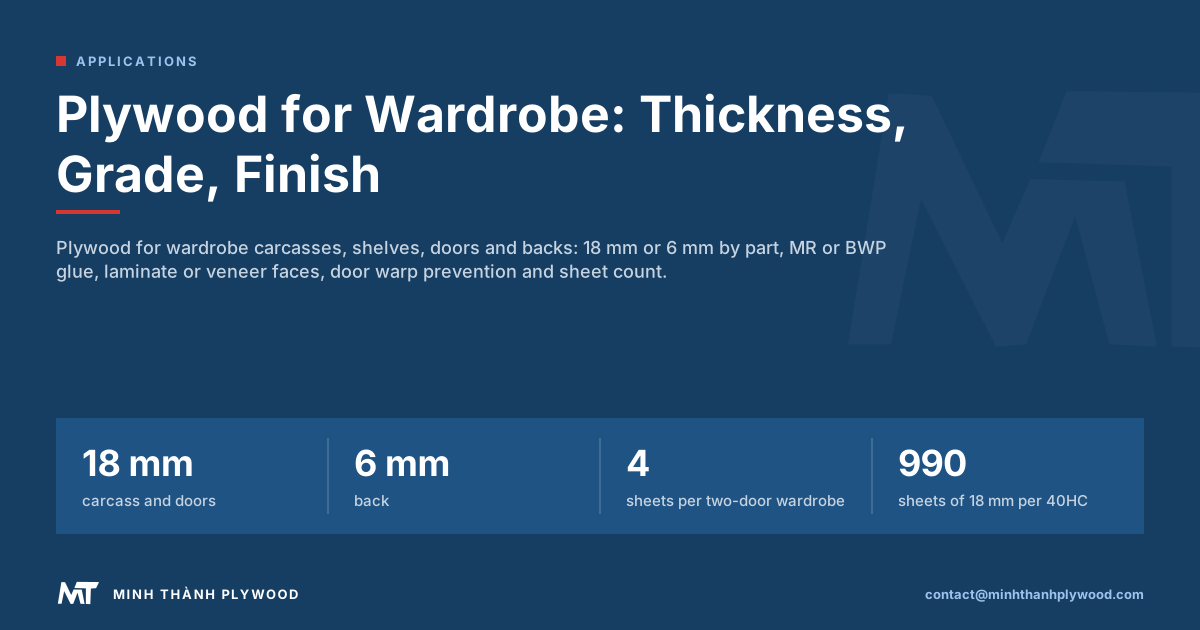
The best plywood for wardrobe carcasses is an 18 mm hardwood-core panel for the carcass, shelves and doors, a 6 mm panel for the back, UF glue at E0 emission for a dry bedroom and faces chosen for the finish. Minh Thanh Plywood presses these panels twice and sands them to ±0.2–0.3 mm, which keeps carcasses square and doors flat.
Which plywood is best for a wardrobe?
The best plywood for a wardrobe is 18 mm hardwood-core plywood with UF glue at E0 emission and faces matched to the finish, used for carcasses, shelves and doors. It holds screws and hinges, stays flat across tall doors and keeps the room’s air clean.
Four choices decide a good wardrobe panel:
- Thickness by part: 18 mm carcass, shelves and doors; 6 mm back.
- Glue and emission: UF glue at E0 emission for a dry room; MR/melamine-fortified or phenolic WBP bond for a humid one.
- Faces by finish: A/A veneer for surfaces you see, A/B for one visible side, B/B under laminate or paint.
- Flatness and tolerance: a twice-pressed, sanded panel with a tight thickness tolerance.
Plywood beats particleboard and MDF on screw holding, weight per strength and resistance to sagging. It costs more per sheet, so many wardrobe makers use plywood for the carcass and doors and keep it in every part that takes hardware.
What plywood sheets do UK buyers see for wardrobes, and what do they cost?
UK wardrobe builders choose between three 18 mm sheets in 2440 × 1220 mm (8 × 4 ft): birch plywood BB/BB, structural hardwood plywood and marine plywood to BS 1088, and a birch BB/BB sheet costs about £104 to £154 including VAT while a BS 1088 marine sheet costs about £62 to £117.
B&Q (diy.com) lists plywood in 18 mm and other thicknesses (B&Q plywood, checked October 2026). Its delivery charges run from £6 to £15.
| 18 mm sheet, 2440 × 1220 mm | Typical UK price per sheet, inc VAT | When it is the right wardrobe panel |
|---|---|---|
| Birch BB/BB throughout | £103.68 (Pure Tree Timber) to £154.22 (Fulham Timber) | Exposed birch carcasses and doors with a clear finish |
| Structural hardwood plywood | listed in packs of 2 and 5 | Hidden carcass parts and painted or laminated units; structural grade is more than a wardrobe needs |
| Marine plywood BS 1088 | £61.63 (Plumb) to £116.65 (Elliotts), £77.89 at Howarth Timber | Overkill for a dry bedroom; right for a bathroom or boat |
Prices checked in October 2026 on the merchants’ pages (Pure Tree Timber, Fulham Timber, Plumb, Elliotts, Howarth Timber); sellers quote with and without VAT and in packs, so confirm at checkout. A Vietnamese furniture panel gives a wardrobe builder an A/B or B/B face, E0 emission and a tight thickness tolerance, quoted from US$350/m³ FOB; an importer compares that with the shelf prices above after freight, duty and VAT.
UK buyers also look for FSC or PEFC chain of custody and for UK Timber Regulation due diligence. FSC is quoted per order and never assumed; the origin records and geolocation files of our EUDR dossier support the due diligence.
Why plywood stays flatter than solid timber, and beats MDF and chipboard in a wardrobe
Plywood stays flatter than solid timber because each veneer is glued at right angles to the next, so the panel’s wood tries to move across its width in one layer and along it in the next, and the layers hold each other still. Solid timber moves across the grain with every change in room humidity, which is why a wide solid door cups and a plywood door stays flat. Plydirect explains the same crossbanding principle for UK carpenters (Plydirect, checked October 2026).
Against particleboard (chipboard) and MDF for a wardrobe carcass, plywood holds hinge and runner screws in its edge, does not crumble at repeated screw-ins, and weighs less for the same strength. The price per sheet is higher, so many makers use plywood for sides, shelves and doors and MDF only for painted door fronts.
Plywood for wardrobe parts: what thickness goes where?
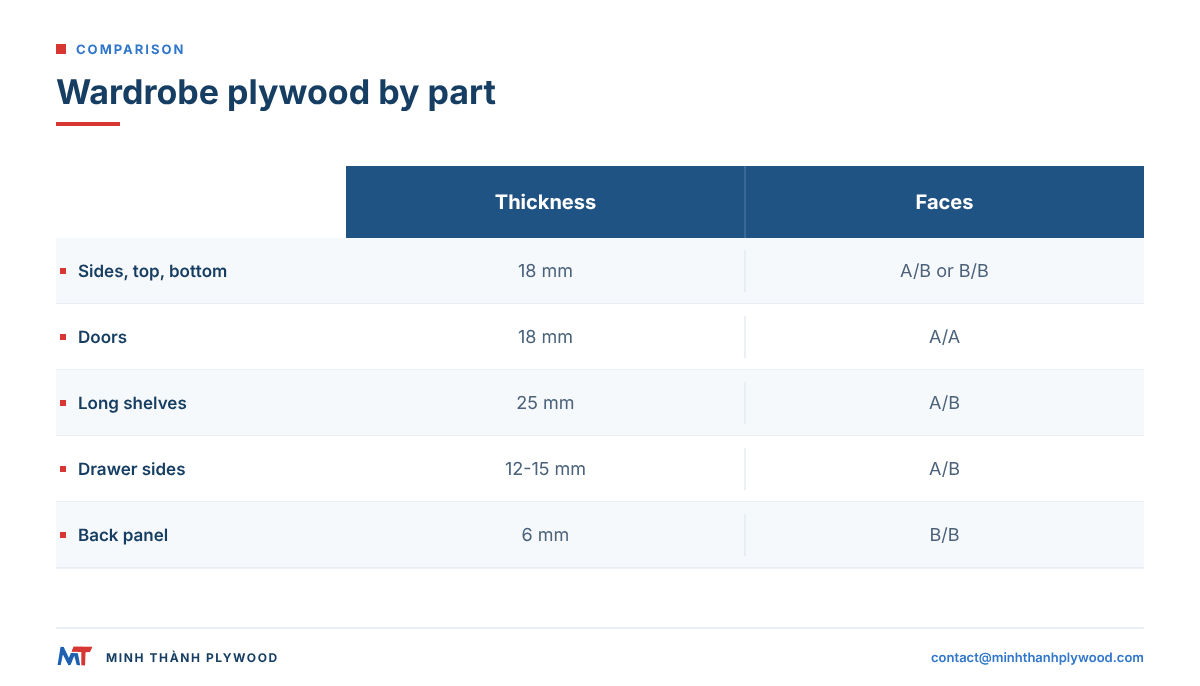
Each wardrobe part has its own job, so each gets its own thickness and face. This table is the build most furniture makers start from.
| Wardrobe part | Thickness | Face and back grade | Why |
|---|---|---|---|
| Sides (gables) | 18 mm | A/B, visible side out | Carries the hinges, runners and shelf pins |
| Top and bottom | 18 mm | B/B | Ties the carcass square |
| Fixed shelves | 18 mm | A/B | Spans the width under load |
| Long or heavy shelves | 25 mm | A/B | Resists sag over a long span |
| Doors | 18 mm | A/A | Both faces finished, kept balanced |
| Back panel | 6 mm | B/B | Holds the carcass square, light |
| Wall-fixed back | 9 mm | B/B | Takes the wall fixing screws |
| Drawer sides | 12–15 mm | A/B | Takes the runner screws |
| Drawer bottoms | 6 mm | B/B | Light, rides in a groove |
| Plinth and rails | 18 mm | B/B | Hidden, takes the levelling feet |
Is 18 mm plywood suitable for a wardrobe?
Yes. 18 mm is the standard thickness for wardrobe sides, doors and shelves. It gives a hinge cup enough depth, holds runner screws in its edge and keeps a full-height door straight when both faces carry the same finish. Thinner 15 mm carcasses work for small cupboards, but they flex more at the hinges.
Plywood cupboard or ply board wardrobe: is the build the same?
Yes. A plywood cupboard and a ply board wardrobe use the same build: 18 mm for the box, shelves and doors, 6 mm for the back. A low cupboard can drop to 15 mm sides, because its doors are short and its shelves carry less.
Thinner panels for backs and drawers
A 6 mm back slides into a groove or is screwed to a rebate and holds the carcass square. Our thin plywood from 3 to 5 mm is always 5-ply; for a 6 mm back, state the ply count with the order so it stays flat and does not split at the screws.
Which mm plywood is best for a wardrobe?
18 mm is the best all-round thickness for a wardrobe. Go up to 25 mm only for shelves that span far or carry heavy loads, and down to 6 mm only for the back and drawer bottoms.
The reason is hardware. Concealed hinges need a cup bored into the door, usually 35 mm wide and about 12 mm deep. On an 18 mm door that leaves a sound layer behind the cup; on a 12 mm door it does not. Drawer runners screw into the side’s face, and shelf pins need wall around their holes. 18 mm gives both.
| Thickness | Use in a wardrobe | Watch out for |
|---|---|---|
| 6 mm | Back panels, drawer bottoms | Too thin for hardware |
| 9 mm | Wall-fixed backs, small drawer bottoms | Not for shelves |
| 12 mm | Drawer sides, light partitions | Hinges and long shelves |
| 15 mm | Small cupboards, light shelves | Flex at the hinges on tall doors |
| 18 mm | Sides, top, bottom, shelves, doors | The standard choice |
| 25 mm | Long or heavily loaded shelves | Weight and cost |
MR, BWR or BWP: which glue for a wardrobe?
For a wardrobe in a normal bedroom, a moisture-resistant bond is enough, and for panels sold into Europe and the US the interior bond of choice is UF glue at E0 emission. Choose a stronger bond only when the room is humid.
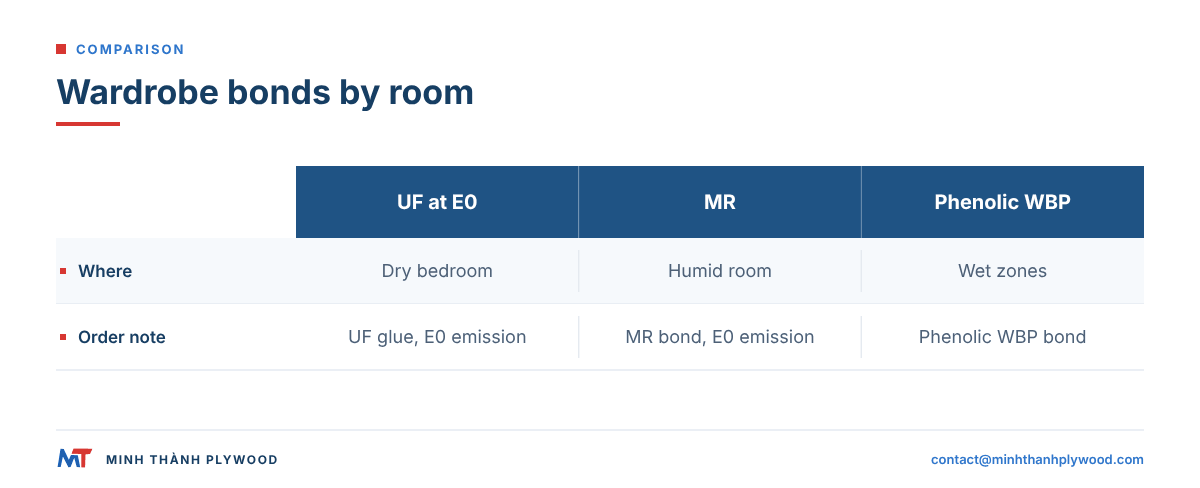
Glue and emission are two separate specifications. The glue describes how the veneers are bonded: urea-formaldehyde (UF), melamine-fortified (MR) or phenolic (WBP, weather and boil proof). The emission class describes how much formaldehyde the finished panel gives off: E0, E1 or a CARB Phase 2 / TSCA Title VI result. Write both on the order.
| Bond | Where it fits a wardrobe | Order line |
|---|---|---|
| UF glue at E0 emission | Dry bedroom, dressing room, hallway | “UF glue, E0 emission” |
| MR / melamine-fortified | Humid climate, outside wall, near a bathroom | “MR bond, E0 emission” |
| Phenolic WBP | Built-in units in wet zones, boat or caravan furniture | “Phenolic WBP bond” |
Indian buyers call these grades MR, BWR and BWP. The labels differ by market, but the logic is the same: match the bond to the room, and do not pay for boil resistance a bedroom does not need.
Is marine plywood overkill for a wardrobe?
Usually, yes. Marine plywood is built for boats and permanent wetting: a durable face species, no core voids and a boil-proof phenolic bond. A wardrobe stays dry, so the extra cost buys nothing you will use. Spend it on a better face, a tighter tolerance or lower emission.
Can commercial plywood be used for wardrobes?
Yes, for hidden parts and for panels that will be laminated or painted. Commercial plywood has utility faces and a looser thickness tolerance, so it suits carcass tops, bottoms, plinths and backs behind a laminate.
For visible veneer faces and tight joinery, use furniture-grade panels. The difference shows in three places:
- Thickness tolerance: our sanded furniture panels hold ±0.2–0.3 mm, down to ±0.2 mm; commercial panels hold ±0.5 mm. A tight tolerance keeps grooves, rebates and edge banding even across a batch.
- Faces: furniture panels carry graded faces such as poplar A/A, A/B or B/B, matched to an approved sample.
- Flatness: furniture-grade panels are pressed twice as standard. The core board is pressed and calibrated first, then the face and back are pressed on, so the surface stays flat under thin finishes.
Many wardrobe plants buy both: furniture plywood for sides, shelves and doors, and commercial plywood for hidden parts.
Laminate, veneer or paint: which face for which finish?
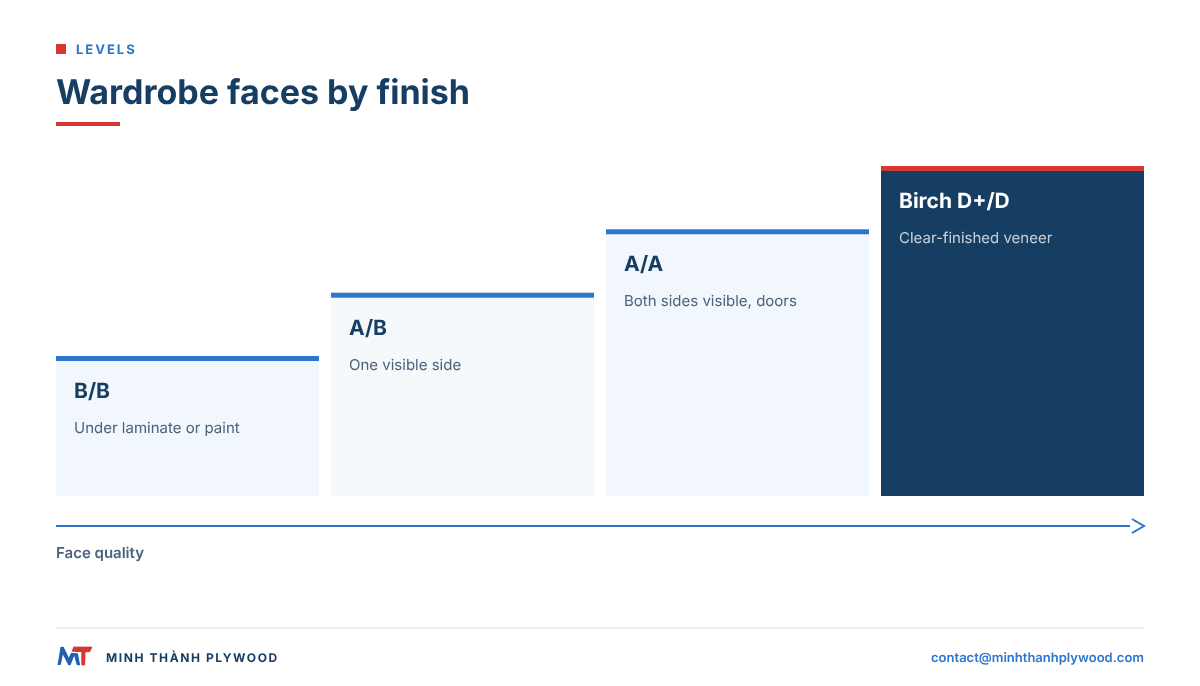
The finish decides the face. Pay for a top face only where the customer will see the wood itself.
| Finish | Face to order | Notes |
|---|---|---|
| Clear lacquer or oil on veneer | Birch D+/D, poplar A/A or okoume A/A | The face is the finish; approve it on a sample |
| Stain or tinted lacquer | Poplar or birch, A/A or A/B | Even grain takes stain evenly |
| UV coating | UV-ready sanded faces | Both faces ready for your UV line |
| Paint | Poplar or birch B/B | Fine, closed faces avoid grain show-through |
| Melamine paper or HPL | B/B, any light face | The laminate hides the face; flatness matters most |
| Engineered veneer look | EV faces | A repeatable pattern across many doors |
Both faces of our furniture panels are sanded and UV-ready, so a wardrobe plant can apply its own UV coating without extra sanding. For pressed-on surfaces, see our guide to laminated plywood: melamine, HPL and PVC.
Is birch plywood good for wardrobes?
Yes. Birch faces are fine, light and take paint and clear finishes well, which is why birch ply wardrobes are a common choice for modern interiors. Our birch faces are graded D+, D and E and quoted as pairs such as D+/D; D+ compares to European grade B and D to BB. They are pressed over a white Styrax or Eucalyptus core, so if the design leaves edges visible, approve the edge look on the sample. See birch plywood for the full grade ladder.
How do you stop wardrobe shelves from sagging?
Keep shelf spans short, use 18 mm or thicker, and run the face grain along the span. Sag grows fast with span length, so shortening the span helps more than any other choice.
- Shorten the span: add a divider so no 18 mm shelf spans much beyond 800 mm under books or folded clothes.
- Run the grain along the span: plywood is stiffer along the face grain, so cut shelves with the grain running wall to wall.
- Stiffen the front: a 40 mm deep front rail glued under an 18 mm shelf adds a lot of stiffness.
- Go thicker: use 25 mm for long shelves that carry heavy loads.
- Fix the back edge: screw the shelf to a 9 mm back or a rail, so it is supported on three sides.
A shelf that sags is rarely a bad panel. It is almost always a long span with the grain the wrong way.
How do you stop wardrobe doors from warping?
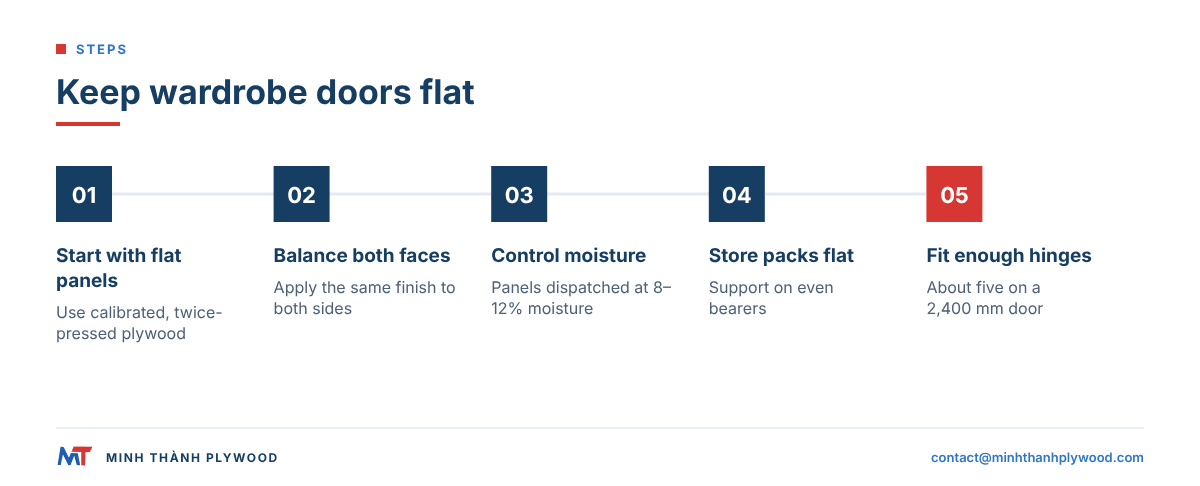
A flat door comes from a balanced panel, the right moisture and enough hinges. Most door warp is built in by the finish or the storage, not by the plywood.
- Balance the panel: give both faces the same finish. A laminate or lacquer on one side only pulls the door into a curve.
- Control the moisture: our veneers and finished panels are dried to 8–12% moisture content at dispatch. Let panels settle in the workshop before machining.
- Store flat: keep packs flat on even bearers, never on edge against a wall.
- Use enough hinges: hinge makers advise about five hinges on a 2,400 mm door, three or four on shorter ones.
- Start flat: double pressing gives a calibrated core before the faces go on, which is the base for a flat door.
Is wardrobe plywood safe for clothes and indoor air?
Yes, when the panel is low-emission. A wardrobe is a closed box full of fabric, so formaldehyde from the panel stays inside longer than in open furniture. Specify UF glue at E0 emission and ask for test results.
Our furniture panels carry CARB P2 / TSCA Title VI certification (ICTT mill no. 23024). Six ASTM D6007 chamber tests between April 2025 and June 2026, on 9, 15 and 18 mm panels, averaged 0.014–0.032 ppm. Under the California Air Resources Board composite wood products rule and TSCA Title VI, the limit for veneer-core hardwood plywood is 0.05 ppm (EPA formaldehyde emission standards). Three tests were run by Shanghai Hongjun and three by ICTT Vietnam.
For European buyers who need a different method, third-party testing to EN 717-1 is arranged through SGS on request. Details are on our formaldehyde emission page.
Which core makes the best wardrobe panel?
A light, even hardwood core makes the best wardrobe panel. Our furniture panels use white Styrax or Eucalyptus cores as standard; Acacia and Pine cores are made on order.
| Core | Reference density | Wardrobe strength |
|---|---|---|
| Styrax | 500 kg/m³ | Light carcasses, easy handling, pale edge |
| Acacia | 580 kg/m³ | Middle weight, firm screw holding |
| Eucalyptus | 650 kg/m³ | Dense, best screw and hinge holding |
A Styrax core keeps a full wardrobe light enough for flat-pack shipping and one-person assembly. A Eucalyptus core holds hinge screws and runners hardest, which suits heavy doors and frequently used drawers. Core layers are stitched both horizontally and vertically, so the inner plies close tight with no gaps behind a hinge cup.
How much plywood is required for a wardrobe?
A two-door wardrobe 1,200 mm wide, 2,400 mm high and 600 mm deep needs about four sheets of 18 mm plywood and one sheet of 6 mm, on 1220 × 2440 mm sheets.
| Parts | Cut from | Sheets |
|---|---|---|
| 2 sides, 2,400 × 600 mm | One 18 mm sheet split lengthwise | 1 |
| Top, bottom and 2 shelves, 1,164 × 600 mm | One 18 mm sheet cut across | 1 |
| 2 more shelves, plinth and rails | One 18 mm sheet, part used | 1 |
| 2 doors, 597 × 2,396 mm | One 18 mm sheet split lengthwise | 1 |
| Back, 1,200 × 2,400 mm | One 6 mm sheet | 1 |
The four 18 mm sheets hold about 0.21 m³ of plywood: each 1220 × 2440 × 18 mm sheet is about 0.054 m³. On a Styrax core each 18 mm sheet weighs about 26.8 kg, so the carcass and doors weigh roughly 107 kg before hardware.
For a factory, the count scales up. A 40HC of 18 mm Styrax-core plywood carries 990 sheets, enough 18 mm stock for about 247 wardrobes of this size. Our container loading calculator gives the count for other thicknesses and cores.
Cut-to-size wardrobe parts: when does it pay?
Cut-to-size parts pay when you build many wardrobes of the same size. One panel can be cut into 4, 6 or 8 pieces at the factory, so the parts arrive ready for edge banding and boring.
Cut-to-size saves three costs: freight on the offcut, the saw time in your plant and the waste disposal. We ship cut-to-size panels regularly to Italy and other European markets. Send a cutting list with the sizes, grain direction and face side, and we quote panel and cutting together. See cut-to-size plywood for the formats.
What to write on a wardrobe plywood order
A wardrobe plywood order is complete when it names the part, thickness, core, glue and emission, faces, size and tolerance. This is the line most buyers send us:
| Field | Example for a wardrobe carcass |
|---|---|
| Application | Wardrobe carcass and doors, bedroom |
| Thickness and tolerance | 18 mm, ±0.2 mm sanded |
| Core | White Styrax core, stitched |
| Glue and emission | UF glue, E0 emission, CARB P2 / TSCA Title VI |
| Faces | Poplar A/B for sides, A/A for doors |
| Size | 1220 × 2440 mm, or cut-to-size list |
| Backs | 6 mm, B/B, ply count as agreed |
| Moisture | 8–12% |
| Packing and quantity | Export packs, 1×40HC mixed by agreement |
Mixed loads are agreed per order, so a wardrobe plant can bring carcass, door and back panels in one container.
Why wardrobe makers buy plywood from Vietnam
Vietnamese plywood gives wardrobe makers furniture-grade faces on plantation hardwood cores at a lower cost than comparable mills elsewhere. Minh Thanh Plywood is a manufacturer in Ha Hoa, Phu Tho, built for top-grade furniture and interior plywood, with Europe as its main market.
What a wardrobe plant gets from us:
- 18 mm and 6 mm panels in 1220 × 2440 and 1250 × 2500 mm, and custom sizes such as 1220 × 2500 mm.
- 10+ face veneers, including EV, poplar, birch, okoume and pine.
- UF glue at E0 emission as standard for interior panels, with MR and phenolic WBP bonds to specification.
- The EUDR compliance dossier (origin records and geolocation files) with every order.
- 50,000+ m³ a year of capacity, production 15–45 days after the deposit, and free samples.
Furniture and interior plywood starts from US$350/m³ (October 2026). The final price depends on face, core, glue, thickness, size, quantity and delivery term. See furniture plywood from Vietnam or poplar plywood for full specifications.
Plywood for a wardrobe door or carcass: send us your spec
Send the wardrobe parts list, thickness, core, glue and emission, faces, sizes and quantity, with your destination port. We reply within hours with a quotation and can send free samples of the faces you are considering. For doors built from plywood, our guide to plywood doors covers flush and panel constructions.
Buyer questions, answered
Which plywood is best for a wardrobe?
An 18 mm hardwood-core plywood with UF glue at E0 emission for the carcass, shelves and doors, and a 6 mm panel for the back. Choose the faces by finish: A/A veneer for visible surfaces, B/B for laminate or paint.
Which mm plywood is best for a wardrobe?
18 mm for sides, top, bottom, fixed shelves and doors; 25 mm for shelves that span far or carry heavy loads; 6 mm for the back, or 9 mm when the back carries a wall fixing.
Is 18 mm plywood suitable for a wardrobe?
Yes. 18 mm is the standard wardrobe carcass and door thickness: it holds hinge screws, drawer runners and shelf pins well and stays flat across a full-height door when both faces are finished.
Can commercial plywood be used for wardrobes?
Yes, for hidden parts and for panels that will be laminated or painted. For visible veneer faces and tight joinery, use furniture-grade panels with sanded faces and a tighter thickness tolerance.
What is better for wardrobes, MR or BWR plywood?
MR (moisture-resistant) bond is enough for a wardrobe in a normal bedroom. Choose a boiling-water-resistant or phenolic WBP bond only when the wardrobe stands in a humid room, against an outside wall in a damp climate, or near a bathroom.
Is marine plywood overkill for a wardrobe?
Usually, yes. Marine plywood is made for permanent wetting; a bedroom wardrobe stays dry. The money is better spent on a good face, a tight thickness tolerance and low emission.
How much plywood is required for a wardrobe?
A two-door wardrobe 1,200 mm wide, 2,400 mm high and 600 mm deep takes about four sheets of 18 mm plywood and one sheet of 6 mm for the back, on 1220 × 2440 mm sheets.
Is birch plywood good for wardrobes?
Yes. Birch faces take paint, lacquer and clear finishes well and give a fine, light surface. Approve the edge on a sample if the design leaves panel edges visible.
How do I stop wardrobe doors from warping?
Use a balanced panel with the same face quality and finish on both sides, keep moisture at 8–12% before machining, store panels flat and fit enough hinges for the door height.
Does wardrobe plywood need low formaldehyde emission?
Yes. A wardrobe is a closed space full of clothes, so emission matters more than in open furniture. Specify UF glue at E0 emission and ask for chamber test results.