
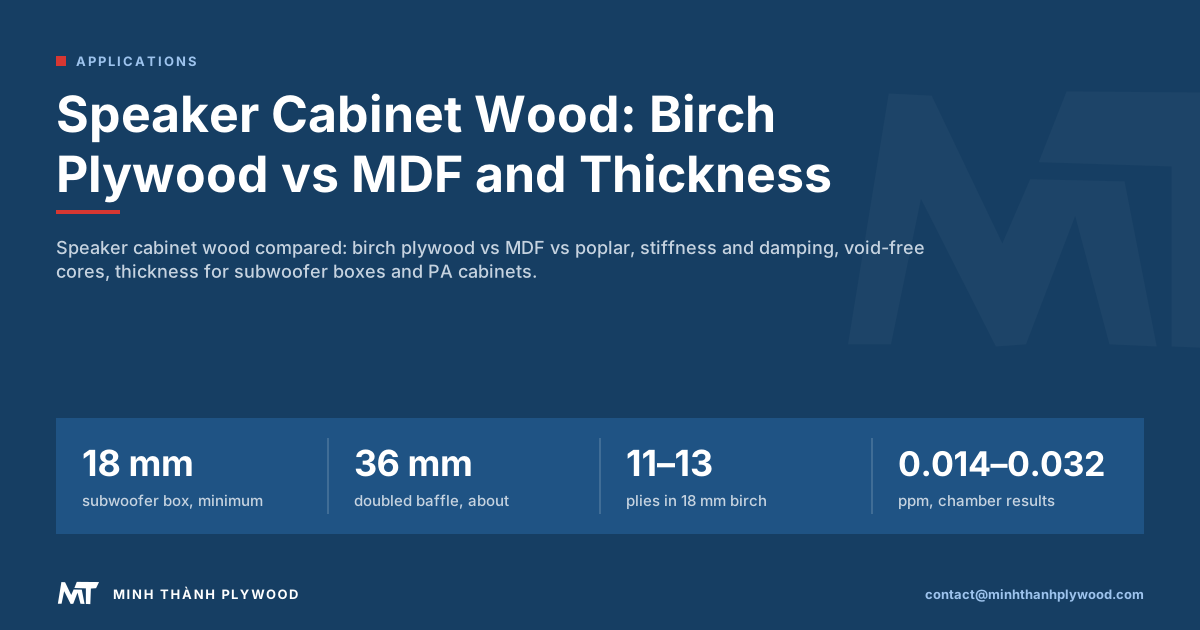
The best speaker cabinet wood is void-free birch plywood for portable, PA and subwoofer boxes, and MDF for heavy home hi-fi cabinets that never move. Birch plywood is stiffer for its weight and stronger at screws and corners; MDF is denser and dead. This guide compares them and sets thickness by box size. Minh Thanh Plywood makes calibrated, void-free furniture panels in Vietnam.
What is the best speaker cabinet wood?
The best speaker cabinet wood is void-free birch plywood for cabinets that are carried, mounted or driven hard, and MDF for home hi-fi cabinets that stay in one place. Both work; the use decides.
- Portable, PA and stage speakers: birch plywood, for strength at corners and lower weight.
- Subwoofer boxes and car audio: birch plywood, for stiffness and screw holding under vibration.
- Home hi-fi, bookshelf and floorstanding: MDF or plywood, braced and veneered.
- Light PA and DIY cabinets: poplar plywood, covered with paint, carpet or vinyl.
Whatever the material, bracing and an airtight build matter more to the sound than the choice between good plywood and MDF.
Birch plywood vs MDF for speakers
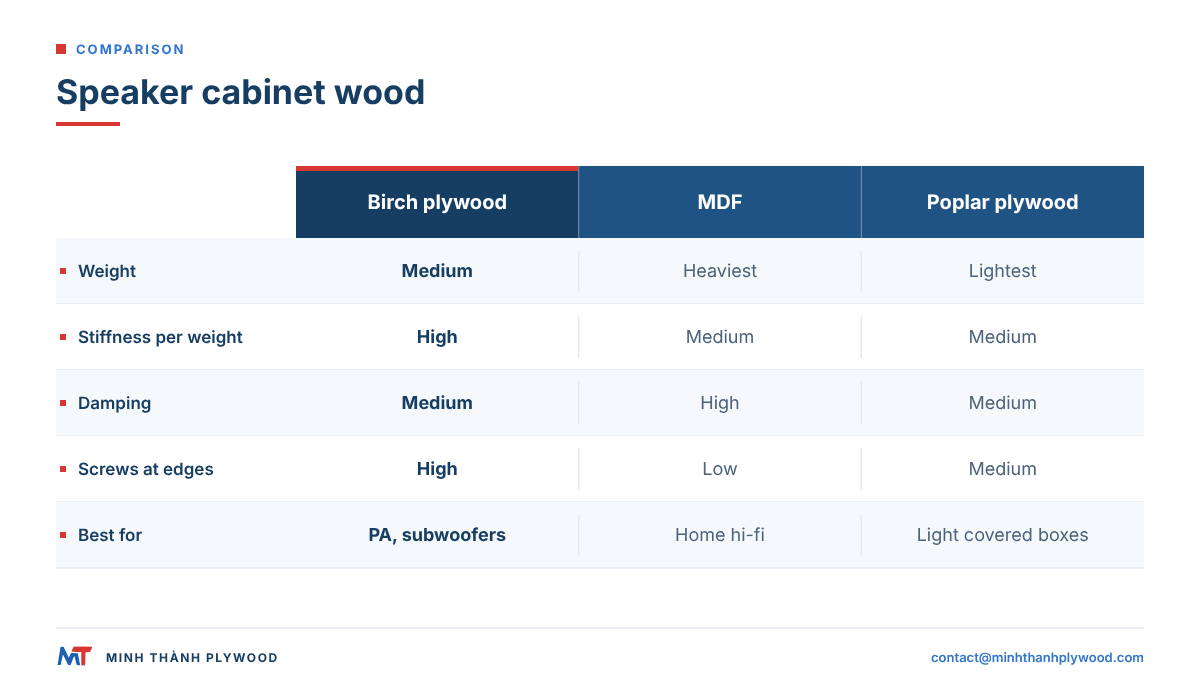
Birch plywood is stiffer and lighter for its thickness and holds screws better; MDF is denser, more uniform and better damped. Choose birch plywood for light, stiff boxes that hold screws, and MDF where mass and damping matter most. The table compares them on the points that matter in a speaker box.
| Property | Birch plywood | MDF | Poplar plywood | Solid oak, maple, walnut |
|---|---|---|---|---|
| Density | About 680 kg/m³ | 700–800 kg/m³ | About 500 kg/m³ on a Styrax core | 610–755 kg/m³ |
| Weight for the same thickness | Medium | Heaviest | Lightest | Medium to heavy |
| Stiffness for its weight | High | Medium | Medium | High along the grain |
| Internal damping | Medium | High | Medium | Low to medium |
| Screw holding at edges | High | Low at edges | Medium | High |
| Corner strength when dropped | High | Low, corners crumble | Medium | High, but boards can split |
| Moisture tolerance | Good with the right bond | Swells when wet | Good with the right bond | Moves with humidity; glued boards can open |
| Machining | Clean with sharp tools | Very clean, dusty | Easy, softer | Clean, needs jointed and glued boards |
| Typical use | PA, subwoofers, car audio | Home hi-fi | Light PA, DIY covered boxes | Furniture-grade hi-fi cabinets and fronts |
The densities are 680 kg/m³ for birch plywood (Handbook of Finnish Plywood), 700–800 kg/m³ for standard MDF (European MDF association) and 755 kg/m³ white oak, 705 kg/m³ hard maple and 610 kg/m³ black walnut (Wood Database, dried weight). Solid hardwood boards must be edge-glued into panels wide enough for a baffle, and each seasonal swing opens joints. Plywood is cross-laminated, so a 18 mm birch panel stays flat and needs no edge-gluing.
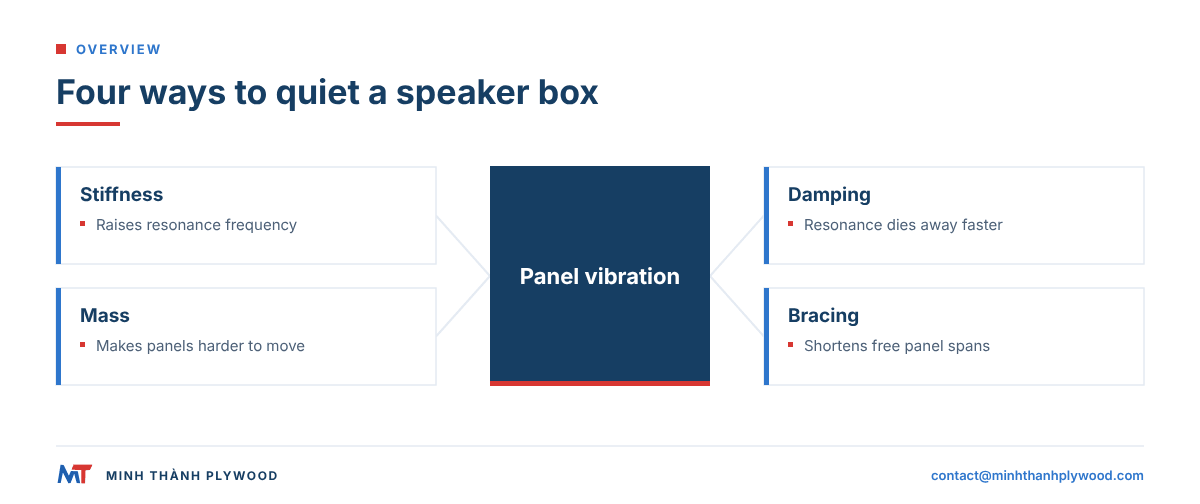
Stiffness pushes panel resonances higher and makes them smaller; damping makes them die away faster. Wikipedia’s loudspeaker enclosure entry says the same: “Bothersome resonances can be reduced by increasing enclosure mass or rigidity”, by “adding stiff cross bracing” and by adding internal absorption.
Producer and author Bobby Owsinski adds a point on ply count: cabinets built from the cheaper, thinner 3- or 5-ply compromise the sound, and Marshall builds with 11-ply Baltic birch. Panel stiffness rises with the cube of thickness, so doubling the wall thickness makes a panel about eight times stiffer. A braced plywood box gets both from the bracing, which is why professional loudspeaker makers build with birch plywood.
Why stiffness, mass and damping matter
A speaker cabinet should not move: any panel that vibrates adds its own sound to the driver’s. Stiffness, mass and damping are the three ways to stop it.
- Stiffness raises the frequency at which a panel resonates, ideally above the range the box plays.
- Mass makes a panel harder to move, which is why heavy MDF sounds dead to the knuckle.
- Damping turns vibration into heat, so a resonance dies away quickly.
- Bracing adds stiffness cheaply by shortening the free span of each panel.
A thin, well-braced plywood panel can match a thick unbraced MDF panel at a fraction of the weight. That trade is why portable and professional speakers use plywood.
Why a void-free core is essential
Plywood for speaker cabinets must have a void-free core, because a void inside a panel can buzz, leak air at a joint and weaken the screws that hold the driver. Voids are hidden until the panel is cut. Plywood for general use is specified in BS EN 636. Its bonding-quality classes are set out in BS EN 314-2.
- Buzz: a loose veneer over a void vibrates at its own frequency.
- Air leaks: a void exposed in a rabbet or a port cut lets air bypass the seal.
- Weak fixings: driver and handle screws pull out of hollow core.
- Uneven panels: core overlaps show as bumps under thin veneers or vinyl.
Our core layers are stitched both horizontally and vertically, which closes gaps between core veneers, and furniture-grade panels are pressed twice: the core board is pressed and calibrated first, then face and back are pressed on.
What thickness for a subwoofer box?
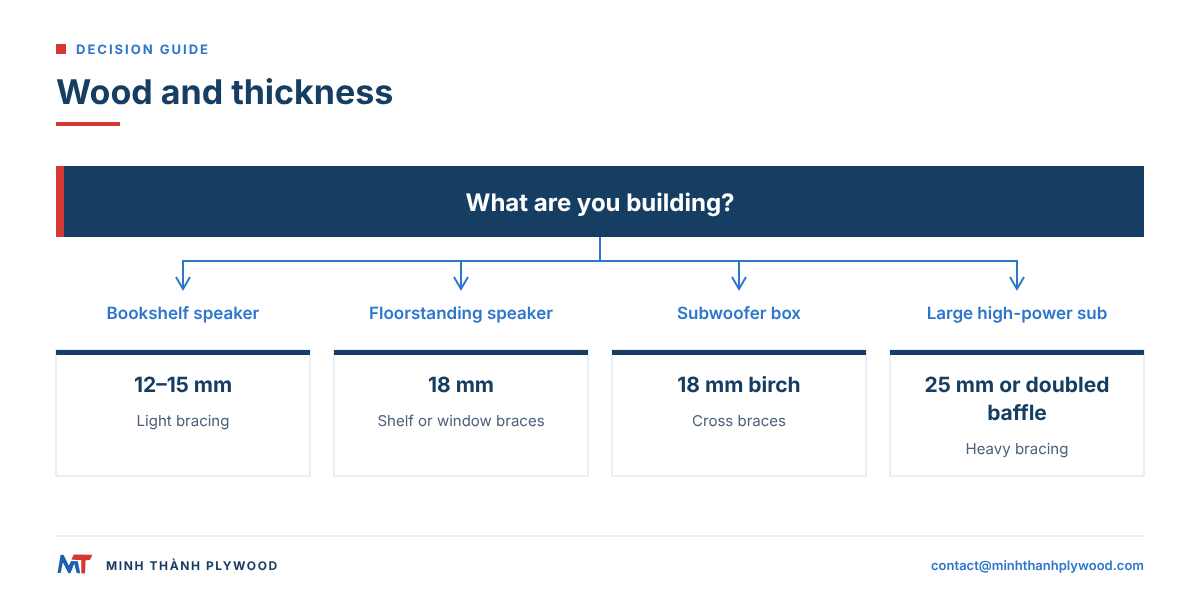
A subwoofer box needs 18 mm walls as a usual minimum, with internal bracing; large, high-power subwoofers use 25 mm walls or a doubled baffle of about 36 mm. Smaller cabinets can use thinner panels if they are braced.
| Cabinet | Panel thickness | Bracing |
|---|---|---|
| Small bookshelf speaker | 12–15 mm | One brace or none |
| Floorstanding speaker | 18 mm | Shelf or window braces every few hundred millimetres |
| Portable PA top | 12–15 mm birch | Braced, for low weight |
| Subwoofer box, car or home | 18 mm | Cross braces between opposite walls |
| Large high-power subwoofer | 25 mm, or 18 mm doubled baffle | Heavy cross bracing |
| Driver baffle on a large cabinet | about 36 mm (two layers) | Glued laminate |
Thicker is not always better: past a point, bracing adds more stiffness per kilogram than extra thickness.
Baltic birch subwoofer box: what makes it the standard
A Baltic birch subwoofer box is the car audio and pro-audio standard because birch plywood of this type has many thin plies, no core voids and a hard face. An 18 mm panel of this build typically has 11–13 plies.
- Many plies: more glue lines, more even strength in both directions.
- Solid core: no voids to buzz or leak.
- Hard face: resists dents and takes paint, vinyl or carpet.
- Screw holding: driver screws and terminal cups hold close to the edge.
Our birch plywood is birch-faced on a white Styrax or Eucalyptus core, graded in the Vietnamese ladder D+, D and E and quoted as face and back pairs such as D+/D, comparable to the European birch grades. For speaker boxes that are painted or covered, a D/E pair gives the same structure at a lower price.
Plywood for speaker cabinets: which face and core?
The right plywood for speaker cabinets depends on the finish: a visible wood face needs a good face grade; a covered box needs only a solid core and a smooth surface.
| Finish | Face | Core | Note |
|---|---|---|---|
| Clear lacquer or oil | Birch D+/D, EV, okoume | White Styrax | Choose the face for the look |
| Paint or textured coating | Birch D/E or poplar | White Styrax or Eucalyptus | Smooth sanded face |
| Vinyl, Tolex or carpet | Poplar or birch D/E | White Styrax | Light and void-free |
| Heavy-duty PA | Birch-faced | Eucalyptus | Harder, heavier core |
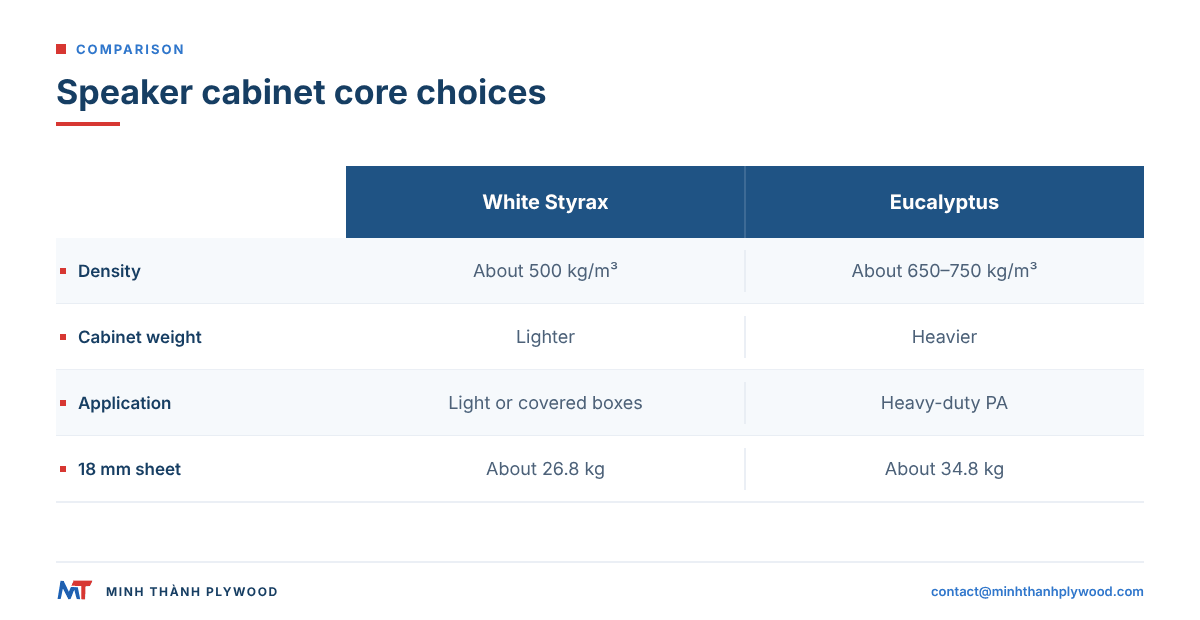
A white Styrax core at about 500 kg/m³ gives the lightest cabinet; a Eucalyptus core at about 650–750 kg/m³ is harder and heavier. At 18 mm, a full 1220 × 2440 mm sheet weighs about 26.8 kg on Styrax and about 34.8 kg on Eucalyptus.
Guitar and bass cabinets: which wood and thickness?
Guitar and bass cabinets are usually built from 12–18 mm birch plywood, or from solid pine in open-back designs. A one-speaker 1 × 12 guitar cab is small, about 485 × 235 × 400 mm (width × depth × height), so its panels are narrow and a stiff plywood wall keeps its own resonance out of the tone.
- Plywood: birch gives a stiff, light box that survives touring. Choose more plies per thickness: Owsinski notes that 13-ply birch is sturdier for transport but heavier, while the cheaper 3- or 5-ply compromises the sound. Our 18 mm panels are built from 11–13 plies.
- Open-back cabs: the baffle carries the speaker and the sides can be thinner, 12–15 mm, because the rear is open and the box is not pressurised.
- Closed-back and bass cabs: 18 mm throughout, with braces across wide panels.
- Price check: UK builders sell a finished 1 × 12 cabinet with a Celestion G12-series speaker for about £749 plus VAT with a lead time of 12 weeks or more, so the panels are a small share of the finished price.
Order the panels as flat, void-free sheets so the cutting list nests on a 1220 × 2440 mm sheet and every joint lands on solid wood; our birch plywood page lists the grades.
Bracing and damping inside the box
Bracing ties opposite walls together so panels cannot flex, and damping material absorbs the sound inside the box. Together they matter more than the cabinet material.
- Window braces: a panel with large holes, glued across the box.
- Cross braces: dowels or strips between opposite walls.
- Shelf braces: horizontal panels in tall cabinets.
- Laminated baffles: two layers glued together under the driver.
- Damping material: wool, foam or fibre on walls or filling the box.
CNC-cut window braces from offcuts of the same sheet are the cheapest stiffness a speaker builder can add.
Joints, glue and an airtight build
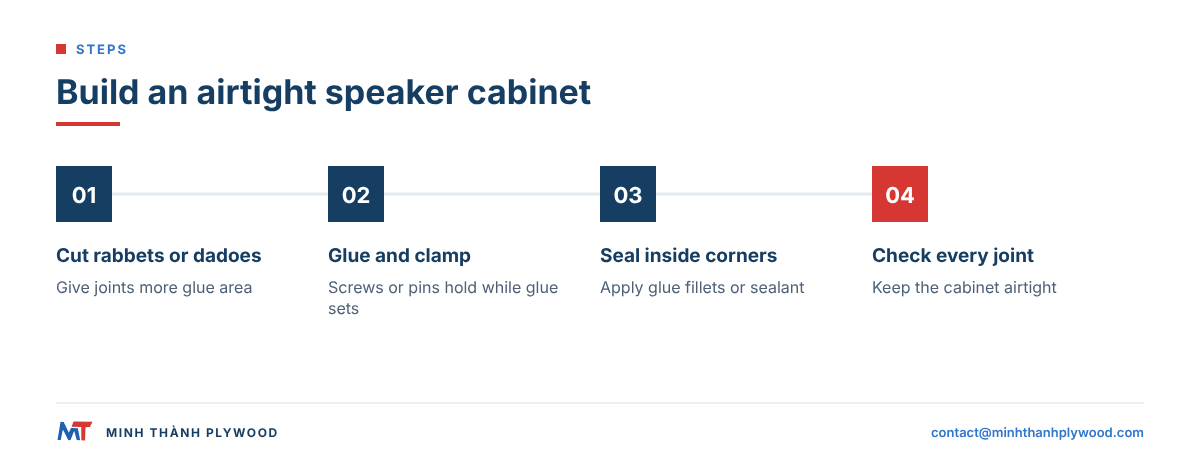
Speaker cabinets are glued and clamped, with screws or pins only to hold parts while the glue sets, and every joint must be airtight. Rabbet and dado joints give more glue area than butt joints.
- PVA wood glue for indoor speakers.
- Polyurethane or epoxy for car, marine and outdoor speakers.
- Rabbets and dadoes locate panels and seal better than butt joints.
- Seal inside with glue fillets or sealant along every internal joint.
The plywood bond also matters for speakers used outdoors or in cars: we make MR (melamine-fortified) and phenolic (WBP) bonds to the customer’s specification, and UF glue at E0 emission for indoor cabinets.
Thickness tolerance and CNC-cut panels
Speaker cabinets cut on a CNC router need panels of even thickness, because rabbets, dadoes and slot joints are machined to a fixed depth. A thick spot leaves a gap; a thin one leaves a step.
| Panel class | Thickness tolerance |
|---|---|
| Sanded furniture panel | ±0.2–0.3 mm, down to ±0.2 mm |
| Commercial | ±0.5 mm |
Calibrated panels let one CNC program cut every cabinet of a run. For joint design on CNC-cut parts, read CNC plywood furniture.
Finishing speaker cabinets
Speaker cabinets are finished with clear lacquer on fine faces, paint or textured coatings on birch and poplar, or vinyl and carpet on PA boxes. The finish also seals the wood against humidity.
- Clear lacquer or oil: shows a birch, EV or okoume face.
- Textured paint: tough, hides joints, common on PA cabinets.
- Vinyl or Tolex covering: glued over a smooth, void-free face.
- Carpet: common on car audio boxes.
Our sanded and polished faces are UV-ready on both sides, to the standard customers need to apply their own UV coating.
Moisture and car audio boxes
Car and outdoor speakers face heat and humidity, so the wood and bond must resist moisture. MDF swells and loses strength when wet; plywood with a moisture-resistant bond keeps its shape.
- Dry panels: our veneers and finished panels are dried to 8–12 % moisture content at dispatch.
- Bond: phenolic (WBP) or MR bond for car, marine and outdoor boxes.
- Seal all faces, including the inside, so the box takes up moisture evenly.
A sealed plywood box keeps its airtight joints through the heat cycles of a car boot.
Emission and indoor air
Speaker cabinets sit in living rooms and studios, so the panels should meet indoor emission requirements. We use UF glue at E0 emission for furniture and interior panels.
Our panels meet the emission requirements European and US furniture buyers ask for, and CARB P2 / TSCA Title VI certification is the accepted proof. Six ASTM D6007 chamber tests between April 2025 and June 2026 on 9, 15 and 18 mm panels averaged 0.014–0.032 ppm. The US limit for hardwood plywood is 0.05 ppm under 40 CFR 770.10.
Common mistakes in speaker box builds
The most common mistakes in speaker box builds are air leaks, unbraced panels and the wrong board for the job, and each one is cheaper to avoid than to fix. The list below gives each mistake and the remedy.
- Air leaks at joints: a sealed or ported box loses bass through any gap. Glue every joint along its full length and seal the inside corners.
- Unbraced large panels: a large flat side wall rings at its own frequency. Add a window brace or cross brace across its middle.
- Panels with core voids: hidden voids buzz and leak. Use a void-free plywood or MDF.
- Driver screws in end grain or MDF edges: they strip and loosen. Use T-nuts or threaded inserts in the baffle.
- Port and driver cut-outs too close to an edge: the remaining strip cracks. Keep a solid margin around every hole.
- Wet or unsealed boxes in cars: MDF swells and joints open. Use a moisture-resistant bond and seal every face.
Calibrated plywood also prevents a quieter mistake: joints cut for one thickness that do not fit the next sheet, leaving gaps that leak air.
What this means for your order
For speaker cabinet wood, order a void-free, calibrated panel first, then choose face and core by finish. Send these lines with your request:
- Application: speaker cabinets, subwoofer boxes or PA enclosures.
- Core: white Styrax for light cabinets, Eucalyptus for heavy-duty.
- Glue and emission: UF glue at E0 emission indoors; MR or phenolic (WBP) for car and outdoor use.
- Face and grade: birch D+/D for clear finishes, birch D/E or poplar for covered boxes, EV or okoume for wood looks.
- Thickness and tolerance: 12, 15, 18 or 25 mm, sanded, ±0.2–0.3 mm.
- Size, packing and quantity: 1220 × 2440 or 1250 × 2500 mm, or cut to size; from one 40HC.
A 40HC holds 990 sheets of 18 mm Styrax-core panels. Production takes 15–45 days after the deposit, and free samples are available. See birch plywood and cut-to-size plywood, and read plywood joints.
Buyer questions, answered
What wood is best for a guitar speaker cabinet?
Birch plywood of 12–18 mm, with more plies for a sturdier cab: Marshall uses 11-ply Baltic birch. Open-back cabs also use solid pine. Avoid 3- and 5-ply panels in thick walls, which compromise the tone.
Is birch plywood or MDF better for speakers?
Birch plywood is better for portable, PA and car audio cabinets because it is lighter, stiffer for its weight and stronger at joints. MDF is better for home hi-fi cabinets that stay in one place, where its density and damping matter more than weight.
What thickness for a subwoofer box?
18 mm is the usual minimum for a subwoofer box, with internal bracing. Large or high-power subwoofers use 25 mm walls or a double-thickness baffle of about 36 mm.
Why is Baltic birch used for subwoofer boxes?
Baltic-type birch plywood has many thin plies and no core voids, so it is stiff, holds screws well and does not rattle. An 18 mm panel typically has 11–13 plies.
Does plywood with voids affect speaker sound?
Yes. Core voids can buzz, leak air at joints and weaken screw fixings around the driver. Speaker cabinets need a void-free core.
Is poplar plywood good for speaker cabinets?
Poplar plywood is good for light PA and portable cabinets that are covered with paint, carpet or vinyl, because it is light and easy to machine. It is softer than birch, so bracing matters more.
Can I use pine or softwood plywood for speakers?
Softwood plywood often has voids and coarse plies, so it is a poor choice for sealed boxes. Use hardwood plywood with a solid core.
What is the best wood for a speaker baffle?
A stiff, flat panel that holds screws: birch plywood or MDF, often doubled to about 36 mm on large cabinets so the baffle does not flex with the driver.
Should speaker cabinets be glued or screwed?
Glued and clamped, with screws or pins to hold parts while the glue sets. Every joint must be airtight in a sealed or ported box.
What glue is used for plywood speaker boxes?
PVA wood glue for indoor speakers and a moisture-resistant glue such as polyurethane or epoxy for car, marine and outdoor speakers.